




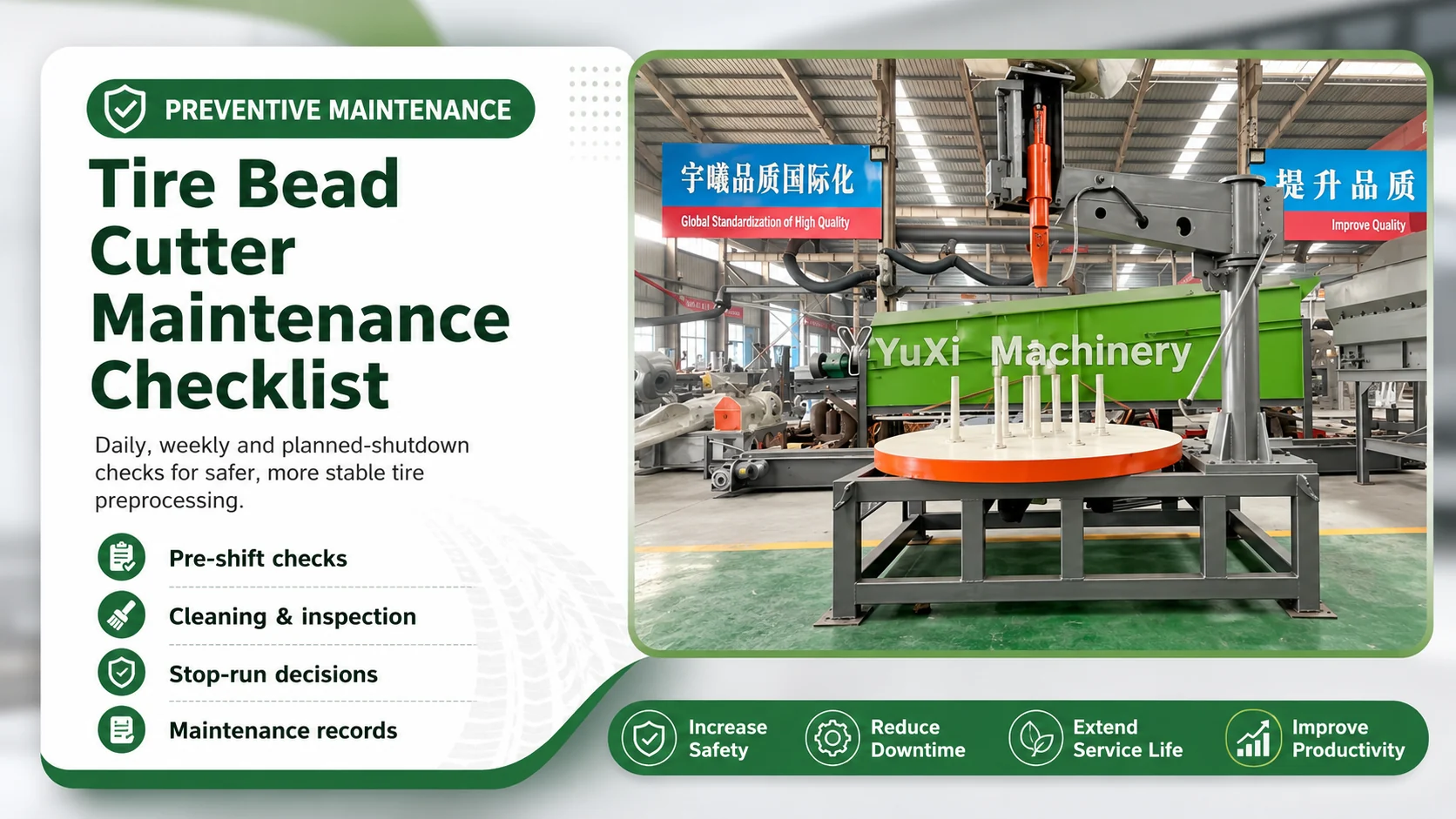
Contents
- Quick answer
- Checklist scope and limits
- Six maintenance zones
- Pre-shift checklist
- End-of-shift checklist
- Weekly checks
- Monthly and planned-shutdown checks
- Lubrication rules
- Guarding and energy isolation
- Stop, inspect or continue?
- Performance-based maintenance
- Maintenance log template
- Spares and shift handover
- Build a site-specific baseline
- What to send YUXI
- FAQ
Quick answer
1. What this checklist covers—and what it does not
- Is the machine safe to start?
- Is the tire likely to remain stable through the cutting cycle?
- Has any component or performance signal changed since the last check?
- Do the conditions require cleaning, planned work, immediate isolation or supplier support?
2. The six maintenance zones around a tire bead cutter
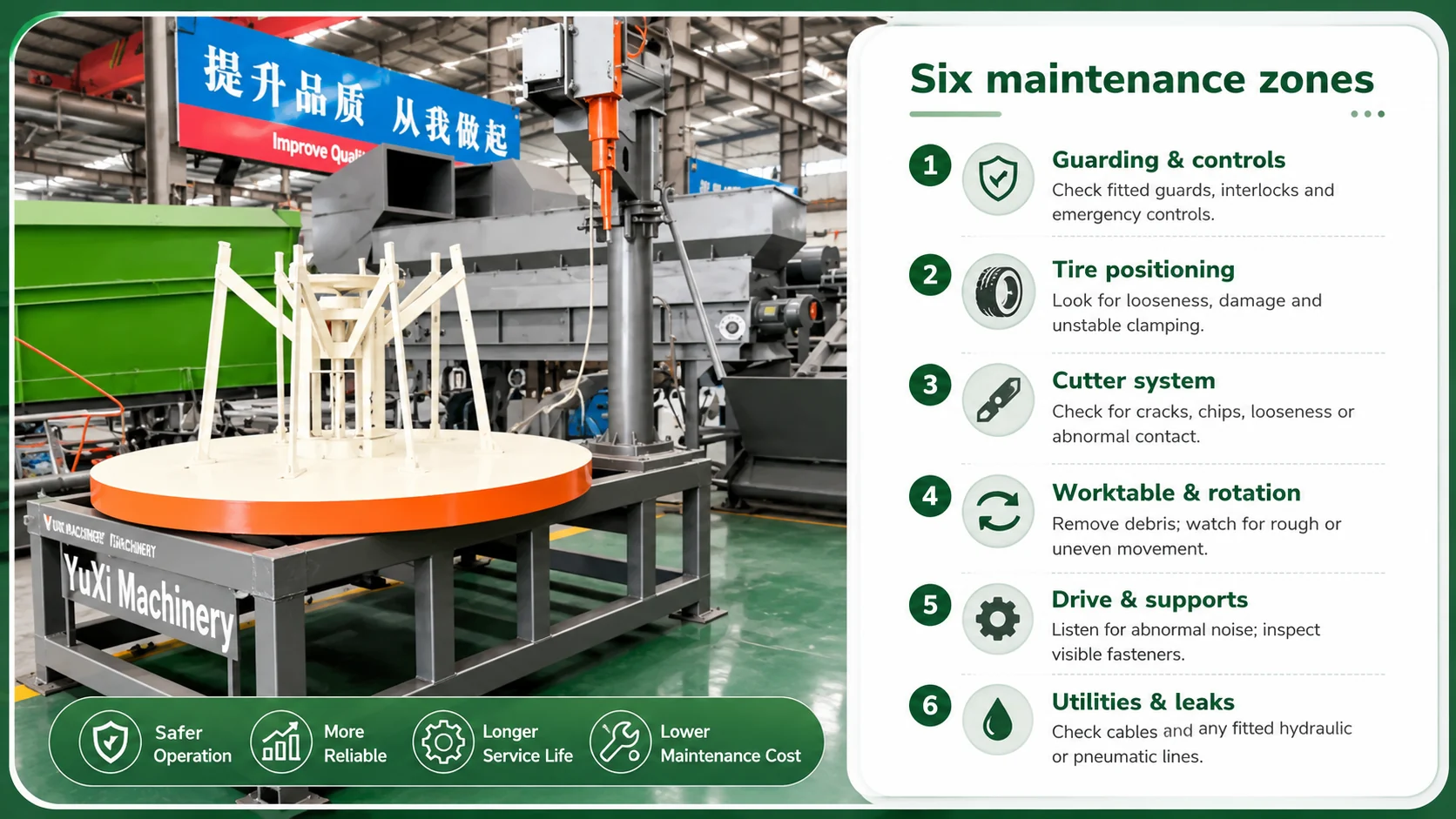
Guarding and operating controls
Tire positioning and clamping
Cutter, holder and mounting
Worktable and rotating structure
Drive, supports and frame
Electrical and fluid-power systems
3. Pre-shift tire bead cutter maintenance checklist
| Check area | What to verify before starting | Action when abnormal |
|---|---|---|
| Work area | Clear access, stable floor, no tire or bead-ring pile blocking controls, guards, discharge or maintenance space. | Remove the obstruction before startup. |
| Previous-shift record | Read unresolved notes, temporary controls and planned work status. | Do not start if the equipment has not been formally released. |
| Guards and covers | All fitted safeguards are present, secure and visibly undamaged. | Stop and escalate; do not bypass. |
| Controls | Buttons, selectors, indicators and fitted emergency controls are intact and accessible. | Follow the test method in the manual or site procedure. |
| Cutter system | No visible crack, major chip, deformation, looseness or unusual contact mark. | Isolate for competent inspection. |
| Positioning and clamping | Parts are intact, clean and free from obvious play or damage. | Do not process a tire that cannot be held predictably. |
| Worktable | Rotation path is clear; no embedded steel wire, loose rubber or tools remain in the area. | Clean under the authorized safe state. |
| Frame and fasteners | No obvious movement, missing fastener, cracked support or fresh metal-to-metal mark. | Mark the area and request inspection. |
| Cables and utilities | No exposed conductors, crushed cable, loose connector, damaged conduit, severe leak or hose damage. | Isolate and refer to a competent person. |
| Dry test / approved startup check | Normal sound and movement using the procedure supplied for the machine. | Stop at the first new noise, binding or uncontrolled motion. |
4. End-of-shift cleaning and handover checklist
- Place the machine in the authorized cleaning state. Normal “stop” is not automatically an energy-isolated maintenance state.
- Remove loose rubber, steel-wire fragments and trapped material using approved tools and access points. Do not use hands inside a cutting or pinch zone.
- Clean inspection surfaces around the cutter holder, tire locating parts, worktable edge and visible supports without damaging seals, cables or sensors.
- Look for fresh marks. Polished metal, scoring, displaced paint, rubber smearing or wire fragments in a repeat location may show movement or abnormal contact.
- Record cut problems. Note repeated passes, incomplete bead separation, unusual tire movement, increased cycle time or irregular cut path by tire category.
- Record sound, vibration, heat or odor changes. “Slightly noisier” is useful only when the location, time and tire type are identified.
- Leave the work cell ready for inspection. Keep bead-sidewall sections and processed tire bodies out of access routes and away from controls.
- Hand over unresolved conditions. State whether the machine is released, restricted or locked out; never rely on an informal verbal warning alone.
5. Weekly condition checks
Mechanical condition
- Inspect accessible fasteners and retaining features for movement or missing parts.
- Check the cutter holder and support for new contact marks or deformation.
- Check the positioning and clamping system for wear,looseness,or damage.
- Observe whether the worktable shows rough running, runout, scraping or moving inconsistently.
- Check the frame, anchor points and surrounding floor for movement or damage.
Electrical and utility condition
- Inspect accessible cables, conduit, glands, control enclosures and connectors.
- Check fitted sensors, limit devices and interlocks using the approved method.
- If so,please check whether the hydraulic or pneumatic hoses,accessories and cylinders are leaking,worn or unsafe.
- Check that labels, warnings and control markings remain readable.
- Confirm that no temporary repair has become a permanent operating condition.
6. Monthly and planned-shutdown checks
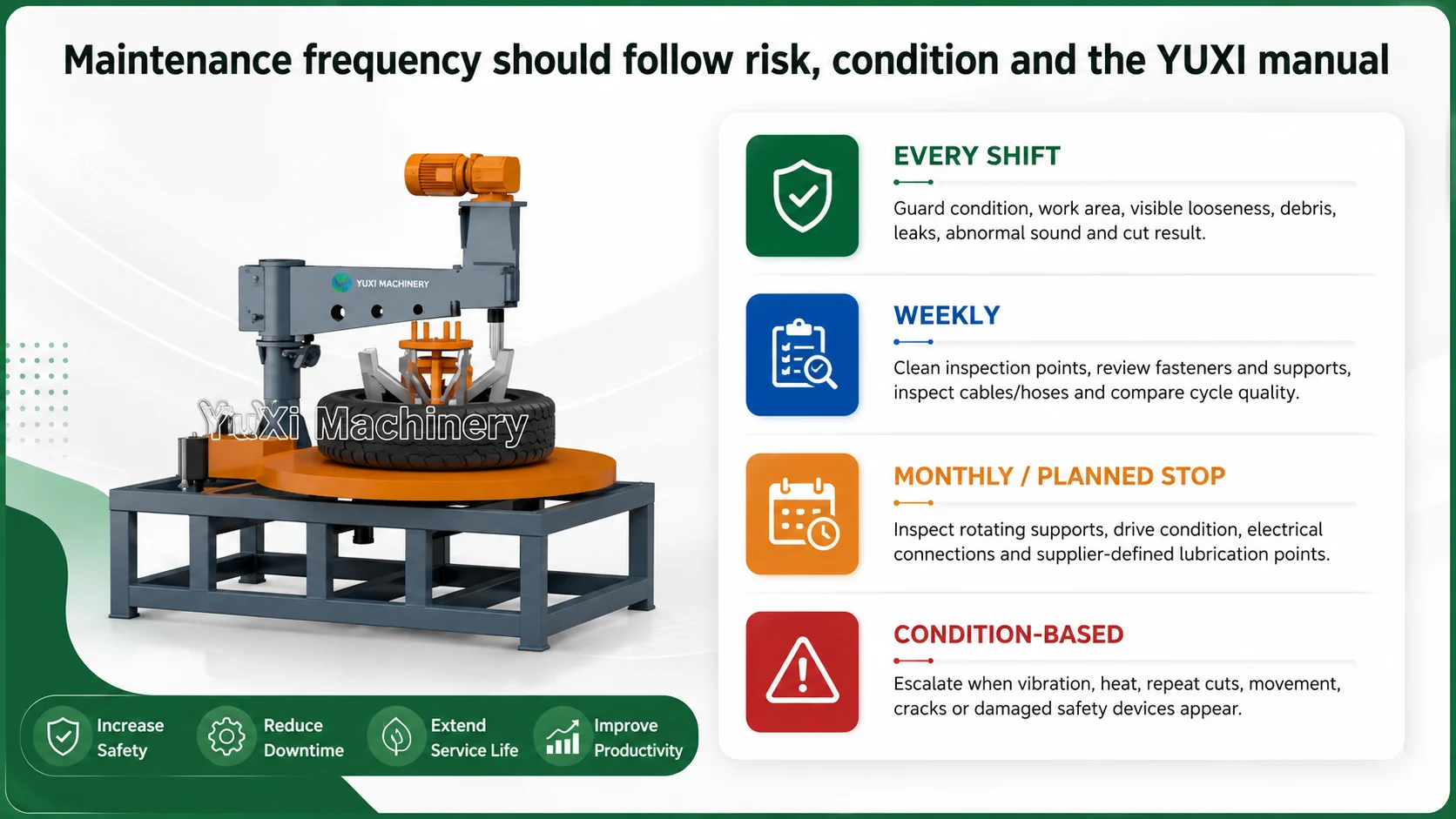
| System | Planned-maintenance questions | Information that must come from YUXI documentation |
|---|---|---|
| Cutter and holder | Is there cracking, deformation, abnormal wear, fretting or damage to the mounting surfaces? | Removal method, replacement criteria, geometry, approved spare and fastener requirements. |
| Rotating worktable | Does it rotate smoothly without excessive play, binding or abnormal sound? | Inspection points, allowable condition, bearing or drive service procedure. |
| Positioning and clamping | Do adjustments hold their position and keep representative tires stable? | Adjustment procedure, clearances and wear limits. |
| Drive system | Are couplings, belts, chains, gears or other fitted components correctly aligned and serviceable? | Actual drive arrangement, tension/alignment values and replacement method. |
| Electrical system | Are enclosures clean and secure, connections sound, protective devices intact and controls functioning? | Electrical drawings, test procedures and authorized capability requirements. |
| Hydraulic/pneumatic system, if installed | Does it control the fluid level,filter conditions,hoses,seals,pressure behavior and pollution? | Fluid level, pressure settings, filter/service interval and decompression steps. |
| Guards and safety functions | Are safeguards correctly positioned, secure and effective after maintenance? | Functional test sequence, reset requirements and approved components. |
| Frame and installation | Is the machine stable, anchored as specified and free from structural damage? | Installation drawing, anchoring requirements and repair acceptance criteria. |
7. Lubrication: the rule is “correct,” not “more”
Use the approved product
Control cleanliness
Record quantity and interval
8. Guarding, isolation and competent maintenance
9. Stop, inspect or continue?
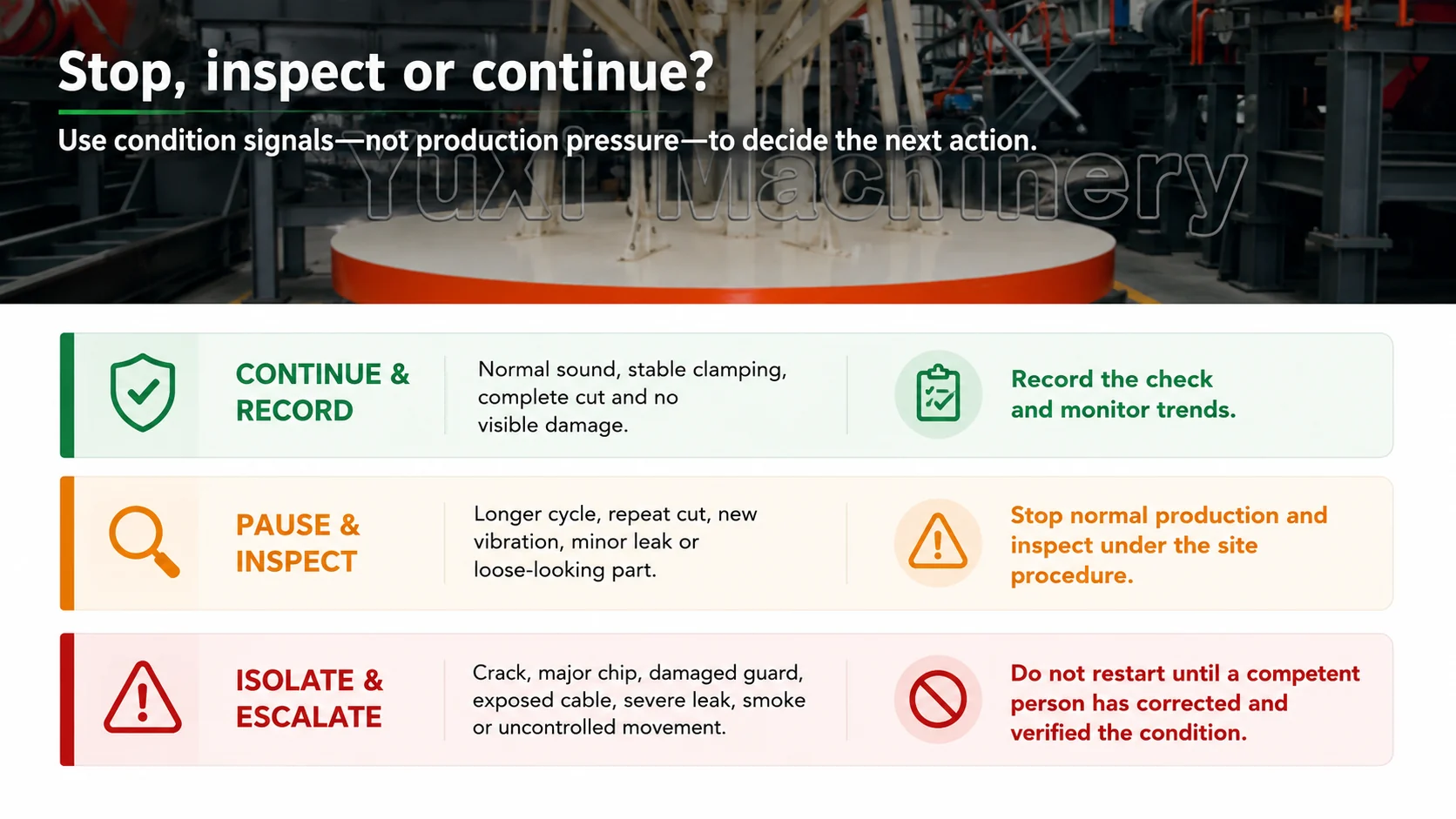
| Observed condition | First checks | Recommended status |
|---|---|---|
| Stable cut and normal sound | Confirm complete separation, stable tire position and no new marks. | Continue and record the check. |
| Longer cycle or repeat cut | Compare tire type, positioning, clamping, cutter condition and worktable behavior. | Pause and inspect; do not compensate by forcing the process. |
| New vibration or metal contact sound | Stop; inspect for movement, debris, loose parts, alignment or structural contact under the safe procedure. | Keep out of service until the cause is known. |
| Tire moves during the cut | Check size/configuration match, positioning parts, clamping condition and operator setup. | Do not process another tire until stable control is restored. |
| Minor leak or damaged hose surface | Identify the system and whether pressure or stored energy is involved. | Stop and refer to a competent person; never search for a high-pressure leak by hand. |
| Cracked or loose cutter | Do not run a confirming test. | Isolate immediately and follow the approved replacement/inspection process. |
| Damaged guard or failed safety function | Prevent use and identify whether maintenance changed the device. | Keep isolated until repaired and function-tested. |
| Smoke, burning odor, exposed conductor or uncontrolled motion | Use emergency/site response procedures without approaching the hazard. | Immediate shutdown, isolation and escalation. |
10. Use performance signals without turning this into a capacity article
- Median full cycle time by tire family: shows gradual drift without being distorted by one difficult tire.
- Incomplete-cut or repeat-pass count: helps distinguish a recurring condition from an isolated input problem.
- Tire movement events: points toward positioning, clamping, setup or tire-range mismatch.
- Unplanned stop minutes: reveals whether a small recurring fault is becoming a real production constraint.
- Abnormal noise/vibration reports: should include location, tire type and cycle stage.
- Maintenance action outcome: confirms whether the action corrected the symptom or merely reset it temporarily.
11. Printable tire bead cutter maintenance log
| Record field | Example entry format |
|---|---|
| Date, shift and machine ID | 2026-07-18 / Shift A / asset number or serial reference |
| Operator and checker | Name or employee ID |
| Tire mix | Passenger, SUV, light truck, truck; note unusual or oversized inputs |
| Pre-shift result | Pass / restricted / out of service, with exception number |
| Safety-device status | Guards and fitted controls checked according to procedure |
| Cleaning completed | Worktable, locating area, discharge zone and inspection surfaces |
| Cut-quality signal | Repeat cuts per batch, incomplete separation or irregular path |
| Condition signal | Noise, vibration, heat, smell, leak, movement or fresh contact mark |
| Maintenance action | Cleaned, inspected, isolated, component replaced, supplier contacted |
| Parts used | Verified part number, quantity and remaining stock |
| Downtime | Start, finish and production impact |
| Release status | Released by authorized person / restrictions / lockout remains |
| Follow-up | Owner, due date and reference to photo/video/work order |
12. Spare parts, tools and shift handover
Control the spare
- Use the verified machine identification and approved part number.
- Protect cutting edges, sealing surfaces and electrical parts from corrosion or impact.
- Record receipt date, storage location and issue history.
- Do not mix visually similar parts without confirmation.
Control the handover
- State the exact machine status at shift change.
- Identify any guard removed, isolation applied or work incomplete.
- Attach the last photos, measurements and work-order reference.
- Require formal release before production restarts.
13. Build a site-specific maintenance baseline after commissioning
- Define tire categories. Do not combine passenger and heavy commercial tires into one maintenance history when their handling and bead structures differ.
- Establish a normal condition. Record sound, movement, cut result and cycle pattern after commissioning and after an approved major service.
- Link faults to operating context. Note the tire, operator task, cycle stage and recent maintenance action.
- Review repeated events monthly. Ask whether the checklist, interval, training, spare plan or machine configuration needs to change.
- Control revisions. Date the checklist and identify who approved each machine-specific value.
14. What to send YUXI when maintenance support is needed
- Machine identification, supplied configuration and electrical standard.
- Tire categories, diameter range and photos of the tire that produced the symptom.
- Shift pattern, approximate operating hours and date the condition first appeared.
- Short video showing the full cycle from an approved safe position.
- Close-up photos of the affected area after the machine is safely isolated.
- Cut result, repeat-pass frequency and whether the symptom occurs on every tire.
- Alarm text, indicator state or control behavior exactly as observed.
- Recent cleaning, lubrication, adjustment, cutter change or repair history.
- Part numbers and dimensions only when requested and measured by the approved method.
Turn the checklist into a machine-specific maintenance plan
FAQ
How often should a tire bead cutter be maintained?
Use the supplied YUXI manual and the site risk assessment as the starting point.A brief pre-use inspection is carried out for each shift,cleaning and abnormal situations are recorded after the shift,and more in-depth inspection is arranged according to working hours,tire combinations,environment and situation trends.
What should you do before starting the machine?
Check the work area, fitted guards and controls, tire positioning and clamping parts, cutter security and visible condition, worktable freedom, cables or hoses, leaks, loose parts and any abnormal condition left from the previous shift.
Should a tire bead cutter be lubricated every day?
Do not use a universal interval.Only lubricate the points,lubricant grades and quantities determined in the machine document.Excessive lubrication,pollution or wrong products can be as harmful as missing lubrication.
When should the machine be stopped immediately?
When the cutter is broken or loose,the protective cover is damaged,the electrical components are exposed,serious smoke leakage,uncontrolled movement,significant vibration or other situations that may cause injury or secondary damage,please stop and isolate the equipment under the on-site procedure.
Does this checklist replace the YUXI manual?
No. It is a planning template. Machine-specific isolation steps, torque values, adjustment dimensions, lubricant specifications and replacement procedures must come from the documentation for the supplied configuration or from YUXI technical support.
What maintenance information should be sent to YUXI?
Send the machine identification, tire types and sizes, operating hours or shift pattern, photos and video of the symptom, cut result, alarm or control information, recent maintenance actions and clear images of the affected component.
References and source notes
- U.S. Occupational Safety and Health Administration, 29 CFR 1910.212 — General Requirements for All Machines.
- U.S. Occupational Safety and Health Administration, 29 CFR 1910.147 — The Control of Hazardous Energy.
- UK Health and Safety Executive, Maintenance of Work Equipment.
- UK Health and Safety Executive, Inspection of Work Equipment.