




Quick Answer
Contents
- What makes a mining tire different
- 1. Create a safe mine-to-recycler handoff
- 2. Inspect and quarantine abnormal tires
- 3. Remove uncontrolled contamination
- 4. Build the processing dossier
- 5. Define the shredder feed envelope
- 6. Choose cut-first, bead-first or hybrid
- 7. Execute a controlled sectioning plan
- Where the YUXI cutter fits
- 8. Inspect and trial the finished sections
- Common mining tire processing mistakes
- Handoff worksheet
- FAQ
- References
What Makes a Large Mining Tire a Separate Processing Case?
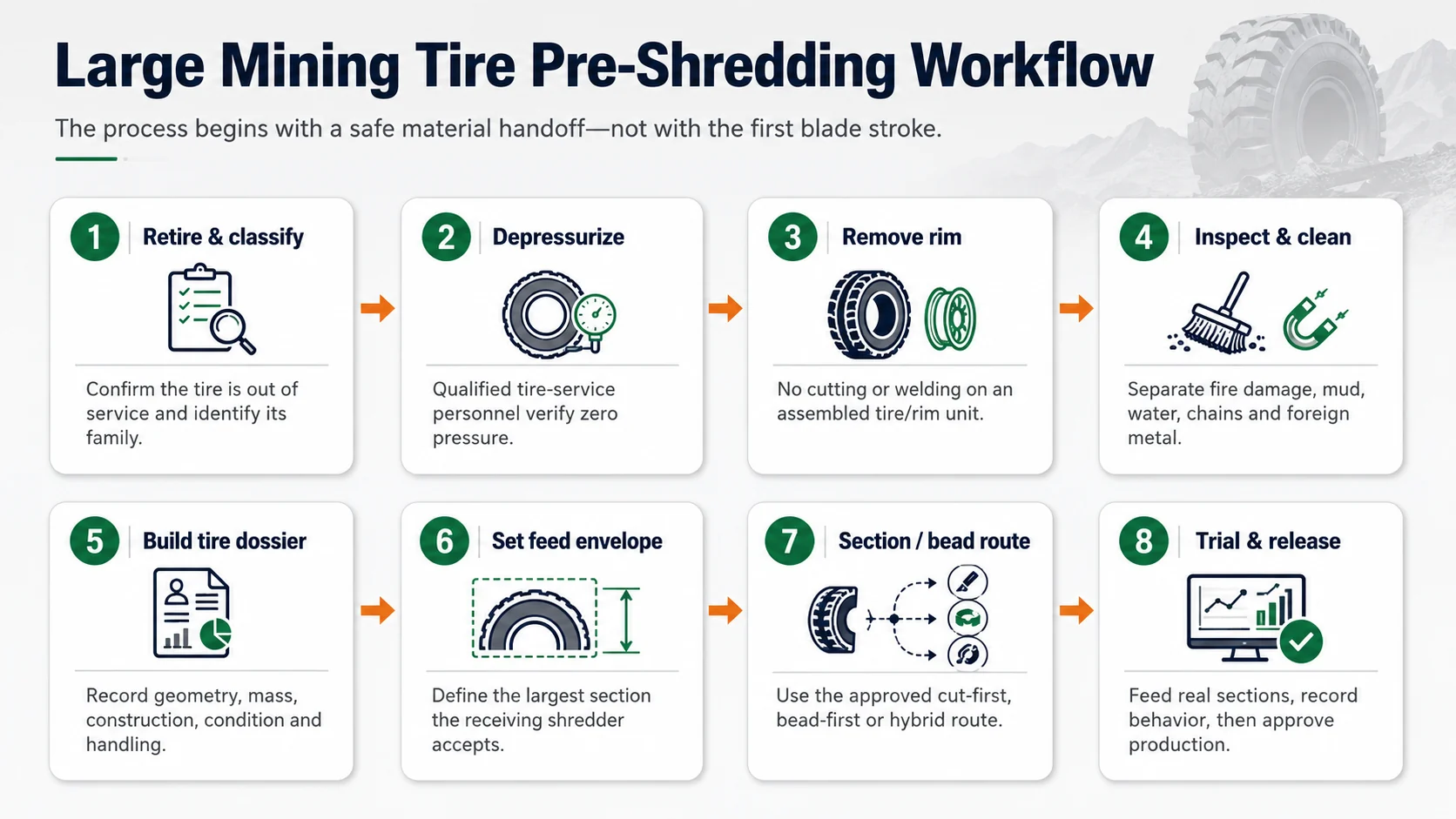
1. Create a Safe Mine-to-Recycling Handoff
The handoff record should state
- equipment or tire identification where available;
- the tire-service status and date removed from service;
- who verified complete depressurization;
- confirmation that the rim has been removed;
- whether the tire was exposed to fire, heat, electrical arcing or unusual chemicals;
- the intended lifting method and designated receiving area.
2. Inspect and Quarantine Abnormal Tires
| Observed condition | Why it matters | Processing disposition |
|---|---|---|
| Rim attached or pressure status unknown | The tire is not an approved recycling input. | Hold for qualified tire-service release. |
| Fire, heat or electrical damage | Internal damage and pressure history may be uncertain; MSHA warns that danger can remain after a heat source is removed. | Quarantine under the mine’s abnormal-tire procedure. |
| Water-, mud- or slurry-filled casing | Actual mass and center of gravity may be far above the dry estimate. | Drain or clean using an approved method before lifting and weighing. |
| Chains, rock ejectors or external metal | Can snag handling equipment and become uncontrolled metal in a cutter or shredder. | Remove before the recycling cell. |
| Major split, collapse or delamination | The tire may fold or release stored deformation as it is lifted and cut. | Use a separate handling and restraint plan. |
| Oil, chemical or unknown residue | May affect worker exposure, fire controls and downstream product acceptance. | Identify and route under the site’s waste-control procedure. |
| Embedded bucket teeth, bolts or large foreign objects | Creates a non-tire impact load and can damage cutting or shredding equipment. | Remove or reject before size reduction. |
3. Remove Uncontrolled Contamination—But Do Not Over-Process
Clean enough to control
- read the tire marking and identify the family;
- see cuts, repairs, bead damage and heat effects;
- remove loose rock, soil, chains and foreign metal;
- prevent uncontrolled water or slurry from entering later equipment.
Do not imply purity
- bead treatment does not remove every steel cord;
- sectioning does not create a clean rubber product;
- a visually clean section can still contain belts, plies and repairs;
- final material quality depends on later liberation and separation.
4. Build the Mining Tire Processing Dossier
| Dossier field | What to record | Why the processing team needs it |
|---|---|---|
| Identity and application | Size code, manufacturer, haul truck/loader/scraper application where known. | Prevents several very different tires being grouped under one OTR label. |
| Measured geometry | Actual outside diameter, overall width and deformation. | Sets transport, support, clamp, cutter travel and finished-section geometry. |
| Approximate mass | Scale record or a defensible value for the specific tire. | Sets lifting equipment, floor loading and target section mass. |
| Construction | Radial/bias where known, steel reinforcement, repairs and bead condition. | Changes the approved cut path and exposed-wire behavior. |
| Incoming condition | Dry, muddy, water-filled, split, collapsed, heat-damaged or partly dismantled. | Changes actual handling time and the stability of each cut. |
| Preparation state | Rim-free, bead intact, sidewall removed, bead ring prepared or previously opened. | Defines what object the cutter and shredder are actually receiving. |
| Production mix | Percentage by family plus monthly or shift quantity. | Stops a small extreme fraction from disappearing inside an average. |
5. Define the Shredder Feed Envelope Before Drawing the Cut Lines
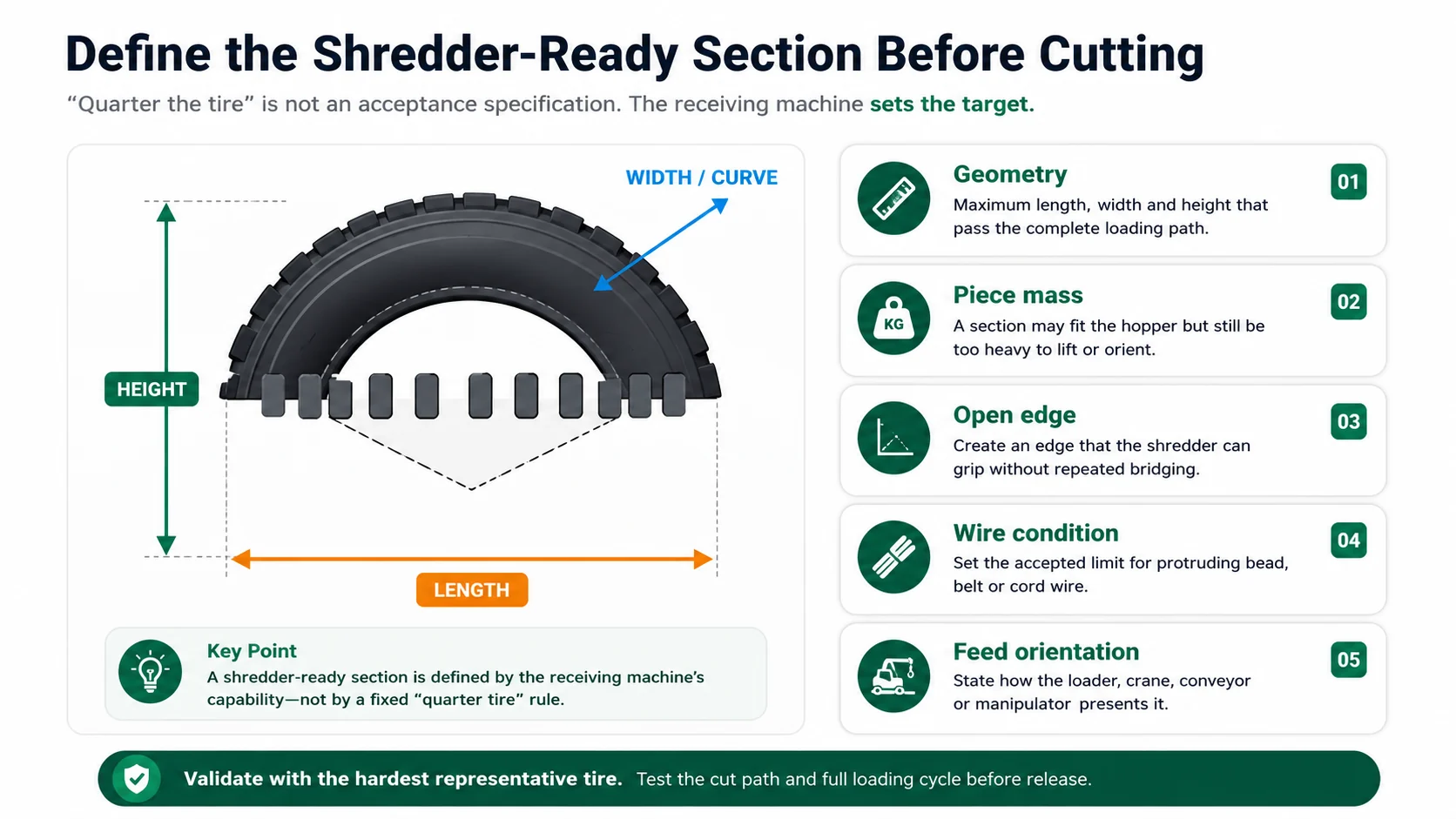
Write six acceptance fields
- Maximum section length, width and height. Check the entire approach, hopper and internal restrictions.
- Approximate maximum piece mass. Match the crane, loader, manipulator or conveyor as well as the shredder.
- Required open edge. A broken ring geometry may present a better bite than a closed loop.
- Maximum protruding wire. State what exposed bead, belt or cord condition is acceptable.
- Permitted contamination. Define limits for mud, water, stones, repair hardware and foreign metal.
- Presentation method. Record the planned orientation and the equipment that will place the section.
6. Choose Cut-First, Bead-First or a Hybrid Route
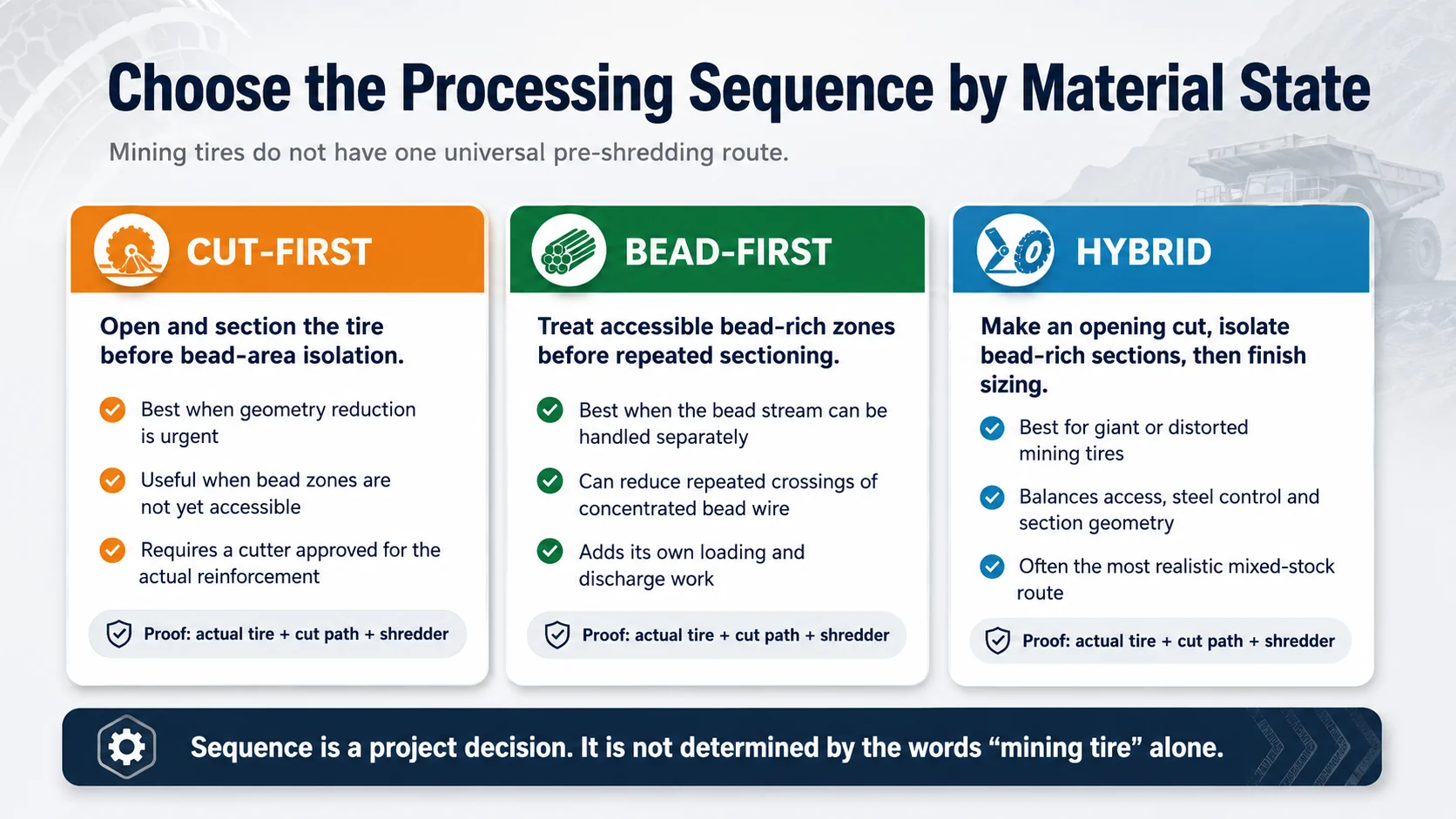
| Route | Starting condition | What it solves | Main control point |
|---|---|---|---|
| Cut-first | Whole, rim-free tire and a cutter approved for the actual reinforcement. | Breaks the closed ring and reduces geometry before component separation. | Support and restraint after the first cut changes casing stability. |
| Bead-first | Bead-rich sidewall areas are accessible and a suitable bead treatment route exists. | Can reduce repeated crossings of concentrated bead wire and create a separate bead-rich stream. | Do not confuse cutting off a bead-sidewall ring with extracting clean steel wire. |
| Hybrid | Giant, deformed or mixed mining tires. | Uses an opening cut to gain access, then treats bead-rich sections and completes sizing. | Every intermediate piece needs an identified destination and handling method. |
| Direct whole-tire shredding | The exact tire passes physical fit, shaft engagement, material-load and sustained-performance tests. | Eliminates a separate cutter stage. | Do not call a test on pre-cut samples “whole-tire capacity.” |
7. Execute a Controlled Sectioning Plan
A practical cut-plan logic
- First cut: open the closed tire ring when the shredder needs a free edge or the tire cannot fit as a whole.
- Intermediate cuts: reduce the longest, widest or heaviest remaining section that still exceeds the feed envelope.
- Bead-zone decision: cross, isolate or route the bead-rich area according to the approved cut-first, bead-first or hybrid plan.
- Final verification: measure and inspect each section before it enters the accepted pile.
Where the YUXI Hydraulic Tire Cutter Fits
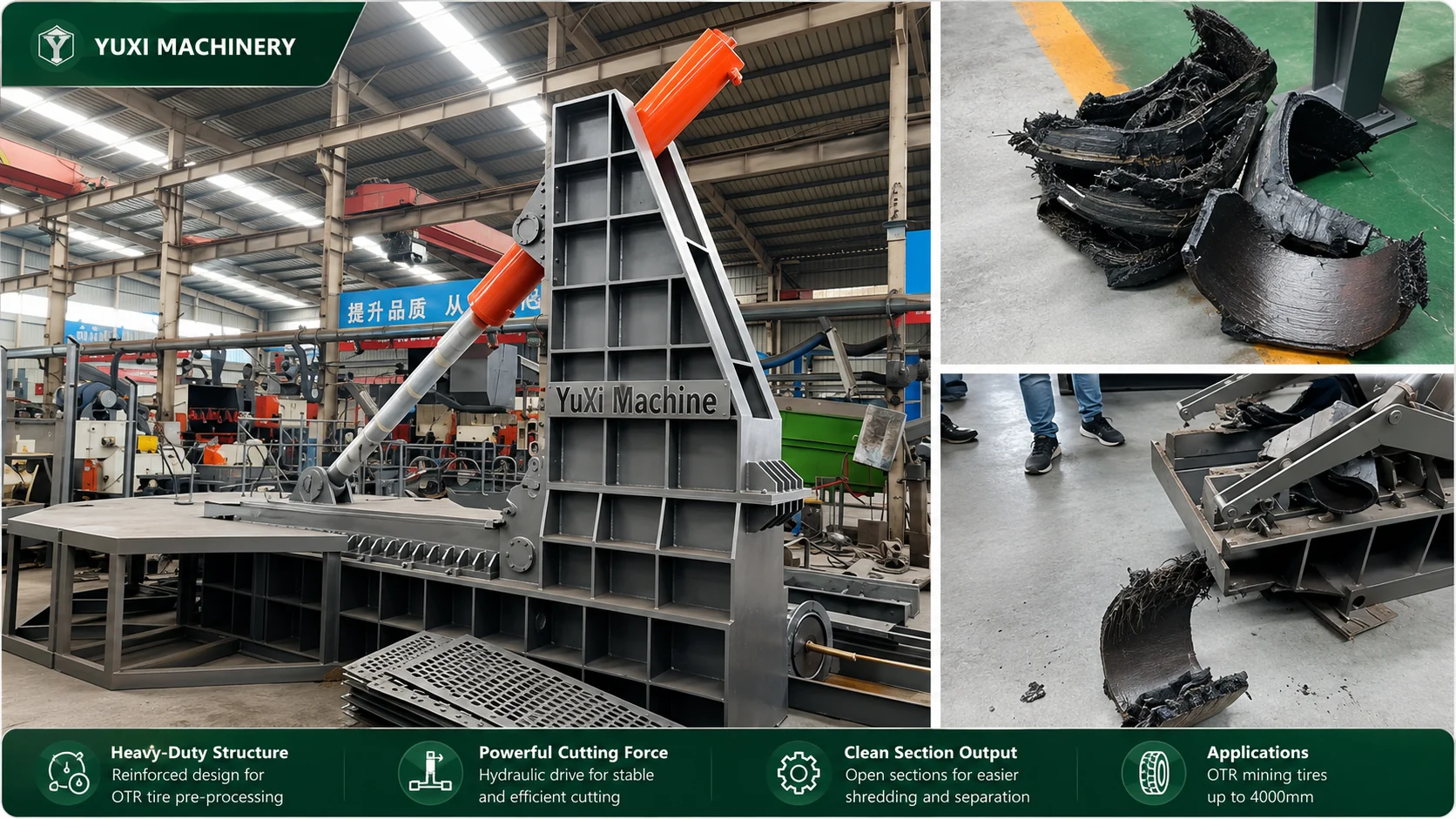
The cutter can be specified to
- support and restrain an approved whole or pre-treated tire;
- apply hydraulic shear force through rubber and steel reinforcement;
- create large sections that fit the defined downstream envelope;
- integrate with the available loading, discharge and layout method;
- be factory-tested against representative tire information and required output.
The cutter does not replace
- tire depressurization and rim removal;
- inspection of fire-, heat- or chemical-damaged tires;
- removal of uncontrolled mud, water, chains or foreign metal;
- wire extraction from a prepared bead ring;
- the shredder or later steel/fiber separation equipment.
8. Inspect and Trial the Finished Sections
Section release check
- measured length, width and height are within the approved envelope;
- approximate mass fits the handling method;
- the intended open edge is present and accessible;
- wire protrusion is within the agreed limit;
- loose foreign material has been removed;
- the section is stable enough to lift, stage and present without improvised manual correction;
- the tire family and processing route are traceable.
Representative shredder trial
Common Mining Tire Processing Mistakes
| Mistake | Why it fails | Better control |
|---|---|---|
| Starting with the cutter instead of tire-service release | Pressure and rim status remain ambiguous. | Require a documented depressurized, rim-free handoff. |
| Calling all stock “OTR tires” | Extreme tires disappear inside a broad label. | Record each family and identify the hardest approved tire. |
| Cutting every tire into four pieces | Quartering does not control width, curvature, mass or wire condition. | Work backward from the shredder feed envelope. |
| Assuming bead removal means steel-free rubber | Belts, plies and cords can remain in the casing. | Define each output stream and later separation step. |
| Testing clean dry samples only | Production includes deformed, repaired, muddy or difficult tires. | Test the actual approved mix and abnormal-tire routing. |
| Ignoring discharge handling | A cut section can still be too heavy or unstable to move safely. | Approve the lift, stage and presentation method for each section type. |
| Measuring cutter strokes instead of completed tires | Loading, repositioning and discharge may dominate the cycle. | Measure from incoming tire pickup to accepted section release. |
| Calling a single shredder bite a production test | It hides repeated bridging, reversals and line imbalance. | Run a representative continuous trial. |
Mining Tire Processing Handoff Worksheet
| Field | Record |
|---|---|
| Tire family and application | Size code, manufacturer and equipment application where known |
| Pressure and rim status | Who verified complete depressurization; confirmation that the rim is removed |
| Abnormal-condition status | Fire/heat exposure, chemical contact, major split, water or mud, external metal |
| Measured incoming condition | Diameter, width, approximate mass, deformation and preparation state |
| Handling plan | Rated lifting equipment, attachment or sling, travel path, staging orientation |
| Processing sequence | Cut-first, bead-first, hybrid or approved direct-shred route |
| Target section envelope | Maximum length, width, height, mass, wire protrusion and required open edge |
| Test evidence | Actual tire, number of cuts, completed cycle time, rejected sections, shredder behavior and accepted output |
| Change-control trigger | New tire family, new condition, new bead state, new cutter configuration or new shredder |
Make the Tire State the Contract Between Machines
FAQ: Mining Tire Processing Before Shredding
Do large mining tires always need to be cut before shredding?
No. A shredder designed and proven for the exact whole tire may accept it directly. Large or irregular mining tires often need sectioning because the closed ring, mass, width or reinforcement prevents stable loading and shaft engagement. The decision belongs to a representative whole-tire versus pre-cut trial.
Must the bead be removed before a mining tire is sectioned?
Not in every project. Bead-first processing can help when the bead-rich zone is accessible and a separate steel-control route is required. Cut-first or hybrid processing may be more practical when a giant or distorted tire must be opened before the bead area can be handled. Use the supplied machine’s approved route.
Can a mining tire be cut while it is still mounted on the rim?
No. The recycling cutting cell should receive a depressurized, rim-free tire. MSHA guidance states that assembled tires should not be welded or cut, and OSHA requires complete deflation before demounting covered rim wheels. Tire and rim servicing must be handled by qualified personnel under the applicable site procedure.
What size should mining tires be cut before shredding?
There is no universal quarter, half or block size. Define the receiving shredder’s maximum accepted section length, width, height and approximate mass, plus the required open edge, wire condition and presentation method. Then prove the cut plan with the hardest representative tire.
What information should be recorded for mining tire processing?
Record tire markings, application, measured diameter and width, approximate mass, construction where known, rim and pressure status, bead condition, major repairs, fire or heat exposure, mud or water loading, foreign objects, deformation, planned lifting method and target shredder feed envelope.
What does a YUXI tire cutting machine do in this process?
It supports, clamps and hydraulically sections approved whole or pre-treated truck, agricultural and OTR/mining tires into larger pieces before shredding or another downstream step. It does not replace tire depressurization, rim removal, contamination control, bead-wire extraction or final shredding.
How should the process be accepted before production?
Run the same route that production will use: actual incoming tire condition, actual handling equipment, all required cuts or bead-treatment steps, real discharge handling and the proposed shredder. Record bridging, reversals, manual intervention, rejected sections and sustained accepted output.
Authority and Product References
- YUXI Machinery — Tire Cutting Machine for Waste Tire Recycling. Official product information on applications, hydraulic clamping and cutting, alloy cutter, working platform, process position and project-specific configuration.
- U.S. Environmental Protection Agency — Scrap Tires: Handbook on Recycling Applications and Management for the U.S. and Mexico. Defines size reduction to include cutting, shredding and other methods.
- U.S. Tire Manufacturers Association — How a Tire Is Made. Describes steel in belts/plies and bead hoops embedded in the sidewall.
- Terán et al. — Reverse logistics network design for large off-the-road scrap tires from mining sites, Waste Management. Discusses heavy-duty downsizing before large shredders and grinding systems.
- Mine Safety and Health Administration — Tire and Rim Safety Awareness Program. Large mining tire/rim servicing, complete deflation, no cutting or welding of assembled tires, handling and suspended-load precautions.
- Occupational Safety and Health Administration — 29 CFR 1910.177. Servicing multi-piece and single-piece rim wheels; complete deflation before demounting.
- Occupational Safety and Health Administration — Control of Hazardous Energy (Lockout/Tagout). Energy-control responsibilities and worker training for covered servicing and maintenance.