




Two black piles can look almost identical beside a shredder. One may pass a fuel buyer’s receiving inspection; the other may create a return load, bridge at a transfer point or fail because its largest pieces and exposed wire were never defined.
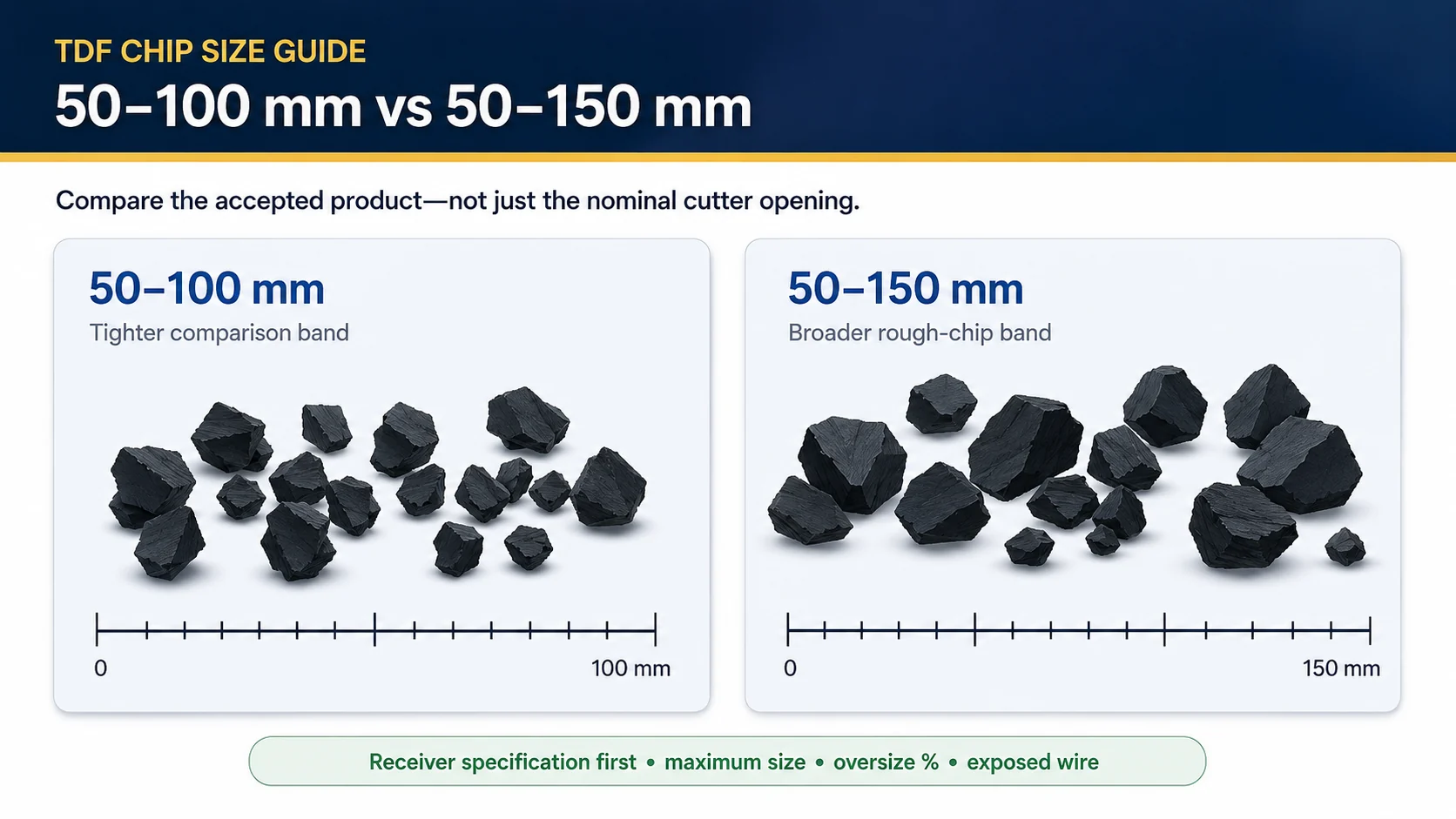
We have seen a size range copied from an early email into the shredder quotation, the screen drawing and the sales contract without anyone defining how the chip would be measured. That shortcut is risky. Tire shreds are irregular, elastic and reinforced with steel. “50–100 mm” can mean a target band, a nominal screen family, a longest-dimension limit or simply a buyer’s shorthand. Those are not interchangeable.
Contents
First Resolve the Naming Issue: 50–80, 50–100 or 50–150 mm?
YUXI’s current Tire TDF Plant page lists approximately 50–80 mm as a common published TDF target and 50–150 mm as a flexible rough-shred range. Other YUXI material has used 50–100 mm when discussing a controlled TDF configuration. This is not a reason to hide one number. It is a reason to separate a website reference range from the final contract specification.
For this comparison, 50–100 mm means the narrower commercial band a buyer may request, while 50–150 mm means a broader coarse-chip band. A project that actually requires 50–80 mm should write 50–80 mm in the quotation and test plan. It should not assume that a 50–100 mm article silently covers the tighter maximum.
50–100 mm vs 50–150 mm at a Glance
| Decision field | 50–100 mm | 50–150 mm | What must be verified |
|---|---|---|---|
| Control objective | Tighter upper limit for a more controlled coarse-chip stream. | Broader rough-chip window with a larger permitted maximum. | Is the upper number a hard maximum, a nominal target or a screen reference? |
| Screening demand | Often requires closer size control and may create more oversize return. | Can accept more large pieces when the receiver permits them. | Screen type, opening, feed layer, return route and actual oversize percentage. |
| Finished throughput | May be lower on the same equipment if recirculation increases. | May preserve more accepted coarse-chip output under a broad specification. | Accepted product t/h, not only whole-tire input or raw shredder discharge. |
| Feeding compatibility | Useful where a receiving opening or metering device rejects larger pieces. | Suitable only where the complete receiving route accepts pieces up to the agreed maximum. | Hopper throat, transfer points, gates, valves, conveyors and injection point. |
| Wire acceptance | Not guaranteed by chip size. | Not guaranteed by chip size. | Embedded steel, exposed wire length and loose-metal limits. |
| Best commercial fit | A written tighter receiver specification with enough margin for stable production. | A written broad specification or an intermediate rough-chip market. | Test load, sampling method and signed acceptance criteria. |
Notice what the table does not claim. It does not rank one range as universally better for combustion. Combustion behavior depends on the specific kiln or boiler, feed point, residence time, fuel blend, operating control and permit. Chip size is one interface variable inside that system, not an independent efficiency score.
How TDF Chip Size Should Be Measured
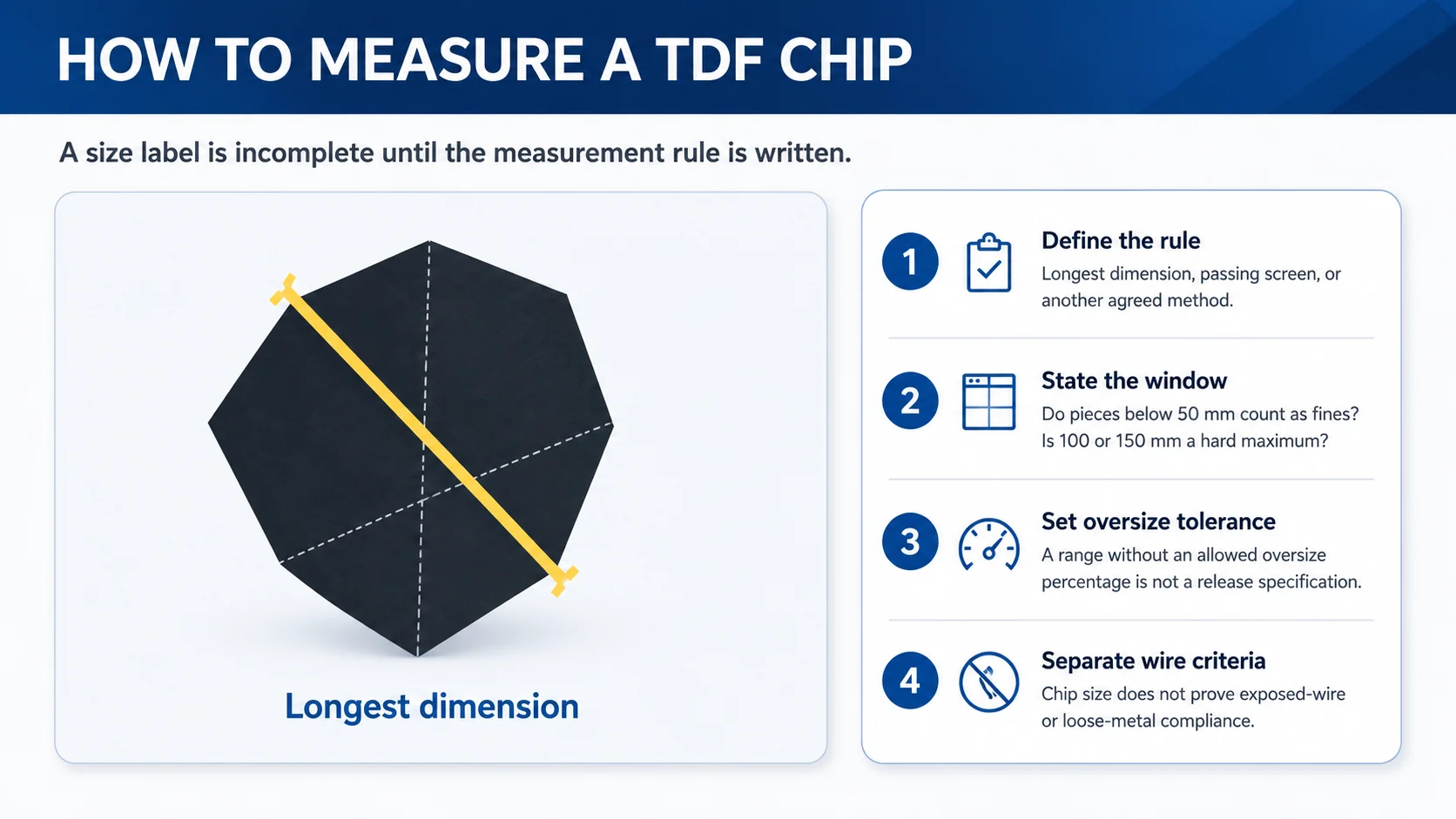
A tire chip is not a cube. It may be long and narrow, folded, curved or connected by steel cord. A piece can pass through a screen in one orientation and appear longer when laid flat. The acceptance document therefore needs more than two numbers.
1. Define the dimensional method
State whether size means the longest measured dimension, a screen-passing result, a two-dimensional envelope or another agreed method. Do not mix a nominal screen opening with a hand-measured maximum unless the contract explains the relationship.
2. Define the lower limit
Does “50–100 mm” reject pieces below 50 mm, or is 50 mm only the intended lower target? If smaller pieces are classified as fines, set their permitted percentage by mass or count. Without that rule, one party may call them acceptable TDF while another calls them off-spec material.
3. Define the upper limit and oversize tolerance
A hard 100 mm maximum is very different from a target of 50–100 mm with a small permitted oversize fraction. The latter gives the process a measurable operating margin. The former can require additional screening, a tighter return loop or a secondary reduction stage.
4. Define the sampling basis
A five-piece hand sample from the top of a pile does not represent a truckload. The parties should agree where samples are taken, how frequently, how much material is included, whether oversize is calculated by mass or piece count, and how folded pieces are handled.
ASTM D6700 remains the ASTM guide covering the use of scrap tires as tire-derived fuel.2 It is useful as a framework, but buyers and processors still need a project-specific acceptance sheet. An ASTM reference should not be used to imply that every user accepts the same 50–100 or 50–150 mm product.
Why the Receiver’s Specification Must Come First
A TDF processor does not create value by making the smallest chip it can. It creates value by repeatedly producing the least-processed chip that the customer can safely and legally receive, store, meter and use. That may be 50–100 mm. It may be 50–150 mm. It may be a different range entirely.
The EPA’s 2019 correspondence described slow-speed opposing-rotor equipment as producing larger 2–5 inch shreds suitable for applications such as cement kilns, while high-speed equipment can produce material below one inch.1 Those examples show the breadth of possible processing. They do not create a universal buyer specification.
Historical CalRecycle reporting described some processed TDF exports as typically 1.5–2 inch chips, approximately 38–51 mm.3 A later CalRecycle market report documented a California cement kiln changing its requirement to one-inch material; processors considered that change uneconomic, and in-state TDF shipments declined.4 The engineering lesson is not that one inch is right or wrong. It is that a receiver’s size change can alter processing cost and market viability.
Fuel-buyer acceptance sheet → line configuration → test conditions → commercial guarantee
How the Size Band Changes Screening, Return Load and Accepted Output
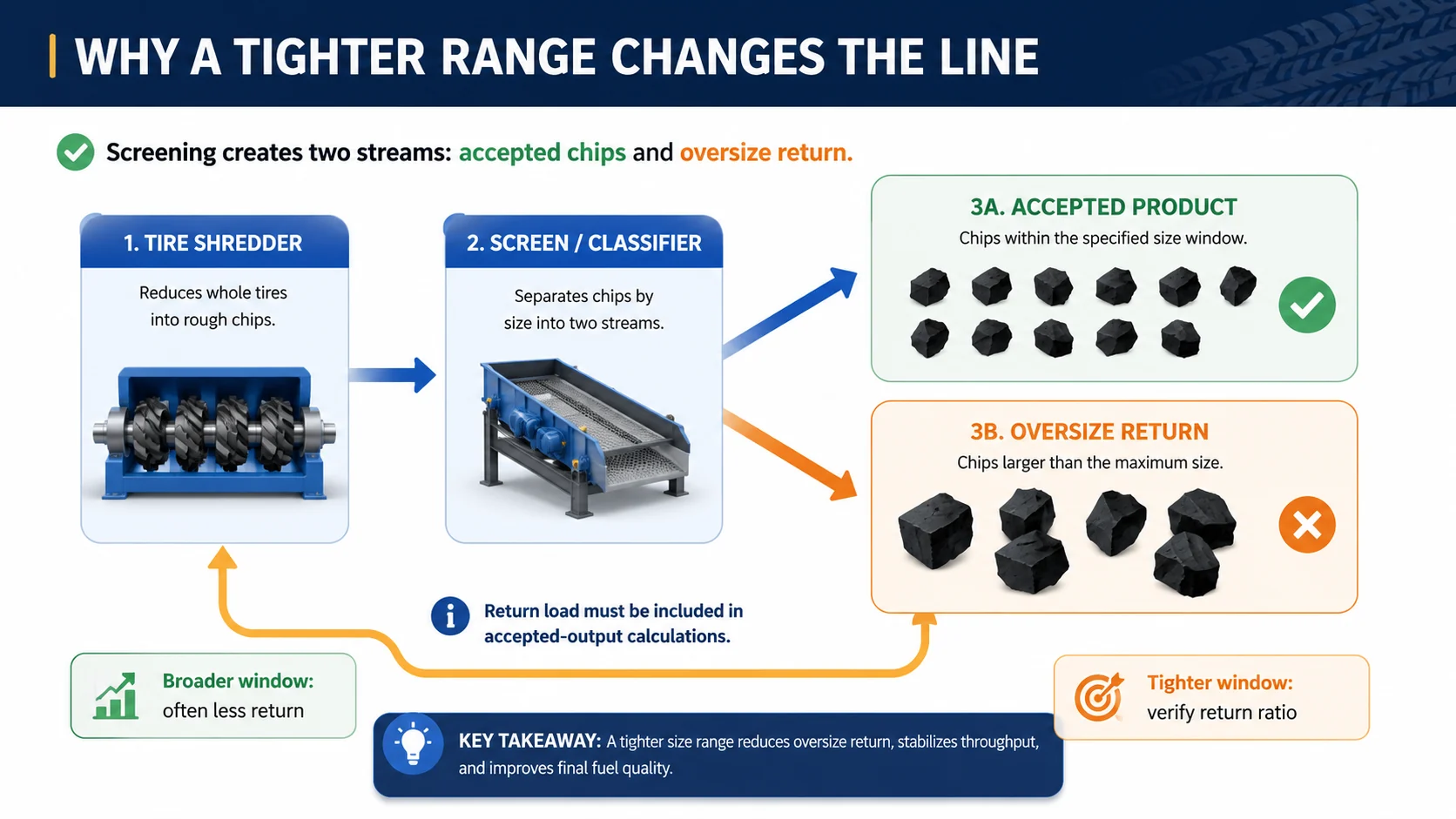
The main difference between the two bands appears after the first cut. A shredder produces a distribution, not identical pieces. Some material falls inside the target window; some remains too large; some may be smaller than the nominal lower target. The screen or classifier separates those streams.
50–100 mm usually creates a stricter rejection boundary
When the maximum drops from 150 mm to 100 mm, more of the first-pass discharge may be returned. The exact increase cannot be predicted from the range alone. Tire type, blade geometry, blade condition, feed rate, chip orientation and screen design all matter. This is why a supplier should report the expected or tested return ratio rather than simply stating that the machine “makes 100 mm chips.”
50–150 mm can reduce recirculation only when the receiver truly accepts it
A broad window may allow more first-pass material to leave as accepted product. That can improve coarse-chip output on the same core shredder. However, the apparent benefit disappears if the buyer later rejects long strips, folded pieces or exposed wire that technically sat within a loose dimension statement.
Raw throughput and accepted throughput are different numbers
A 10 t/h shredder input figure is not a 10 t/h accepted TDF guarantee. Material returning from the screen is counted again by the machine but not again as saleable output. Quote comparison should therefore separate incoming whole tires, gross shredder circulation and net accepted chips.
Practical capacity statement: accepted metric tons per hour, from the declared tire mix, after screening and recirculation, while meeting the written size and wire limits over the stated continuous test period.
Feeding, Storage and Transport: Maximum Shape Matters More Than the Label
Two lots can have the same nominal range and behave differently. One contains compact chunks; the other contains long straps connected by steel. The second lot may bridge in a bunker or catch at a transfer point even when many pieces measure below the nominal maximum.
Check the complete receiving path
Ask for the smallest opening from truck unloading to the combustion feed point. Include the bunker outlet, screw or belt feeder, rotary valve, gates, chutes, magnets and injection hardware. A 150 mm maximum cannot be approved just because the first receiving hopper looks large.
Do not assume smaller pieces always improve storage
Bulk density and pile behavior depend on shape distribution, fines, steel, compaction and moisture condition. A smaller maximum may pack differently, but the direction and magnitude should be measured. Generic claims about truck utilization or storage volume should not be used as guarantees.
Watch long pieces, not only heavy pieces
A thin 170 mm strip may weigh less than a compact 90 mm chip yet create more handling trouble. This is another reason to define the maximum dimension and oversize method instead of relying on average piece weight.
TDF Chip Size Does Not Define Exposed Steel
Bead removal, shredding, magnetic separation and final wire inspection solve different problems. Removing the concentrated bead bundle can protect downstream cutting and recover a steel-rich stream, but it does not remove every belt or cord from the tire body. Shredding can expose those cords. A screen can control geometry while allowing a long wire to pass with a small rubber chip.
The acceptance sheet should distinguish:
- Embedded steel: reinforcement still contained inside the rubber piece.
- Exposed wire: steel extending from a chip, measured by an agreed method.
- Loose metal: liberated steel pieces not attached to rubber.
- Bead bundles: concentrated rings or sections that may need dedicated front-end treatment.
A project can meet 50–100 mm and still fail the wire rule. It can also meet a low loose-metal limit while retaining acceptable embedded steel. These fields must be quoted and tested separately.
When 50–100 mm Is the Better Project Range
The narrower band is more defensible in four situations.
The receiving system has a hard opening constraint
A small valve, chute, metering device or injection point may make 150 mm pieces unacceptable. Confirm the smallest effective opening and the operator’s historical bridging limit rather than using the kiln type alone.
The buyer’s contract sets a tighter maximum
Where the receiver has already published 100 mm or a nearby maximum, designing around 150 mm creates a predictable commercial dispute. In that case, the processor should focus on screen performance, return capacity and representative acceptance testing.
The plant needs a more controlled intermediate feed
A downstream stage may accept coarse chips more consistently when the largest pieces are limited. This should be verified with the actual next machine, not inferred from a generic process diagram.
The project can absorb the return load
A tighter range is only useful when the shredder, return conveyor and screen can sustain it. The line should still achieve the contracted accepted output with the declared passenger, truck or OTR mix.
When 50–150 mm Is the Better Project Range
The broader range can be the rational choice when the receiver has confirmed that larger coarse pieces are acceptable and the commercial priority is efficient first-stage TDF or rough-chip production.
The fuel user accepts a broad coarse-chip specification
Some industrial systems are designed around larger tire pieces. The written specification and trial delivery should confirm the upper dimension, shape, wire and oversize conditions. A verbal statement that the plant “takes TDF” is not enough.
The product is an intermediate rough chip
A collection yard or downstream processor may purchase rough chips for another preparation stage. In that case, forcing every piece below 100 mm may add cost without adding sale value.
The project needs to protect accepted throughput
Where 150 mm pieces are allowed, the broader window can reduce unnecessary return. The benefit should appear as tested accepted output, not merely a higher catalog number.
Important: 50–150 mm is not a license for random strips. The maximum, oversize percentage, chip shape and wire criteria still need control.
How to Prove the Selected TDF Chip Size
A short demonstration with clean passenger tires is weak evidence for a mixed commercial project. We normally recommend a test plan that preserves the variables most likely to change the result.
- Declare the feed. Record tire category, maximum dimensions, truck-tire percentage, OTR content, rims and contamination exclusions.
- Declare the preparation. State whether bead wire is removed and whether large tires are pre-cut.
- Declare the machine condition. Record cutter set, screen or classifier, blade condition and return arrangement.
- Run continuously. Include enough time for the screen and return loop to reach a representative circulating load.
- Define the lot. Identify the accepted material produced during the measured period.
- Sample across the lot. Avoid selecting only the most uniform pieces from the top of the pile.
- Measure size and wire separately. Apply the agreed dimensional and steel rules.
- Report net output. Weigh accepted product, oversize return and rejected material where practical.
For a 50–100 mm requirement, the test should show how much material exceeds 100 mm and how that figure was calculated. For 50–150 mm, it should still show whether large strips near the maximum create handling issues. A passing size table does not replace a receiver trial when the feeding interface is new.
How the YUXI TDF Line Fits This Size Decision
YUXI positions the low-speed double-shaft tire shredder machine as the core size-reduction stage, with preparation, conveyors, size control and return equipment selected around the project. The published TDF line also covers passenger, truck, OTR and mining tires, but those tire groups do not create the same return load or accepted throughput.
For a broad 50–150 mm route, a primary shredder with appropriate size control may be enough when the buyer accepts the tested distribution. For a 50–100 mm or 50–80 mm target, the screen/classifier and oversize return become more important. Large and heavily reinforced tires may also justify bead treatment and pre-cutting before the main shredder.
The complete TDF production process article owns the end-to-end sequence from intake to dispatch. The point here is narrower: equipment should be configured only after the selected band has been converted into a measurable acceptance standard.
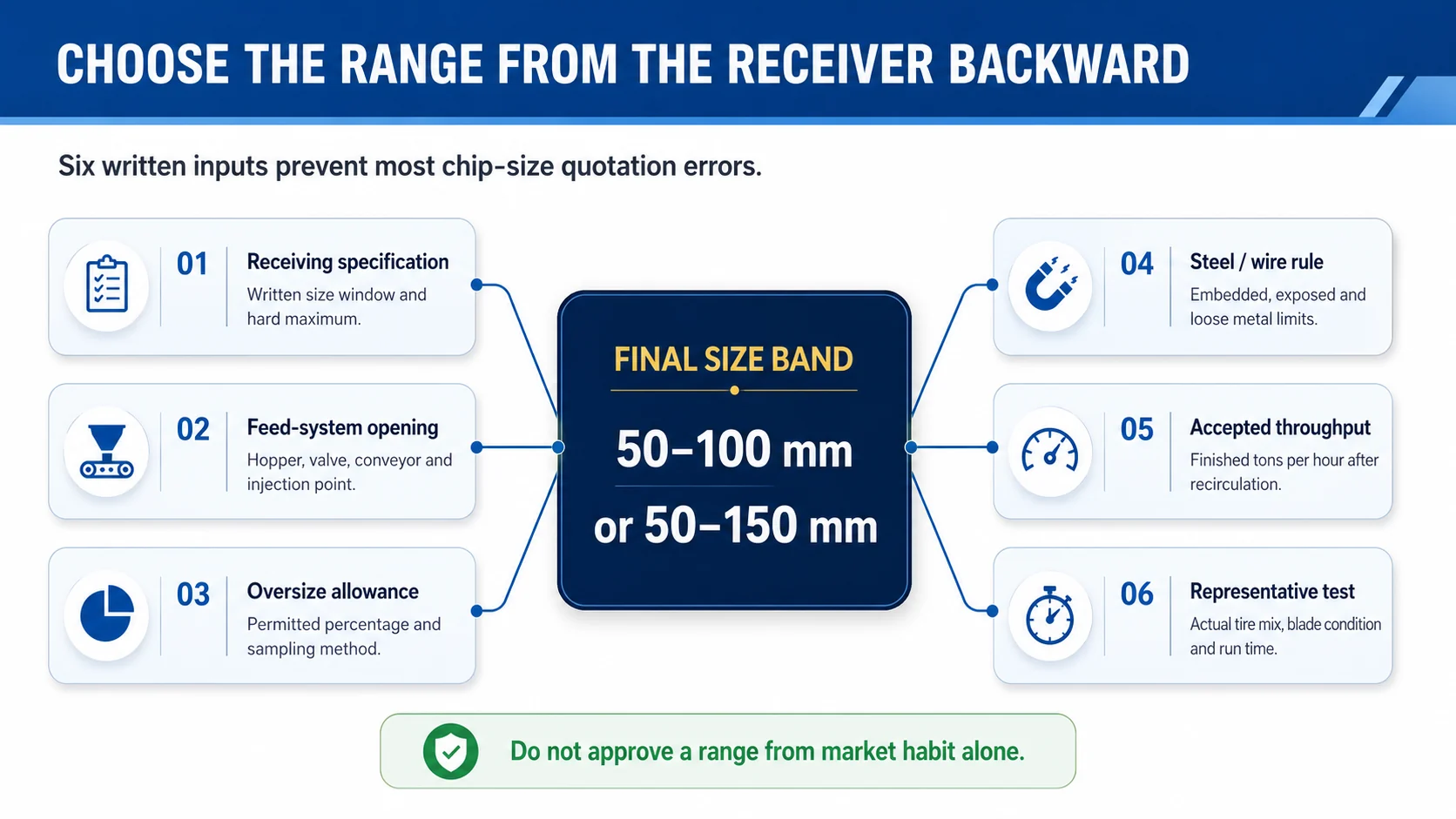
RFQ Checklist for a 50–100 or 50–150 mm Project
Material and product
- Tire categories and percentages
- Maximum tire diameter, width and weight
- Bead treatment and pre-cut condition
- Exact target range and hard maximum
- Fines and oversize tolerance
- Embedded, exposed and loose-steel limits
Performance and proof
- Accepted finished t/h
- Expected return ratio
- Sampling and measurement method
- Continuous test duration
- Screen and return configuration
- Receiver trial-load requirement
Also send photographs of the tire stream, the receiver’s written specification and the smallest opening in the receiving system. Those three items often change the proposal more than a preferred motor power.
Common TDF Chip Size Mistakes
Copying a competitor’s range without a buyer
A popular number can still be wrong for the local plant. Secure the receiving specification before using the range as a design basis.
Treating screen opening as finished-product proof
The screen is part of the control system. It does not remove the need to sample and measure the actual discharge.
Comparing supplier capacity at different sizes
A 50–150 mm output figure and a 50–100 mm accepted-output figure are not directly comparable. Normalize tire mix, size window, wire rule and test duration.
Ignoring pieces below the lower target
A lot can contain few oversize pieces but too many fines. Write both sides of the distribution where the receiver cares about them.
Assuming size solves wire problems
Screening controls geometry. Wire acceptance may require front-end bead treatment, magnetic separation, inspection or another project-specific step.
Frequently Asked Questions
What TDF chip size is best for a cement kiln?
There is no universal best size. Use the kiln operator’s written acceptance specification, including the measurement rule, maximum piece, oversize tolerance, exposed-wire limit and delivery condition. A general market range cannot replace the receiver’s feed-system and permit requirements.
Is 50–100 mm TDF always better than 50–150 mm?
No. The tighter band can reduce maximum piece size where the receiving system requires it, but it may also increase screening and recirculation. The broader band can preserve more finished throughput where the receiver accepts it. Neither range is automatically superior.
Does a 100 mm screen guarantee every chip is below 100 mm?
Not by itself. Elastic, irregular tire pieces can orient differently on a screen, and actual results depend on screen type, opening, residence time, feed layer, chip shape and return design. The finished lot still needs an agreed sampling and measurement method.
Does TDF chip size include exposed steel wire?
No. Size and wire are separate acceptance fields. A chip can pass the dimensional requirement and still fail because of long exposed wire or loose metal. The quotation and test plan should state both limits.
Why can smaller TDF chips reduce plant capacity?
A tighter maximum size can send more material back for another pass. More recirculation means more cutting work per accepted ton, so raw shredder input and finished accepted output should be reported separately.
How should 50–100 mm TDF be tested?
Use representative tire batches and a continuous run. Define the lot, sample locations, measurement method, number or mass of pieces measured, oversize calculation, wire inspection and accepted finished tons per hour. Keep the tire mix and blade condition in the test record.
Can the same YUXI TDF line make both ranges?
A project can be configured for different coarse-chip targets, but the final arrangement depends on tire mix, cutter setup, screen or classifier, return conveyor and receiver requirements. The proposal should not promise both bands at the same accepted throughput without representative evidence.
References and Source Notes
- U.S. EPA, 2019 correspondence on processing discarded scrap tires into TDF. The letter describes shredding, screening and metal removal as the main processing steps and states that their level depends on end-user needs and specifications.
- ASTM D6700-19, Standard Guide for Use of Scrap Tires as Tire-Derived Fuel. ASTM’s 2026 standards listings continue to include D6700-19.
- CalRecycle, California Waste Tire Market Report 2012. The report noted that some processed export TDF chips were typically 1.5–2 inches.
- CalRecycle, Waste Tire Market Report 2022, published May 2024. It reported that one cement kiln changed its TDF requirement to one-inch particles and that processors found the change uneconomic.
- U.S. Tire Manufacturers Association, 2023 End-of-Life Tire Management Report page. Used for current market context; it is not treated as a universal chip-size specification.
Define the Chip Before Configuring the Line
Send YUXI your tire mix, receiver specification, target accepted output and wire limits. The proposal can then separate a workable 50–100 mm requirement from a broader 50–150 mm route.