




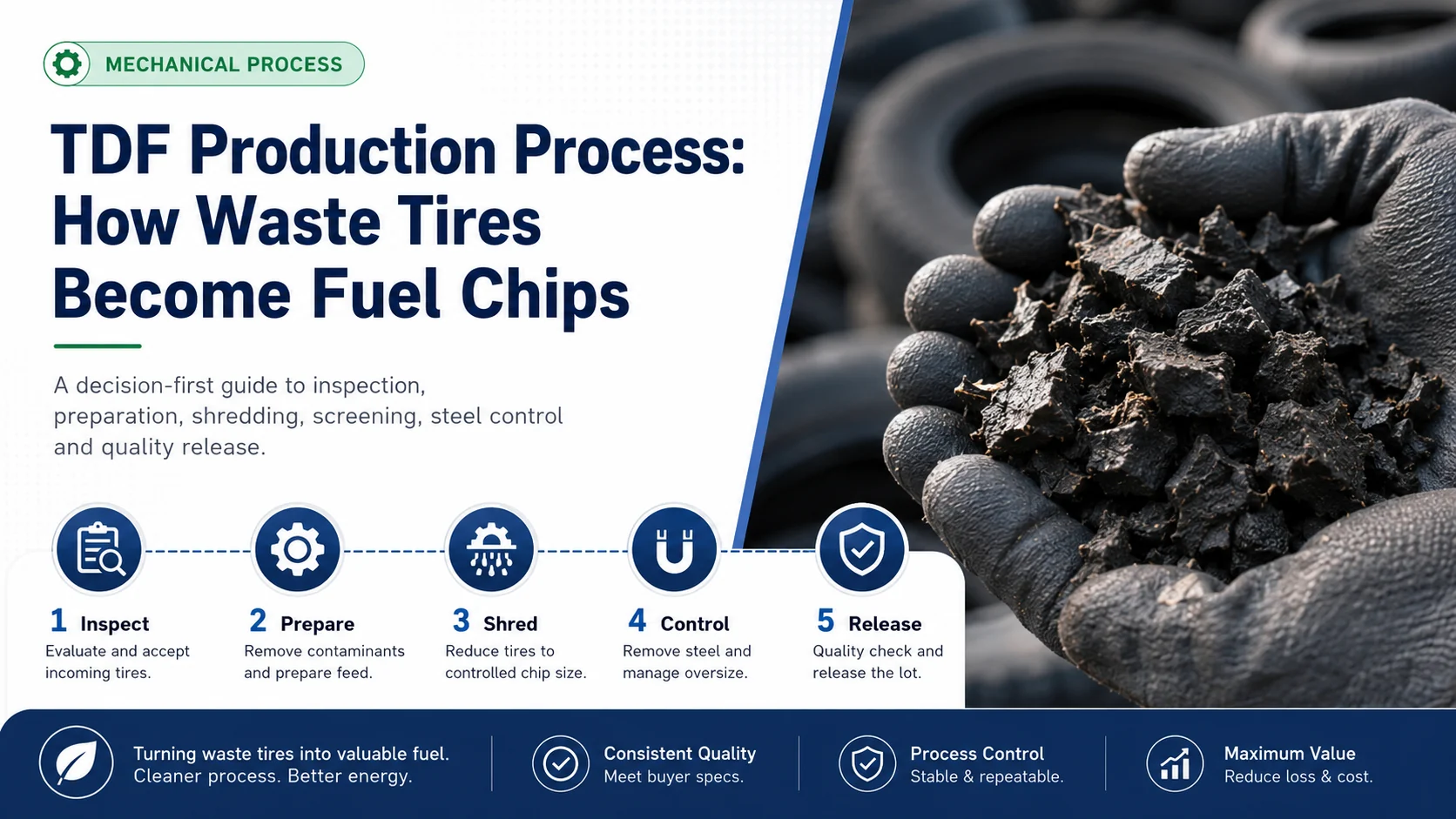
The discharge conveyor is the easiest part of a TDF demonstration to film. It is not the part that proves the process works. A dependable route begins with the incoming tire mix and ends with a fuel-chip lot that a real receiving plant will accept.
We have seen project discussions jump directly from “whole tires” to “50 mm TDF” as though the material moves through one machine and comes out finished. In practice, the difficult work sits between those two phrases. Truck tires bring concentrated bead steel. OTR tires may not feed as whole units. A narrow maximum-size rule can create a heavy return load. Long exposed wire can pass a size screen and still fail at the fuel user’s conveyor.
Table of Contents
Start with the Accepted Fuel Chip, Not the First Machine
A process flow should be drawn backward from the receiver. ASTM D6700 provides guidance for recovering the fuel value of scrap tires and recognizes that the material must be engineered for the combustion unit rather than produced to one universal recipe.2 The practical implication is simple: the process endpoint must be written before the equipment route is fixed.
The acceptance sheet should state the permitted physical form, target size window, maximum piece, oversize tolerance, exposed-wire rule, contamination limits, sampling method and delivery condition. Some receivers also require laboratory fuel analysis, but this article does not assign generic calorific, sulfur, chlorine, ash or moisture values to every project. Those numbers belong to representative testing and the buyer’s contract.
This ordering avoids a common error. A supplier may configure a line that makes visually attractive chips, yet the finished stream bridges in the bunker, contains too many long pieces, catches on a transfer point or arrives with unacceptable loose wire. None of those failures can be corrected by calling the output “TDF” more often.
Engineering rule: nominal cutter spacing is a machine setting; accepted chip distribution is a product result. They are related, but they are not the same measurement.
The TDF Production Process in Eight Practical Stages
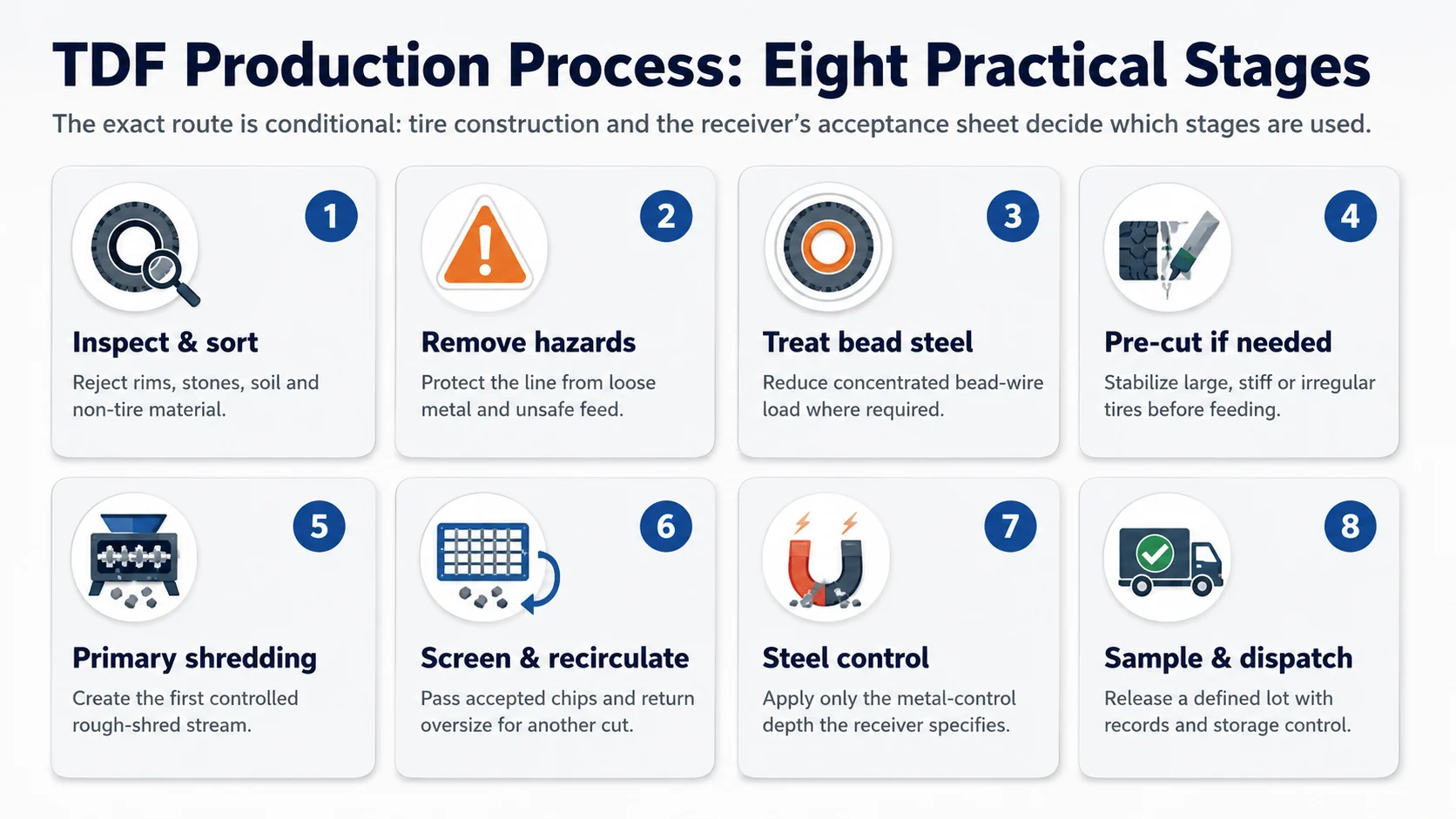
1. Receive, identify and inspect the tire stream
The process begins at the unloading area, not at the shredder hopper. Record the tire categories, maximum dimensions and approximate percentages. Passenger, truck, agricultural, OTR and mining tires do not impose the same cutting load or handling method. Mixed loads should also be checked for rims, wheel parts, chains, stones, soil, water, wood and other non-tire material.
This inspection is both a quality step and a machine-protection step. A hidden rim or heavy foreign object can damage cutters, increase shock loading and contaminate the output. Wet, soil-filled tires also change handling and delivered mass. Surprisingly, some “capacity problems” begin here: the line was quoted for clean tire feed, while the actual plant spends time sorting and cleaning an uncontrolled collection stream.
2. Separate unsuitable material and define feed batches
A plant rarely benefits from feeding every tire in random order. Batching similar tire types makes loading, power demand and product shape more stable. Where possible, separate passenger tires from steel-heavy truck tires and isolate very large units for a dedicated preparation route.
The batch identity should stay traceable through the process. This becomes useful during commissioning. When an oversize or wire problem appears, the team can determine whether it came from a particular tire category, worn cutters, unstable feeding or an inappropriate screen arrangement instead of blaming the entire line.
3. Treat concentrated bead steel where required
A tire bead contains a concentrated steel bundle that is different from the thinner reinforcing cords distributed through the carcass. Removing or opening this area can reduce shock loading and improve downstream cutting stability, particularly with truck and larger tires. A tire wire drawing machine is one possible front-end tool when the approved route calls for bead-wire treatment.
This step should not be described as complete de-wiring. Bead treatment reduces the concentrated bundle; steel cords can still remain in the sidewall and tread sections. That distinction matters later when the fuel user sets a limit for long exposed wire or loose metal.
4. Pre-cut tires that cannot feed reliably as whole units
Whole-tire shredding is possible in some configurations, but it is not automatically the best route for every diameter and construction. Large, stiff or irregular tires can sit across the hopper, bounce, rotate without biting or create an uneven loading cycle. A hydraulic tire cutting machine reduces these tires into sections that are easier to present to the shredder.
Pre-cutting is a feed-conditioning decision, not a universal ritual. Passenger tires may feed directly in a suitable line. Truck tires may need bead treatment, cutting or both depending on the shredder and output target. OTR and mining tires usually require a more deliberate sequence because maximum diameter, width, weight and reinforcement affect both handling and real throughput. The related guide on whether tires need cutting before shredding deals with that decision in more depth.
5. Perform primary size reduction
The main size-reduction stage is commonly a low-speed, high-torque double-shaft shear shredder. The cutters grip the prepared tire, pull it into the cutting chamber and shear the rubber-and-steel composite into rough pieces. A YUXI tire shredder machine is the core reduction unit within the published TDF route.
A short discharge video does not show the full process condition. Feed consistency, reversal frequency, cutter wear, clearance, shaft loading, long-wire behavior and the proportion of oversize over a continuous run are more useful. One customer may accept a broad rough shred after this stage. Another may require a controlled chip stream and therefore needs the next stage.
6. Screen the chips and return oversize when needed
Screening turns a nominal shredding result into a measurable size-control process. Material inside the accepted opening passes to the finished stream. Oversize remains in the circuit and returns for another cutting pass. EPA’s process description explicitly includes screening as one of the main processing categories for discarded scrap tires, with the required level determined by the end user.1
The screen does not create capacity for free. Every returned piece consumes conveyor space and another cutting cycle. A tighter maximum size, worn cutters or an unsuitable first-pass distribution can raise the recirculation load until the shredder appears undersized. This is why finished accepted output should be measured after the return loop, not only as whole tires entering the primary machine.
7. Apply steel control to the required depth
Metal removal can be placed before, during or after size control depending on the tire mix and receiver. Some cement applications can tolerate retained steel because iron can contribute to the process, while other feeding systems reject long exposed wire because it catches on conveyors and chutes. EPA’s archived TDF material notes that the need for steel removal varies by application.3
A magnetic separator can remove suitable liberated ferrous material, but it cannot pull embedded steel out of a large rubber piece simply because a magnet is present. Liberation, piece shape, belt loading, magnet position and the contract’s definition of acceptable steel all matter. Fiber separation is also not a universal TDF stage. It belongs only where the final fuel specification or downstream handling requires it.
8. Sample, release, store and dispatch the lot
The finished conveyor is not the end of quality control. Define the lot, take a representative sample and check the agreed physical limits. Record the weight, feed batch, screen condition, visible wire observations, contamination, storage condition and any non-conforming material. Finished chips should be kept in a way that prevents water, soil or unrelated waste from changing the delivered load.
The receiving plant’s unloading system must also be considered. A load can pass a laboratory test and still fail commercially if it bridges in the trailer, contains pieces that jam the receiving hopper or cannot be unloaded within the agreed time.
One-Pass Shredding or a Closed-Loop Process?
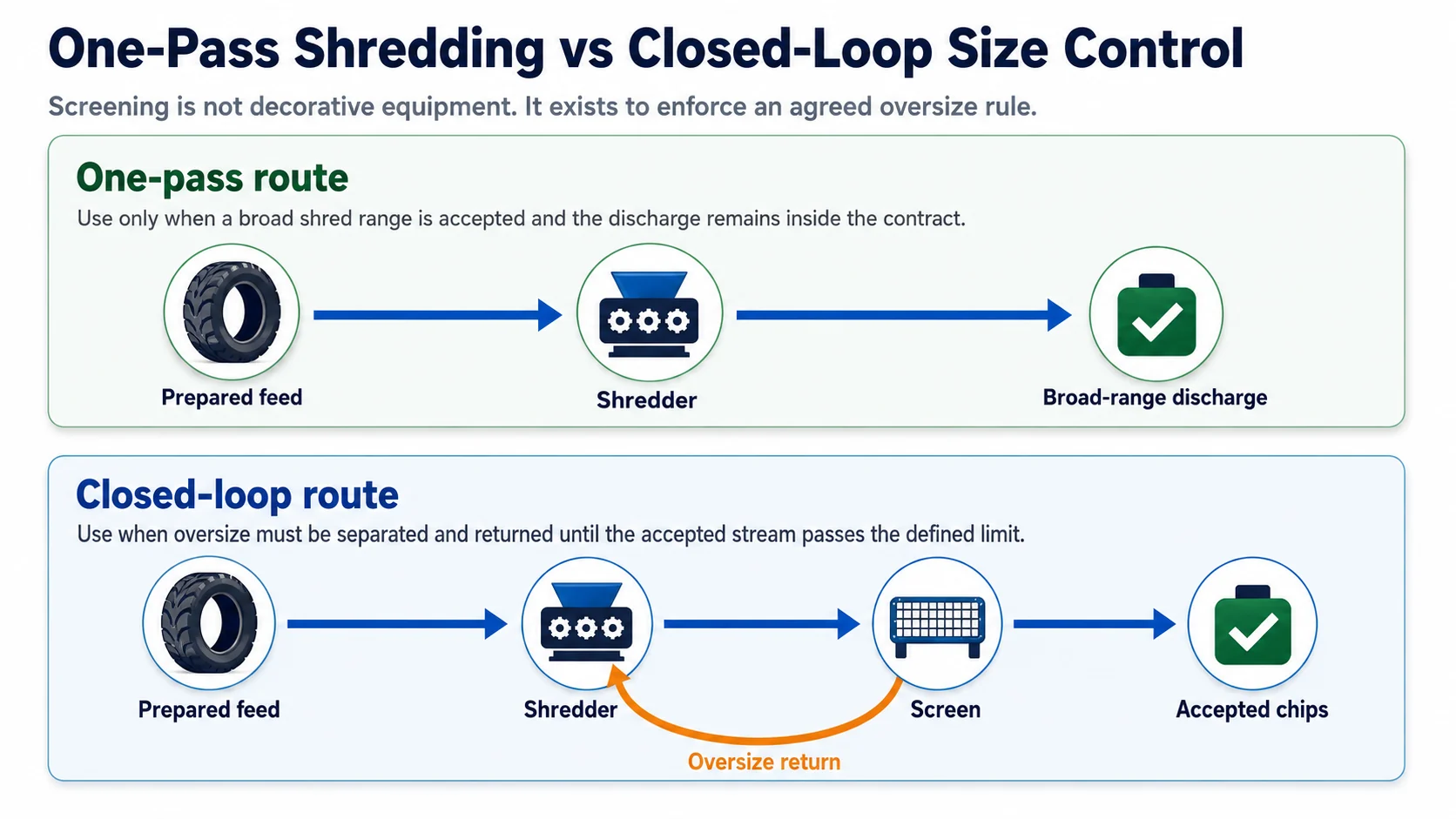
A one-pass line is simpler. Prepared tires enter the shredder and the discharge moves directly to storage or the next process. It can be appropriate where the buyer accepts a broad 50–150 mm rough-shred range, or where the output is an intermediate material rather than the final fuel product. The condition is important: the actual distribution still has to remain inside the agreed contract.
A closed-loop line adds a screen and return conveyor. This route is more controllable, but also more sensitive to the relationship between first-pass shred shape, screen opening, return load and cutter condition. If the screen rejects too much material, the loop can circulate the same pieces repeatedly and reduce saleable output. If it rejects too little, oversize reaches the finished pile.
We normally recommend that buyers ask suppliers to show both figures during a representative test: total feed entering the system and accepted product leaving after screening. Without both measurements, a quoted tons-per-hour number can hide a large circulating load.
How the Tire Mix Changes the Process Route
| Tire stream | Front-end concern | Likely process adjustment | Verification point |
|---|---|---|---|
| Passenger tires | High piece count, mixed sizes and foreign items from collection. | Inspection and stable metered feeding; direct shredding may be possible in the approved configuration. | Continuous feed rate, oversize distribution and loose-wire behavior. |
| Truck tires | More concentrated bead steel, greater mass and stronger construction. | Bead treatment and/or cutting may be added before shredding. | Shock loading, cutter wear, long-wire formation and accepted finished output. |
| Agricultural tires | Large flexible sidewalls, soil contamination and variable geometry. | Cleaning, controlled loading and pre-cutting according to diameter and stiffness. | Bridging, operator handling and material remaining inside the carcass. |
| OTR and mining tires | Very large dimensions, heavy steel construction and difficult lifting. | Dedicated bead treatment, staged sectioning and suitable loading equipment before the shredder. | Maximum approved dimensions, safe handling method and batch-specific throughput. |
| Mixed tire stream | The average feed condition changes from hour to hour. | Batching, recipe-based settings and a conservative bottleneck review. | Weighted finished output by tire mix, not a best-case short test. |
This is one reason a “universal TDF process diagram” can mislead. The broad logic remains the same, but the feed-conditioning work changes. A line designed around passenger tires should not be assumed to accept mining tires because both materials are black and circular.
Where Should Steel Removal Happen?
There is no single correct location because “steel removal” describes several different jobs. Bead treatment deals with concentrated steel before the main shredder. Magnets recover liberated ferrous material after cutting. Additional size reduction can expose more steel but also increases energy use, wear and fines. The fuel contract decides how far the process must go.
| Steel-control objective | Possible process response | What it does not guarantee |
|---|---|---|
| Reduce concentrated bead load | Debeading, bead opening or targeted bead cutting before shredding. | Removal of all steel cords from tread and sidewall pieces. |
| Reject long exposed wire | Improve cutting condition, control piece shape, inspect the stream and add suitable separation where justified. | A completely metal-free product. |
| Recover liberated ferrous material | Place an appropriately selected magnet after sufficient liberation and with controlled burden depth. | Extraction of steel still embedded inside large rubber chips. |
| Meet a low total-steel specification | Use deeper size reduction and multiple separation steps supported by sampling. | That a coarse TDF line remains the correct commercial route. |
That last row is worth attention. A buyer asking for coarse fuel chips and near-complete steel removal may be combining two incompatible expectations. The project may need deeper processing, a different product category or a revised fuel contract. It is better to identify that conflict before purchasing equipment.
Process Control Points That Matter During a Full Shift
Feed presentation
Watch whether tires enter the cutting zone consistently or bridge, bounce and require repeated manual intervention.
Reversal frequency
Automatic reversal is protective, but frequent reversals indicate unstable feed, overload or unsuitable preparation.
First-pass distribution
Sample material before the screen to understand whether the shredder is creating an efficient feed for the return loop.
Oversize return
Measure the returning mass. A hidden high recirculation ratio can consume most of the available cutting capacity.
Wire condition
Inspect long exposed strands, loose bundles and the way wire behaves at transfer points—not only total metal mass.
Blade and screen condition
Worn cutters shift the size distribution; damaged or blocked screens change what is accepted and what returns.
A factory acceptance test should state the tire mix, preparation condition, output definition, test duration, measurement points and treatment of downtime. Ten clean passenger tires filmed for a few minutes do not demonstrate a mixed-tire production shift.
Common TDF Process Mistakes
Calling every black shred a finished fuel chip
Color and general shape do not prove acceptance. The receiver needs measurable limits and a sampling method.
Installing a screen without designing the return load
The screen can expose an inefficient first-pass distribution. Conveyors, chute angles, buffer capacity and shredder loading must support the expected return stream.
Assuming bead removal means wire-free output
It does not. Bead steel and carcass steel are different process problems.
Adding every separator seen in a competitor diagram
More equipment is not automatically a better TDF process. Fiber separation, multiple magnets and secondary reduction should have a written product reason. Otherwise they add investment, wear, dust, power demand and maintenance without changing what the buyer pays for.
Quoting input capacity as finished TDF output
Finished output must be measured after oversize return, rejects and normal operating interruptions. The distinction belongs to a future capacity guide, but it cannot be ignored in the process design.
Leaving storage out of the process drawing
Open storage, water ingress, soil contamination and mixed stockpiles can undo the control achieved by the machinery. Dispatch is part of the production process.
Where the YUXI Tire TDF Plant Fits
The published YUXI Tire TDF Plant is a mechanical line for passenger, truck, OTR and mining tires. Its standard route combines bead-wire treatment, tire cutting and double-shaft shredding, with conveyors and size control selected around the receiving requirement. YUXI lists approximately 50–80 mm as a common TDF target and 50–150 mm as a broader rough-shred range; these are reference project directions, not a universal fuel standard.
The same page lists a broad 0.5–20 t/h reference capacity across different tire mixes and configurations. That range should not be copied into a project promise. The useful quotation basis is accepted finished material per hour under a stated tire mix, preparation route, output window and continuous test condition.
For a new project, the route can be discussed in four layers:
- Core preparation: inspection, bead treatment and cutting only where the tire mix requires them.
- Core reduction: the double-shaft shredder and controlled material transfer.
- Product control: screening, oversize return and steel-control options required by the fuel user.
- Evidence: representative testing, sampling, accepted-output measurement and service access review.
Commissioning: Prove the Process, Not Just the Machine
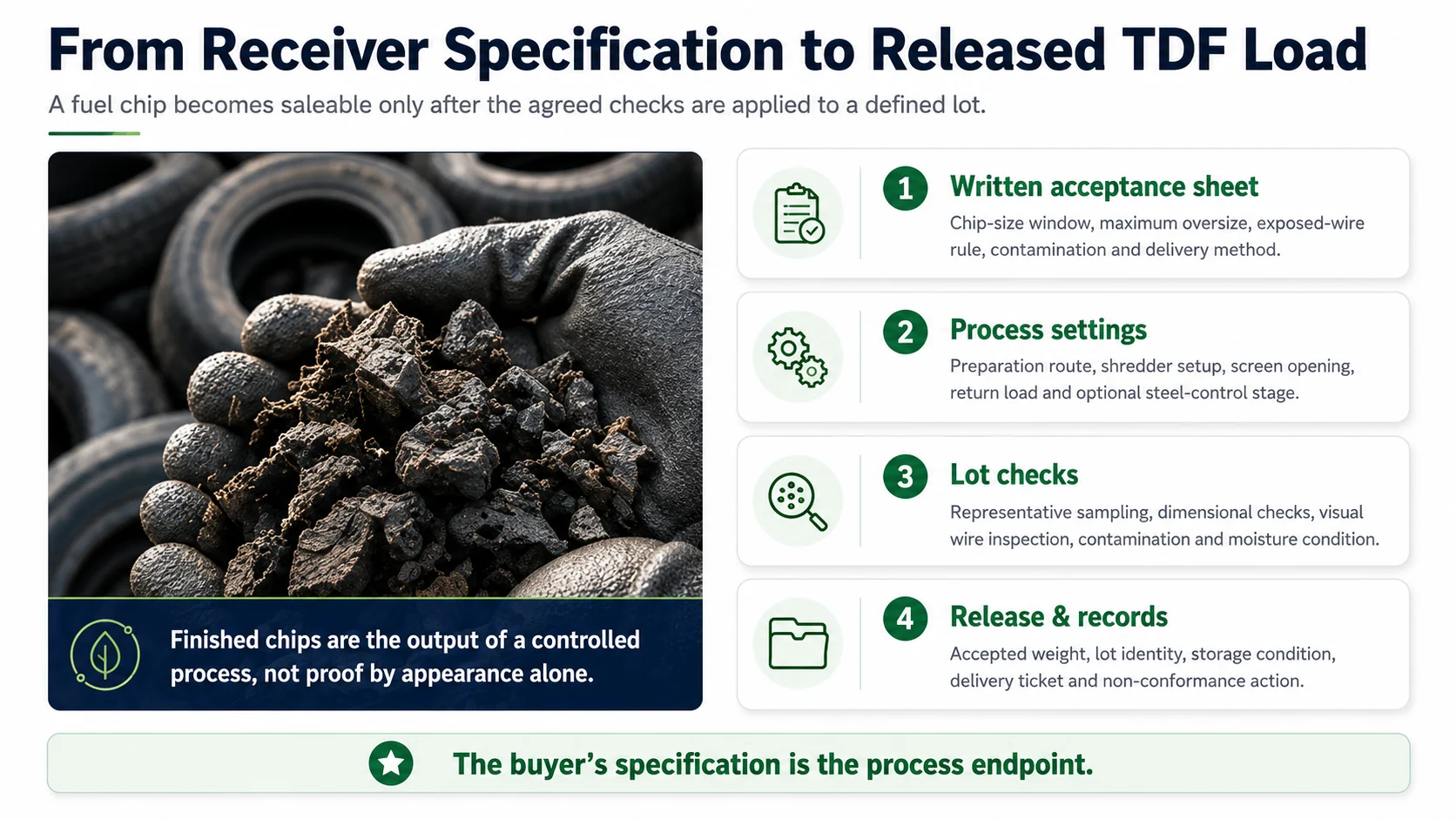
A useful commissioning run follows material from unloading to dispatch. It does not begin after the feed has already been cleaned and prepared off camera. Record what entered, which preparation steps were used, how much passed the screen, how much returned, what was rejected and how much accepted product left the line.
| Test item | Evidence to record | Why it matters |
|---|---|---|
| Representative feed | Tire categories, dimensions, percentages, preparation state and contamination. | Confirms that the test material matches the proposed project. |
| Continuous operating period | Start/stop times, all downtime, reversals, manual intervention and maintenance. | Separates steady operation from a short best-case demonstration. |
| Mass balance | Input, accepted chips, oversize return, recovered steel and rejects. | Shows where material goes and reveals hidden recirculation. |
| Physical acceptance | Defined lot, sample method, size check, oversize, exposed wire and contamination. | Connects the machine result to the fuel contract. |
| Operating condition | Motor-load trends, feed stability, screen condition and cutter condition. | Provides context for the measured output. |
| Service access | Clearing, cutter inspection, screen access, magnet cleaning and safe isolation. | Determines whether the process can be maintained over repeated shifts. |
Prepare a process-based TDF inquiry
Send YUXI the tire mix, maximum tire dimensions, required accepted chip range, oversize rule, exposed-wire limit, finished output basis, site power and proposed loading method. The engineering discussion can then separate mandatory stages from options that only tighter product control requires.
Discuss the TDF process route
Frequently Asked Questions
What is the basic TDF production process?
A practical route starts with tire inspection and feed classification, adds bead treatment or pre-cutting where the tire mix requires it, performs primary shredding, controls oversize through screening and recirculation when needed, applies the agreed steel-control step, then samples and releases the finished lot.
Do all tires need to be debeaded before TDF shredding?
No. The need depends on tire construction, shredder feeding conditions, blade-wear risk and the receiver’s steel limits. Truck, OTR and mining tires usually require more careful bead and pre-cutting decisions than a uniform passenger-tire stream.
Is magnetic separation always part of a TDF line?
No. EPA material describes metal removal as one of the main processing categories, but its depth is set by the end user’s needs. Some receivers accept embedded steel while rejecting only loose or long exposed wire; others require deeper steel reduction.
Why is a screen used after the tire shredder?
A screen separates material inside the accepted size window from oversize pieces. The oversize can return to the shredder for another pass, creating a closed loop that is more controllable than relying on a single nominal cutter opening.
Can one shredder pass make finished TDF chips?
Sometimes. A one-pass route can work when the buyer accepts a broad rough-shred distribution and the actual oversize remains within the contract. A tighter maximum-size rule usually needs screening and return handling.
What changes when the feed includes OTR or mining tires?
Maximum tire diameter, width, weight, sidewall stiffness, bead construction and handling method become much more important. Large tires may need dedicated bead treatment, staged cutting and lifting or loading equipment before the main shredder.
What should be checked before TDF chips are dispatched?
Check the defined lot against the agreed size window, oversize limit, exposed-wire rule, contamination limits, moisture or storage condition, sampling method and delivery requirements. Appearance alone is not a release test.
References and Source Notes
- U.S. EPA correspondence on processing discarded scrap tires into TDF. Used for the authoritative summary that processing consists of shredding, screening and metal removal, with the level of each set by the end user’s needs and specifications.
- ASTM D6700-19, Standard Guide for Use of Scrap Tires as Tire-Derived Fuel. Used for the fuel-recovery scope and receiver-specific engineering principle.
- U.S. EPA, Tire-Derived Fuel Frequent Questions. Used for established TDF processing and application context.
