




A recycler can make clean 10–20 mm rubber chips and still own the wrong production line for the market. The material may look finished, the steel may be largely removed, and the conveyor may be running steadily. Then the first serious buyer asks for a 1–3 mm fraction, a sieve report and a separate fiber limit.
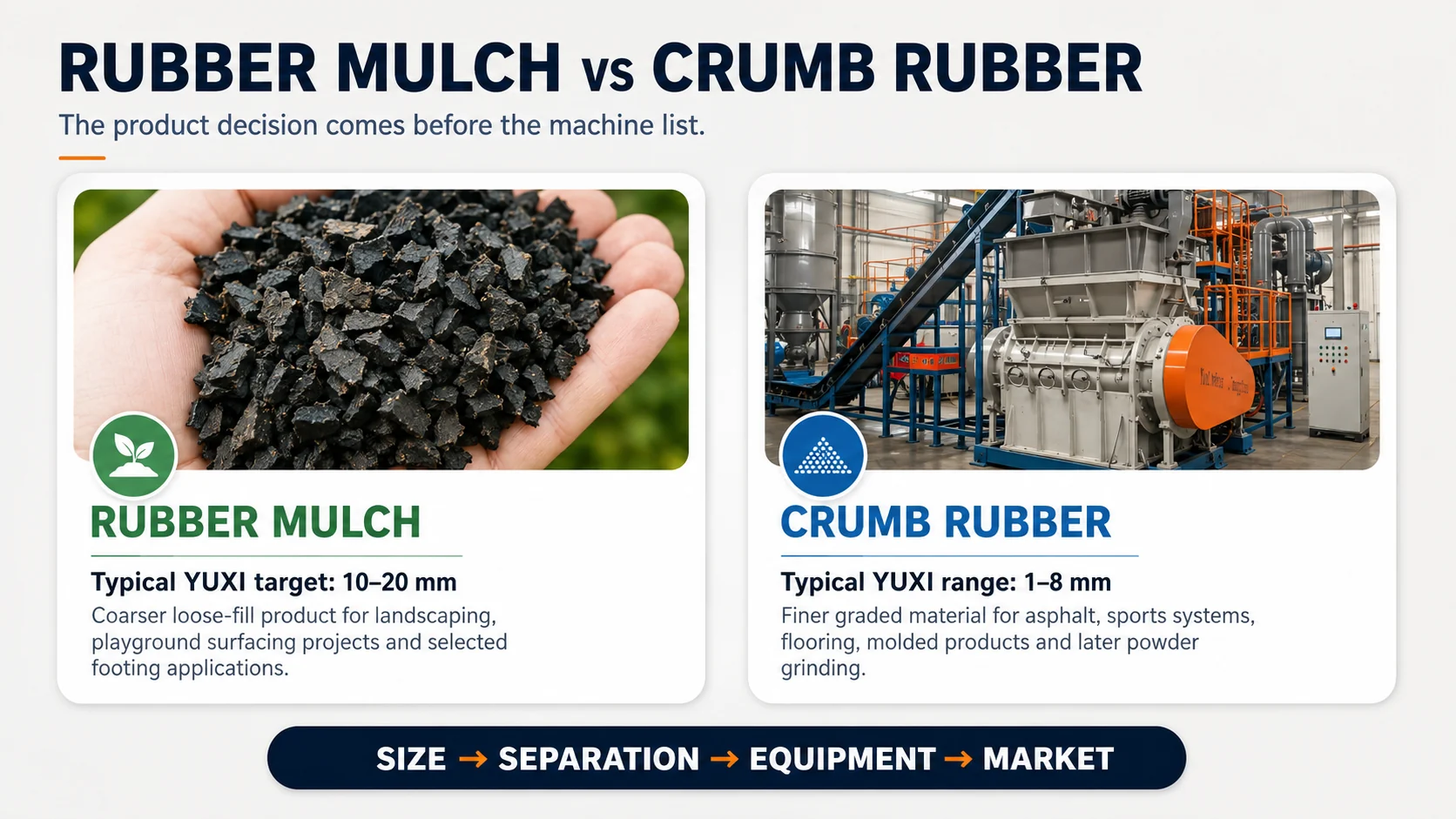
That is where the difference between rubber mulch and crumb rubber becomes commercial rather than semantic. They come from the same tire, and much of the front-end equipment can be shared. However, they are not the same output. The particle size, finishing depth, quality checks, operating cost and buyer group are different.
On This Page
Rubber Mulch and Crumb Rubber Come From the Same Tire—but Stop at Different Stages
Rubber mulch: the coarser finished or intermediate product
Rubber mulch is made after rough tire shredding, secondary rasping and steel recovery. The YUXI product direction centers on 10–20 mm material. At this size, the product still has recognizable chips or nuggets rather than a sand-like texture. Screening may tighten the range, and fiber separation can be added when the direct-use buyer requires a lower textile content.
The important point is that mulch is not merely “unfinished crumb.” It can be a legitimate finished product where the market buys loose-fill rubber. It can also be an intermediate feed for a later granulation stage. The same bag of 10–20 mm material therefore has two possible commercial roles, and the plant layout should reflect which one is intended.
Crumb rubber: finer material with a more demanding specification
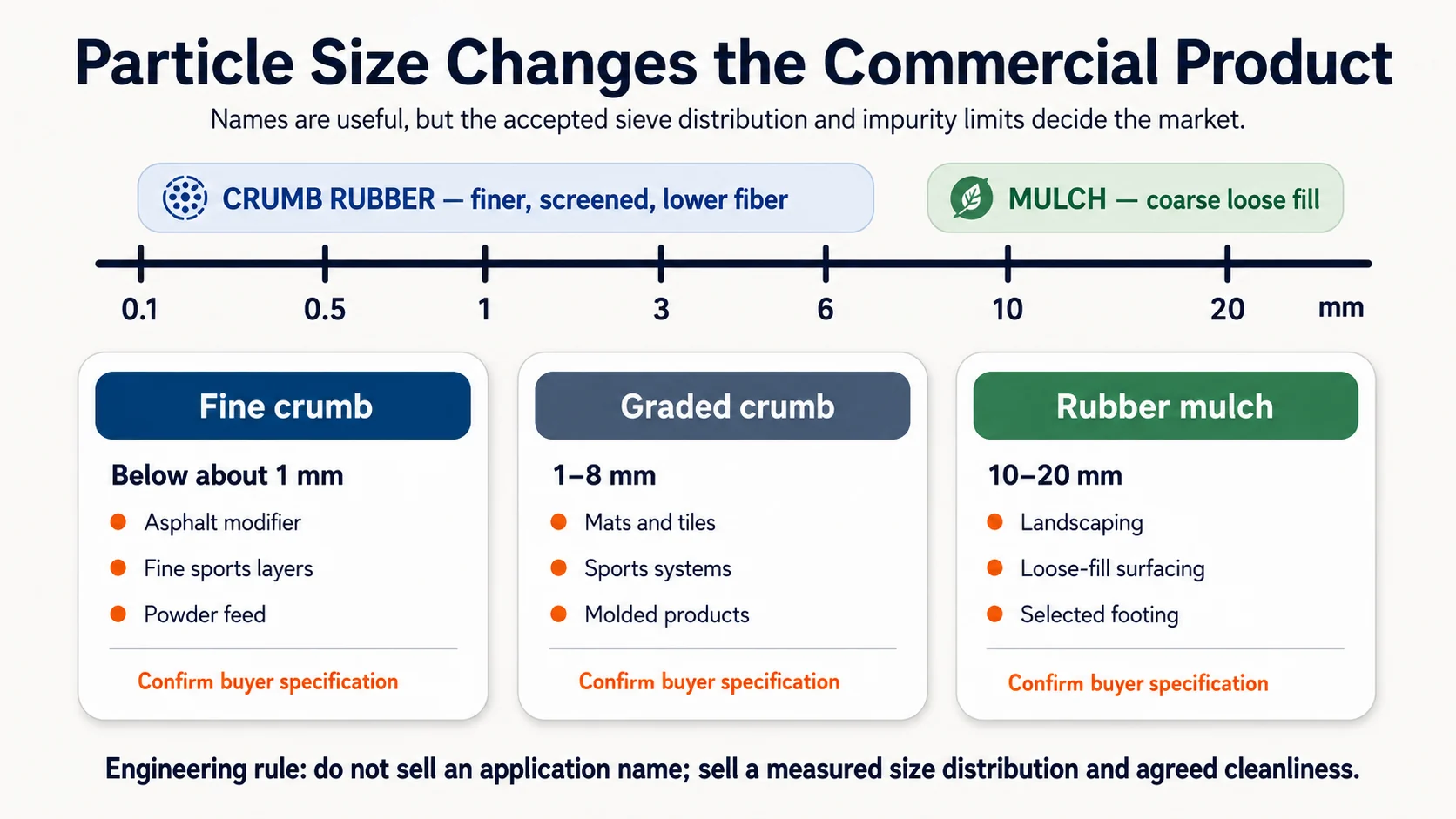
Crumb rubber is produced by reducing the clean rubber chips further and classifying them into smaller fractions. CalRecycle’s reporting definition places crumb rubber at one-quarter inch or less, which is about 6.35 mm.1 That regulatory reporting definition is useful, but individual buyers may specify 0–5 mm, 1–3 mm, 3–5 mm, mesh sizes or another distribution.
The YUXI Tire Rubber Crumb Plant uses wire-free 10–20 mm chips as a practical downstream feed and adds the stages needed for approximately 1–8 mm granules. Its product page highlights 0–5 mm as a primary finished direction, while also explaining that 1–6 mm, 1–8 mm and separated fractions can describe different plant outputs. Those numbers should never be treated as interchangeable.
Output Size: Compare the Distribution, Not One Headline Number
A nominal target such as 10 mm or 5 mm does not describe the whole product. Real material contains a distribution. A useful specification states how much product must fall inside the accepted range, how oversize is handled, whether fines are limited and how the sample is taken.
| Comparison item | Rubber mulch | Crumb rubber |
|---|---|---|
| Typical YUXI direction | 10–20 mm wire-free mulch | 1–8 mm granulator output; selected 0–5 mm or graded fractions depending on the screen setup |
| Physical appearance | Irregular chips or nuggets | Smaller granules, often classified into one or more fractions |
| Size-control equipment | Product screen and oversize return where tighter control is required | Granulator screen, grading screen, multiple collection fractions and return crushing |
| Common measurement | Agreed dimensional or sieve check, plus oversize inspection | Sieve analysis and particle-size distribution; mesh may be used for finer products |
| Fines sensitivity | Often application-specific; excessive dust can still affect handling and acceptance | Usually more important because binder demand, surface finish, flow and formulation can change |
| Typical next step | Direct sale or feed to granulation | Direct sale into a specified application or feed to fine powder grinding |
ASTM D5644 describes a method for determining the particle-size distribution of recycled vulcanized particulate rubber.2 It is not necessary for every mulch sale to use that exact method, but the engineering principle is sound: agree on the test before commissioning, not after a buyer rejects the first shipment.
Equipment Difference: Crumb Rubber Adds a Finishing Plant After the Mulch Stage
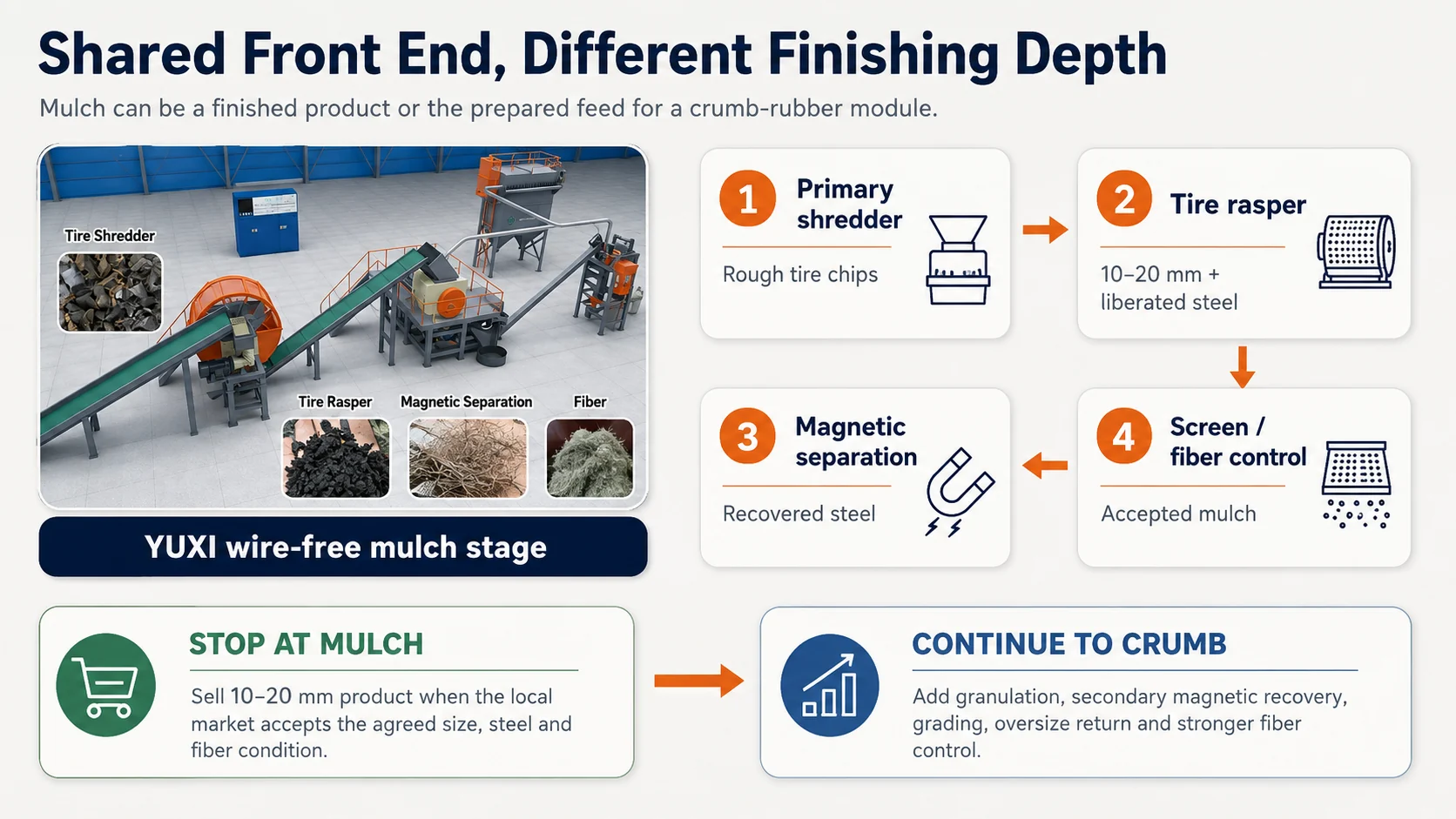
The two products share much of the front end. Whole tires still need controlled feeding and primary size reduction. The rasper still performs secondary cutting and steel liberation. Magnetic separation still depends on how well that steel has been exposed.
The difference appears after the 10–20 mm stage. A mulch line may screen and collect the product. A crumb line keeps going.
Core route for rubber mulch
- Primary tire shredder: prepares rough chips from whole or prepared tires.
- Tire rasper: cuts the rough chips to the mulch range and exposes embedded steel.
- Magnetic separation: removes liberated ferrous wire.
- Screen and oversize return: controls the accepted mulch range where required.
- Fiber handling: selected according to the direct-use market and allowed textile content.
Additional stages for crumb rubber
- Metered feed from clean mulch: keeps the granulator from alternating between starvation and overload.
- Rubber granulator: reduces 10–20 mm chips into smaller granules.
- Secondary magnetic recovery: captures smaller steel pieces released during further cutting.
- Vibrating grading screen: separates accepted fractions and sends oversize back for another pass.
- Fiber separator and dust extraction: remove loosened textile and control the finer airborne fraction.
- Product bins or packing: keep different grades separate and prevent recontamination.
The rubber mulch production guide explains the complete path to the coarser product. The decision here is whether the local market justifies adding the granulation and finishing stages beyond that point.
In practice: a granulator should not be asked to solve poor upstream preparation. Long wire, large oversize pieces and unstable feed increase knife damage, heat and recirculation. Better crumb starts with controlled mulch.
Steel, Fiber and “Purity” Become More Critical as the Product Gets Finer
Both products need steel control, but crumb buyers normally notice residual contamination more quickly. A small wire fragment hidden inside a 15 mm mulch chip may be exposed during granulation. Fine textile that was visually minor in coarse mulch can become a large, light fraction after the rubber is cut again.
Keep three measurements separate
Steel liberation
How effectively the rasper opens the rubber around embedded steel. This is a cutting-stage result.
Magnetic recovery
How effectively the magnetic system collects steel that has already been liberated. Material depth and belt settings matter.
Finished-product quality
The metal, fiber, moisture, fines and size condition in the product the customer actually receives.
The EPA describes crumb-rubber production as staged size reduction with screens returning oversize, magnets removing wire and air separators removing fabric.3 That description supports the process logic, but it should not be converted into a universal guarantee for every plant or every product size.
Why crumb often needs two magnetic opportunities
The first magnet removes steel exposed by the rasper. The granulator then cuts rubber that may still contain small embedded pieces, exposing more metal. A second magnetic stage after granulation can collect that newly released fraction. One large magnet before the granulator is not automatically equivalent to staged recovery.
Why fiber separation becomes harder at smaller sizes
Textile is light, flexible and irregular. Air separation must remove it without carrying too much valuable fine rubber into the fiber stream. Moisture, feed surges, mixed particle sizes and poor enclosure all reduce stability. A line that makes acceptable coarse mulch can therefore need stronger aspiration, grading and dust collection when it moves into crumb.
For buyers pursuing a demanding clean-granule specification, the tire rubber granule purity guide goes deeper into staged magnetic recovery, screening, recirculation and fiber separation. This comparison intentionally keeps the focus on the mulch-versus-crumb decision.
Finer Output Changes Capacity, Wear and the Cost per Saleable Ton
A common mistake is to compare the reference 0.5–10 t/h ranges on the mulch and crumb pages and assume the same machine input will deliver the same finished tonnage. It may not. The range is a project orientation, not a guarantee that every tire mix and every screen will produce an identical accepted output.
Accepted finished capacity = saleable product mass passing the agreed size and impurity checks ÷ measured net production time
Why crumb can reduce net finished throughput
Every smaller target requires more cutting events. A tighter screen sends more material back. The return conveyor handles part of the same tonnage more than once, and the granulator remains loaded even though the final-product conveyor may appear slower. A broad 1–8 mm stream and a tightly separated 1–3 mm grade should not share one capacity claim.
Why wear planning changes
The mulch stage already contains wear parts: rasper knives, screens, liners and conveyors. Crumb production adds granulator knives, closer knife-gap control, more screens, additional air-handling components and a larger fine-dust burden. The first-year budget should include sharpening, rotation, replacement, screen changes and cleaning access—not just the motor list.
Why power cannot be compared by one motor rating
A line’s real power demand includes cutting, conveyors, magnets, screens, air separation, dust extraction and recirculation. More motor power does not prove higher accepted output. A better comparison uses representative feed, the exact product grade, continuous runtime and total line energy measured during the acceptance test.
Quotation rule: Ask each supplier to state whether capacity is measured at whole-tire infeed, rasper infeed, granulator infeed, broad mixed output or accepted packed product. Blank definitions are not minor details; they are the main reason two offers cannot be compared.
Markets: Mulch Is Usually a Loose-Fill Product; Crumb Enters Formulated Systems
Particle size opens a market, but it does not guarantee a sale. The same nominal crumb can be accepted by one asphalt technology provider and rejected by another because of gradation, moisture or fiber. The same mulch can suit landscaping and fail a playground specification because the project requires documented impact performance and tramp-metal limits.
| Market direction | More natural product fit | What the buyer should specify | Main plant consequence |
|---|---|---|---|
| Landscaping and decorative ground cover | Rubber mulch | Chip range, color or coating if used, visible wire, textile condition, packaging | Mulch screening, steel recovery and consistent presentation |
| Loose-fill playground surfacing | Rubber mulch designed and tested for the project | Applicable impact, particle-size, metal, installation and maintenance requirements | Documented product testing and tight control of tramp metal |
| Horse arena or selected footing | Often mulch or a specified coarse granulate | Particle shape, size, steel/fiber, dust, drainage and blend requirements | Application-specific screening and cleanliness |
| Rubber tiles, mats and molded products | Graded crumb rubber | Fraction, fines, fiber, bulk density, moisture and binder compatibility | Granulation, grading, fiber control and separate bins |
| Sports and impact surface systems | Specified crumb or system-approved granulate | Permitted material, size, performance documentation and local regulation | Consistent grading and quality records |
| Rubber-modified asphalt | Crumb or finer ground tire rubber | Process-specific particle size, gradation, moisture, steel/fiber and supply consistency | Fine grinding may be required beyond a standard crumb plant |
| Rubber powder and compounding feed | Fine ground rubber | Mesh, heat history, contamination, moisture and formulation compatibility | Separate fine-grinding stage after clean crumb |
ASTM F3012 covers test methods and performance requirements for loose-fill rubber intended for playground surfacing, including particle-size distribution, metals and tramp metal; it also notes that impact attenuation is addressed through related standards.4 The CPSC likewise treats rubber mulch as a loose-fill surfacing material and advises that installation and maintenance conditions matter.5 A recycling-line supplier can prepare material to an agreed specification, but the project designer and local authority determine whether the product is approved for a particular playground.
For asphalt, FHWA references crumb-rubber particle sizes from sub-millimeter material to several millimeters depending on the process.6 This is why “crumb rubber for asphalt” is incomplete RFQ wording. The asphalt process provider must define the actual grade.
When Should a Plant Stop at Rubber Mulch?
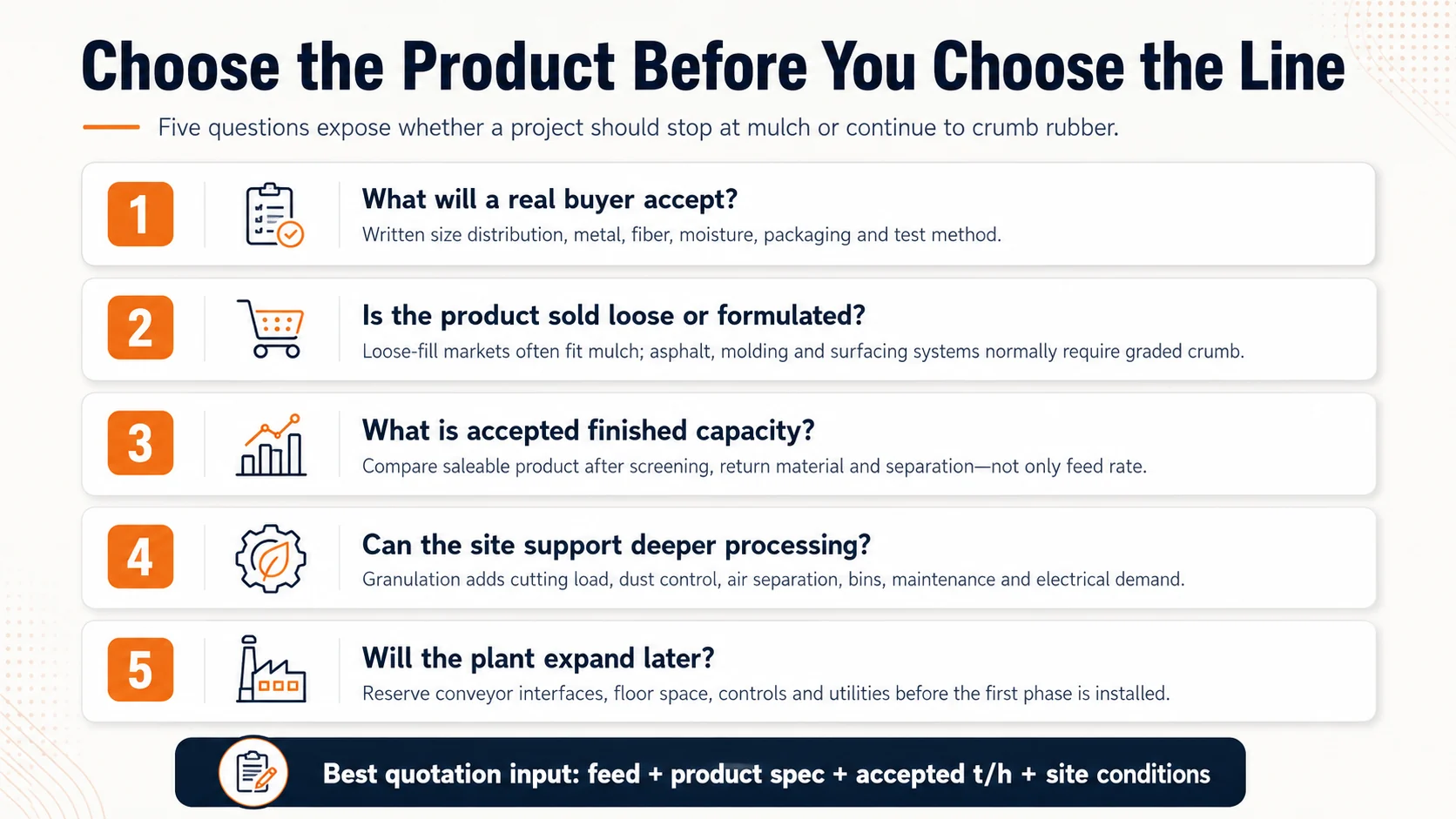
Stopping at mulch is often the stronger decision when the local buyer wants a coarse loose-fill product, the plant needs a simpler first phase, or the recycler already has a dependable sales channel for 10–20 mm material.
- A verified local buyer accepts the proposed mulch size and cleanliness.
- The project wants fewer finishing machines and a simpler quality-control routine.
- Transport and packaging economics favor regional bulk sales.
- The expected price premium for crumb does not cover granulation, energy, wear, dust control and rejection risk.
- The site plans to add crumb later but needs to begin with a commercially useful first product.
When Does Crumb Rubber Make More Sense?
Crumb is justified when a buyer needs a smaller controlled fraction and the recycler can consistently meet the full specification, not only the maximum particle size.
- An asphalt, flooring, molding or sports-surface customer has supplied a written grade.
- The expected annual sales volume supports the extra finishing line and quality testing.
- The site can manage finer dust, fiber extraction, product segregation and additional maintenance.
- The acceptance test measures finished grade throughput after recirculation.
- The plant has a plan for off-spec material, fines, recovered steel and textile residue.
Surprisingly, finer is not automatically better. A plant can spend more to make a product that is harder to sell. The strongest project starts with buyer samples and specifications, then works backward to the machine configuration.
A Modular Line Can Sell Mulch First and Add Crumb Later
The most flexible project is not necessarily the largest initial line. A recycler may install the complete mulch stage, establish tire supply and local operations, then add a crumb module after securing a technical buyer. That sequence reduces market risk, but only when the first layout reserves the correct interfaces.
Reserve these items in phase one
- Discharge height and conveyor connection from the mulch collection point to the future granulator.
- Floor area and maintenance clearance for granulation, grading, magnets and fiber separation.
- Electrical capacity, control-cabinet space and spare PLC inputs and outputs.
- Dust-extraction route, filter location, fire planning and housekeeping access.
- Separate bins or packaging points for multiple crumb grades.
- Structural loading, foundations and safe service access.
“Expandable” should appear as drawings and interface data, not only as a sales phrase. Ask for the future feed elevation, conveyor width, motor allowance, cable route, control signals and reserved footprint. Otherwise, the second phase may require moving the first line.
RFQ Checklist: Send Product Information Before Asking for a Machine List
| RFQ item | Information to provide | Why it matters |
|---|---|---|
| Feedstock | Passenger, truck and other tire percentages; maximum size; dirt, water and foreign material | Determines front-end duty, steel load and wear |
| Starting point | Whole tires, rough shreds or 10–20 mm wire-free chips | Defines whether the quote includes the mulch stage or only crumb finishing |
| Finished product | Mulch range or crumb fractions; oversize and fines limits | Determines screens, return load and collection bins |
| Impurity limits | Separate metal, fiber, moisture and other contamination limits | Determines magnetic, air and dust-control depth |
| Capacity basis | Accepted finished t/h at the exact grade and tire mix | Prevents feed-rate and product-rate confusion |
| Market documentation | Buyer specification, sample, test report or application standard | Stops the plant from producing a generic unsold grade |
| Site data | Layout, height, power, utilities, climate, loading and storage | Defines conveyors, extraction, controls and installation scope |
| Expansion plan | Future crumb fractions or rubber powder target | Allows interfaces and utilities to be reserved |
Factory acceptance test for mulch
- Approve representative tire or chip feed.
- Run continuously for an agreed measurement period.
- Weigh only accepted product, excluding oversize return, steel, fiber and rejects.
- Check the agreed 10–20 mm distribution and oversize rule.
- Inspect final visible steel and textile condition using a written sampling method.
Factory acceptance test for crumb
- Approve the incoming mulch size and residual contamination.
- Measure accepted output separately for each promised fraction.
- Record return-material load and any product blended between grades.
- Run sieve analysis and separate metal, fiber, moisture and fines checks.
- Review granulator temperature, knife access, magnet cleaning, fiber loss and dust capture.
We normally recommend retaining labeled samples from the feed, accepted product and rejected fractions. Photographs and weights make the test basis much easier to understand during site commissioning.
Common Buying Mistakes
1. Treating every black rubber particle as the same product
Appearance is not specification. A buyer may reject material because the distribution is too broad, even when the average size looks correct.
2. Assuming a primary shredder makes crumb
The shredder prepares rough feed. Rasping, magnetic separation, granulation, grading and fiber removal perform different jobs. One machine cannot credibly replace the complete chain.
3. Using “99% purity” without defining the impurity
Metal, textile, moisture and fines should be measured separately. Steel liberation at the rasper is not the same as final crumb cleanliness.
4. Comparing broad-range capacity with narrow-grade capacity
A line may produce a high total flow across several fractions but much less of the one fraction the buyer wants. Ask for the accepted tonnage of the saleable grade.
5. Choosing crumb before finding a crumb buyer
More equipment does not create demand. Obtain the buyer’s grade, annual volume, packaging, test method and rejection rules first.
6. Ignoring the value of a staged investment
A mulch-first project can be sensible when the line is designed for expansion. It is risky when the future crumb module has no reserved space, power or material interface.
Frequently Asked Questions
What is the main difference between rubber mulch and crumb rubber?
Rubber mulch is a coarser tire-derived product, commonly around 10–20 mm in the YUXI wire-free mulch process. Crumb rubber is finer and more tightly graded, commonly 1–8 mm for granulator output, with some applications requiring still finer material. The finer product needs additional granulation, screening, magnetic recovery and fiber separation.
Can one tire shredder make finished crumb rubber?
No. A primary tire shredder normally prepares rough chips. Finished crumb rubber requires downstream steel liberation, magnetic separation, granulation, screening, oversize return and textile-fiber control. Fine powder requires another grinding stage.
Is crumb rubber always more valuable than rubber mulch?
No. Value depends on a real local buyer, the accepted specification, packaging, transport, operating cost and rejection risk. Finer processing can open more technical markets, but it also adds equipment, wear, dust control, screening and quality-control requirements.
Can 10–20 mm rubber mulch feed a crumb rubber plant later?
Yes. Wire-free mulch can be used as prepared feed for a downstream crumb-rubber module when its size, residual steel, textile content and feed consistency match the granulator design. The first phase should reserve floor space, conveyors, electrical capacity and control interfaces for the expansion.
How should capacity be compared between the two products?
Compare accepted finished-product tons per hour at the exact size and cleanliness specification. Do not compare whole-tire feed rate for a mulch line with granulator feed rate or broad-range output for a crumb plant.
Which product is better for playground projects?
That depends on the surface system and written project specification. Loose-fill rubber mulch and crumb-rubber-containing systems are different products. The supplier must confirm particle size, impact-performance requirements, metal and other quality limits, installation depth and applicable local standards with the project designer or authority.
Sources and Engineering References
- CalRecycle, RDRS Material Type List. Defines crumb rubber in the reporting system as tire-derived rubber one-quarter inch or less in size.
- ASTM D5644, Determination of Particle Size Distribution of Recycled Vulcanizate Particulate Rubber. Particle-size test method reference.
- U.S. EPA, Tire Crumb Questions and Answers. Describes staged size reduction, screening, magnetic removal and air separation used in tire crumb production.
- ASTM F3012-22, Loose-Fill Rubber for Playground Safety Surfacing. Covers particle-size, metal and related performance requirements for the specified product category.
- U.S. Consumer Product Safety Commission, Crumb Rubber Safety Information Center. Federal information and practical precautions related to recycled tire rubber surfacing.
- Federal Highway Administration, Scrap Tires—Material Description. Describes crumb-rubber size ranges and mechanical processing methods used for asphalt and related applications.
- U.S. Tire Manufacturers Association, 2023 End-of-Life Tire Management Report. Identifies ground-rubber markets including rubber-modified asphalt, athletic fields, automotive and industrial uses.
Configure the Line Around the Product You Can Sell
Send your tire mix, starting material, target mulch or crumb size, impurity limits, accepted finished capacity, buyer specification, site layout and future expansion plan. YUXI can separate the shared front end from the finishing stages your market actually requires.