




Passenger, truck and OTR tires can all become rubber mulch, but they should not be treated as the same incoming material. Tire size, reinforcement, handling and preparation change the front end long before the product reaches a 10–20 mm screen.
A buyer once sent us a feed description that said only “waste tires.” The photos told a different story: stacks of passenger tires, several all-steel truck tires and a few large earthmover tires were expected to enter the same line. On paper that was one raw material. At the machine, it was three different loading problems.
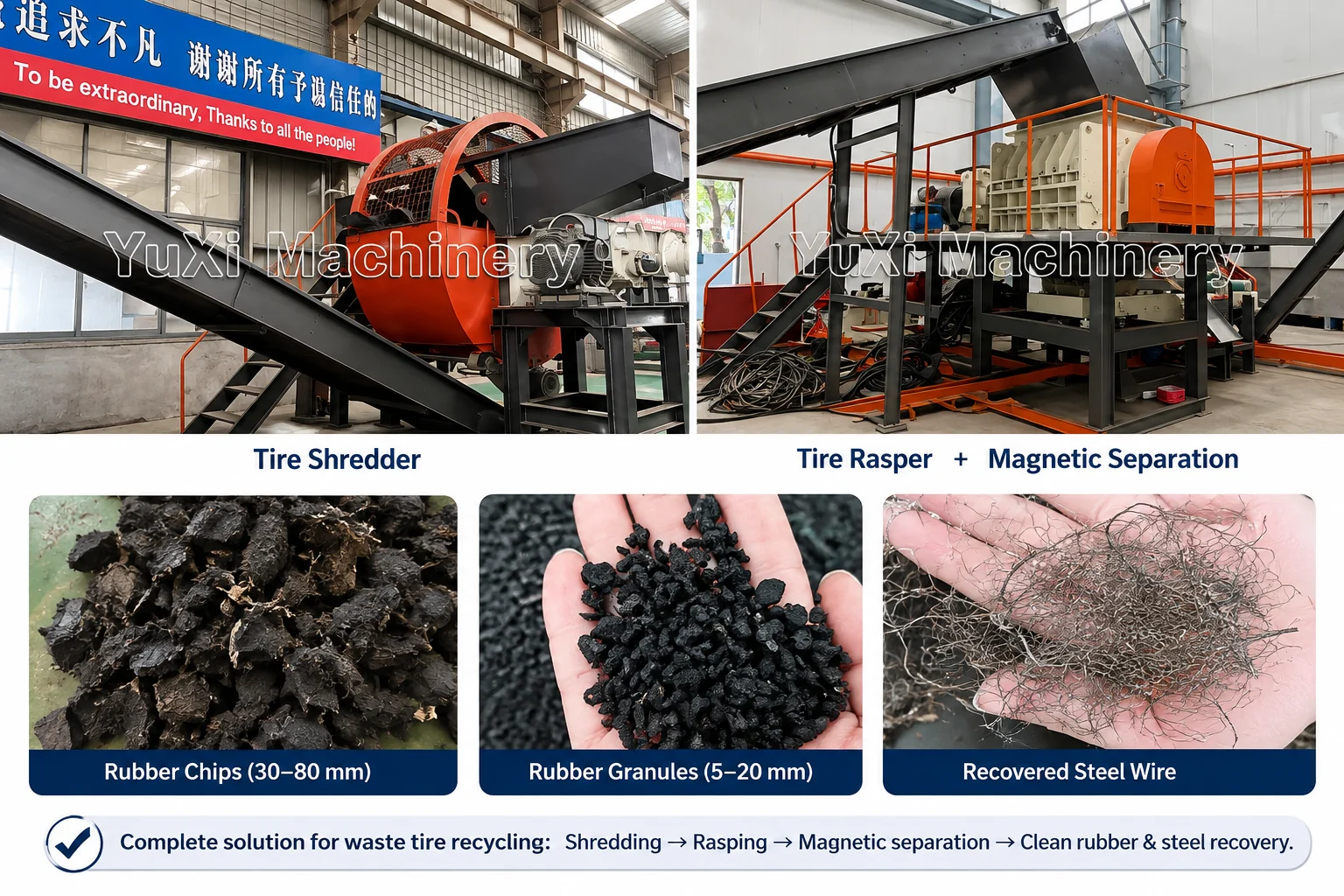
That distinction matters in rubber mulch production because the finished product is made after several mechanical handoffs. Whole tires must first become stable shredder feed. Rough shreds must become a consistent rasper feed. The rasper must cut deeply enough to expose reinforcement, and the magnetic and fiber-control stages must deal with what that tire construction releases. A line that looks comfortable on passenger tires can behave very differently when the same hourly target is suddenly filled with truck tires or oversized OTR sections.
Can Passenger, Truck and OTR Tires All Make Rubber Mulch?
Yes, but not under one universal process assumption. Passenger tires are usually the simplest whole-tire feed for a properly sized recycling line. Truck tires increase weight, stiffness and reinforcement duty. Large OTR tires often need a separate handling and pre-cutting route before they are suitable for primary shredding.
The final product can still be controlled around a 10–20 mm mulch direction, but quotation capacity should identify the tire family used in the test. For mixed feed, record the mix by weight and confirm accepted finished mulch rather than relying on a single-machine feed-rate number.
Passenger vs Truck vs OTR Tires: The Processing Difference
| Feedstock | Typical front-end behavior | Main engineering concern | Practical route toward mulch |
|---|---|---|---|
| Passenger tires | More uniform size and lower individual mass | Stable whole-tire feeding, bead condition, mixed contaminants | Inspection → direct shredding when approved → rasper → steel/fiber control |
| Truck / bus tires | Larger, heavier and more heavily reinforced | Torque demand, bead/steel load, feeding shocks and wear | Inspection → bead treatment as needed → heavy-duty shredding → rasper → stronger separation duty |
| OTR / mining tires | Very wide variation in diameter, width, mass and construction | Handling, lifting, support, pre-cutting and safe feed envelope | Project-specific opening/pre-cutting → controlled sections → shredding → mulch stages |
A tire family name does not provide enough data to assign a universal tons-per-hour value. A “truck tire” stream can range from relatively uniform commercial casings to mixed bus and heavy-service tires. OTR is broader still. The machine specification should therefore define the largest tire, the normal production mix and the preparation state before it enters each process boundary.
Passenger Tires: Usually the Easiest Baseline—But Still a Real Tire
Passenger tires are often the most convenient baseline for a whole-tire rubber mulch project because the individual pieces are relatively easy to store, convey and meter into a suitably sized primary shredder. That does not make them “rubber only.” Steel belts, bead wire and textile reinforcement remain built into the casing, and road debris or foreign metal can still arrive with the feed.
From a production point of view, the main advantage is consistency. If a plant receives a well-defined passenger-tire stream, operators can establish a repeatable feeding rhythm and a stable rough-shred condition. That gives the rasper a more predictable burden and makes screen-return trends easier to interpret. When blade wear, throughput or steel carryover changes, the team has a cleaner baseline for diagnosis.
The common mistake is to prove a line with easy passenger tires and then quote the same accepted output for a heavier mixed stream. A test is only transferable when the real feed is comparable. If truck tires will represent 40% of annual incoming tonnage, they belong in the acceptance basis rather than in a footnote.
Truck Tires: More Rubber per Piece, but More Work per Piece
Truck and bus tires normally shift the operating problem from simple feeding toward heavier-duty cutting. YUXI’s current tire shredder information notes that truck tires have thicker rubber and stronger wire and therefore require a heavy-duty configuration with stable feeding. In practice, that additional reinforcement affects more than the primary shredder. It follows the material downstream.
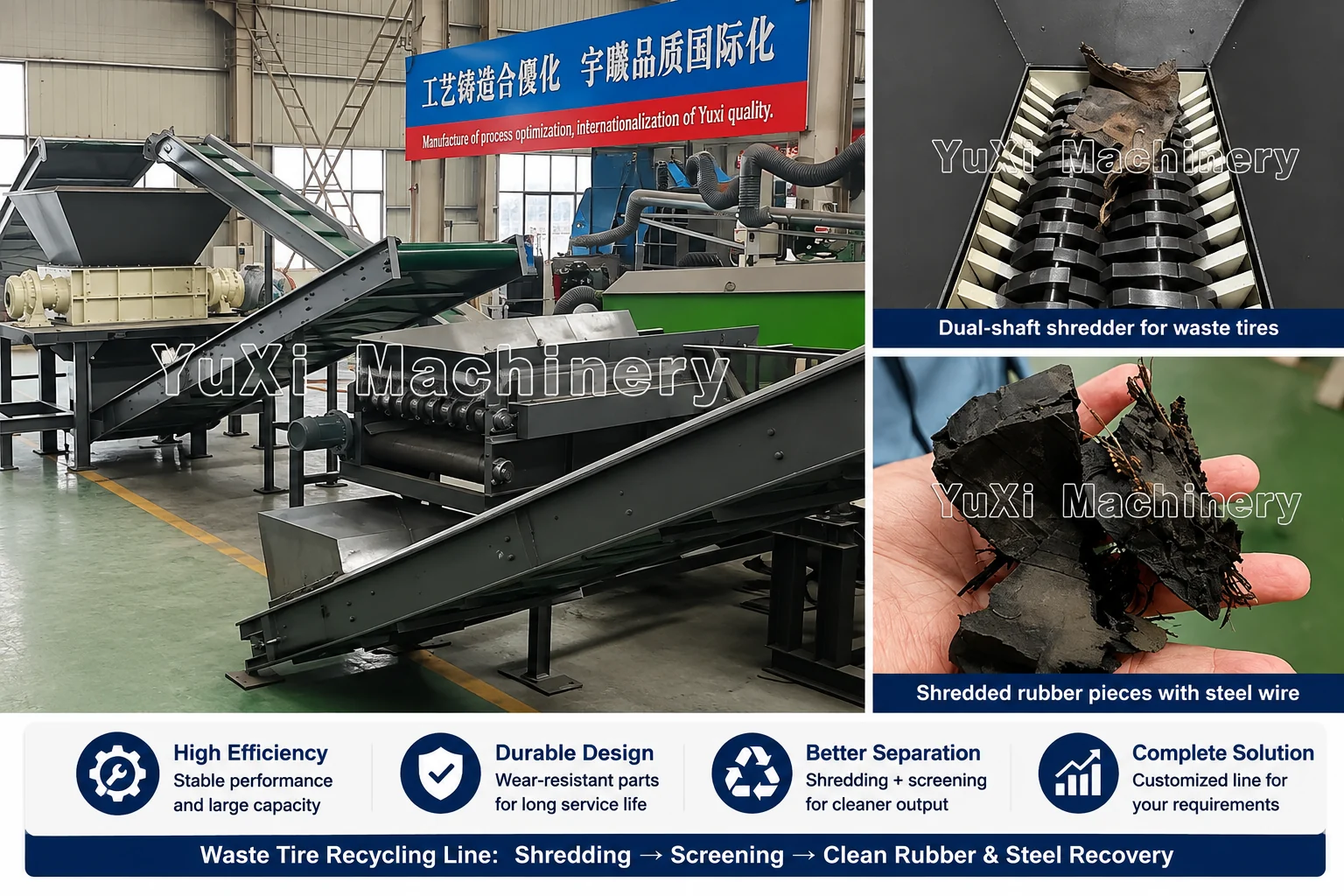
A heavier reinforced chip can demand more cutting work from the rasper before enough steel is exposed for magnetic recovery. That may increase motor load, reduce instantaneous throughput or increase the proportion of material returning through the screen. If operators compensate by overfeeding, the result can be the opposite of what they want: a deeper burden at the magnet, more uneven cutting and more visible defects in the accepted product.
Truck tires also make bead strategy more important. There is no rule that every project must remove every bead before cutting or shredding, but the decision should be explicit. If the bead package produces shock load, unstable feeding or concentrated steel that is expensive to carry through the cutting system, pre-treatment can be justified. The existing guide on whether to remove tire beads before cutting covers that sequence decision in more detail.
For capacity comparisons, use the tire mix that will actually be purchased. A supplier who quotes the same t/h figure for passenger tires and all-steel truck tires without explaining the test basis has not yet provided enough information for a commercial comparison.
OTR Tires: Treat Them as a Material-Handling Project First
Large off-the-road tires are where generic “whole tire” language becomes most dangerous. OTR tires serve mining, quarry, construction and industrial equipment, and their dimensions vary dramatically across applications. Bridgestone, for example, lists certain earthmover tire sizes with overall diameters from about 2.85 m to more than 3.5 m. Those examples are not a universal OTR size range; they simply show why the category cannot be reduced to one feed dimension.
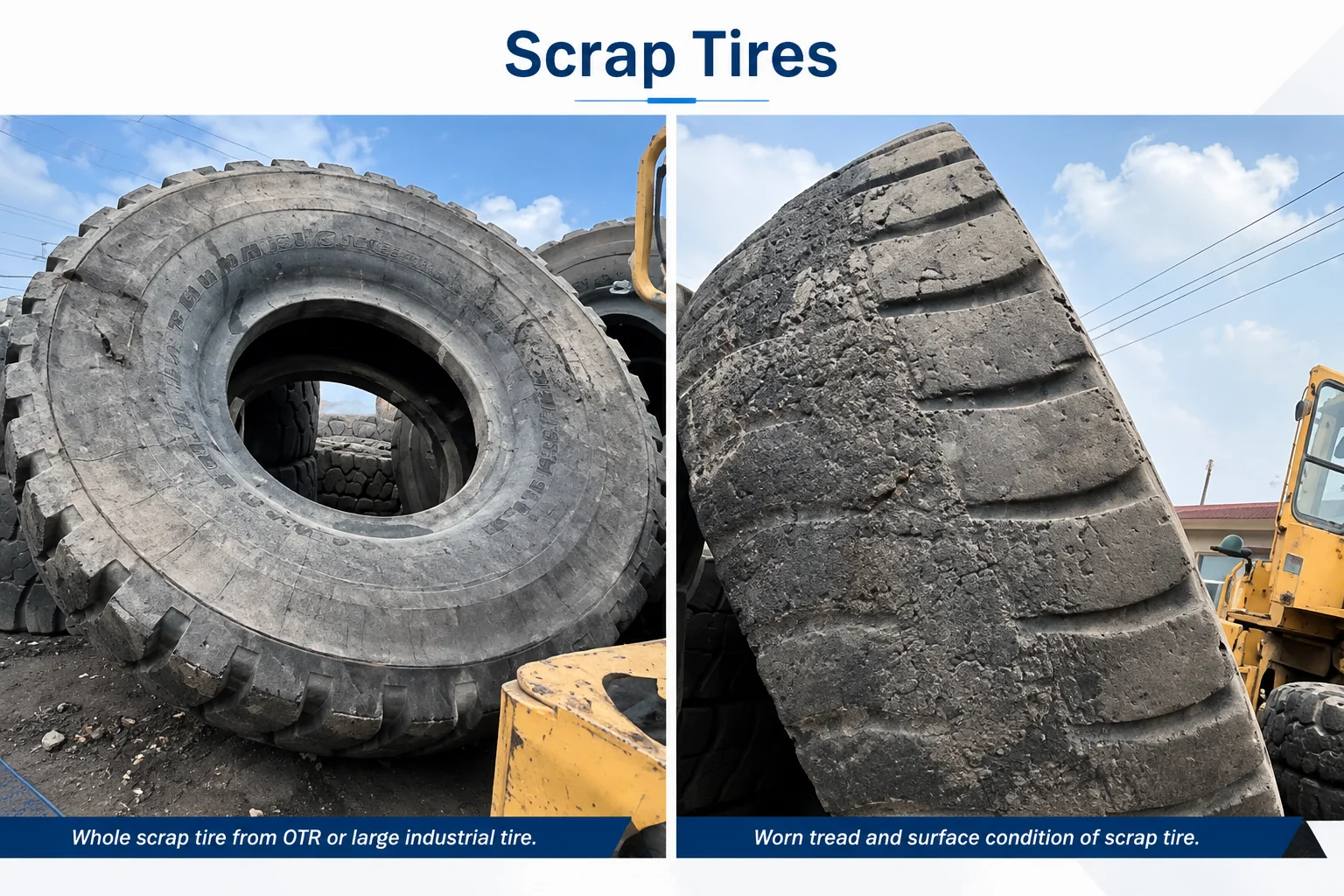
For this reason, the first OTR question is not “Can the rasper process it?” The rasper should never receive a whole earthmover tire. The question is how the tire will be converted into a repeatable section or chip that the primary shredder and then the rasper can accept. That involves tire weight, outer diameter, width, stiffness, steel distribution, deformation, loading equipment, operator position and the required cut path.
YUXI’s hydraulic tire cutting information positions pre-cutting specifically for truck, agricultural and OTR tires that are too heavy or too stiff for stable direct feeding. The more detailed hydraulic tire cutting guide explains why support, clamping, repositioning and discharge are part of the full cycle rather than incidental handling.
An OTR rubber mulch project should therefore be quoted in two linked scopes. The first scope proves that the incoming tire can be safely and consistently turned into shredder-ready sections. The second proves that those sections can pass through primary shredding, rasping, separation and screening at the required accepted output. Skipping the first scope creates a paper capacity that may not exist on the plant floor.
Why Tire Construction Changes Cutting and Separation
Different tire families are engineered for different loads, operating temperatures and service conditions, so their internal reinforcement is not identical. An older Rubber Manufacturers Association dataset reproduced in a USTMA assessment is useful as an illustration: it shows different body-cord and steel/fiber patterns for passenger and truck tires and much higher average tire mass for truck tires in the dataset. Those figures are historical and should not be copied into a modern equipment guarantee, but they support the engineering point that “one tire” is not one material package.
For the recycling line, reinforcement appears as four practical variables:
- Cutting resistance: thicker rubber and stronger reinforcement increase the work required to create a clean fracture or shear path.
- Steel liberation duty: more reinforcement can mean more material must be opened before magnets can recover wire effectively.
- Recovered-steel load: magnets, chutes and collection areas must handle the amount and shape of released wire without excessive entanglement.
- Wear exposure: bead wire, belt wire, foreign metal and unstable feed all influence blade and screen condition over a shift.
This is why a magnet cannot correct every steel problem. If wire is still buried in thick rubber, the magnetic separator has nothing accessible to pull away. Likewise, increasing magnet duty does not solve an unstable rasper feed that produces a wide chip-size distribution.
Choose Pre-Treatment by the Tire, Not by Habit
| Condition | Direct whole-tire shredding | Bead treatment | Hydraulic pre-cutting |
|---|---|---|---|
| Uniform passenger tires within the approved chamber/feed envelope | Often practical | Optional according to wear and steel-control strategy | Usually unnecessary |
| Truck tires matched to a heavy-duty shredder | May be practical | Often worth evaluating | Useful when diameter, stiffness or handling makes direct feed unstable |
| Large, irregular or heavy OTR tires | Rarely the default assumption | Project-specific | Commonly part of the preparation route |
| Unknown mixed stockpile | Do not assume | Inspect and segregate first | Reserve a route for oversize pieces |
The best preprocessing route is the one that produces a stable next-machine feed at acceptable total cost and risk. Removing a bead can reduce concentrated steel duty but adds another loading and discharge step. Cutting an OTR tire improves feedability but also creates a material-handling cell that must be sized for the tire, not just for the cutter stroke. Direct shredding eliminates pre-treatment equipment but can transfer more wear and shock load to the shredder.
Procurement rule: compare complete routes on accepted finished mulch, not only on how fast the first machine touches the tire.
Mixed Tire Streams: Capacity Must Be Weighted by the Real Feed
Most commercial recyclers do not receive one perfect tire family all year. A realistic stream may include passenger tires during one week, heavier truck casings the next and occasional oversize units that require separate handling. The engineering problem is not the existence of variation. It is allowing that variation to remain undocumented.
The YUXI Tire Wire Free Mulch Plant states a reference line range of 0.5–10 t/h, while also noting that passenger tires, truck tires and whole-tire versus chip-feed routes do not load the line in the same way. The practical way to use a capacity number is therefore to attach a feed basis to it.
For example, an acceptance plan might state that the test feed will be 60% passenger and 40% truck tires by mass, with all tires inside an agreed dimension range and with the bead condition recorded. That is much stronger than “mixed tires.” If OTR tires are part of routine production, their prepared section size and percentage should be listed separately because their front-end cycle may become the dominant constraint.
For more detailed capacity normalization—especially the difference between incoming feed, single-machine throughput and accepted finished mulch—use the rubber mulch production line capacity guide.
What Changes at the Rasper, Magnet and Screen?
By the time different tire families reach the rasper, they should already have been converted into a controlled rough-chip envelope. That does not erase their history. A truck-rich stream may still contain heavier reinforcement and thicker pieces than a passenger-rich stream, and poor OTR preparation can introduce unusually thick sections that disturb the secondary cutting stage.
Watch the following trends when the feed mix changes:
- Rasper motor load and feed rhythm: repeated spikes can indicate that the incoming chips are too large, too thick or too heavily reinforced for the current setting.
- Oversize return rate: a rising return loop means more cutting work is required to reach the accepted size.
- Steel condition after rasping: long exposed wire, embedded wire and loose recovered wire are different observations and should be recorded separately.
- Magnet burden depth: a thicker, uneven material layer can hide released steel and reduce effective recovery.
- Screen condition: wear or blockage changes the apparent product distribution and can disguise a feed-related problem.
If the target is a tight 10–20 mm fraction, the screen and return system deserve the same attention as the primary machine. The 10–20 mm rubber mulch size-control guide explains why a screen opening alone does not guarantee the whole finished distribution.
The Finished Product Specification Does Not Care Which Tire Was Easier
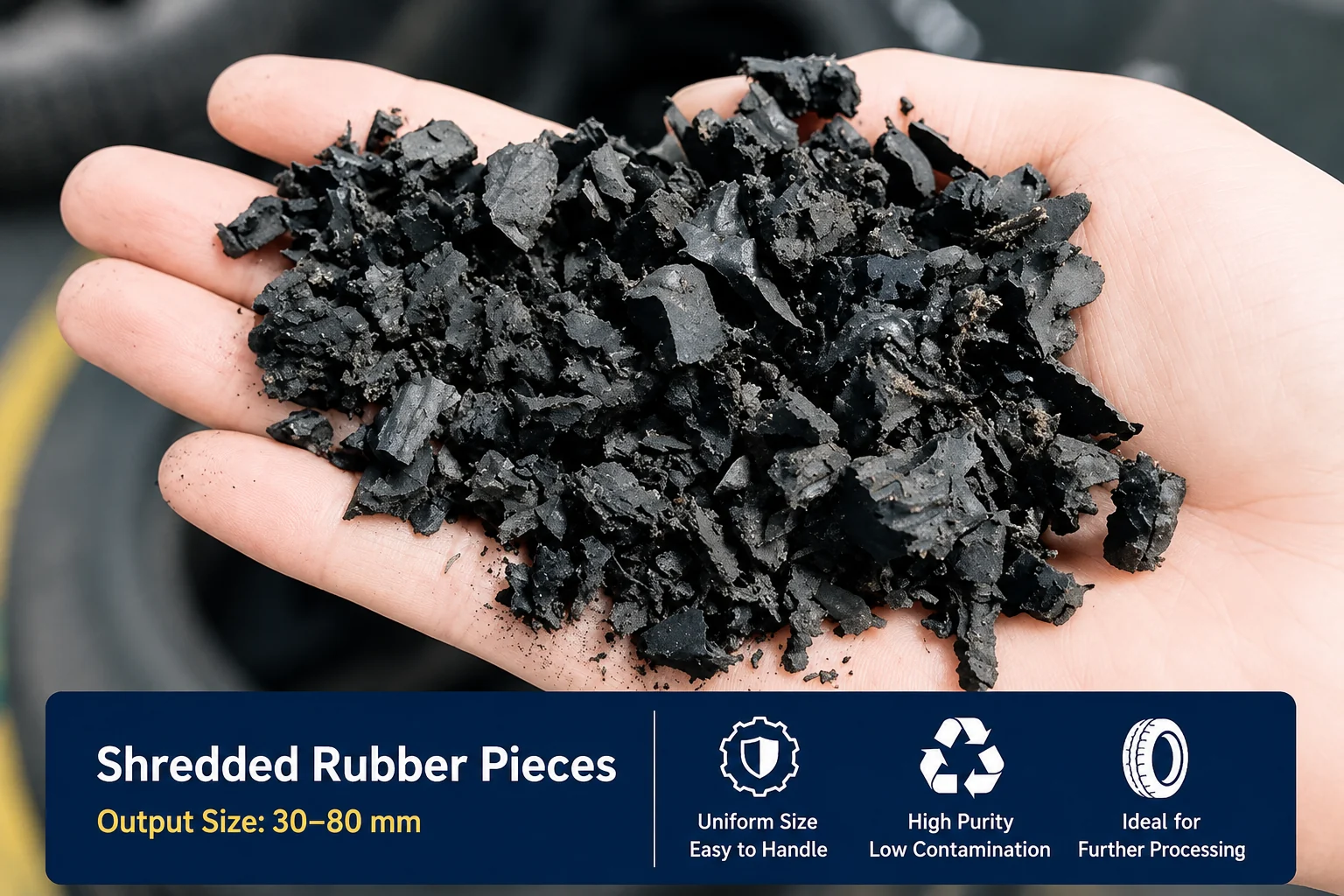
Feedstock changes the work required to make the product; it does not excuse a weak product definition. Landscaping mulch, equestrian material, a downstream crumb-rubber feed and playground surfacing can all have different expectations for size, visible metal, loose textile, fines, color, coating and documentation.
This is especially important for playground claims. The U.S. Consumer Product Safety Commission distinguishes loose-fill rubber used as playground surfacing from landscaping material and points to applicable ASTM performance and material requirements. A recycler should therefore avoid assuming that any clean-looking tire mulch automatically qualifies for every end market.
Write the finished specification before the feed test. At minimum, define the target size band, measurement method, permitted oversize and fines, visible or residual steel rule, textile-fiber condition, moisture/contamination exclusions and how the lot will be sampled. Then test each tire family—or the agreed weighted mix—against that same output definition.
How to Verify Passenger, Truck and OTR Capability in a FAT
A factory acceptance test should recreate the production problem, not just prove that the motors run. We normally recommend separating the test into feed preparation, steady-state line operation and finished-product verification.
1. Prove the feed route
Photograph and identify representative tires. Record size range, tire family, preparation state and the handling method. For OTR, include the actual cut route and the size of sections entering the shredder.
2. Run to steady state
Operate long enough for the shredder, rasper, screen return, magnetic separation and discharge to reach a representative working condition. Record stops, interventions and return load.
3. Test accepted output
Weigh the accepted mulch and side streams. Sample finished material across time rather than from one attractive discharge moment. Check size, steel and fiber against the agreed rule.
If the project will process several feed families, one short passenger-tire demonstration is not enough. Either test the agreed mix or run separate lots and calculate the production plan from measured results. OTR preparation capacity should be included in the same overall commercial boundary when those tires are part of routine feed.
Better capacity statement: “Accepted mulch t/h using the agreed passenger/truck mix after all recirculation and separation” is commercially clearer than “shredder input t/h.”
Information to Send Before Requesting a Rubber Mulch Line
A useful RFQ makes the tire mix visible before machinery is selected. Send enough information for the supplier to identify the hardest routine tire, not just the easiest example.
- Passenger, light-truck, truck/bus, agricultural, OTR or mining tire families expected.
- Minimum, normal and maximum tire dimensions; maximum individual tire weight where relevant.
- Representative photos, especially for OTR, damaged or unusually reinforced tires.
- Estimated feed mix by weight, plus seasonal or contract-driven changes.
- Whether rims, stones, chains, soil, waterlogged tires and foreign metal are excluded.
- Bead condition: intact, sidewall ring removed, wire extracted or project-specific.
- Whole-tire, pre-cut section or pre-shredded-chip feed boundary.
- Required finished mulch size, oversize/fines limits, steel condition and fiber expectation.
- Required accepted finished tons per hour and annual operating schedule.
- Whether the plant should later feed a crumb-rubber or powder stage.
Match the Mulch Line to Your Actual Tire Mix
Send representative tire photos, the passenger/truck/OTR mix, maximum tire size, preparation plan and required 10–20 mm product. YUXI can use those inputs to separate the standard mulch stages from the front-end handling and pre-cutting equipment your feed actually requires.
Frequently Asked Questions
Can passenger tires be used to make rubber mulch?
Yes. Passenger tires are a common feedstock for mechanical rubber recycling. A rubber mulch line still needs a defined shredding, rasping, magnetic-recovery, screening and fiber-control route that matches the required finished product.
Are truck tires harder to process than passenger tires?
Usually they place a heavier duty on the front end because they are larger, heavier and more strongly reinforced. The practical effect is higher cutting and handling demand, so the line should be tested with representative truck tires rather than assuming passenger-tire throughput.
Can OTR tires go directly into a rubber mulch line?
Not automatically. Large OTR and mining tires often need project-specific handling, bead treatment, opening or hydraulic pre-cutting before primary shredding. The approved route should be based on actual tire dimensions, weight, construction and the receiving-machine feed envelope.
Should passenger, truck and OTR tires be mixed together during production?
They can be processed in one plant when the equipment is configured for the range, but an uncontrolled mix makes capacity and wear harder to predict. Segregating feed by tire family, or at least recording the mix by weight, gives a much stronger production and acceptance basis.
Does truck or OTR feed change the final 10–20 mm mulch specification?
The target product can remain the same, but the work required to reach it can change. Heavier reinforcement can increase cutting, recirculation and steel-recovery duty. Final acceptance should still be based on size distribution, visible or residual steel condition, fiber condition and the agreed test method.
What tire information should be sent before a rubber mulch line is quoted?
Send the tire families, size range, representative photos, approximate mix by weight, whether rims and foreign material are excluded, bead-treatment plan, required finished mulch specification, desired accepted tons per hour, operating hours and any future crumb-rubber expansion plan.
References and Source Notes
- U.S. Tire Manufacturers Association. Tire Recycling Markets. Current overview of end-of-life tire markets and ground-rubber applications. https://www.ustires.org/advocacy/tire-recycling-markets
- U.S. Tire Manufacturers Association. Assessment of Markets for Fiber and Steel Produced From Recycling Waste Tires. Historical construction/composition data used here only to illustrate passenger-versus-truck reinforcement differences, not as a present-day equipment guarantee. https://www.ustires.org/sites/default/files/PRO-011_Assessment_of_Markets_for_Fiber_and_Steel_Produced_From_Recycling_Waste_Tires.pdf
- Bridgestone Corporation. Off-the-Road Tire VMT specifications. Example earthmover dimensions used to illustrate the breadth of OTR tire sizes. https://www.bridgestone.com/products/off_the_road/products/VMT.html
- U.S. Consumer Product Safety Commission. Tire crumb rubber / playground surfacing information. Used for the distinction between landscaping mulch and playground-surfacing requirements. https://www.cpsc.gov/Safety-Education/Safety-Education-Centers/Crumb-Rubber-Safety-Information-Center/status-report-on-tire-crumb-rubber-full-questions-and-answers