




A practical selection guide for matching a 0.5-10 t/h rubber mulch line to annual demand, tire mix, output quality, shifts and acceptance-test evidence.
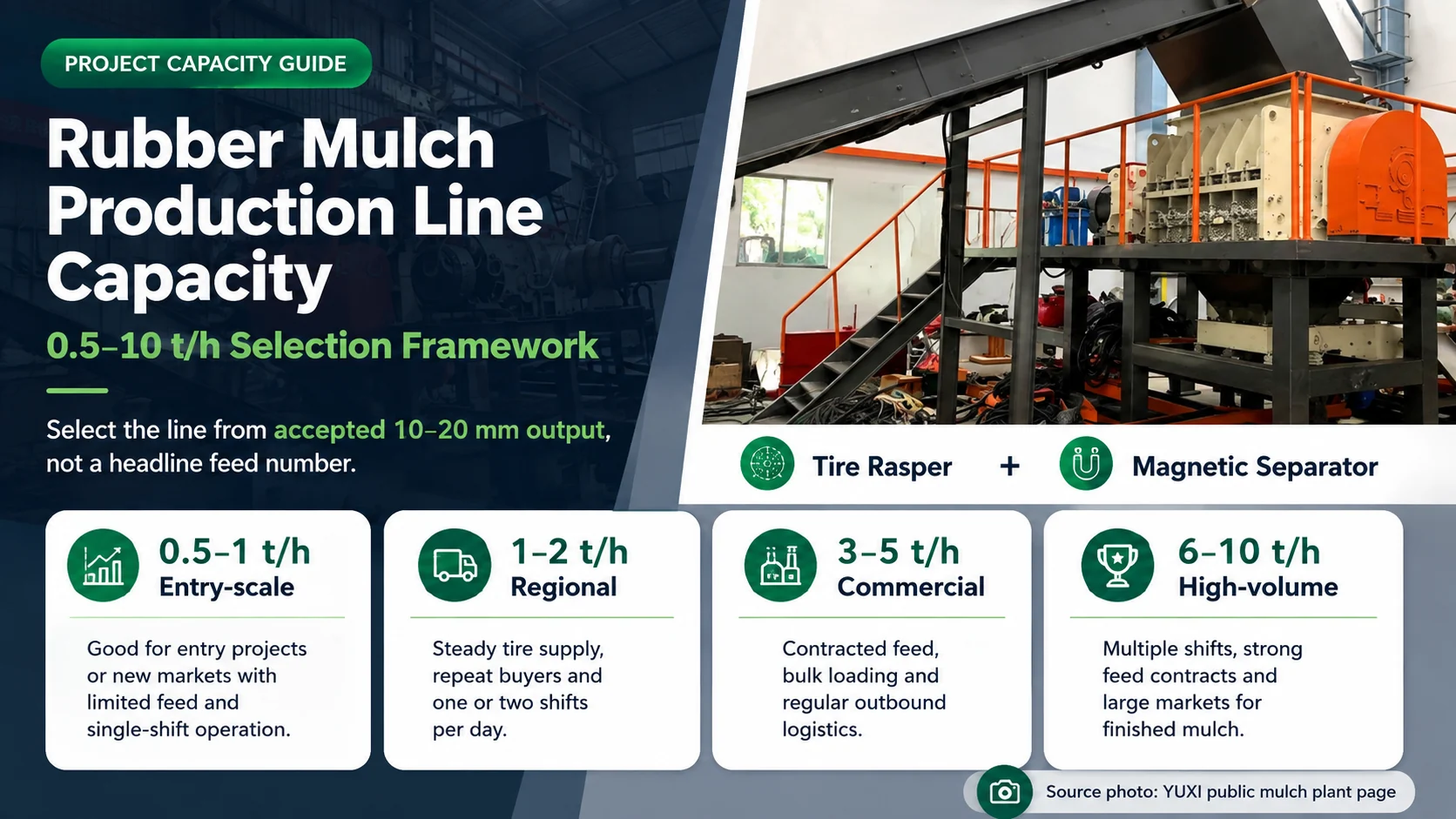
A customer once described the project in one sentence: “We need a 3 t/h rubber mulch line.” After a few questions, the number no longer looked so simple. The feed would be mostly truck tires, the plant would run one eight-hour shift, the local buyer wanted a tight 10-20 mm fraction, and the customer expected the quoted tons per hour to mean bagged saleable mulch. None of those conditions had appeared in the first inquiry.
That is the real selection problem behind rubber mulch production line capacity. The YUXI Tire Wire Free Mulch Plant is presented with a reference range of 0.5-10 t/h. The correct point within that range cannot be chosen from annual tire supply or motor power alone. It should be chosen from the required accepted mulch output, the actual feed route, tire construction, recirculation, steel-and-fiber requirements, productive time and the slowest stable stage in the complete line.
What Capacity Should a Rubber Mulch Project Select-
Select the smallest line that can produce the required accepted 10-20 mm mulch during realistic productive hours, with the agreed tire mix and quality limits, while keeping enough operating margin for normal feed variation and maintenance. Work backward from annual saleable demand. Do not start with the largest available shredder or a supplier’s short no-load demonstration.
A 0.5-1 t/h project may suit a new or local market. A 1-2 t/h line often fits a steady regional operation. A 3-5 t/h plant needs stronger feed contracts, bulk handling and balanced separation. A 6-10 t/h project normally requires high-volume logistics, robust utilities, surge capacity and a clear redundancy plan. These are planning bands, not fixed model promises.
On This Page
- Define the capacity number
- Calculate required accepted t/h
- Compare 0.5-10 t/h bands
- Whole tires vs prepared chips
- What reduces finished throughput
- Find the real bottleneck
- Plan shifts and productive time
- Match capacity to site logistics
- Compare supplier quotations
- Verify capacity in a FAT
- Common selection mistakes
- RFQ checklist
- FAQ
1. First Decide What “Tons per Hour” Means
We regularly see four different numbers described as line capacity. They can all be legitimate measurements, but they answer different questions.
Incoming feed rate
The mass of whole tires or chips entering the quoted process boundary. This is useful for receiving and front-end handling, but it is not the same as finished mulch output.
Single-machine throughput
The amount passing through the shredder or rasper under stated conditions. It may exclude downstream separation, recirculation and product rejection.
Stable complete-line rate
The fresh feed the entire line sustains after conveyors, screen return, magnets, fiber control and discharge have reached normal loading.
Accepted finished output
The mulch fraction that passes the agreed size, visible-steel, fiber and delivery-condition checks. This is normally the most useful commercial number.
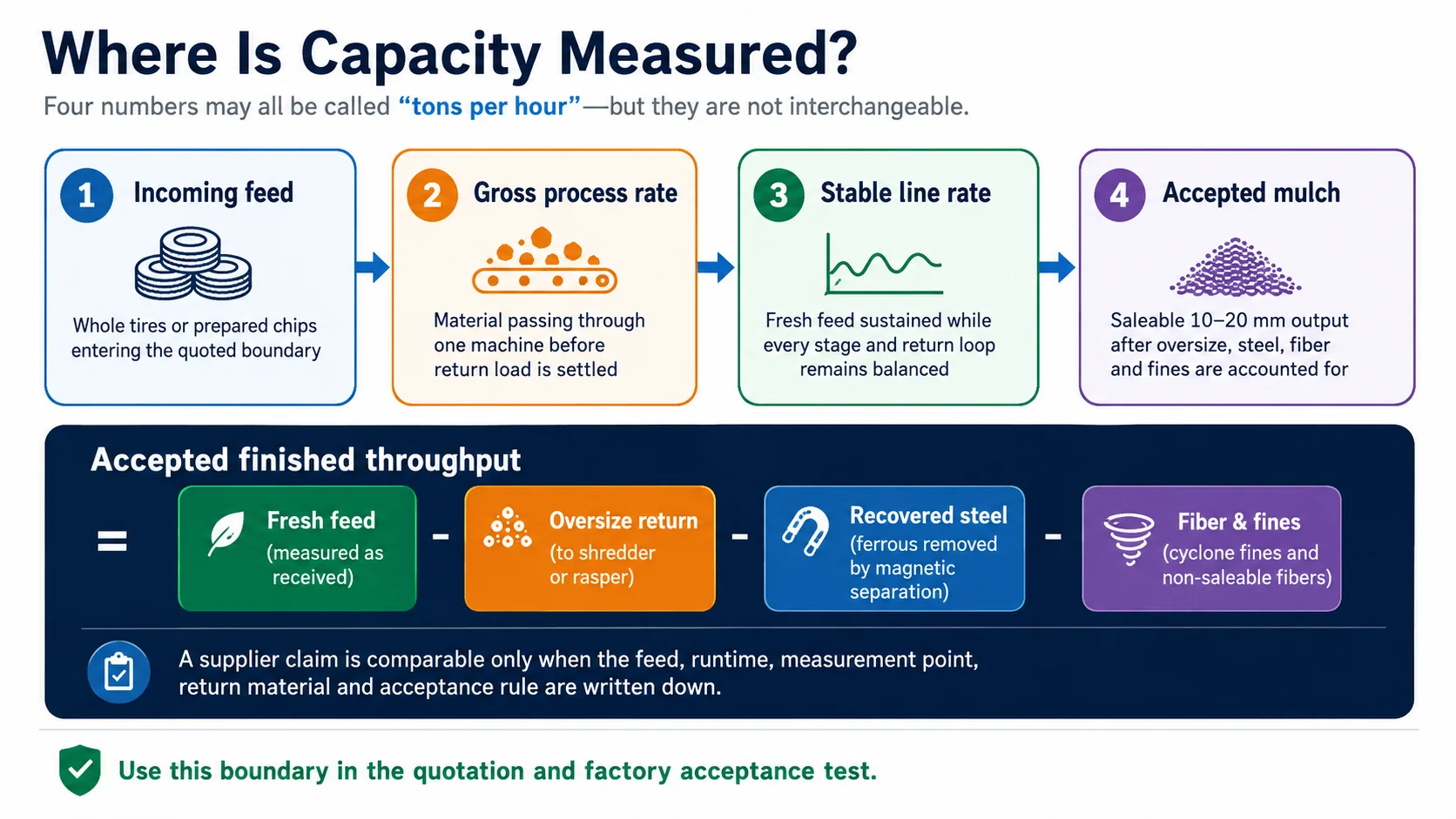
Accepted mulch t/h = fresh feed t/h − recovered steel − removed textile fiber − fines and rejected material − net material accumulation
Gross rasper and screen load = fresh feed t/h + recirculated oversize t/h
These expressions are deliberately simple. Their value is not in providing a perfect mass balance, but in forcing the quotation to define what is counted and where each stream is measured. If one supplier quotes fresh tire feed and another quotes accepted 10-20 mm mulch, the figures should not be placed in the same comparison column. During a steady-state test, net material accumulation should be close to zero, and all mass-flow terms should be measured over the same test period.
Engineering note: oversize return is not permanent waste. It remains in the process and consumes rasper, conveyor and screen capacity until it reaches the accepted size. A short demonstration can therefore look stronger than a steady-state run because the return loop has not yet accumulated.
2. Work Backward from Annual Saleable Demand
Buying capacity from tire availability alone is tempting. A recycler may have access to 8,000 tons of tires per year and immediately ask for a line sized to consume all of them. That reverses the commercial logic. The project should first confirm what amount of finished mulch can be sold, stored or transferred to a downstream process.
Required accepted t/h = annual saleable target ÷ (working days × scheduled hours/day × productive utilization)
Productive utilization is the portion of scheduled time in which the complete line is making accepted output. It is not a universal percentage. Feeding gaps, cutter inspection, screen cleaning, steel discharge, changeovers, housekeeping, minor stops and planned maintenance all reduce it. Use the plant’s own operating plan or a conservative scenario until site data exists.
Worked planning example
Assume a project plans to sell 4,800 tons of accepted mulch per year. It expects 300 working days, two eight-hour shifts and 75% productive utilization:
4,800 ÷ (300 × 16 × 0.75) = 1.33 t/h accepted mulch
This does not automatically mean “buy a 1.5 t/h machine.” It means the supplier must propose a line that demonstrates at least 1.33 t/h of accepted mulch under the agreed feed and quality basis, with a stated operating margin. The selected nominal scope may be higher when the tire mix is difficult, the size band is tight, expansion is planned or peak production periods matter.
When annual input is the starting number
Sometimes the project is contractually required to process a certain incoming tire tonnage. In that case, calculate both boundaries. The input requirement sizes receiving and front-end processing; the expected rubber, steel, textile and fines balance sizes finished-product storage and outbound logistics. Do not assume that one ton of incoming tires becomes one ton of saleable rubber mulch.
3. How the 0.5-10 t/h Selection Bands Change the Project
Capacity changes more than machine size. It changes the feedstock contract, operator workload, conveyor duty, buffer storage, electrical distribution, maintenance approach and the amount of finished product that must leave the site. The table below is a planning framework, not a YUXI model chart.
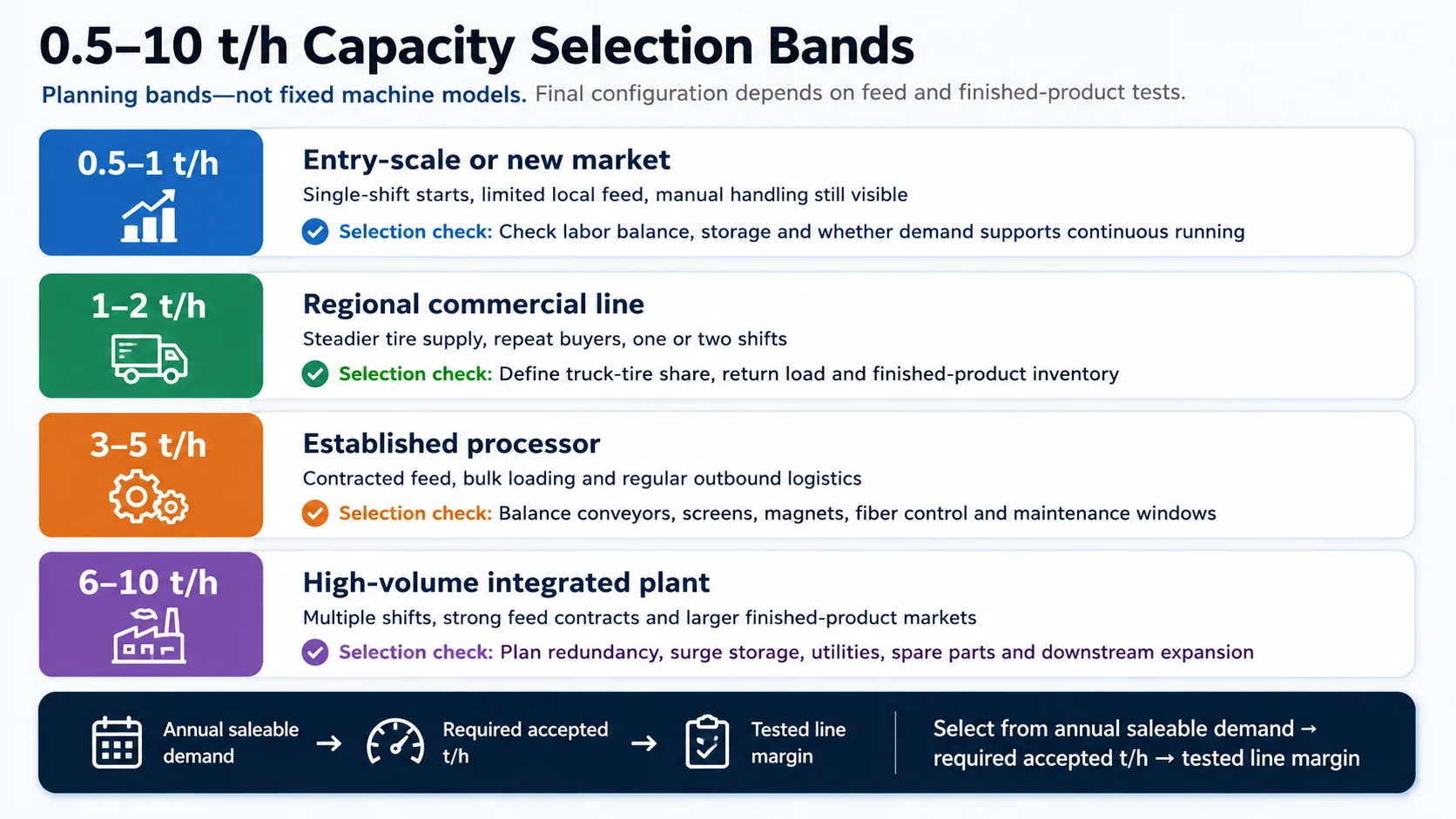
| Planning band | Where it may fit | What usually becomes critical | Questions before moving higher |
|---|---|---|---|
| 0.5-1 t/h | New market development, local tire supply, a smaller downstream module or a deliberately phased start. | Manual feeding, labor per ton, storage interruptions and whether the line can run long enough to reach stable conditions. | Is demand consistent- Can the operator keep the rasper and separation stages fed without unsafe rushing- |
| 1-2 t/h | A regional recycler with repeat feedstock and buyers, or an existing shredder adding a mulch stage. | Truck-tire percentage, return load, finished storage and maintenance coverage across one or two shifts. | Are incoming chips controlled- Does the site have enough buffer capacity to prevent frequent stops- |
| 3-5 t/h | An established commercial processor with stronger supply contracts and bulk material handling. | Balanced conveyors, screening, magnetic separation, fiber handling, power distribution and outbound logistics. | Can every downstream stage sustain the headline rate- Where will several tons of product and side streams go each hour- |
| 6-10 t/h | A high-volume integrated plant with multiple shifts, reliable markets and formal maintenance planning. | Surge storage, line redundancy, spare parts, dust and housekeeping systems, utility peaks, service access and downtime cost. | Does one large train or parallel modular sections create the better risk profile- What happens when one critical stage stops- |
The upper end should not be treated as a prestige target. A line operating at a sustainable load, with enough reserve for normal feed variation and maintenance, can be a better business than a larger line waiting for tires, buyers or operators. Conversely, deliberately undersizing a line can create overtime, repeated recirculation and no room for growth. The choice is a balance between utilization, market certainty and expansion risk.
4. Whole Tires and Pre-Shredded Chips Need Different Capacity Definitions
A complete line from whole tires includes primary shredding before the rasper and separation stages. A downstream module starts from controlled chips, generally below the feed limit confirmed for the selected rasper. Those two scopes can share the same finished mulch target while having very different installed equipment, power, footprint and operating responsibilities.
Complete line from whole tires
Capacity must cover tire receiving, feeding, primary shredding, any screen return, secondary rasping, magnetic recovery, optional fiber control and finished discharge. Tire diameter, passenger/truck mix and preparation requirements belong in the test basis.
Mulch module from chips
The customer or upstream supplier owns chip preparation. Feed size distribution, exposed wire, bulk presentation, contamination and supply rate must be guaranteed at the interface. Uncontrolled chips can transfer the bottleneck into the rasper.
The commercial difference is explained in more detail in the whole-tire line vs rasper module comparison. For capacity selection, the key rule is simple: state exactly where the supplier’s responsibility begins and where the tons per hour are weighed.
Passenger tires, truck tires and larger tires
Mixed tires do not create equal cutting work per ton. Truck tires contain heavier reinforcement and larger sections than passenger tires. Larger off-road tires may require separate preprocessing and project confirmation rather than being folded into a generic “mixed tire” claim. A representative test mix should therefore list the percentage of each tire category, not only the total mass.
5. Six Factors That Reduce Accepted Finished Throughput
Target mulch size and allowed oversize
A tighter 10-20 mm product usually creates more cutting events and a higher return load than a broader coarse product. Screen opening alone does not define the finished distribution; material shape, presentation, screen wear and recirculation also matter. The separate guide on controlling 10-20 mm rubber mulch size covers that mechanism in more depth.
Rasper cutter condition
As cutters wear, the same feed can require more passes, create a broader distribution or increase motor load. Capacity evidence should therefore record cutter condition at the start and end of the test. A new-cutter demonstration should not be treated as a complete wear-life guarantee.
Steel liberation and magnetic presentation
The rasper must release embedded steel before the magnet can recover it. Deep or uneven material on the conveyor can reduce magnetic presentation. Increasing fresh feed without checking liberation and burden depth may raise gross throughput while worsening the accepted product.
Textile-fiber requirement
Steel and textile are different separation problems. A project selling loose-fill mulch may accept one fiber condition, while a downstream granulator or specific buyer may require another. Stronger air separation can also carry saleable light rubber into the fiber stream. Capacity should be measured at the agreed fiber setting, not with the system turned down for a visually clean demonstration.
Moisture, contamination and feed inconsistency
Mud, rims, foreign metal, stones and inconsistent tire sections create interruptions and wear. Moisture can change material behavior at screens and air separators. Receiving specifications and reject rules are therefore part of capacity planning, not only housekeeping.
Return material and transfer points
The return conveyor, chute geometry and screen loading may become the limiting system even when the rasper has spare motor capacity. We normally recommend viewing the line as a circulating mass flow rather than a straight row of machines.
6. The Slowest Stable Stage Controls the Complete Line
A common quotation mistake is to select every component from its individual maximum. In operation, stages interact. The primary shredder may discharge rapidly enough to surge the rasper. The rasper may cut faster than the screen can classify. The screen may accept the gross burden while the magnet receives material too deeply. The fiber separator may produce the required cleanliness only at a lower rate.
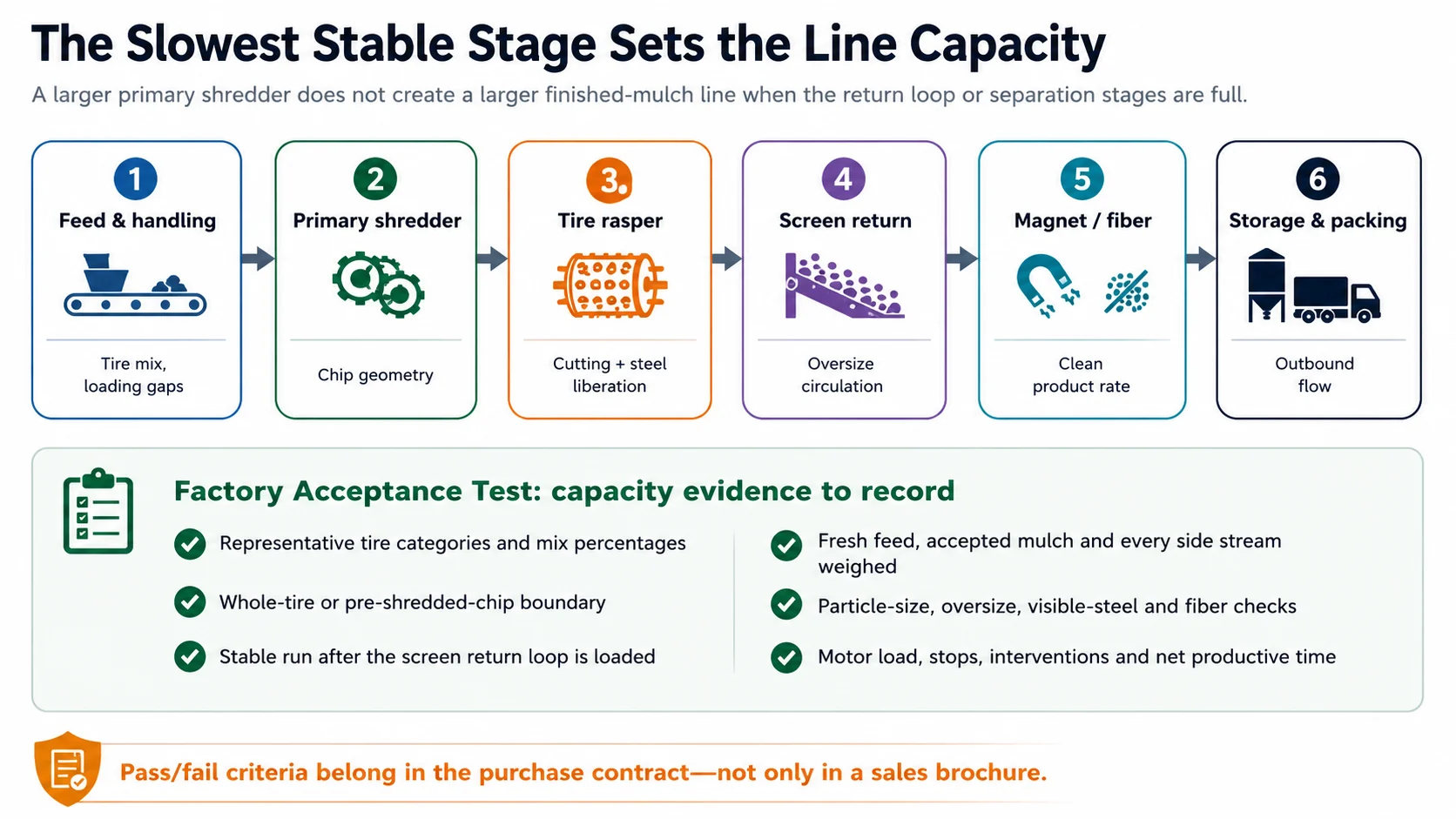
Better line-balance question: At what fresh-feed rate can all stages run continuously, the return loop remain stable, all side streams discharge normally and the accepted mulch specification still pass-
For larger projects, a surge bin or controlled buffer may decouple short fluctuations. It does not repair a permanently undersized stage. Likewise, parallel equipment may reduce single-point risk, but it adds controls, space, maintenance and balancing work. The decision should be based on downtime cost and expansion plans rather than a generic rule that “two smaller machines are always better.”
7. Convert Hourly Capacity into a Real Shift Plan
A nominal hourly figure can produce very different annual results depending on how the plant is staffed. One shift with frequent loader gaps is not equivalent to two staffed shifts with dedicated receiving, maintenance and finished-product handling.
Expected shift output = accepted t/h × scheduled shift hours × productive utilization
| Time item | Include it in the plan | Why it matters |
|---|---|---|
| Start-up and stabilization | Time to establish feed, fill the return loop and reach normal separator settings. | Short runs can overstate output if stabilization is excluded. |
| Planned inspections | Cutter, screen, magnet, bearings, conveyors and discharge checks. | Skipping them may increase apparent utilization while raising failure risk. |
| Housekeeping and side-stream removal | Steel, fiber, fines and dust collection plus transfer-point cleaning. | Full containers and accumulated fiber can stop or restrict the line. |
| Feeding and product handling | Loader travel, tire staging, bag changes and finished-stock movement. | The line can be mechanically available but starved or blocked. |
| Corrective stops | Jams, foreign material, screen blinding and minor adjustments. | They determine real productive utilization and maintenance staffing. |
Do not use overtime as the permanent capacity margin. If the project only meets annual demand by assuming maximum shifts, no maintenance time and perfect attendance, the selected capacity is probably too tight.
8. Higher Capacity Requires More Than a Larger Machine Footprint
At 0.5 t/h, a small storage interruption may be inconvenient. At 10 t/h, the same interruption can stop a large circulating process and rapidly create several tons of blocked material. Site planning should therefore scale the complete material path.
- Raw tire storage: enough days of approved feed, with fire and access requirements determined locally.
- Infeed logistics: loader routes, tire staging, chip containers and safe separation from finished-product traffic.
- Surge and return capacity: chutes, conveyors and buffers sized for both fresh and recirculated material.
- Recovered steel: discharge, collection and removal without contaminating the rubber stream.
- Fiber and fines: sealed or controlled handling appropriate to the plant’s dust and housekeeping assessment.
- Finished mulch: bins, bulk bays, bagging or transfer to downstream granulation at the actual accepted rate.
- Maintenance access: room to remove screens, cutters, shafts, bearings and conveyors without dismantling unrelated equipment.
9. How to Compare Two Capacity Quotations
Do not compare the headline t/h column until the following items match. This is especially important because public industry pages use capacity bands differently: some show single equipment stages, some show whole systems, and some switch between incoming feed and finished output without a clear boundary.
| Comparison item | What the quotation should state | Red flag |
|---|---|---|
| Feed boundary | Whole tires, prepared sections or chips; maximum and typical dimensions. | “Waste tires” with no category, size or preparation state. |
| Tire mix | Passenger, truck and other tire percentages used for the capacity claim. | One easy feed tested, then marketed as mixed-tire capacity. |
| Output boundary | Accepted 10-20 mm mulch, gross rasper discharge or another clearly named point. | Tons per hour with no weighing location. |
| Quality criteria | Size distribution, oversize, fines, visible steel, fiber and sampling method. | “Wire-free” or “high purity” without a pass/fail method. |
| Runtime | Stabilization period, measured period, allowed stops and net productive time. | A short video or batch trial presented as continuous output proof. |
| Return and side streams | Oversize return, recovered steel, fiber, fines, rejects and rubber losses. | Only incoming and final scale readings shown. |
| Included equipment | Conveyors, screens, magnets, fiber control, controls, structures and discharge scope. | A single rasper compared with a complete whole-tire line. |
Capacity also changes project price, but it is only one cost driver. The rubber mulch machine price guide separates the effects of line boundary, screening, separation, controls, site scope and acceptance testing.
10. Verify the Selected Capacity with a Factory Acceptance Test
A useful FAT should reproduce the promised process, not create the most attractive sample. Before the test, both parties should sign or acknowledge the feed, product and measurement method.
- Freeze the feed basis. Record tire categories, percentages, dimensions, preparation, contamination limits and the total test lot.
- Define the process boundary. State whether the test begins with whole tires or prepared chips and where accepted output is weighed.
- Reach steady state. Allow the screen and return loop to build to normal loading before the official measurement period.
- Record all mass streams. Fresh feed, accepted mulch, oversize return, steel, fiber, fines and rejects should be identified.
- Measure productive time. Record planned stops, unplanned stops, interventions, feed gaps and the exact net test duration.
- Sample the product. Use the agreed number, size and timing of samples for particle size, visible steel and fiber condition.
- Check line stability. Review motor-load trends, screen loading, conveyor flow, magnet discharge and any accumulation points.
- State pass/fail rules. Capacity and quality must pass together. A higher rate that fails the product specification is not accepted capacity.
Field note: We prefer a sustained test over a dramatic short run. The line should not require repeated manual clearing, temporary removal of a screen, reduced fiber control or another intervention that will not be acceptable in normal production.
11. Common Capacity Selection Mistakes
Choosing from annual tire supply only
The plant is sized to consume available tires without confirming the saleable mulch market, storage limit or downstream demand.
Using primary shredder capacity as line capacity
The rough-shredding stage may be faster than the rasper, screen, magnet or fiber separator.
A test dominated by passenger tires is applied to a heavier reinforced production mix.
Specifying a tight size band without return data
The buyer requests uniform 10-20 mm material but compares suppliers only by gross feed rate.
Planning at 100% scheduled utilization
No time is reserved for inspection, housekeeping, handling interruptions or normal maintenance.
Buying future capacity too early
A large line is installed before feed contracts, product buyers, utilities or operating staff can support it.
12. Information YUXI Needs for a Capacity Review
A serious capacity proposal should begin with a project data sheet, not only “send price for 5 t/h.” Include:
- Whole tires, prepared sections or pre-shredded chips.
- Passenger, truck, agricultural, OTR or other tire percentages and representative photos.
- Maximum tire dimensions or chip-size distribution.
- Required finished mulch range and permitted oversize/fines.
- Visible-steel and textile-fiber acceptance method.
- Annual saleable target, working days, shifts and scheduled hours.
- Desired accepted finished t/h and planned operating margin.
- Existing equipment, especially the shredder and chip interface.
- Power supply, floor plan, building height, loading method and storage limits.
- Whether mulch is sold directly or will feed a later crumb-rubber stage.
- Local dust, fire, noise, environmental and worker-safety requirements to be integrated by the project team.
FAQ
Is 0.5 t/h enough for a commercial rubber mulch business?
It can be, when the local feedstock, buyers, shifts and labor plan support that scale. Evaluate annual accepted output and cost per saleable ton rather than treating 0.5 t/h as automatically “too small.”
Should capacity be based on whole tires or finished mulch?
For commercial comparison, accepted finished mulch is usually more useful. Also record incoming tire capacity because it affects receiving, front-end equipment and mass balance. The quotation should state both when possible.
Why does a tighter 10-20 mm range reduce capacity?
More oversize returns to the rasper, so material receives additional cutting passes and continues using screen and conveyor capacity. The actual effect depends on feed, cutters and the agreed distribution.
Can a 5 t/h shredder support a 5 t/h mulch line?
Not automatically. The rasper, screen return, magnetic recovery, fiber control and discharge must all sustain the required accepted rate with the same tire mix.
How much capacity margin should be added?
There is no universal percentage. Base the margin on feed variation, market peaks, maintenance strategy, future expansion and test evidence. Keep the required accepted rate and the supplier’s proposed design basis separate.
What is the best way to verify a 10 t/h claim?
Use a representative feed lot, run the complete line to steady state, weigh all streams, record productive time and require the accepted mulch specification to pass throughout the measured test.
External References
- OSHA – Combustible Dust: An Explosion Hazard. Rubber is listed among materials that may create combustible dust.
- OSHA – Control of Hazardous Energy (Lockout/Tagout). General energy-control guidance, including conveyor-jam hazards.
Define the Capacity Before Comparing Equipment
Send YUXI your tire mix, feed boundary, required 10-20 mm product, annual target, shifts, accepted finished t/h, steel and fiber limits, power supply and floor plan. The proposal can then separate whole-tire equipment, the mulch module, capacity margin and acceptance-test basis.