




A practical comparison of the tire rasper and rubber granulator, focused on which stage comes first, what each machine should receive and how to prevent one machine from compensating for an upstream problem.
The question often appears late in a quotation review: “Can we remove the rasper and send the shredder output directly to the granulator-” On a flow diagram, that change looks like one less machine. On the factory floor, it changes which rotor receives the largest chips, where embedded steel is expected to be released, how magnets are loaded and which wear parts absorb the uncertainty in the feed.
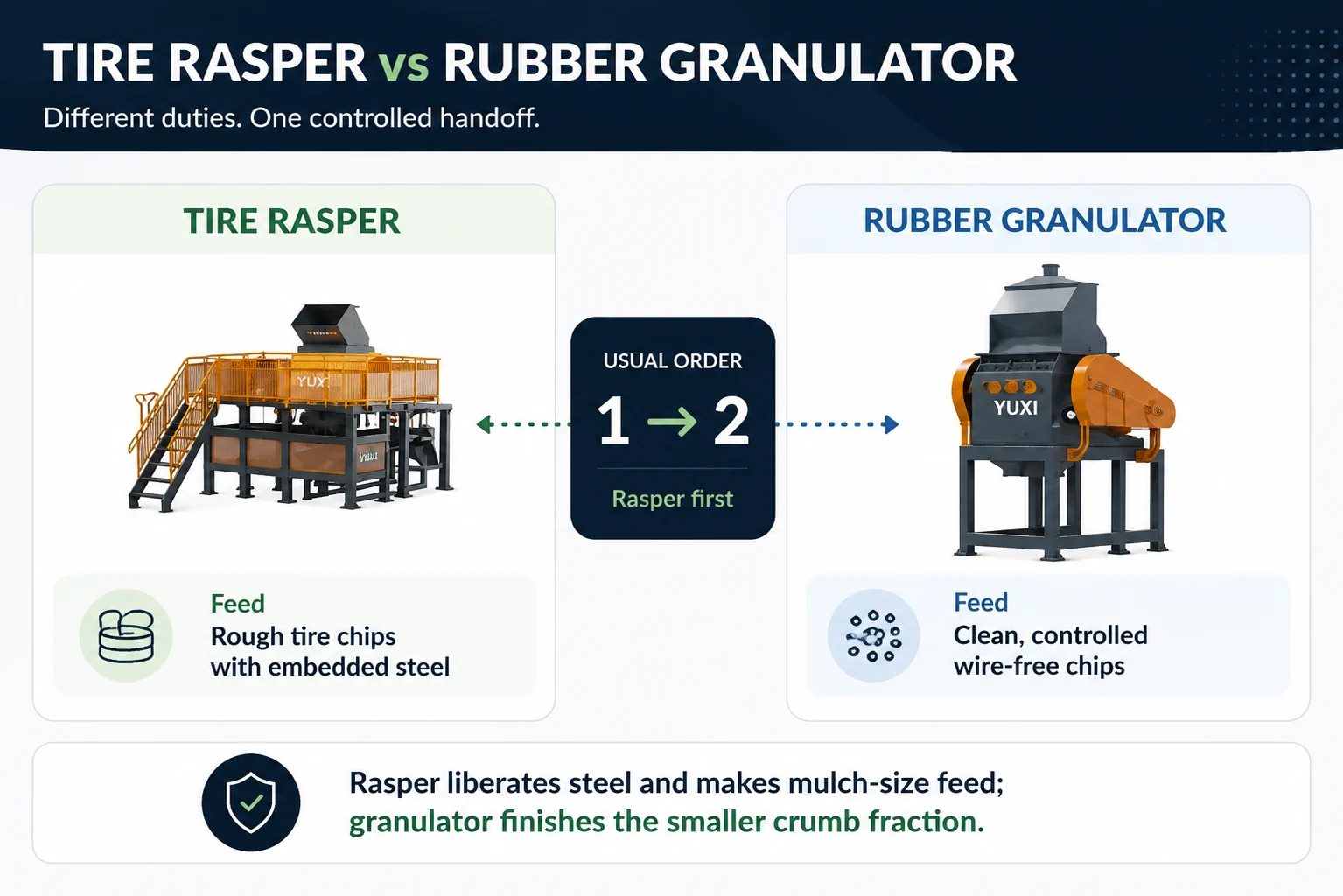
A tire rasper and a rubber granulator both reduce particle size, but they do not own the same process problem. The rasper works in the difficult middle of the line, where rough tire chips still contain belts and cords. The granulator works later, after the main steel-liberation and magnetic-recovery duty has been completed. Treating them as interchangeable can make a shorter quotation look attractive while moving risk into the most sensitive fine-reduction stage.
Which Machine Comes First in a Tire Recycling Line-
In a complete tire-to-crumb process, the tire rasper normally comes before the rubber granulator. The rasper receives pre-shredded tire chips, reduces them toward mulch size and opens the rubber around embedded steel. Magnets then recover the released ferrous material. The granulator receives the cleaner, controlled rubber fraction and reduces it into smaller crumb.
There are two important exceptions. When the target product is 10–20 mm rubber mulch, the line may stop after the rasper, magnetic separation, screening and any required fiber control; no granulator is needed. When a plant already buys or produces accepted wire-free chips, the granulator can be the first new machine purchased, although it remains a downstream process stage.
On This Page
- Why the machines are not interchangeable
- Where they sit in the process
- Feed, output and duty comparison
- Why the rasper normally comes first
- When a granulator can be the first purchase
- What goes wrong with the wrong order
- Define the rasper-to-granulator handoff
- Balance capacity across both stages
- Three practical line configurations
- Factory acceptance testing
- RFQ information
- Frequently asked questions
A Rasper and a Granulator Reduce Size for Different Reasons
Machine names vary by market. A rasper may also be called a secondary tire shredder or rubber rasper. A granulator may be described as a rubber crusher or fine granulation machine. The names are less useful than the feed condition and the duty written into the contract.
The tire rasper owns liberation
Its feed is normally rough tire chips within a confirmed maximum size and shape. These chips may still contain steel belts and cords bonded inside the rubber. The rasper repeatedly cuts and opens the structure so steel becomes separable. The discharge is expected to be a mixed stream: rubber chips, released wire, textile and some off-size material.
The rubber granulator owns finer reduction
Its feed should already be much more controlled. The granulator cuts wire-free or tightly steel-controlled rubber chips into smaller granules, commonly toward the 1–8 mm project range in YUXI’s product structure. It works with classification, return crushing, magnetic protection and fiber removal rather than replacing the main steel-liberation stage.
This boundary is also consistent with the way YUXI organizes its production solutions. The Tire Wire Free Mulch Plant uses primary shredding, rasping and magnetic steel recovery to produce approximately 10–20 mm mulch, while the finer crumb route continues with granulation and additional separation. The complete-line capacity range of 0.5–10 t/h is a solution reference, not a claim that every rasper and granulator pair delivers the same finished rate.
Useful specification language: do not write “granulator receives tire chips.” Write the maximum chip dimensions, accepted size distribution, residual steel condition, textile condition, contamination limits and steady feed rate.
The Normal Process Order Is Shredder → Rasper → Separation → Granulator
A complete plant begins with whole tires or prepared tire sections. The primary shredder creates rough pieces that can be conveyed and metered. The rasper then performs the more intensive secondary cutting needed to expose and detach much of the embedded steel. Magnetic separation receives that mixed discharge. Screening controls the material that can move forward, and oversize returns for another cutting pass.
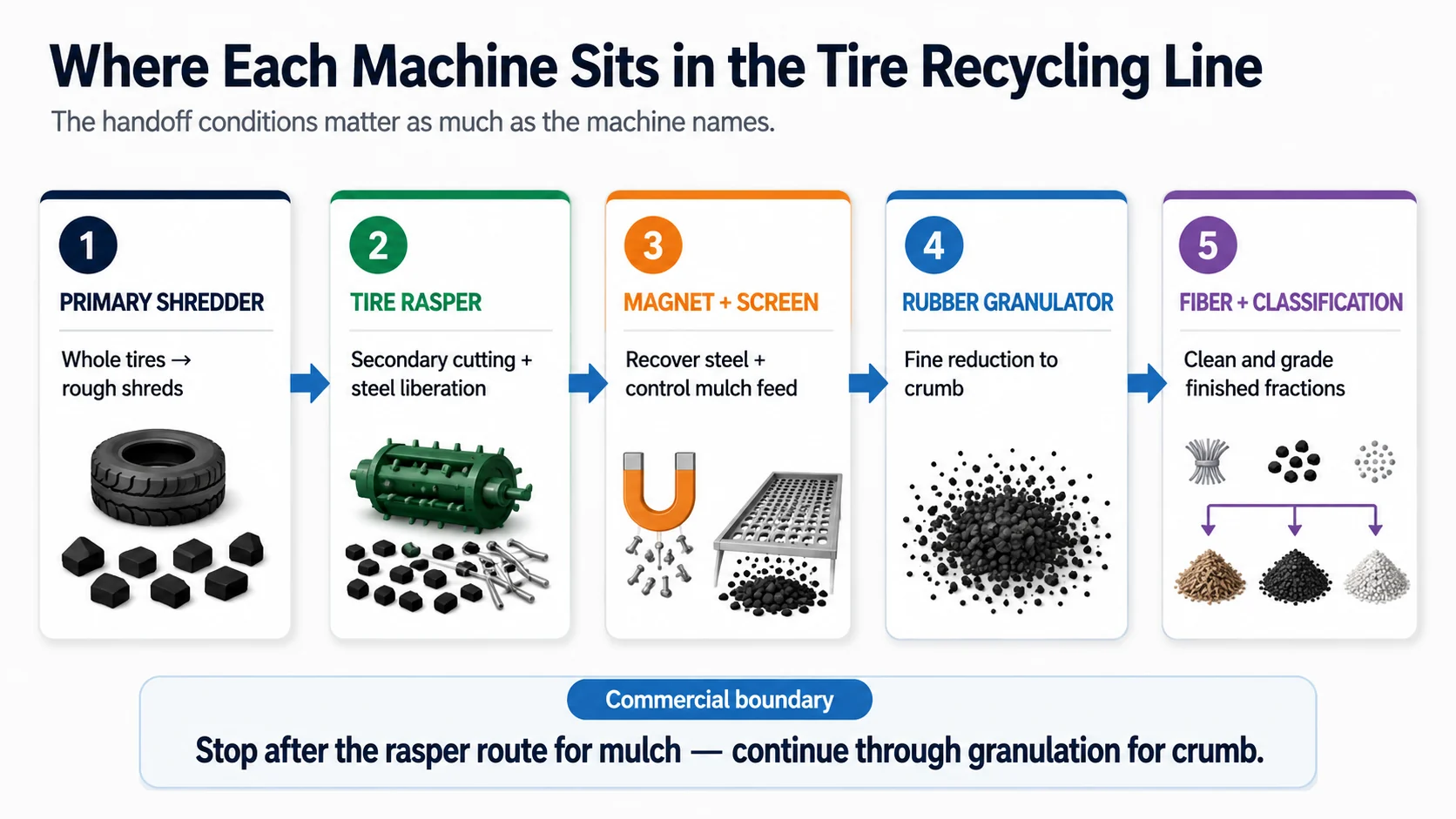
The U.S. EPA describes tire crumb production as a staged process in which tires are reduced to the required sizes, screens return oversize material, magnets remove wire and air separation removes fabric.1 That description does not prescribe one supplier’s machine names, but it supports the engineering principle: size reduction, steel recovery, classification and fiber removal are connected duties, not one undefined grinding step.
The granulator comes after this preparation because its performance should be judged on fine rubber reduction, not on its ability to survive uncontrolled strips of tire belt. A protective magnet before the granulator is still useful. It catches escaped ferrous pieces and protects the downstream rotor. It is not evidence that the upstream liberation stage can be removed.
Tire Rasper vs Rubber Granulator: Feed, Output and Process Duty
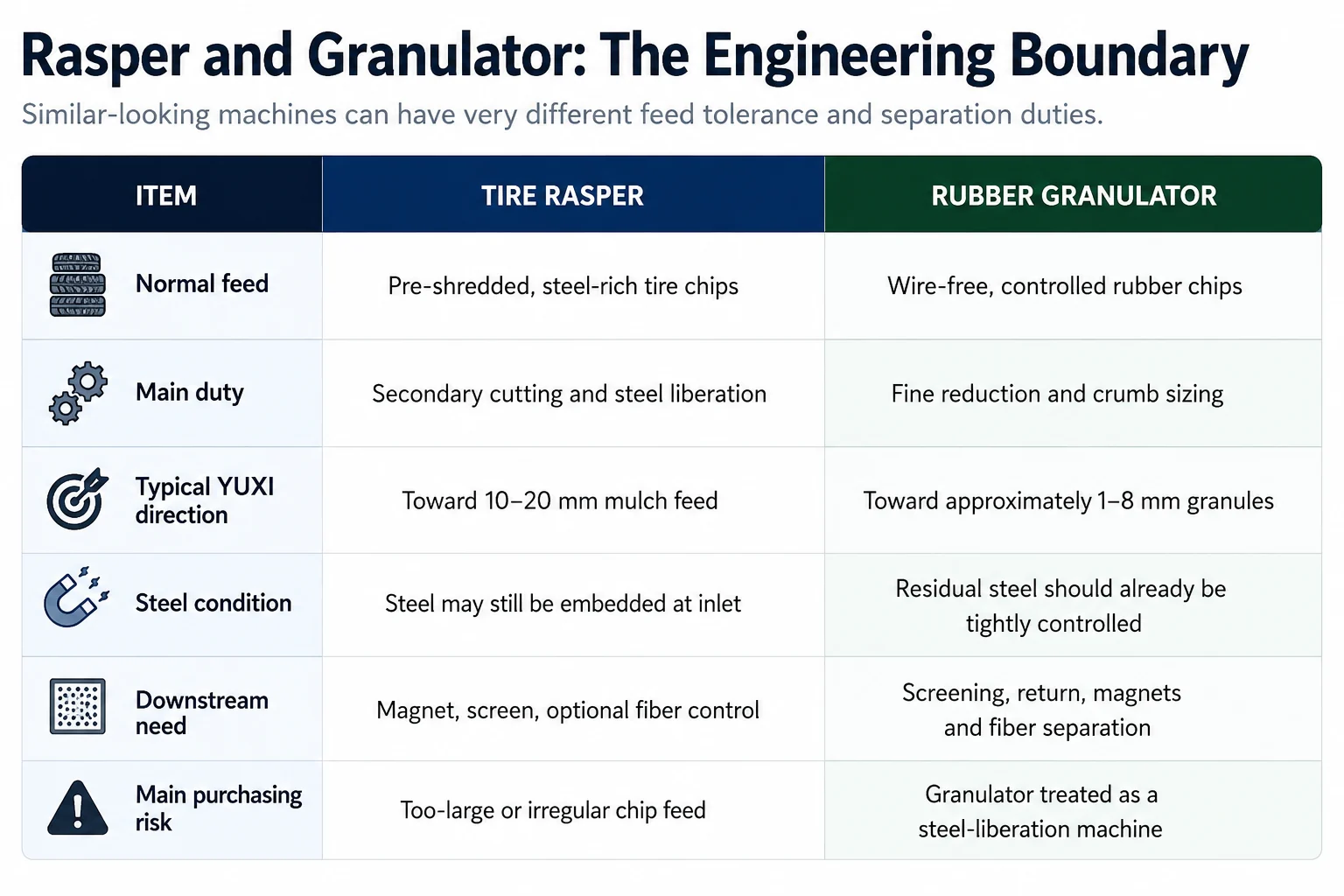
| Comparison item | Tire rasper | Rubber granulator |
|---|---|---|
| Normal line position | After primary shredding | After rasping and main steel recovery |
| Typical feed | Pre-shredded tire chips within an agreed maximum size; embedded steel is expected | Wire-free or tightly steel-controlled rubber chips with stable size and flow |
| Main duty | Secondary reduction and steel liberation | Fine reduction and crumb preparation |
| Typical YUXI product direction | Approximately 10–20 mm rubber mulch output, which can also serve as granulator feed | Approximately 1–8 mm rubber granules, depending on the configured screen and grading route |
| Discharge condition | Rubber, liberated ferrous wire, textile and off-size material | Fine rubber granules with remaining fiber, fines and occasional metal controlled by downstream separation |
| Normal downstream equipment | Magnetic separator, product screen, oversize return and optional fiber control | Screening, return conveyor, further magnets, fiber separation, grading and dust handling |
| Primary wear concern | Abrasive steel-rich chips, large irregular pieces and high internal circulation | Fine cutting load, residual metal, excessive feed size, heat, fines and screen packing |
| Finished-product decision | Can be the last size-reduction machine for mulch | Required when the market buys smaller crumb fractions |
The existing tire rasper machine guide goes deeper into rotor knives, screen retention and steel liberation. The important comparison here is narrower: the rasper makes the material suitable for separation and optional finer processing; the granulator assumes that difficult preparation has already happened.
Why the Rasper Normally Comes Before the Granulator
1. Rough chips need a machine with the correct feed tolerance
Primary shredder output is not a bag of uniform cubes. It includes long pieces, curved sections, thick tread blocks and chips with exposed or embedded steel. The least consistent pieces often decide whether the next machine feeds smoothly. A rasper is selected around that mid-stream condition. A granulator selected around clean 10–20 mm chips should not be expected to accept whatever happens to leave a rough shredder.
2. Steel must be liberated before it can be recovered
A magnet can only collect ferrous material that is physically accessible. Steel trapped inside a thick rubber chip may pass under a strong magnetic separator with much of its rubber still attached. The rasper opens the rubber matrix. The magnet then performs recovery. These are separate measurements, and a high magnetic-recovery claim cannot compensate for poor liberation.
3. Fine-reduction knives should not become the main steel-processing stage
Some residual wire protection is normal in a crumb line. However, there is a large difference between intercepting an occasional escaped fragment and continuously feeding belt-rich rough chips. The second condition can create impact, wrapping, edge damage, fastener stress and unplanned opening of the granulator. The apparent capital saving then reappears as wear, downtime and unstable product.
4. A controlled feed makes crumb sizing repeatable
Granulator output depends on screen opening, open area, knife condition, gap, rotor load and the amount of material retained for another cut. When feed size and steel condition change sharply, motor load and internal circulation change with them. Product temperature rises, fines may increase and the accepted crumb rate falls even when the feed conveyor still appears busy.
Field note: when a granulator draws repeated current spikes, operators often reduce the feed rate first. That may keep the line running, but it does not identify the cause. Compare the spikes with oversize chips, steel events, screen packing and knife condition. A stable average current can hide damaging peaks.
When a Granulator Can Be the First Machine Purchased
“Rasper first” describes the process order in a whole-tire line. It does not mean every site must buy both machines in the same order. A plant may already own a suitable rasper module. It may buy wire-free mulch from another recycler. It may be expanding from a mulch business into crumb rubber. In those cases, the granulator can be the first new capital item.
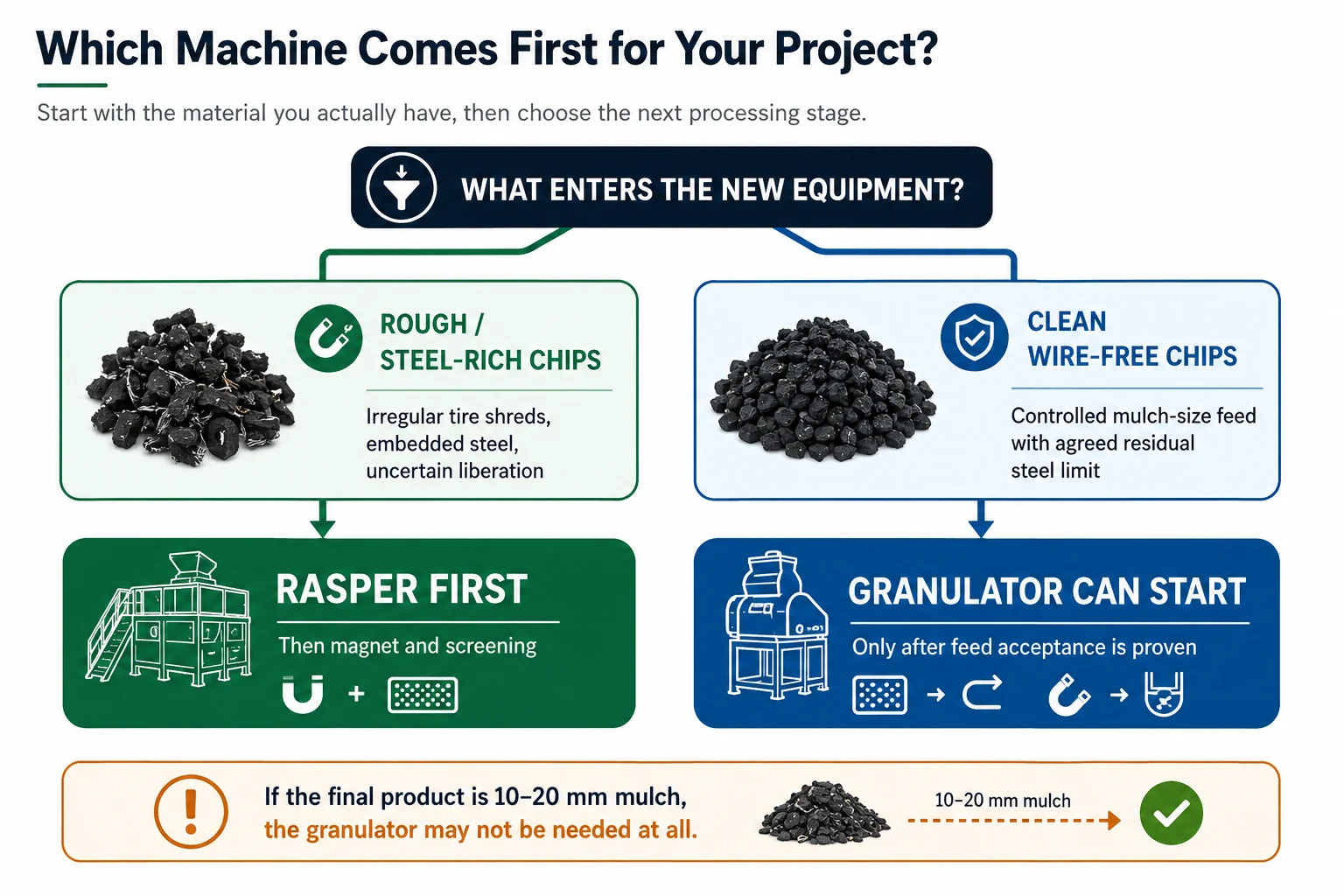
A granulator-first purchase can be reasonable when all of these are true
- The incoming material is already wire-free or meets an agreed residual-steel limit.
- The maximum chip dimensions and size distribution fall inside the quoted granulator feed envelope.
- The feed is sufficiently free of stones, rim pieces, tools and other foreign metal.
- The textile condition is understood and matched to the downstream air-separation system.
- The supplier has tested representative material rather than a clean hand-selected sample.
- The buyer has a written crumb specification and a verified market for the smaller fraction.
The commercial reason for adding the granulator should also be real. The comparison between rubber mulch and crumb rubber is not simply coarse versus valuable. Finer output adds energy, knife wear, classification, dust control, fiber handling, sampling and rejection risk. The downstream buyer must pay for that additional processing.
What Happens When the Granulator Is Asked to Do the Rasper’s Job-
| Observed problem | Possible process cause | What to check first |
|---|---|---|
| Repeated overload trips | Oversize or irregular chips; concentrated steel-rich pieces; batch feeding | Sample maximum chip dimensions, inspect conveyor metering and correlate trips with feed events |
| Knife edges chip or dull quickly | Residual steel beyond the intended feed limit; foreign metal; incorrect gap | Open and inspect the chamber, audit upstream magnets and test the feed for embedded steel |
| Wire wraps shafts or transfer points | Main steel liberation did not occur upstream; magnetic burden is too deep | Inspect material immediately after the rasper and separately after the magnet |
| Crumb contains visible metal | Poor liberation, poor magnetic recovery or both | Do not adjust only the final magnet; isolate the failure by process stage |
| Excess heat and fines | Over-retention, dull knives, rubbing rather than clean cutting, packed screens | Check knife condition, gap, screen open area, product temperature and return load |
| Headline feed rate is met but accepted output is low | High oversize return, rejected product, fiber loss or frequent micro-stops | Weigh accepted crumb and all side streams over a steady-state test |
A common mistake is to solve a liberation problem with more magnetic equipment. Another magnet may improve collection of loose steel, but it cannot reach steel that remains encapsulated in rubber. Likewise, reducing the granulator screen opening may make a finer sample while increasing recirculation and cutting work. Each adjustment should match the actual failed measurement.
Define the Rasper-to-Granulator Handoff Before Selecting Either Machine
The interface between machines is where separate supplier quotations often fail. The rasper supplier may say the module makes “wire-free 20 mm chips.” The granulator supplier may say the machine accepts “20 mm rubber.” Those statements appear compatible, yet they leave out the distribution tail, chip thickness, loose wire, embedded steel, textile, contamination and surge behavior.
| Handoff item | What should be written | Why it matters |
|---|---|---|
| Particle-size distribution | Required percentage inside the feed range, maximum piece rule and fines condition | A single nominal size does not describe the difficult pieces |
| Shape and thickness | Maximum length, width, thickness and treatment of long strips | Flexible strips can bridge or enter the rotor differently from compact chips |
| Steel condition | Limits for embedded steel, loose wire, exposed sharp ends and foreign ferrous metal | “Wire-free” has no universal zero-metal meaning |
| Textile condition | Allowed loose fiber, bonded cord and expected fluff load | Fiber affects conveying, air separation, dust and finished-product cleanliness |
| Contamination | Rims, stones, glass, tools, soil, water and other non-tire material | Foreign objects can damage knives or create quality rejection |
| Feed presentation | Steady t/h, surge limit, conveyor layer depth and buffer arrangement | A compatible average rate can still overload the granulator in batches |
| Sampling method | Lot definition, increment timing, composite sample, test method and non-conformance rule | Both suppliers must judge the same material boundary |
ASTM D5644 provides a formal method for determining the particle-size distribution of recycled vulcanizate particulate rubber and uses that distribution to assign a mesh or average particle-size designation.2 A project may use another agreed sieve method for coarse 10–20 mm feed, but the same principle applies: define how the material will be sampled and measured before the factory test.
Accepted granulator feed = material passing the agreed size, steel, fiber and contamination checks at the handoff conveyor
Balance Capacity at the Accepted Product Boundary
A rasper and granulator do not automatically form a balanced line because both brochures show the same tons per hour. The rasper may report incoming chip rate. The magnet may be tested under a thin material layer. The granulator may report clean feed throughput with a broad output. The screen may return a large fraction that is not included in the headline figure.
Record four rates separately
- Fresh feed to the rasper: the declared tire-chip mix entering the mid-stream module.
- Accepted mulch feed to the granulator: material that passes the handoff specification.
- Gross granulator discharge: all material leaving before classification.
- Accepted finished crumb: the saleable fraction after size, steel and fiber checks.
The line should be tested after the return loops are full and the machines have reached steady operation. A short run from empty screens often looks faster because no recirculating load has accumulated. Measure productive time, pauses, reversals, clearing, knife checks and product changeover. A ten-minute peak rate is not an eight-hour shift result.
Capacity should also follow the chosen product route. After wire-free chip preparation, the downstream process adds fine granulation, classification, secondary magnetic recovery and fiber separation. The tire rubber granule plant purity guide explains how these stages work together to control particle size, residual steel and textile fiber. These additional stages produce a finer product, but they also create more internal circulation and more quality boundaries than a line that stops at mulch.
Three Practical Configurations
Configuration A: Whole tires to 10–20 mm mulch
Route: primary shredder → tire rasper → magnetic separation → screen and return → optional fiber control.
This route is appropriate when 10–20 mm wire-free mulch is the finished product. The granulator is omitted because the market does not require a smaller fraction. The project should still define accepted oversize, visible or embedded steel, textile condition and end-use requirements.
Configuration B: Whole tires to crumb rubber
Route: primary shredder → tire rasper → magnetic separation → controlled mulch feed → rubber granulator → classification → further magnetic and fiber separation.
This is the normal sequence when the plant must make smaller granules from whole tires. The rasper protects the downstream process by taking ownership of the main steel-rich secondary cutting duty. The granulator then works on prepared rubber.
Configuration C: Purchased wire-free chips to crumb
Route: incoming-feed inspection → buffer and metering → protective magnet → rubber granulator → classification and separation.
This route can reduce the project scope, but it transfers feed risk to the buyer. Supply contracts should contain the same handoff limits used for the equipment guarantee. A low-cost chip source is not economical if variable steel and size cause knife damage, downtime or finished-product rejection.
End-use caution: machine output is not automatic approval for a playground, sports, molded-product or asphalt application. For example, the U.S. CPSC distinguishes playground rubber mulch designed and tested for that use from general landscaping material and refers to applicable impact and loose-fill standards.3 Obtain the buyer’s written specification before selecting the final screen and separation depth.
Factory Acceptance Test: Prove the Sequence, Not Only Each Machine
A useful factory acceptance test should run the connected process with representative material. Separate no-load inspections and clean-feed demonstrations are still valuable, but they do not prove the interface between the rasper and granulator.
Before the test
- Declare the tire mix and the condition of the rough chips.
- Record the rasper screen, granulator screen and knife condition.
- Define the steady-state test duration and productive-time rule.
- Agree on the handoff-feed and finished-crumb sampling methods.
- Calibrate or verify the weighing method for input, steel, fiber, return and accepted product.
During the test
- Allow the screens and return conveyors to reach normal circulating load.
- Record motor load trends and repeated peaks, not only average current.
- Measure material directly after the rasper to judge liberation.
- Measure material after magnetic separation to judge recovery.
- Inspect the accepted granulator feed before it enters fine reduction.
- Record trips, reversals, clearing, stoppages and rejected material.
Pass condition
The declared tire mix produces the agreed accepted finished tons per hour for the stated test duration while the rasper-to-granulator feed meets its written boundary and the final crumb passes particle-size, steel and fiber checks.
Incomplete pass condition
Each machine runs separately for a short demonstration, but the test does not weigh accepted material, fill the return loops, use representative steel-rich chips or verify the material condition at the interface.
Information to Send Before Requesting a Rasper or Granulator Quote
Feed evidence
Tire type and percentages, rough-chip or wire-free-chip dimensions, photos and video, steel condition, textile condition, contamination and bulk handling method.
Product specification
Mulch or crumb range, accepted oversize and fines, visible and embedded steel rule, fiber limit, moisture or cleanliness limits and packaging route.
Capacity basis
Required accepted finished t/h, operating shifts, productive hours, annual demand, planned maintenance and how recirculating material will be counted.
Site and expansion
Power supply, floor plan, conveyor elevations, dust-control expectations, maintenance lifting, control interfaces and whether a mulch line will later expand to crumb.
The quotation should state whether the rasper, magnets, screen, return conveyor, granulator, fiber separation, dust collection, controls, spare knives and commissioning support are included. A machine list without responsibility for the interfaces is not yet a complete process proposal.
Frequently Asked Questions
Does a tire rasper come before a rubber granulator?
Usually yes. In a complete tire-to-crumb line, the primary shredder makes rough chips, the rasper performs secondary cutting and steel liberation, magnetic separation removes released steel, and the granulator then reduces the cleaner rubber feed into smaller granules.
Can a rubber granulator process rough tire shreds directly?
It should not be assumed. Rough tire shreds may be too large, too irregular and too steel-rich for the granulator’s confirmed feed envelope. Direct feeding can increase load peaks, knife damage, wire wrapping and residual-metal risk.
When can a granulator be the first machine purchased?
A granulator can be the first new machine in an expansion project when the site already buys or produces controlled wire-free chips that meet the granulator supplier’s written limits for size, residual steel, fiber, contamination and feed rate.
Is a granulator needed for 10–20 mm rubber mulch?
Not necessarily. When 10–20 mm wire-free mulch is the saleable final product, the process can stop after rasping, magnetic recovery, screening and any required fiber control. Granulation is added when the market requires smaller crumb fractions.
What should be checked at the rasper-to-granulator handoff?
Define the feed size distribution, maximum piece dimensions, embedded and loose steel limits, textile condition, contamination, moisture where relevant, bulk feed stability, accepted feed rate and the sampling method used to verify each condition.
How should rasper and granulator capacity be compared?
Do not compare brochure feed rates. Verify the complete line at steady state and report accepted finished product after the agreed particle-size, steel and fiber checks. Also record recirculation, downtime and representative tire mix.
Sources and Engineering References
- U.S. Environmental Protection Agency, Tire Crumb Questions and Answers. Staged size reduction, oversize return, magnetic wire removal and air separation.
- ASTM D5644-23, Determination of Particle Size Distribution of Recycled Vulcanizate Particulate Rubber. Particle-size distribution and product size designation.
- U.S. Consumer Product Safety Commission, Tire Crumb Rubber Questions and Answers. Distinction between general landscaping mulch and playground surfacing requirements.
Configure the Rasper and Granulator Around One Feed Boundary
Send YUXI your tire mix, current chip condition, target mulch or crumb size, accepted finished capacity and steel-and-fiber limits. The proposal can then define where the rasper stage ends, what the granulator must receive and how the connected line will be tested.