




A bad run may bring several problems at once: the shredder jams, current rises, reversing becomes frequent, and the discharge turns uneven. They may come from the same disturbance, but they should not be treated as the same fault. If everything is called “overload” and the settings are changed straight away, the original cause can easily be missed before anyone has a clear record of what happened.
For the tire shredder machine used as the reference here, the practical machine boundary includes the feed into the dual-shaft cutting chamber, the drive/load response, the programmed reversing behavior, the disc screen, and the oversize return route. A problem seen at the shafts may start with feed geometry. A problem seen at discharge may start with the return loop. A high-current event may be mechanical, electrical, or both.
This guide is therefore about machine-level diagnosis, not a preventive-maintenance schedule and not a blade-service manual. Daily, weekly and shutdown work is covered in the tire shredder maintenance checklist. Cutter wear, sharpening, replacement and service economics belong in the tire shredder blade guide.
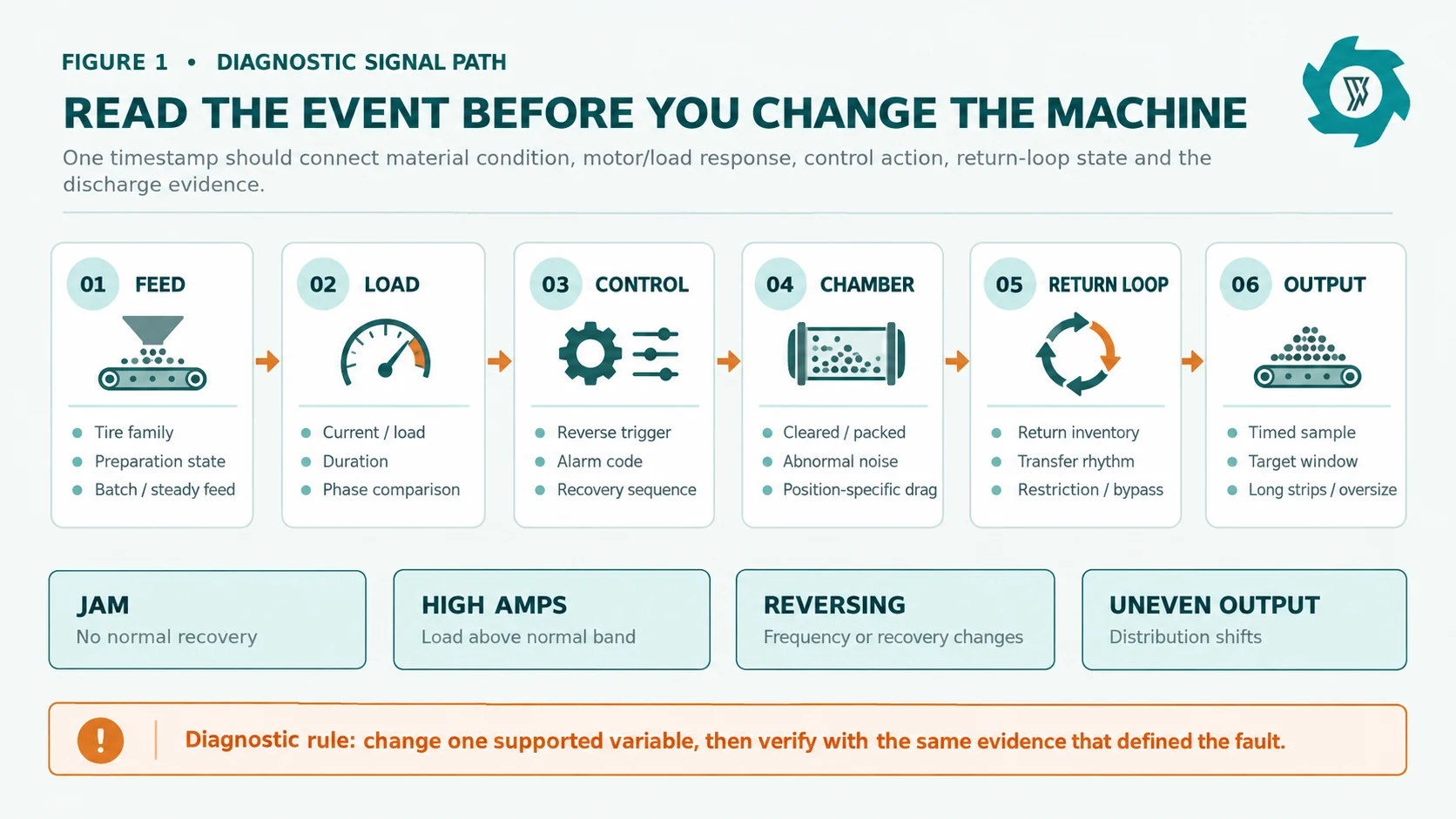
Define the Symptom Before You Open the Machine
Industrial shredders routinely see short load spikes because a tire is elastic, reinforced and irregular. A brief high-current peak is not automatically an electrical fault. A short programmed reverse is not automatically a jam. A coarse piece on the discharge belt is not automatically a failed screen. Before assigning a cause, define the symptom in a way that another shift could recognize from the same data.
| Observed symptom | Useful definition | Record first | Do not assume |
|---|---|---|---|
| Jam | Material or a machine condition does not clear through the approved automatic recovery sequence and productive cutting cannot resume normally. | Feed item, event time, reversals, alarms, last normal discharge, return status. | Every heavy bite is a jam. |
| High amps | Motor current or controller load rises above the machine’s normal band for comparable duty, whether as a spike or sustained event. | Phase currents if available, voltage, duration, feed event, drive alarm, shaft response. | The mechanical chamber is the only possible cause. |
| Repeated reversing | Reverse events become more frequent, last longer or fail to restore stable cutting compared with the same operating condition. | Count, duration, trigger, recovery result, tire mix, fresh-feed rate, return loading. | Reversing itself means the PLC is malfunctioning. |
| Uneven output | The measured distribution, shape or long-piece frequency moves outside the project’s accepted window. | Timed sample, size/shape result, screen condition, return behavior, feed mix. | One unusual chip proves the whole output is off-spec. |
The EPA’s scrap-tire recycling handbook describes tire shredders as low-speed, high-torque machines in which tire construction, cutter condition, product size and repeated passes affect the cutting duty.[1] That is important for diagnosis: the same motor and chamber can show very different load behavior when the tire mix, required size or amount of recirculated material changes.
1. Tire Shredder Jams: Separate Feed Lock, Chamber Packing and Mechanical Interference
A useful jam diagnosis starts with where the motion stopped. If a tire remains above the cutters and never establishes a stable bite, the primary question is feed presentation. If the shafts engage and then stall in a dense bed of rubber and wire, the question moves toward chamber loading, concentrated reinforcement, foreign material or a return loop that is adding too much recut material. If the machine stops with little material in the chamber, inspect the alarm history and mechanical/electrical condition.
Feed geometry and a failed bite
Large closed tire rings can rotate, sit across the hopper or enter at an angle that gives the cutters a poor edge to grip. Very stiff truck, agricultural or OTR tires can make this worse. If repeated events occur only with a specific tire family, record its diameter, section width, weight range and preparation state. A tire that physically fits into the hopper is not automatically a stable production feed. Where large tires repeatedly fail to present correctly, compare the operating route with the guidance on when tire pre-cutting is needed before shredding.
Chamber packing from fresh feed plus return material
A return-screen system creates two feeds to the cutting chamber: fresh tires and material that already failed the size classification. When the return load rises while fresh feed continues at the same rate, the chamber can become busy cutting the same mass again. Operators may see slower recovery after each bite, repeated reverse-forward cycles and less accepted output even though the inlet conveyor appears full. The key check is not “Is the screen running?” but “How much material is circulating back, and is the return stream arriving in slugs?”
This is one area where machine-level and line-level troubleshooting separate. If the dominant problem is the finished TDF specification, line throughput, bridging outside the shredder or plant-wide oversize balance, use the TDF plant troubleshooting guide. At the shredder itself, keep the question on chamber loading and recovery behavior.
Foreign objects or concentrated steel-rich sections
Tires already contain steel reinforcement; that is normal duty for a correctly configured tire shredder. The diagnostic concern is material outside the agreed feed condition or an unusually concentrated object that creates a different load signature. Record any foreign-object event and isolate the affected material stream. Do not turn a one-time incident into a permanent control change without confirming that ordinary feed needs the same adjustment.
Mechanical interference
If current rises or the drive trips with little material present, or if the same shaft position repeatedly produces rubbing or a hard stop, a mechanical inspection may be required. Possibilities include trapped wire, loose or displaced components, bearing or shaft problems, damaged screen/return hardware contacting moving parts, or a cutter-stack condition that needs service. This is where troubleshooting must stop being an operating experiment. If inspection requires entering a danger zone, removing guards, reaching into the chamber or exposing personnel to unexpected motion or stored energy, use the site’s hazardous-energy-control procedure first. OSHA specifically includes unjamming, inspecting and adjusting within servicing activities when those hazards are present.[4]
2. High Amps: Decide Whether the Load Is Mechanical, Electrical or Both
Motor current is a useful troubleshooting signal because it responds to torque demand, but it is not a complete diagnosis. First ask whether the high current tracks a material event. A sharp rise that begins as a heavy tire enters the cutters and falls after a successful reverse is different from a sustained current increase with an empty or lightly loaded chamber. The first pattern points toward process load. The second deserves a broader drive, power-supply and mechanical check.
Compare against a like-for-like baseline
Use the same machine, similar tire mix, similar screen/return configuration and similar production state. A truck-tire run should not be judged against a light passenger-tire baseline. Nor should a smaller target size be compared with a coarser product without acknowledging that more recutting work may be required. EPA notes that smaller tire products can require more recycle passes and more cuts, increasing cutting duty.[1]
Correlate current with the event timeline
For each abnormal period, place current/load trend beside feed, reverse commands, drive alarms and the state of the return route. A repeated pattern such as “feed slug → current rises → auto reverse → return conveyor still full → forward restart → current immediately rises again” is more informative than a maximum amp number on its own. It suggests the chamber is not returning to a stable material inventory between cycles.
Check phase balance and supply condition before changing settings
On a three-phase motor system, electrical supply quality matters. The U.S. Department of Energy notes that relatively small voltage unbalance can create much larger current unbalance, along with increased losses, vibration, mechanical stress and overheating.[2] DOE also notes that excessive voltage drop and poor electrical connections can reduce motor torque and increase current.[3] Those are reasons to compare line-to-line voltage and phase current using the site’s qualified electrical procedures when the load pattern does not match the material event.
Do not raise overload limits, bypass protection or change VFD parameters simply to make a high-current symptom disappear. Protection and drive settings belong to the approved electrical design and the motor/drive documentation.
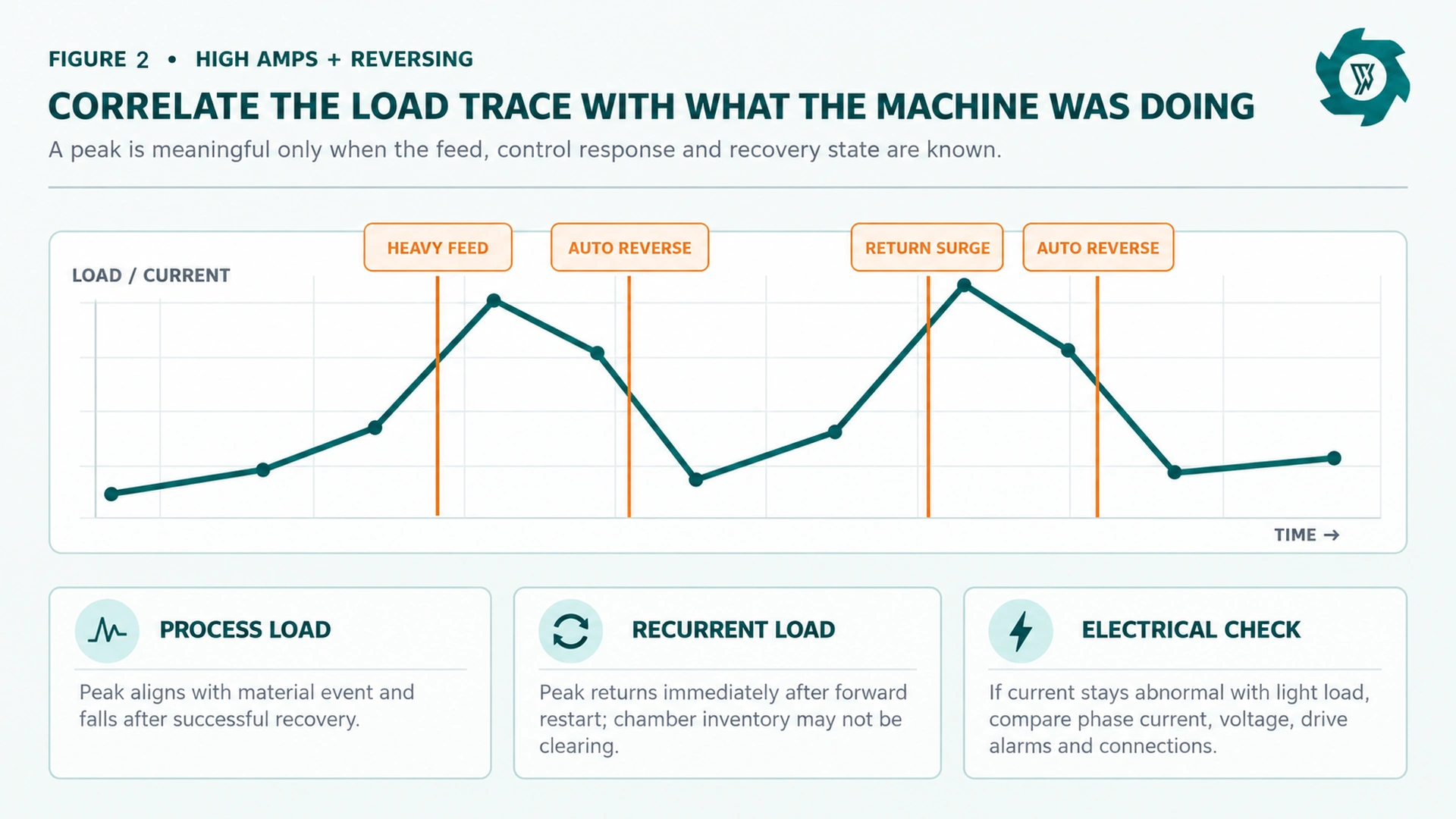
3. Repeated Reversing: Treat the Sequence as Evidence, Not the Failure
Automatic reverse is normally intended to help a shredder recover from a difficult bite or excessive load. The machine briefly changes direction, releases or repositions material and then attempts forward cutting again. That control action is useful. The fault condition is when reversals become so frequent or ineffective that they consume productive time, create repeated trips or fail to clear the same material state.
Start by classifying the pattern. A single reverse on an occasional stiff tire is different from five reverse commands on nearly every tire. A reversal that immediately clears the load is different from a sequence in which the same current peak returns as soon as forward rotation resumes. A reversal that begins after returned oversize enters the chamber points to a different material balance than one that begins on fresh-feed engagement.
Do not use reversal count alone as a universal pass/fail number. The useful metric is the machine’s baseline under a defined feed condition, plus whether each reversal restores productive cutting. If a previously stable run develops a clear upward trend with the same feed, that change deserves investigation. Cutter condition can contribute, but detailed wear inspection and sharpen-or-replace decisions should stay in the blade service procedure.
4. Uneven Output: Measure the Distribution Before Adjusting the Shredder
Primary tire shredder output is naturally irregular. The relevant question is whether the project’s accepted size and shape window is still being met. A screen opening is part of that control, but it does not guarantee every piece will have identical dimensions. Long flexible strips can present differently to a screen, pieces can fold, and returned material can be cut multiple times before it passes.
Collect a timed sample from the agreed discharge point and classify it using the project’s measurement method. Record oversize, target-window material, fines if relevant, long strips or folded pieces, and visible steel condition where that matters to the downstream process. Then match the sample to the same operating interval used for current and reversal data. If the sample is poor but load behavior is normal, the size-control path may deserve more attention than the drive.
Uneven output with rising return load
This combination suggests that more material is failing classification or arriving at the screen in a form that does not pass readily. Inspect the screen and return path for build-up, damaged components, bypass routes, poor transfer or a changed material presentation. Also confirm that the target size did not change without a corresponding change in expected recirculation.
Uneven output with more reversals and high current
When all three appear together, the problem is more likely to be upstream of final discharge. Check whether the chamber is overfilled, whether difficult tire sections are arriving in batches, whether return material is surging back, and whether the cutting system has changed condition. Do not jump straight to a smaller screen. A tighter classification can increase return load and make the original load problem worse.
Uneven output with normal chamber load
If current, feed rhythm and reversal behavior remain near baseline, inspect the classification and material-transfer path. Look for a damaged or incorrectly installed screen component, an unintended bypass, spillage re-entering the product stream, or a downstream conveyor that is remixing accepted and returned material.
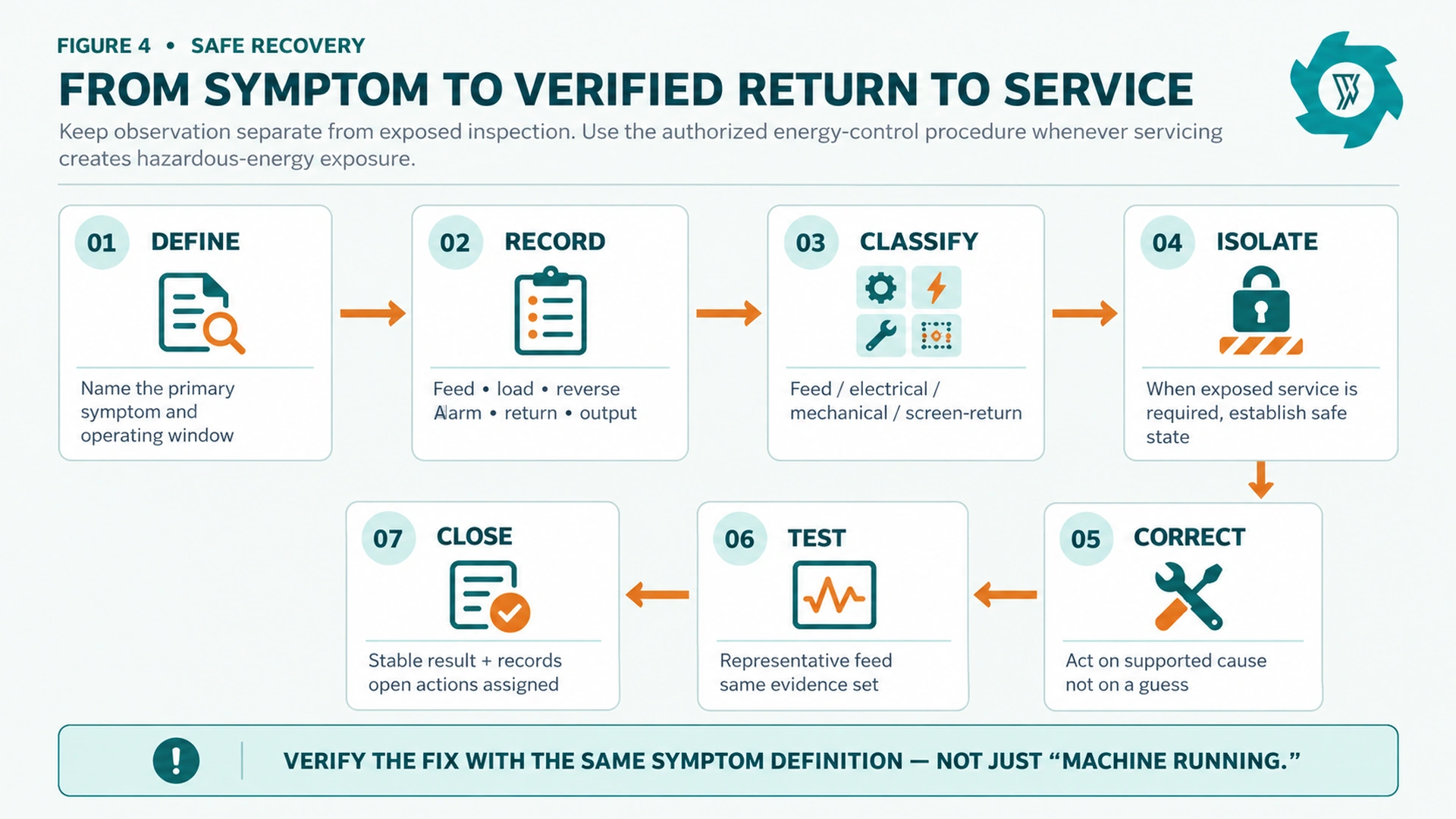
A Practical Troubleshooting Sequence for Operators and Maintenance Teams
The sequence below is designed to prevent random adjustment. It is not a substitute for the machine manual or the site’s safety procedures. It simply gives production and maintenance teams a common order for collecting evidence and deciding when the machine must move from observation to controlled inspection.
- Name one primary symptom. Use “repeated reverse without recovery,” “sustained high phase-B current,” “jam after truck-tire bead section,” or “oversize distribution increased,” not “machine unstable.” Secondary symptoms can be added after the primary one is defined.
- Freeze the comparison boundary. Record tire family, preparation state, screen/return configuration, fresh-feed method and the observation window. Avoid changing three settings at once.
- Capture the event timeline. Record feed arrival, load/current response, reverse commands, alarms, stop duration, operator interventions, manual clearing if any, and return-loop state. Use timestamps whenever the controller makes them available.
- Separate feed, load, control, mechanical and classification causes. Ask which evidence supports each category. A suspected cause without matching evidence remains a hypothesis.
- Stop and isolate when inspection creates exposure. OSHA requires hazardous-energy control for covered servicing where unexpected energization, startup or stored energy can cause injury; machine guarding requirements also remain applicable.[4][5]
- Correct one supported cause. Examples may include restoring the agreed feed preparation, clearing a restricted return transfer under the authorized procedure, repairing damaged classification hardware, correcting an electrical supply problem, or completing machine-specific mechanical service.
- Run a controlled recovery test. Use representative feed and compare the same indicators that defined the fault: current/load, reversals, productive cutting, return behavior and output sample. Close the issue only when the symptom has returned to the agreed normal range and any safety or maintenance action is documented.
NIOSH’s hazardous-energy-control guidance emphasizes documented procedures, isolation of energy sources, control of stored energy and verification before exposed service work. It also notes that jam-clearing is a recurring context in which workers can be exposed to hazardous energy.[6] For that reason, a troubleshooting sheet should clearly separate observations made from a normal safe operating position from work that requires an authorized service state.
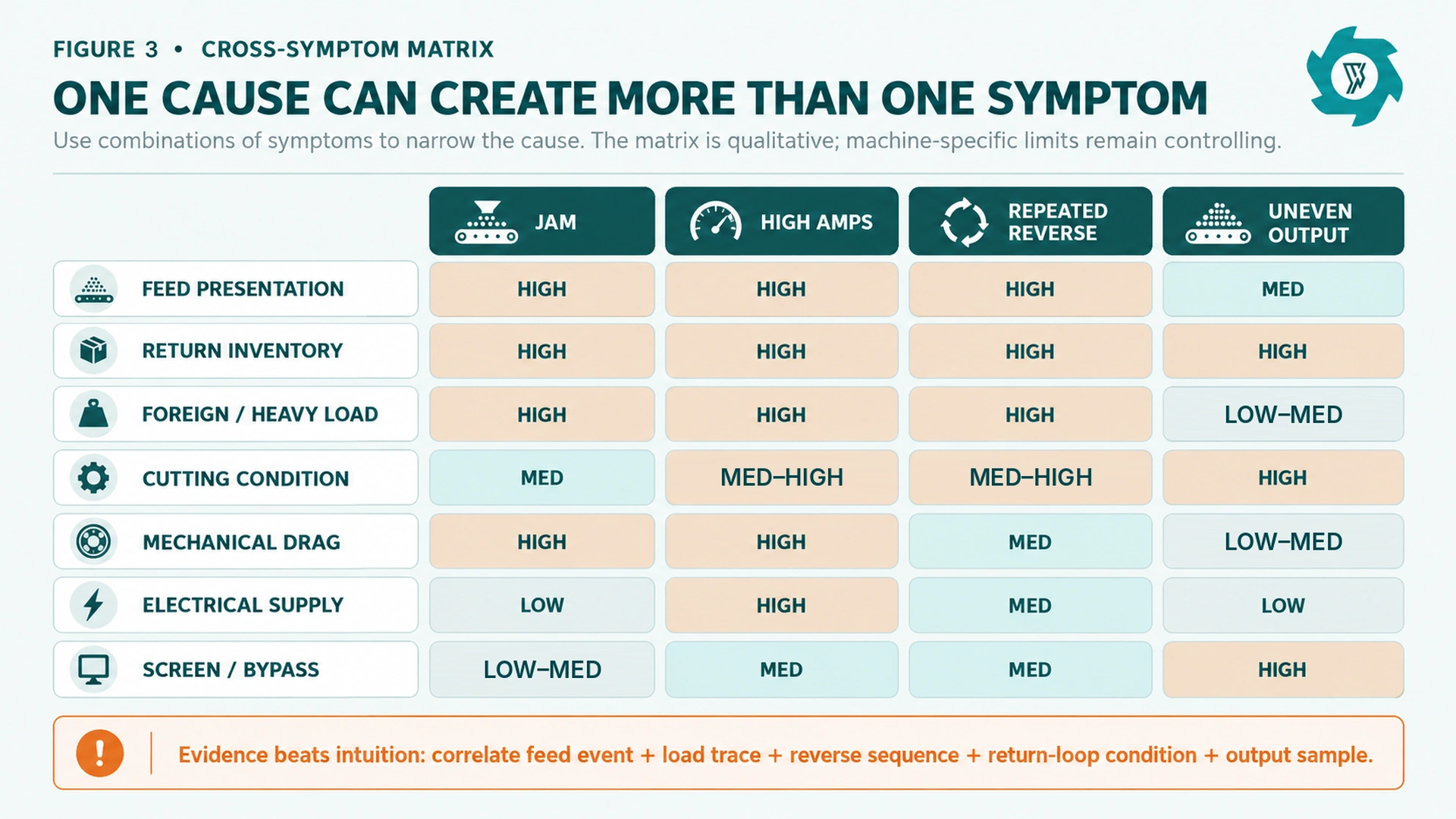
Use a Cross-Symptom Matrix Instead of One-Cause Thinking
| Possible cause group | Jam | High amps | Repeated reverse | Uneven output | Evidence that helps confirm it |
|---|---|---|---|---|---|
| Unstable or oversized feed presentation | High | High | High | Medium | Event begins with a specific tire geometry or feed slug; improves when agreed feed state is restored. |
| Excess return inventory / recirculation surge | High | High | High | High | Return conveyor or screen inventory rises before events; forward recovery is brief. |
| Foreign object / abnormal concentrated load | High | High | High | Low–medium | One material event has a distinct load signature or physical evidence. |
| Cutting-system condition change | Medium | Medium–high | Medium–high | High | Trend develops over time under comparable feed; physical inspection supports the change. |
| Mechanical drag or interference | High | High | Medium | Low–medium | Load remains abnormal with little material; noise, rubbing, position-specific resistance or inspection evidence appears. |
| Electrical supply / connection problem | Low | High | Medium | Low | Phase current/voltage imbalance, voltage drop, drive alarm or abnormal load without matching material event. |
| Screen / classification / bypass problem | Low–medium | Medium | Medium | High | Output sample shifts while chamber load may remain normal; physical screen/transfer evidence confirms it. |
The matrix is deliberately qualitative. Different shredder models use different motors, drive controls, cutter arrangements and protection logic. A universal current threshold or reversal count would be misleading. Use the machine-specific limits, controller logic and component ratings as the hard limits, and use the plant’s own baseline to detect change.
What to Record During a Troubleshooting Run
A useful troubleshooting log should be short enough that operators will actually complete it. One event row can include timestamp, tire family, preparation state, feed pattern, current or load value, reversal count, drive alarm, time to recover, return-loop condition and a note on discharge quality. Add a photo or video reference only when it can be captured from a designated safe position.
Trend data are more valuable than isolated maxima. If a current trace is only available as a screenshot, include the time scale and the event that produced it. If the control system stores alarms, export or photograph the sequence before repeated resets erase the context. If the issue appears only after the machine has run for a period, note the elapsed production time and whether the return loop was already loaded.
When to Escalate Instead of Continuing to Experiment
Stop trial-and-error adjustment when the machine shows a condition that cannot be explained and safely tested from the normal operating position. Escalation is also appropriate when a jam cannot be cleared through the approved automatic sequence, when the same protection trip repeats after restart, when high current persists with little material in the chamber, when there is abnormal mechanical noise or visible movement, when guarding or an interlock is damaged, or when an electrical fault is suspected.
At that point, create a controlled maintenance work order. The goal is to preserve evidence and avoid secondary damage. If the supplier is involved remotely, send one coherent evidence package instead of separate messages from several shifts. Include the machine identification, configuration, tire feed condition, event chronology, alarm history, load trends, safe photos/videos, screen-return status and the output sample tied to the same time window.
Verify the Fix With the Same Evidence That Found the Fault
A machine that restarts is not automatically repaired. If the original problem was repeated reversing, verify reversal behavior. If it was high current, compare the load trace under similar feed. If it was uneven output, resample the discharge using the same method. If it was a jam that occurred on a difficult-but-normal tire class, include that representative feed in the controlled recovery test rather than proving the repair with only easy passenger tires.
Keep fresh feed and accepted output as separate observations. A shredder can consume tires while producing little accepted material if the return loop is circulating too much mass. Likewise, a current trace can look calmer simply because the machine is starved. A valid recovery test therefore confirms material flow and electrical/mechanical behavior together.
Why does a tire shredder keep reversing?
Automatic reversing is often a protective or recovery response, not a fault by itself. Investigate when the frequency, duration or recovery pattern changes under a comparable tire mix. Correlate each reversal with feed presentation, motor load, alarms, return-loop condition and the material that entered just before the event.
What causes high amps on a tire shredder?
High current can come from genuine mechanical load, packed material, concentrated steel, a restricted return path, rubbing or drivetrain problems, but electrical supply conditions can also raise current. Compare the event with the machine baseline, phase currents and voltages, controller history and feed condition before changing protection or drive settings.
When is a tire shredder jam different from a normal hard bite?
A hard bite is a short load event that the machine clears through its normal control sequence and returns to stable cutting. Treat it as a jam when material or a machine condition persists beyond the approved recovery sequence, causes repeated nonproductive reversals or trips, or requires a controlled stop and inspection.
Why is tire shredder output uneven even when the screen is installed?
A screen only classifies what reaches it. Uneven output can still result from changing tire construction, long folded strips, worn or damaged screening components, bypass or spill paths, unstable recirculation, inconsistent cutting behavior or a downstream transfer problem.
What evidence should be sent to the supplier for remote troubleshooting?
Send the machine model and configuration, tire types and preparation state, the exact symptom, timestamped alarms, current or load trends, reversal count, safe operating videos, photos of the feed and discharge, screen and return status, recent maintenance history and a controlled output sample. Keep the time window and feed condition clear so the supplier can correlate the evidence.
Need Help Diagnosing a Tire Shredder?
Send the tire range, preparation state, machine configuration, screen/return arrangement, alarm history, current or load trend, reversal behavior, safe operating video and a recent discharge sample. That evidence makes it possible to separate feed, drive, chamber and classification causes before recommending a change.
References
- EPA handbook. Tire-shredder cutting duty and recycle-pass context.
- OSHA LOTO. Hazardous-energy control during servicing.
- DOE voltage. Motor voltage-unbalance troubleshooting context.
- DOE drop. Voltage-drop and connection context.
- OSHA guarding. Machine-guarding requirements.
- NIOSH guide. Hazardous-energy-control guidance.