




Rubber powder mesh is easy to quote and easy to misunderstand. A buyer may ask for “40 mesh” or “80 mesh,” but that number does not tell you the whole particle-size distribution, contamination limit, test method or the production rate at which the material must be produced. For a tire recycler, those missing details matter because every step toward a finer accepted powder changes grinding work, screen return, heat generation and usually throughput.
What Rubber Powder Mesh Size Actually Means
Mesh is a sieve reference. In everyday rubber-powder trading, a higher mesh number generally means a finer material because the corresponding screen opening is smaller. For example, common U.S. test-sieve references are about 850 µm for No. 20, 425 µm for No. 40, 180 µm for No. 80 and 125 µm for No. 120.[1]
That does not mean every particle in “40 mesh rubber powder” measures exactly 425 µm. Ground tire rubber is irregular. A commercial lot contains a distribution of particle sizes, and the product description may mean material that passes a certain sieve, material retained between two sieves, or a grade controlled by several retained/passing limits. ASTM D5603 treats recycled vulcanizate particulate rubber as a material produced to a desired particle-size distribution, while ASTM D5644 provides a sieve-shaker method for measuring that distribution.[2][3]
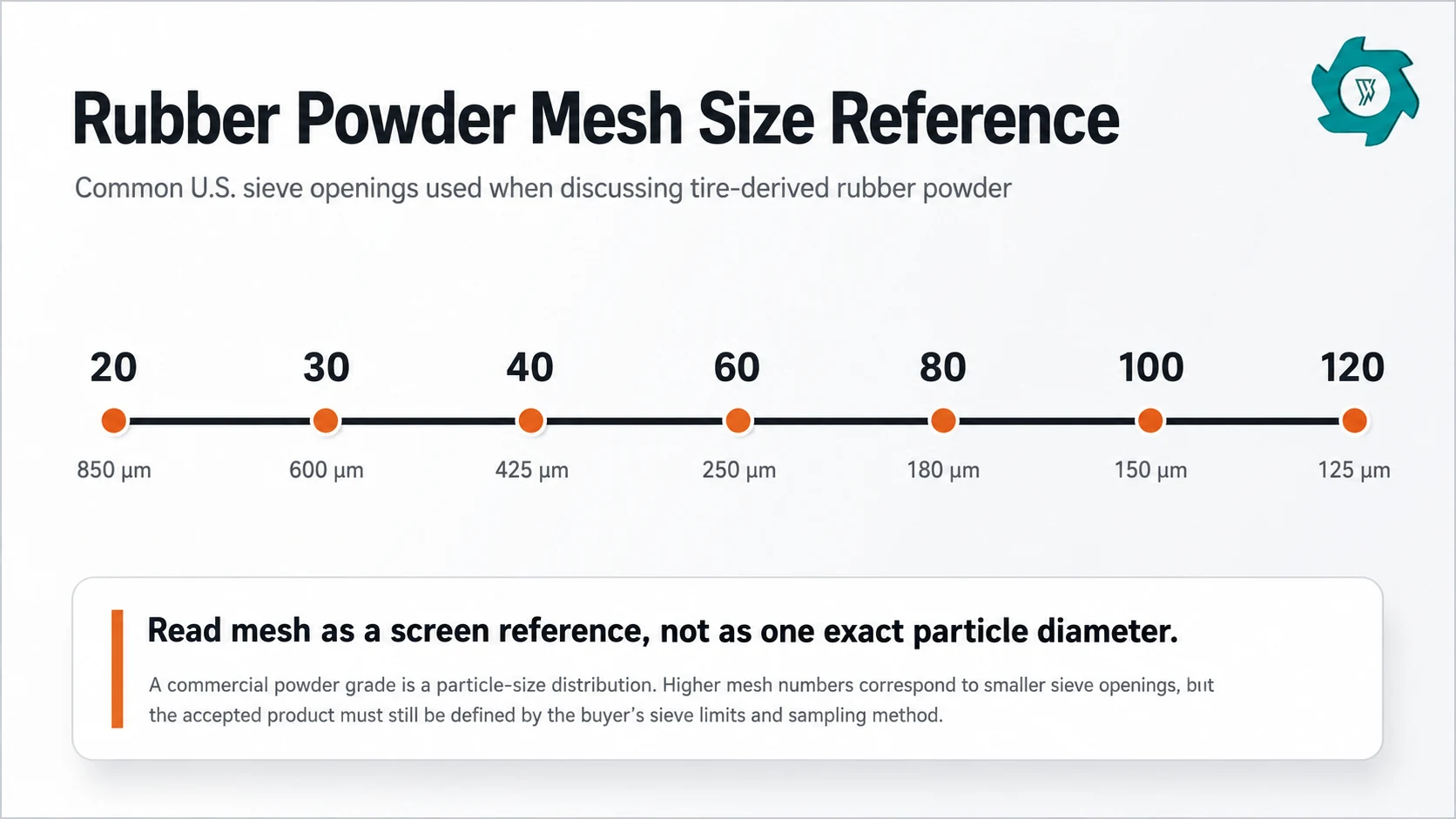
| U.S. sieve / mesh | Approx. opening | How it feels in production | What to verify |
|---|---|---|---|
| 20 mesh | 850 µm | Coarser powder; lower fine-grinding duty than very fine grades | Whether the buyer means passing No. 20 or a bounded grade |
| 30 mesh | 600 µm | Common transition between fine crumb and powder discussions | Asphalt or molded-product specification |
| 40 mesh | 425 µm | Widely discussed industrial powder size | Oversize limit, steel/fiber cleanliness, accepted t/h |
| 60 mesh | 250 µm | Noticeably finer; classification duty becomes more important | Return load and heat control |
| 80 mesh | 180 µm | Fine powder; more mill work per accepted ton | Guaranteed output at 80 mesh, not grinder feed rate |
| 100 mesh | 150 µm | Fine compounding range for selected formulations | PSD, dust handling and buyer test method |
| 120 mesh | 125 µm | Very fine end of many ambient tire-powder lines | Cooling, wear, recirculation and saleable yield |
20–40 Mesh Rubber Powder: Where Coarser Powder Fits
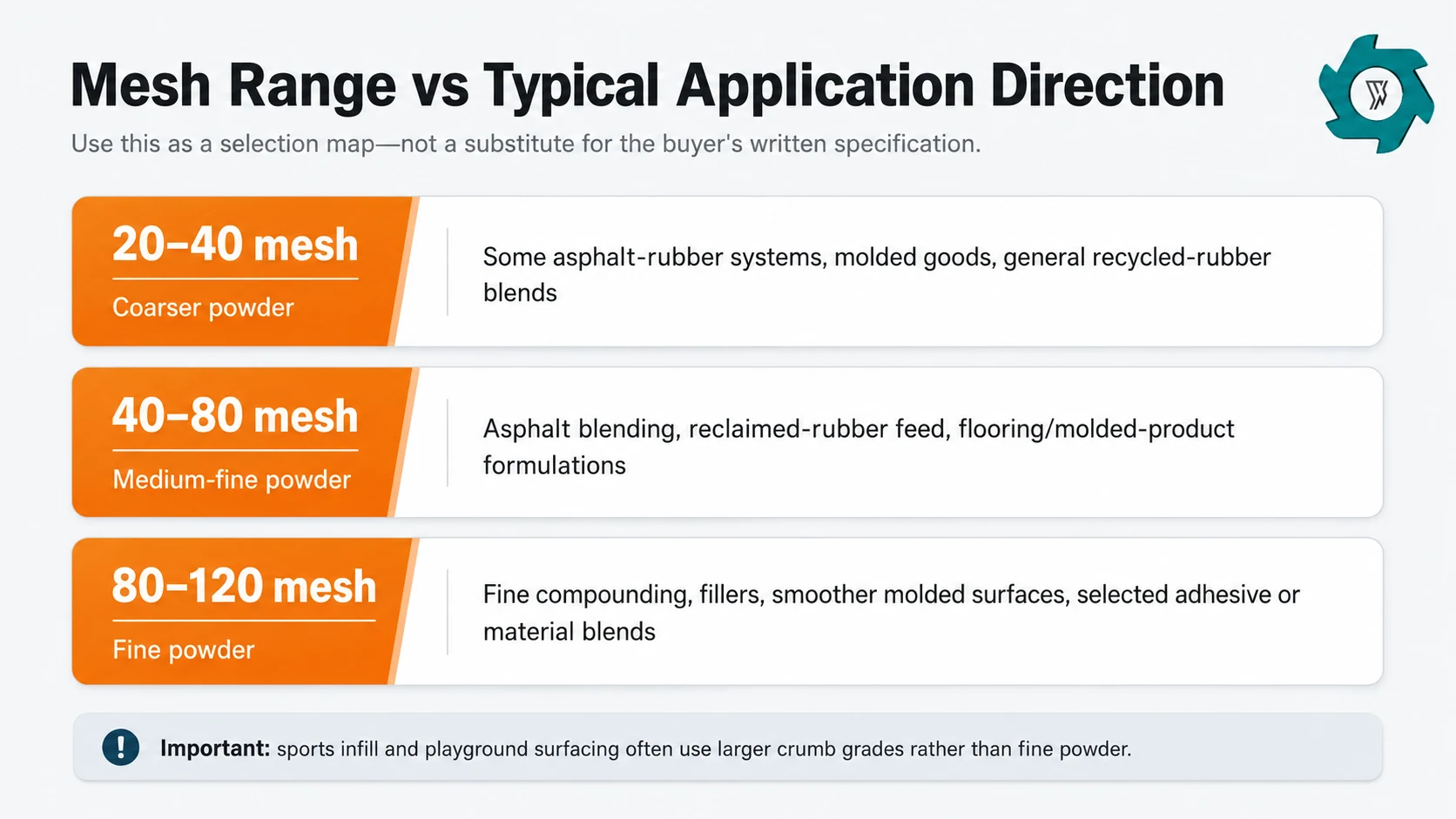
For many recycling projects, 20–40 mesh is a practical starting range because it is fine enough for several industrial uses without pushing the grinding section to the same duty as 80–120 mesh production. The key is to match the grade to a confirmed recipe or paving specification rather than assuming coarser material is automatically “lower quality.”
Rubber-modified asphalt
Asphalt is one of the clearest examples of why a single universal mesh recommendation is risky. FHWA describes crumb rubber used as an asphalt modifier in roughly the 0.6–0.15 mm range, corresponding approximately to No. 30 through No. 100 sieves.[4] An EPA scrap-tire handbook also notes that specifications have varied by process: the Arizona process historically used about 16–30 mesh ground rubber, while terminal-blending approaches used finer grades and later found minus 40 mesh workable in some cases.[5]
So “asphalt rubber = 40 mesh” is too simple. A wet-process binder, terminal blend and dry-process mix can ask for different gradations. If asphalt is your target market, obtain the agency, contractor or binder supplier specification first. The plant should then be configured around that sieve range and the required continuous accepted output.
Molded rubber products and general recycled-rubber blends
Coarser powder can also be used in molded mats, blocks, underlays and other recycled-rubber formulations where the producer is comfortable with visible or larger rubber particles. ASTM D5603 explicitly recognizes molded rubber products and other tire and non-tire end uses for recycled vulcanized particulate rubber.[2] The acceptable size depends on the mold, binder system, surface requirement and how much recycled rubber is being blended into the product.
A useful purchasing question is not “Can 30 mesh be used for mats?” but “What maximum particle size and retained percentage does the mat producer accept?” That wording can be tested. The first wording cannot.
40–80 Mesh Rubber Powder: A Flexible Industrial Range
The 40–80 mesh band is often attractive because it gives formulators a finer, more uniform material while remaining within the practical range of many ambient mechanical grinding systems. It can appear in rubberized asphalt, reclaimed-rubber preparation, flooring compounds, molded-product recipes and other rubber or polymer blends. None of those markets should be treated as a guaranteed outlet, but they are useful directions for customer development.
Why 40 mesh is such a common reference point
No. 40 is fine enough to enter a wide range of discussions about asphalt, recycled rubber compounds and molded goods, but it does not require the same degree of fine classification as 100 or 120 mesh. This makes it commercially convenient for a recycler that wants a broadly marketable grade. It is still necessary to control residual steel and textile fiber, because those contaminants become more visible to downstream processors as the rubber itself gets finer.
Why an 80 mesh order changes the plant conversation
Moving from 40 mesh toward 80 mesh is not just a screen swap. More material may need another grinding pass before it enters the accepted bin. Recirculation increases internal tonnage even when saleable output stays the same. The mill also has to remove more heat per accepted ton, while screens and collection equipment handle a finer, dustier material.
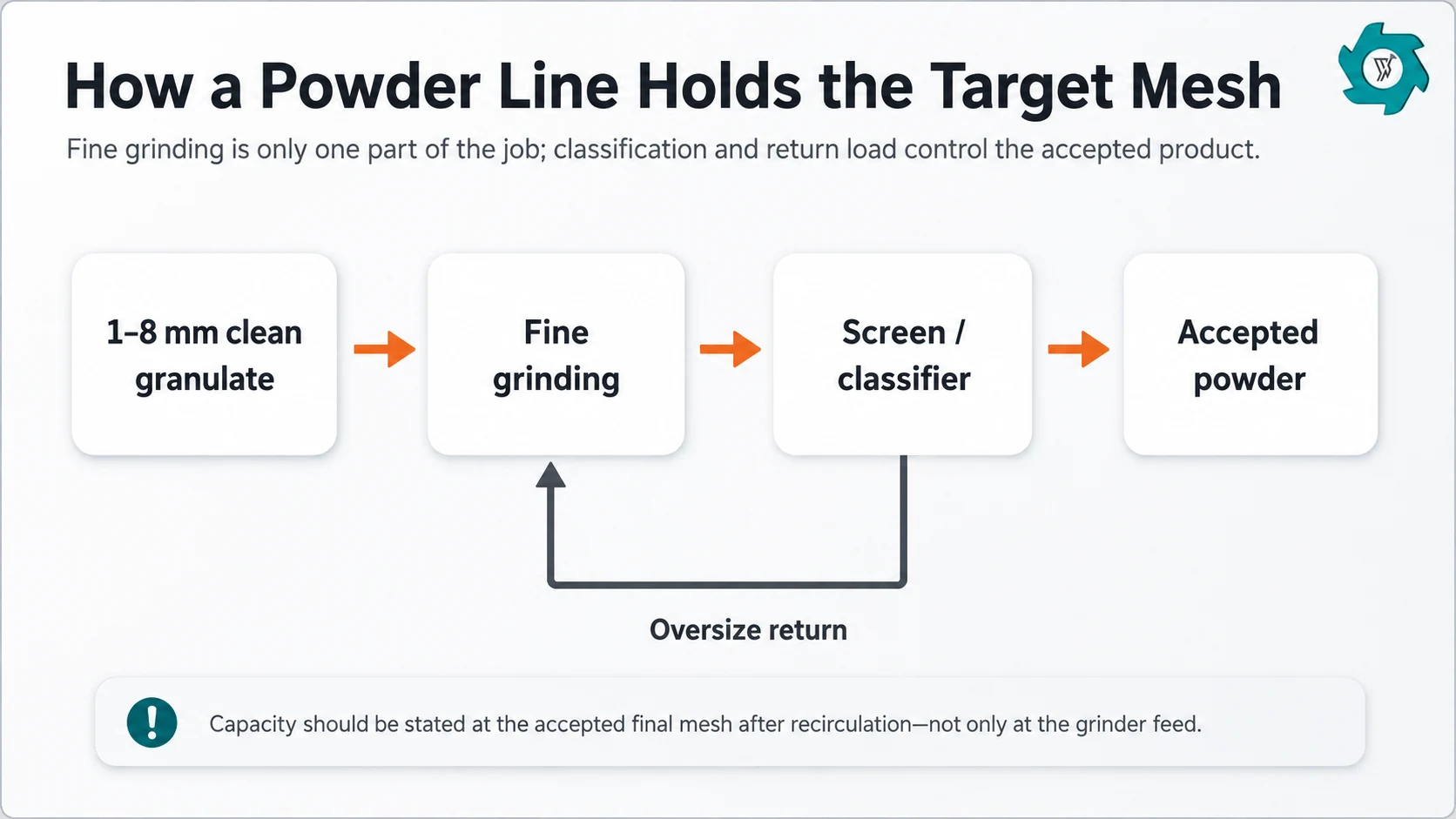
The current YUXI tire rubber powder plant is described as an ambient mechanical line producing approximately 20–120 mesh powder from clean 1–8 mm rubber granulate. The process also makes the right commercial distinction: finished capacity should be checked at the required mesh, not only at the upstream feed point.
80–120 Mesh Rubber Powder: When Finer Really Helps
Fine rubber powder can disperse more evenly in selected compounds and can help when the downstream product needs a smoother appearance or a smaller maximum particle size. Typical directions include fine recycled-rubber compounds, fillers, some adhesive or building-material formulations, and molded products where a coarse particle would be undesirable.
But “finer is better” is not a reliable business rule. Finer grinding raises the specific processing duty. If the buyer would accept 40 mesh, making 120 mesh simply because the machine can do it may reduce throughput and increase wear without adding sales value. The mesh should be a market decision first and a machine setting second.
Decision rule: choose the coarsest grade that fully satisfies the downstream specification. Only move finer when the buyer’s process, surface requirement, reactivity target or quality standard gives a reason to do so.
Applications That Usually Need Crumb, Not Fine Powder
Search results often mix rubber crumb and rubber powder into one category, which creates a practical sourcing problem. Synthetic-turf infill, many running-track systems, playground layers and landscaping products commonly use particles larger than the fine 20–120 mesh range discussed here. ASTM D5603 lists synthetic turf infill among recycled rubber end uses, but that does not make 80 mesh powder a normal infill grade.[2]
If your buyer is asking for millimeter-sized particles, the project may belong upstream at the crumb-rubber stage rather than at fine powder grinding. That distinction matters because a plant designed around 1–4 mm crumb has a different bottleneck, screen set, dust profile and energy demand from a plant whose saleable product is 80 mesh powder.
This is one of the first checks we would make before adding a powder grinder to an existing tire recycling line: is the market actually paying for powder, or is the customer calling a larger crumb fraction “powder” in casual conversation?
How Grinding and Screening Hold the Final Mesh
Fine grinding creates smaller particles, but the classifier or screen decides what counts as finished product. Oversize material that does not pass the selected screen should return for another grinding pass instead of being mixed into the accepted bin. This return loop is why a nominal “2 t/h grinder” does not automatically mean 2 t/h of saleable 80 mesh powder.
Feed preparation still controls the powder section
The grinder should receive clean, controlled rubber granulate. Residual wire can damage wear parts and contaminate finished powder. Excess textile fiber interferes with classification and product consistency. Wide feed-size swings also make the grinder load uneven. A well-run powder section therefore depends on steel liberation, magnetic separation, granulation, fiber separation and grading that happened earlier in the line.
Fine powder increases the importance of heat control
Grinding rubber creates heat. As the target becomes finer, more work is usually required per accepted ton, so wind or water cooling, stable metering and sensible recirculation become more important. Overloading a mill to chase nameplate capacity can increase temperature while producing a wider and less predictable particle-size distribution.
A grinder can produce fine material faster than a poorly sized classifier can separate it. When that happens, the operator may see high internal circulation, product carryover or a screen that spends too much time handling material that should have been controlled upstream. For multi-grade plants, each saleable fraction also needs its own bin, transfer route and packaging plan.
How to Specify Rubber Powder So Suppliers Quote the Same Product
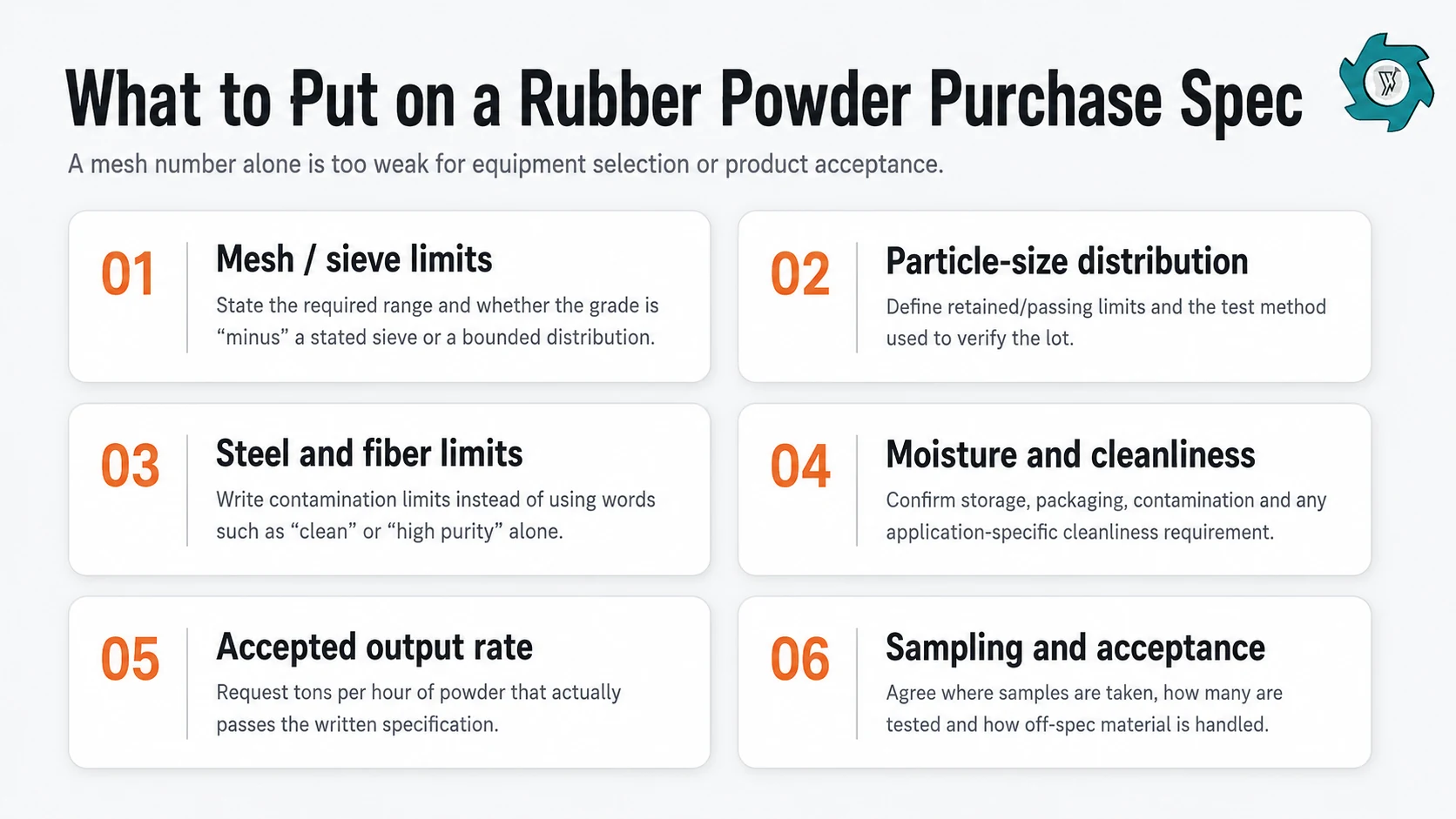
A useful RFQ should go beyond “80 mesh rubber powder line.” Otherwise, two suppliers can quote completely different performance boundaries and both appear to meet the request.
1. Write the sieve distribution
State the target screen or screens and how the grade is defined. If the buyer uses “minus 40 mesh,” confirm whether all material must pass No. 40 or whether a small oversize allowance exists. If the product is bounded between two sieves, write both limits.
2. Name the test method
ASTM D5644-23 describes a mechanical vibratory sieve-shaker procedure for recycled vulcanizate particulate rubber at 90 µm (170 mesh) and larger.[3] Even if the buyer uses another local method, both sides should use the same procedure, sample preparation and reporting basis.
3. Define steel and fiber limits
“High purity” is not an acceptance test. State the maximum metal and textile contamination the buyer will accept and how it will be measured. This makes the upstream magnetic and air-separation duties part of the equipment design instead of an afterthought.
4. Confirm moisture and storage conditions
Moisture can change screening behavior, storage and dosing. If bags may sit outdoors or travel through humid conditions, packaging and storage expectations belong in the specification too. The number does not need to be invented by the machine supplier; it should come from the downstream buyer or process requirement.
5. Ask for accepted finished tons per hour
This is one of the most important commercial checks. Ask how many tons per hour will enter the finished-product bin while continuously meeting the stated mesh and cleanliness limits. Do not accept an upstream tire-feed number as a substitute.
6. Agree on sampling before the performance test
Specify where samples will be taken, how long the plant must run at steady state, how many samples are required and what happens to off-spec material. This avoids a familiar commissioning argument in which one side tests the best ten minutes and the other side expects a full-shift average.
Choosing Between 20, 40, 80 and 120 Mesh
| If your buyer says… | Start by checking… | Plant implication |
|---|---|---|
| “20–30 mesh is acceptable” | Whether a coarser powder or even fine crumb meets the product recipe | Do not overinvest in ultra-fine grinding without a reason |
| “40 mesh for asphalt” | The exact paving/binder specification and passing limits | Size screens and return around the asphalt gradation, not the label |
| “60–80 mesh for compounding” | Dispersion requirement, contamination limits and accepted PSD | More fine-grinding, cooling and classification duty |
| “100–120 mesh” | Why the formulation needs that fineness and what value it adds | Verify real output at the fine grade and expected wear |
| “Several mesh grades” | Daily demand for each fraction and whether orders overlap | Additional classification, bins, conveying and packaging may be required |
If you are still comparing investment levels, the rubber powder machine price and production line cost guide explains why finer mesh, wider delivery scope, dust control and the difference between grinder-only and whole-tire lines can change the budget substantially.
A Practical Plant-Selection Sequence
- Find the buyer first. Ask for an actual product specification, not just an application name.
- Translate mesh into a testable PSD. Confirm sieve series, passing/retained limits and test method.
- Define feed condition. Whole tires, wire-free chips and clean 1–8 mm granulate require very different equipment scopes.
- Set contamination targets. Steel and fiber limits influence separation stages before fine grinding.
- Request accepted output at the target mesh. This prevents an upstream capacity number from being mistaken for powder capacity.
- Check return, cooling and dust interfaces. These become more important as the product gets finer.
- Plan product handling. A plant making three grades needs a different collection and packaging layout from a plant making one grade all week.
We normally recommend that buyers send a small set of representative downstream requirements together with feed photos and a desired shift schedule before finalizing a configuration. It is a much stronger starting point than asking for “the biggest 80 mesh machine,” because the real bottleneck may be separation, screening or return handling rather than motor power.
FAQ
Which rubber powder mesh is used for asphalt?
There is no single universal asphalt mesh. FHWA documents common modifier sizes around No. 30–No. 100 sieve, while individual wet-process, terminal-blend and local agency specifications can differ. Use the paving specification as the controlling document.
Can one rubber powder plant make several mesh sizes?
Often yes, provided the grinding, screening, return, collection and packaging sections are configured for those fractions. Capacity should be verified for each saleable grade.
Does finer rubber powder always sell for more?
No. The cost of producing fine powder is more, but its value depends on a downstream buyer that needs the smaller particle size. A coarser grade can be the better business choice when it already meets the application specification.
Need to Produce a Specific Rubber Powder Mesh?
Send your tire feed, target mesh distribution, required finished output and buyer cleanliness limits. YUXI can configure the grinding, screening, separation and return system around the product you actually need to sell.
References
- ASTM E11 — U.S. test sieve openings.
- ASTM D5603-23 — Recycled rubber classification.
- ASTM D5644-23 — Rubber particle-size testing.
- FHWA — Scrap tires in pavement applications.
- U.S. EPA — Scrap tire recycling and applications.