A manufacturer list is only useful when every company is being judged against the same job. For rubber powder projects, that job is not simply “make tires smaller.” The supplier has to deliver a controlled feed into the fine-grinding stage, keep steel and textile out of the mill, manage heat, return oversize material, and hold output close to the mesh range the buyer can actually sell.
How We Compared Rubber Powder Machine Manufacturers
Fine rubber powder puts different demands on a plant than TDF chips or ordinary crumb rubber. A primary shredder can tolerate a broad discharge range; a powder mill cannot. Once the line is working below a few millimeters, feed consistency, residual metal, fiber carryover, cooling, screen loading and wear rate start to matter more than the headline motor size.
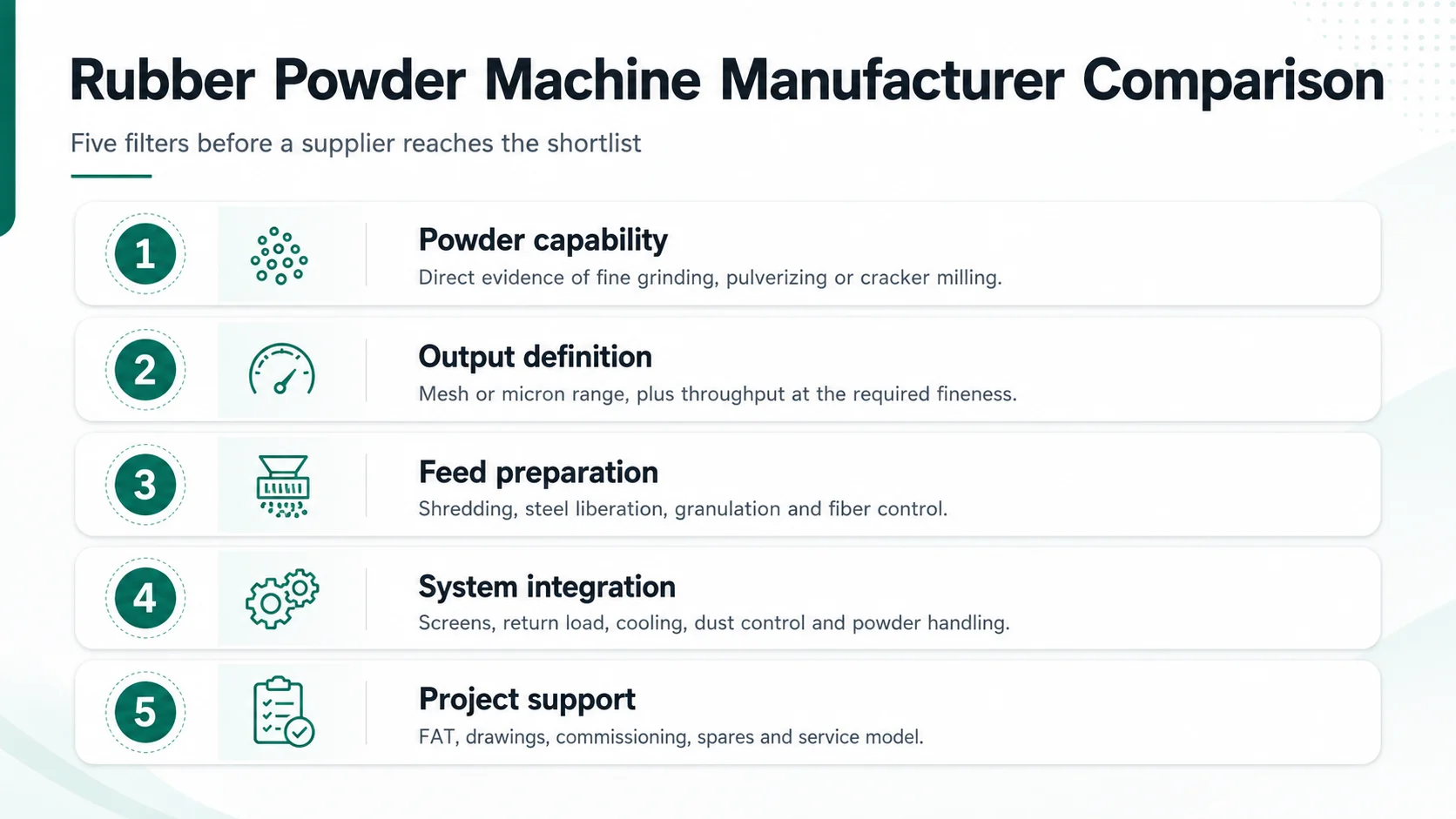
For that reason, we used five practical filters. First, the company had to show a direct link to rubber powder, fine grinding, pulverizing, cracker milling or a tire-recycling system that clearly reaches the powder stage. Second, we looked for published size ranges or other evidence describing the final material. Third, we considered whether the supplier can connect the mill to upstream shredding, granulation and separation. Fourth, we looked at service footprint or project evidence where it was publicly documented. Finally, we considered fit: a large established recycler buying a high-duty refining system does not shop in the same way as a first-time overseas investor buying a complete plant.
Use the same buying criteria across suppliers. A strong powder machine can still be a poor project choice if the upstream feed and separation system are mismatched.
Top 9 Rubber Powder Machine Manufacturers at a Glance
Rank
Manufacturer
Base
Published powder/fine-grind capability
Best fit
1
ELDAN Recycling
Denmark
Powderiser / cracker mill; powder plant down to 50 mesh
Established recyclers wanting modular turnkey systems and documented plant engineering
2
Granutech-Saturn Systems
United States
Powderizers and G-4X refiner; published 10–80 mesh on refiner
North American and international plants prioritizing heavy-duty fine grinding
3
YUXI Machinery
China
Complete ambient tire-to-powder line; published 20–120 mesh
Export buyers comparing complete-line scope, customization and project cost
4
CM Shredders
United States
Dual Drive Crackermill; published 10–80 mesh
Turnkey tire processors needing staged shredding, liberation, granulation and milling
5
ECO Green Equipment
United States
ECO Krumbuster and integrated tire-recycling equipment; powder capability to fine mesh
Buyers focused on modular tire systems and high-throughput crumb/powder production
6
PALLMANN / Siempelkamp SRS
Germany
Rubber pulverizing systems including PolyGrinder and fine-powder technologies
Processors that need specialized grinding technology and material testing
7
ZERMA
Germany / China
Tire fine shredding, granulation and pulverizing technology
OEMs, integrators and processors building modular size-reduction systems
8
3E Machinery
China
Tire line with mill; published 40–80 mesh and broader line output options
Buyers needing a configurable complete tire-recycling line
9
WANROOETECH
China
Rubber mill / pulverizer; published 30–120 mesh line and finer machine ranges
Cost-sensitive buyers comparing standalone mills and complete lines
Manufacturer Profiles
1. ELDAN Recycling — Denmark
ELDAN is one of the clearest references in this category because it treats powder production as an extension of a complete tire-recycling system rather than as an isolated grinder. Its tire-recycling pages describe modular plants that can move from chips to granulate and then from granulate to powder. The company’s Cracker Mill is positioned as the powderiser used in ELDAN powder plants, with published production down to 10–50 mesh.
That modular approach matters when a recycler already sells several fractions. A plant may want to stop part of the stream at granulate size while sending another fraction to fine grinding. ELDAN also publishes customer cases where plants produce multiple rubber fractions and document long operating histories. This makes the brand especially relevant to established recyclers that value output flexibility and engineering documentation more than minimum upfront price.
Where it stands out
Strong tire-specific engineering, modular expansion from granulate to powder, documented customer cases, and a long-established European service model.
What to verify
Premium equipment can require a larger capital budget. Buyers should compare the exact powder module, energy demand, local service arrangement, and total installed scope.
2. Granutech-Saturn Systems — United States
Granutech-Saturn has unusually direct fine-grinding documentation. Its tire systems combine shredders, granulators, Powderizers and refiner mills. The company states that the Saturn G-4X Refiner Mill can produce 10–80 mesh rubber powder from clean upstream stock, while its Powderizers cover coarser powder and granulate ranges. That gives buyers more than one route to the final particle size.
Another advantage is system depth. A buyer can evaluate the fine mill as part of a two-, three- or four-stage tire-recycling system rather than sourcing a grinder and then solving feed preparation separately. For operators who already understand tire recycling and want a robust U.S.-based equipment package, Granutech is a natural benchmark.
Where it stands out
Published fine-powder range, heavy-duty tire-recycling specialization, multiple refining technologies, and more than five decades of industrial rubber size-reduction experience.
What to verify
Confirm throughput at the exact mesh you intend to sell. Capacity normally falls as powder becomes finer, so a nominal mill rating should not be treated as finished-product output without test conditions.
3. YUXI Machinery — China
YUXI approaches rubber powder as the final stage of an ambient tire-recycling line. Its tire rubber powder plant connects bead handling, cutting, primary shredding, rasping, magnetic separation, granulation, grading, fiber separation and fine grinding. The published final range is 20–120 mesh, with clean 1–8 mm rubber granulate feeding the powder grinder.
That full-line focus is where YUXI is most competitive. It is not being ranked here as the oldest global fine-grinding brand, and it does not have the same long public case history as ELDAN or Granutech. Its appeal is different: overseas buyers can compare one integrated proposal covering the full tire-to-powder route rather than sourcing the front end, separation system and mill from several vendors.
The buyer still needs to verify the difficult details. Ask for sustained output at the chosen mesh, cooling arrangement, steel and fiber limits, screen-return load, electrical standard, spare wear parts, installation responsibilities and acceptance test conditions. For projects still defining the front end, the earlier decision on whether bead steel should be removed or isolated can affect downstream wear; this bead-removal guide explains that relationship in more detail.
Where it stands out
Complete tire-to-powder scope, broad published mesh range, export-oriented customization, and one-supplier integration across shredding, separation and grinding.
What to verify
Compared with older Western brands, buyers should ask for destination-specific reference projects, local service response, FAT conditions and spare-parts planning before order placement.
4. CM Shredders — United States
CM’s tire processing route is laid out in stages, ending with milling and screening. The Dual Drive Crackermill accepts clean crumb and is published for 10–80 mesh output. Two independently driven rolls let the mill change friction ratio, while water-cooled rolls and integrated controls address the heat that appears during fine grinding.
CM is also attractive to buyers who want one supplier across the chain: primary shredding, wire liberation, granulation, fiber removal, milling, screening and cleaning. That makes technical responsibility easier to assign when a downstream bottleneck is actually caused by an upstream machine.
Where it stands out
Clear staged tire-processing architecture, dedicated crackermill technology, broad tire-equipment portfolio, and manufacturing/service presence in several regions.
What to verify
Ask how the system will be configured for your tire mix and target powder. A crackermill that performs well on clean 6–8 mm feed still depends on good liberation and separation upstream.
5. ECO Green Equipment — United States
ECO Green Equipment builds tire-specific shredding, granulation and downstream systems. Its ECO Krumbuster is marketed as a fine-grinding machine for scrap rubber, and published project material describes production of fine powder alongside higher-throughput crumb rubber. The equipment range also includes shredders, granulators, screening, conveying, magnets and bagging support.
The practical appeal is modularity. A recycler can build a line around several ECO machines instead of buying only the final mill. Buyers comparing ECO with CM or Granutech should pay attention to the whole process guarantee: feed size into the fine grinder, steel and fiber specification, product collection, and whether capacity is quoted at the mesh that actually earns revenue.
Where it stands out
Tire-focused equipment portfolio, modular line design, U.S. support, and a dedicated fine-grind product rather than only general-purpose shredders.
What to verify
Request product samples from a comparable tire feed and verify the accepted particle-size distribution, not only a “mesh” headline.
PALLMANN’s strength is fine grinding itself. Current rubber-preparation literature from Siempelkamp Size Reduction Solutions describes multiple pulverizing systems for rubber and positions the PolyGrinder for continuous operation. PALLMANN has also developed technologies for producing very fine rubber powder from pre-cut tire rubber, including systems aimed at temperature-sensitive material.
This profile is different from a supplier whose main offer is a turnkey tire yard. PALLMANN is especially relevant when the buyer already has clean granulate and needs a specialized powder stage, wants trials in a technology center, or is evaluating particle characteristics beyond a single mesh number.
Where it stands out
Deep size-reduction specialization, laboratory and technology-center testing, and dedicated rubber pulverizing systems.
What to verify
Clarify what upstream tire preparation is included. A specialized pulverizing package may require separate shredding, steel liberation, fiber separation and classification equipment.
7. ZERMA — Germany / China
ZERMA is a major size-reduction manufacturer with a product range that includes tire shredders, heavy-duty granulators, pulverizers and accessories. Its tire technology is particularly strong in pre-shredding and fine shredding, while its broader portfolio gives integrators access to granulation, conveying, metal separation and de-dusting components.
For a buyer, ZERMA is less about a single branded “rubber powder plant” and more about building a technically sound size-reduction train from standardized machines. That can be an advantage for OEMs and engineering companies that want control over every module. It can be less convenient for a first-time investor who expects one vendor to own the complete tire-to-powder process guarantee.
Where it stands out
Global size-reduction footprint, tire-specific shredders, a broad machinery platform, and strong suitability for OEM/integrator projects.
What to verify
Confirm the exact machine chain for sub-millimeter or mesh-defined rubber powder. Not every ZERMA pulverizer configuration is tire-specific.
8. 3E Machinery — China
3E Machinery publishes a complete tire-recycling line with shredding, rasping, granulation, separation and milling. Its line literature describes rubber granulate entering a mill for 40–80 mesh output, and its broader tire-line specifications cover a wide capacity range and several finished sizes.
3E deserves a place in procurement comparisons because it is selling the connected process rather than only the powder mill. It is likely to be evaluated against YUXI and WANROOETECH by buyers who want a Chinese supplier and are weighing price, layout customization, automation level and export support.
Where it stands out
Complete tire-recycling system coverage, published mill stage, and a broad capacity envelope.
What to verify
Ask for the current configuration rather than relying on older case pages. Confirm the exact mill technology, guaranteed mesh, hourly output, wear package and control scope offered in the quotation.
9. WANROOETECH — China
WANROOETECH has one of the more explicit Asian product ranges for fine tire grinding. Its waste-tire line describes a rubber mill after shredding, rasping, granulation and separation, while individual pulverizer pages publish ranges such as 20–100 mesh and line pages commonly cite 30–120 mesh. The company also supplies fiber separators, magnetic equipment and other upstream modules.
For cost-sensitive buyers, this makes WANROOETECH worth benchmarking. The important step is to separate catalog capability from project guarantee. A mill may be able to produce very fine material, but the economic question is how many kilograms per hour it can sustain at that fineness with the actual rubber formulation and feed temperature.
Where it stands out
Dedicated rubber pulverizer models, complete-line availability, and a wide published fineness range.
What to verify
Request a feed/output test, power consumption at the target mesh, cooling-water requirement, tool-life assumption and a clear definition of what “capacity” means.
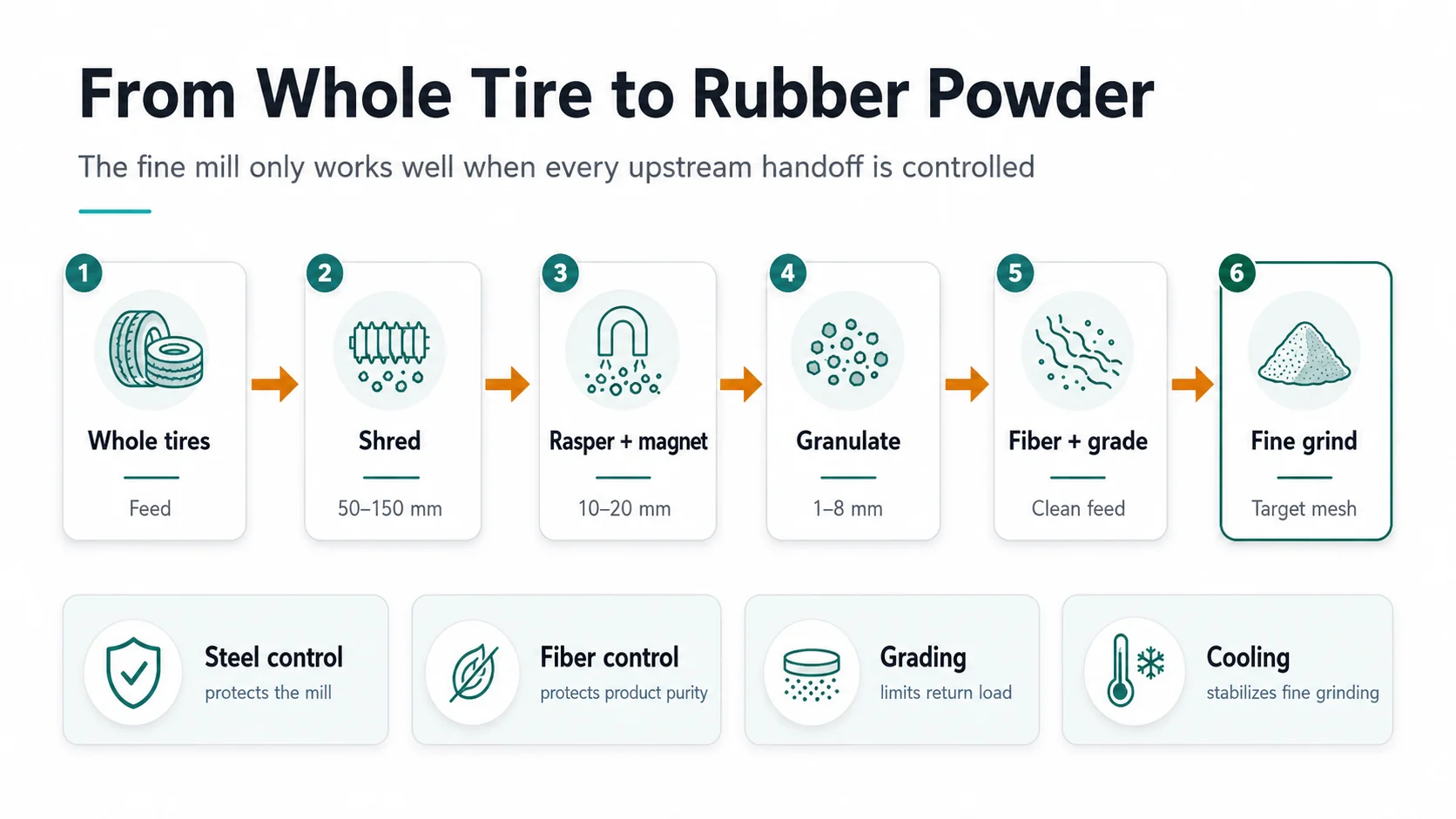
The powder mill is the last value-adding step in a longer preparation chain. Stable fine grinding depends on clean, graded rubber feed.
Rubber Powder Machine vs. Complete Tire-to-Powder Line
The phrase “rubber powder machine” can describe two very different purchases. One buyer may already own a crumb-rubber plant and only need a refiner or pulverizer. Another may have whole waste tires and expect a supplier to deliver everything from bead handling to bagged powder. Comparing those quotations as if they were the same product creates most of the confusion in this market.
If you already have clean, low-metal granulate, focus on the grinder: feed size, fineness curve, throughput at target mesh, cooling, specific power consumption, wear part life, product temperature, screening and return load. If you are starting with whole tires, the upstream machines become part of powder quality. Residual steel that escapes a magnet can damage the fine grinder. Fiber that is not removed can contaminate the final powder. A screen that is too small can choke the line with return material.
This is also why a tire shredder price alone does not predict the cost of a powder project. A standalone machine quote leaves out conveyors, raspers, magnets, granulators, fiber separation, grading, dust collection, electrical integration and powder handling. For a breakdown of those scope differences, see the tire shredder machine price guide.
How to Choose the Right Rubber Powder Machine Supplier
1. Start with the marketable powder, not the machine
Ask the intended customer for a specification. “40 mesh” by itself is still incomplete. You may need a particle-size distribution, maximum oversize, steel limit, fiber limit, moisture limit, bulk density range or packaging requirement. A recycler selling to an asphalt blender may be evaluated differently from one supplying molded rubber products.
2. Compare output at your exact mesh
Fine grinding gets harder as the target gets smaller. A supplier may advertise a broad throughput range that is valid at a coarse setting but not at the finest setting. Put the target mesh in the commercial guarantee and ask what fraction of the finished material must pass the stated screen. If oversize is recycled, ask how much return load the capacity calculation assumes.
3. Define the feed entering the powder mill
Make the supplier write down feed size, residual steel, fiber content and maximum temperature. The fine mill should not become a correction step for poor upstream separation. If the project is still building the granulation stage, purity deserves its own acceptance criteria; a practical overview is available in this rubber granule plant purity guide.
4. Treat cooling as a process requirement
Rubber heats as it is repeatedly compressed, cracked or sheared. Depending on the mill design, cooling may involve water-cooled rolls, internal water circuits, air handling or other temperature-control measures. Ask for normal operating temperature, alarm limits, water quality requirements and what happens to output when ambient temperature is high.
5. Ask who owns integration responsibility
If three vendors supply the shredder, granulator and powder mill, downtime can turn into an argument about whose machine caused the problem. A turnkey supplier has a stronger obligation to make the handoffs work, but the guarantee must still be written around the complete system. Conversely, a specialist mill supplier can be the better choice if you already have competent plant engineering and a stable upstream line.
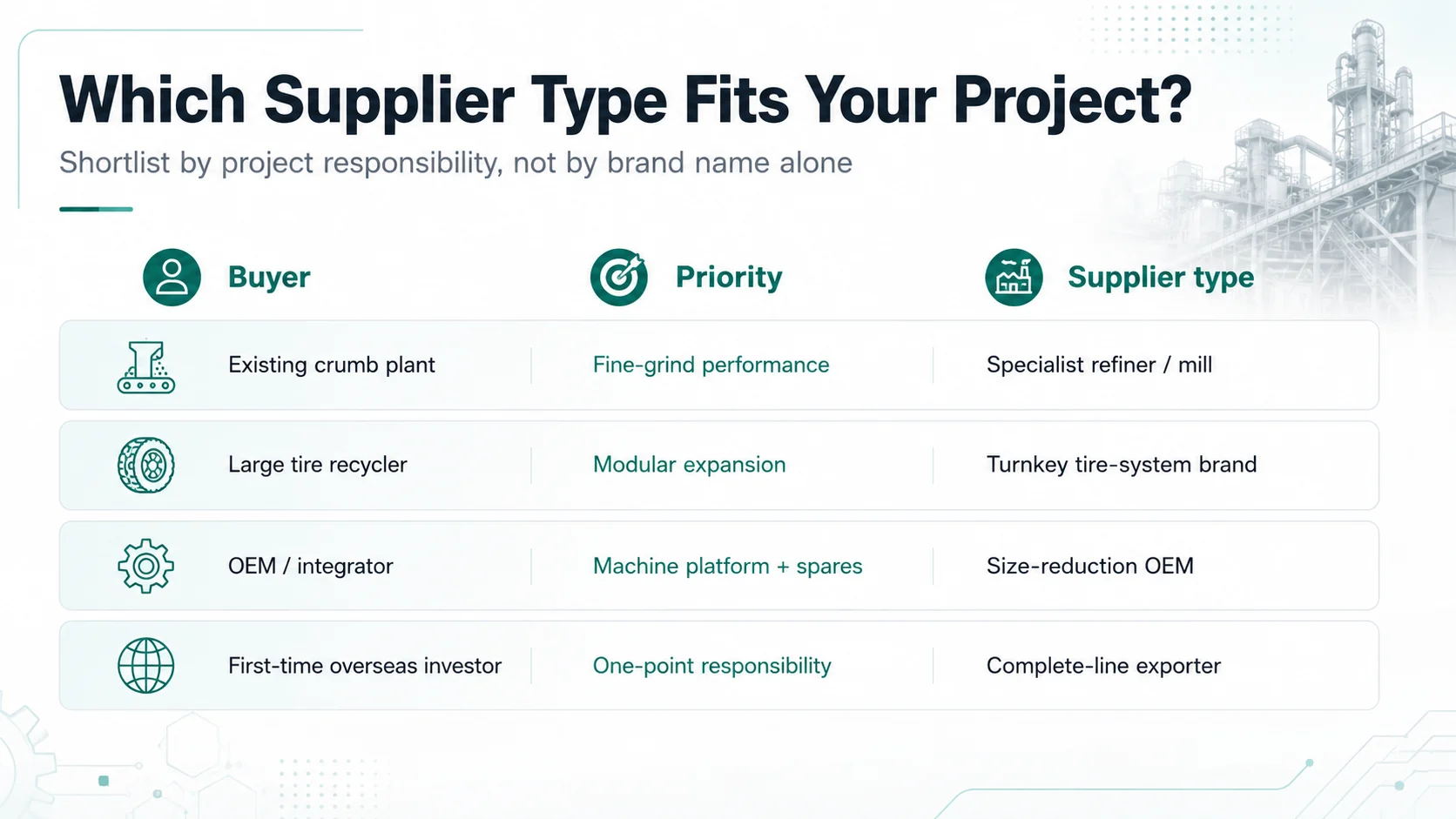
The “best” manufacturer changes with the buyer. Existing recyclers, OEM integrators and first-time turnkey investors need different supplier strengths.
6. Compare maintenance before comparing price
Ask which wear parts are field-replaceable, whether rolls or grinding surfaces can be reconditioned, typical replacement intervals under your feed, tool-change time, lifting requirements and recommended spare inventory for the first year. Fine grinding can turn a low purchase price into a high cost per ton if the plant stops often for wear adjustment.
7. Make the FAT use representative feed
A factory acceptance test should not rely on unusually clean rubber that is easier to process than your actual material. Agree on feed size, contamination limits, test duration, target mesh, sampling method and accepted output before the test. If the supplier cannot process your exact material at its factory, document the difference and adjust the commissioning acceptance plan.
RFQ Checklist for a Rubber Powder Machine or Complete Plant
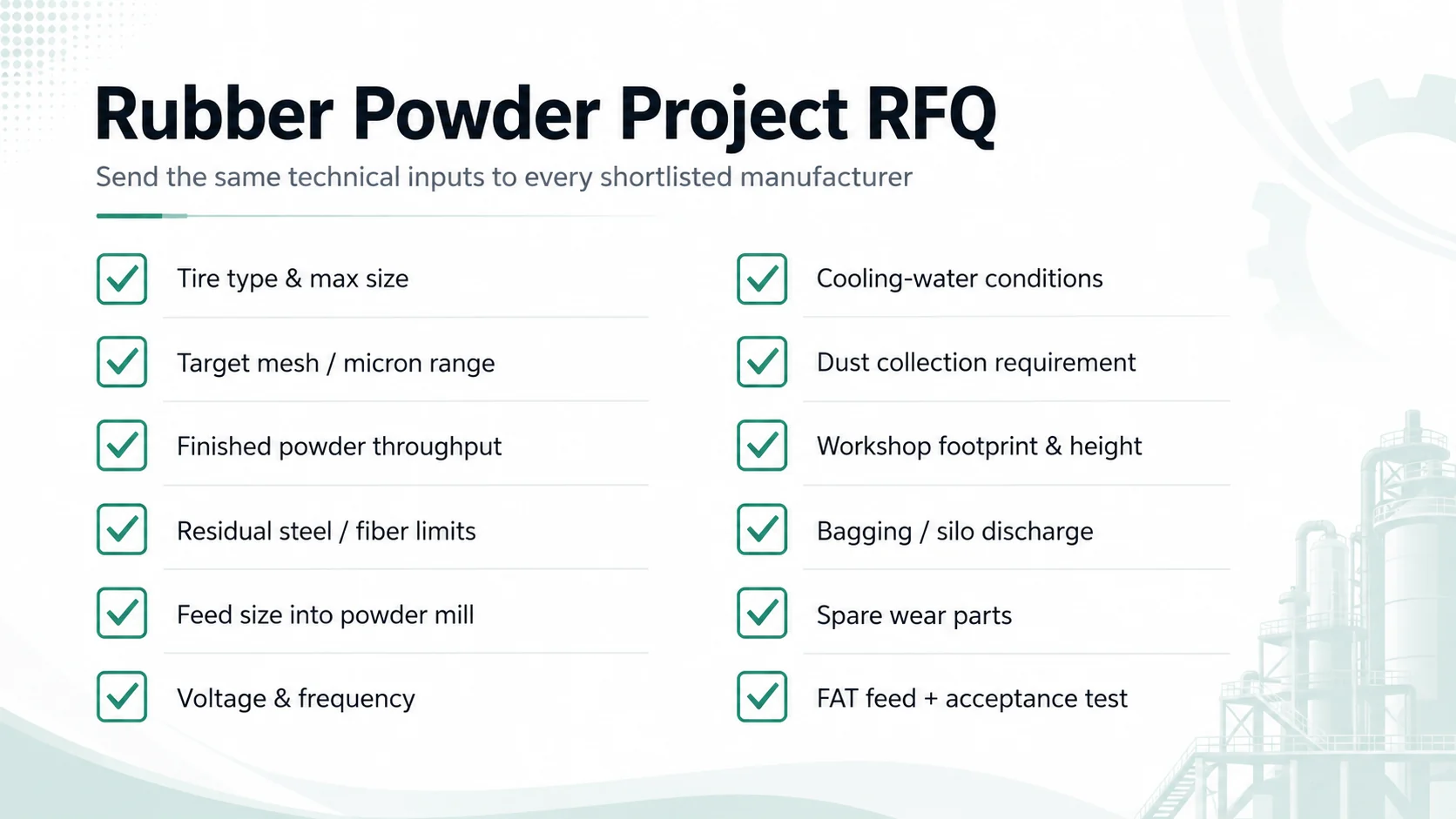
A good RFQ reduces the chance of receiving ten quotations that cannot be compared. At minimum, send the following information:
Tire type: passenger, truck, bus, agricultural, OTR or mixed
Maximum tire diameter and width
Whether bead wire is removed before shredding
Required finished powder mesh or micron range
Accepted oversize fraction or PSD requirement
Maximum residual steel and textile fiber
Required finished powder throughput
Operating hours per shift and shifts per day
Available power supply, voltage and frequency
Cooling-water availability and ambient temperature
Dust collection and local environmental requirements
Available workshop footprint and clear height
Feed and finished-product storage method
Bagging, silo or bulk discharge requirement
Requested spare parts for the first operating year
Installation, commissioning and training scope
FAT feed sample and acceptance method
Required drawings, manuals and electrical documentation
Send the same RFQ to each shortlisted supplier. Comparable inputs produce comparable quotations.
Which Manufacturer Type Fits Which Buyer?
Buyer situation
Supplier type to prioritize
Manufacturers from this list to examine first
Existing crumb-rubber plant adding fine powder
Specialized refiner / pulverizer supplier
PALLMANN, Granutech-Saturn, CM, ELDAN
Large established tire recycler expanding product range
Modular tire-recycling system supplier
ELDAN, Granutech-Saturn, CM, ECO Green
OEM or integrator building its own system
Size-reduction platform manufacturer
ZERMA, PALLMANN, CM
Overseas investor buying a complete ambient tire-to-powder line
Turnkey export-oriented supplier
YUXI, 3E, WANROOETECH
Budget-sensitive small or mid-scale project
Configurable Asian complete-line supplier
YUXI, WANROOETECH, 3E
No table can replace a material test and a complete scope comparison. The useful outcome of a manufacturer shortlist is not a winner on paper; it is three or four suppliers that can all meet the same written powder specification, so you can compare total installed cost, operating assumptions and support on equal terms.
Need a Rubber Powder Plant Configuration?
Send your tire type, target mesh, required finished output, local power standard and available workshop size. YUXI can prepare a tire-to-powder process proposal so you can compare line scope and acceptance conditions against other shortlisted suppliers.
FAQ
What should I compare first when choosing a rubber powder machine manufacturer?
Start with the required finished mesh and sustained output at that mesh. Then compare feed specification, cooling, steel and fiber control, screen-return logic, wear parts, power demand, dust collection and after-sales support.
Can one rubber powder machine process whole waste tires directly?
Normally no. Whole tires usually require bead handling, primary shredding, steel liberation, magnetic separation, granulation and fiber removal before fine grinding. The powder mill should receive a clean and controlled rubber granulate.
What mesh range is common for tire-derived rubber powder?
Commercial systems vary widely. The manufacturers reviewed here publish ranges that include roughly 10 to 120 mesh, while some specialized systems describe output using microns rather than mesh. The purchase specification should state the exact accepted particle-size distribution.
Is the lowest machine price usually the lowest project cost?
Not necessarily. Fine grinding is sensitive to power consumption, wear, cooling, return load and downtime. A lower purchase price can be offset by higher operating cost or weaker downstream integration.
Why does feed purity matter before fine grinding?
Residual steel can damage grinding components, while textile fiber affects product cleanliness and separation efficiency. Consistent 1–8 mm or similarly controlled granulate is generally easier to grind than mixed, contaminated feed.
Marie has 8+ years of experience in tire shredding and recycling equipment,with a focus on tire shredders,rubber recycling machines,TDF production,rubber crumb processing,and complete tire recycling systems.