




A Tire Shredder Maintenance Plan Has to Follow the Material Path
A tire shredder does not operate as a completely separate machine. The cutting chamber, shaft supports, reducers, feed conveyor, disc screen, oversize return path, discharge equipment, guarding, and controls are all connected by the same material flow. The maintenance checklist should follow that flow as well.
That matters because the first visible symptom is not always the original cause. More reversals can come from an overloaded feed pattern, trapped wire, a changing tire mix or deteriorating cutter condition. A hot bearing can be a lubrication problem, a seal problem, contamination, alignment or an increasing load elsewhere in the machine. A return conveyor that is carrying more material than usual may be telling you something about screen build-up or cutting performance rather than about the conveyor itself.
A tire shredder machine with a dual-shaft cutting chamber, screening and oversize return needs maintenance planning around the whole material path. That system boundary is the one used in this checklist. It is broader than the cutter stack, but narrower than a complete crumb-rubber or powder plant.
This is also intentionally different from the separate tire shredder blade guide. The blade article covers wear patterns, sharpening, replacement and blade cost per accepted ton. Here, cutters appear only as one inspection point inside a complete preventive-maintenance routine. The goal is to decide what operators and maintenance teams should check daily, what deserves a weekly condition review, and what should be reserved for a controlled planned shutdown.
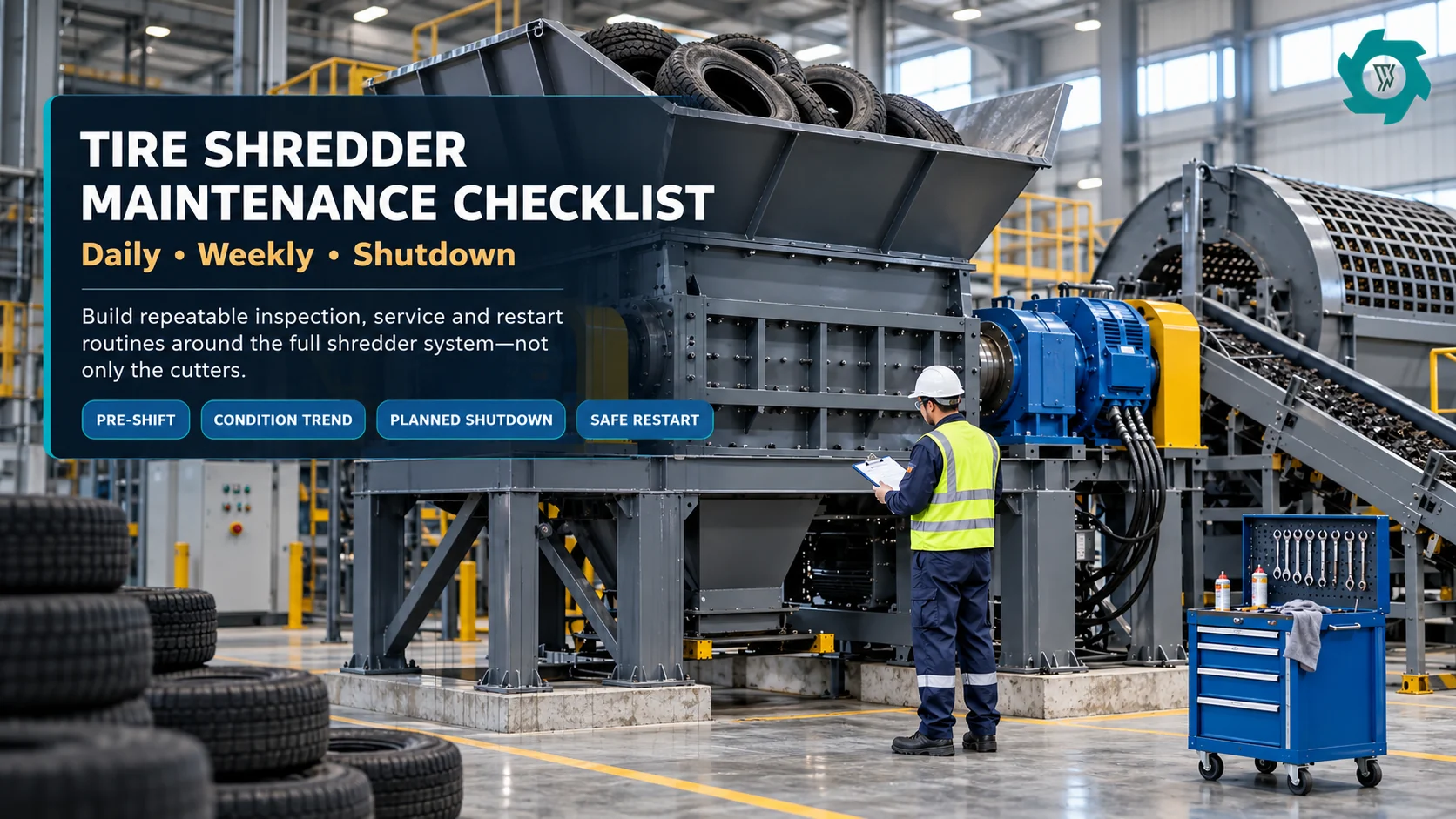
Start by Separating Daily Checks, Weekly Condition Review and Shutdown Work
A strong maintenance program does not turn every observation into a shutdown. It assigns work to the safest and most useful maintenance window. Daily checks are mainly observation, housekeeping and handover. Weekly work adds trend comparison and closer inspection. Planned shutdown work is where isolation, access, measurement, service, replacement and controlled restart belong.
For U.S. general-industry facilities, OSHA’s lockout/tagout standard applies to servicing and maintenance when unexpected energization, startup or release of stored energy could injure employees. The standard explicitly includes activities such as inspecting, cleaning, unjamming, adjusting and tool changes when workers may be exposed to those hazards.[1] NIOSH likewise recommends hazardous-energy control programs for machine maintenance and warns that unexpected startup or released stored energy can cause crushing, amputation and fatal injuries.[3]
That means the checklist should make a clear distinction between observations that can be made from the normal safe operating position and work that requires a defined energy-control procedure. “Quick inspection” must never become a reason to reach into a chamber, remove a guard from a running conveyor or clear wrapped material while energy remains uncontrolled.
| Maintenance window | Main purpose | Typical work | What should trigger escalation |
|---|---|---|---|
| Daily / pre-shift | Catch visible change before production amplifies it | Leaks, guards, work area, feed and discharge path, alarms, unusual noise, running behavior, handover record | New leak, damaged guard, unusual vibration/noise, repeated reversal, abnormal temperature indication, conveyor tracking change |
| Weekly condition review | Turn observations into trends | Compare bearing and drive behavior, inspect screen and return path, review cutter/spacer condition, conveyor condition, fasteners and repeated stop causes | Week-to-week deterioration, position-specific wear, recurring loose hardware, rising return load, repeated alarms or manual clearing |
| Planned shutdown | Create safe access for measurement and service | Isolation, deep cleaning, measurement, cutter-stack inspection, bearing/gearbox work, screen service, structural inspection, guard/interlock restoration, restart verification | Any defect outside the machine’s approved service limits or any condition that prevents safe release to production |
Daily Tire Shredder Maintenance Checklist
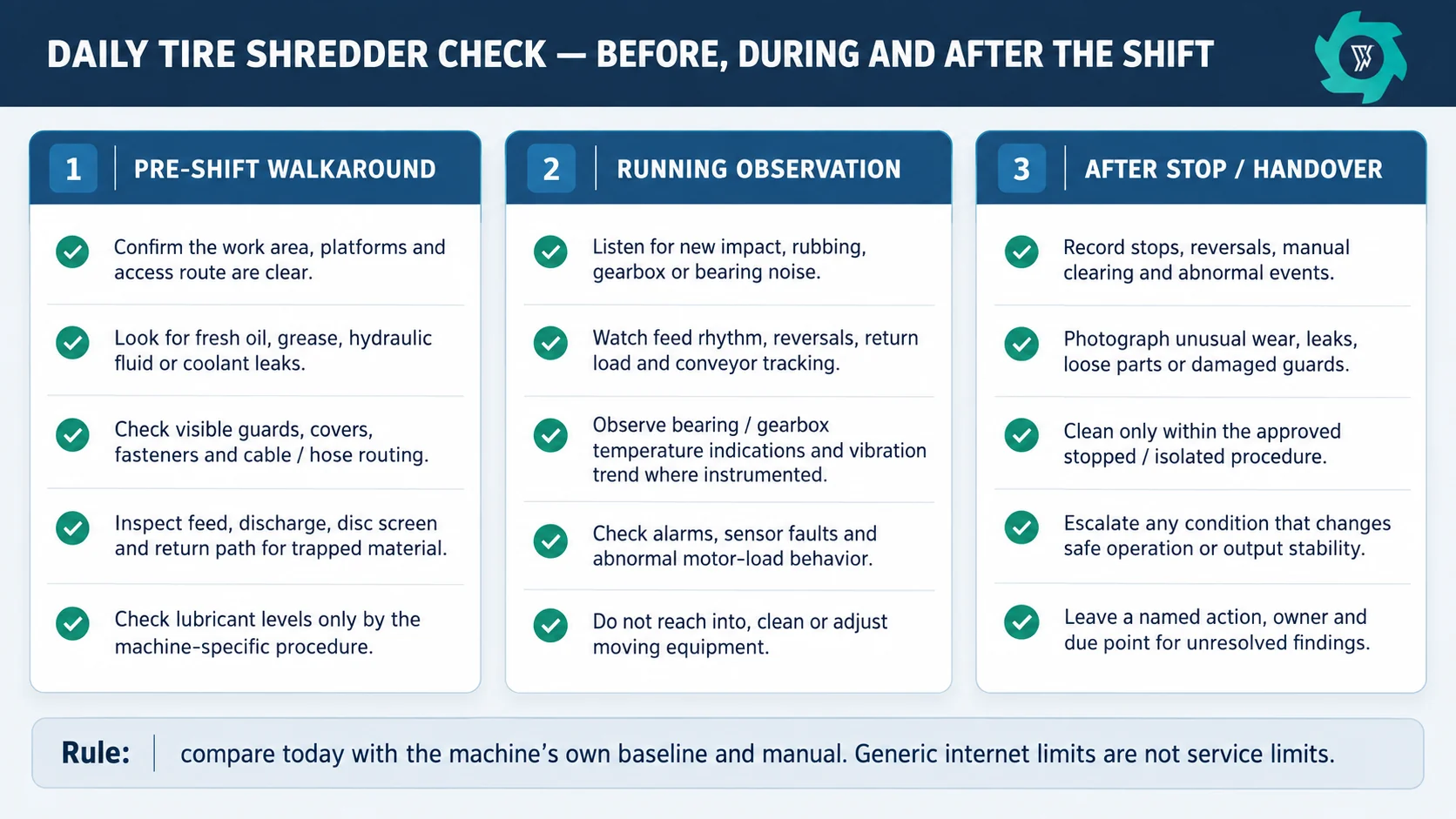
1. Pre-shift walkaround: look for change before the first tire enters
Walk the same route every shift. Start outside the shredder and move with the material path. Check the feed conveyor and hopper area for leftover tires, wire, tools or debris that could affect feeding. Look around the cutting-chamber housing, bearing locations, reducers and connected hydraulic equipment if fitted. Fresh lubricant, oil or hydraulic fluid on the floor or frame is more useful as a maintenance signal when the previous shift left the area reasonably clean.
Continue to the screen, oversize return and discharge. Make sure material from the previous run has not created a blocked transfer point or deep build-up. Look at conveyor belts, idlers, guards, access panels, cables, hoses and visible fasteners. The objective is not to perform repair while walking. It is to identify anything that changed from the known normal state and decide whether production can start safely.
OSHA’s general machine-guarding rule requires guarding methods to protect employees from hazards including points of operation, ingoing nip points and rotating parts.[2] A daily checklist therefore needs a visible guard-and-access check. A missing panel, defeated access device or damaged belt guard is not simply a housekeeping item.
2. During operation: observe load behavior, not only whether the shafts are turning
Once production starts, compare the machine with its normal behavior under a reasonably similar tire mix. Listen for new rubbing, impact, bearing or gearbox sounds. Watch whether tires enter at a controlled rhythm or arrive in slugs. Note whether the shafts reverse more often, whether the hopper repeatedly empties, whether the screen return appears heavier, and whether the discharge becomes less consistent.
The separate TDF plant troubleshooting guide goes deeper into diagnosing oversize chips, low throughput, bridging and accelerated wear. For maintenance, the important rule is simpler: an operating symptom should create an inspection question, not an instant diagnosis. If reversal frequency rises, record the feed mix, the event and what changed before assuming the cutters need service.
Where the machine has bearing-temperature, motor-load, vibration, oil-pressure or other condition indicators, use them as trends. The useful comparison is the same machine under similar duty. Do not copy a bearing-temperature limit or vibration alarm from another shredder and treat it as an approved setting. Vendor limits, component ratings and site alarm logic must remain the controlling values.
3. After stop: close the shift with evidence
At handover, record the events that the next shift or maintenance team needs to know: stops, reversals, operator interventions, manual clearing, alarms, unusual noises, leaks, foreign-object incidents and work that remains open.
If cleaning, unjamming, inspection or adjustment would place a person in a hazard zone or expose them to unexpected movement or stored energy, follow the applicable hazardous-energy-control procedure before the task begins. NIOSH’s hazardous-energy guidance emphasizes identifying energy sources, isolating them, controlling stored energy and verifying the safe state.[3]
Weekly Maintenance: Review Conditions That Daily Checks Can Miss
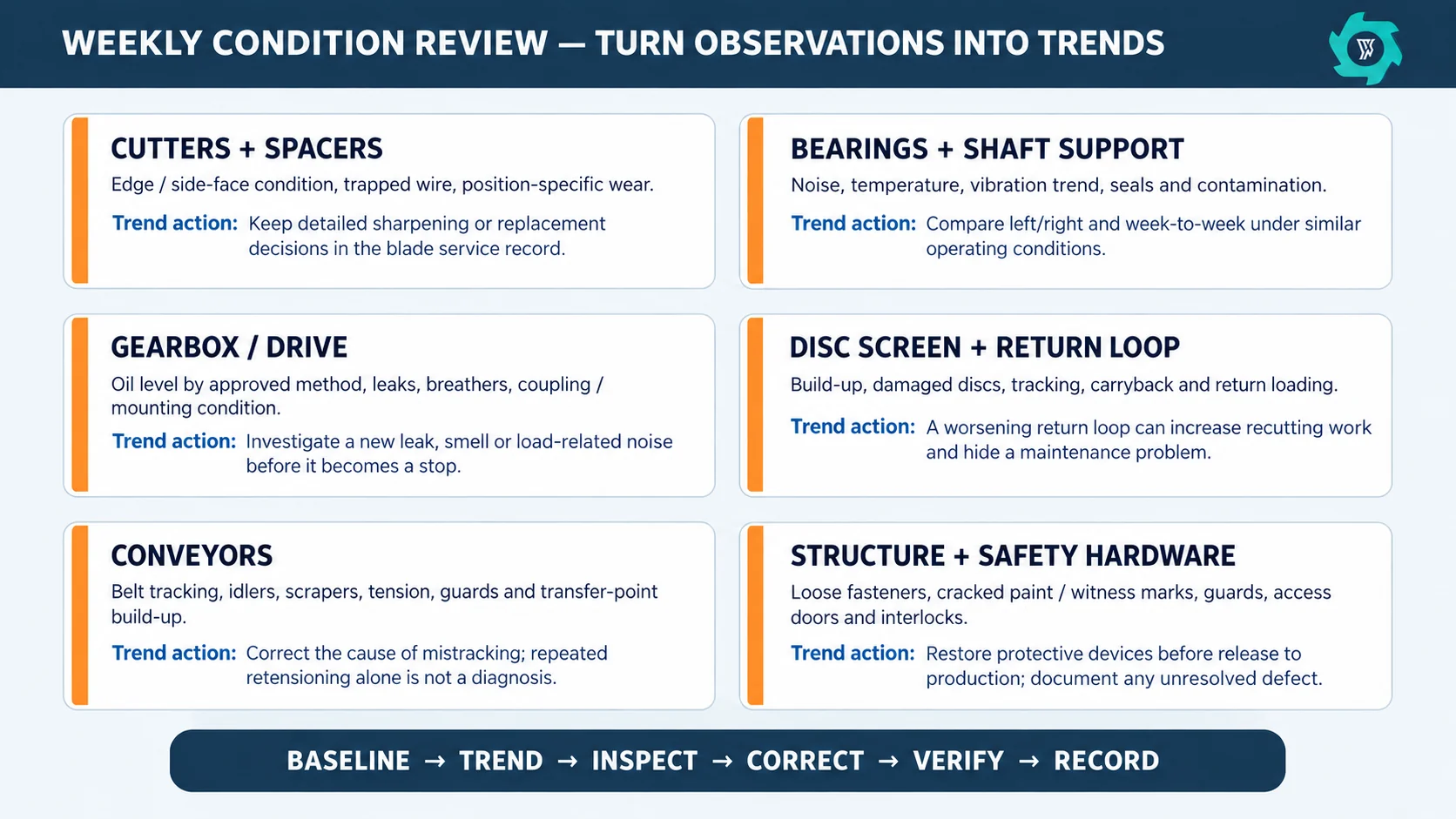
Weekly work should compare a week of production with the previous baseline and look for patterns. That is especially useful in tire recycling because duty changes with passenger versus truck tires, intact bead concentration, contamination and the amount of oversize recirculation.
Cutting chamber, cutters and spacers
Inspect accessible evidence of the cutter stack using the approved machine procedure. Look for trapped wire, asymmetric wear, chipped edges, rubbing marks, spacer condition and signs that one position is behaving differently from adjacent positions. Keep the detailed sharpen-or-replace decision in the blade service record instead of duplicating it here. The maintenance question is whether cutting condition is stable enough to remain in service or needs a planned inspection window.
The U.S. EPA scrap-tire recycling handbook notes that deteriorating knife condition can increase the cutting gap, allow reinforcing wire to be pulled rather than cleanly sheared, and contribute to shaft, bearing and cutting-box problems. It also notes that smaller product sizes and more recycle passes can increase knife wear.[4] That is why cutter condition should be read together with screen return, tire mix and output behavior.
Bearings, shafts and seals
Compare left and right sides and week-to-week condition under similar production. Check for new leakage, seal damage, abnormal noise and any available temperature or vibration trend. Do not wait for a seized bearing before creating a work order. A modest but repeatable change that follows load can justify a closer shutdown inspection even when the machine still runs.
Also look at what may be causing the bearing condition. Contamination around seals, a recurring impact event, looseness, alignment change or cutter-stack problem can be upstream of the bearing symptom. Replacing the bearing without correcting the source can turn maintenance into a repeating cycle.
Gearbox, coupling and drive mounting
Check oil level and condition only by the prescribed method and at the required machine state. Inspect breathers, seals, mounts, guards and coupling areas for leakage, contamination or movement. Record a new oil smell, unusual load-related noise or change in backlash only if the machine procedure gives a safe way to assess it. Oil type, fill quantity, sampling interval and change interval are machine- and component-specific.
Disc screen, return conveyor and transfer points
A screen-return system adds maintenance value because it reduces the risk of oversize leaving the process unnoticed, but it also creates another loop that needs inspection. Check for wrapped wire, lodged rubber, damaged discs or bars, excessive build-up, poor tracking and material accumulation at transfer points. Compare return behavior with recent production. A rising return load can increase recutting work and may be a process symptom even if the return conveyor itself appears healthy.
If operators want a clearer explanation of how the cutter, screen and return loop interact, the separate tire shredder working-principle guide maps that material flow. Maintenance records should use the same process boundary so that “shredder output” means the same thing across shifts.
Conveyors, structure, fasteners and protective devices
Inspect belt tracking, idlers, scrapers, transfer skirts, guards and tension condition. Repeated belt correction without finding why the belt is moving is not a maintenance strategy. Check structure and mounting points for new movement marks, cracked paint around high-stress locations, loose fasteners or impact damage. Where the machine has access switches or interlocks, test them only through the approved procedure and record the result.
Planned Shutdown Maintenance: Do the Work That Needs Safe Access
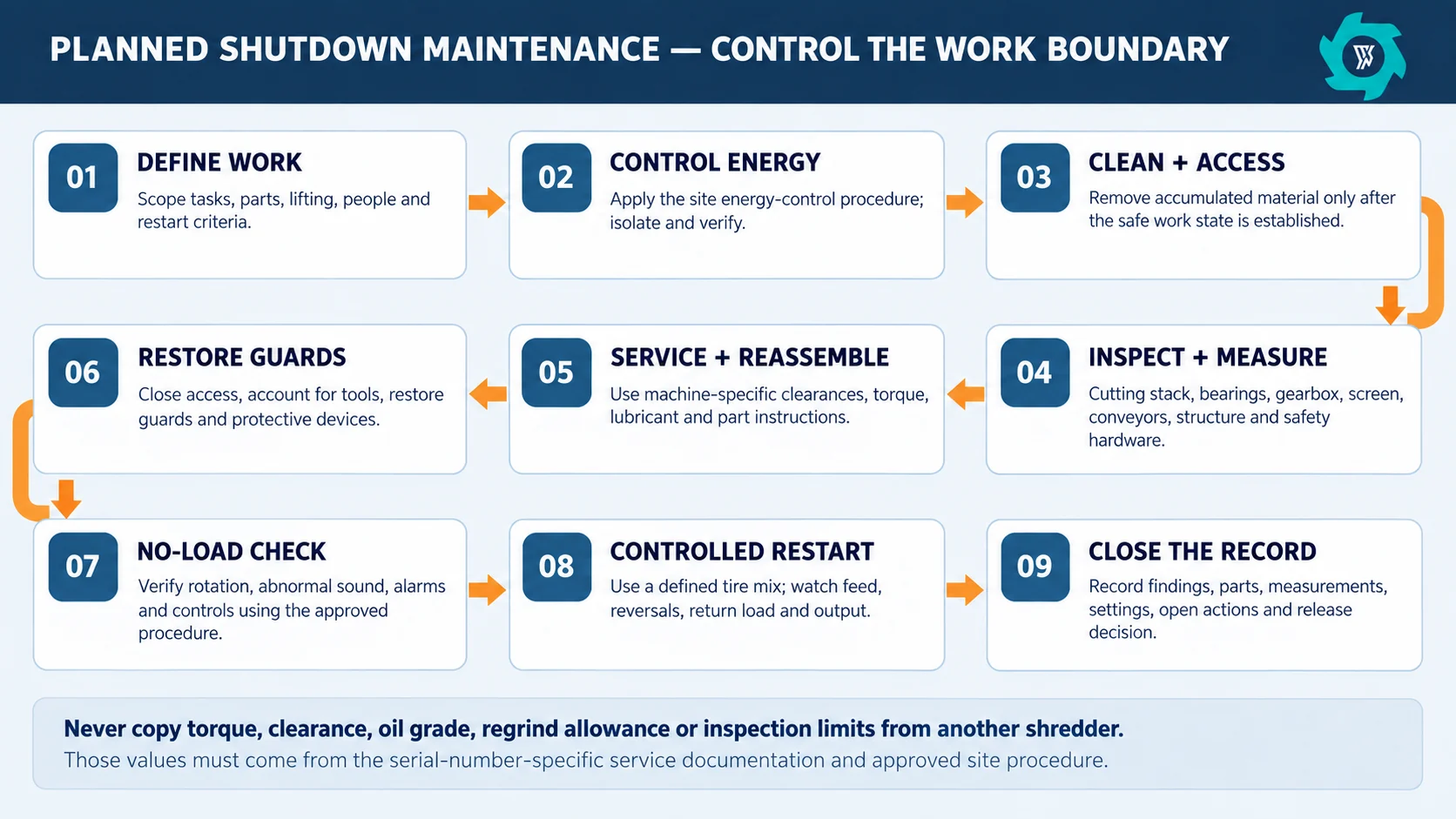
A planned shutdown should begin before the last tire of the run. Define the job scope, required parts, tools, lifting method, people, expected measurements and restart criteria in advance. If a cutter set, bearing, seal, screen component or conveyor part may need replacement, confirm availability before opening the machine. Otherwise a one-shift inspection can become a multi-day outage waiting for a part.
1. Establish the work boundary and control hazardous energy
Identify every energy source relevant to the actual installed system: electrical, mechanical, hydraulic, pneumatic, gravity, stored rotational energy and any other source identified by the site procedure. OSHA requires an energy-control program for covered servicing work and requires procedures for shutdown, isolation, application of lockout/tagout devices, control of stored energy and verification of isolation.[1] Use the site’s authorized procedure; a checklist graphic is not a substitute for it.
2. Clean for inspection, not for appearance
After the safe work state is established, remove accumulated rubber, wire, dust and carryback from the locations that must be inspected. Cleaning makes cracks, leaks, loose fasteners, seal condition and wear surfaces visible. It also prevents old debris from being mistaken for a new failure after restart. Avoid turning the maintenance stop into uncontrolled compressed-air or hand-cleaning around sharp wire and cutting edges; the cleaning method should be part of the site procedure.
3. Inspect and measure the complete mechanical path
Open the areas covered by the planned job and document before-service condition. Typical shutdown work may include cutter and spacer measurements, shaft and support inspection, bearing and seal checks, gearbox service, screen inspection, conveyor idlers and pulleys, belt condition, structural fasteners, guards, access doors, sensors and cabling. The exact list depends on the machine configuration and hours since the previous planned service.
Use defined measurement locations. “Position 4, measurement A, compared with previous service record” creates evidence. The same principle applies to screen wear, belt condition and leakage. If a component is changed, record part number and reason for replacement.
4. Service and reassemble to the machine-specific procedure
Do not borrow torque values, knife clearances, lubricant grades, oil quantities or regrind limits from another model. Similar-looking shredders can use different shafts, fasteners, bearing arrangements and cutter geometry. Reassembly should follow the serial-number-specific instructions, including any matched-set requirements, tightening sequence, clearance checks, lubricant method and post-service verification.
If the planned stop finds a cutter condition that needs sharpening or replacement, use the separate blade guide for that decision rather than expanding the shutdown into an improvised grinding job. If repeated heavy bead-wire loading is one of the wear drivers, the article on bead removal before shredding explains when front-end preparation may reduce concentrated steel load. Do not assume bead removal is mandatory for every tire stream.
5. Restore guards and account for tools before power is returned
Before release, confirm that temporary supports, lifting devices, loose tools, rags, measuring instruments and removed parts are accounted for. Restore access panels, guards and protective devices. OSHA’s machine-guarding requirements are not suspended because maintenance has just been completed.[2] A machine should not return to production with a guard intentionally left off for “observation.”
6. Use a staged restart instead of jumping directly to full production
Perform the supplier’s specified post-service and no-load checks first. Confirm rotation direction where relevant, abnormal noise, leaks, alarms and control response. Then run a controlled production test with a defined tire mix. Record feed behavior, reversals, screen return, discharge appearance and any abnormal heat, noise or vibration that appears under load.
The goal is to prove that maintenance restored the machine boundary you intended to repair. If the problem was repeated reversals, the restart record should include reversals. If the problem was screen build-up, check the screen and return route during the test. If the problem was a bearing trend, verify that the relevant indication has returned to its normal band under comparable duty.
Maintenance Records Should Connect Condition, Work and Production
A useful record does more than prove that a checklist was signed. It lets maintenance, production and purchasing reconstruct what happened. At minimum, record machine ID, date, running hours or agreed production counter, tire mix, major abnormal events, inspected locations, measurements required by the manual, parts changed, lubricant or service performed, open actions, person responsible and restart result.
For recurring problems, add production context. The TDF plant operating-cost guide uses accepted output as an economic denominator because maintenance invoices without production context are hard to compare. The same idea helps maintenance: if a screen, bearing or cutter position needs repeated attention, compare the service interval with accepted production and feed conditions.
This also prevents preventive maintenance from becoming “replace everything every Friday.” A fixed schedule is useful for planning, but condition and service limits should decide whether a part is acceptable. Calendar frequency can be tightened when feed is dirty, tire construction is harder, recirculation is high or operating hours rise, and relaxed only when the manual and site experience support that decision.
Common Tire Shredder Maintenance Mistakes
- Opening the machine because the task is “only visual.” If access creates exposure to hazardous energy or moving parts, use the required energy-control procedure.
- Copying generic service values. Internet torque, clearance and lubrication numbers are not substitutes for the actual machine documentation.
- Changing a bearing without investigating the cause. Load, contamination, seal condition, looseness or alignment may be driving repeat failures.
- Calling every reversal a blade problem. Feed slugs, large tires, trapped material and return-loop conditions can create the same symptom.
- Ignoring the screen and return path. Oversize recirculation is part of the shredder’s cutting duty and can change wear and throughput.
- Leaving work orders open without an owner. “Monitor” is not a closure action unless someone knows what to measure and when to review it.
- Restarting at full production immediately after major work. A defined no-load and controlled-load check gives the team a chance to catch assembly or control problems early.
- Mixing maintenance records from different machine boundaries. Keep the shredder, screen and return loop consistent when comparing service history.
How to Turn This Checklist Into a Site Maintenance Plan
Start with the serial-number-specific manual and the site’s safety procedures. List every maintenance point named by the manufacturer, then assign it to daily, weekly, hours-based, condition-based or planned-shutdown work. Add the installed conveyors, screen, return system, hydraulic equipment, dust collection interfaces and safety devices that actually exist at the plant.
Next, define the evidence needed for each check. “Check for fresh leakage at input/output seals, verify oil level by the specified method, note new load-related noise and create a work order if the condition changes” is actionable. Do the same for bearings, screen, conveyors, guards and cutter-stack inspection.
Finally, decide what stops production, what can be planned for the next maintenance window and what can remain under observation. Those thresholds should come from the equipment documentation, component limits, applicable safety requirements and the plant’s approved maintenance policy.
Frequently Asked Questions
What should be checked every day on a tire shredder?
Check the work area, feed and discharge path, visible guards, leaks, cable and hose condition, conveyors, screen and return route, alarms, unusual noise or vibration, reversal behavior and any abnormal temperature or load indication provided by the machine. Record significant events at shift handover. Cleaning, unjamming or inspection that creates exposure to hazardous energy should follow the applicable energy-control procedure.
What belongs in a weekly tire shredder maintenance check?
A weekly review should compare condition trends rather than repeat the daily walkaround. Inspect cutter and spacer condition, bearings and seals, gearbox and drive mounting, screen and return-loop build-up, conveyor tracking and idlers, structural fasteners, guards and recurring alarms or stop causes. Compare findings with the machine’s own baseline under similar feed conditions.
What maintenance should wait for a planned shutdown?
Tasks that require safe access for cleaning, measurement, adjustment, part replacement or internal inspection belong in a planned shutdown. Typical work includes detailed cutter-stack inspection, bearing or seal work, gearbox service, screen repair, conveyor service, structural inspection and restoration testing. Use the machine-specific service instructions for torque, clearances, lubricants and acceptance limits.
Does a tire shredder need lockout/tagout for maintenance?
For covered U.S. general-industry servicing and maintenance, OSHA 29 CFR 1910.147 applies when unexpected energization, startup or release of stored energy could injure employees. The site procedure should identify relevant electrical, mechanical, hydraulic, pneumatic, gravity and other energy sources, isolate and control them, address stored energy and verify the safe condition before exposed work begins.
How should maintenance be verified before the shredder returns to production?
Confirm that tools and temporary devices are removed, guards and protective devices are restored, required fasteners and settings are verified, and the specified post-service or no-load checks are completed. Then use a controlled production restart with a defined tire mix and record feed behavior, reversals, screen return, output condition, leaks, noise, vibration, alarms and any unresolved action before full release.
Need a Tire Shredder Configuration or Spare-Parts Plan?
Send your tire range, machine configuration, output target, operating hours and current maintenance concerns. YUXI can review the shredder, screen, return and downstream interface around the actual project duty.
References
- OSHA LOTO. Hazardous-energy control for servicing.
- NIOSH guide. Machine-maintenance lockout guidance.
- OSHA guarding. Machine-guarding requirements.
- EPA handbook. Tire-shredder knife wear and recycle-pass context.