




Why Tire Shredder Blade Cost Should Be Managed by Accepted Tons
Blade wear does not follow a simple hourly schedule. The same cutter can last very differently depending on what is fed into the shredder and how the machine is set up. Passenger tires, truck tires, intact bead wire, dirt, or stray metal all change the load on the cutting stack. Recirculated material can add even more cutting passes. Wear also develops around the blade, not only on the edge itself, so spacers, shaft fit, side faces, bearings, and drive condition can all affect when service is actually needed.
For that reason, the useful maintenance question is not “How many hours should the blade last?” It is “What wear mode is developing, can this cutter be serviced without moving outside the machine’s approved geometry, and what did the blade set cost for each accepted ton produced before the next comparable service event?” For buyers evaluating a tire shredder machine, blade condition should be read together with feed, output size and recirculation. The U.S. EPA notes that smaller tire products can require more cuts and more recycle passes through the shredder, increasing knife wear.[1]
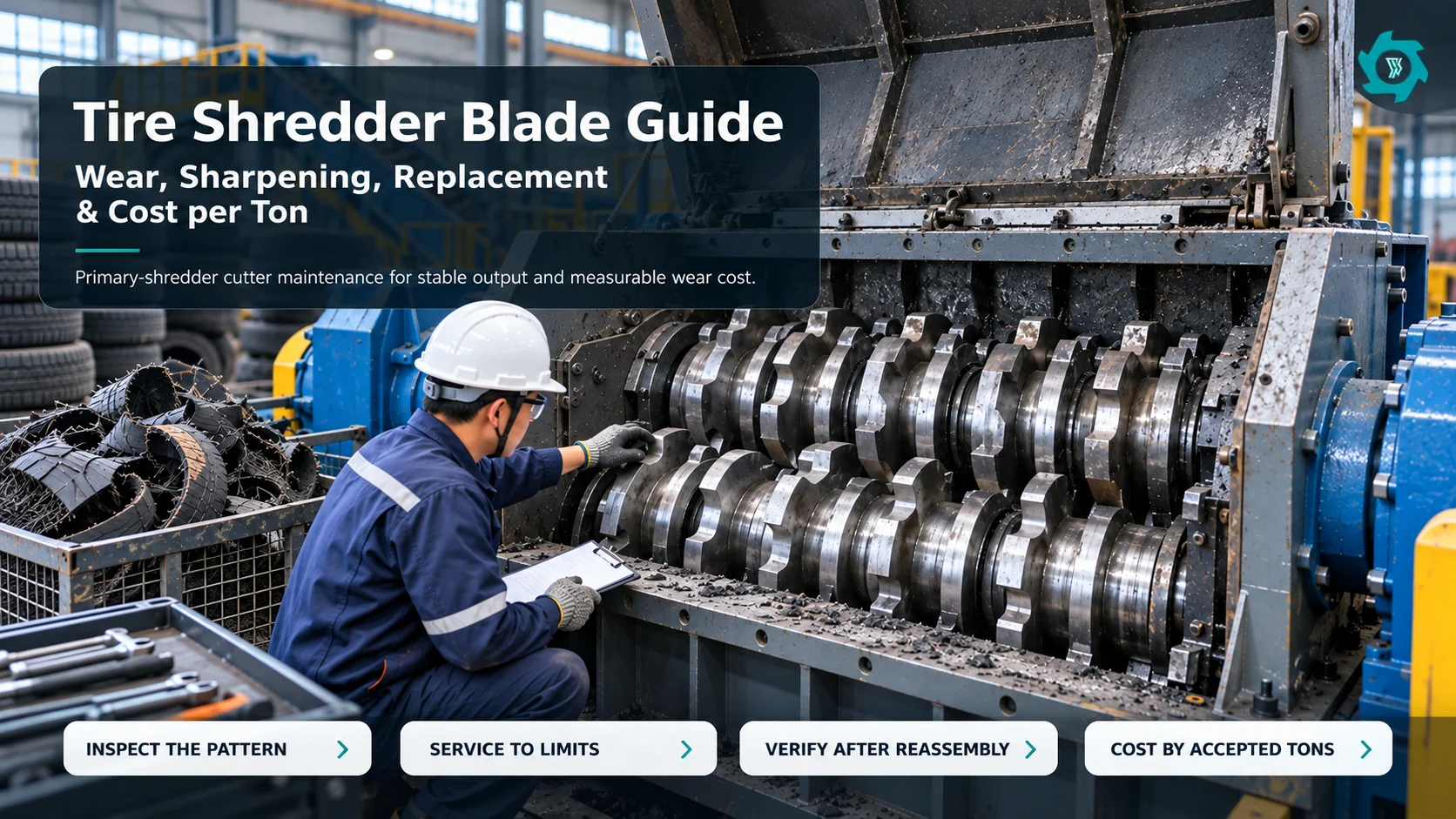
This guide stays on the primary tire shredder cutting system. Broader electricity, labor and whole-line maintenance accounting belongs in the separate TDF plant operating cost guide. A worn cutter does not always need to be thrown away. If there is still enough material on the blade and no serious damage, sharpening may put it back into service. Cracks, heavy edge loss, or a blade that has already been ground close to its limit usually point toward replacement instead. Record what was done each time and how much material the cutter handled afterward. Over several service cycles, those records show which blades are holding up and which ones are costing more to keep in use.
Start With the Cutter Stack, Not the Edge Alone
A low-speed tire shredder pulls reinforced rubber between opposing cutters. The U.S. EPA’s scrap-tire processing handbook describes common tire shredders as rotor assemblies with alternating cutting discs and spacers, and it emphasizes that knife tolerance and maintenance affect whether reinforcing wire is sheared cleanly or dragged through a widening gap.[1] That point is still useful even though the exact geometry, clearance and service limits are machine-specific.
When a blade is removed, maintenance should therefore look beyond the bright working edge. Inspect the side faces where adjacent parts may rub, the bore or mounting interface, the seating surfaces, spacers, shaft contact areas, fasteners and any evidence that the cutter has shifted axially. A blade can be sharp enough at one point yet still cut poorly because a dirty seat, damaged spacer or misalignment changes how the stack closes under load.
Four Wear Patterns That Lead to Different Decisions
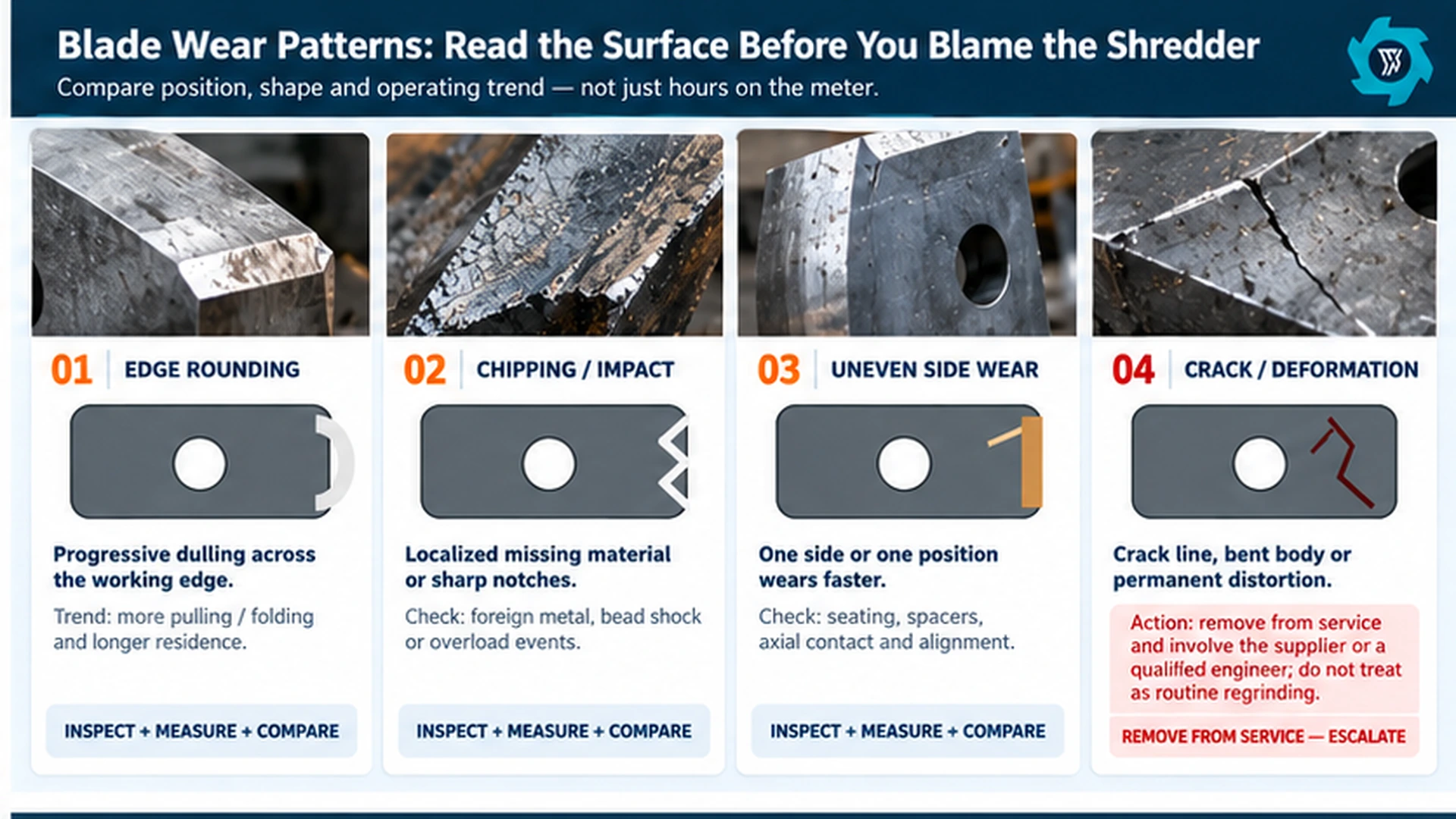
A rounded edge, a localized chip, one-sided face wear and a crack may all reduce cutting quality, but they point to different causes and different service decisions. Photograph the same blade positions at each inspection and keep the position or set ID in the file.
Edge rounding
Progressive edge rounding is the most ordinary condition. The shredder may still run, but it can take longer to pull and shear similar feed. Operators may notice more folding or tearing, a change in chip shape, more residence in the chamber or a rising tendency to reverse. These are trend signals, not automatic replacement triggers. Compare them with the physical edge and with a similar tire mix.
Chipping and impact damage
A localized notch or missing piece deserves an event review. Look for rim fragments, thick concentrated bead sections, unapproved material, an overload incident or a recent reassembly issue. If the damaged area is deep, repeated or close to a critical section of the cutter body, do not think grinding will make it acceptable. A shop can remove visible damage and still leave too little material or change the required geometry.
Uneven side or positional wear
When one cutter or one side face wears much faster than neighboring positions, ask why. Check the seats, spacers, axial contact marks, fasteners and alignment before installing a fresh cutter in the same location. Replacing the most visibly worn blade without correcting the stack condition can simply move the same damage onto the new part.
Cracking or permanent deformation
A crack, bent cutter body or other permanent deformation is not a routine sharpening case. Remove the affected part from service and involve the machine supplier or a qualified engineer. The underlying event may also justify inspection of neighboring cutters, spacers, shafts and bearings before production resumes.
Use Operating Symptoms as Evidence, Not as Proof
The U.S. EPA notes that as shredder knives wear and the tolerance between cutting surfaces increases, reinforcing wire can be drawn through the gap instead of being sheared cleanly.[1] Research on shredder-blade wear in recycling equipment has also documented progressive wear involving abrasive, adhesive and oxidation mechanisms, with severe blade wear associated with reduced shredding performance.[5] That study used PET rather than tires, so it is useful as general wear-mechanism evidence rather than as a tire-shredder service limit. In a tire line, changes in reversing or output should still be checked against tire mix, feeding, recirculation and recent abnormal events before blade wear is blamed.
Before opening the machine, record the symptom in production terms. The separate TDF troubleshooting guide explains how to separate blade evidence from feed, screen and return-path faults. For cutter decisions, the minimum evidence set is simple:
- tire family and approximate mass processed since the last comparable blade service;
- accepted shredder-output mass over the same period;
- screen and return configuration;
- reversal count or reversal trend under comparable feed;
- chip-shape or incomplete-cut observations;
- foreign-object and abnormal-impact events;
- blade position, photographs and measured dimensions required by the service manual.
If the line only records operating hours, the wear history loses context. One hour of relatively clean passenger-tire feed is not the same duty as an hour dominated by truck tires, exposed wire, repeated return passes or contaminated stock.
When Sharpening Is Reasonable—and When It Is Not
Sharpening can be economically useful when the cutter design allows regrinding, the wear is recoverable, and enough material remains to restore the approved profile without falling below the supplier’s service limit. The maintenance team should not invent an edge angle or remove “just enough” material by eye. The decision belongs to the drawing, service instruction and measured condition of that specific blade.
Before sending cutters to a machine shop, confirm five points with the shredder supplier: whether the cutter may be reground; which surfaces may be machined; the minimum remaining dimensions or maximum material removal; whether cutters must be processed as a matched set; and what inspection is required before reinstalling the set. The U.S. EPA makes a tire-specific maintenance point: as knife condition deteriorates, failure to shear reinforcing wire cleanly can create lateral stresses and contribute to shaft scoring, shaft or bearing failure and other costly repairs. Delaying necessary knife maintenance can therefore create larger long-term maintenance costs.[1]
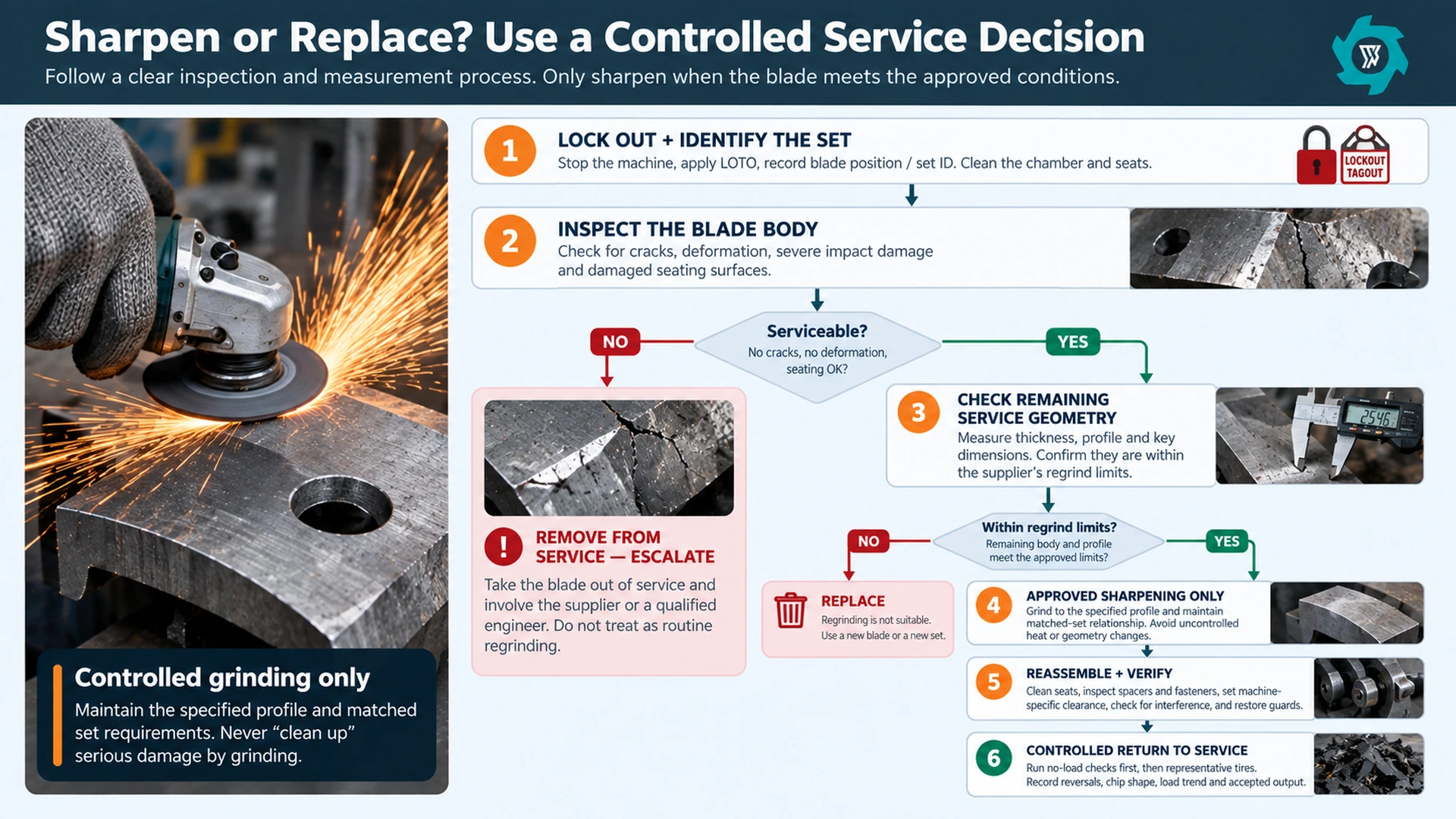
Do not treat severe chipping, cracks, permanent deformation, damaged bores or seating faces, or unknown heat damage as ordinary regrinding work. Also stop if the shop cannot document how it will maintain the required geometry and matched-set relationship. An inexpensive grind that creates uneven cutter dimensions can cost more when the stack is reassembled.
For tire plants that regularly send cutters out for service, use a traveler sheet with the blade set. Include machine ID, part number, blade position, before-service dimensions, defect photographs, requested service, supplier limits and the inspection report to be returned with the finished set. This prevents a repaired cutter from coming back as an anonymous steel disc with no history.
Safe Blade Removal and Reassembly Need Their Own Procedure
Opening a shredder exposes sharp tooling and hazardous stored or unexpected energy. OSHA 29 CFR 1910.147 covers servicing and maintenance where unexpected energization, startup or release of stored energy could injure employees, and requires an energy-control program with isolation and verification steps.[2] OSHA’s general machine-guarding rule also requires guarding against hazards including points of operation, ingoing nip points and rotating parts.[3] These OSHA requirements apply to covered general-industry servicing and machine-guarding situations in the United States; they do not replace the machine-specific maintenance procedure or other applicable requirements. NIOSH likewise recommends lockout/tagout procedures during machine maintenance to reduce the risk of injury from unexpected startup or the release of hazardous energy.[4]
A practical cutter-change sequence should identify the work boundary before tools enter the chamber. Shut down and isolate every relevant energy source, control or block any stored mechanical or hydraulic energy, verify the safe state, and use authorized personnel. Then mark blade positions, support heavy parts correctly and prevent shaft or cutter movement during disassembly.
Once the set is out, clean the seats before measuring. Rubber, wire fragments or burrs trapped under a cutter can falsify the fit. Inspect spacers, sleeves, fasteners and shaft surfaces while access is available. Reassembly should follow the specified order, torque procedure and clearance method for that machine. After tightening, recheck critical measurements because components can move during final clamping.
Before restoring production, verify that no tools remain in the chamber, guards and interlocks are restored, the cutter stack can move without unintended contact under the prescribed manual or test procedure, and the machine passes its no-load checks. The first production run after major blade work should use a defined tire mix and record reversal behavior, chip condition, accepted output and abnormal noise or vibration.
Replacement Should Be Triggered by Condition and Economics
Replacement becomes the better option when the cutter can no longer be restored within the approved geometry, when cracks or deformation make further service inappropriate, when repeated repairs consume too much productive time, or when a worn set is materially increasing the work required per accepted ton. The EPA handbook warns that delaying necessary knife replacement can accelerate deterioration of shafts, bearings and the cutting box, turning a short-term saving into a larger maintenance cost.[1]
The decision can also be position-specific. A plant that sees recurring abnormal wear at one stack location should investigate that location instead of simply ordering more blades. Compare the failed position with adjacent cutters and review the history after previous services. Repeating the same failure mode is evidence that the part may be the victim rather than the cause.
Front-end preparation can change the wear environment. For heavy tire streams, the separate guide on why bead removal may be used before shredding explains the trade-off between extra preparation and reducing concentrated bead-wire load. Do not assume that every tire must be debeaded; compare the actual tire range and machine configuration.
How to Calculate Tire Shredder Blade Cost per Ton
Use the accepted output that crosses the same primary-shredder boundary for every comparison. If your plant sells TDF directly from the screen-return system, accepted TDF tons may be the denominator. If the shredder is only feeding a downstream rasper, use accepted primary-shredder output tons at that transfer point. Do not divide a blade invoice by incoming tire purchases from a different accounting period.
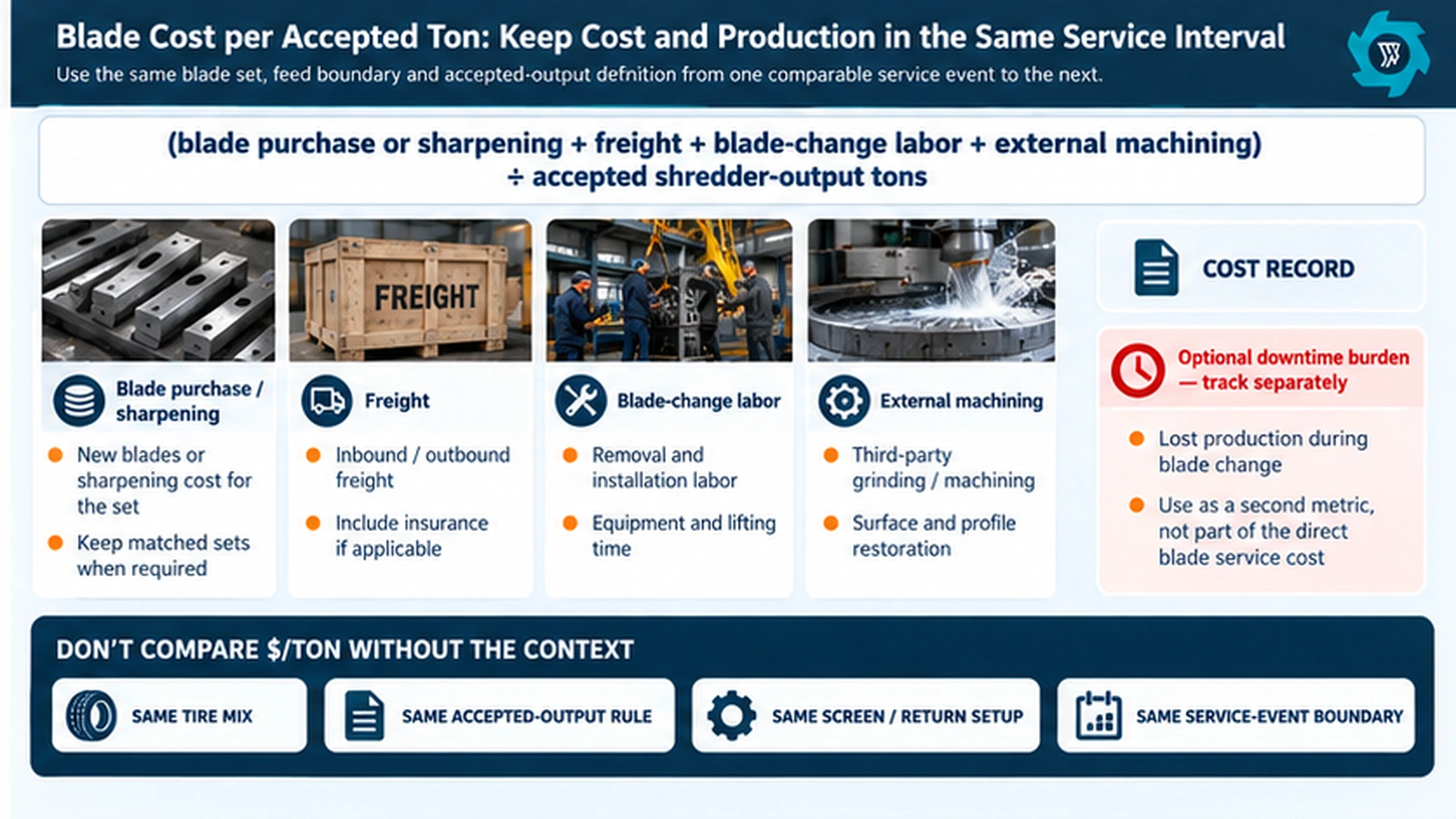
(blade purchase or sharpening + freight + blade-change labor + external machining) ÷ accepted shredder-output tons during the comparable service interval
A second metric can add the financially assigned burden of blade-related downtime, but keep it separate from the direct service number unless your accounting method consistently values downtime. Otherwise two plants can appear different simply because one assigns lost contribution margin and the other records only cash maintenance expense.
A simple worked example
Assume a replacement set costs $7,800, freight is $900, and the planned change uses $1,000 of maintenance labor. From restart to the next comparable service event, the line produces 3,250 accepted tons at the defined shredder boundary. The direct blade service cost is $9,700 ÷ 3,250, or about $2.98 per accepted ton.
Suppose a later sharpening job costs $2,400 for machining, $450 for freight, and $850 for removing and refitting the cutter set. The total is $3,700. If that set then runs for another 2,150 accepted tons before the next similar service, the sharpening cost works out to about $1.72 per accepted ton. That figure is useful only when the operating conditions are reasonably similar. A different tire mix, a different definition of accepted output, or extra downtime after sharpening can make the comparison misleading.
If blade-change labor already sits inside your maintenance labor ledger, either keep the blade KPI as a diagnostic metric or remove the duplicate line from the plant total. The tire shredder machine price guide is better suited to the larger total-cost-of-ownership discussion.
What Moves Blade Cost per Ton Up or Down
| Driver | Why it changes the cutter duty | What to record |
|---|---|---|
| Tire mix | Passenger, truck and large tires present different rubber thickness, reinforcement and bead conditions. | Mass by tire family or a practical mix estimate for the service interval. |
| Feed preparation | Pre-cutting or bead treatment may change impact and feeding behavior. | Whether tires entered whole, cut, debeaded or in another approved state. |
| Foreign material | Rims, hard scrap, stones and contamination can create abnormal impact or abrasion. | Incident date, object found, affected blade position and resulting stop. |
| Screen return | More recirculation means more cutting work can be required for each accepted ton. | Screen configuration and a consistent return-load indicator where available. |
| Feeding stability | Large surges and bridging can create repeated overload/reversal events. | Feed method, reversal trend and abnormal batch events. |
| Maintenance quality | Dirty seats, incorrect clearance or poor reassembly can imitate dull blades or accelerate wear. | Service checklist, measurements, fastener procedure and post-service test results. |
The EPA handbook also notes that smaller tire products can increase knife wear because they require more cuts and more recycle passes, and that contamination can increase maintenance requirements.[1] That does justify keeping target output and return configuration beside every cost-per-ton number.
Build a Blade Ledger That Maintenance and Purchasing Can Both Use
The best blade ledger is simple enough to complete every time. Give each set a permanent ID. Record installation date, machine ID, blade positions, whether the set is new or sharpened, starting dimensions required by the supplier, feed mix, accepted tons, running time, elapsed time, major abnormal events and the reason the set was removed.
Then add cost fields: purchase or sharpening invoice, freight, external machine-shop cost, direct change labor and any explicitly assigned downtime burden. The resulting history lets purchasing compare suppliers on actual site duty instead of brochure life. It also shows whether a cheaper sharpening cycle is really saving money once the accepted tons are counted.
Spare Blade Planning: One Set on the Shelf Is Not Always Enough
A spare strategy should follow lead time, equipment criticality and the available service route. If sharpening is local and predictable, one installed set plus one serviceable spare may be enough for some operations. If blades must travel internationally, if customs clearance is uncertain, or if the machine runs multiple shifts with little maintenance window, the buyer may need a deeper buffer. Reliability-centered maintenance guidance from Pacific Northwest National Laboratory treats equipment downtime, maintenance cost and spare-parts inventory as variables that should be tracked when maintenance decisions are evaluated.[6]
Order the supporting items that can stop a blade change as well: approved fasteners, spacers or sleeves where applicable, seals disturbed by the work, lifting fixtures, measuring tools and the correct documentation. A full spare cutter set is not operational insurance if one unavailable special fastener keeps the chamber open for two extra days.
What Buyers Should Put in the Blade Section of an RFQ
Get the blade details from the supplier before ordering spares. Start with the cutter part number and the blade count on the machine. That sounds basic, but it prevents a lot of spare-parts mistakes. Some cutter stacks also have to stay matched, so replacing only one damaged blade may not be acceptable. Regrinding limits are another point to settle with the supplier, along with the minimum usable size after machining. If material grade or heat-treatment data is available, keep it with the spare record. Also note what should be kept in stock and how long a replacement order normally takes.
Also ask what must be checked after service. The answer should cover seating, spacers, fasteners, clearance or alignment, guard restoration, interference checks and the return-to-service test. If the supplier gives only a blade price and no service method, the buyer still owns the most difficult part of the maintenance problem.
- controlled blade/cutter part number and drawing;
- quantity and stack position information;
- approved inspection and regrinding policy;
- minimum dimensions or discard limits where applicable;
- fastener and spacer identification;
- removal, lifting and installation procedure;
- machine-specific clearance/alignment method;
- recommended initial spare set and replenishment lead time;
- post-service no-load and production verification steps.
Frequently Asked Questions
How do I know when tire shredder blades are worn?
Use more than one symptom. Compare the physical edge and side faces with earlier inspections, then check chip shape, reversal frequency, accepted output, load behavior and recent feed events. A falling throughput number by itself does not prove blade wear because feeding, screen return, downstream restrictions and tire mix can create the same symptom.
Can tire shredder blades be sharpened instead of replaced?
Only when the blade design is approved for regrinding and the remaining body can still meet the supplier’s dimensional, profile and service limits. Cracked, permanently deformed, severely chipped or badly damaged seating surfaces should not be treated as routine sharpening work. Keep matched blades within the machine-specific reassembly requirements.
How should tire shredder blade cost per ton be calculated?
For one comparable service interval, add blade purchase or sharpening cost, freight, blade-change labor and external machining, then divide by accepted shredder-output tons produced during that interval. Keep the tire mix, output boundary, screen or return configuration and service-event definition with the number so later comparisons remain meaningful.
Why can new or sharpened blades still perform poorly after installation?
Blade work does not correct a dirty seat, damaged spacer, loose or incorrect fastener condition, wrong clearance, misalignment, abnormal shaft condition or a feed problem. After reassembly, verify the machine-specific fit and clearance, check for interference, restore guards, complete the prescribed no-load checks and then run a controlled production test.
What blade information should a buyer request before ordering a tire shredder?
Ask for the blade or cutter drawing and part identification, the replacement and regrinding policy, minimum service dimensions or limits where applicable, matched-set requirements, fastener and spacer information, recommended spare quantity, expected lead time, removal and installation instructions, and the post-service verification procedure for the exact machine configuration.
Plan the Blade Package Around Your Tire Mix
Send YUXI your tire range, maximum dimensions, expected truck or OTR share, feed preparation, target output, operating schedule and current blade-service records. The discussion can then focus on the right shredder configuration, spare set and maintenance evidence instead of a generic blade-life promise.
References
- EPA handbook. Tire-shredder cutter wear, recycle passes and maintenance context.
- Wear study. General shredder-blade wear mechanisms.
- OSHA LOTO. Hazardous-energy control during servicing.
- OSHA guarding. Machine-guarding requirements.
- NIOSH guide. Lockout/tagout maintenance guidance.
- RCM guide. Maintenance economics and spare-parts context.