




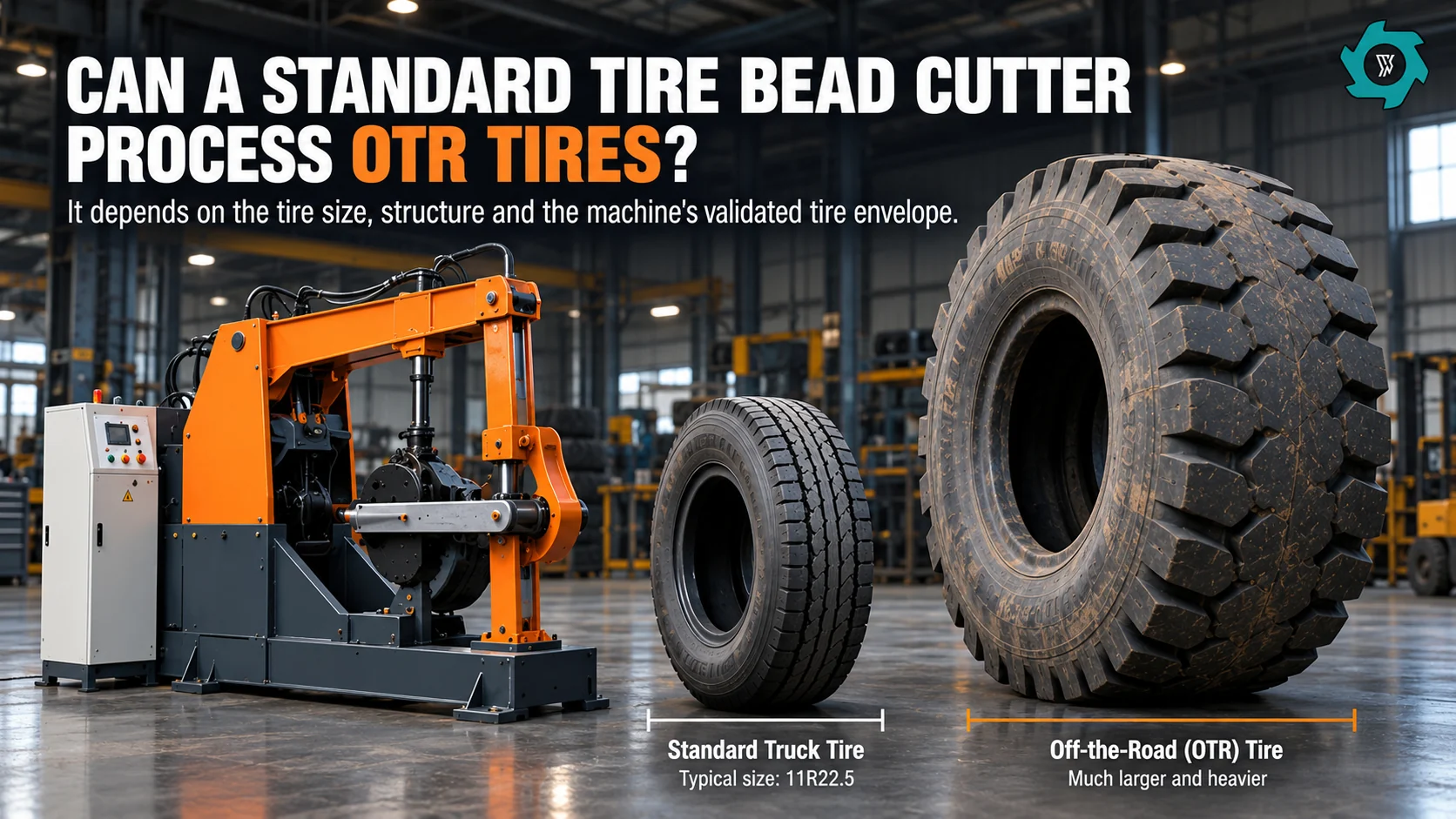
Some OTR tires can be handled by a standard bead cutter, but tire category alone is not enough to judge machine fit. The actual tire size, width, bead structure, loading method, support, rotation, and discharge arrangement all need to match what the cutter is built to handle. If the tire falls outside those limits, it is better to change the equipment or preparation method than force it through the machine.
This article answers one practical engineering question: where does a conventional rotary waste tire bead cutting machine stop being a sensible OTR solution, and what evidence should move a project toward an OTR-specific or staged route?
Quick answer
A smaller OTR tire may be a legitimate standard-bead-cutter application when the tire can be fully supported, clamped, rotated through the complete circumference, cut through the bead zone without overload, and removed without uncontrolled manual handling.
For larger earthmover and mining tires, the first barrier is often not simply cutting force. The tire may overhang the worktable, resist stable rotation, require a loader for every repositioning step, or place a bead section outside the cutter’s normal geometry. In those cases the project commonly moves to heavy sectioning, a custom OTR work cell, or a staged cut-and-bead route rather than a normal shop-floor bead cutter.
There is no defensible universal diameter at which every standard bead cutter becomes unsuitable. The boundary is the complete work cycle. A useful pass/fail review has five gates: tire geometry, support and rotation, bead cutting load, material handling, and a representative proof test.
Why the OTR label is not enough
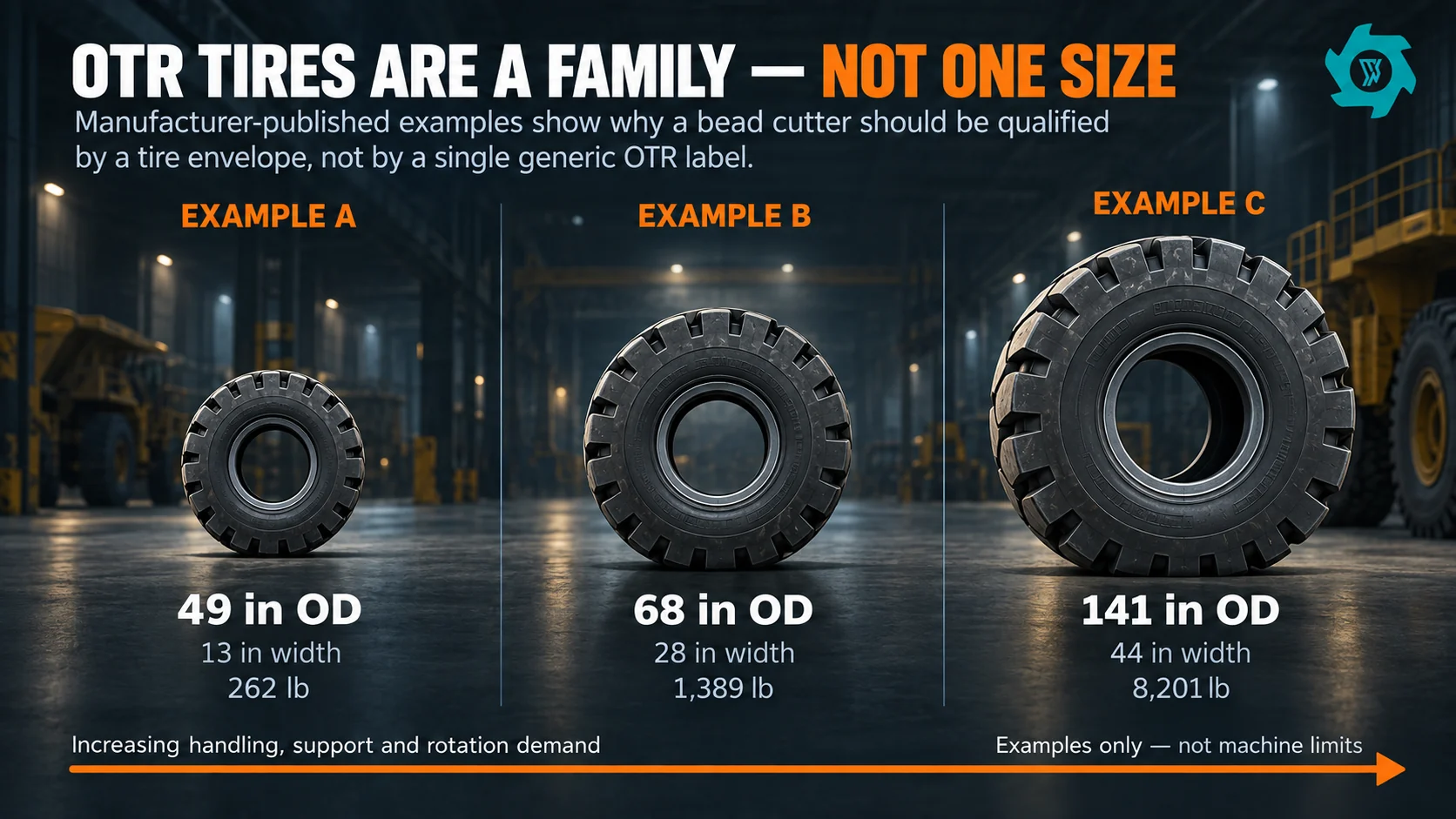
The U.S. EPA handbook defines OTR as “off the road” tires designed primarily for unpaved or no-road service and emphasizes ruggedness and traction.[1] That category spans very different machines and tire constructions: compact construction equipment, underground units, loaders, scrapers, rigid haul trucks and other earthmoving applications. For recycling equipment, those differences are more important than the shared OTR label.
Current manufacturer data shows the scale of that spread. One published earthmover example is about 49 inches in overall diameter and 262 lb; another loader tire example is about 68 inches and 1,389 lb; a large surface-mining example reaches about 141 inches and 8,201 lb. These are not cutter limits.
The bead itself also matters. USTMA describes a tire bead as a steel-wire bundle coated with rubber and used to secure the tire to the wheel.[2] The bead cutter must therefore work through a concentrated steel-rubber region while keeping the tire controlled. An OTR tire that fits by diameter can still be a poor match if bead geometry, sidewall stiffness or the support arrangement pushes the cutting system outside its tested condition.
First separate a bead cutter from an OTR tire cutter
This distinction prevents a large amount of specification confusion. A standard bead cutter usually supports and rotates the tire while the cutting tool follows the sidewall close to the bead circumference. Its normal output is a main tire body plus a separated bead-rich ring or sidewall section. It is a circumferential preparation machine.
A heavy hydraulic OTR tire cutting machine performs a different job. It supports a whole or prepared tire and makes straight sectioning cuts so an oversized carcass becomes several manageable pieces. The downstream objective is usually to create sections that can be moved, shredded or processed further.
That difference creates a useful routing rule. If the whole OTR tire can be positioned and rotated safely through a normal bead-cutting cycle, the standard cutter may remain a candidate. If the tire cannot be rotated or supported as a whole workpiece, a sectioning step may be required before the project can even discuss bead handling.
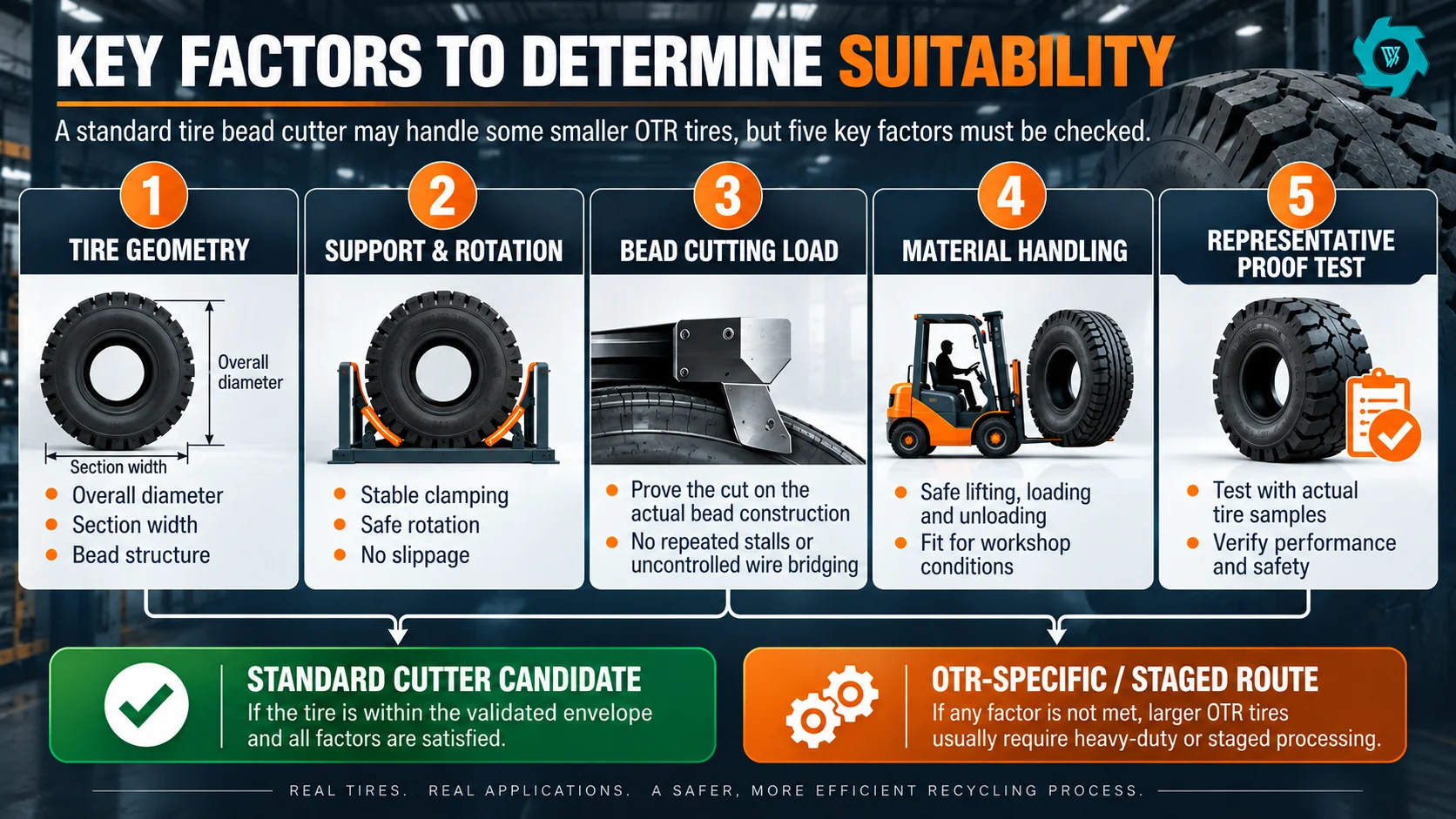
Gate 1 — Tire geometry must fit the complete motion
Start with the outside diameter, overall width, sidewall profile and the space required for the tire to rotate. Do not compare only the diameter printed on a specification sheet. A wide, heavily deformed casing can occupy more operating space than a visually taller but narrower tire. Deep tread and collapsed sidewalls also change how the tire rests on a table.
The important question is not whether the tire can be placed near the cutter. It is whether the full tire can complete the intended rotation without hitting the frame, guard, clamp, floor, lifting device or discharge bin. A tire that fits only when the guard is open or a loader is left inside the operating envelope does not pass this gate.
Record the largest normal tire, not just an average tire. If the project receives mixed OTR scrap, define at least the common tire family and the largest recurring family. One unusual giant tire can be routed separately; it should not silently force the standard machine to become a universal OTR solution.
Gate 2 — Support and rotation usually fail before the catalog motor rating
A rotary bead cutter depends on stable contact between the tire, table, locating elements and clamp. When the tire becomes much heavier, the rotating assembly is no longer dealing with a convenient workshop workpiece. Static mass, eccentricity, sidewall collapse and poor balance can change the contact loads before the cutter even reaches the bead.
Watch the tire through a full dry positioning cycle. Does it sit flat enough to locate consistently? Can the clamp restrain it without crushing or slipping? Can the drive rotate it at a controlled rate without the tire climbing, dragging or oscillating? Can the operator or handling device keep clear of the moving envelope? If the answer is no, adding a stronger blade does not fix the real problem.
This is also why a one-second video clip of the tool entering rubber is weak evidence. Suitability is demonstrated by the complete circumference: load, locate, clamp, rotate, cut, separate, release and remove. Any intervention required during that sequence belongs in the machine decision.
Gate 3 — Bead cutting load must be proven on the exact construction
OTR bead zones are not uniform. Even within one nominal size, construction, reinforcement, repairs, age and casing condition can change the way the blade enters and exits the bead-rich section. A machine that completes one light industrial tire may still struggle on the hardest recurring tire in the plant.
Do not convert hydraulic pressure, motor power or blade material into an assumed “maximum OTR size.” Those values matter, but they do not describe the entire mechanical path. Cutter support, blade geometry, approach angle, workpiece restraint, drive torque, structural stiffness and relief settings all affect the result. The most useful evidence is a clean, repeatable cut on the same tire family that will be processed after delivery.
Signs that the tire is outside the comfortable cutting envelope include repeated stalls, multiple unplanned re-entries into the same bead location, severe tire movement, excessive deformation around the clamp, rapid edge damage or a cut that leaves an uncontrolled wire bridge. Those are not throughput problems to be averaged away; they are qualification failures that need engineering review.
Gate 4 — Material handling can disqualify an otherwise capable cutter
A small OTR tire may be cuttable yet too heavy for the normal load-and-unload method. The incoming tire has to arrive at the correct height and orientation. The removed bead section has to leave the cutter. The prepared carcass has to move to storage or the next machine.
As tire mass rises, forklift, crane or loader use can become routine. That changes aisle width, floor space, cycle time and the separation between people and suspended or moving loads. If a loader must hold the tire in place during cutting, the machine has not really demonstrated independent restraint. If an operator has to push or pull a heavy carcass by hand to keep it rotating, the proposed setup is not a credible standard-cycle solution.
The dedicated bead-cutter safety guide covers guarding and energy-control details. For this OTR fit decision, keep one boundary in mind: the handling method must be defined before the machine is accepted, because it directly changes whether the standard cutter can complete the work cycle at all.
Gate 5 — Use a representative proof test, not an OTR label
The final gate turns the discussion from opinion into evidence. Choose a representative tire from the hardest normal family, document its measured diameter and width, note its approximate mass and visible condition, and agree on the required output. Then observe the complete cycle under the proposed handling method.
A useful fit test records more than “cut completed.” Record whether the tire was supported without improvised blocking; whether the normal clamp held it through the full rotation; whether the cutter completed the bead path without uncontrolled wire bridging; whether planned stops or reversals occurred; whether the prepared tire and bead section could be removed using the stated equipment; and whether the output condition is acceptable for the next process.
Run enough consecutive tires to expose repeatability problems. One successful sample can hide heat buildup, edge degradation, difficult casing variation or a handling bottleneck. The objective is not to create a full procurement FAT inside this article. It is to establish a clear application boundary: this tire family is inside the validated standard envelope, requires modification, or should be routed to a different OTR process.
Three OTR routes that keep the machine boundary clear
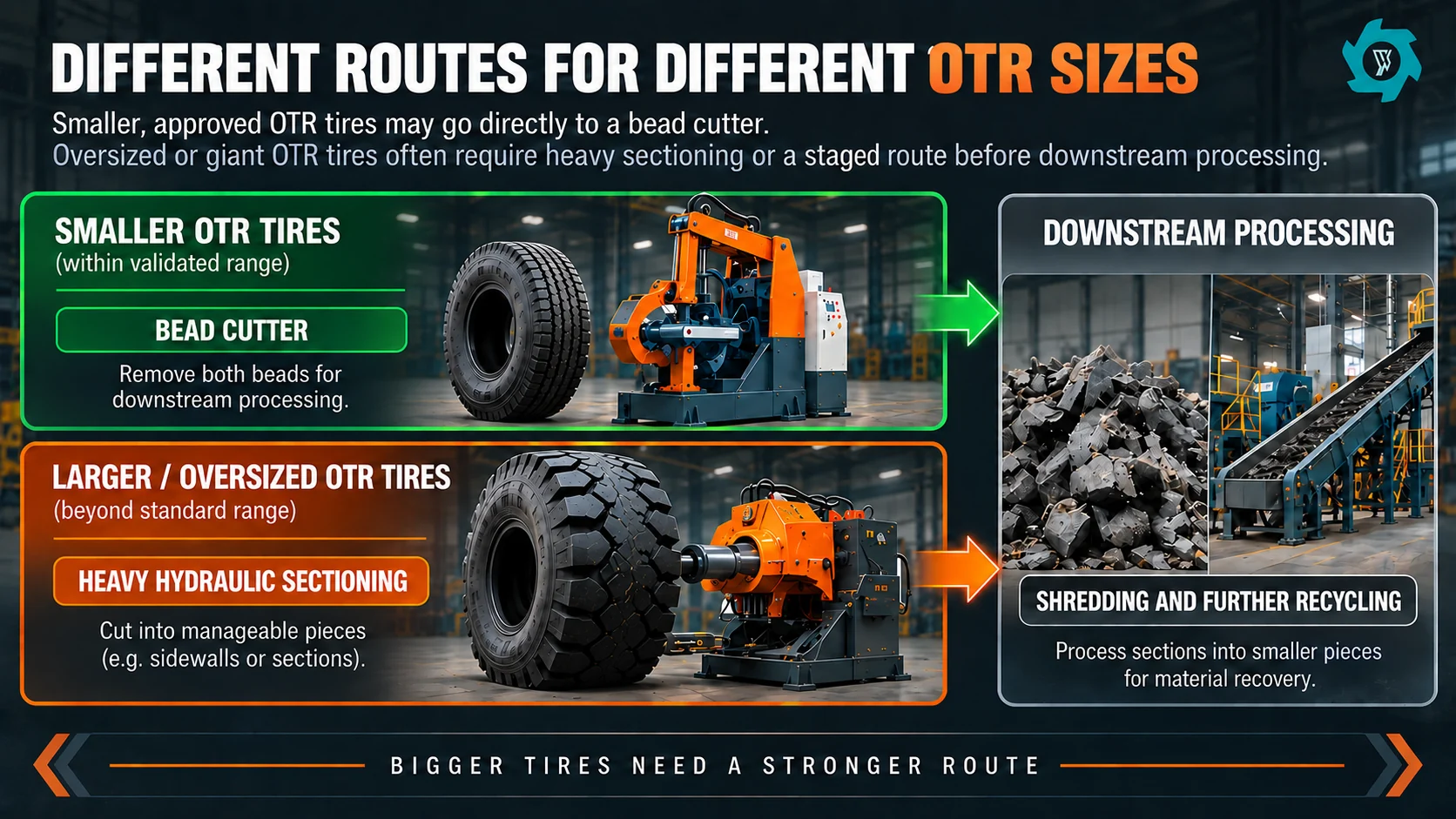
Once the five gates are applied, most projects fall into one of three practical routes.
Route A — Direct bead cutting on an approved smaller OTR tire
Use this when the complete tire fits the table and guard envelope, rotates under stable restraint, the bead zone is proven on the cutter, and the handling method supports normal loading and discharge. The phrase “smaller OTR” is intentionally qualitative; the approved boundary belongs to the tested tire dossier.
Route B — Heavy sectioning first, then downstream size reduction
When the tire is too large or heavy to behave as a rotary workpiece, whole-tire sectioning may become the first mechanical step. The resulting sections can be sized for the receiving tire shredder or another approved process. Bead handling may occur before, during or after sectioning depending on the tire construction and final material route.
Route C — Project-specific staged or custom OTR preparation
Mixed OTR stockpiles, giant mining tires or unusually reinforced tires may need a project-specific sequence rather than one universal machine. The separate OTR tire cutting machine buying guide owns the detailed work-cell and sectioning discussion. Here, the key point is simply that a standard bead cutter should not be stretched into that role when the full tire can no longer be supported and rotated as designed.
A practical decision matrix for a standard bead cutter
| Decision factor | Standard cutter remains a candidate | Engineering review required | Move to staged / OTR-specific route |
|---|---|---|---|
| Whole-tire geometry | Fits table, guard and full rotation envelope. | Near limits or mixed tire family. | Overhang, collision risk or rotation cannot be completed. |
| Support & restraint | Tire remains located under normal clamping. | Extra fixture or powered assistance may be needed. | Loader or manual intervention is required to keep the tire controlled. |
| Bead cut | Repeatable full circumferential cut on representative tires. | Longer cycle or configuration change needs testing. | Stalls, uncontrolled wire bridges, severe movement or repeated failed passes. |
| Handling | Defined loading and discharge method fits the cell. | Lift assistance changes cycle time or layout. | Tire/section mass makes the proposed cell impractical or unsafe. |
| Downstream fit | Prepared output enters the next stage as planned. | Additional trimming or orientation may be needed. | The output is still too large or unstable for the next machine. |
| Proof evidence | Consecutive representative cycles complete under normal conditions. | More testing is needed for the hardest tire family. | No representative proof is available. |
An OTR project is not always a binary choice between “standard machine” and “giant OTR system.” A supplier may be able to change the table, clamp, guarding, drive or handling interface. But once those changes alter the core work cell, the project should be treated as a configured application rather than a standard catalog claim.
What OTR tire data should be sent before a quotation?
For a bead-cutter fit review, the supplier does not need a generic description such as “we process OTR tires.” The quotation should be based on enough information to reconstruct the actual bead-cutting workpiece and its handling condition.
- measured maximum outside diameter and overall width;
- approximate tire mass and known tire or equipment family;
- clear sidewall, tread and bead-area photographs;
- normal casing condition, including major deformation or repairs;
- the planned lifting, loading, turning and removal method;
- the required bead-cut output and the next machine’s accepted feed envelope.
Ask the supplier to identify which submitted tire is closest to the limit of the quoted configuration. That tire should become the reference workpiece for checking table support, clamp contact, full rotation, cutter reach and discharge. This is more useful than receiving a broad statement that the machine is “suitable for OTR tires.”
Do not use diameter as the only cutoff
Diameter is useful for initial screening, but it should not become the machine’s final OTR rating. Two tires with similar outside diameters can impose very different loads on the bead-cutting cell because their width, mass, sidewall profile, bead construction and collapsed casing shape are different.
A more useful limit is a validated tire envelope: maximum proven geometry, acceptable support condition, defined handling method, compatible bead construction and a repeatable full-cycle result. When a new tire family arrives, compare it with that envelope. Do not assume that sharing the same OTR label—or remaining below one diameter number—automatically makes it suitable.
How this decision affects downstream shredding
Bead cutting is preprocessing, not the final size-reduction step. Removing or opening the concentrated bead section may reduce one difficult input feature, but the remaining carcass still contains rubber, textile reinforcement and, depending on tire construction, substantial steel in belts or plies. The next machine must be selected for that prepared state.
For a shredder, specify the maximum accepted section or prepared tire geometry, preferred orientation and any limit on exposed wire. If the standard bead cutter produces a carcass that is still too large for reliable engagement, the plant has not solved the OTR problem; it has only completed one cut. This is the most common reason to evaluate bead cutting and whole-tire sectioning as separate decisions.
The same principle applies to rubber granulation or powder routes. A bead cutter can improve the front-end material state, but it does not replace primary shredding, steel liberation, magnetic separation or later granulation. Keeping those boundaries explicit prevents one machine from being credited with work that belongs to the rest of the line.
The procurement question to ask instead
Replace “Is this bead cutter suitable for OTR tires?” with a tighter request:
“Please confirm whether the quoted configuration can complete the full bead-cutting cycle on the attached tire families. State the approved tire envelope, loading method, support/clamping method, expected cut result, handling method for the bead section and prepared carcass, and the representative test you will use to confirm suitability.”
That wording does not force the supplier to invent a universal OTR rating. It makes the supplier connect the machine to the actual tires and to the output that the plant needs. It also exposes early when a tire should be routed to heavy sectioning or to a custom work cell.
Confirm OTR Tire Fit Before Quoting
Send the tire diameter, width, approximate mass, bead-area photos, loading method and required downstream feed size. YUXI can check whether a standard bead cutter is suitable or whether an OTR-specific route is safer.
Frequently Asked Questions
Can a standard tire bead cutter process OTR tires?
Yes, some smaller or moderate OTR tires can be processed if the exact tire is within the machine’s validated geometry, support, rotation, bead-cutting and handling envelope. Oversized or giant OTR tires should not be assumed suitable without a representative full-cycle test.
Is there a universal OTR tire diameter limit for a standard bead cutter?
Diameter alone does not define suitability. Width, mass, bead construction, sidewall behavior, clamping, rotation space, loading method and downstream output also determine whether a standard bead cutter is appropriate.
What usually becomes the limiting factor first on larger OTR tires?
Support, rotation and material handling often become limiting before a simple cutter-power comparison is useful. A tire that cannot be stably supported and rotated through the full circumference is not a good standard rotary-bead-cutter workpiece.
Should an oversized OTR tire be sectioned before bead cutting?
Sometimes. When the whole tire is too large or heavy to support and rotate on a standard bead cutter, heavy hydraulic sectioning or another staged route may be required. The correct sequence depends on the tire construction and the downstream feed requirement.
How should a supplier prove that a bead cutter can handle my OTR tires?
Use representative tires from the hardest normal family and observe consecutive complete cycles: loading, support, clamping, rotation, bead cutting, separation, release and removal. Record interventions and confirm that the prepared output fits the next process.
Can one bead cutter cover passenger, truck and OTR tires?
Possibly for a defined range, but do not assume one configuration covers every tire class. Mixed streams should be divided into tire families and each family should be checked against the machine’s validated envelope and handling method.
References
- EPA handbook. OTR tire definition and recycling context.
- USTMA report. Bead construction description.