




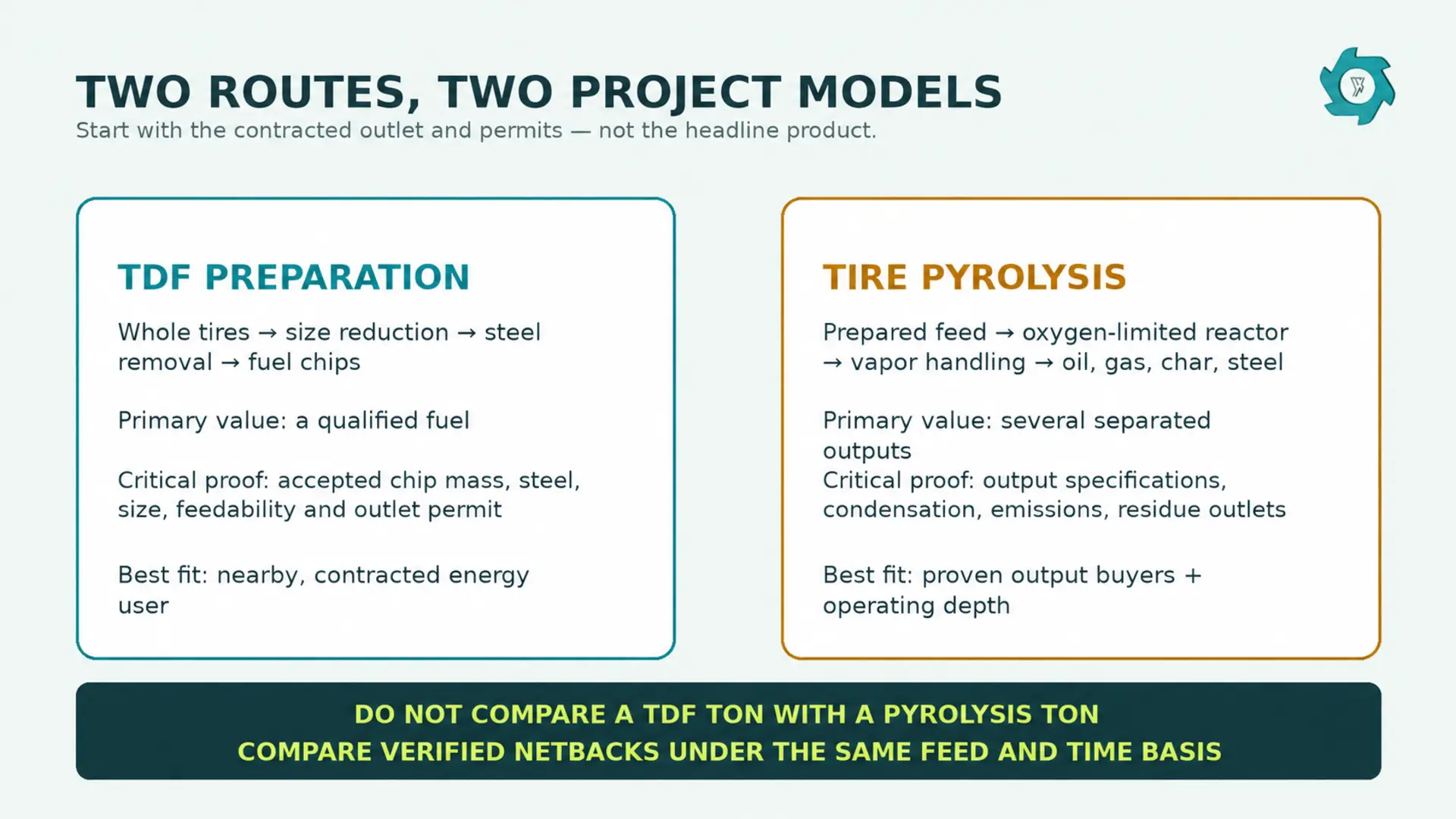
TDF and tire pyrolysis serve different applications and address different business needs. One prepares a controlled fuel for a known combustion system; the other operates a thermal process whose several outputs must each find a compliant, paying destination. The right route is the one with the stronger verified outlet, not the more impressive product list.
Start with the revenue chain. Before comparing shredder horsepower or reactor temperature, identify the buyer, specification, permit route, logistics and acceptance test for every material that will leave the site.
They are different businesses before they are different processes
A TDF line reduces whole tires to a fuel form that a permitted industrial user can handle. In the tire-derived fuel plant guide, the practical center of gravity is consistent fuel preparation: chip size, liberated steel, return control and delivery-ready product.1
Pyrolysis adds a thermal conversion step in an oxygen-limited system. The project therefore has to control prepared feed, heating, vapor movement, condensation, gas management, solids handling and emissions. Its output list is longer, but liquid product, non-condensable gas, carbonaceous solid and recovered steel all need a defined route.
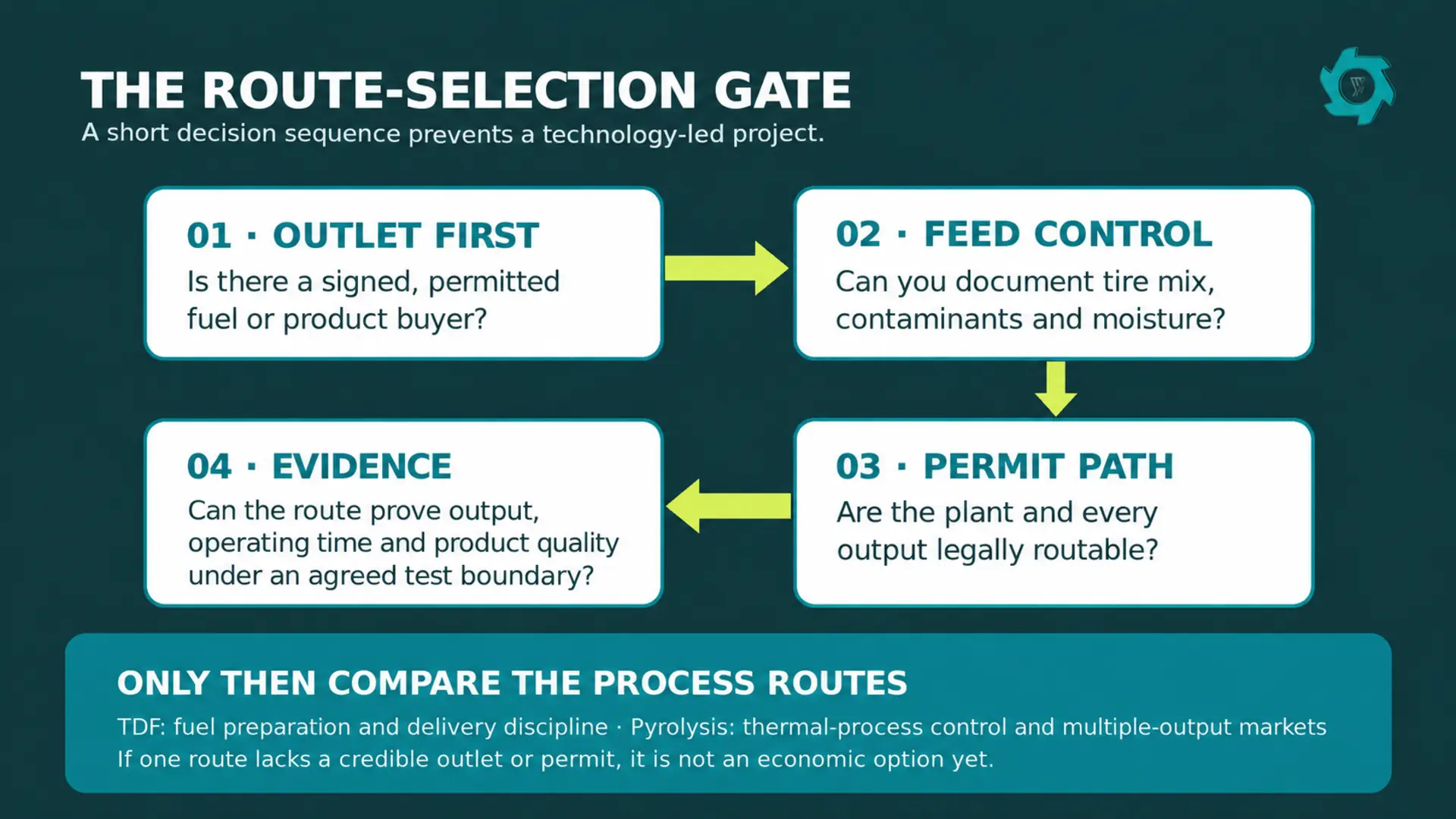
Use four gates before you select a route
1. Outlet
Ask who buys the actual product at the actual specification, how often they accept deliveries and what happens when they do not.
2. Feed control
Document tire type, bead treatment, moisture, dirt, textile and other incoming material.
3. Permit path
Check the facility, emissions-control configuration, storage, residues and each output classification with the responsible local authority.
4. Evidence
Require measured output, operating time and product samples—not only an hourly capacity assertion or theoretical yield split.
What each route must prove
| Decision area | TDF route | Pyrolysis route |
|---|---|---|
| Commercial anchor | A fuel user can receive, meter and permit the prepared tire fuel. | Buyers and specifications exist for each saleable output, not just the preferred one. |
| Preparation focus | Chip geometry, steel removal, fines, oversize return and stable handling. | Consistent feed plus the preparation needed for controlled thermal operation. |
| Plant proof | Accepted fuel mass and quality under a defined test window. | Continuous operating stability, mass balance, samples and output quality over a stated window. |
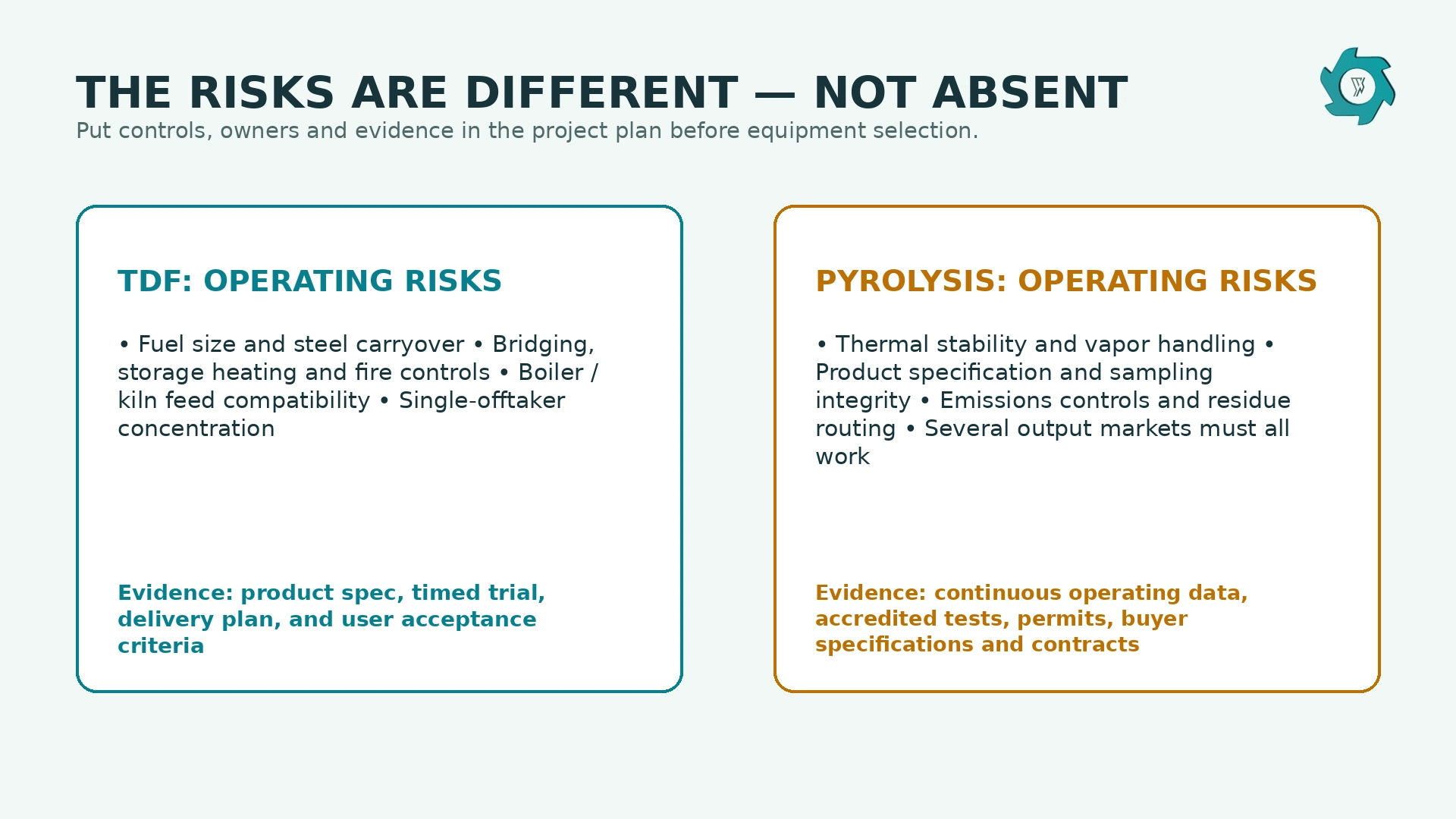
| Economic weak point | Freight distance, single-offtaker exposure and mismatch with combustion equipment. | Multi-output marketing, product qualification, thermal uptime and residue/emissions obligations. |
For a project that first needs a reliable way to turn tires into a specified, transportable material, the broader tire recycling equipment overview helps map the preparation stages. Where cutting is the constraint, review the tire cutting machine options before assuming either downstream route can accept whole tires without pre-treatment.
Do not let “yield” hide the real comparison
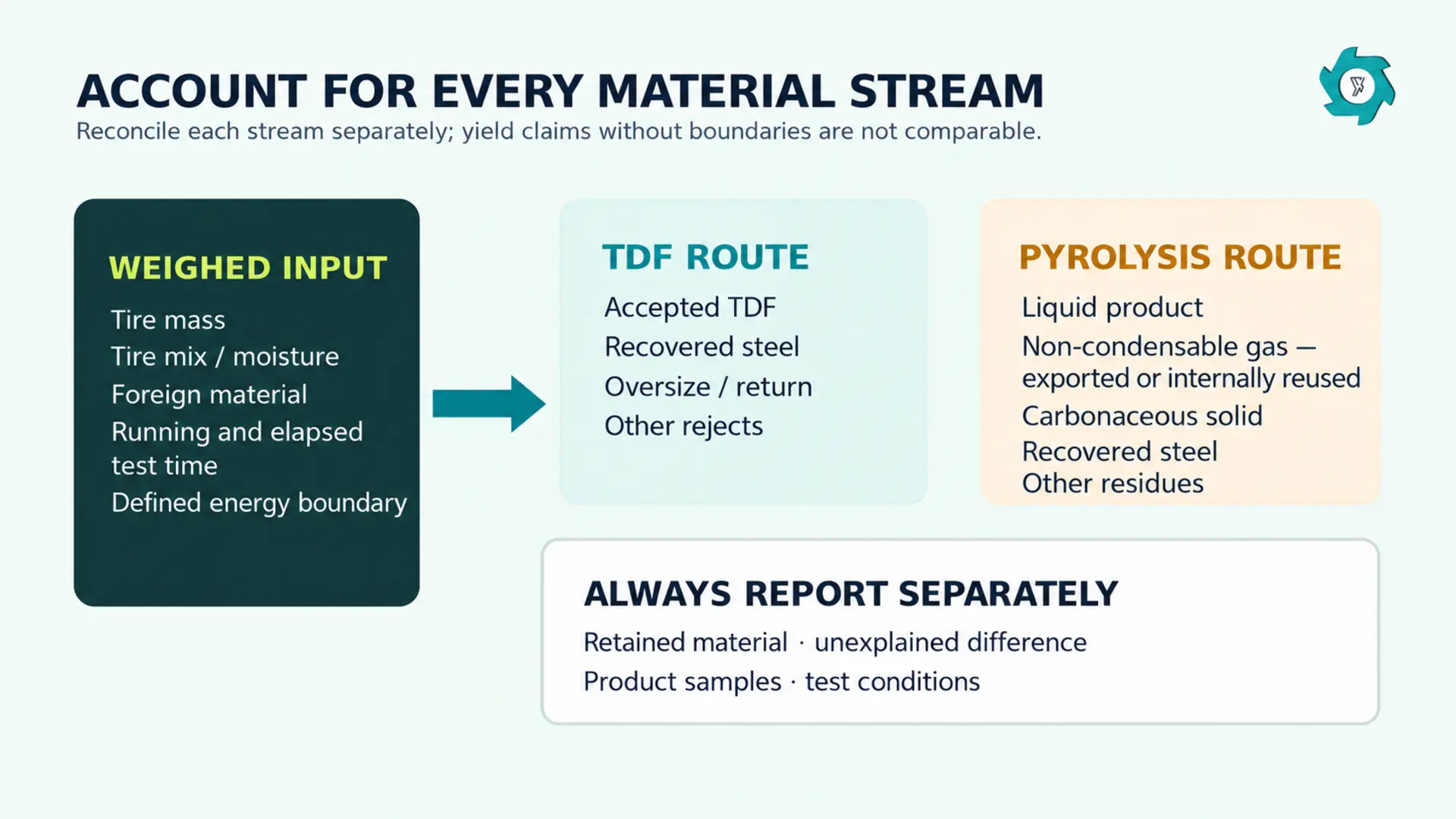
Do not compare a TDF output rate with a pyrolysis oil percentage as though they were equivalent. TDF is normally valued as an accepted fuel stream. Pyrolysis produces a portfolio of streams, so a quoted oil yield may omit gas consumption, solids quality, residues, retained material, shut-downs, storage and the treatment or discount applied to off-spec output.
Weigh a representative input; weigh each output separately; record both machine-running time and elapsed test time; define whether electrical loads, auxiliary fuel and gas use are inside the energy boundary. Then reconcile retained material and unexplained difference. The same discipline appears in quality work for a tire rubber crumb plant.
Turn uncertainty into a priced decision
Most feasibility models fail because every open item is shown as neutral. It is not neutral. A missing product specification, an unsigned offtake, or an unconfirmed residue route should receive a clear provisional status and a financial consequence.
| Evidence status | What counts as evidence | How to treat it in the model |
|---|---|---|
| Proven | Current permit confirmation, written buyer specification, signed commercial term or repeat acceptance history. | Use the contracted price and capacity, with a documented operational allowance. |
| Conditional | Buyer interest or a lab result, but no accepted production sample and no binding route. | Use a discounted price, cap the volume and show qualification cost separately. |
| Unproven | A brochure claim, indicative conversation or theoretical yield only. | Assign no revenue until a test and destination are defined; include handling or treatment exposure instead. |
This evidence ladder is especially useful for pyrolysis, where one attractive output can distract from a stream without a buyer. It is equally useful for TDF: a fuel outlet is not bankable until the receiving system, acceptance terms and transport pattern have been checked.
Test reversibility before committing capital
The low-risk project is not necessarily the route with the smallest machine list. It is the route that leaves the operator more ways to respond when the market changes. TDF preparation can sometimes redirect suitable material to other size-reduction markets, subject to the actual feed and product specification. A thermal project has more coupled equipment and several output obligations, so its shutdown, storage and off-spec plan deserves attention before startup.
Ask each supplier for a one-page “bad day” operating note: what happens if the principal outlet stops taking material for 14 days, a product sample fails, or incoming tires carry more moisture or contamination than expected? The answer should identify where material waits, what becomes off-spec, which system can safely stop and what data must be retained.
Specify a minimum viable comparison trial
- At least one representative, documented tire batch and an agreed feed-preparation description.
- A stated start and stop point, including warm-up, cleaning, stoppages and all return flows.
- Individually weighed input and outputs, with retained material and unexplained difference reported outside “losses.”
- Retained samples, chain-of-custody labels and the method used for each quality result.
- A written disposition for each off-spec stream, including who pays for transport, treatment or reprocessing.
- An energy statement that separates process electricity, auxiliary fuel and internally reused gas where applicable.
That evidence package lets lenders, operations staff and buyers review the same facts. It also prevents a supplier test from looking successful simply because a difficult stream has left the reporting boundary.
Use route-switch triggers, not a one-time verdict
Market conditions change after the equipment order. A useful feasibility study therefore sets trigger points in advance: facts that force a review before the project compounds a weak route. These triggers are not universal thresholds; they are management controls that should be tailored to the buyer specification, local permit and financing case.
| Trigger | What it may mean for TDF | What it may mean for pyrolysis | Required response |
|---|---|---|---|
| Receiving buyer changes its acceptance rule | Chip, steel or delivery specification may no longer match the line. | One output may lose its sale route or require new testing. | Freeze incremental capital; obtain written revised criteria and rerun the netback. |
| Representative trial misses the mass balance | Hidden return, fines or material retention may be distorting accepted tonnage. | Output allocation, condensation or residue handling may be outside the assumed boundary. | Repeat the trial with a traced batch and a separately reported unexplained difference. |
| Off-spec material persists after normal adjustment | Preparation or receiver compatibility may be the limiting factor. | Product qualification, thermal stability or downstream treatment may be the limiting factor. | Stop counting the affected stream as standard revenue until a corrective run is accepted. |
Measure revenue quality, not only output quantity
Two projects can report the same total output mass but have very different commercial results. A practical planning sheet therefore labels every output as accepted, conditional, off-spec or unrouted. Only accepted output earns the full contracted netback. Conditional output earns a discounted assumption; off-spec and unrouted material carry storage, transport, reprocessing or treatment exposure.
For each route, show the accepted product mass, rejected or returned mass, testing frequency, buyer deductions and the party responsible for disposal. The result is a revenue-quality bridge that a buyer, lender and operations team can all audit.
Prepare the first 90 operating days before startup
Days 1–30: establish the baseline
Run documented feed batches; verify scales and sampling labels; capture start-up, cleaning and shutdown time; and confirm every physical storage location in the mass balance.
Days 31–60: prove repeatability
Repeat the accepted test with normal operators and ordinary feed variation. Compare quality, accepted output and interruption causes against the baseline.
Days 61–90: prove the commercial handoff
Make a normal delivery or product release, retain the receiver’s acceptance record, reconcile deductions and test the response to one planned off-spec or delayed-offtake scenario.
At every review
Keep a signed decision log: what changed, which data proves it, who owns the action and whether the netback model was revised.
This is particularly important for a route that relies on several buyers. A stable plant reading is not enough if product release, transport documents, laboratory results and commercial acceptance are not functioning as one chain.
Keep the comparison boundary intact
A route comparison becomes misleading when one proposal stops at the factory gate and the other includes delivery, residue handling and test costs. Put both choices on the same ledger. The boundary should start at the same weighed tire input and end only when the buyer has accepted the final material or its disposal route is complete.
| Ledger item | Question that exposes a weak comparison | Record to request |
|---|---|---|
| Input condition | Were the same tire mix, moisture condition and foreign-material allowance used? | Weighed batch ticket, feed description and photographs. |
| Time basis | Does the claimed rate include start-up, cleaning, stopping, sampling and routine intervention? | Running-time log and elapsed-time log, both with a start and finish definition. |
| Energy and utilities | Are electricity, auxiliary fuel, cooling, inerting or internally reused gas consistently assigned? | Meter readings and a written energy boundary. |
| Commercial finish line | Is the cost or revenue measured at production, dispatch, buyer acceptance or final residue treatment? | Buyer acceptance record, freight terms and residue disposition record. |
If a supplier cannot state the finish line, the comparison should remain provisional. This does not disqualify a technology; it protects the project team from using two different accounting systems to create a false winner.
Follow the product clock to buyer acceptance
Every output has a clock. It starts when material leaves the process and ends only after the buyer accepts it, it is reprocessed, or it is sent to an approved treatment route. Mapping that clock reveals costs and risks that a production-yield chart does not show.
- Release: identify the sample, batch, specification and custody record before it enters storage.
- Hold: define the maximum storage period, segregation rule and what happens while a result or delivery slot is pending.
- Transfer: assign loading condition, freight responsibility, documentation and the point at which title or rejection risk changes.
- Acceptance: record the buyer’s test, deductions, rejection route and final credited quantity.
For TDF, this focuses attention on dispatch and receiver acceptance. For pyrolysis, it prevents a stored liquid or carbonaceous solid from being treated as revenue before its classification, sample result and purchaser acceptance are complete.
Know when the correct answer is “not yet”
Hold the equipment decision when any one of the following is true:
No proof path
No representative feed trial can be scheduled, weighed and sampled using an agreed boundary.
No accountable outlet
The assumed buyer will not provide an acceptance specification, a rejection rule or a contact accountable for technical qualification.
No safe disposition
Off-spec product, retained material or residues have no permitted holding and treatment plan.
No operational owner
No named operator owns the sampling, mass balance, storage release and commercial handoff after commissioning.
When TDF is usually the more direct fit
TDF is often the clearer route when an industrial fuel user is close enough to make logistics workable, can state an acceptance specification, and has a permit and feed system suited to tire-derived fuel. The decision should be tied to the buyer’s written limit for size, steel and contaminants. Use your TDF quality specification checklist to turn those requirements into measurable supplier and acceptance criteria.
When pyrolysis may earn its additional complexity
Pyrolysis can suit a project that has a defensible thermal-process design, sufficient operating capability, an approved emissions and residue plan, and buyers that will qualify the actual outputs. A robust financial model credits only quantities that meet buyer specifications, applies realistic discounts to the rest, and prices transportation, storage, testing, treatment and downtime.
Bottom line
Choose TDF when you can turn tires into a specified fuel for a nearby, permitted and committed user. Consider pyrolysis when the project can genuinely operate a thermal system and has documented routes for every material it produces. Neither route is “better” in the abstract. The better project is the one whose feed, permits, product acceptance and measured mass balance all connect.
Plan the line around your actual outlet
Send your tire mix, target market, local constraints and requested capacity. We can help define the preparation scope and the test data worth requesting.
Frequently asked questions
Is tire pyrolysis always more profitable than TDF?
Pyrolysis has several potential product streams, but each needs specification, storage, sampling, a legal route and a real buyer. TDF can be the stronger project when a qualified local fuel user, permit path and delivery economics are already in place.
Can the same tire feedstock serve both routes?
Often yes at a broad level, but the required preparation and proof points differ. TDF is controlled around chip size, steel carryover and fuel-user acceptance. Pyrolysis also needs stable thermal operation and marketable liquid, gas, carbonaceous solid and steel streams2.
What should be measured during a supplier trial?
Weigh representative input and every output stream separately, record running and elapsed time, state the energy boundary, retain samples and reconcile retained material and unexplained difference.
Engineering References
- U.S. DOE, opportunity fuels. Industrial fuel context.
- ASTM International, D8474 standard. Pyrolysis carbon-black testing.