




A finished TDF specification should tell the processor exactly what the receiving plant will measure — and what happens when a load misses the limit. Chip size, wire, moisture, contamination and oversize need separate acceptance rules.
Two truckloads can both be sold as “50–80 mm TDF” and still behave differently at the receiving plant. One may contain a small tail of long strips. Another may carry exposed wire that catches on handling equipment. A third may arrive wet after outdoor storage even though the chip size looks acceptable.
What Makes a TDF Quality Specification Usable?
A usable specification gives every important property four parts: the requirement, the measurement method, the sampling basis and the action if the lot fails. Without those four parts, a number can look precise while still causing disputes at delivery.
Start After the Buyer Has Chosen the TDF Product
That decision belongs to the fuel receiver.[1] If the project is still deciding between coarse size ranges, the separate TDF chip size guide covers the size-versus-recirculation trade-off in more depth. Likewise, the TDF production process article owns the end-to-end route from tire intake to dispatch.
Here, assume the customer has said, “This is the fuel form we can receive.” The job is to turn that statement into a repeatable inspection and release system. TDF definition and uses guide already explains the broad specification categories. This article goes one level deeper: how to make those categories measurable at the finished-product boundary.
The current YUXI Tire TDF Plant page publishes 50–80 mm as its standard final TDF direction and an approximate 50–150 mm adjustable range, controlled by screen selection and oversize return.
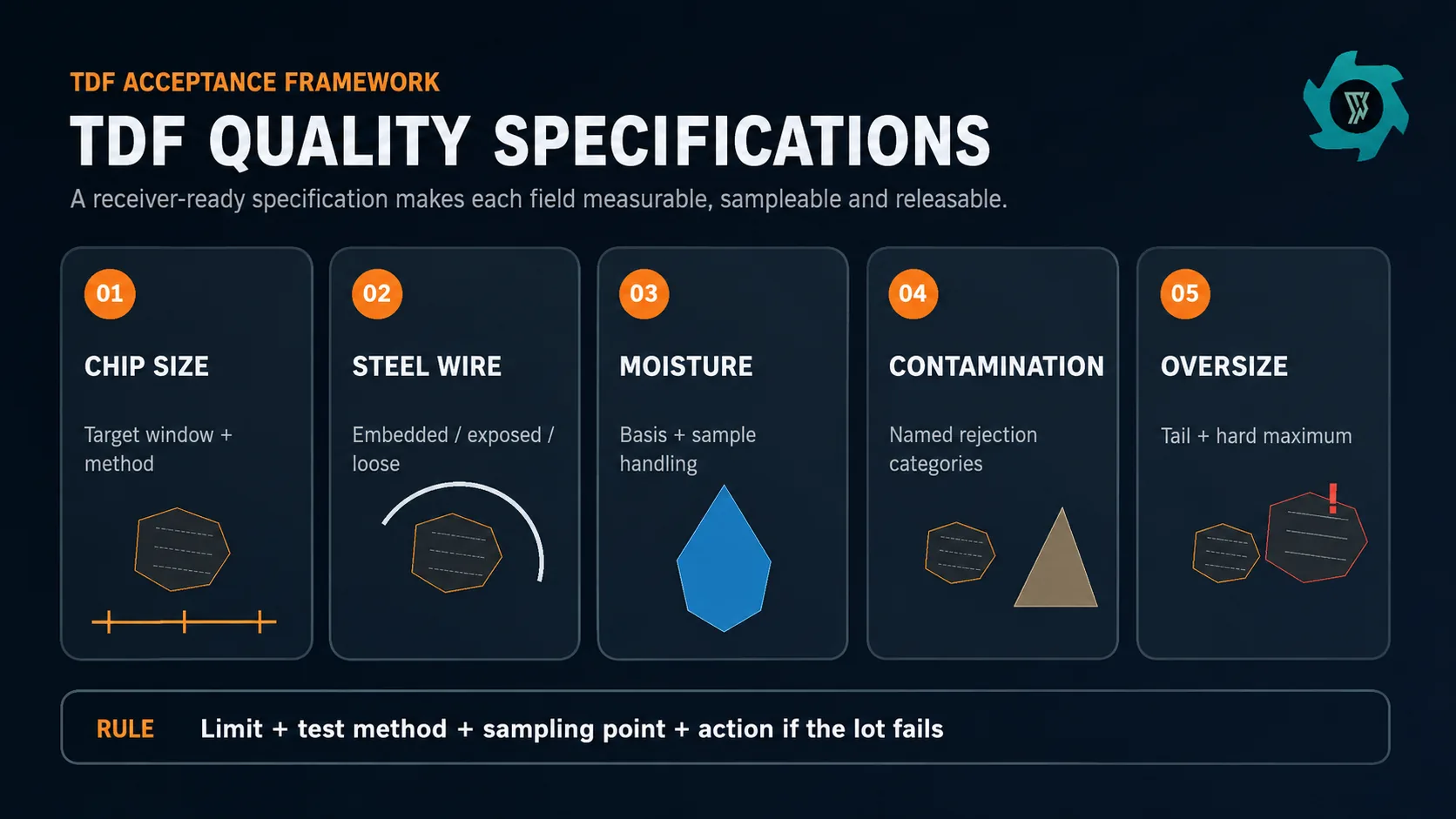
Use a Five-Field Acceptance Sheet Instead of “Good TDF”
The table below keeps physical quality separate from fuel chemistry. Calorific value, ash, sulfur, chlorine and other chemistry can be added when the receiving plant requires them.
| Quality field | Write in the contract | Verify on the finished lot | If it fails |
|---|---|---|---|
| Chip size | Target window and dimensional method. | Representative sample using the agreed gauge, dimension or receiver method. | Hold and evaluate re-screening / re-shredding. |
| Steel wire | Rules for embedded steel, exposed attached wire and loose metal. | Visual/physical or other agreed inspection on a defined sample basis. | Hold, separate further or rework if the contract allows. |
| Moisture | Maximum result, reporting basis and test method. | Protected sample taken at the agreed point and tested promptly. | Hold, dry/store differently, blend only if contract permits, or reject. |
| Contamination | Named prohibited materials and tolerance, if any. | Intake controls plus finished-lot inspection. | Quarantine and remove the source before release. |
| Oversize | Permitted tail, basis of calculation and any hard maximum. | Same representative lot sample used for size control where appropriate. | Return oversize to the process or reject the lot under the agreed rule. |
The key is not whether every row contains a number. It is whether both sides can make the same pass/fail decision from the same lot. GCCA’s cement co-processing guidance makes consistency and regular sampling central to alternative-fuel quality, and notes that site permits may specify values and sampling procedures.[2]
1. Chip Size: Specify the Finished Distribution, Not Only the Screen
A screen opening is a production setting. A chip-size specification is a customer acceptance rule. Tire shreds are flexible and irregular. Their ability to pass a screen depends on orientation, shape, thickness and the condition of the screening and return system. A line can therefore use a particular screen without proving that every discharged piece has one identical dimension.
For purchasing, separate three ideas. First is the normal target window: the range the plant expects most accepted material to occupy. Second is the oversize allowance: the permitted tail outside that normal window. Third is the hard maximum, if the receiver has a physical feeder, valve or chute that cannot accept a piece beyond a certain dimension.
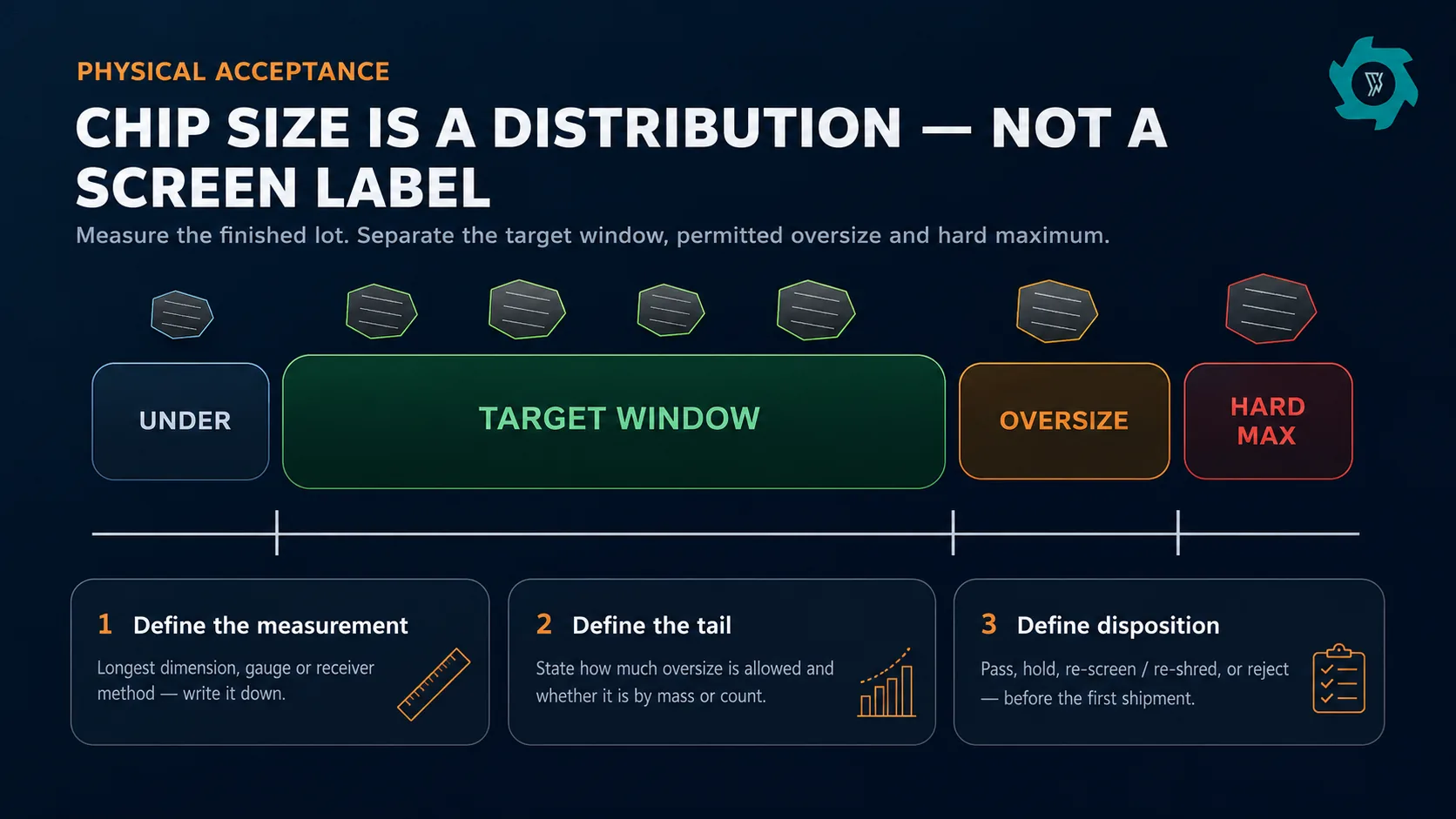
This is also why a brochure phrase such as “output 50 mm” is weak contract language. It does not tell the buyer how many pieces may fall outside the target, whether an occasional long strip is permitted, how many chips must be inspected, or whether size is evaluated by mass or by piece count. The measurement basis belongs beside the limit.
2. Steel Wire: Separate Embedded, Exposed and Loose Metal
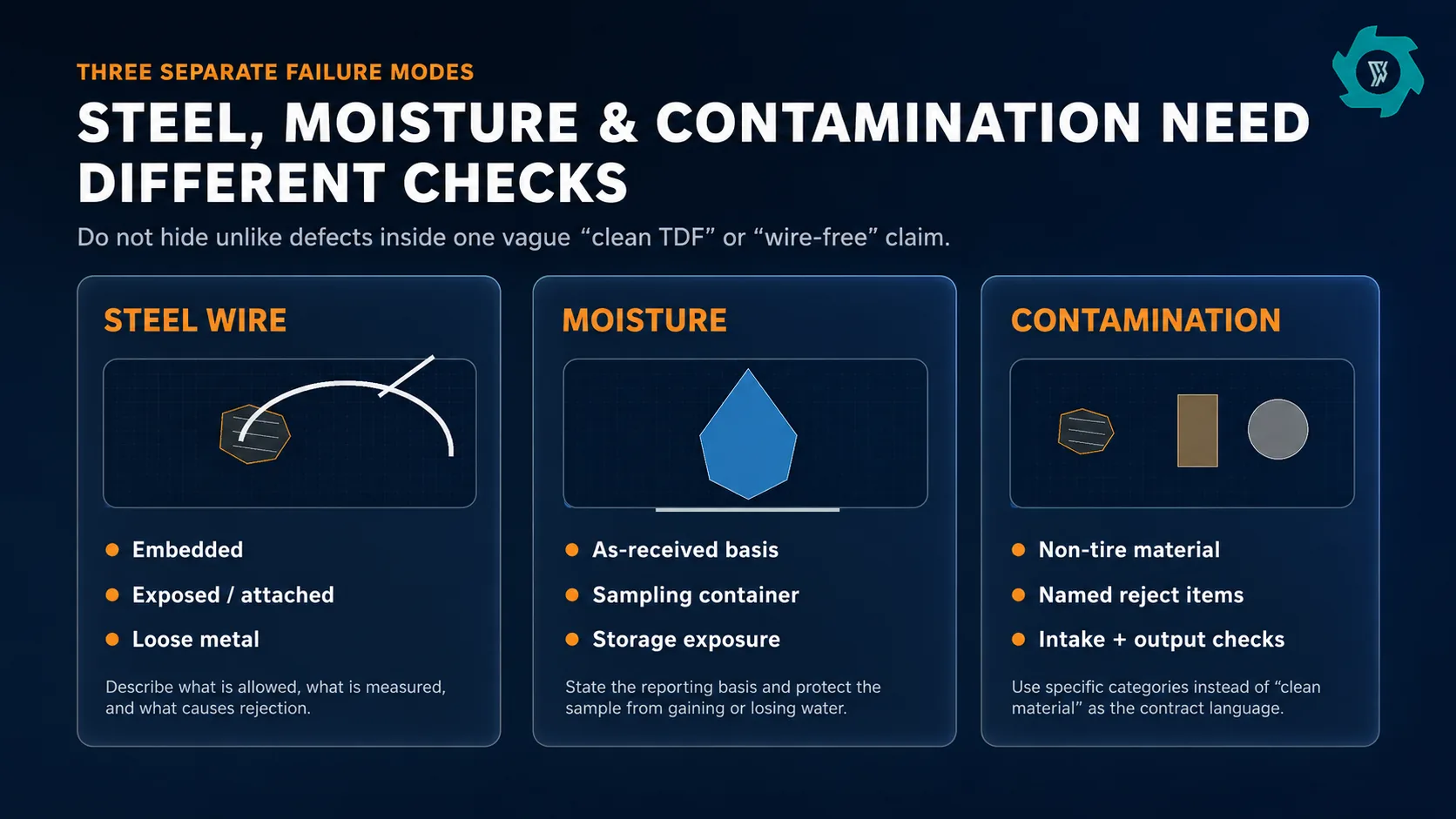
“Wire-free” is often too blunt for TDF. A rough fuel chip can still contain steel belt cord inside the rubber after the concentrated bead steel has been removed. The handling problem is often not the existence of every steel filament; it is the form in which steel reaches the bunker, conveyor, metering equipment or feed point.
Embedded steel
Steel remains captured inside the rubber chip. Some receivers accept it because it does not behave like a loose strand during handling.
Exposed attached wire
Wire protrudes from the rubber. The buyer may limit exposed length, number of pieces or another receiver-specific criterion because long strands can snag.
Loose metal
Detached wire, bead fragments or other free ferrous pieces are a different defect. They can be specified and checked separately from embedded reinforcement.
A magnetic separator can remove liberated ferrous material, but it cannot be assumed to extract every cord still embedded in a rubber chip. Conversely, a visual check for long protruding wire does not quantify all ferrous content.
Steel results also tell the plant something about the feed and process. A sudden increase in bead fragments may point to a change in tire mix or preparation. More loose wire after secondary cutting may indicate that steel is being liberated faster than the collection step can remove it. The correct response is to trace the source, not merely reject a truck and continue with the same settings.
3. Moisture: Define the Reporting Basis Before the Maximum
A percentage without a method does not tell the supplier where the sample came from, whether it was exposed to rain during loading, how long it sat before testing, or which mass basis the laboratory used. Those details matter because TDF is sold and transported by mass while the fuel user cares about stable handling and usable energy.
For physical QA, the specification should answer four questions: Where is the sample taken? How is it protected from moisture change? What test method is used? What reporting basis controls acceptance? If the receiver uses an “as received” result, write that language. If it uses another defined basis, write the conversion and laboratory method rather than assuming both parties mean the same thing by “5% moisture” or any other number.
Whole tires can collect water outdoors; open chip piles can be exposed to rainfall and wet ground; a dry production line can therefore load a wet shipment if finished storage is poorly managed. If moisture is a contractual property, covered storage, drainage, loading practice and sample containers may matter as much as the shredder itself.
4. Contamination: Name the Reject Material
Typical project discussions may distinguish tire rubber and its permitted steel reinforcement from rims, large loose metal, stones, soil, concrete, wood, plastics or other non-tire material. The actual prohibited list must come from the receiver, local rules and the site’s safe-handling procedure.
Contamination control starts before shredding because a foreign object can be both a product-quality problem and an equipment problem. Intake inspection, segregated storage and a clean loading floor are usually cheaper than discovering the defect after a mixed lot has been produced. The finished-product check then verifies that the upstream controls worked.
Do not use a single “purity” percentage to hide unlike contaminants. One kilogram of stones, one long steel tool and one kilogram of wet soil are not operationally equivalent even if the arithmetic produces the same percentage. Separate rejection categories make root-cause work possible.
5. Oversize: Define the Tail and the Hard Stop
A fuel user may tolerate a small number of pieces above the normal target while having an absolute mechanical limit beyond which a chip will not pass a feeder or gate. If the contract only says “50–80 mm,” it does not tell the processor which situation applies.
A useful oversize clause answers three questions. How is oversize identified? How much is permitted? Is there an absolute maximum that triggers failure regardless of the average? Then state the calculation basis. A percentage by piece count can give a different result from a percentage by mass, especially with irregular tire shreds.
If oversize can be returned to the shredder and the lot retested, write that route. If the receiver rejects the full truck once a hard maximum is found, the processor needs to know before loading.
Sampling Turns a Pile of TDF Into a Defensible Lot Result
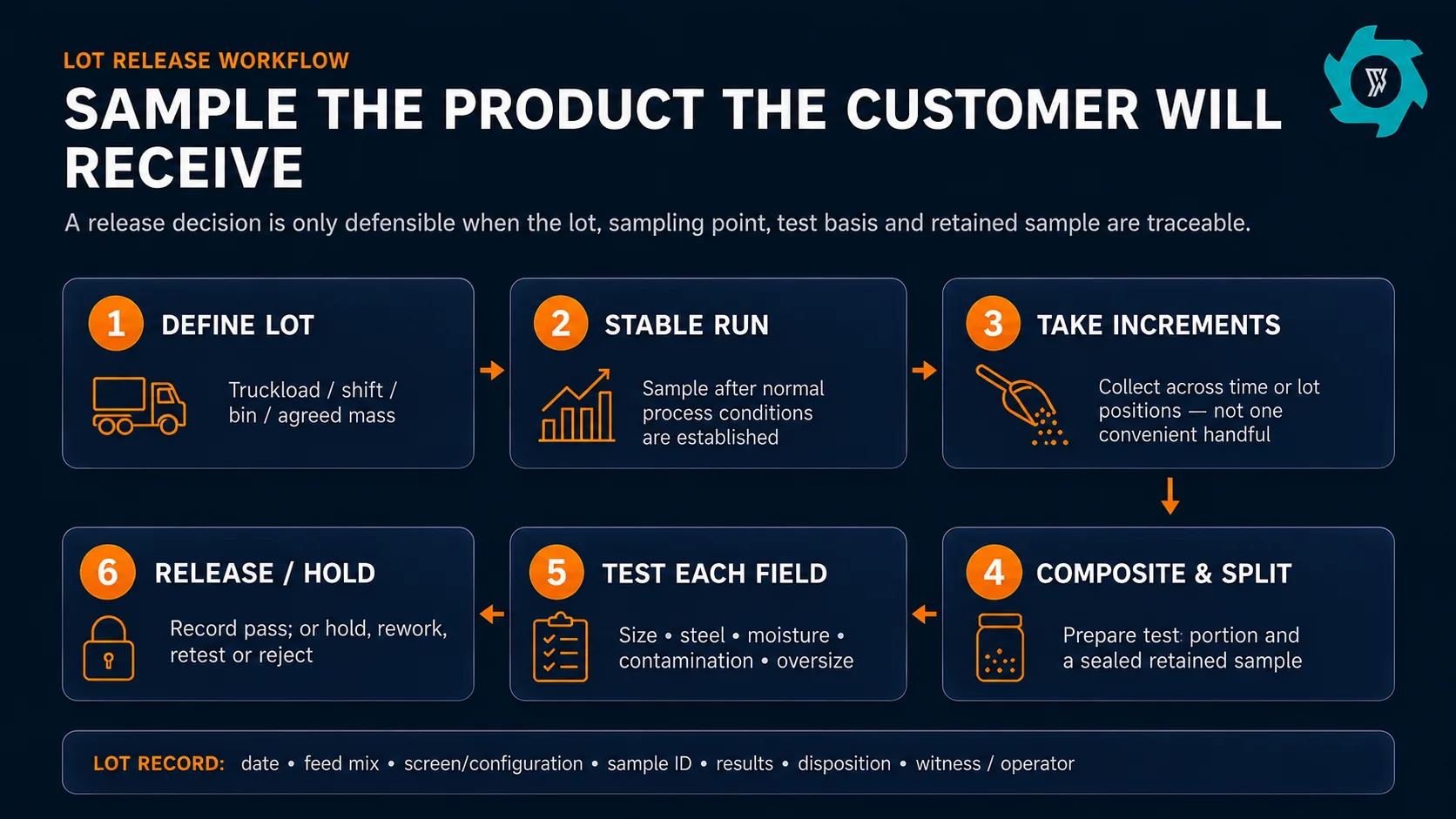
The strongest specification still fails if the sample is not representative. Grabbing a few good-looking chips from the top of a pile encourages selection bias and misses variation through the production period.
Next, choose the sampling point. For a process acceptance test, timed increments from the finished conveyor after stable operation are often more informative than a surface sample from a static pile. For shipment release, the buyer may prefer increments taken during loading or another documented method. The exact plan is contractual; the important part is that it is written before results are disputed.
Combine increments according to the agreed procedure, prepare the test portion without hand-picking the “best” chips, and retain a sealed duplicate when the contract requires one. Moisture samples may need their own closed container so the result does not drift while the size sample is being handled. Label the sample with the lot ID, time, sampling point and person or witness responsible.
Minimum Lot Record
- lot or shipment ID and date;
- feed description and major tire-mix changes;
- production period and relevant screen/configuration identification;
- sampling point and sampling method;
- results for chip size, steel, moisture, contamination and oversize as contracted;
- rework, abnormal-stop or non-conformance notes;
- release, hold, retest or rejection decision;
- retained-sample identification when required.
Use Quality Results to Find the Process Variable That Changed
Finished-product QA is more useful when it feeds back into production. A failed result should trigger a targeted check instead of a general instruction to “make better TDF.” The table below keeps the article at the quality-control boundary while showing the first process questions to ask.
| Observed quality drift | Check first | Why it can change the result |
|---|---|---|
| More oversize or long strips | Blade condition, screen integrity/bypass, feed surges and return path. | Cutting and size-control conditions determine whether large pieces are reduced again before discharge. |
| More exposed or loose steel | Tire mix, bead preparation where used, steel-liberation pattern and any magnetic collection stage. | Different tire constructions release steel differently; a process designed for one mix may drift when the feed changes. |
| Moisture rises between production and delivery | Finished-product storage, floor drainage, rain exposure and loading practice. | The line can make acceptable chips and still ship a wet lot after storage. |
| Foreign material appears in output | Inbound inspection, storage segregation and loader/floor housekeeping. | Contamination is easier to prevent before the shredder than to sort from a mixed finished lot. |
| Test results vary sharply between samples | Lot definition, sampling position, increment spacing and process stability. | The apparent quality problem may be a poor sampling plan rather than a real shift in the whole lot. |
The quality sheet should also include change control. If a project moves from mostly passenger tires to a high truck- or OTR-tire share, or changes the screen configuration, do not assume the old verification data still describes the new operating condition. Record the change and confirm that the accepted product remains inside the receiver’s limits.
Turn the Specification Into a Factory Acceptance Test
A factory acceptance test should prove two things at the same time: the line can run on representative feed, and the product made during that run passes the written specification. Testing only shredder intake tonnage leaves the buyer with an unanswered question — how much accepted TDF does the line actually produce?
- Freeze the test feed. Describe tire categories, dimensions and known contamination conditions well enough that a later test is comparable.
- Freeze the product recipe. Record screen / return configuration and the quality limits being tested.
- Reach stable operation. Avoid taking the main acceptance sample while empty conveyors, screens and return loops are still filling.
- Measure the finished boundary. Weigh or otherwise measure the accepted product using the agreed capacity basis.
- Take representative increments. Build the composite sample across the stable test period rather than choosing attractive pieces.
- Test the five fields separately. A pass on size should not conceal a failure on loose metal, moisture or contamination.
- Record interruptions and rework. Note abnormal stops, bypasses and material returned for another pass.
- Release the result against the written rule. The report should show what passed, what did not, and what corrective action was taken.
A Buyer-Ready TDF Specification Template
Product form: Prepared tire-derived fuel chips for ____________________.
Lot definition: ____________________ (truckload / shift / agreed mass / other).
Chip-size target: ____________________. Measurement method: ____________________.
Oversize allowance: ____________________ by mass / count / other. Hard maximum: ____________________.
Steel: Embedded steel rule ____________________; exposed attached wire rule ____________________; loose metal rule ____________________.
Moisture: Maximum ____________________; reporting basis ____________________; test method ____________________.
Contamination: Prohibited categories ____________________; tolerance/test basis ____________________.
Sampling: Point ____________________; increment/composite method ____________________; retained sample ____________________.
Non-conformance: Hold / rework / retest / reject rule ____________________.
Capacity acceptance: Required accepted finished TDF ____________________ under the above specification and representative feed basis.
Fuel chemistry can be added as a separate block when the receiver requires calorific value, ash, sulfur, chlorine, trace elements or other laboratory properties. Keeping that block separate from physical handling quality makes the responsibility and sampling method easier to audit.
Keep Product Quality and Regulatory Status Separate
A shipment can meet a buyer’s physical chip specification and still be subject to separate legal rules about waste status, transport, storage, fuel use or emissions. In the United States, EPA’s current non-hazardous secondary materials guidance distinguishes scrap tires based on how they were managed and, for some discarded tire material, how they were processed before combustion.[3]
Common TDF Specification Mistakes to Fix Before Ordering Equipment
Copying a generic chip range
A market range is not proof that the receiver’s feeder accepts it.
Using the screen as the guarantee
The screen is part of process control. The accepted lot still needs a finished-product check.
Writing “wire-free” with no definition
Separate embedded reinforcement, exposed attached wire and loose metal. They create different handling and inspection questions.
Stating a moisture number with no basis
Without sample point, method and reporting basis, two labs can disagree while both believe they followed the contract.
Sampling only the easiest material
A handful from the top of the pile is not a defensible lot sample. Define the increments and composite method.
Quoting capacity before quality
Incoming tire tons per hour are not the same as accepted finished TDF after normal screening, return and rejection.
No rework or rejection rule
A specification needs a commercial disposition path. Otherwise every failed result becomes a new negotiation.
No change-control trigger
A major change in tire mix or screen configuration can change the product distribution. Record and re-verify the new condition.
Frequently Asked Questions
Is there one universal TDF quality specification?
No. TDF acceptance depends on the receiving plant, its handling and feeding system, permit conditions and commercial contract. A useful specification names the product limits, measurement method, sampling basis and action for a failed lot instead of copying a generic market number.
Does TDF have to be wire-free?
Some receivers accept embedded tire steel but restrict long exposed wire or loose metal; others require more steel reduction. The contract should separate embedded steel, exposed attached wire and loose metal so both the processor and receiver know what is being checked.
How should moisture be specified for TDF?
State the agreed maximum only after defining the reporting basis and test method. The specification should say where the sample is taken, whether the result is reported as received or on another agreed basis, how the sample is protected from moisture change, and what happens to a wet load.
How should TDF oversize be controlled?
Define both the normal chip-size window and the permitted oversize tail. State whether oversize is evaluated by mass, count or another receiver method, identify any absolute maximum piece dimension, and write the rework or rejection rule before production starts.
What records should follow a TDF lot or shipment?
At minimum, keep a lot or shipment ID, production date or period, feed description, sampling point, test results for the contracted quality fields, non-conformance or rework notes and the final release decision.
References
- ASTM D6700 – TDF use, handling, feeding and combustion considerations.
- GCCA Q&A – alternative-fuel quality, sampling and permit context.
- EPA NHSM – U.S. regulatory-status distinction for secondary materials.
Configure the TDF Line Around the Receiver’s Acceptance Sheet
Send the tire mix, maximum tire dimensions, written chip-size method, oversize rule, steel-wire limits, moisture/contamination requirements and required accepted output. YUXI can match the preparation, shredding, screening and return arrangement to those conditions.