




Tire-derived fuel may have a higher heating value than some types of coal, but a higher heating value does not mean it can directly replace coal. Its suitability for use in a cement kiln also depends on the fuel’s physical properties, chemical composition, and the actual operating conditions of the kiln system.
The Short Version: Compare Energy First, Then Kiln Fit
TDF is normally used to replace part of the conventional fuel input, not to copy coal on a mass basis. Historical U.S. EPA material reports tire fuel in roughly the 14,000–15,500 Btu/lb range (about 32.6–36.0 MJ/kg), while coal in the same comparison is around 10,000–13,000 Btu/lb (about 23.3–30.2 MJ/kg).[1]
During kiln operation, fuel supply must remain stable while maintaining clinker quality, controlling chlorine and trace elements, meeting emissions permit requirements, and ensuring overall combustion stability. GCCA guidance therefore treats calorific value as only one field inside a broader alternative-fuel acceptance system.[2]
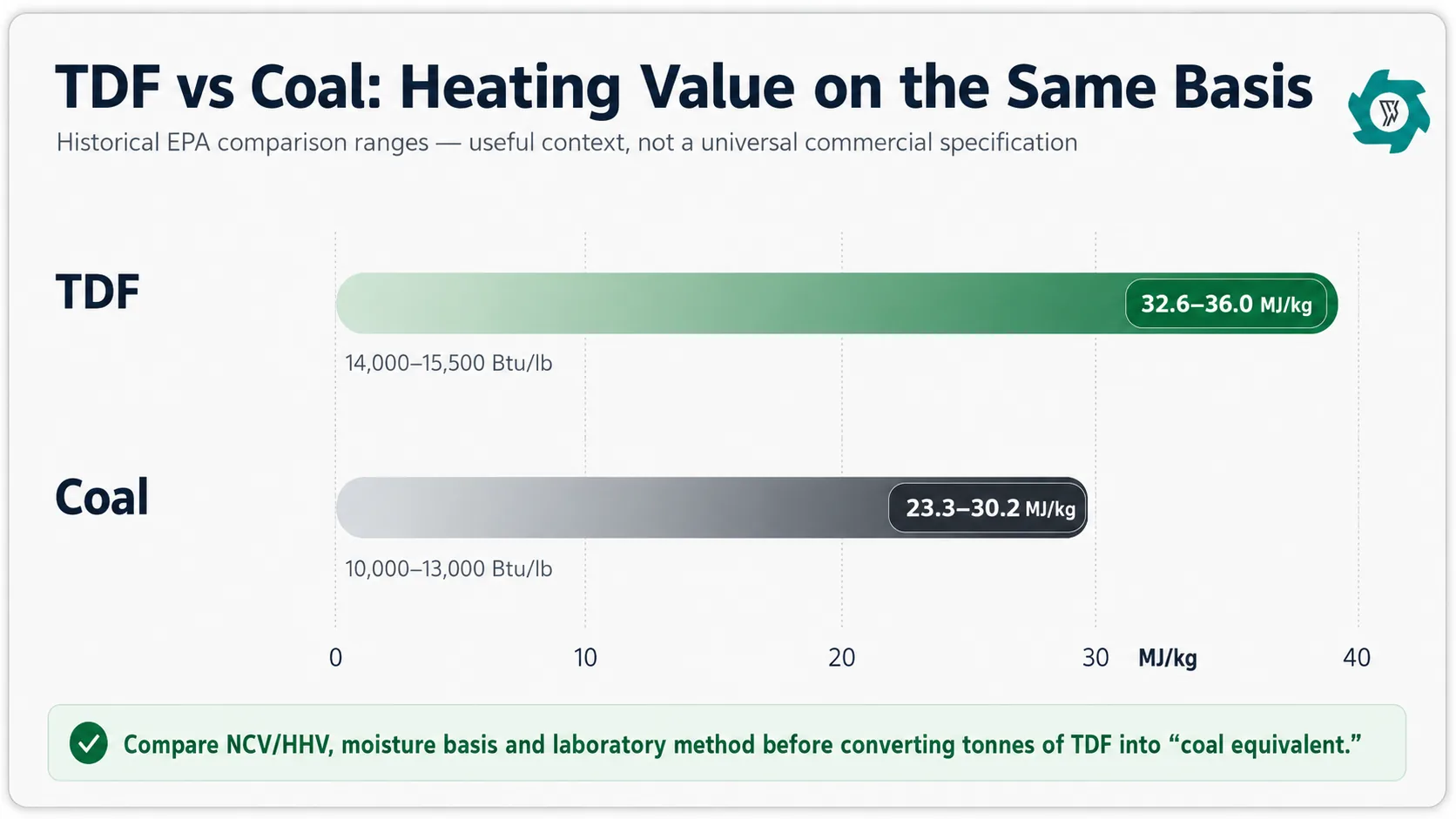
TDF and Coal Are Not Interchangeable by Weight
Coal is not one fuel. TDF is also variable. Passenger and truck tire mixes differ, retained steel changes the non-combustible fraction, outdoor storage can add water, and the reporting basis can change the number. A comparison becomes misleading when one laboratory reports a dry-basis gross calorific value and the other fuel is priced as received.
An older EPA pilot-study report illustrates the point. Its comparative table used an average TDF analysis with lower moisture and a higher heating value than the coal sample in that study. The same report explicitly describes TDF as having a higher heating value than coal and sulfur roughly comparable with medium-sulfur coal.[3] The table is useful as engineering context, but it should not be copied into a purchase contract.
| Field | EPA example TDF | EPA example coal | How to use the comparison |
|---|---|---|---|
| Heating value | 7,428 kcal/kg | 6,396 kcal/kg | Shows why energy per tonne can favor TDF. |
| Moisture | 0.62% | 5.24% | Low tire moisture is useful, but rainwater and storage conditions can change delivered material. |
| Ash | 4.78% | 6.23% | Ash quantity and chemistry both matter because cement kilns incorporate mineral input into the process. |
| Sulfur | 1.23% | 1.59% | Do not generalize from one coal. |
| Nitrogen | 0.24% | 1.76% | The nitrogen content varies between fuels, but actual NOx emissions depend largely on the operating conditions of the entire combustion system. |
Use NCV or HHV consistently
Before anyone calculates “coal replacement,” write down which heating-value basis is being used. Gross calorific value / higher heating value includes the latent heat associated with water vapor. Net calorific value / lower heating value does not. Both can be valid, but two fuels should be compared on the same basis and at the same moisture condition.
For cement procurement, an as-received NCV is often more useful than a best-case dry laboratory value because the plant pays to transport and handle the material that actually arrives at the gate.
Why Cement Kilns Can Use Tire-Derived Fuel
Cement kilns are relevant to this comparison because they use fuel for high-temperature process heat while clinker chemistry is controlled at the same time. That makes fuel selection different from a simple boiler decision: energy value matters, but so do the chemical contribution of the fuel, combustion behaviour and the operating envelope of the kiln system.
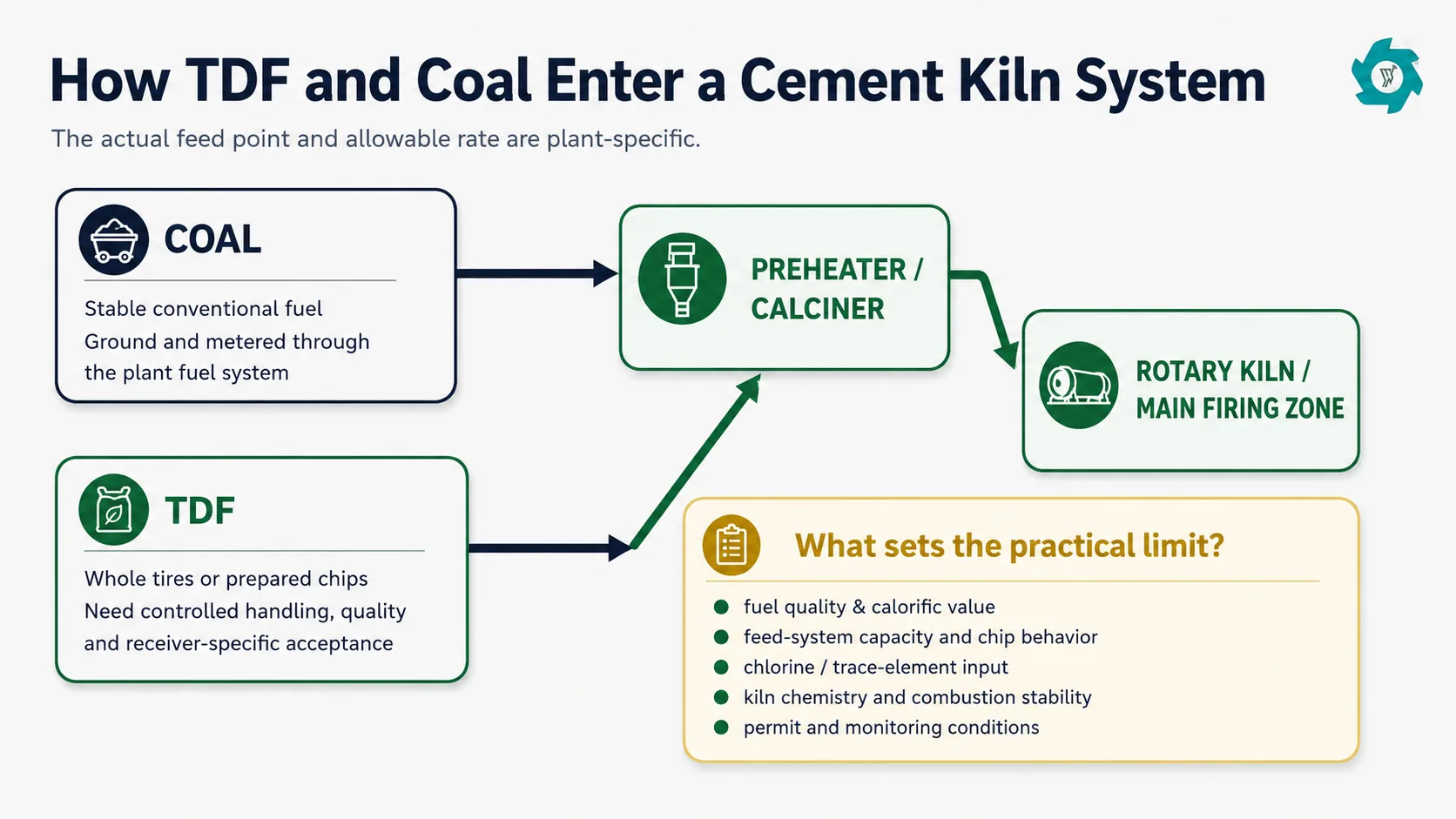
Higher Heating Value Does Not Mean Unlimited Coal Substitution
Published substitution rates vary widely by kiln design, fuel form and feed point, so no single percentage should be treated as a general limit. A current GCCA case study for Golden Bay in New Zealand reports chipped tires being used at substitution rates of up to 40% in the calciner after dedicated handling and feed equipment was installed.[4]
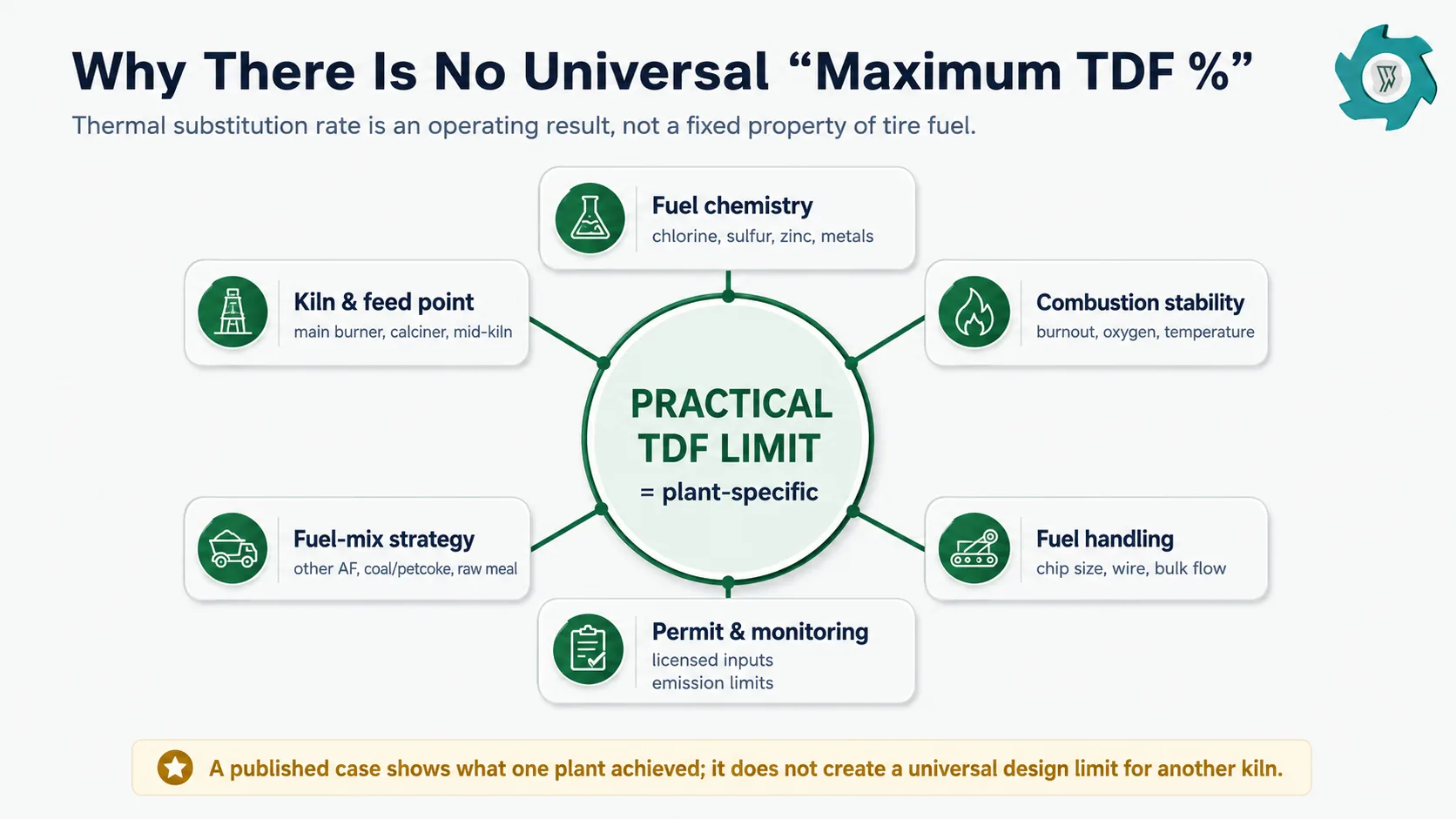
1. Kiln design and feed point
A main burner, calciner or mid-kiln feed location gives the fuel a different temperature, oxygen environment, residence time and mixing history. The same TDF form will not behave identically at every point.
2. Fuel quality and consistency
GCCA calls for consistent alternative-fuel quality, including adequate calorific value and controlled metals, halogens and ash.[2] A variable load forces the operator to protect the process with a lower or more conservative feed rate.
3. Chlorine and volatile cycles
Chlorine is specifically restricted in alternative-fuel specifications because excessive input can create process difficulties in the kiln system.[2] The allowable TDF share therefore depends on total input from all fuels and raw materials, not on the tire analysis alone.
4. Trace elements and clinker chemistry
Zinc and other trace elements from tires are often discussed in the technical literature. The plant chemist must evaluate the cumulative input and its effect on clinker and cement quality rather than apply a generic tire percentage.
5. Handling and metering capacity
A kiln may be chemically capable of using more TDF than its receiving and feed system can deliver steadily. Bridging, long wire, irregular chips or insufficient feeder capacity can become the real limit.
6. Permit and monitoring conditions
GCCA notes that feeding point, energy content, trace-element limits and sampling procedures can be detailed in the permit.[2] A project cannot use another plant’s substitution rate to bypass its own regulatory basis.
How to Compare One Tonne of TDF with One Tonne of Coal
Start with energy, not mass. If a verified TDF sample contains more usable energy per kilogram than the coal being displaced, less TDF mass may be needed for the same theoretical heat input. That does not mean the kiln will realize the same conversion one-for-one in operation, but it gives the correct first normalization.
For an illustrative calculation only, suppose a contract laboratory reports TDF at 33 GJ/t NCV and the coal at 26 GJ/t NCV on the same as-received basis. One tonne of that TDF carries 33 GJ, which is theoretically equal to about 1.27 tonnes of that coal by energy. The plant should still apply its own operating experience, combustion efficiency and permitted fuel-mix constraints before turning this ratio into a purchasing forecast.
Compare delivered cost per accepted GJ
Coal may require grinding and a mature feed system. TDF may require tire collection, shredding, screening, quality control, special storage and a separate feeder. The useful metric is therefore the cost of acceptable energy delivered into the kiln system, not just the price per tonne at the recycler’s gate.
What the Comparison Means for Fuel Procurement
The useful buying question is not “How many tonnes of coal does one tonne of TDF replace?” It is “How much accepted thermal energy does each delivered fuel provide under the same reporting basis?” That means the comparison should start with NCV or HHV, moisture basis and delivered price, then move to the site-specific constraints that can limit how much of that energy the kiln can actually use.
Two fuels with similar delivered cost per GJ can still have very different operational value. A coal supply may be easier to meter and more familiar to the kiln team. TDF may provide attractive energy value and reduce fossil-fuel demand, but only when supply consistency, handling, chemistry and the approved substitution envelope remain under control.
For procurement teams, the practical output of the comparison is therefore a fuel acceptance and trial framework: a common energy basis, agreed chemical limits, delivery consistency, a planned substitution ramp and a clear method for measuring kiln response.
TDF vs Coal: Practical Comparison for Cement Projects
| Decision field | TDF | Coal | Project implication |
|---|---|---|---|
| Heating value | Often high; historical EPA comparisons show values above typical coal samples. | Varies strongly by rank, source and moisture. | Compare verified NCV/HHV on the same basis. |
| Moisture | Rubber itself is low-moisture, but storage can introduce water. | Can range from relatively dry to high-moisture grades. | Use as-received values for delivered-energy calculations. |
| Fuel preparation | May need shredding, screening and steel/contamination control. | Often uses established crushing/grinding and pulverized-fuel systems. | Include the whole handling chain in cost and reliability comparisons. |
| Mineral contribution | Retained steel can add iron; tire ash and trace elements enter the kiln system. | Coal ash also contributes mineral matter and chemistry. | The plant chemist evaluates total raw meal + fuel input. |
| Feed behavior | Irregular chips and exposed wire can challenge storage and metering. | Ground coal is usually handled by an established fine-fuel system. | Physical feed capacity can limit TDF before thermal demand does. |
| Substitution rate | No universal rate. | Usually the reference conventional fuel in a coal-fired system. | TSR must be demonstrated on the specific kiln and permitted fuel mix. |
| Emissions | Cannot be generalized independently of kiln operation and controls. | Also depends on coal chemistry, raw materials and controls. | Use permit conditions and monitored plant results rather than generic claims. |
| Supply model | Depends on local end-of-life tire collection, preparation and contracts. | Usually purchased as a conventional commodity fuel. | Fuel security can become as important as nominal price. |
When TDF Is a Strong Fit—and When Coal May Remain Easier
TDF is a strong candidate when
- the cement plant has an approved alternative-fuel route and a suitable receiving/feed system;
- local tire supply can support the required monthly fuel volume without extreme seasonal gaps;
- the recycler can repeatedly meet the written size, wire, contamination and fuel-quality limits;
- the delivered energy economics remain competitive after preparation, storage, transport and quality control;
- the plant can manage total chlorine, sulfur and trace-element inputs without destabilizing the kiln or clinker chemistry.
Coal may remain operationally easier when
- there is no permitted TDF feed point or the alternative-fuel system is too small for the proposed rate;
- tire supply is irregular and the plant cannot tolerate fuel-energy swings;
- the TDF producer cannot control long wire, oversize or contamination reliably;
- the kiln’s current chemistry or volatile cycles leave little margin for the additional fuel inputs;
- the logistics cost overwhelms the energy value by the time the fuel reaches the plant.
Questions to Answer Before Comparing TDF with Coal
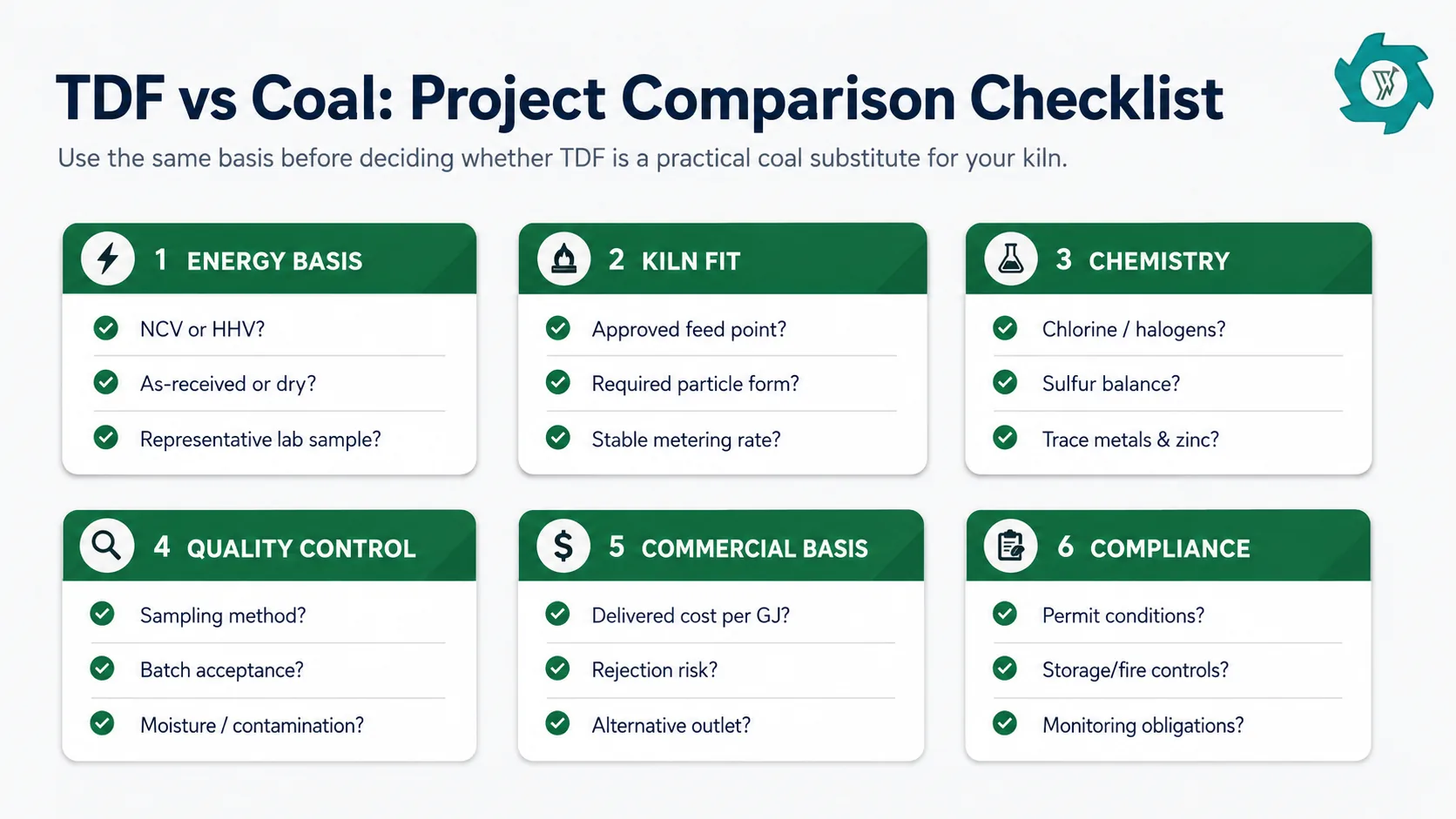
- Which coal or petcoke grade is the reference fuel?
- Are both fuels reported on the same NCV/HHV and moisture basis?
- What is the delivered cost per accepted GJ rather than only per tonne?
- How variable are calorific value, moisture and ash from load to load?
- Which chlorine, sulfur, zinc and other trace-element limits matter at this kiln?
- Which feed point and combustion zone will determine usable substitution?
- What substitution level will be tested first, and what operating indicators will govern the ramp-up?
- How will clinker quality, emissions, kiln stability and fuel-feed performance be evaluated during the trial?
- What permit or reporting conditions limit the approved fuel mix?
- Can the local TDF supply chain maintain the required energy and chemistry consistency over time?
Frequently Asked Questions
Does TDF have a higher heating value than coal?
Often, yes. Historical EPA comparisons show tire fuel above typical coal samples on a heating-value basis. The actual difference depends on the tire mix, retained steel, moisture, coal rank and the test method, so commercial projects should compare their own representative samples.
Can one tonne of TDF replace one tonne of coal?
Not reliably. Compare verified energy first. If TDF has a higher NCV per tonne, the theoretical mass equivalent may be lower, but the kiln’s feeding, combustion and permit constraints still determine the usable replacement.
What is the maximum TDF substitution rate in a cement kiln?
There is no universal maximum. Published projects report different values because kiln design, fuel-feed location, chemistry, chlorine and trace elements, combustion stability, handling equipment and permits differ. A rate achieved at another plant should be treated as a case, not a guarantee.
Does TDF always produce lower emissions than coal?
No universal emissions claim is appropriate. GCCA notes that many cement-kiln emissions are strongly influenced by raw materials and plant operation, while alternative fuels require strict acceptance, permit controls and monitoring. Site data should control the comparison.
Why does TDF sometimes keep steel in the chip?
In some cement plants, retained tire steel can contribute iron to the process. Even then, long exposed wire or loose metal may be limited because it can interfere with conveyors and feeders. The fuel specification should separate chemical usefulness from handling acceptance.
What should a TDF producer get from the cement plant first?
Request the written fuel-acceptance sheet, approved fuel form and feed point, size and wire criteria, calorific-value and moisture basis, chemistry limits, sampling procedure, unloading method and expected monthly demand before fixing the processing line.
Configure the TDF Line Around the Cement Plant’s Fuel Specification
Send YUXI the tire mix, maximum tire dimensions, required TDF form and size, exposed-steel limit, expected finished output, fuel-user acceptance sheet, site layout and local power supply. The line can then be configured around the product the kiln can actually receive.