How to Choose a Rubber Powder Machine: Buyer Guide
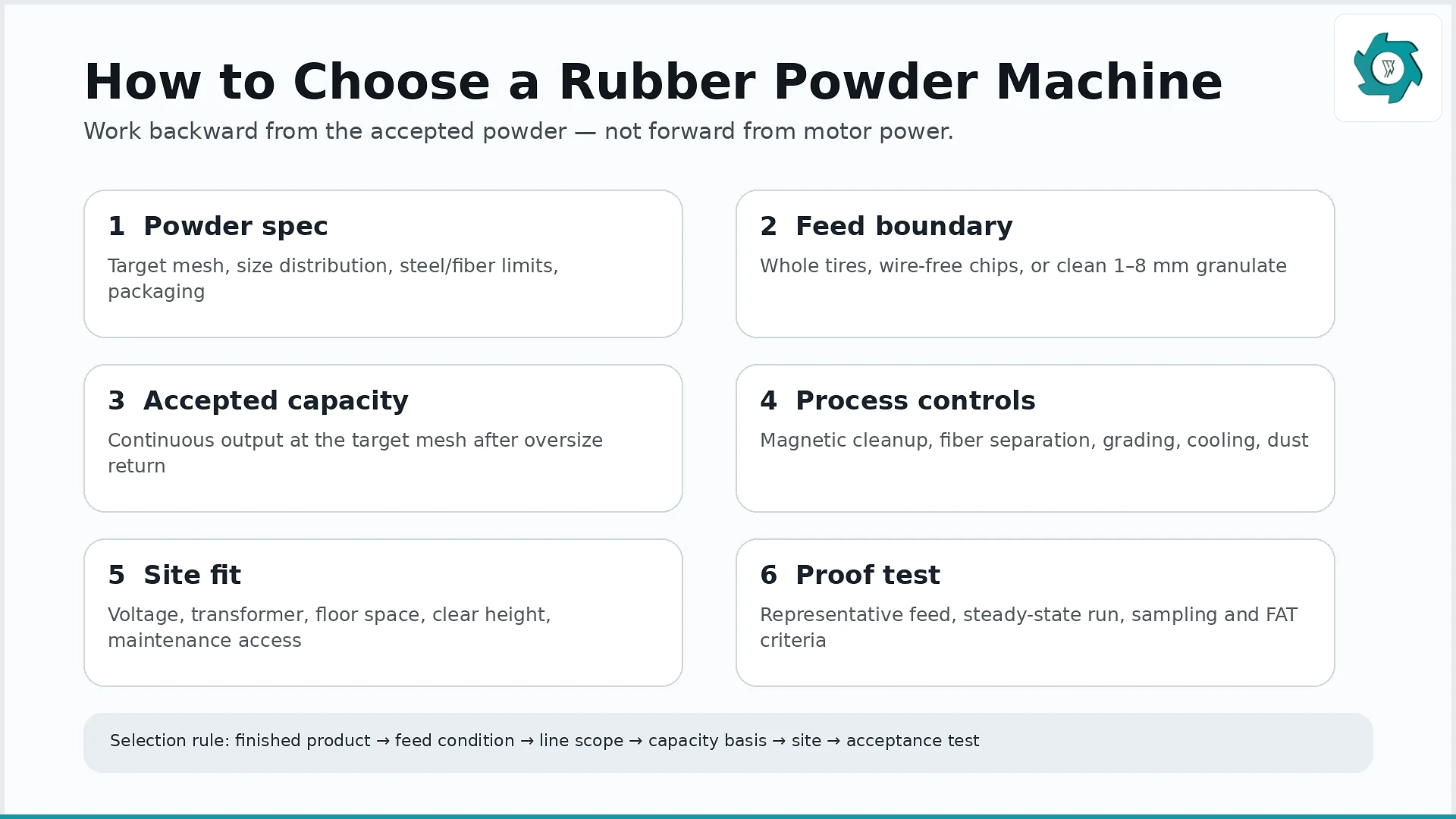
A rubber powder machine should be chosen from the finished product backward. The target mesh, accepted powder output, feed condition and contamination limits tell you what the grinder actually has to do. Only after those points are fixed does it make sense to compare motor power, model size or price.
Choose the Machine from the Finished Powder Backward
Start with four numbers or statements that a downstream buyer can actually verify: the target particle size, the acceptable size distribution, the allowed steel and fiber contamination, and the quantity of accepted powder needed per hour or per shift. ASTM D5603 describes recycled vulcanizate particulate rubber as material processed to obtain a desired particle-size distribution, while ASTM D5644 provides a test method for measuring that distribution.[1][2] That is a useful purchasing mindset: “40 mesh” is not just a label on a brochure; it needs to become a measurable product specification.
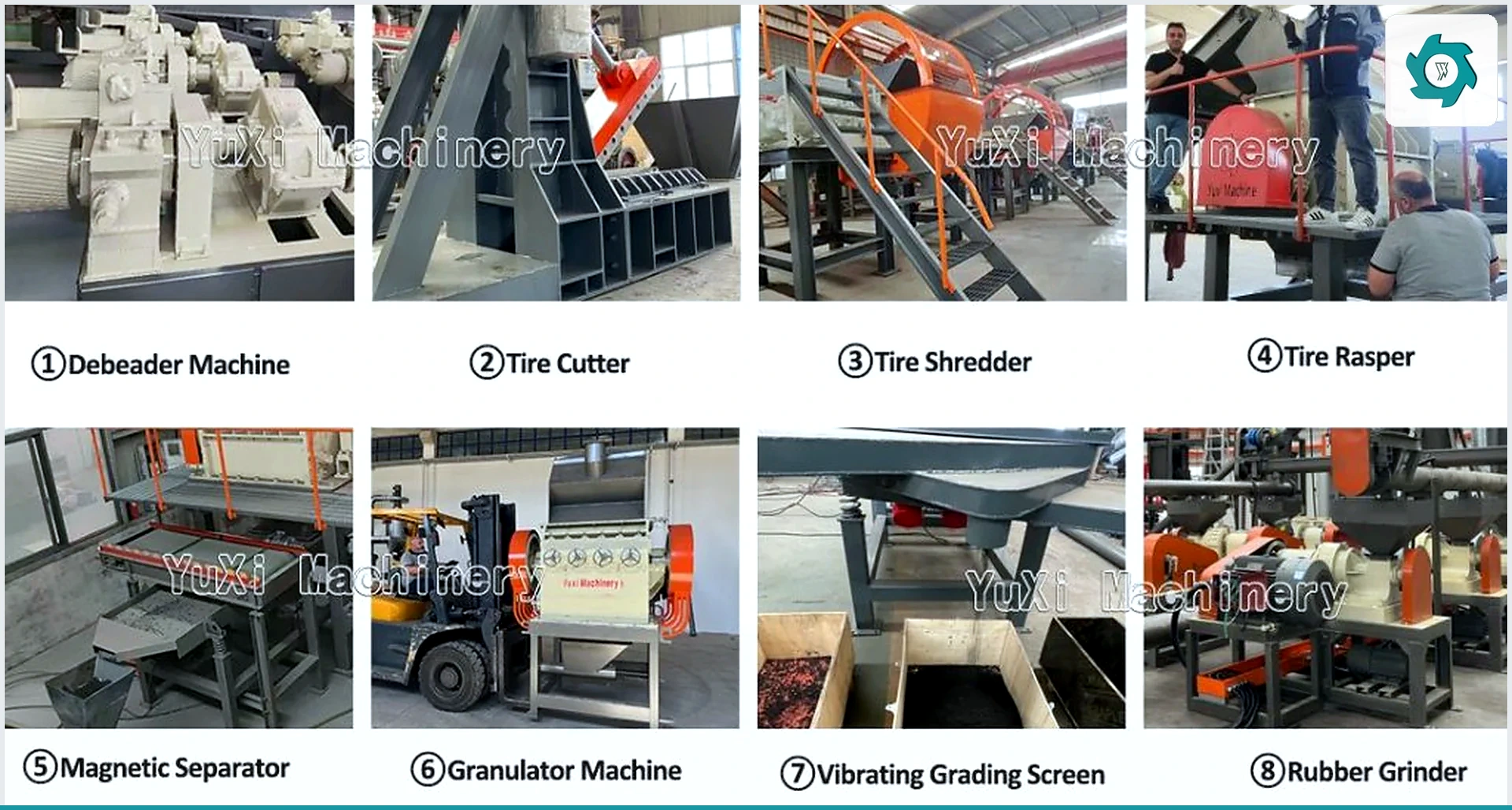
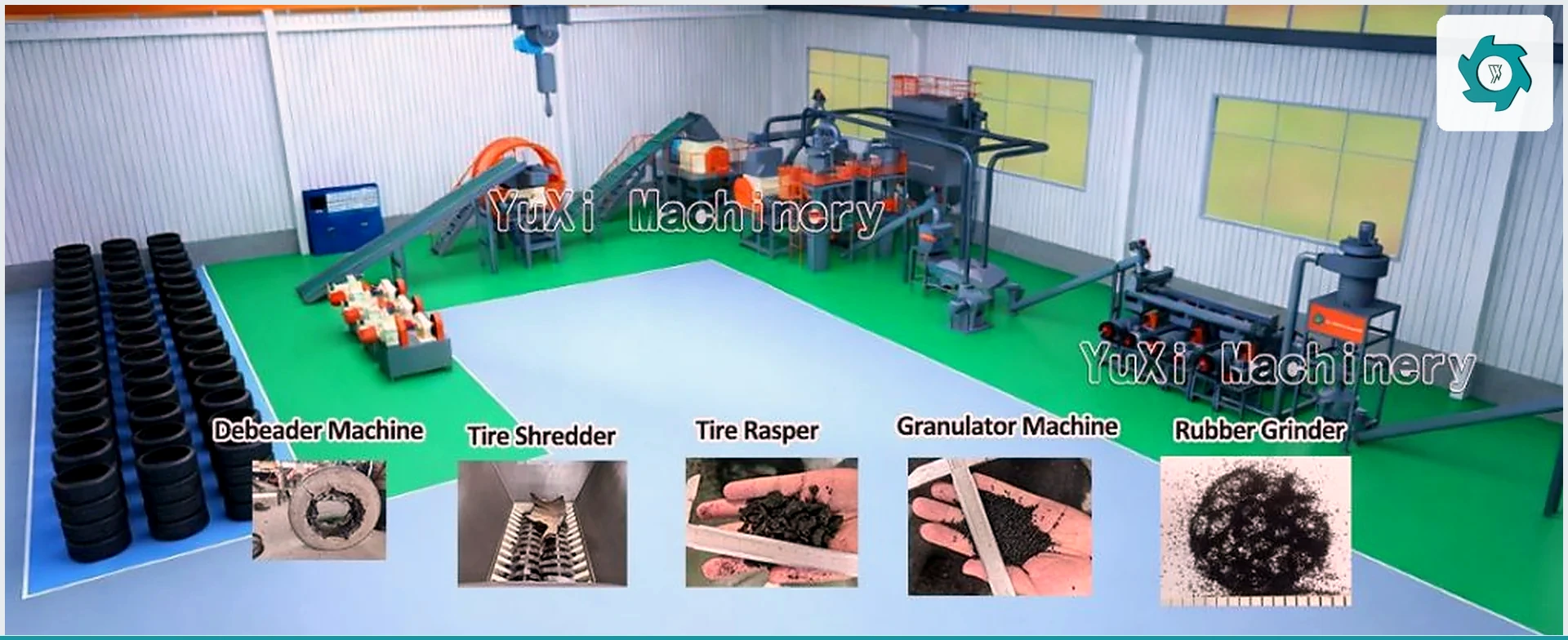
The current YUXI tire rubber powder plant page shows why this matters. Its complete ambient route does not jump from a whole tire straight into a powder mill. The material is prepared, shredded, opened for steel recovery, granulated, graded, cleaned of textile fiber and then fine-ground. The grinder is the last size-reduction step, not a substitute for the upstream line.
A useful machine selection starts with the accepted powder and works backward to the feed, line scope and proof test.
1. Decide Whether You Need a Grinder or a Complete Tire-to-Powder Line
Before comparing models, draw one line on paper: where does the supplier’s responsibility begin? This single question prevents a lot of bad comparisons.
Starting material
Likely equipment scope
Main selection risk
Clean 1–8 mm rubber granulate
Feeding, fine grinding, classification, collection, cooling and related controls
Buying a complete line when only a finishing module is needed
Wire-free 10–20 mm rubber chips
Granulation, magnetic cleanup, fiber separation, grading and fine grinding
Underestimating cleaning and return-load duty
Whole passenger or truck tires
Preparation, shredding, steel liberation, magnetic separation, granulation, fiber separation, screening and grinding
Comparing a grinder-only quote with a whole-plant quote
If you already make clean crumb, the purchase can be relatively narrow. If your raw material is whole tires, the powder mill is only one part of the project. The separate guide on how to make rubber powder from waste tires is useful for checking the full process boundary before you ask suppliers to quote.
We normally recommend writing the feed boundary directly into the RFQ: “Supplier scope begins with clean 1–3 mm rubber granulate,” or “Supplier scope begins with mixed passenger and truck tires up to the stated maximum size.” Do not leave that sentence for the sales engineer to guess.
2. Specify the Mesh You Intend to Sell
Rubber powder buyers do not all want the same fraction. Ground tire rubber can be used in molded products, athletic surfaces and asphalt-related applications, among others, and the acceptable particle size depends on the end use and the buyer’s own formulation or project specification.[3] The machine should therefore follow a confirmed market, not the other way around.
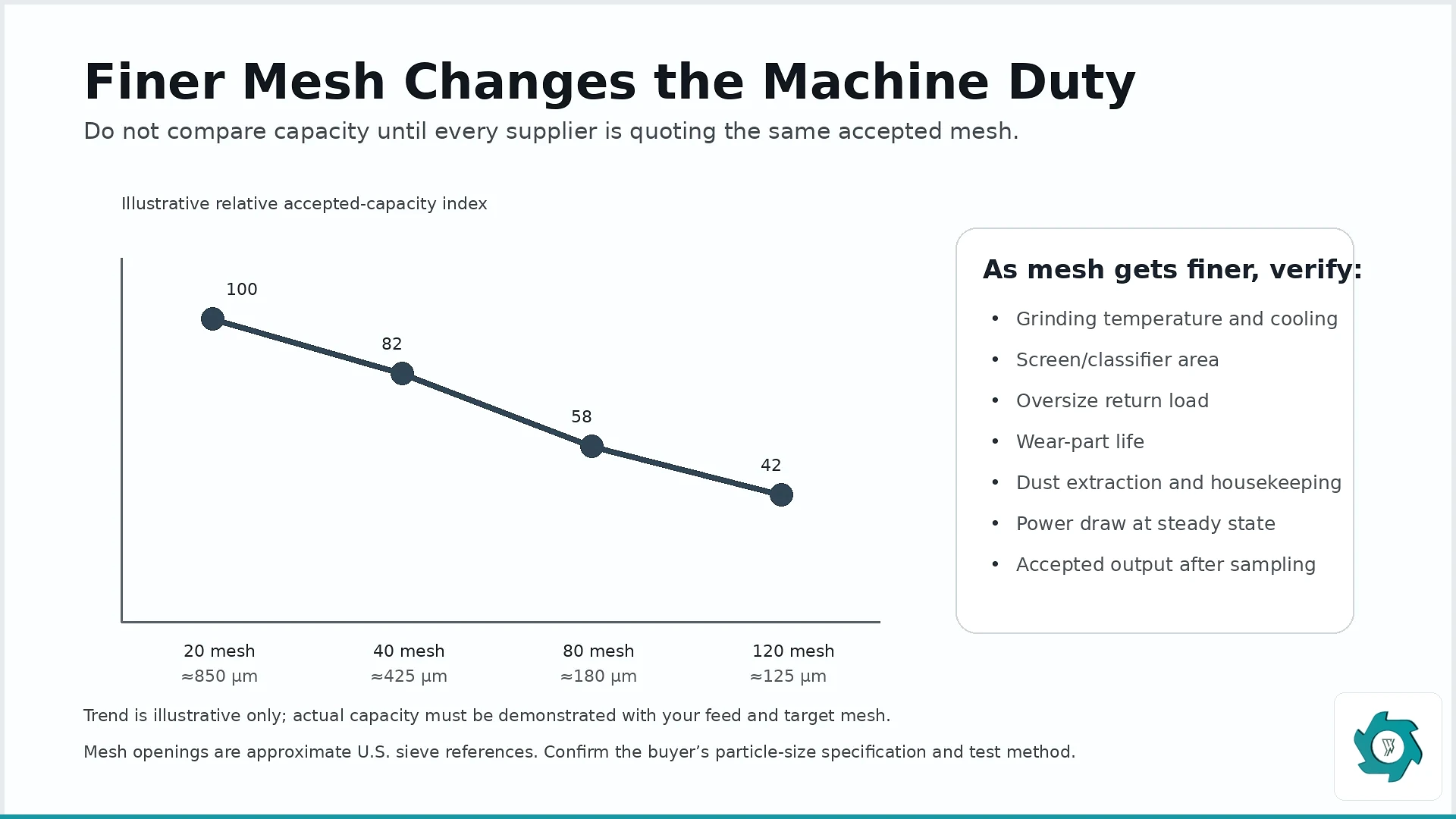
For early discussion, buyers often use familiar mesh numbers such as 20, 40, 80 or 120 mesh. Approximate U.S. sieve openings are about 850 μm for No. 20, 425 μm for No. 40, 180 μm for No. 80 and 125 μm for No. 120. Treat those as sieve references, not as a complete material specification. The accepted percentage passing and retained on each sieve can matter more than one headline mesh number.
If the target is still open, review the rubber powder mesh size and applications guide before sizing the mill. It is cheaper to change a product plan on paper than to discover after installation that your local buyer wants a different fraction.
Finer mesh is a different operating duty. Compare accepted output at the mesh you will actually sell.
3. Compare Capacity at the Final Mesh, Not at the Feed Hopper
This is one of the most important checks in the purchase.
A line can accept one ton per hour at an upstream conveyor and still produce much less than one ton per hour of accepted fine powder. The exact numbers will differ by machine, rubber formulation, temperature, wear state and test conditions, but the buying lesson is consistent.
Ask for three capacity figures:
Fresh feed rate: material entering the agreed equipment boundary.
Internal circulation: oversize material returned for more grinding or classification.
Accepted finished output: powder that passes the written mesh and contamination requirements.
4. Match the Machine to the Real Feed, Especially Truck-Tire Content
Two projects can target the same 40-mesh powder and still need different front ends. Passenger tires, truck tires, mixed tire feed and off-spec rubber compounds do not arrive at the grinder in the same condition.
For a whole-tire line, confirm at least the maximum tire diameter and width, the percentage of truck tires, whether bead steel is removed in advance, and the amount of dirt or foreign material normally present. Heavier tires put more work into cutting, shredding and steel liberation. They also change how much steel the downstream magnetic system has to handle.
If the supplier starts from clean granulate instead, the feed specification should move closer to the mill: particle-size range, steel content, fiber content, moisture, bulk density and whether the material is a consistent stream or a mixture from several upstream processes.
5. Protect the Fine Grinder with Steel and Fiber Separation
A fine rubber grinder should not be asked to finish the separation work that should have happened upstream. Steel can damage wear parts and contaminate the product. Textile fiber can interfere with classification, lower apparent powder cleanliness and create housekeeping problems.
On a complete mechanical tire line, steel control is normally staged. Bead steel may be removed during preparation; a rasper or comparable secondary reduction step releases embedded wire; magnets recover liberated steel; and a later magnetic pass can catch finer residual pieces after more rubber has been opened. Fiber is usually removed after granulation, when the textile is loose enough for air separation.
The practical buying question is not “Does the line have a magnet?” It is “What condition reaches the grinder?” Ask the supplier to show samples from the grinder feed as well as the final product. If the upstream material still carries visible wire or bundles of fiber, a finer mill will not fix the process logic.
The fine grinder performs best when each upstream stage has already prepared a controlled, clean feed.
6. Check Cooling and Grinding Temperature Before Chasing Finer Powder
Rubber does not behave like a brittle mineral. During ambient grinding, mechanical work turns partly into heat. As the target becomes finer, the mill can become the thermal bottleneck as well as the capacity bottleneck.
During a test, watch more than the final bag. Check whether the machine reaches a stable temperature after the first few minutes. A short demonstration can look excellent while a longer run slowly raises rubber temperature, softens the material and changes throughput or screen behavior.
7. Look at the Screen, Classifier and Return Path as Part of the Grinder
Fine grinding and classification work together. The mill makes a distribution of particle sizes; the screen or classifier decides what is accepted and what goes back. That return loop is real machine load.
Ask to see the complete path for oversize material. Is it returned automatically? Can the conveyor or pneumatic transfer handle peak return flow? Is there a buffer or metering point before the grinder? What happens if the screen blinds or the return line backs up?
A larger mill with an undersized classification section can deliver worse plant performance than a smaller, well-balanced system. This is why a production line should be sized around the bottleneck rather than the biggest motor on the quotation.
8. Treat Dust Control as a Plant Requirement, Not an Optional Accessory
Fine rubber processing creates more dust-management work than coarse tire shredding. Transfer points, screens, fiber separation, grinders and collection stations should be reviewed as one system. The answer is not simply to attach a small collector to the mill and hope the rest of the plant stays clean.
For U.S. projects, the hazard review deserves attention early. OSHA’s technical material on combustible dust lists tire and rubber manufacturing among industries that can handle combustible dust hazards.[4] That does not mean every rubber-powder plant has the same dust classification or the same protection design. It means the local project should be evaluated by competent safety professionals, with the collector, ducting, housekeeping, ignition control and applicable codes considered together.
From a purchasing standpoint, define the battery limits. Which extraction hoods and ducts are included? Is the dust collector in the machine quote or by others? Where are discharge points? What information will the supplier provide for local engineering? An incomplete scope usually becomes an expensive site change later.
9. Verify Power from the Whole Line, Not One Motor
Motor power is easy to compare and easy to misuse. A higher installed kilowatt figure does not automatically mean a better machine, and a lower figure does not automatically mean lower operating cost.
For a complete line, request the connected load by machine and a realistic operating-load estimate. The shredder, rasper, granulator, air separator, grinders, screens, conveyors, magnets, dust collector and cooling equipment may not all draw nameplate power at the same time, but the electrical system still has to support starting, controls and peak conditions.
Also confirm voltage, frequency, transformer capacity, motor standard, control voltage and whether variable-frequency drives are included where useful. Overseas projects often lose time because the machinery layout is finished before the site power information is confirmed.
10. Check Wear Parts, Access and the Maintenance Routine
Rubber powder production is not maintenance-free. Knives, screens, grinder wear parts, bearings, belts, filter elements and other consumables eventually need attention. The key question is how much production is lost when that happens.
Open the access doors during a factory visit or video review. Can the operator reach the wear area safely? How is a screen changed? Does the grinder need to be moved to remove a part? Are lifting points provided? Is there enough clearance in the proposed workshop to pull a shaft or service a motor?
Then ask for the startup spare package as a separate line item. A low machine price can become expensive if the first wear-part replacement has a long lead time. For buyers comparing budgets, the existing rubber powder machine price and production line cost guide is a useful companion because it separates machine price from the broader installed project.
11. Review Controls by What They Prevent, Not by the Word “PLC”
“PLC controlled” appears on many quotations, but the useful part is the control logic. Ask what the system does when a downstream machine is overloaded, a screen stops, a return conveyor backs up or a motor current rises.
A balanced line should be able to meter feed and stop upstream equipment before material piles into the next stage. Interlocks, alarms, emergency-stop zones and restart logic matter more than a colorful touch screen. If remote diagnostics are offered, confirm what data can be viewed and what access the buyer must provide.
12. Make the Factory Acceptance Test Part of the Purchase Order
A factory video is useful; a written FAT is better. The acceptance test should answer the exact commercial question you used to select the machine.
FAT item
What to write into the test
Feed
Representative tire mix or granulate specification, not hand-selected easy material
Duration
Long enough to reach stable temperature and steady return load
Product
Target mesh or particle-size distribution and agreed sampling method
Purity
Steel, fiber and other contamination limits
Capacity
Accepted finished output, with internal return excluded from saleable production
Utilities
Power, water, air and other test conditions recorded
Evidence
Weights, sample labels, sieve results, current readings and video of the full material path
If the supplier cannot run whole tires because your project is being tested only on the powder section, that is fine—provided the written boundary matches the purchase. The problem begins when a grinder test on prepared granulate is presented as proof of the whole tire-to-powder plant.
For a complete line, acceptance should follow the material through each handoff rather than judging the final grinder in isolation.
A Practical Rubber Powder Machine Decision Matrix
Project situation
Best starting point
What to prioritize
You already produce clean 1–3 mm granulate
Fine-grinding module
Target mesh, accepted kg/h, cooling, classification and dust collection
You have wire-free 10–20 mm chips
Granulation + cleaning + powder section
Residual steel, fiber removal, screen return and final mill duty
You collect mixed passenger and truck tires
Complete tire-to-powder line
Front-end robustness, steel liberation, balanced capacity and site layout
You need several saleable powder sizes
Flexible classification and collection
Screen change, bins, cross-contamination, packaging and return routing
You plan 80–120 mesh as the main product
Fine-grinding capacity first
Cooling, wear, energy, dust, classification and proof at final mesh
You have limited transformer capacity
Site power audit before machine selection
Connected load, starting method, parallel mills and expansion plan
Common Buying Mistakes
Buying by maximum mesh
“Up to 120 mesh” tells you capability, not commercial output. Ask how much accepted 120-mesh product the machine makes continuously with your feed.
Comparing total price before comparing scope
A grinder, a granulation-and-grinding section and a whole tire recycling plant are different purchases. Normalize the feed boundary and delivery scope first.
Ignoring return material
Oversize circulating through the line consumes power and machine time. It should not be counted twice as fresh production.
Using purity as a single percentage without a test
Ask what is being measured, how the sample is taken and whether the figure refers to steel, fiber, combined contamination or something else.
Testing only easy material
A short run on clean passenger-tire granulate can hide problems that appear with your truck-tire share, warm ambient conditions or longer operation.
Leaving dust, cooling and packaging for later
Those systems affect layout, power, operating stability and local compliance. They belong in the project definition before the purchase order.
Information to Send Before Requesting a Quote
A detailed inquiry usually gets a more useful proposal than “Please quote a 1 t/h rubber powder machine.” Send the following:
Raw material: whole tires, tire chips or rubber granulate.
For whole tires: passenger/truck mix, maximum diameter, width and approximate truck-tire percentage.
For prepared rubber: particle-size range, steel/fiber condition and moisture if relevant.
Target finished mesh or particle-size distribution.
Required accepted output at that mesh.
Steel and fiber limits or the downstream buyer’s material specification.
Operating hours per shift and shifts per day.
Voltage, frequency and available transformer capacity.
Workshop length, width, clear height and maintenance access.
Preferred packaging method.
Destination country and required Incoterm.
Required scope for conveyors, dust collection, cooling, installation, training and spare parts.
Proposed FAT conditions and sample-testing method.
Need a Rubber Powder Line Matched to Your Mesh Target?
Send your tire or granulate feed, required powder mesh, accepted output, voltage and workshop dimensions. YUXI can configure the process around the material you actually have and the powder your buyer actually needs.
Rubber Powder Machine FAQ
What is the first thing to confirm when choosing a rubber powder machine?
Start with the finished powder specification: target mesh or particle-size distribution, contamination limits, intended application and required accepted output. Those items determine the grinding, classification and separation duty.
Is a rubber powder grinder the same as a complete tire recycling line?
No. A grinder may receive clean rubber granulate, while a complete tire-to-powder line can include tire preparation, shredding, steel recovery, granulation, fiber separation, screening and final grinding.
Why does rubber powder machine capacity change with mesh size?
Finer powder generally requires more grinding and classification work, creates more return material and places greater demand on cooling and wear parts. Compare capacity at the exact final mesh you plan to sell.
What feed should enter a fine rubber grinder?
The feed should be clean, controlled rubber granulate within the grinder’s specified size range, with steel and textile fiber removed to the agreed level. Whole tires or uncontrolled tire chips require upstream processing.
What should be included in a rubber powder machine FAT?
A useful FAT should define representative feed, test duration, target mesh, sampling method, contamination limits, accepted throughput, return-material accounting, temperature checks and the evidence used to confirm the result.
What information should I send a supplier for a quotation?
Send the tire or granulate feed description, maximum tire size if whole tires are included, target powder mesh, required accepted capacity, purity limits, operating hours, voltage and frequency, workshop dimensions, destination country and required delivery scope.
Marie has 8+ years of experience in tire shredding and recycling equipment,with a focus on tire shredders,rubber recycling machines,TDF production,rubber crumb processing,and complete tire recycling systems.