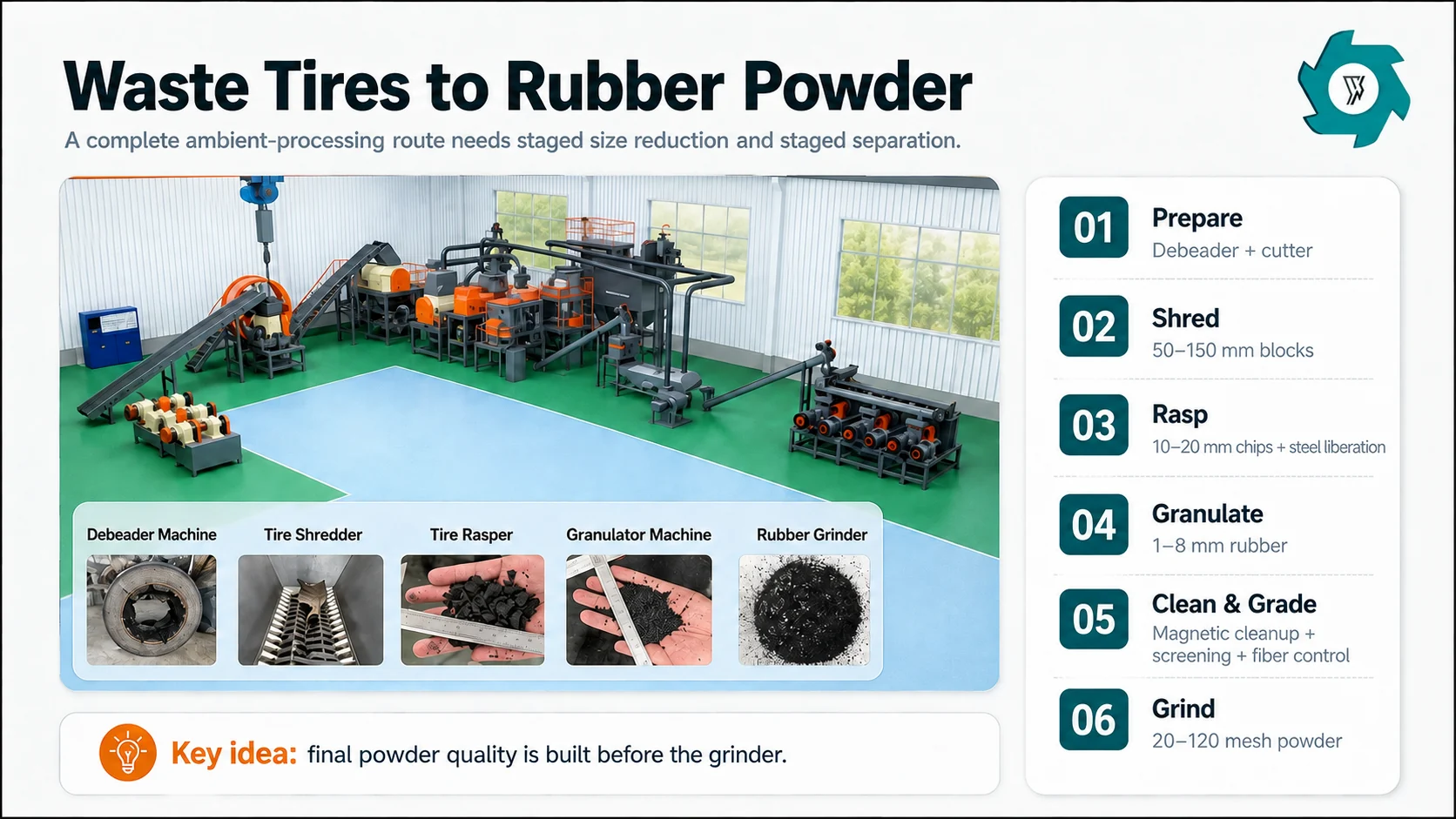
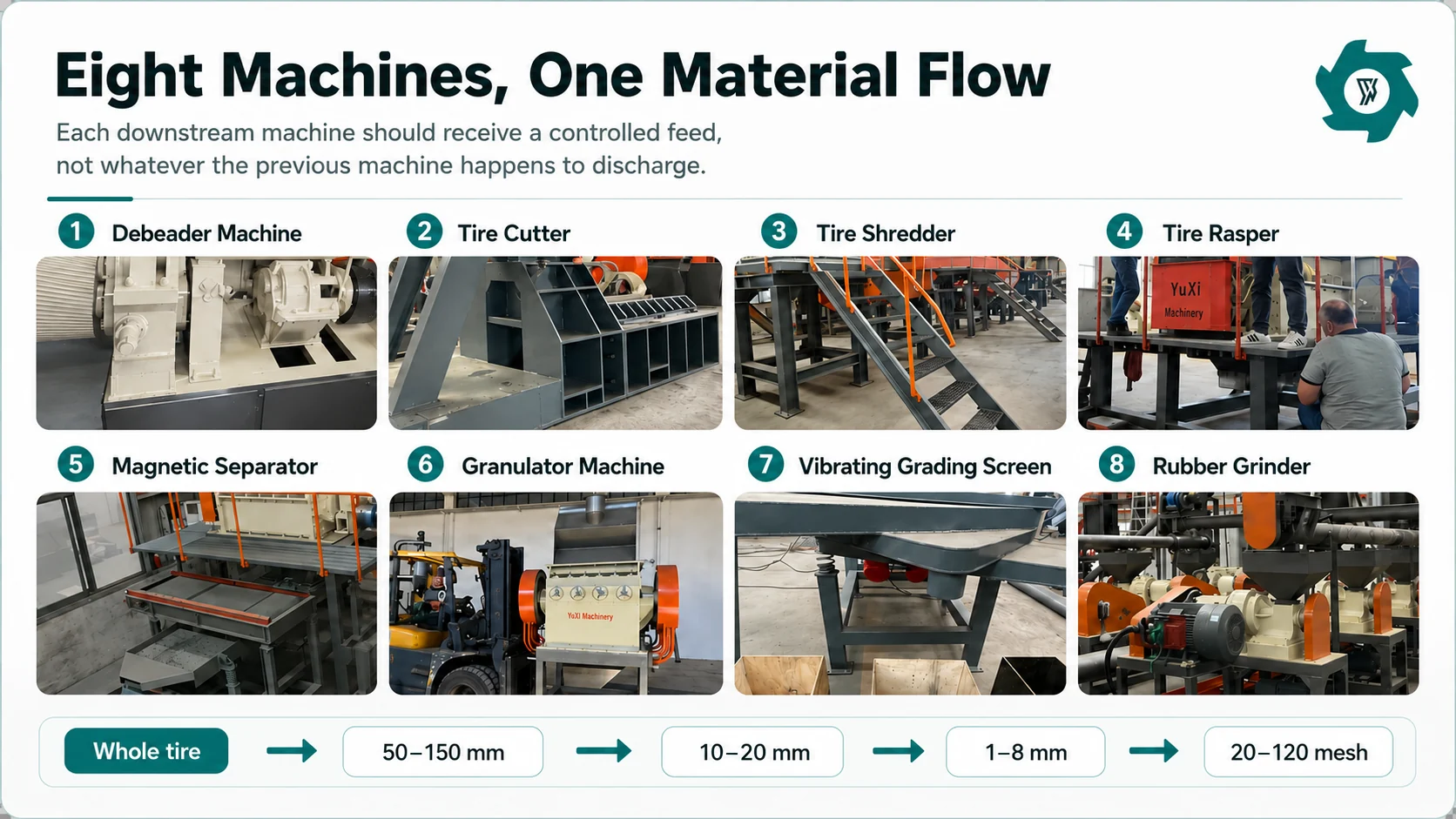
Making rubber powder is not a one-machine job. A stable line first makes the tire easier to process, then removes steel, controls particle size, separates the remaining textile fiber, and only then sends clean granulate into the powder grinder.
A useful process design follows the material, not the machine list: whole tire → rough shred → wire-free chip → clean granulate → fine rubber powder.
From Whole Tire to Fine Rubber Powder
For a complete plant, the practical route is: prepare the tire, reduce it into manageable blocks, liberate embedded steel, recover that steel, granulate the rubber, remove residual metal, grade the material, return oversize, separate the remaining textile fiber, and finally grind the clean granulate into powder. YUXI’s current tire rubber powder plant follows this ambient mechanical route and publishes a final range of 20–120 mesh, with 1–8 mm granulate feeding the fine-grinding section.
The important word is complete. Online, “rubber powder machine” can mean a fine mill that expects clean granulate at the inlet, or it can mean a whole-tire recycling line. Those are different battery limits. If your raw material is still a whole passenger or truck tire, a standalone grinder is not the first machine you need.
The U.S. EPA describes tire crumb production in much the same process logic: tires are reduced to the required size, screens classify the material and return oversize for more reduction, magnets remove wire and metal, and air separation removes fabric. That sequence is useful because it shows why product cleanliness cannot be repaired at the very last step. EPA tire crumb guidance also notes that end-of-life tire management is regulated mainly at state level in the United States, so plant planning should include local waste-tire rules as well as machinery selection.
Stage
Typical material condition
Main purpose
Tire preparation
Whole waste tires
Remove or reduce heavy bead-steel load and create controlled feed pieces where required.
Primary shredding
Prepared or whole tires
Reduce bulky tires to rough blocks for secondary processing.
Rasping + magnetic separation
Rough tire shreds
Open rubber around embedded steel and recover liberated wire.
Granulation + magnetic cleanup
Wire-free chips
Produce small rubber granules and remove remaining residual steel.
Screening + return
Mixed-size granulate
Hold the accepted size band and recirculate oversize.
Fiber separation
Graded rubber granulate
Remove remaining textile fiber with controlled airflow before fine grinding.
Fine grinding
Clean, graded granulate
Produce the required 20–120 mesh rubber powder under controlled grinding and cooling conditions.
1. Define the Feed Before You Size the Line
Start with the tires, not with a catalog capacity. Passenger tires, truck tires and mixed streams do not put the same steel load or rubber mass through the front end. Tire diameter matters, but construction matters too. A line with a high percentage of heavy truck casings may need a different preparation and feeding strategy from a plant processing mostly passenger tires.
Also decide what is not allowed in the feed. Rims, loose metal parts, stones, mud and other foreign material can increase wear or upset separation. A serious RFQ should therefore state tire categories, approximate mix, maximum size, whether tires arrive whole or pre-cut, and the contamination condition. Photos of the normal feed are more useful than one photograph of the cleanest tire in the yard.
There is another commercial reason to define the feed: not every used tire should automatically be destroyed. Local rules may distinguish reusable tires from waste tires. For example, CalRecycle separately defines used tires and waste-tire-derived crumb rubber in California. Check the receiving jurisdiction’s definition before designing the material flow.
2. Remove Heavy Bead Steel and Prepare the Tire
The first mechanical decision is how much tire preparation the shredder should handle. The YUXI pillar lists a debeader followed by a tire cutter before the shredder. That arrangement reduces heavy bead-steel loading and turns the tire into pieces that can be fed in a more controlled way.
Not every plant needs the same front end. The right route depends on tire size, tire construction, shredder opening and the capacity basis used in the project. What should not change is the engineering question: will the downstream shredder receive material within the condition used for its performance test? If the supplier’s test uses prepared truck-tire sections while the buyer plans to feed untreated tires, the two operating conditions are not equivalent.
3. Shred the Tire into Rough Blocks
Primary shredding handles the biggest change in geometry. Whole or prepared tires become rough rubber blocks that a rasper can process consistently. On YUXI’s current powder-plant page, the published shredder stage is 50–150 mm. That number should be treated as a stage handoff, not as finished-product quality.
The temptation here is to ask the shredder for a much smaller output to “save a machine.” In practice, that can shift too much reduction duty into a machine whose job is to handle bulky, reinforced feed. A staged line lets the shredder do coarse reduction while the rasper and granulator do the finer work under conditions where steel liberation, screening and wear can be controlled.
Stage handoffs matter. The line is easier to balance when each machine receives the size range it was selected to process.
4. Rasp the Shreds to Liberate Embedded Steel
A tire contains steel that does not simply fall away after primary shredding. The rasper opens the rubber around the embedded wire while reducing the rough shreds further. YUXI publishes 10–20 mm chips for this stage. The exact plant result still depends on feed condition, wear state and separation setup, but the process role is clear: expose the steel so a magnetic separator can actually recover it.
This is why “stronger magnet” is not a complete answer to steel contamination. A magnet can only collect metal that has been sufficiently liberated and presented in a controllable material layer. If wire remains tightly bound inside large rubber pieces, magnetic strength alone does not solve the problem.
5. Recover Steel Before It Reaches the Granulator
After rasping, the first magnetic separation stage removes the larger liberated wire. This protects the finer reduction equipment and creates a separate steel stream. The layer depth on the belt, magnet position, conveyor speed and the amount of exposed wire all affect what the separator sees.
A second magnetic cleanup after granulation is also useful because finer size reduction can expose residual wire that was still trapped during the first pass. The goal is not to boast about a theoretical recovery percentage. The useful acceptance question is simpler: how much metal remains in a representative sample of the accepted rubber stream after the complete separation sequence?
6. Granulate the Wire-Free Rubber to 1–8 mm
Once the large steel has been removed, the rubber can be reduced into a much smaller, controlled granulate. YUXI’s powder line uses a granulator to produce 1–8 mm material before final powder grinding. Knife condition, clearance, screen opening and feed stability all influence the particle distribution leaving this machine.
This stage is also where buyers should distinguish “granulate quality” from “powder quality.” Clean 1–8 mm material may already be a saleable product in some markets. If the project really needs powder, the granulate becomes the prepared feed for the next section. If there is no confirmed buyer for fine powder, adding a grinding stage simply adds energy, wear, dust-control duty and another capacity bottleneck.
For a more detailed discussion of how sieve terms should be written into a purchase specification, use the crumb rubber size and mesh guide. A mesh label by itself does not describe the full particle-size distribution.
7. Screen the Granulate and Return Oversize
A vibrating grading screen does two jobs. It separates the material that meets the selected size band, and it identifies the material that does not. Oversize should be returned for more reduction instead of being quietly mixed with the accepted product.
This return loop affects capacity. If a large share of the material keeps coming back, the crusher or granulator sees extra internal load even when the external feed rate has not changed. That is why accepted finished tons per hour and incoming tons per hour should not be treated as the same number.
For quality testing, particle-size distribution is more informative than a visual check. EPA points to ASTM D5644 for determining the particle-size distribution of vulcanized particulate rubber. In an equipment acceptance test, the buyer and supplier should agree on the sampling point, sample size, sieve method and how returned material is counted before the test starts.
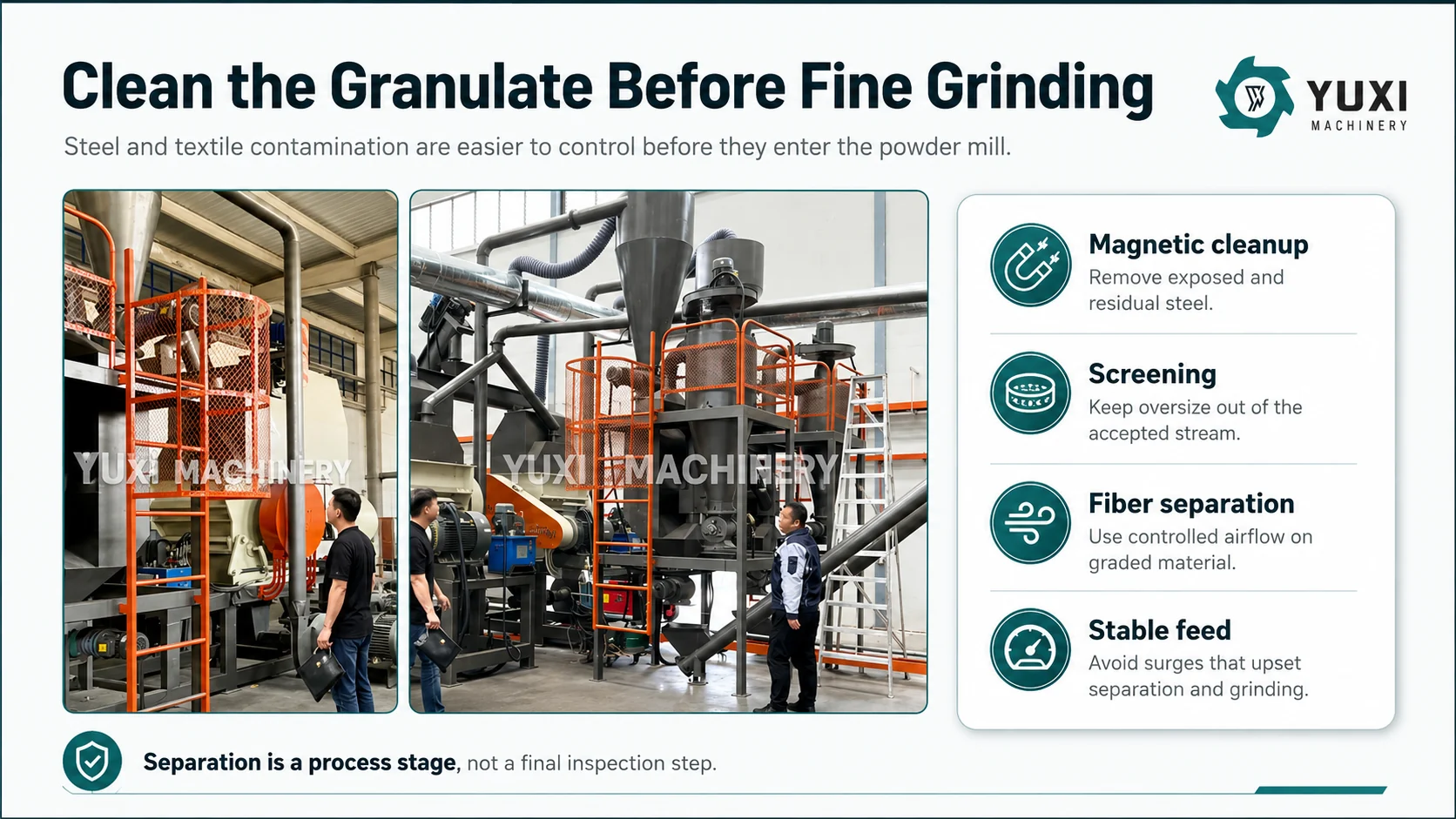
8. Remove Textile Fiber and Residual Metal Before Fine Grinding
Tire textile behaves differently from steel. Magnets cannot remove it, so the line needs airflow separation after the rubber has been reduced and graded enough for density and aerodynamic differences to become useful. EPA likewise describes air separators for fabric removal in tire crumb production.
Feed consistency matters here. A fiber separator receiving a surge of mixed coarse and fine particles is harder to tune than one receiving a stable, graded stream. Moisture and clumped fiber can also change separation behavior. This is one reason the screen, return loop and air separator should be treated as one connected section rather than three unrelated accessories.
Fine grinding should receive clean, stable granulate. Steel and fiber removal are upstream process duties, not cosmetic finishing steps.
If a buyer needs very clean granulate or powder, acceptance should be based on sampling rather than the machine list alone. The existing rubber granule purity guide explains why staged magnetic separation, screening, return crushing and fiber separation work together.
9. Grind Clean Granulate into 20–120 Mesh Powder
The fine grinder is the last major size-reduction stage. It should receive clean rubber granulate—not tire chunks mixed with wire and fiber. YUXI’s current process page states a 20–120 mesh finished range and uses wind and water cooling around fine grinding to manage heat.
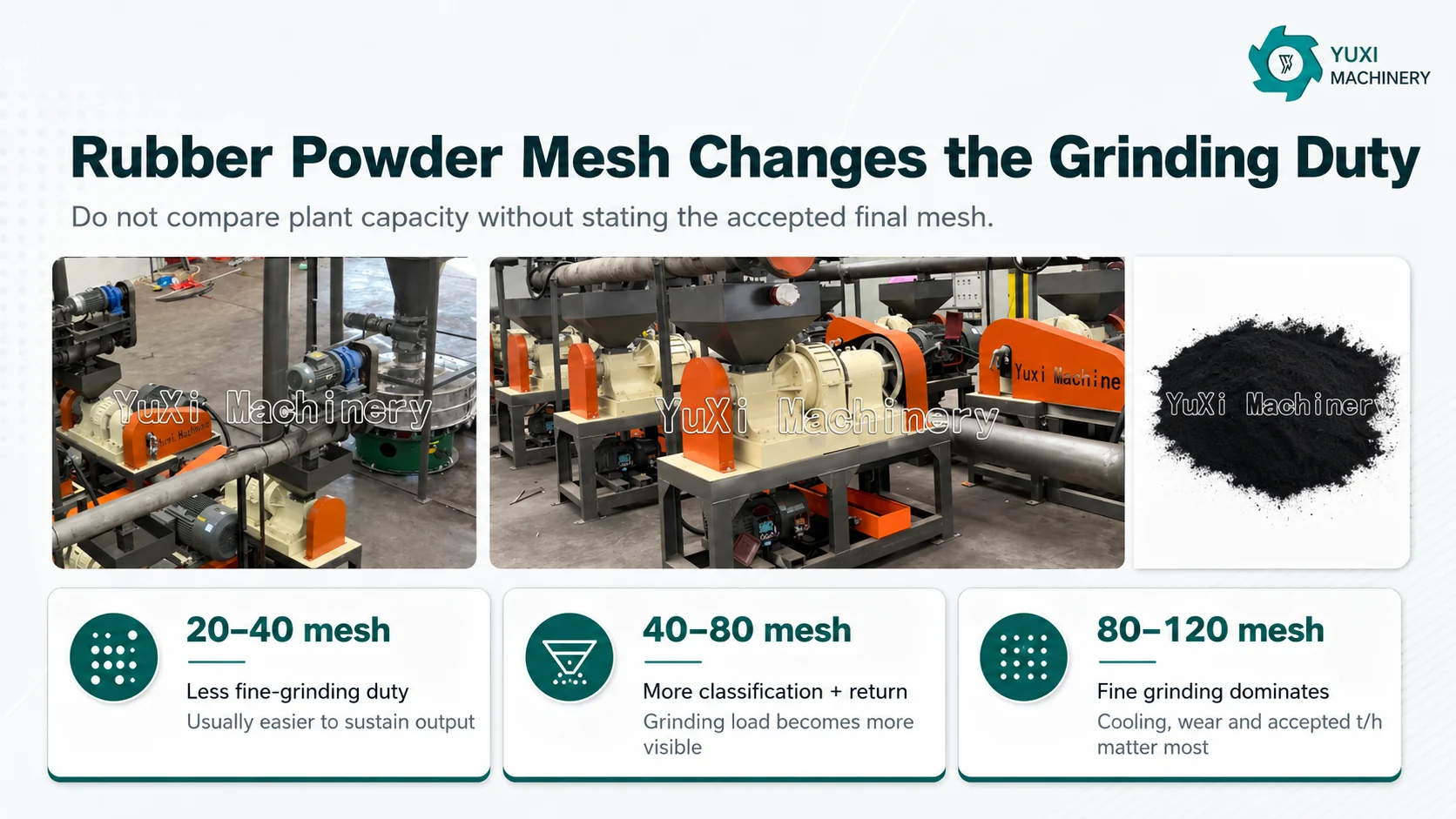
Rubber generates heat when it is worked repeatedly. As the target becomes finer, the mill sees more grinding duty per accepted ton and more material may circulate through classification. Trying to force more feed through the mill can raise temperature, increase wear and still fail to improve accepted output.
This is also why a supplier’s “maximum mesh” is not enough for a project decision. Ask for the continuous output at the mesh you actually plan to sell, using your agreed feed condition. A machine that can physically make a small quantity of 120-mesh powder does not automatically deliver its nominal plant capacity at 120 mesh.
Finer powder usually means more grinding and classification duty. Capacity should be stated at the accepted final mesh.
Ambient Grinding vs Cryogenic Grinding
Most complete tire-to-powder lines discussed in industrial recycling use mechanical size reduction at ambient or controlled normal temperature. The FHWA’s scrap-tire material guidance describes crackermill, granulator and micro-mill routes for producing ground and crumb rubber, and also notes that cryogenic processing can make rubber brittle by cooling it with liquid nitrogen before size reduction. FHWA’s material description is useful background when comparing the two approaches.
Cryogenic processing is therefore not simply “a better grinder.” It is a different process route with different utilities, equipment and economics. If the required product can be made with an ambient line, compare the ambient route on accepted particle distribution, contamination, temperature control, wear and cost. If a downstream buyer specifically requires a product characteristic associated with another grinding method, make that requirement part of the product specification before requesting equipment.
What Rubber Powder Mesh Should You Make?
The end user decides this, not the recycling machine brochure. Rubberized asphalt, molded products, boards, fillers and other applications can purchase different particle distributions and contamination limits. FHWA notes that ground and crumb rubber used in asphalt spans several sieve ranges depending on the process. The useful lesson for a new plant is not one universal mesh—it is the need to get a written buyer specification first.
Target range
Plant effect to expect
Question to verify
20–40 mesh
Moderate fine-grinding duty compared with very fine powder.
What accepted t/h is demonstrated at this exact grade?
40–80 mesh
More grinding, classification and return load may be required.
How are cooling, wear and recirculation handled?
80–120 mesh
Fine grinding can become the dominant bottleneck.
Is the stated capacity feed rate or accepted finished powder rate?
Several saleable fractions
More grading, bins, conveyors and packaging interfaces.
Can the line make and collect each fraction without cross-mixing?
How to Judge Rubber Powder Quality
“Black powder” is not a product specification. A useful receiving standard should cover at least particle-size distribution and limits for steel and textile fiber. Depending on the market, moisture, foreign material, packaging and sampling method may also matter.
Particle size: define the sieve series, percent passing or retained, and any oversize limit.
Steel: define how residual metal is measured and the acceptable limit.
Fiber: define the test or visual/sieving procedure used by the buyer.
Moisture and storage: keep the product condition consistent enough for fair sampling and downstream use.
Temperature: verify the line can grind steadily without overheating the material or forcing unstable stop-start operation.
Sampling: collect representative material from steady-state production rather than one hand-picked bag.
A factory acceptance test should tie these quality checks to throughput. A sample that passes the mesh test at a slow demonstration rate does not prove that the same quality can be held at the quoted continuous output.
Common Problems While Making Rubber Powder
Steel remains in the rubber
Check liberation first, then magnet loading, belt speed and the second cleanup pass. A magnetic separator cannot recover steel that is still locked inside oversized rubber.
Fiber reaches the powder mill
Look at grading, airflow, moisture and feed surges. Mixed particle sizes make the air separator harder to tune.
Powder output is below the quote
Confirm whether the quoted number referred to whole-tire feed, granulate feed or accepted powder at your target mesh. Then check return load and grinder bottlenecks.
The grinder runs hot
Reduce overload, verify cooling and stabilize feed. Finer powder cannot be forced through simply by increasing the hopper rate.
The screen or return line plugs
Inspect screen condition, feed metering and return-conveyor capacity. A return loop must be sized for realistic oversize flow.
Granulator wear rises quickly
Look for residual steel, oversize feed and incorrect knife clearance before blaming the knife material alone.
Can You Make Rubber Powder with Only One Grinder?
Only if the material entering that grinder is already clean and within the feed size the grinder was designed to accept. A factory that buys 1–8 mm steel-free, low-fiber granulate may need only a fine-grinding and classification section. A factory receiving whole tires needs much more equipment before the rubber is ready for that mill.
How to Size a Rubber Powder Production Line
Start with accepted finished output, then work backward. If the commercial target is one ton per hour of 80-mesh powder, the engineering question is not “Which shredder is one ton per hour?” It is whether the complete line can continuously produce one accepted ton per hour after screens return oversize and after steel, fiber and off-spec powder are excluded.
Ask suppliers to state the basis of every capacity figure. Tire mix, incoming condition, final mesh, purity requirement, operating hours and the definition of accepted product should all appear in the proposal. Also confirm whether the quote includes conveyors, dust extraction interfaces, cooling, controls, platforms, guarding, collection, packaging and commissioning support. Missing scope at transfer points is a common reason two “complete line” quotations are hard to compare.
Information to Send Before Requesting a Rubber Powder Line Quote
Tire categories and approximate percentage of passenger, truck or other tires.
Maximum tire diameter and width, plus normal condition of the feed.
Photos or video of the actual tire stream and visible contamination.
Required finished mesh and the downstream buyer or intended application.
Target accepted finished output, shifts per day and operating hours.
Steel, fiber, moisture and oversize requirements if already specified by the buyer.
Site voltage, frequency and available transformer capacity.
Workshop dimensions, clear height, access, storage and maintenance clearance.
Required delivery scope: conveyors, dust control, cooling, controls, packaging, installation, training and spare parts.
Factory acceptance test material, test duration and sampling method.
Configure the Line Around the Powder You Need to Sell
Send your tire mix, target mesh, accepted output, power supply and workshop dimensions. The proposal should be built backward from the finished rubber powder specification so shredding, separation, granulation, screening and grinding are balanced as one system.
FAQ
What size should the rubber be before the powder grinder?
It depends on the mill design. YUXI’s current tire rubber powder plant uses clean 1–8 mm rubber granulate before the fine-grinding stage.
Why are steel and fiber removed before fine grinding?
Residual steel can damage downstream equipment and contaminate the product, while textile fiber reduces cleanliness and can interfere with grinding and classification. They require different separation methods: magnets for steel and airflow separation for fiber.
Does finer mesh reduce rubber powder plant capacity?
Often it can, because finer powder requires more grinding and classification work per accepted ton. Capacity should be confirmed at the exact final mesh and quality specification, not only at the incoming feed rate.
Can a rubber powder grinder process whole tires directly?
A fine rubber grinder normally expects prepared rubber feed rather than whole reinforced tires. Whole-tire projects need upstream preparation, shredding, steel liberation, magnetic separation and granulation before final powder grinding.
Marie has 8+ years of experience in tire shredding and recycling equipment,with a focus on tire shredders,rubber recycling machines,TDF production,rubber crumb processing,and complete tire recycling systems.