




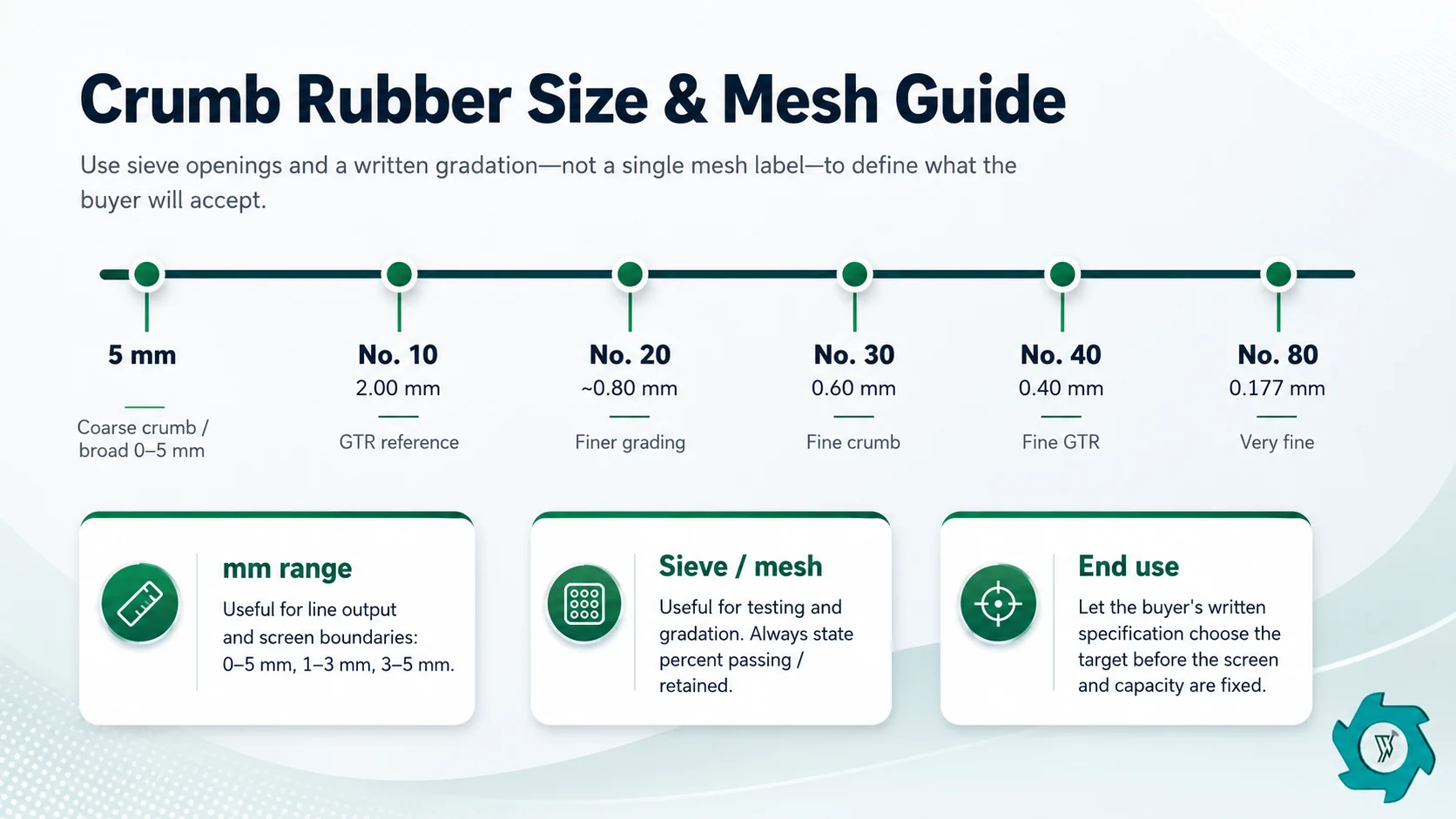
“We need 20 mesh crumb rubber” sounds like a precise RFQ line. It often is not. One supplier may hear “everything passing a No. 20 sieve.” Another may understand a narrow fraction around that sieve. A third may quote a broad product and use “20 mesh” only as a market label. The samples can look different, flow differently and produce different yields even though the same two words appear in every quotation.
That is why crumb rubber size should be treated as a gradation, not a single diameter. Millimetres are useful for describing a plant’s broad output range. Sieve or mesh designations are useful for testing. The commercial specification connects the two with percentages: how much must pass the upper sieve, how much may pass the lower sieve, what oversize and fines are allowed, and where the sample is taken.
How mm and Mesh Should Be Read for Crumb Rubber
A U.S. sieve designation such as No. 10, No. 20 or No. 40 refers to a test-sieve opening, not to one exact particle diameter. FHWA guidance cross-references No. 10 with a 2.0 mm opening, No. 20 with roughly 0.8 mm, No. 30 with 0.6 mm and No. 40 with 0.4 mm.1 A useful purchase specification therefore says more than “20 mesh.” It states the sieve stack and the required percentage passing or retained on each sieve. ASTM D5644 is the current ASTM method for determining particle-size distribution of recycled vulcanizate particulate rubber.2
Millimetres, Mesh and Sieve Number Are Related—but Not Interchangeable
A millimetre value is easy to picture. A 5 mm opening is physically larger than a 2 mm opening. Plant pages therefore use ranges such as 0–5 mm, 1–3 mm or 3–5 mm because they quickly communicate the product scale. The difficulty starts when a broad machine-output label is treated as if every granule has the same dimension.
Tire rubber is irregular. Ambiently cut particles can be blocky, elongated or thin; a particle can orient itself differently on a sieve surface. The test result is therefore a mass distribution across openings, not a caliper reading on one “average” granule. EPA’s current tire-crumb Q&A describes the same process logic: tire crumb is reduced to different sizes for intended applications, screens classify the material and return oversize, and ASTM D5644 is used to determine particle-size distribution.3
What a sieve designation tells you
ASTM E11 specifies woven-wire test sieve cloth and test sieves, including opening tolerances and inspection requirements.4 In other words, “No. 20 sieve” is part of a standardized test language. It is more useful than a casual conversion chart, but it still does not tell you the complete product distribution.
mm
Direct size language. Good for broad plant output and screen-cut discussions.
Sieve No. / mesh label
A test classification reference tied to an opening. Good for laboratory or factory acceptance work.
Gradation
The percentage of sample mass passing or retained at several openings. This is what makes two products comparable.
Crumb Rubber mm-to-Mesh Reference Table
The following cross-reference uses the rounded sieve nomenclature shown in FHWA recycled-tire-rubber guidance, with the finer No. 80 point also reflected in FHWA’s GTR size discussion.1 It is a working buyer reference, not a substitute for the exact sieve standard named in a contract.
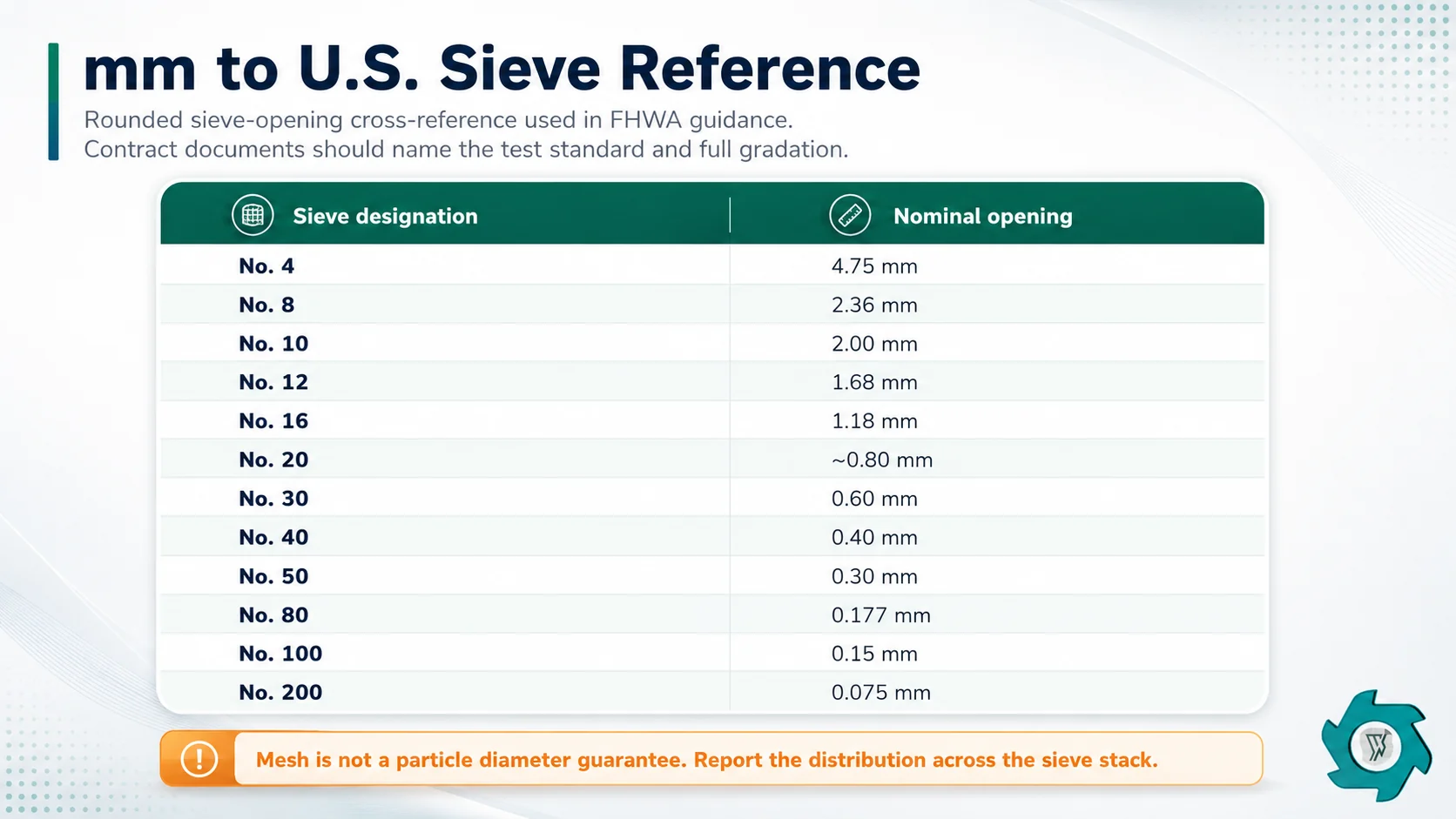
| U.S. sieve designation | Nominal opening used here | How to interpret it in a crumb-rubber specification |
|---|---|---|
| No. 4 | 4.75 mm | Useful near the top end of coarse crumb; do not confuse with a 4.75 mm single-size particle. |
| No. 8 | 2.36 mm | Coarse GTR / crumb boundary in some road specifications. |
| No. 10 | 2.00 mm | FHWA describes GTR, in its asphalt guidance context, as 2.0 mm (10 mesh) and smaller. |
| No. 12 | 1.68 mm | Intermediate sieve useful for building a tighter distribution. |
| No. 16 | 1.18 mm | Often appears inside multi-sieve asphalt gradations rather than as a standalone product name. |
| No. 20 | about 0.80 mm | A common commercial label, but “20 mesh” still needs passing/retained limits. |
| No. 30 | 0.60 mm | Fine crumb / GTR territory; can increase grinding and classification duty. |
| No. 40 | 0.40 mm | Fine GTR used in some asphalt-related ranges and downstream rubber processing. |
| No. 50 | 0.30 mm | Finer material with higher surface area and greater dust/heat-control importance. |
| No. 80 | about 0.177 mm | Very fine GTR; not a normal direct target for a basic 0–5 mm granulation line. |
| No. 100 | 0.15 mm | Fine powder territory for many plant layouts; confirm downstream mill and test method. |
| No. 200 | 0.075 mm | Very fine fraction; typically treated as powder/fines rather than ordinary crumb. |
Do not use a universal formula such as “mesh = 25.4 ÷ mm.” Wire diameter and standardized sieve construction matter. Use the designated test sieve and nominal opening from the applicable standard or project specification.
Why “20 Mesh Crumb Rubber” Can Describe Different Products
A mesh label becomes useful only after its direction is clear. “Passing No. 20” means something different from “retained on No. 20.” “20 mesh minus” often means material small enough to pass that sieve, but it says nothing about how much 40-, 80- or 100-mesh material is also present. A 100% passing top cut can contain a broad amount of finer rubber unless another lower boundary is written.
This is not a wording problem limited to tire recycling. It is the reason gradation tables exist. ASTM D5644 is specifically intended to determine the particle-size distribution of recycled vulcanizate particulate rubber and to support a product mesh or average-particle-size designation.2 A distributor, compounder or road agency can then compare a delivered lot with the written curve instead of comparing photographs.
Top-cut specification
Example logic: 100% passes the upper sieve. Simple, but it can allow a wide quantity of fines unless a second condition is added.
Band-pass specification
Example logic: most mass lies between an upper and lower sieve, with limited oversize and limited fines. Better for a tight commercial fraction.
Multi-point gradation
Several sieves each have a permitted percent-passing range. This is common when particle-size distribution affects downstream performance.
Maximum-piece rule
A buyer may also limit long particles or a largest dimension. This should be written separately from the sieve curve.
How to Write a Crumb Rubber Size Specification That Can Be Tested
The easiest way to improve an RFQ is to stop asking a machine to “make 20 mesh” and start describing the accepted product. The equipment supplier can then size the granulator, screens, return loop and downstream collection around a measurable target.
A useful size specification normally contains six pieces of information:
- Named test method. State ASTM D5644 or another method required by the buyer, project or local standard.
- Sieve stack. Name every sieve that defines the product—not just the marketing mesh.
- Percent passing or retained. Give a range at each control sieve.
- Oversize and fines limits. Make both boundaries explicit so one is not traded for the other.
- Sampling rule. Define where, when, how often and how large the sample is.
- Lot / acceptance rule. State whether each sample must pass or whether a composite sample represents the lot.
Product size = sieve stack + % passing/retained + sampling rule — not one mesh number
Keep cleanliness separate from size. A beautiful sieve curve does not prove low steel or low textile content. The published wire-free rubber guide explains why exposed steel, embedded steel and textile fiber should have their own acceptance language rather than being hidden inside one “purity” percentage.
Select Crumb Rubber Size From the End Use Backward
The machine should not decide the market. The market should decide the screen. ASTM D5603 lists recycled vulcanizate particulate rubber end uses that include synthetic-turf infill, asphalt-rubber and molded rubber products, among others.5 Those categories confirm that one recycled-rubber stream can enter very different downstream processes. They do not create a universal size for each use.
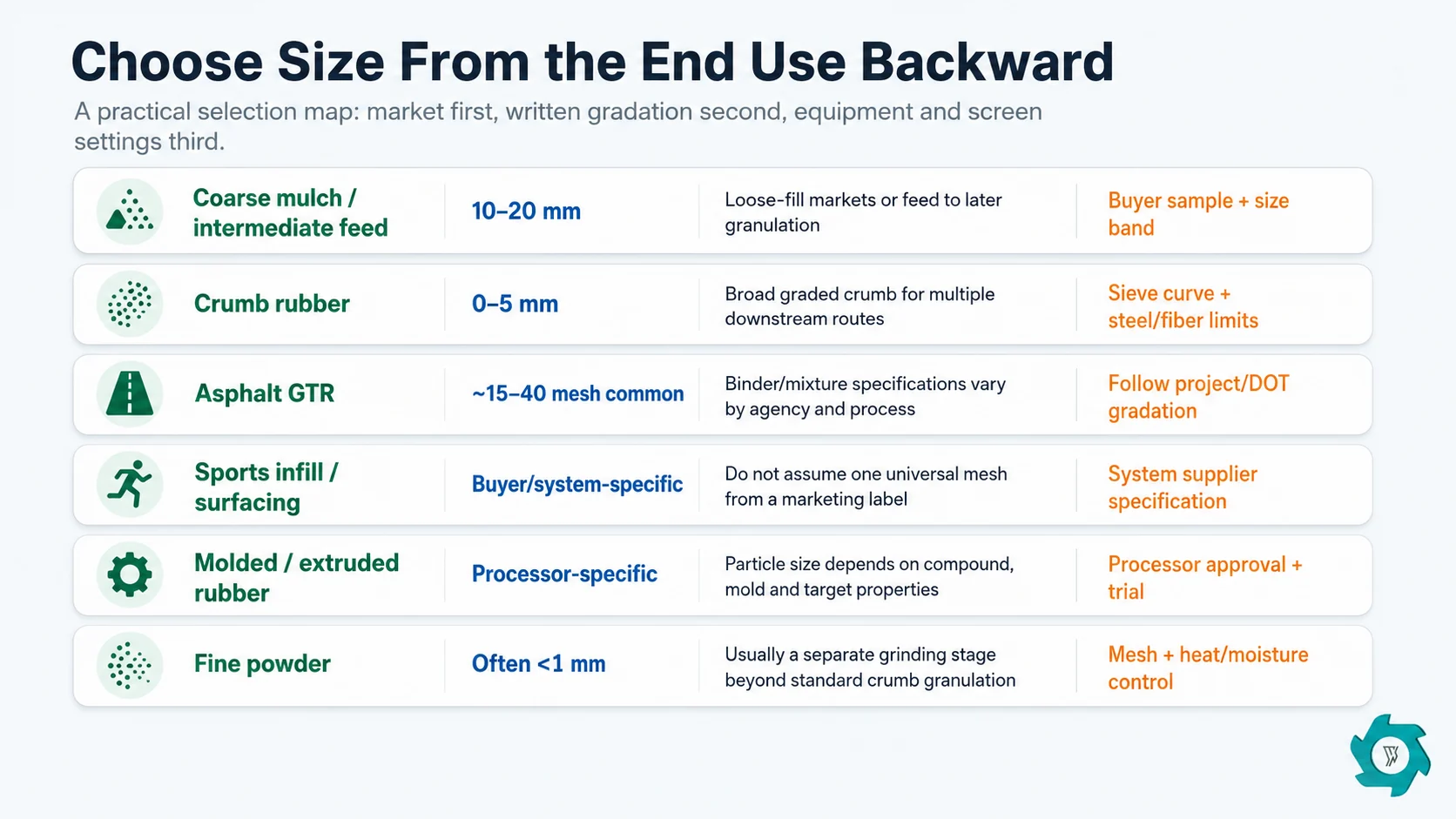
| Product / end-use direction | Useful size language | What should be confirmed before equipment selection |
|---|---|---|
| Coarse rubber mulch / intermediate feed | Typically discussed in mm, such as 10–20 mm | Upper/lower cuts, long-piece rule, steel/fiber limits, whether it is sold directly or sent to granulation. |
| General crumb rubber | 0–5 mm or narrower graded fractions such as 1–3 / 3–5 mm | Actual sieve distribution, accepted t/h, oversize return and downstream buyer tolerance. |
| Asphalt GTR | Often written with several sieve numbers | Agency/process gradation, source/material requirements, moisture, fiber/metal limits and certification. |
| Sports infill / surfacing | System-supplier or field specification | Do not assume a generic 10-, 20- or 30-mesh label is accepted; get the system’s gradation and material requirements. |
| Molded / extruded products | Processor-specific mm or mesh distribution | Compound formulation, molding process, surface area, flow, contamination and trial-lot approval. |
| Fine powder / high-surface-area feedstock | Often sub-1 mm and higher mesh numbers | Additional grinding stage, heat, dust, moisture, screen/classifier performance and accepted fine-powder capacity. |
If the market decision is still between a coarse direct-use product and a finer crumb product, settle that before debating mesh. The existing industrial rubber-mulch process guide shows the upstream route to a controlled coarse feed; the crumb stage adds another level of size reduction and classification.
Asphalt GTR Shows Why a Single Mesh Number Is Not Enough
Road specifications are a useful example because agencies write the particle distribution explicitly. FHWA’s recycled-tire-rubber guidance states that GTR used in modified asphalt binders and mixtures typically ranges from about 1.5 mm down to 420 μm—roughly 15 to 40 mesh—with more limited use of finer 80- and 120-mesh material.1 Another FHWA publication notes that designers may consider finer 30- to 80-mesh GTR in certain dry-added applications.6
That still does not mean “order 30 mesh for asphalt.” FHWA’s TOPS asphalt-rubber document shows a MassDOT example with a multi-sieve gradation: 100% passing No. 10, 90–100% passing No. 16, 25–100% passing No. 30 and 0–20% passing No. 80.6 The range is the specification. No single row can represent it.
Sports and Recreational Uses: Get the System Specification First
Sports surfacing is one of the identifiable markets for tire crumb,and ASTM D5603 clearly includes synthetic-turf infill in the end use of recycled rubber.5 The mistake is assuming that all synthetic turf, tracks, playground systems or recreational surfaces purchase the same gradation.
They do not share one universal commercial size. A turf system may combine rubber with sand and may have its own infill geometry, density, particle-size and material requirements. A bound running surface can use rubber as one component of a layered system. Loose-fill playground material has separate material and installed-system qualification concerns. For an equipment buyer, the engineering action is the same: obtain the current specification from the system supplier or end customer, then design the crumb product around that document.
Molded and Extruded Rubber Products: Particle Size Is a Processing Variable
Molded and extruded products are also recognized recycled-rubber end uses in ASTM D5603.5 Here, particle size interacts with the recipe and process. A coarser recycled particle can change surface texture and flow. A finer particle provides more surface area but usually requires more grinding energy and tighter dust control. Binder level, pressure, temperature and the share of recycled rubber in the compound can all change what the processor wants.
For this market, a trial lot is often more valuable than a generic “best mesh” chart. Ask the processor for the permitted sieve curve, metal/fiber limits, moisture condition, bulk-density or handling expectations if relevant, packaging format and the size of sample needed for approval. Then keep a retained sample from the accepted production lot. That gives both sides something concrete to compare when a later shipment is questioned.
What the YUXI 0–5 mm Crumb Plant Size Range Actually Means
YUXI’s current pillar is centered on 0–5 mm high-purity crumb as the main finished direction. It also shows a granulator-stage range around 1–6 mm, broader intermediate ranges such as 1–8 mm, and narrower fractions such as 1–3 mm or 3–5 mm after grading. Those labels describe configurable process targets, not a guarantee that every feed and every tight fraction will leave the line at the same tonnes per hour.
The practical boundary is especially important below 1 mm. The pillar treats fine powder as an additional grinding stage. Once a buyer moves from ordinary crumb toward 40-, 80- or 100-mesh powder, the project should be reviewed as a fine-grinding problem: downstream mill type, heat generation, screen or classifier duty, dust collection, moisture and product collection become more important.
Upstream preparation still matters. The tire rasper normally performs the steel-liberation job before clean chips are sent to fine granulation. The tire rasper machine guide is the better place for that cutter/steel-liberation detail; this guide keeps the focus on how the final size is specified.
For equipment scope and size-range planning, see the YUXI Tire Rubber Crumb Plant.
Why Finer or Tighter Crumb Usually Changes Real Capacity
A granulator does not know that the sales team wants “30 mesh.” It sees cutting resistance, screen area, open area, material temperature and the amount of product that cannot yet pass. When the upper cut becomes smaller, more particles remain in the cutting/screening loop. When a lower cut is added to limit fines, the line may need another classification step and a separate destination for the fine fraction.
More recirculation
Oversize receives another pass instead of becoming saleable output immediately. Internal mass flow can rise even when fresh feed is unchanged.
More cutting energy
Finer product requires more size reduction per tonne and exposes knife condition more quickly.
More heat
Repeated cutting raises the importance of temperature management, feed stability and clean screens.
More classification duty
A narrow band may need multiple decks, returns or product streams rather than one top-cut screen.
Accepted finished t/h ≠ fresh feed t/h when a significant fraction is returning for another pass
This is why quotations should state the output at the exact agreed sieve curve. A 5 t/h broad 0–5 mm claim and a 5 t/h tight 20–40 mesh claim are not automatically the same engineering task. If a supplier cannot state where the capacity number is measured, the comparison is not ready.
How to Verify Particle Size in a Factory Acceptance Test
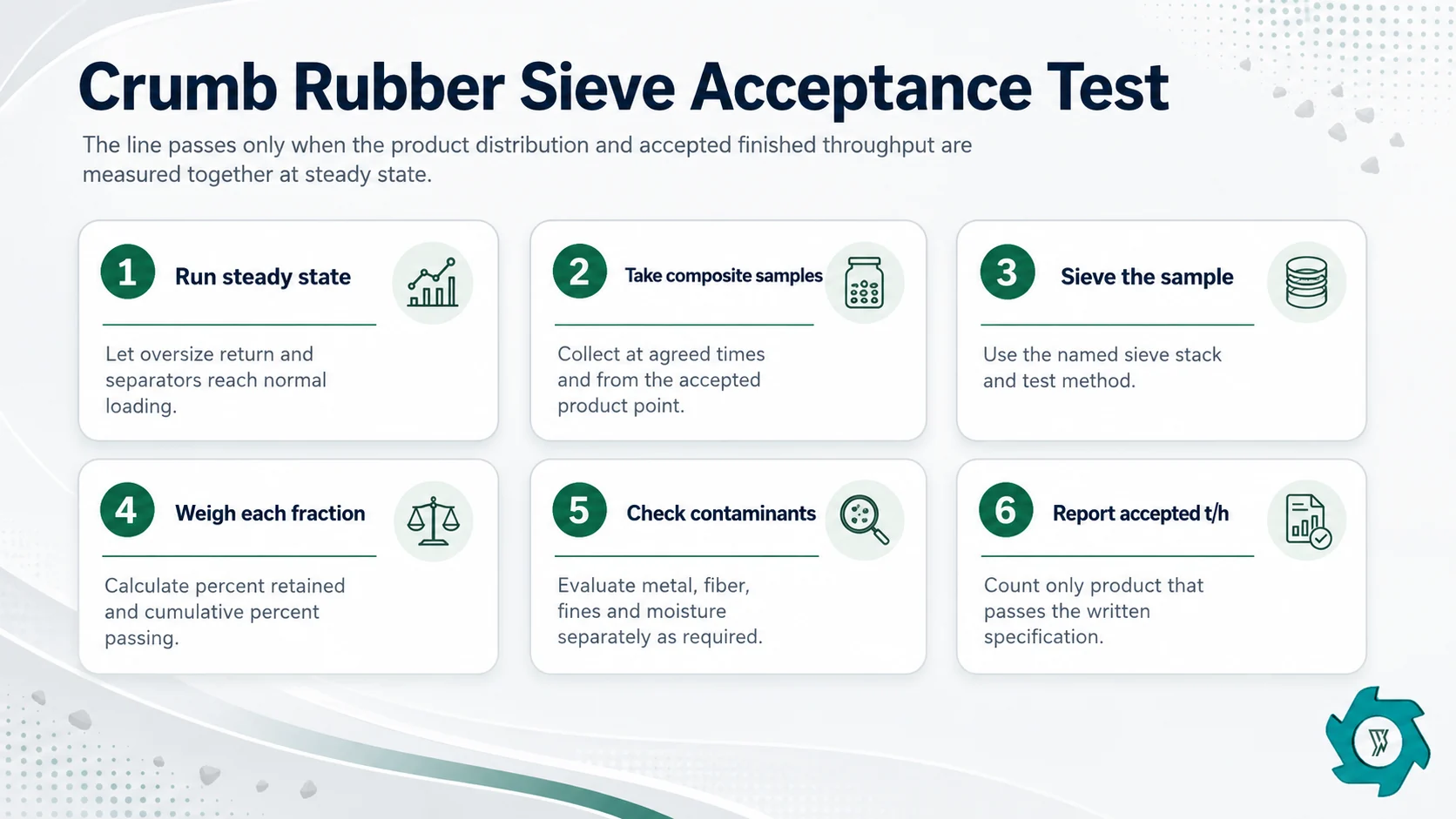
A FAT should make the size claim boring—in a good way. Run the complete line long enough for the screen-return loop to reach normal loading, take representative samples, sieve them, weigh the fractions and compare the result with the written curve. If the plant only passes when the operator slows feed temporarily before sampling, the test has not proved the required commercial output.
A practical FAT record
- Feed basis: tire categories, prepared-chip size and contamination limits.
- Screen configuration: installed screens, openings and any classifier settings.
- Steady-state period: enough runtime for return flow and separators to stabilize.
- Sampling: composite sample timing, location, mass and handling.
- Sieve results: mass retained and cumulative percent passing at each control sieve.
- Other product checks: steel, textile, moisture and fines where required.
- Return load: oversize mass or a documented operating indicator.
- Accepted throughput: only saleable product passing the specification per unit net production time.
Seven Common Crumb Rubber Size and Mesh Mistakes
1. Converting one mesh number into one diameter
A sieve opening is treated as the exact size of every particle instead of one point in a distribution.
2. Writing “mesh” without passing or retained
The supplier cannot tell whether the buyer wants a top cut, a retained fraction or a band-pass product.
3. Using machine screen size as product specification
Particle shape, recirculation and screen behavior mean the installed opening does not automatically equal the finished distribution.
4. Selecting an end use from a generic internet chart
The recycler builds inventory before obtaining the actual buyer or project gradation.
5. Ignoring fines
A product passes the top sieve but contains too much very fine material for the customer’s process.
6. Comparing capacity at different product grades
One supplier quotes broad crumb and another quotes a tight fraction, yet both numbers are placed in the same t/h column.
7. Treating sub-1 mm powder as ordinary crumb
Fine grinding, heat, dust and classification are left out of the equipment scope because the buyer sees only a higher mesh number.
What to Put in an RFQ for a Specific Crumb Rubber Size
A useful RFQ gives the supplier enough information to quote the product rather than a generic granulator. Include:
- Incoming material: whole tires or prepared wire-free chips.
- Representative tire mix and expected contamination.
- Target product in both mm language and sieve/mesh language where available.
- Full sieve table with percent-passing or percent-retained ranges.
- Maximum oversize, maximum fines and any longest-particle rule.
- Metal, textile, moisture and other quality limits kept separate from particle size.
- Required accepted finished tonnes per hour at that exact grade.
- Operating hours and expected annual saleable tonnage.
- Packaging / bulk handling and number of simultaneous finished fractions.
- Required test standard, sample mass, sampling frequency and FAT pass/fail rule.
Best starting document: send a current buyer specification or a sieve report from an approved competitor sample. That is more valuable for plant selection than asking for “a machine that can make 20 mesh.”
Frequently Asked Questions
Is 20 mesh crumb rubber exactly 0.8 mm?
No. No. 20 is a sieve designation associated with a nominal opening, not a guarantee that every particle has one diameter. A commercial crumb-rubber specification should state the sieve stack and the percentage passing or retained at each relevant sieve.
What is the difference between mm and mesh for crumb rubber?
Millimetres describe a linear size or sieve opening directly. Mesh or U.S. sieve designations identify standardized sieves used to classify a particle-size distribution. The safest purchase specification records both the sieve designation and the nominal opening, then adds percent-passing or percent-retained limits.
What mesh is 2 mm crumb rubber?
In the FHWA sieve cross-reference, a 2.0 mm nominal opening corresponds to the No. 10 sieve. That does not mean a product called 10 mesh consists only of 2 mm particles; its full gradation still needs to be stated.
What size crumb rubber is used in asphalt?
There is no single universal asphalt size. FHWA guidance describes typical GTR sizes for modified asphalt binders and mixtures from about 1.5 mm down to 420 micrometres, roughly 15 to 40 mesh, with some uses employing finer material. State, agency and process specifications control the actual gradation.
Can a 0–5 mm crumb rubber plant make 80 mesh powder directly?
It should not be assumed. YUXI’s crumb-plant direction is centered on graded 0–5 mm material, while sub-1 mm fine powder usually requires an additional grinding stage. The required mesh, capacity, heat management and separation duty should be confirmed before equipment is selected.
How should crumb rubber particle size be accepted in a factory test?
Run the complete line to steady state, collect representative composite samples at the accepted-product point, sieve them using the agreed method, report the mass retained and cumulative percent passing, and record accepted finished throughput at the same time. Metal, fiber, moisture and fines should be checked separately where the purchase specification requires them.
Need a Crumb Rubber Line Built Around Your Buyer’s Size Specification?
Send YUXI your feed material, target sieve curve, accepted finished capacity and cleanliness requirements. The line configuration can then be reviewed around the product your customer will actually buy.
External Engineering References
- Federal Highway Administration. Resource Responsible Use of Recycled Tire Rubber in Asphalt Pavements. Includes GTR size discussion and sieve nomenclature.
- ASTM International. ASTM D5644-23 — Determination of Particle Size Distribution of Recycled Vulcanizate Particulate Rubber.
- U.S. Environmental Protection Agency. Tire Crumb Questions and Answers. Describes application-driven size reduction, screening/oversize return, and ASTM D5644 / D5603 use.
- ASTM International. ASTM E11-24 — Woven Wire Test Sieve Cloth and Test Sieves.
- ASTM International. ASTM D5603-23 — Classification for Rubber Compounding Materials—Recycled Vulcanizate Rubber.
- Federal Highway Administration. TOPS Asphalt Rubber Gap-Graded Mixtures How-To Document. Includes example State DOT crumb-rubber gradations.