




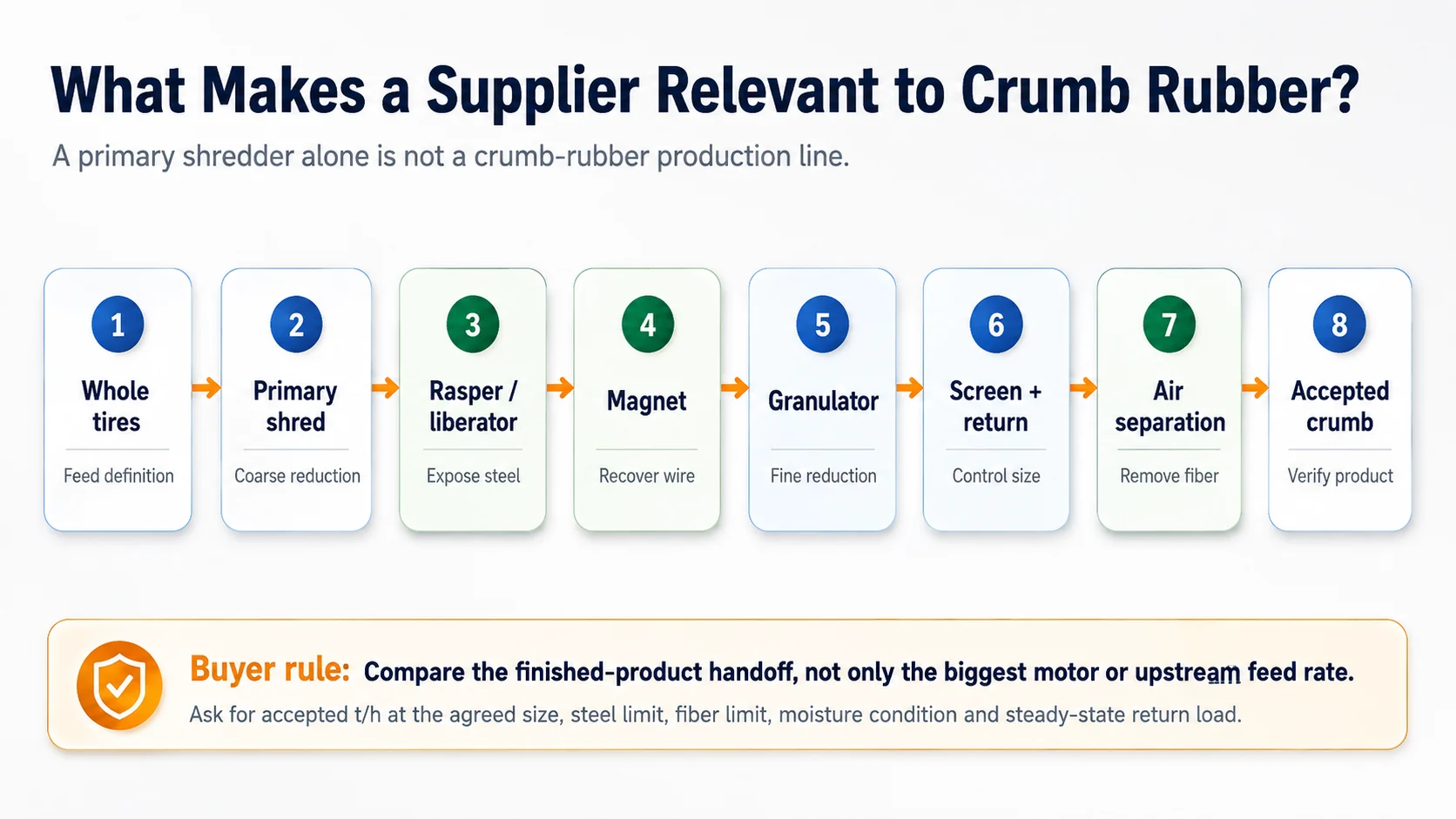
A supplier can build an excellent tire shredder and still be the wrong supplier for a crumb-rubber plant. The dividing line appears after the coarse chips leave the shredder: steel must be liberated, rubber reduced again, oversize circulated back, fine wire recovered, textile pulled out, and the accepted fraction proved against a real product specification.
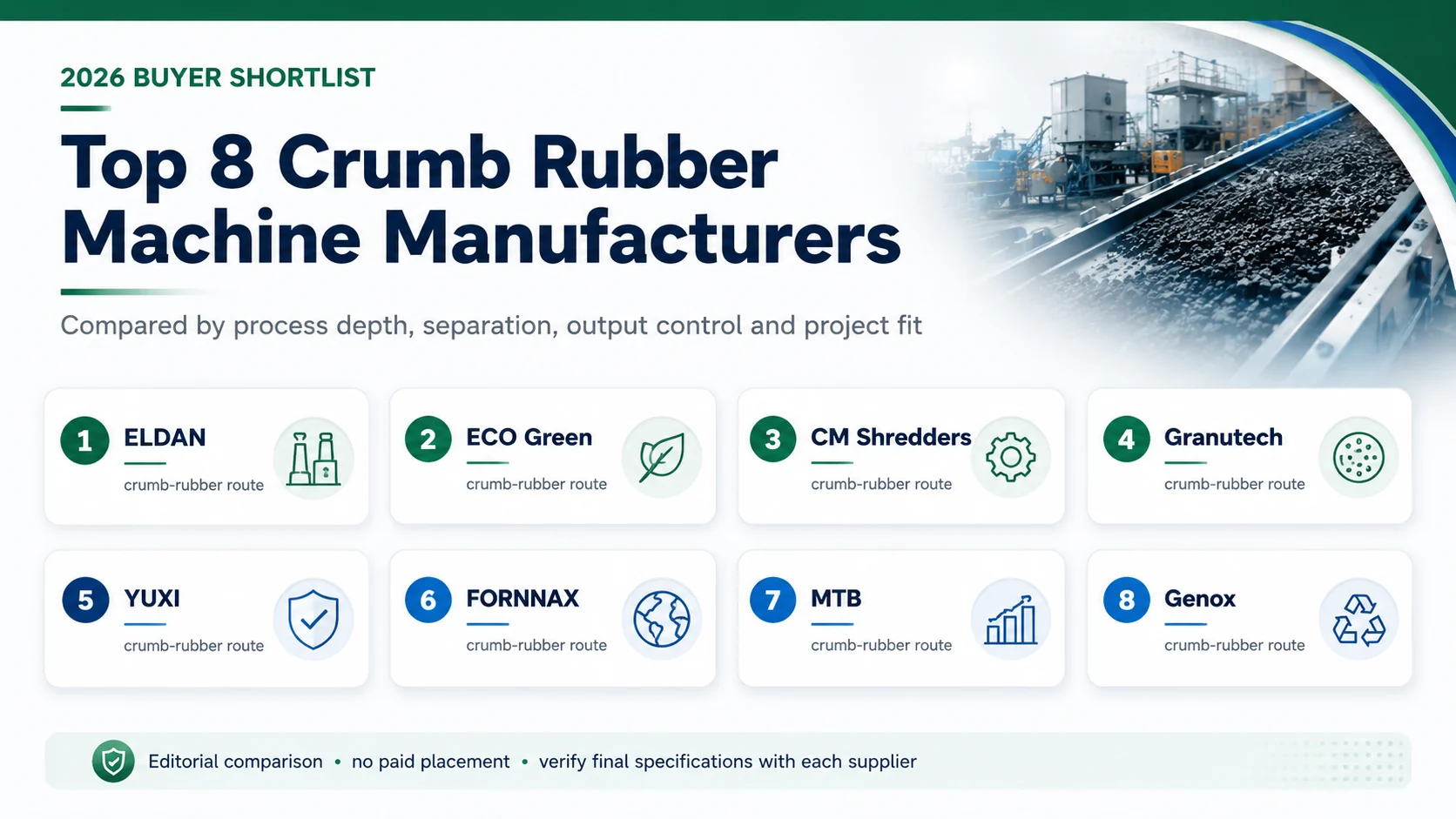
Which Manufacturers Lead the 2026 Shortlist?
| Rank | Manufacturer | Public crumb-rubber evidence | Best fit to investigate |
|---|---|---|---|
| 1 | ELDAN Recycling | Granulation and separation plants, whole-tire integration, steel/textile separation, high-purity upgrade options. | Large integrated plants where output quality and system depth carry high weight. |
| 2 | ECO Green Equipment | Tire-specific secondary shredding, Crumbler granulation, Krumbuster fine milling and detailed product-stage documentation. | Operators wanting a tire-focused modular route from chips to crumb and powder. |
| 3 | CM Shredders | Liberator, granulation/fiber removal, milling/screening/cleaning and cracker-mill stages. | Plants that value a deep equipment family and multiple tire-product routes. |
| 4 | Granutech-Saturn Systems | 2-, 3- and 4-stage tire systems with granulators, powderizers and refiner mills. | Projects requiring custom system integration and multiple output-size options. |
| 5 | YUXI Tire Recycling | Whole-tire or prepared-chip configurations, staged magnetic recovery, granulation, grading, return and fiber separation. | Buyers comparing configurable 0.5–10 t/h project scopes and 0–5 mm output direction. |
| 6 | FORNNAX Technology | Tyre recycling plants, R-series secondary shredders, TR-series granulators and published CRM-3000 project cases. | Industrial projects that want a strong secondary-reduction and granulation package. |
| 7 | MTB Recycling | Complete tire lines with shredding, granulation, sorting and published 0–4 mm / 99% granulate direction. | European-style turnkey or compact/containerized concepts with material recovery focus. |
| 8 | Genox Recycling Tech | Two-stage rasping, fine granulation, textile aspiration, central dust filtration and optional back-end milling. | Integrated systems where process controls, dust/noise options and multi-tire feed matter. |
What Counts as a Crumb Rubber Machine Manufacturer?
The search results for “crumb rubber machine manufacturer” are messy. Marketplaces mix small rubber crushers, full tire lines, powder mills and unrelated rubber-processing machinery. Some results are crumb-rubber producers, not machine builders. To make the shortlist useful, we required evidence that the supplier participates in the downstream tire route where clean rubber granulate is actually created.
That route has a physical logic. EPA describes tire crumb production with repeated size reduction, screens, magnets and air separation for fabric.1 CalRecycle defines crumb rubber for its regulatory context as waste-tire-derived rubber granules no larger than one-quarter inch (about 6 mm).2 ASTM D5644 provides a test method for particle-size distribution of recycled vulcanizate particulate rubber.3 These references point to the same procurement lesson: a machine is relevant only if it helps deliver a measured finished product, not merely smaller tire pieces.
If your project is still deciding whether to stop at coarse material, the rubber mulch vs crumb rubber comparison is the more useful first step. A 10–20 mm wire-free chip can be a finished product in one market and only an intermediate feed in another.
How We Organized the Ranking
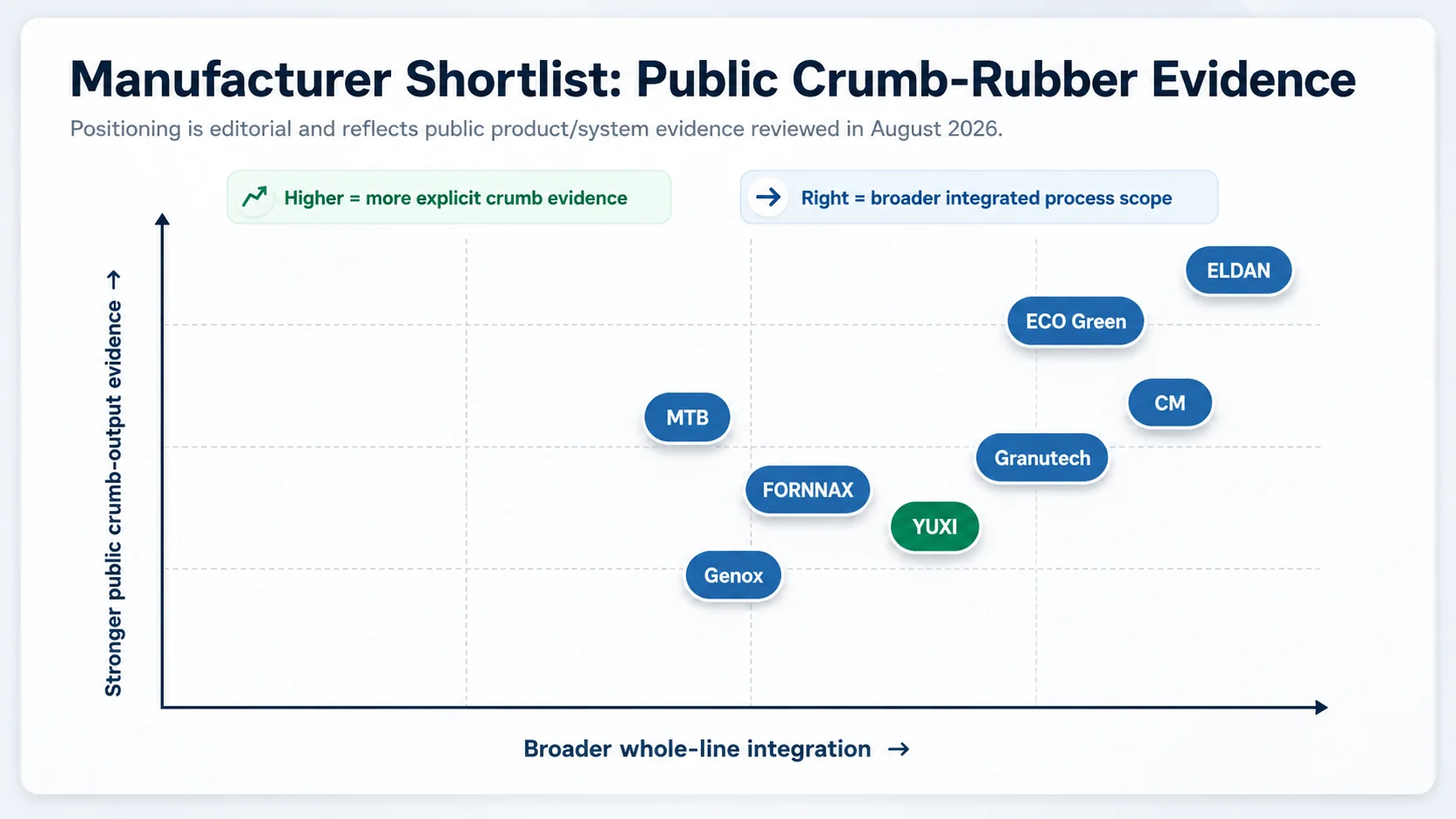
The order reflects six questions that matter when a buyer is shortlisting suppliers.
Ranking note: This is an editorial shortlist based on publicly available tire-recycling equipment, process, project and support information reviewed in August 2026. It is not a market-share ranking or an independent performance test. The order may change with feedstock, finished-product specification, plant scope and service requirements.
Crumb-specific equipment
Does the supplier show granulators, mills or dedicated downstream tire-processing stages rather than only a primary shredder?
Separation depth
Are steel liberation, magnetic recovery and textile removal part of the documented process?
Output control
Does the public material discuss screening, grading, return loops, mesh or specific granulate ranges?
Whole-line integration
Can the supplier connect whole-tire preparation to the final crumb stage, or is it mainly a single-machine vendor?
Evidence
Are there operating plants, product data, process descriptions or customer cases that buyers can use to frame a technical discussion?
Project support
Do controls, installation, training, spare parts, testing or service appear in the supplier’s public offering?
1 ELDAN Recycling
Best fit to investigate: integrated tire-recycling plants where granulate quality, multiple tire categories and mature separation architecture are central to the purchase.
ELDAN’s public tyre-recycling architecture is unusually explicit. Its A-plant handles primary shredding, the B-plant makes chips, the D-plant covers granulation and separation, and the E-plant combines stages into a complete granulation/separation route. The company also describes upgrade systems intended to push rubber fractions toward very high purity.4
This modular naming makes quotation boundaries easier to discuss. A buyer can ask whether a proposal starts with whole tires, pre-cut tires or prepared shreds and can then map the required separation stage to the finished product. ELDAN also states that its complete E-plant can handle whole tyres and pre-cut mining tyres, which is relevant for mixed-feed projects that may eventually grow beyond passenger tires.
Where we would probe further is the exact accepted-product contract. “High-quality granulate” still needs a sieve curve, metal limit, textile limit, moisture condition and finished t/h. A mature equipment architecture does not eliminate the need for a project-specific FAT.
2 ECO Green Equipment
Best fit to investigate: tire-focused modular systems where the buyer wants clearly separated stages for chips, crumb and finer rubber powder.
ECO Green is one of the clearest examples of a manufacturer that treats tire recycling as a staged product ladder. Its public material separates primary shredding, secondary shredding, granulation and cracker-mill/fine-milling stages. The ECO Crumbler is positioned as the granulator that takes prepared rubber toward crumb, while the ECO Krumbuster continues into smaller crumb and powder.5
The published Crumbler example is useful because it states a machine context rather than a vague plant promise: ECO reports about four metric tons per hour, granules from roughly 16 to 4 mm, and 99.9% tire-fluff removal for that granulator article. Its broader FAQ also distinguishes chip, wire-free chip, crumb and powder markets. Those numbers are supplier-published and must still be normalized to the actual feed and final specification, but they give a buyer concrete questions to ask.
ECO also documents remote technical assistance around its control platform and offers installation/training options. For an overseas buyer, that support model can be as important as the rotor design—especially when a line includes several recirculation and separation stages that must be tuned together.
3 CM Shredders
Best fit to investigate: operators who want a broad tire-processing equipment family extending from primary reduction through liberation, granulation, cleaning and fine milling.
CM’s public tire-equipment list reads like a process map. Primary and chipping shredders cover coarse reduction; the Liberator handles steel liberation; a Zero Waste system addresses commingled steel and rubber; granulation/fiber-removal systems take the material finer; milling, screening and cleaning systems cover the final tire-recycling stage; and a crackermill provides an additional fine-reduction option.6
That depth is why CM ranks above companies that may publish one strong granulator but less evidence of the complete tire chain. It also gives established recyclers a way to add a stage rather than replace an entire front end.
The buying caution is the same: CM publishes high throughput for some upstream shredders, but that number should never be reused as the expected crumb-rubber output. The downstream granulator, screening system, fiber-removal duty and target fraction can become the real bottleneck. Ask for the measured accepted crumb rate after all return material is circulating.
4 Granutech-Saturn Systems
Best fit to investigate: custom tire-processing plants that may need several reduction stages, multiple output sizes or later expansion into fine powder.
Granutech-Saturn presents 2-, 3- and 4-stage recycling systems combining shredders, grinders, granulators, powderizers and refiner mills. Its tire pages specifically state that complete systems can convert whole scrap tires into crumb rubber and allow output sizing to be configured for different end products.7
The company also publishes individual machine examples, such as the Saturn Grizzly and fine-refining equipment. Those examples help show the available processing depth, but they should not be added together into a fictional “line capacity.” A 10 t/h coarse or intermediate machine and a 3 t/h fine refiner can coexist in the same product family because they serve different particle sizes.
Granutech is therefore a strong shortlist candidate when a project owner knows the product roadmap—coarse crumb now, finer fractions later—and wants to discuss a staged system rather than a single catalog machine.
5 YUXI Tire Recycling
Best fit to investigate: buyers who want either a complete whole-tire-to-crumb line or a downstream granulation module starting from prepared 10–20 mm wire-free chips.
YUXI’s Tire Rubber Crumb Plant publishes two quotation boundaries that are easy to miss in competitor comparisons. A new plant can begin with whole tires and include shredding, steel liberation, magnetic recovery, granulation, grading and fiber removal. An existing recycler can start later in the process with 10–20 mm wire-free chips and add the fine-granulation module.
The page gives a configurable 0.5–10 t/h reference feed envelope and highlights 0–5 mm as the primary finished direction, while warning that actual output changes with tire mix and granule size. It also shows two magnetic stages, oversize return and air-based textile separation. From a buyer’s perspective, that is more useful than a single “rubber crusher” because the quality-control chain is visible.
Before comparing its offer with another supplier, review the crumb rubber manufacturing process. It makes the handoff conditions between shredder, rasper, magnets, granulator, screens and fiber separation explicit.
6 FORNNAX Technology
Best fit to investigate: industrial tire-recycling projects where heavy secondary reduction, steel liberation and granulation are the core engineering challenge.
FORNNAX lists SR-series primary shredders, R-series secondary shredders, TR-series granulators and separation systems as part of its tyre-recycling portfolio. The company also publishes customer stories around its CRM-3000 crumb-rubber granules plant; one example describes a 3 t/h input installation.8
That case evidence gives buyers something better than a generic marketing claim: a named plant architecture and an operating capacity context. At the same time, “3 t/h input” should not be treated as 3 t/h of every possible finished mesh. The supplier should state where the rate is measured, what feed reaches the plant and which product fraction is counted as accepted output.
FORNNAX is worth serious comparison when the project includes tough feed and high steel-liberation duty. For a fine-crumb purchase, ask for the complete downstream screen, air-separation, dust and product-collection scope rather than stopping at the granulator nameplate.
7 MTB Recycling
Best fit to investigate: European turnkey projects, varied tire categories and buyers interested in compact/containerized system concepts.
MTB publishes a four-step tire/rubber process—pre-shredding, shredding, granulation and sorting—and says its complete solutions can process tire types ranging from light vehicles to mining tires. Its public page gives a granulation direction of 0–4 mm at 99% purity and also describes clean-steel recovery and optional textile cleaning.9
The company also promotes a compact Tire Box concept using shredders, granulators and separators in a containerized arrangement. That can be interesting where site deployment and modular logistics matter, although a buyer still needs to verify whether the compact concept covers the same throughput and final-product contract as the larger turnkey line.
MTB ranks lower only because this article weights the depth of crumb-specific public documentation heavily. The published output figures are still strong enough to make it a legitimate shortlist candidate, especially for buyers prioritizing material recovery and plant compactness.
8 Genox Recycling Tech
Best fit to investigate: integrated tire systems where two-stage steel liberation, dust extraction, process automation and environmental controls are important design points.
Genox’s tire-recycling system covers car, commercial, truck and OTR tires. Its public technical page describes a two-stage rasper arrangement for steel liberation, a fine-granulation system designed for tire rubber, textile/dust aspiration at several locations and a central reverse-jet filtration system. It also mentions optional back-end milling, sound attenuation and water spray/misting for temperature and fire control.10
Those details are valuable because they address operating problems that rarely appear in “top manufacturer” lists: noise, heat, dust, fire risk and linked automation. The reason Genox sits eighth is not that the system appears weak. It is that the public page gives less finished-crumb specification detail than the suppliers ranked above.
If Genox is on your shortlist, make the commercial proposal define the end of the line. “Fine granulation” should become a written size distribution, impurity limits, packaging point and accepted t/h.
Which Manufacturer Fits Which Project?
There is no single “best” crumb rubber machine manufacturer once the plant boundary changes. A company adding a granulator behind an existing mulch line is buying a different project from a greenfield facility receiving whole truck tires.
| Project situation | Manufacturers worth investigating first | Why |
|---|---|---|
| Large integrated whole-tire plant | ELDAN, CM, Granutech, YUXI | Broad documented equipment chains and whole-line integration options. |
| Existing 10–20 mm wire-free chip feed | YUXI, ECO Green, ELDAN, MTB | Clear downstream granulation/separation logic; easier to define a module boundary. |
| Fine rubber / future powder expansion | ECO Green, Granutech, CM | Published cracker-mill, powderizer or refiner options beyond coarse crumb. |
| Heavy secondary shredding and steel liberation | FORNNAX, CM, ELDAN, Genox | Strong public emphasis on secondary reduction and wire liberation. |
| Compact/containerized deployment | MTB | Public Tire Box concept emphasizes compact modular integration. |
| Dust/noise/temperature controls emphasized | Genox | Public system description explicitly includes filtration, sound and misting options. |
If cost is the main constraint, the crumb rubber plant cost guide explains why a downstream module, a whole-tire line and a line with fine-powder expansion should not be compared as if they were the same quotation.
Do Not Compare Crumb Rubber Manufacturers by “t/h” Alone
We can usually see this mistake in supplier spreadsheets. One column says 10 t/h, another says 4 t/h, and the buyer highlights the larger number. But what was weighed? Whole tires into the first shredder? Prepared chips entering a granulator? Or accepted 1–4 mm product after screening and fiber removal?
The physics gets harder as the product gets smaller. Finer screens create more recirculation. Truck-tire content changes steel load. Dull knives raise power and heat. Fiber separation can become unstable if feed surges. A large upstream machine cannot compensate for an undersized screen, air separator or return conveyor.
Required accepted crumb t/h ≠ nominal upstream feed t/h
For a serious comparison, ask every supplier to quote the same five numbers: fresh feed t/h, accepted crumb t/h, oversize-return t/h, steel side-stream mass and textile/fines side-stream mass. Then define the exact product fraction. If the target is high-purity material, the tire rubber granule plant purity guide gives a useful structure for separating steel, fiber and size claims instead of hiding everything behind one percentage.
What to Request From Every Shortlisted Supplier
A good supplier comparison ends with evidence, not adjectives. Before the purchase order, convert the sales discussion into a factory acceptance test that uses your feed and your product definition.
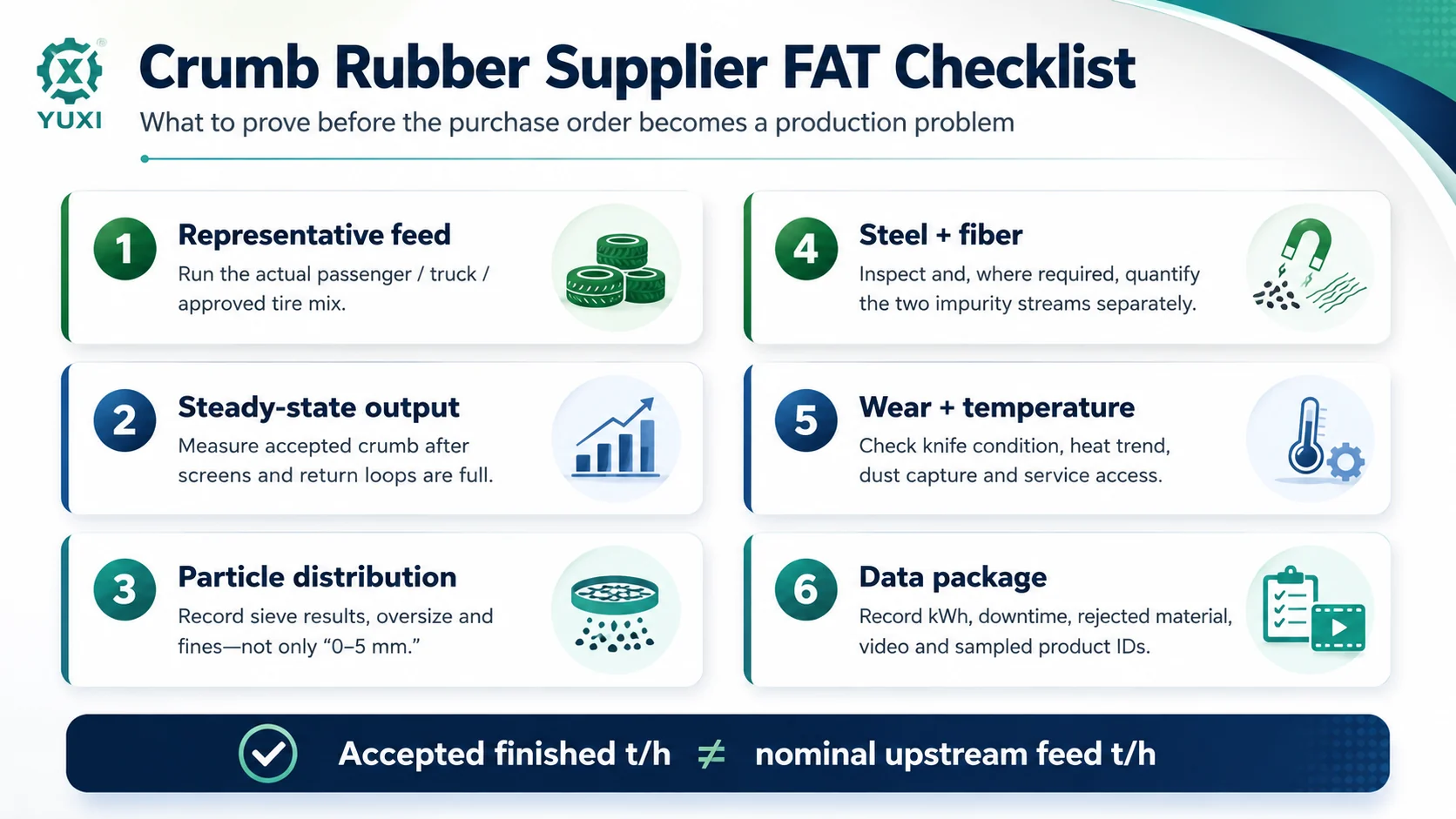
- Representative tires: declare passenger, truck, agricultural or approved OTR percentages, maximum dimensions, rims and contamination exclusions.
- Starting point: state whether the test starts with whole tires, coarse shreds or prepared wire-free chips.
- Finished size: write the target sieve range, permitted oversize, permitted fines and the sampling method. ASTM D5644 can support particle-size distribution testing where applicable.3
- Separate impurity limits: metal and textile are different failure modes. Do not accept one vague “99% pure” number without the test basis.
- Steady-state duration: run long enough for screens and return conveyors to carry normal recirculating load.
- Accepted mass balance: weigh accepted product and, where practical, steel, textile/fines and returned oversize.
- Power and heat: record actual line power trend, granulator temperature behavior and any water/misting or dust-control duty.
- Wear state: note knife condition at the start and end. A short test with fresh knives can hide the maintenance profile.
- Downtime: record reversals, clearing, screen cleaning, knife checks and any stop not included in the headline production rate.
- Retained samples: seal and label representative finished samples so your downstream buyer can approve the product before shipment.
FHWA’s historical tire-rubber guidance also illustrates why particle size and processing method matter to end use; it distinguishes granulated and ground rubber ranges and notes the separation of steel and fiber during processing.11
Common Buying Mistakes in Manufacturer Comparisons
Buying the biggest upstream number
The first shredder may be capable of far more material than the granulator and separation section can finish. Compare saleable output, not the easiest point to weigh.
Treating “0–5 mm” as a complete spec
A maximum size says nothing about fines, distribution, steel, fiber or moisture. Product acceptance needs more than one number.
Ignoring the feed boundary
A quote starting from wire-free 10–20 mm chips should cost less and use fewer machines than a whole-tire line. That does not make it a better bargain—it is a different scope.
Using one purity percentage
Residual steel, textile, dust and other contamination are different problems. Ask how each is sampled and measured.
Forgetting return load
A tight finished fraction can send substantial material back through the granulator. Return conveyors and screens need enough capacity for that internal circulation.
Choosing the machine before the buyer
Crumb for molded goods, surfacing or asphalt can require different gradations. Confirm the end-market specification before freezing the equipment list.
Crumb Rubber Machine Manufacturer FAQ
Who are the leading crumb rubber machine manufacturers in 2026?
A practical shortlist includes ELDAN Recycling, ECO Green Equipment, CM Shredders, Granutech-Saturn Systems, YUXI Tire Recycling, FORNNAX Technology, MTB Recycling and Genox Recycling Tech. This list is based on public tire-specific granulation, separation and system evidence, not on paid placement.
What equipment is needed to make crumb rubber from whole tires?
A complete ambient route can include tire preparation, primary shredding, a rasper or liberator, magnetic steel recovery, fine granulation, screening with oversize return, secondary magnetic recovery, fiber separation, conveying, dust control and controls. Some projects begin with prepared wire-free chips and omit part of the front end.
Is a tire shredder the same as a crumb rubber machine?
No. A primary shredder often produces coarse tire shreds or chips. Crumb rubber requires further size reduction and separation so the finished material meets a smaller particle-size range with controlled steel and textile contamination.
How should I compare crumb rubber plant capacity?
Compare accepted finished-product tons per hour at the exact target fraction and impurity limits. Ask suppliers to report fresh feed, return load, accepted product and by-product streams separately. Do not compare whole-tire shredder input with finished crumb output.
Should the lowest-priced crumb rubber line win the bid?
Not until the equipment boundary is normalized. Check whether each quote includes the same feed point, magnets, fiber separation, screens, return conveyors, dust collection, controls, freight, installation, commissioning, wear parts and acceptance testing.
What is the most important factory test?
Run representative feed long enough for the line to reach steady state, then weigh the accepted crumb and verify its particle-size distribution plus steel and fiber limits. A short demonstration with empty screens and freshly sharpened knives is not enough evidence for shift production.
Compare a Crumb Rubber Line Around Your Real Product
Send your tire mix, starting material, target crumb size, accepted finished capacity, steel and fiber limits, workshop conditions and destination. YUXI can configure either a complete whole-tire line or a downstream granulation module and prepare the quotation boundary for side-by-side comparison.
Sources and Engineering References
- U.S. Environmental Protection Agency, Tire Crumb Questions and Answers: screens, magnets and air separators in tire-crumb production. https://www.epa.gov/chemical-research/tire-crumb-questions-and-answers
- CalRecycle, What Is a Waste Tire?: California regulatory definition of crumb rubber as waste-tire-derived granules ≒ 1/4 inch (6 mm). https://calrecycle.ca.gov/tires/enforcement/wasteorused/
- ASTM International, D5644-23: determination of particle-size distribution of recycled vulcanizate particulate rubber. https://store.astm.org/d5644-23.html
- ELDAN Recycling, Tyre Recycling Solutions: modular A/B/D/E plant architecture, granulation/separation and quality-upgrade information. https://www.eldan-recycling.com/tyre-recycling/
- ECO Green Equipment, Recycling FAQs and How the ECO Crumbler Can Transform Your Tire Recycling Business: staged tire process, Crumbler/Krumbuster roles, published granulator examples and support information. https://ecogreenequipment.com/parts-and-services/faqs/ https://ecogreenequipment.com/how-the-eco-crumbler-can-transform-your-tire-recycling-business/
- CM Shredders, Tire Equipment: Liberator, Zero Waste, granulation/fiber removal, milling/screening/cleaning and crackermill stages. https://cmshredders.com/tire-equipment/
- Granutech-Saturn Systems, Tire Shredders & Recycling Equipment: complete tire systems, granulators, powderizers and refiner mills. https://www.granutech.com/tire-shredding-and-recycling.html
- FORNNAX Technology, tyre recycling product range and CRM-3000 customer-case information. https://www.fornnax.com/ https://www.fornnax.com/info-center/success-story/success-story-of-vichoor-bitu-chemicals/
- MTB Recycling, Tires / Rubber: shredding, granulation, sorting, 0–4 mm granulate direction and material-recovery information. https://www.mtb-recycling.fr/en/equipements-de-recyclage/tires-rubber/
- Genox Recycling Tech, Tire Recycling System: two-stage rasping, fine granulation, aspiration, filtration, sound, misting and automation options. https://www.genoxtech.com/en/solution_i_S0004.html
- Federal Highway Administration, scrap-tire material/user guidance: granulated/ground rubber particle ranges and processing context. https://www.fhwa.dot.gov/publications/research/infrastructure/structures/97148/st1.cfm https://www.fhwa.dot.gov/publications/research/infrastructure/structures/97148/st3.cfm