




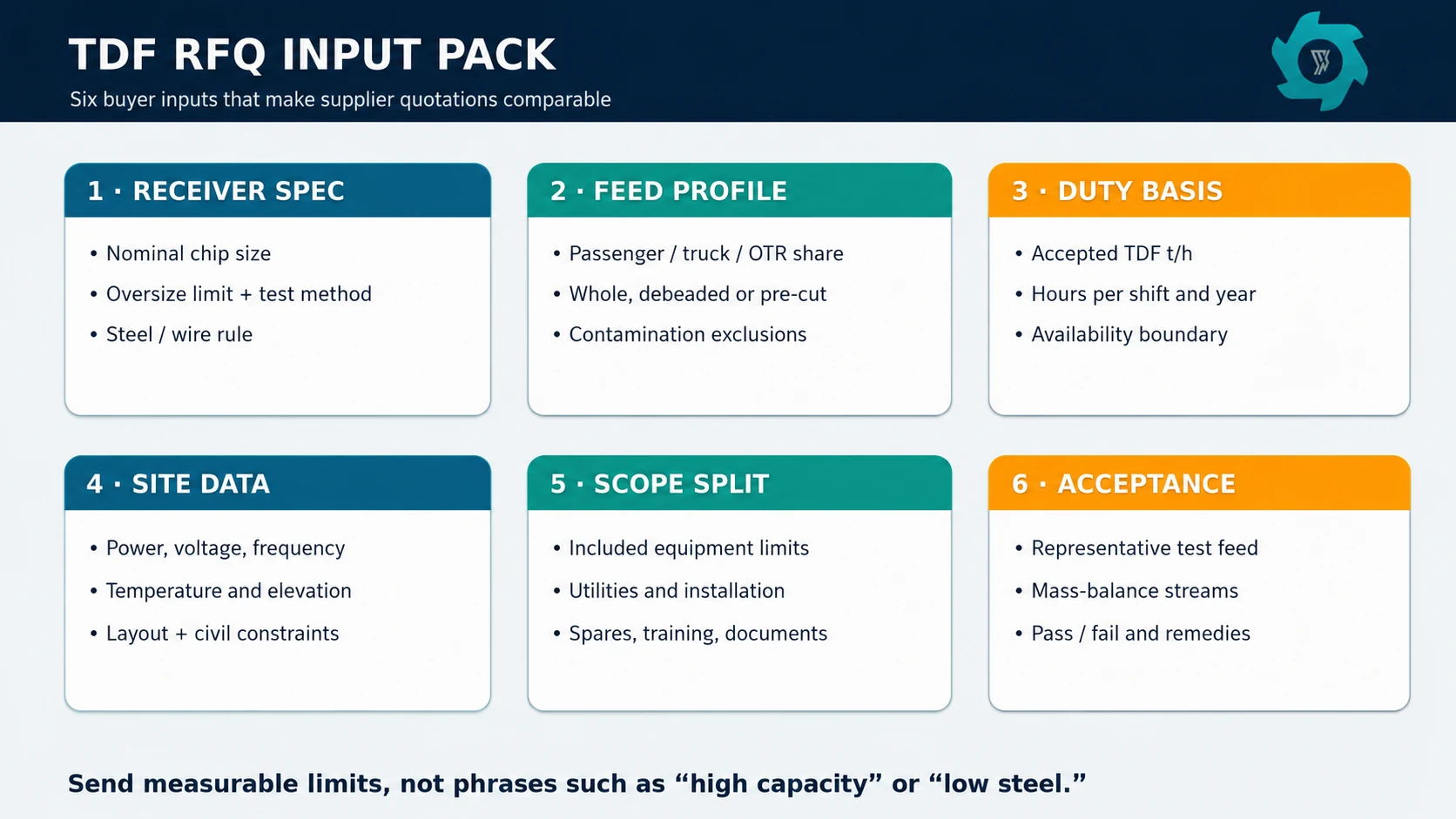
A useful TDF plant RFQ does more than ask for price, motor power and “tons per hour.” It gives every supplier the same feed boundary, finished-product limits, operating duty, site interfaces, scope split and acceptance test.
1. Start with the TDF receiver, not the shredder
Before requesting machinery, obtain a written acceptance sheet from the cement kiln, pulp mill, boiler or other approved receiver. EPA’s TDF overview notes that tires may need both size reduction and additional physical processing such as de-wiring, depending on the combustion system.1
Put the receiver’s requirements into measurable fields. State nominal chip size, absolute maximum dimension, permitted oversize fraction, exposed-wire rule, free-steel limit if applicable, moisture basis, prohibited materials and sampling procedure. If a buyer still needs to settle these values, use a dedicated TDF quality specification before sending the RFQ.
| RFQ field | Weak wording | Bid-ready wording |
|---|---|---|
| Size | 50 mm TDF | Nominal range, maximum piece dimension, oversize percentage and sieve/manual measurement method |
| Steel | Low wire | Exposed-wire and/or free-steel limit, measurement basis and sample mass |
| Contamination | Clean tires | Named prohibited items plus maximum dirt, stones, water and non-tire material |
| Delivery | Finished product | Measurement location: conveyor discharge, stockpile, loading point or receiver gate |
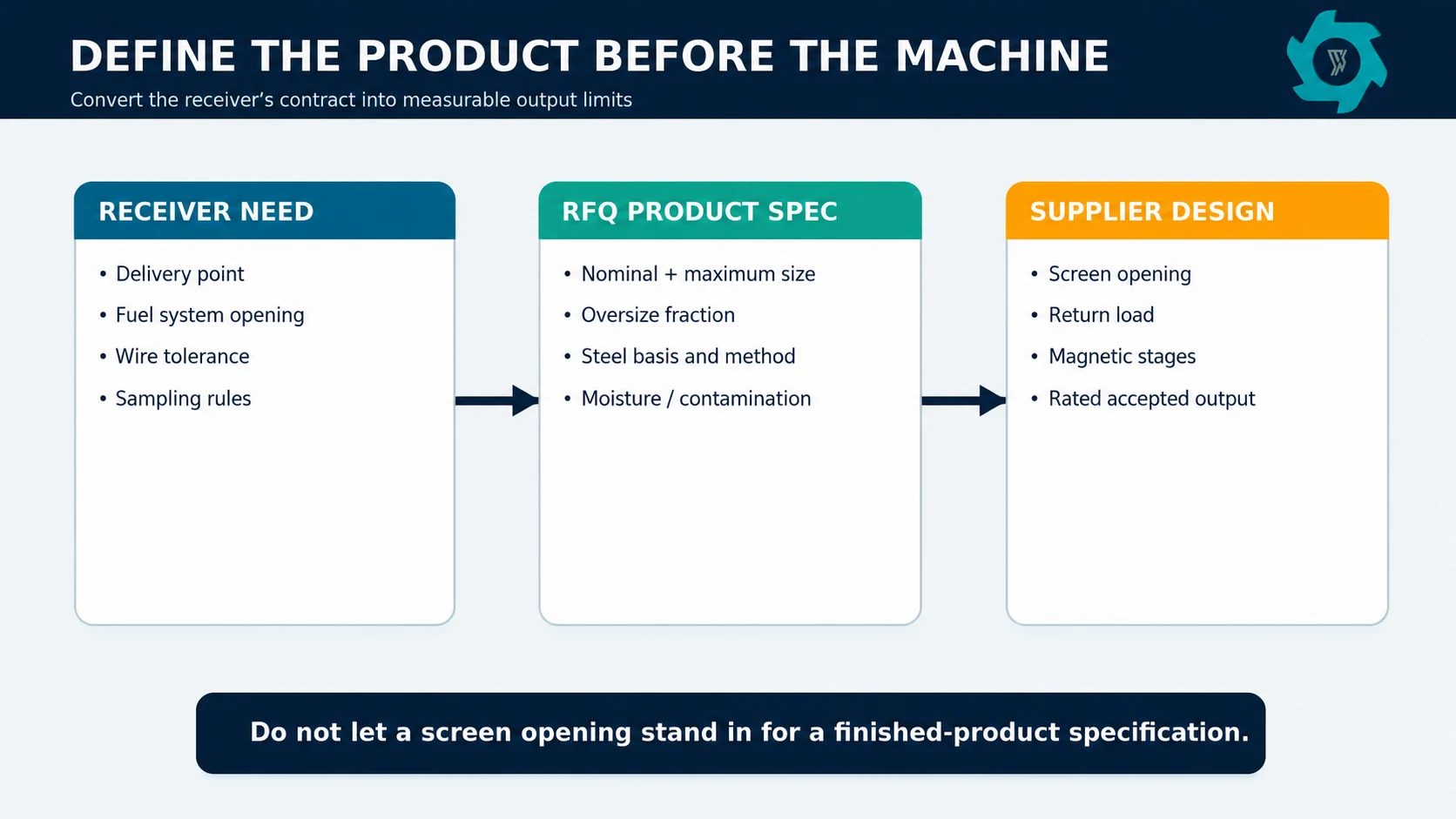
A screen opening is a machine setting, not proof that every discharged chip meets a receiver’s maximum dimension. The RFQ should distinguish nominal product, maximum limit and the percentage allowed outside the nominal band. ASTM D6700 provides recognized guidance for the use of scrap tires as tire-derived fuel, but the project must still adopt the receiver’s contract, permit and test methods.2
2. Describe the incoming tires as a range
“Mixed waste tires” hides the variables that decide preparation time, cutter loading and steel burden. Give the supplier a feedstock passport based on records and representative sampling, not the easiest load available.
- Monthly and annual tonnage, seasonal peaks and delivery pattern.
- Mass share of passenger, light-truck, truck/bus, OTR, agricultural and solid tires.
- Minimum, typical and maximum diameter, width and unit weight.
- Whole, debeaded, sidewall-cut, quartered or otherwise prepared condition.
- Rim frequency, water retention, dirt, stones, chains, repair material and prohibited items.
- How rejected tires will be isolated, recorded and removed.
Do not ask the supplier to assume preparation. State whether the quoted line begins at whole-tire unloading or at a prepared-tire conveyor. Passenger and truck tires also should not be treated as interchangeable test feed; their construction can change handling, steel release and cutter duty. When shortlisting bidders, the TDF equipment manufacturer guide shows which process and test evidence to request instead of relying on catalogue ranges.
3. Define capacity as accepted TDF
Ask for capacity in accepted product mass per running hour at the named product setting. Fresh feed entering a shredder is not the same as finished TDF leaving the system: oversize may recirculate, steel and contamination may leave through other routes, and material may remain in the line.
Also request fresh-feed rate, accepted yield, oversize/return load, planned operating hours, shift pattern and guaranteed availability definition. Keep running time, scheduled time and calendar time separate. If recirculation, bridging or wear disrupts a trial, the TDF plant troubleshooting guide helps the team record causes without quietly changing the capacity denominator.
| Metric | Buyer must define | Supplier must return |
|---|---|---|
| Accepted output | Product limits, test feed, duration | Guaranteed t/h and permitted test tolerance |
| Availability | Included/excluded stops and period | Guaranteed percentage and calculation |
| Energy | Meter boundary and operating state | kWh per accepted tonne plus installed load |
| Wear | Feed and product boundary | Expected service actions, parts and assumptions |
4. Lock the supply boundary and site interfaces
Mark the battery limits on a one-page process sketch. The TDF plant route shows a typical route—preparation where required, shredding, screen-controlled sizing and oversize return—but the RFQ must say where the supplier’s responsibility starts and ends.
List the receiving hopper, conveyors, platforms, magnets, screen, return loop, controls, guarding, dust pickup points, fire-detection interfaces, discharge storage and load-out as separate lines. For each, mark included, by buyer, optional or excluded. Do the same for foundations, cranes, cabling, piping, freight, duties, installation labor, commissioning consumables and test material.
Provide voltage, frequency, available short-circuit data, transformer limit, ambient-temperature range, elevation, indoor/outdoor location, drainage, compressed air and water. Attach a scaled layout with access doors, columns, clear height, maintenance pull space and truck/loader routes. Safety obligations should cover applicable local law, risk assessment, guarding and isolation. OSHA requires guarding against machine hazards and has separate requirements for hazardous-energy control.34
5. Force quotations into one response schedule
Provide a spreadsheet-style schedule with three columns: buyer requirement, supplier guaranteed response and deviation/comment. Require every blank to be completed or marked “not applicable.”
Ask for a process flow, equipment list, motor schedule, control philosophy, mass-flow estimate, utility list, layout, foundation loads, noise basis, emissions/dust interfaces, recommended spares, consumables, manuals, training, warranty and delivery milestones. Separate base price from options. A lower base price may simply exclude magnetic separation, platforms, cabling or commissioning.
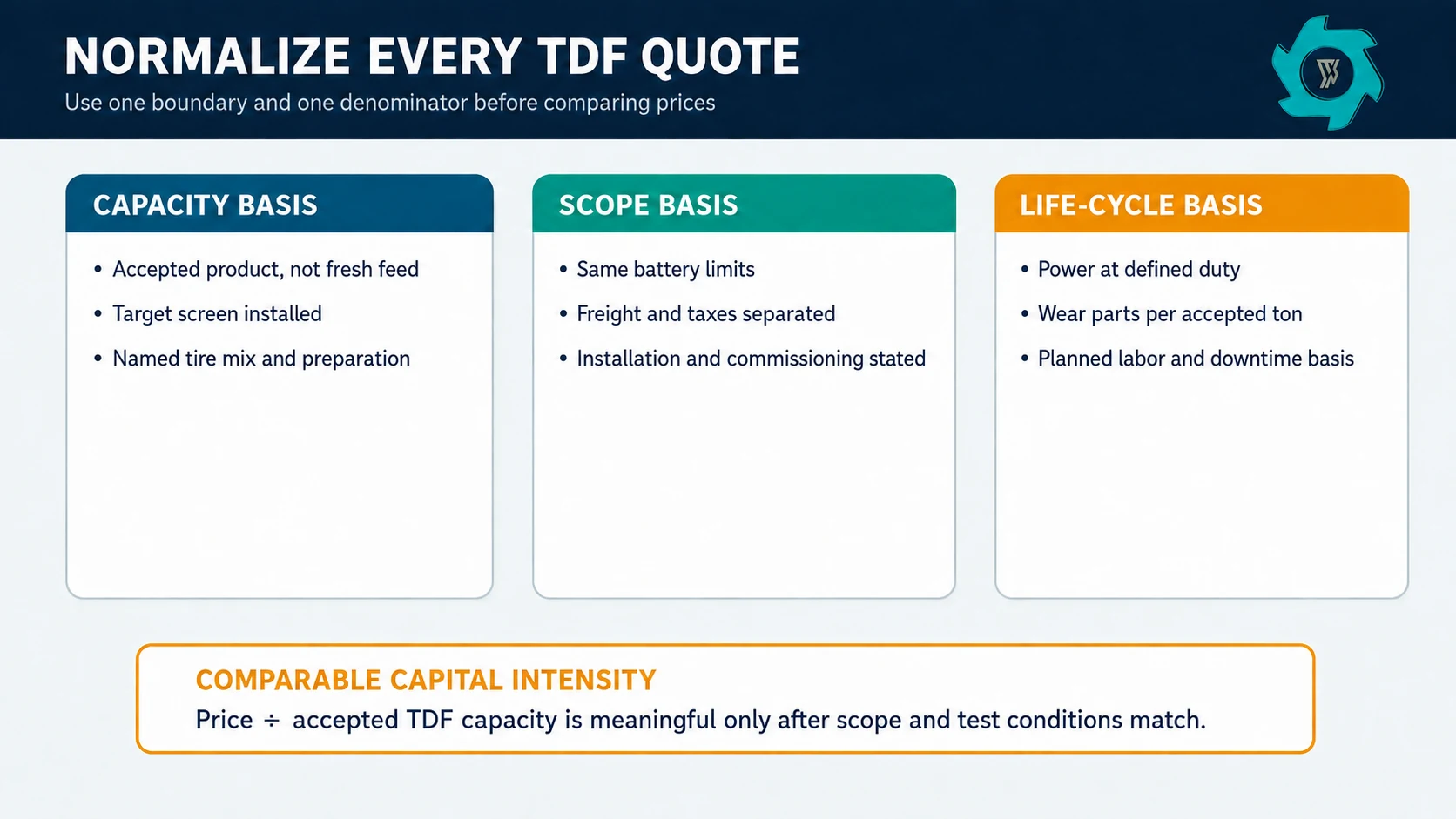
Power, cutter service and labor should be reported against accepted TDF, with the feed and product boundary stated. For a deeper cost worksheet, refer to the TDF plant operating-cost guide.
6. Write the FAT and SAT before purchase
An acceptance test written after fabrication usually measures whatever is easiest to demonstrate. Put the evidence plan in the RFQ so the supplier can price test feed, labor, instruments and time.
Define the feed lot and who supplies it; its tire mix and preparation; installed screen and cutter arrangement; warm-up and stabilization rule; test duration; allowed interventions; scale accuracy; electrical meter boundary; sampling frequency; and laboratory responsibility.
During the test, weigh accepted TDF, recovered steel, oversize/return, fines, other rejects and retained material separately where those streams exist. Record stops by cause instead of erasing them from the average. Product samples must be taken under the agreed method and preserved for review.
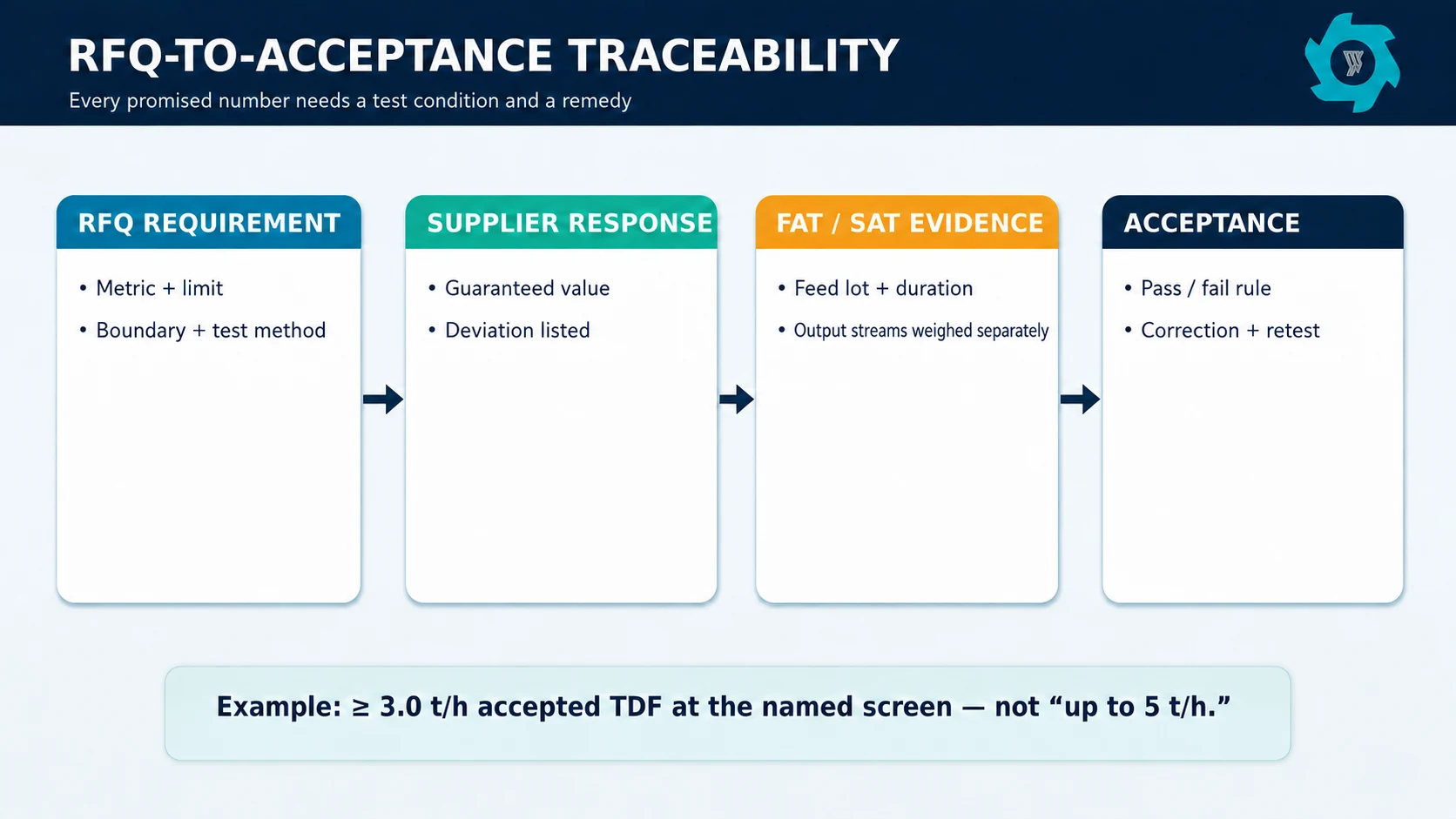
State what happens if a criterion fails: correction period, repeat-test responsibility, effect on shipment or final payment, and the buyer’s right to reject unresolved deviations. FAT proves the agreed factory test; SAT confirms installation, interfaces and site performance.
7. Use a weighted comparison, then investigate red flags
| Evaluation block | Example weight | Evidence to score |
|---|---|---|
| Product compliance | 25% | Guaranteed limits, sampling method, receiver fit |
| Accepted-output performance | 20% | Test basis, return load, availability boundary |
| Scope and integration | 20% | Battery limits, layout, controls, utilities |
| Life-cycle support | 15% | Wear assumptions, spares, service response, documentation |
| Acceptance and risk | 10% | FAT/SAT detail, guarantees, remedies, deviations |
| Commercial offer | 10% | Normalized price, milestones, warranty and delivery |
Treat these as red flags: “up to” capacity without a test condition; output size stated only as screen opening; power shown only as installed motor rating; one price with exclusions scattered through notes; no mass balance; generic tire photographs instead of the project feed; and warranty beginning before site commissioning is possible.
8. Grade the buyer’s own data before suppliers price it
A quotation can look precise even when its inputs are guesses. Add a confidence code beside every critical RFQ value so bidders know what has been measured and where contingency belongs. This also stops an early assumption from turning into an accidental guarantee.
| Code | Evidence level | How to use it in the RFQ |
|---|---|---|
| A — controlled | Receiver contract, permit condition, utility letter or measured production record | Treat as fixed unless the supplier declares a deviation. |
| B — sampled | Representative tire survey or timed site observation with date and method | Use as the design basis; state the range and retain the raw record. |
| C — estimated | Planning forecast, supplier assumption or data from a different site | Require a sensitivity price or design allowance. |
| D — unresolved | No reliable value yet | Create a hold point; do not let bidders silently choose different assumptions. |
For example, if annual truck-tire share is only a C-level estimate, request a base quotation at the expected mix and a stated performance or price adjustment at the upper-bound mix. The response becomes useful even if feed sourcing changes before commissioning.
9. Ask for a small sensitivity matrix, not one perfect-point quote
A single duty point hides how quickly output or wear may change. Ask each supplier to complete a compact matrix using the same three variables that matter most to the project. Keep it small enough to test or justify.
| Quoted case | Tire mix | Product setting | Supplier must state |
|---|---|---|---|
| Base | Expected passenger/truck/OTR shares | Contract target | Guaranteed accepted t/h, energy basis and normal crew |
| Fine-product case | Same feed | Next smaller agreed screen or tighter oversize limit | Accepted t/h, estimated return load and wear implication |
| Heavy-feed case | Upper-bound truck/OTR share | Contract target | Required preparation, accepted t/h and exclusions |
This is not a request for unsupported predictions across dozens of combinations. It is a disciplined way to expose whether the design margin sits in the cutter, screen, return conveyor, magnet or material handling. Any non-tested figure should be labeled an estimate rather than a guarantee.
10. Control interfaces with an owner-and-evidence register
Many commissioning disputes occur between supplied packages rather than inside a machine. Add an interface register that names who designs, supplies, installs, powers, tests and accepts each connection.
| Interface | Minimum RFQ record | Close-out evidence |
|---|---|---|
| Feed to first machine | Elevation, rate, surge volume, loader/conveyor owner and prohibited feed | Approved layout and loading trial |
| Electrical | Supply point, voltage tolerance, cable termination, earthing and control-network boundary | Drawings, settings list and functional test |
| Dust/fire controls | Pickup-point owner, airflow basis, detection/interlock interface and local-code review | Commissioning records and cause-and-effect test |
| Finished TDF discharge | Transfer height, downstream capacity, storage limit and blockage signal | Loaded transfer test at agreed duty |
| Data and performance | Scale, energy meter, historian tags, access rights and report format | Calibrations plus FAT/SAT data export |
Carry unresolved interfaces into a dated action register with an owner and decision deadline. If a late answer can change price or delivery, require the supplier to show that consequence next to the open item.
11. Build a bid equalization sheet before opening prices
Start with each bid price, then add only identifiable items needed to reach the common scope: excluded conveyors, electrical cabinets, magnets, freight, installation supervision, commissioning, initial spares and required options.
Copy-ready TDF plant RFQ checklist
- Attach the receiver’s signed or controlled TDF acceptance specification.
- Issue a feed passport with mass shares, dimensions, preparation and contaminants.
- Set accepted-output capacity, operating schedule and availability calculation.
- Draw battery limits and complete the included/by-buyer/optional/excluded matrix.
- Provide utilities, climate, elevation, layout and maintenance-access constraints.
- Ask for guaranteed technical responses, not brochures alone.
- Separate base scope, options, freight, installation, commissioning and taxes.
- Define FAT and SAT feed, duration, measurements, samples and pass/fail limits.
- Require a deviations register signed into the final contract.
- Compare bids only after normalizing output, scope, test conditions and warranty.
Frequently asked questions
What is the most important specification in a TDF plant RFQ?
The receiving facility’s finished-TDF acceptance specification is the starting point. It should state size limits, oversize allowance, steel or exposed-wire rule, contamination limits, sampling method and delivery condition.
Should TDF plant capacity be quoted as input or output?
Ask for guaranteed accepted-product output at the named feed mix, preparation state, screen setting and test duration. Fresh-feed rate alone can include material that is still circulating or rejected.
What tire samples should a buyer send to suppliers?
Send photographs, dimensions, weights and the expected share of passenger, truck, OTR or other tires. Identify rims, bead condition, pre-cutting, dirt, water and prohibited contamination. A representative test lot is better than one easy tire type.
What belongs in a TDF plant FAT?
The FAT should lock the feed lot, preparation, screen and operating boundary; time the stable run; weigh accepted product, recovered steel, oversize or return, fines, other rejects and retained material separately where present; record stops and energy; and apply agreed pass/fail rules.
How can buyers compare TDF plant quotations fairly?
Issue one response schedule and normalize every bid to the same product specification, accepted-output basis, battery limits, site conditions, warranty boundary and acceptance test.
Should an RFQ prescribe every machine in the line?
Define the feed, required product, duty, site interfaces, safety expectations and acceptance evidence. Suppliers can then propose the process, while the buyer can still require explanations for preparation, screening, recirculation, steel removal and dust control.
Engineering References
- U.S. EPA, TDF guidance. Scrap tire fuel context.
- ASTM International, D6700 standard. TDF specification guidance.
- OSHA, machine guarding. Guarding guidance.
- OSHA, hazardous energy. Lockout/tagout guidance.
Turn your receiver specification into a workable plant RFQ
Send your tire mix, target TDF specification, required accepted output and site constraints. YUXI can return a defined process scope, utility list and test basis for review.