




The useful comparison is not who owns the largest shredder. It is who can turn your actual tire mix into the fuel chip your receiver will accept—at a measurable net output rate.
Top TDF Tire Shredding Equipment Manufacturers in 2026
TDF equipment means more than a machine capable of biting a tire. The supplier must have a credible route to a controlled fuel product: feeding and preparation where needed, primary or secondary cutting, size classification, oversize recirculation, and steel control appropriate to the off-taker. That narrower definition separates TDF projects from general waste-volume reduction.
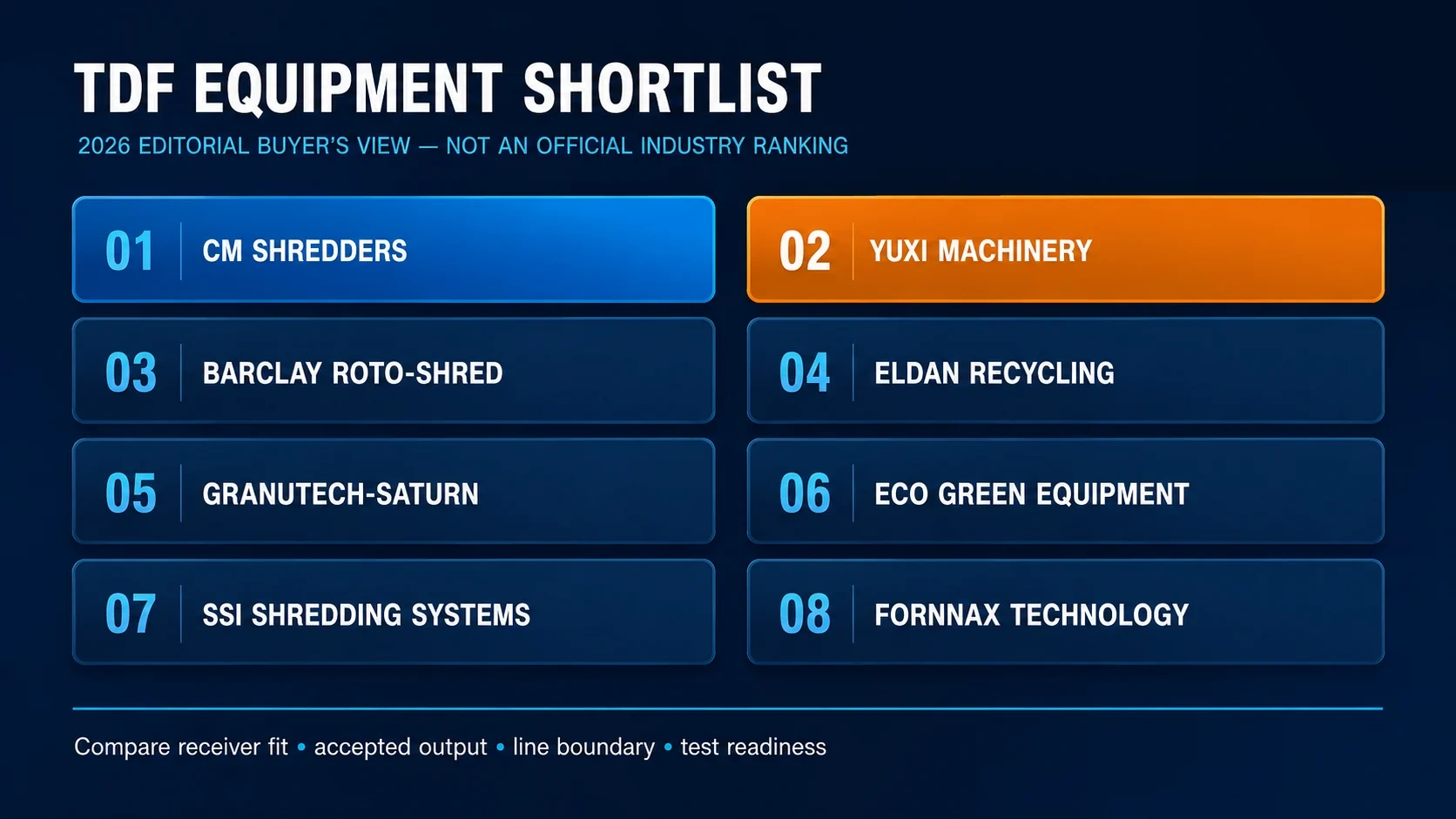
| Rank | Manufacturer | Relevant equipment focus | Best-fit buying situation | First item to normalize |
|---|---|---|---|---|
| 1 | CM Shredders | Tire-dedicated primary, chipping and screening systems, including mobile configurations | Buyers prioritizing a mature tire-specific TDF/TDA equipment family | Whether quoted output is coarse Stage 1 material or receiver-ready fuel |
| 2 | YUXI Machinery | Configurable preparation, shredding, screen-return, magnetic separation and conveying route | Export projects seeking a complete line configured around feed and off-taker limits | Maximum tire class, pre-cutting/debeading boundary and accepted-output basis |
| 3 | Barclay Roto-Shred | Primary and secondary tire shredders with classification options | North American operators focused on heavy-duty TDF size reduction | Screen arrangement, knife condition and final-size distribution |
| 4 | ELDAN Recycling | Modular tire chip and downstream granulation/separation plants | Plants that may begin with chips and later deepen material recovery | Where the quoted process stops and which steel fraction remains |
| 5 | Granutech-Saturn Systems | Multi-stage tire systems spanning shredding, grinding and separation | Buyers comparing staged expansion and broad downstream capability | Equipment included in the initial TDF stage versus future modules |
| 6 | ECO Green Equipment | Modular tire-recycling systems organized around multiple finished products | Projects that may diversify from TDF into cleaner rubber outputs | TDF product specification and the exact modules required today |
| 7 | SSI Shredding Systems | Custom high-duty shredding and tire size-reduction systems | Sites needing engineered feed handling or non-standard primary duty | Responsibility for screening, return conveying and downstream separation |
| 8 | FORNNAX Technology | Heavy-duty primary and secondary tire recycling modules | High-duty projects handling difficult passenger, truck or larger-tire mixes | Representative feed mix and accepted TDF test conditions |
How the Shortlist Was Built
We gave the most weight to five practical signals: tire-specific equipment, an intelligible material path, output-size control, a defined approach to embedded steel, and enough system scope to support a meaningful acceptance test. A generic twin-shaft shredder may reduce a tire, yet that fact alone says little about fuel consistency.
Capacity claims were not compared as if they shared one definition. One proposal may state fresh tire input. Another may state screen discharge. A third may exclude time spent clearing bridged material or changing worn knives. The more useful measure is accepted fuel output over stated net runtime. The distinction is examined in the TDF plant capacity guide.
We also avoided treating maximum process depth as an automatic advantage. A cement kiln that accepts coarse chips with exposed wire may not need the same separation train as a boiler with tighter metal limits. Extra equipment adds capital, transfer points, maintenance and power. The best-fit supplier is the one that stops at the right product boundary.
Manufacturer Profiles
1. CM Shredders
CM earns the first position because TDF/TDA is presented as a distinct tire-processing application, supported by primary shredders, disc screening and chipping options. That makes the early technical conversation easier: the buyer can discuss a fuel chip route instead of trying to adapt a municipal-solid-waste shredder.
Best fit: Tire processors who want a tire-dedicated supplier with stationary and mobile paths.
Verify: Whether the proposed chip is the receiver’s finished fuel or an intermediate material for another stage.
2. YUXI Machinery
YUXI is a strong option when the project needs one configured route from tire preparation through controlled chip discharge. The current Tire TDF Plant combines preparation where required, shredding, screening with oversize return, conveying and optional steel-control stages. That arrangement is useful for projects where passenger and truck tires, local labor, building limits and the off-taker’s specification must be balanced together.
Best fit: International buyers who need line configuration, layout coordination and an output-led equipment boundary.
Verify: The exact feed envelope, utilities, wear parts, magnet location, control philosophy and FAT method in the contract.
3. Barclay Roto-Shred
Barclay has long-standing visibility in tire-specific primary and secondary size reduction. Its fit is strongest where robust cutting, classification and maintenance access are central to the project. Buyers should still separate corporate experience from the performance guarantee for their own material.
Best fit: North American TDF operations seeking established tire-shredder architecture.
Verify: Product distribution under worn-knife conditions, not only with a freshly serviced cutting stack.
4. ELDAN Recycling
ELDAN is relevant when the investment may later extend beyond fuel chips. Its modular tire-processing approach can support coarse chip production and deeper granulation or separation.
Best fit: Buyers who value modular expansion.
Verify: Which conveyors, screens, magnets, dust controls and downstream modules belong to the current TDF phase.
5. Granutech-Saturn Systems
Granutech-Saturn’s staged tire-system concept gives buyers a clear way to think about expansion. It can suit a business that starts with coarse fuel or feedstock and later adds secondary recovery. Do not compare a multi-stage proposal against a primary-shredder-only quote on total price alone.
Best fit: Plants planning staged investment.
Verify: The accepted product after each stage and whether transfer equipment is included between stages.
6. ECO Green Equipment
ECO Green organizes much of its tire portfolio around commercial outputs. That is useful for a buyer considering TDF today and cleaner rubber products later.
Best fit: Operations that may diversify their product mix.
Verify: Which modules are necessary for the contracted fuel specification and which are optional future additions.
7. SSI Shredding Systems
SSI is well known for engineered shredding systems across demanding waste streams, including tires. Its strength is most relevant at the front end, especially when feed presentation or duty is unusual. The buyer must make integration ownership explicit if screens, return belts or magnets come from others.
Best fit: Custom primary-duty and difficult-feed projects.
Verify: Who guarantees the connected line rather than the shredder in isolation.
8. FORNNAX Technology
FORNNAX is a credible candidate for heavy-duty primary and secondary tire reduction. Projects with mixed truck tires or larger casings may value that emphasis. As with every supplier here, a catalogue feed claim is not a substitute for testing the recurring difficult end of the real feed mix.
Best fit: High-duty tire streams and staged recycling lines.
Verify: Maximum recurring tire dimensions, preparation rules, recycle load and wear allowance.
Start With the Fuel Receiver, Then Select the Line
EPA material describes TDF as shredded scrap tires used as supplemental fuel and notes that size reduction and, depending on the use, de-wiring may be required.1 ASTM D6700 provides a standard practice for using scrap-tire-derived fuel and is a sensible reference point for discussions with the fuel user.2 The commercial specification, permit and handling system at the receiving facility still control the project.
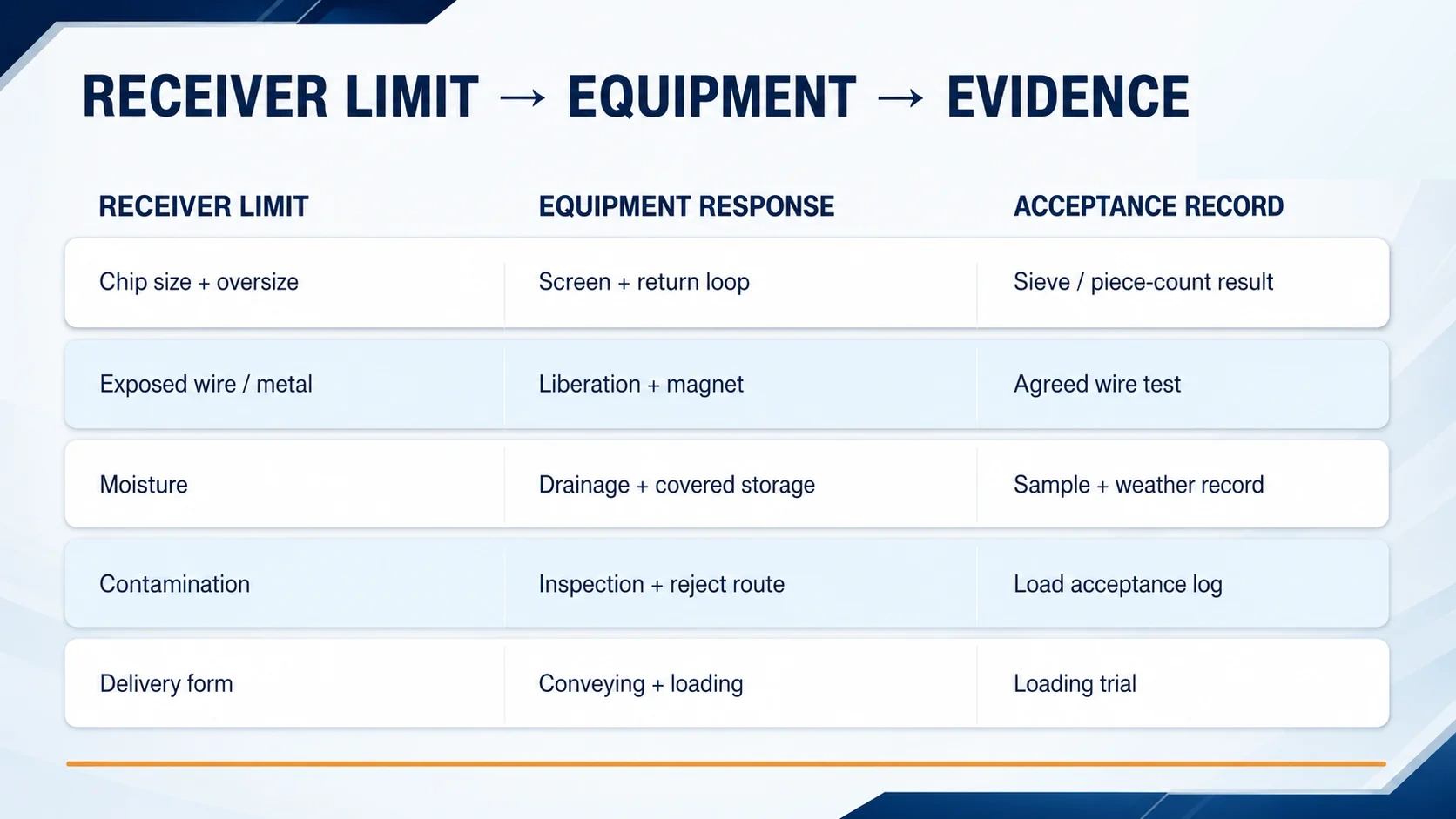
| Receiver requirement | Equipment consequence | Evidence to request |
|---|---|---|
| Nominal chip size plus oversize limit | Screen selection, return conveyor and sufficient secondary cutting duty | Sieve or piece-count method, sample mass and oversize result |
| Exposed-wire or residual-metal limit | Feed preparation, liberation depth and magnet arrangement | Written inspection or analytical method and separated-steel mass |
| Moisture limit | Drainage, covered storage and stock rotation; not just shredding | Sampling location, test method and weather condition |
| Contamination limit | Receiving inspection, reject route and housekeeping controls | Load acceptance record and contamination log |
| Delivery form and bulk density | Conveying, trailer loading and stockpile design | Loading trial, bulk-density basis and discharge observation |
For detailed contract language around size, wire, moisture and contamination, use the TDF quality specifications guide. Storage is also part of product quality: drainage, pile geometry, first-in/first-out control and fire planning can undo good processing if they are left outside the equipment discussion. The TDF storage and handling guide covers that downstream boundary.
Use One RFQ Data Sheet for Every Manufacturer
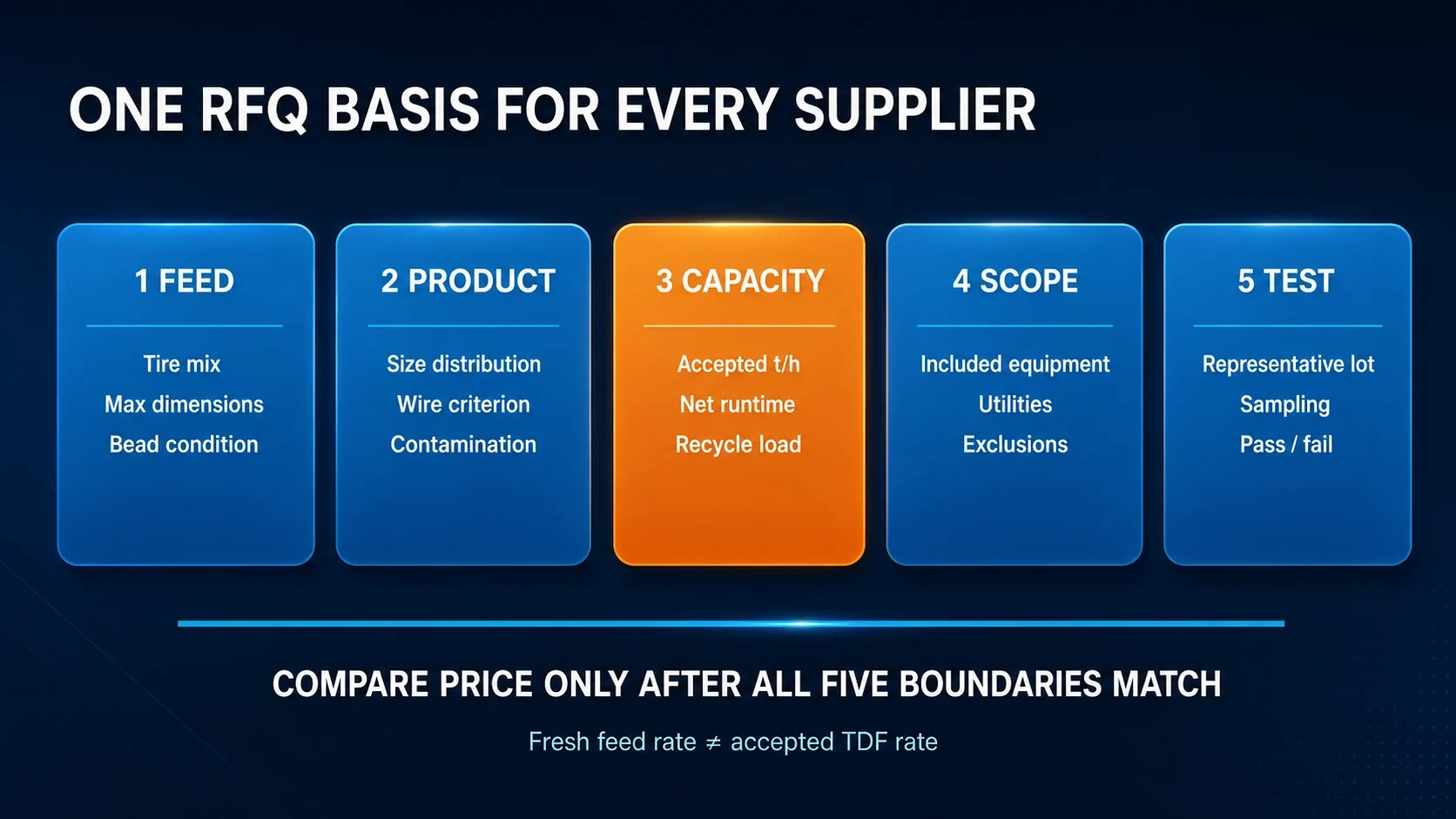
Send every supplier the same one-page technical basis. Include the percentage of passenger, truck and larger tires; maximum recurring dimensions; bead condition; contamination; target size distribution; wire criterion; accepted output rate; shift pattern; power supply; climate; elevation; building envelope and local safety requirements.
Ask each supplier to mark exclusions. “Complete line” may exclude the loader, civil works, electrical distribution, fire protection, dust collection, spare screens, commissioning labor or overseas travel.
Track fresh feed and return load separately. A screen can recirculate the same oversize more than once, so adding return-belt tonnage to fresh input exaggerates production. Also request an operating-cost schedule that separates installed motor power from measured energy, blade service, labor and planned maintenance. The TDF operating cost per ton guide provides a practical logging structure.
Make the Factory Acceptance Test Reach Steady State
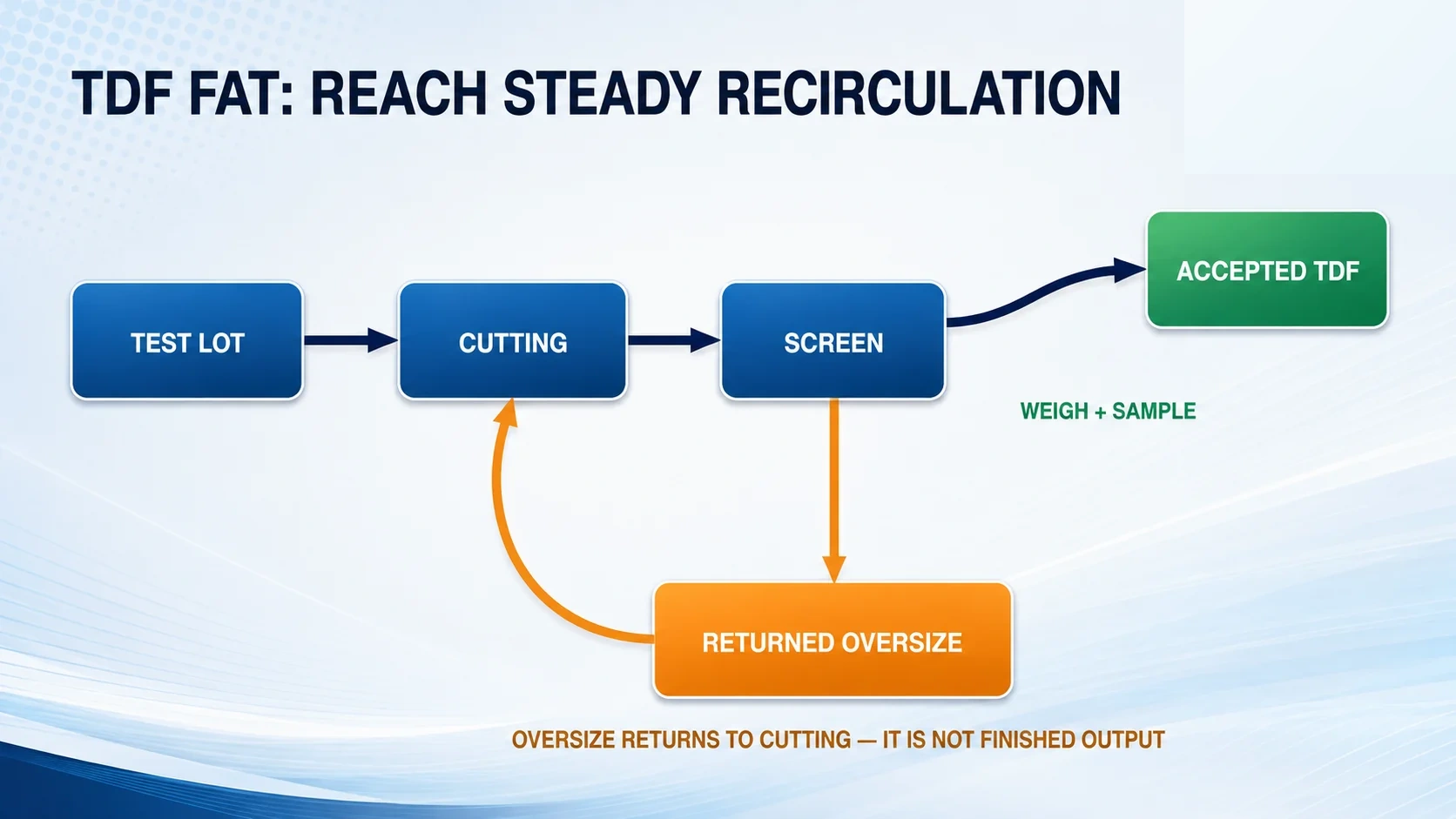
A short demonstration with selected tires and sharp knives proves that the equipment can run. It does not prove a shift-level production result. The test should continue until the screen and return conveyor carry a representative circulating load. Only then does the line reveal whether oversize accumulates, the hopper bridges, the magnet burdens unevenly or accepted output falls below the headline rate.
- Freeze the test lot. Record tire categories, counts or mass, maximum dimensions, bead condition and visible contamination.
- Define a warm-up. Keep warm-up material and time outside the measured lot, but do not start measurement before the return circuit stabilizes.
- Measure separate streams. Weigh accepted TDF, returned oversize, recovered steel and rejects separately.
- Sample the product. Build a composite from timed increments rather than taking the cleanest handful from a pile.
- Record interruptions. State the cause and duration of every stop; do not silently remove inconvenient downtime.
- Preserve settings. Record screen, knife condition, gaps, speeds and magnet condition so the result can be repeated.
If oversize, bridging, throughput or knife wear changes during the run, the diagnostic sequence in the TDF plant troubleshooting guide helps separate symptoms from causes.
A Practical Selection Rule
Choose the supplier that can write the clearest chain from incoming tire to accepted fuel and then prove that chain with your material. A lower-cost proposal may be the better project if the receiver accepts coarse, wire-bearing TDF. A deeper line may be justified when the chip must be smaller, cleaner or easier to meter. Neither choice is correct until the off-taker signs the product definition.
Before issuing a purchase order, attach the feed schedule, product specification, capacity definition, equipment boundary, utilities list, spare-parts package, FAT protocol and commissioning responsibilities.
TDF Tire Shredding Equipment Manufacturer FAQ
Who makes TDF tire shredding equipment?
A shortlist includes CM Shredders, YUXI Machinery, Barclay Roto-Shred, ELDAN Recycling, Granutech-Saturn Systems, ECO Green Equipment, SSI Shredding Systems and FORNNAX Technology. The right choice depends on the receiver’s chip-size, exposed-wire, moisture and contamination limits, as well as the required line boundary.
Is a primary tire shredder enough to make TDF?
A coarse whole-tire fuel specification may need only primary size reduction and sizing. A smaller or more tightly controlled chip may require secondary cutting, screening with oversize return, magnetic separation and additional handling equipment.
How should TDF shredder capacity be compared?
Compare accepted TDF tons per hour after the agreed size, wire and contamination checks. State net runtime, tire mix, screen configuration and recycle load. Fresh feed rate and accepted-product rate are not interchangeable.
What should a TDF factory acceptance test include?
Use representative tires, reach a stable circulating load, weigh accepted product separately from returned oversize and rejects, sample each defined lot, and record runtime, stops, settings, screen condition and magnet condition.
Should bead wire always be removed before TDF shredding?
The decision depends on tire type, shredder design, wear risk and the fuel user’s steel specification. Concentrated bead bundles from truck or larger tires can increase shock loading, so the feed boundary must be agreed before quotations are compared.
Compare a TDF Line on One Measurable Basis
Send your tire mix, target chip specification, accepted output rate, off-taker requirements, power supply and site constraints. YUXI can prepare a line boundary and test basis for technical comparison.
Engineering References
- U.S. EPA, TDF guidance: fuel-use and size-reduction context.
- ASTM, D6700 standard: TDF practice reference.