Moving from 1 T/H to 5 T/H takes more than just bigger motors. At higher throughput, the problem often shows up somewhere else in the line. Steel may not separate fast enough, the granulator or grinder may fall behind, or the screening, cooling, dust system and conveyors may struggle to keep up. The required powder mesh matters just as much as the headline tonnage. A line that can move several tonnes of clean granulate per hour may produce considerably less accepted 80- or 120-mesh powder if the grinding and return circuit are not sized for that grade.
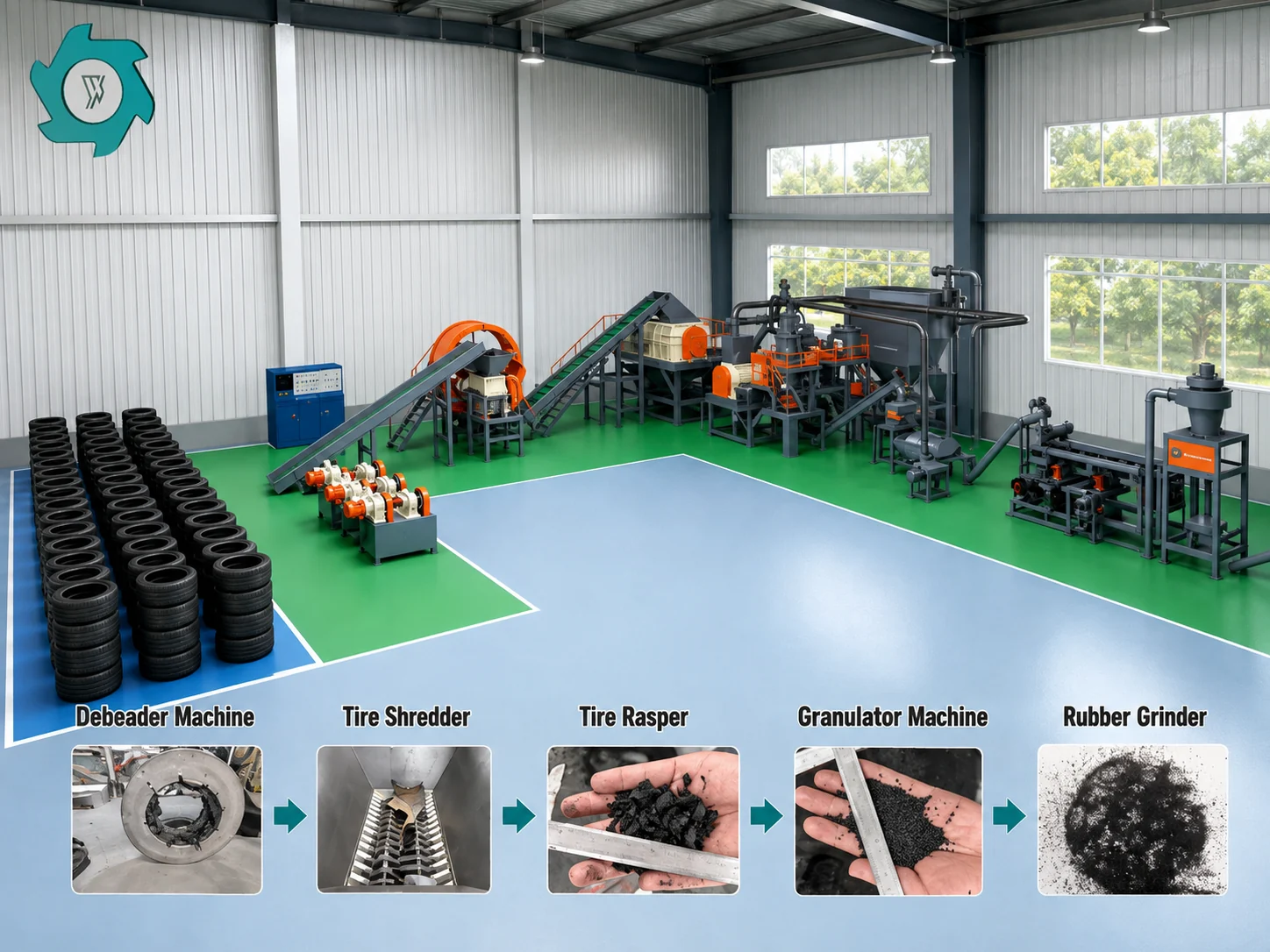
For that reason, capacity should be specified at the finished-product point. In this guide, 1, 2, 3 and 5 T/H mean the target rate of saleable rubber powder that meets the agreed particle-size and contamination specification during a defined production test. This is the same purchasing logic behind the YUXI tire rubber powder plant: whole tires are prepared, shredded, opened for steel recovery, granulated, graded, cleaned of textile fiber and then fine-ground rather than being fed directly into one powder mill.
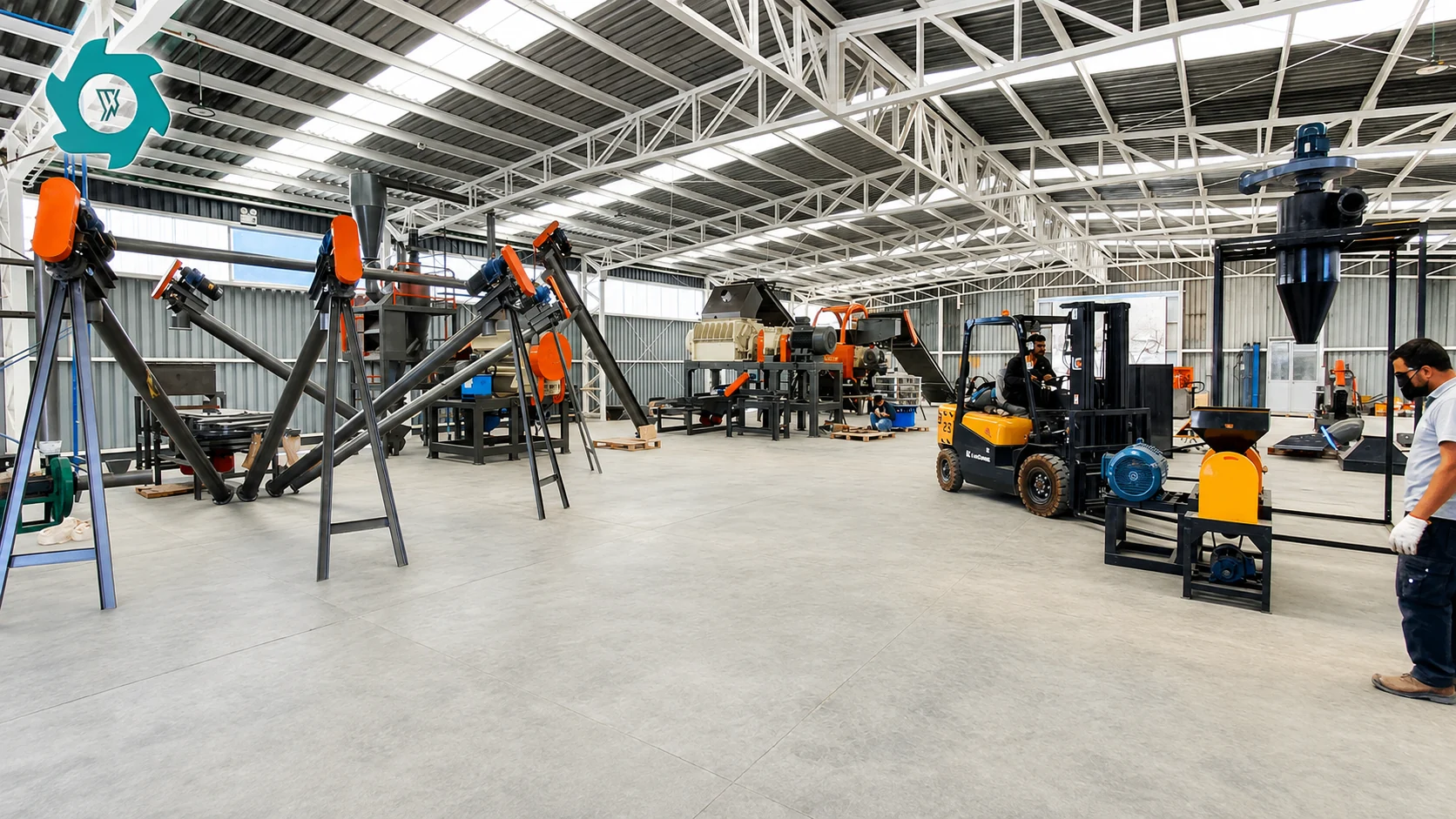
A complete powder project has to balance every stage, not only the final grinder.
What 1, 2, 3 and 5 T/H Should Mean in a Rubber Powder RFQ
The first job is to define the measurement boundary. “5 tons per hour” can describe at least four different numbers: tires entering the shredder, chips leaving the rasper, granulate entering the powder section, or accepted powder entering storage. Those values are not interchangeable.
Return material should not be counted twice merely because it passes a mill or screen more than once. Recovered steel and textile are side streams, not rubber output. If the supplier also reports instantaneous machine throughput, keep that figure separate from sustained finished-product capacity.
The U.S. EPA describes tire crumb production as staged size reduction followed by screening, magnetic removal of steel and air separation of fabric, with oversize material returned for more reduction.[1] Rubber powder adds another fine-grinding and classification duty after the clean crumb stage.
Capacity Comparison: Which Scale Fits Which Project?
Target capacity
Best fit
Main engineering focus
Typical expansion question
1 T/H
New recycler, regional feedstock, one-shift operation, market validation
Stable feeding, product quality, simple material flow, room for a second grinding module
Can the site and electrical system support 2 T/H later?
2 T/H
Established local sales, regular whole-tire supply, multi-product strategy
Balancing granulation with grinding, return-load capacity, packaging and buffer storage
Can a second grinder or parallel classifier be added without rebuilding the upstream line?
3 T/H
Industrial recycler with contracted demand and continuous feedstock
Which stages should be duplicated before moving toward 5 T/H?
5 T/H
Large processor with verified monthly demand and strong inbound logistics
Parallel processing, line availability, storage, utilities, dust handling and bottleneck isolation
Should the project use one large train or multiple parallel modules?
1 T/H Rubber Powder Plant: Good for Market Entry and Controlled Growth
A 1 T/H project is often the easiest scale at which to learn the local tire supply and finished-powder market without oversizing the entire site. It can suit a recycler moving from tire collection into material processing, or an existing crumb producer adding a fine-grinding section.
One well-balanced line is usually easier to operate than a collection of oversized machines connected by undersized conveyors. We have seen project discussions where the primary shredder was selected first because its brochure tonnage looked attractive. Later, the fine mill became the limiting step, leaving upstream equipment idle for part of the shift. Starting from the powder requirement avoids that mismatch.
Capacity must stay balanced from whole-tire preparation through fine grinding.
2 T/H Rubber Powder Plant: The Balance Point for Many Commercial Lines
At 2 T/H, the project usually stops behaving like a small demonstration line. Raw tire storage, loader or conveyor feeding, intermediate buffers, finished-product packaging and maintenance planning start to influence real production hours.
If the plant can sell 20–40 mesh, 40–60 mesh and a finer fraction, classification can sometimes reduce unnecessary regrinding. If all accepted material must meet a narrow fine grade, more material may return to the grinding circuit.
This is where the distinction between crumb and powder becomes commercial, not just technical. The crumb rubber vs rubber powder guide explains why the powder route adds grinding, cooling, fine classification and collection after the clean granulate stage. At 2 T/H, those auxiliary systems should be sized as production equipment rather than treated as small accessories.
Plan enough buffer capacity that a short interruption at the grinder does not immediately force a stop at the primary shredder. The reverse is also true: a large buffer cannot rescue an under-capacity grinder. It only delays the point at which the bottleneck becomes visible.
3 T/H Rubber Powder Plant: Shift Efficiency Becomes as Important as Machine Size
A 3 T/H plant generally needs a stronger operating system around the equipment. At this scale, one hour of downtime removes three tonnes of planned output before considering restart and stabilization losses. Maintenance access, quick cleaning, spare wear parts and predictable material transfer begin to matter almost as much as nominal machine capacity.
We normally look for three types of reserve. The first is mechanical: can the critical grinding, screening and extraction equipment run continuously at the required load without being pushed at its limit? The second is process reserve: can the return conveyor, air separation and cooling circuits handle short-term surges? The third is operating reserve: can normal knife or screen maintenance be completed without turning a routine service job into a long production stop?
A 3 T/H project should also separate daily feed capacity from saleable powder capacity in its production plan. If the line is scheduled for an eight-hour shift, a theoretical 24 tonnes per shift is only a starting number. Warm-up, inspections, product changeovers, cleaning, planned maintenance and short stops reduce actual saleable output. A realistic business model uses measured utilization rather than assuming 100% runtime.
The detailed rubber powder machine buyer guide is useful when the project reaches this stage, because it forces the RFQ to state the feed boundary, mesh, contamination limits and accepted output before comparing model names.
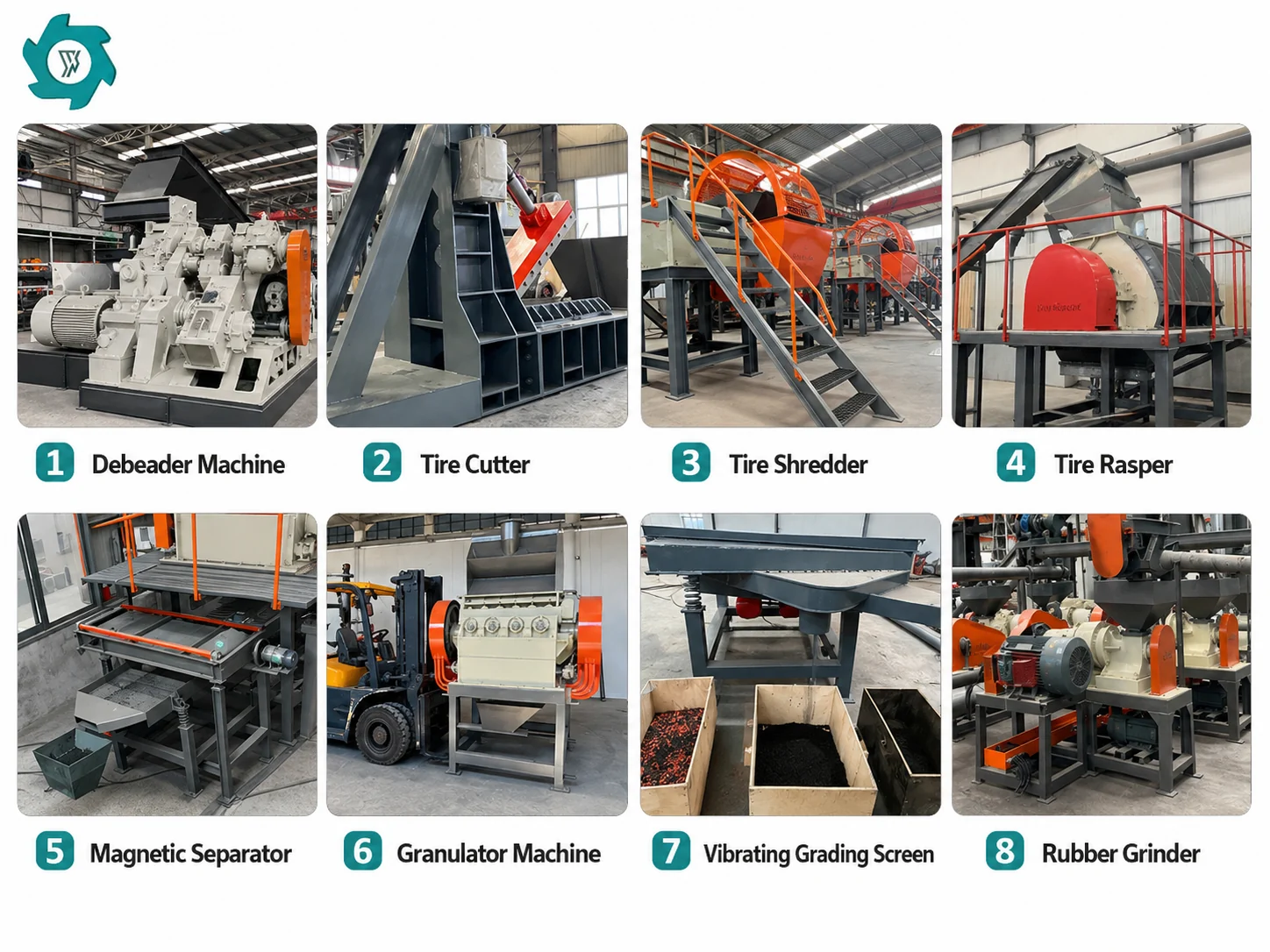
The larger the plant, the more important each machine handoff becomes.
5 T/H Rubber Powder Plant: Design Around Parallel Duty and Bottleneck Isolation
At 5 T/H, simply enlarging every machine in a single straight line can create an expensive single point of failure. A large industrial project should at least evaluate where parallel modules make sense. The answer will depend on the selected equipment, but fine grinding, classification and dust collection are common places to consider modular duty.
Five tonnes per hour across an eight-hour shift equals 40 tonnes of finished powder before accounting for utilization. The plant therefore needs enough clean granulate buffer, bulk bag or packaging capacity, forklift access and finished-goods space to prevent the last conveyor from becoming the plant bottleneck.
Dust handling deserves the same treatment. Fine rubber has a much larger exposed surface area than coarse tire chips. Enclosures, local extraction, duct routing, collector capacity and housekeeping should be part of the layout discussion from the beginning. They should not be added after the building and conveyors are already fixed.
Why 40 Mesh and 120 Mesh Cannot Be Quoted at the Same T/H
Mesh changes the amount of work the grinding section has to do. Higher mesh numbers correspond to smaller sieve openings. ASTM D5644 is specifically intended for determining particle-size distribution of recycled vulcanizate particulate rubber and uses sieve-based product designation.[2] ASTM D5603 likewise classifies recycled vulcanizate particulate rubber around its desired particle-size distribution and origin.[3]
Powder target
What usually changes in the line
Capacity consequence
20–40 mesh
Less fine-grinding duty, lower return load, easier product flow
Usually closest to the upper practical output of the powder section
40–60 mesh
More grinding passes and tighter classification
Finished t/h may drop if grinding area is unchanged
60–80 mesh
Heat control, classifier efficiency and dust collection become more important
More installed grinding capacity may be needed to hold the same accepted t/h
80–120 mesh
Fine classification, agglomeration control, cooling and recirculation become critical
Do not assume the same output as coarse powder without a test
Feed temperature, rubber formulation, particle shape, moisture, equipment condition and the accepted sieve curve all affect performance.
FHWA guidance provides a useful market example: ground tire rubber used in asphalt can be specified across different fine size ranges, and some dry-process applications use material below about 0.6 mm (30 mesh).[4] The lesson for a recycling plant is not that one mesh is best. It is that the receiving application controls the product specification.
Upstream Capacity Still Matters: The Grinder Cannot Fix Dirty Feed
Fine grinding should receive clean, controlled granulate. Residual steel increases wear and can damage sensitive downstream equipment. Loose textile makes classification and powder collection unstable. Large oversize pieces create uneven mill loading. The powder line therefore depends on proper steel liberation, magnetic separation, granulation, screening and fiber removal before the final mill.
The current YUXI process lists eight main stages from debeading and cutting through shredding, rasping, magnetic separation, granulation, grading and grinding. Its stated granulator output is 1–8 mm before the final 20–120 mesh grinding stage. That handoff is important: a powder plant should be sized as a connected system, not as a large grinder attached to uncontrolled tire shreds.
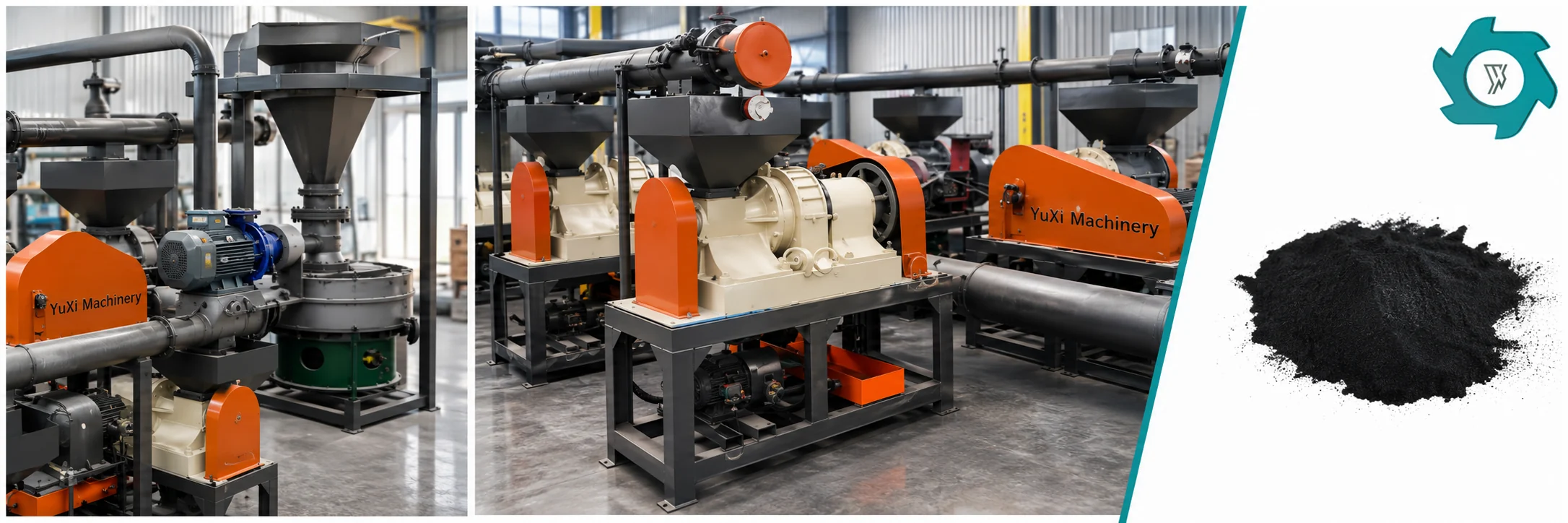
Fine grinding is the last reduction stage; feed cleanliness and grading determine how steadily it can run.
How Much Annual Output Does Each Capacity Represent?
Hourly capacity is only useful when it is translated into a realistic operating schedule. The following example assumes one 8-hour shift, 300 operating days per year and 85% overall production utilization. It is an illustration for planning, not a production guarantee.
Accepted powder capacity
Theoretical output per 8-hour shift
Illustrative annual output at 85% utilization
1 T/H
8 t
2,040 t/year
2 T/H
16 t
4,080 t/year
3 T/H
24 t
6,120 t/year
5 T/H
40 t
10,200 t/year
For two-shift operation, do not simply double the answer and stop there. Longer operating hours change preventive maintenance windows, spare-part strategy, operator coverage and the value of parallel equipment. A line designed for occasional eight-hour operation may need a different availability strategy if it is expected to run sixteen or twenty hours per day.
Floor Space and Utilities: Avoid Generic Numbers
That number is rarely reliable before the process scope is fixed. A grinder-only module starting with clean granulate occupies a very different site from a whole-tire line with tire storage, debeading, shredding,cutting, steel recovery, fiber separation,granulation, powder milling and packaging.
RFQ Checklist for a Rubber Powder Capacity Quote
Feed: whole passenger tires, truck tires, mixed tires, pre-shredded chips or clean 1–8 mm granulate.
Finished size: required mesh or sieve distribution, including oversize and fines limits.
Accepted capacity: 1, 2, 3 or 5 T/H measured at the finished-product point.
Quality: residual steel, textile fiber, moisture and other buyer-specific limits.
Operating schedule: hours per shift, shifts per day and planned operating days.
Acceptance: test duration, measurement point, sampling method and pass/fail rule.
Need a 1–5 T/H Rubber Powder Plant Configuration?
Send your tire type, target mesh, required accepted powder capacity, operating hours, workshop dimensions and local power conditions. YUXI can configure the line around the product and production rate you actually plan to sell.
Rubber Powder Plant Capacity FAQ
Is a 1 T/H rubber powder plant rated by tire input or powder output?
It should be clarified in the quotation. For a meaningful comparison, specify 1 T/H as accepted finished rubber powder at the agreed mesh and quality rather than only the amount of tire material entering an upstream machine.
Can the same plant produce 40 mesh and 120 mesh at the same capacity?
Do not assume so. Finer powder usually needs more grinding and classification duty and may create a larger return load. Ask for the guaranteed finished capacity at each mesh you intend to sell.
Is a 5 T/H line just five 1 T/H lines combined?
Not necessarily. Some stages may scale with larger equipment, while critical finishing stages may be better arranged in parallel. The right configuration depends on feed, powder grade, availability target, layout and maintenance strategy.
Which capacity is best for a new tire recycling business?
The best size is the one supported by confirmed feedstock and product demand. A smaller line can reduce market risk, while a larger line makes more sense when monthly buyers, utilities, storage and operating staff are already in place.
How should rubber powder plant capacity be tested?
Run representative feed at the agreed product setting until the process is stable, measure accepted finished powder over a defined period, verify the particle-size and contamination specification, and record downtime and return material separately.
What information does YUXI need to size a rubber powder line?
Provide tire type or prepared feed, target mesh, required accepted output, quality limits, working hours, workshop dimensions, voltage/frequency and whether the project starts from whole tires or clean rubber granulate.
Marie has 8+ years of experience in tire shredding and recycling equipment,with a focus on tire shredders,rubber recycling machines,TDF production,rubber crumb processing,and complete tire recycling systems.