Tire cutting equipment is a small category with a surprisingly wide spread of machine types. This shortlist focuses on suppliers that can solve a real preprocessing or primary size-reduction duty—not simply companies that happen to use the phrase “tire cutter” in a catalog.
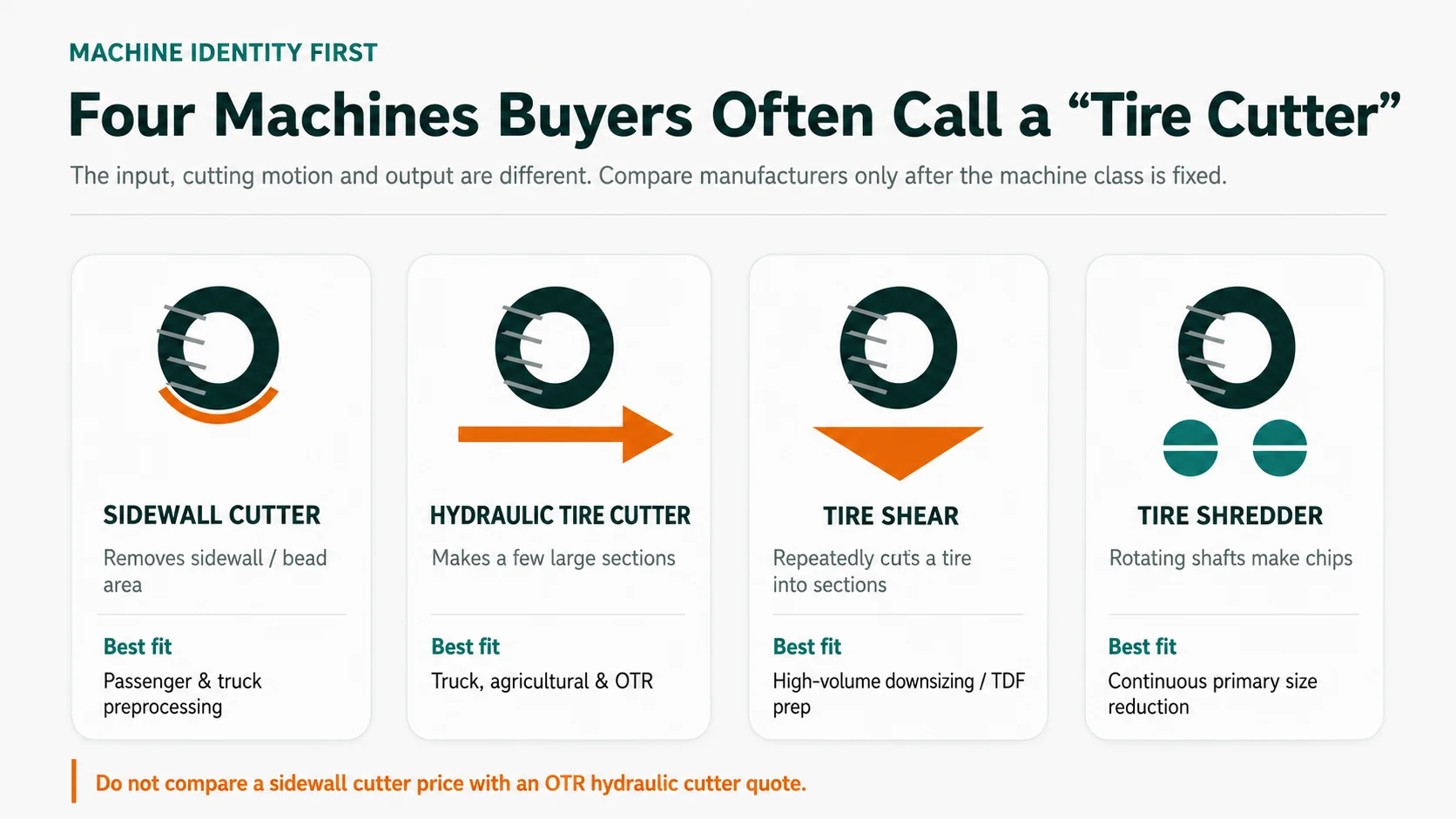
Start by fixing the machine class. A sidewall cutter, hydraulic section cutter, tire shear and shredder do different jobs even though buyers may search for all of them as a “tire cutting machine.”
Top 7 Tire Cutting Machine Manufacturers
Rank
Manufacturer
Country / region
Best-known cutting route
Best fit
1
Eagle International
USA
Dedicated tire shears, sidewall cutters and OTR systems
Buyers who want a broad, purpose-built cutting portfolio
2
YUXI Machinery
China
Hydraulic section cutting tied to downstream tire shredding
Truck, agricultural and OTR projects planned as a complete front end
3
Gradeall
Northern Ireland, UK
Car/truck sidewall cutting, agricultural shearing and staged OTR cutting
Operations that want clearly separated preprocessing steps
4
Engineering & Equipment Co. (EECO)
USA
Sidewall, tread and bead deconstruction modules
Tire shops, haulers and compact preprocessing businesses
5
ECO Green Equipment
USA
OTR rubber removal/shearing plus tire shredding systems
Mining-tire projects where material recovery matters before shredding
6
ELDAN Recycling
Denmark / Europe
Twin-shaft clean-cut tire shredding
Continuous clean-cut TDF or recycling feed production
7
CM Shredders
USA
Primary and chipping tire shredders
High-throughput continuous tire size reduction and TDF lines
First, Define What “Tire Cutting Machine” Means
Procurement problems start when a buyer asks seven suppliers for a “tire cutting machine” and receives seven technically different quotations. One company may quote a sidewall remover for passenger tires. Another may propose a hydraulic shear for OTR sections. A third may quote a dual-shaft shredder because the target is 100 mm chips rather than a few large tire pieces.
We separate the machines by input, cutting motion and output. A sidewall cutter follows the tire circumference and removes a ring. A hydraulic cutter makes one major shear at a time and requires repositioning. A tire shear can make repeated section cuts. A shredder grips the tire with rotating shafts and produces smaller pieces continuously. That distinction matters more than the wording printed on a brochure.
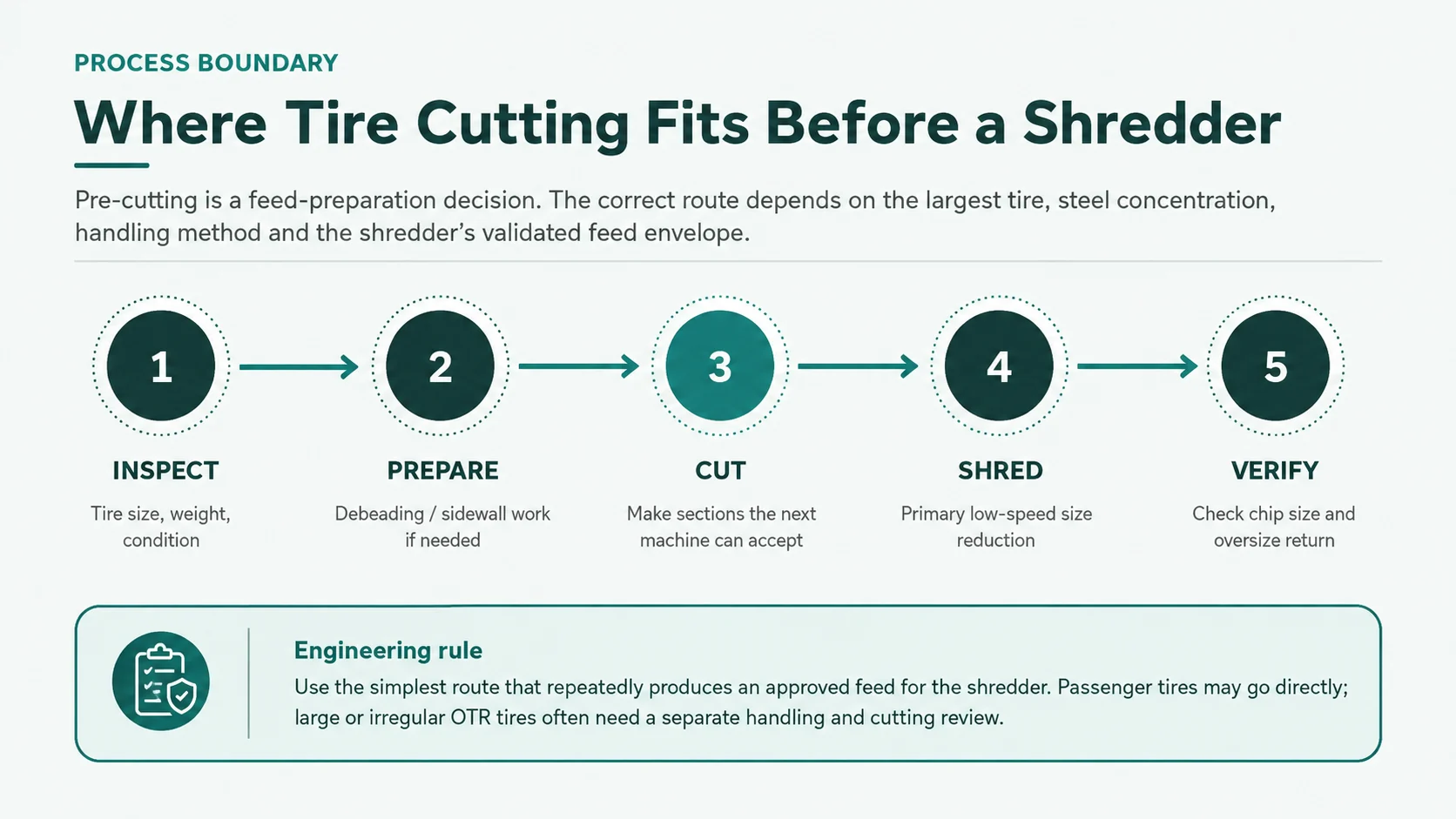
If the downstream stage is already fixed, use its approved feed envelope as the starting point.
How We Ranked the Manufacturers
Four ranking factors
Purpose-built tire cutting depth: Is the equipment genuinely designed for tires rather than adapted from a general scrap shear?
Tire-size coverage: Does the public range cover passenger, truck, agricultural or OTR tires, and are those limits explained?
Technical transparency: Can a buyer find meaningful information about input, output, cycle, machine type or process role before requesting a quote?
Line integration: Can the supplier connect the cutter to the next stage when the project needs shredding, TDF preparation, granulation or OTR processing?
1. Eagle International — Deepest Dedicated Tire-Cutting Range
USATire shearsSidewall cuttersOTR downsizing
Eagle International is difficult to ignore in a dedicated tire-cutter comparison because tire downsizing is the center of its product identity. The company lists tire cutters, sidewall cutters, debeaders, derimmers and an OTR system, and it has been building tire recycling equipment since the early 1990s. Its range covers compact shop-scale cutting through large mining-tire work.
The practical strength is choice within one brand. A small operation can look at the TC Gator for passenger and pickup/SUV tires, while larger processors can compare Tuf-Cut and Titan-style equipment. Eagle also publishes Punch Cutter machines for splitting large OTR tires through the tread. This makes the portfolio easier to map to the tire rather than forcing one cutter geometry across every input.
Public technical detail is another reason Eagle stays at No. 1. The TC Gator page, for example, provides maximum tire capacity and an average cycle time. Historic and current Eagle literature also documents large OTR tire limits for its heavy equipment. You still need a test or written duty confirmation, but the conversation starts with more than marketing copy.
Best fit
North American tire processors, TDF operators, quarries and OTR projects that want a dedicated stand-alone cutting machine.
Watch point
Do not assume one Eagle model covers every tire. Match the exact tire size, ply, tread width and required cut pattern to the correct machine.
2. YUXI Machinery — Strong Choice for Cutter-to-Shredder Integration
ChinaHydraulic tire cutterTruck tiresAgricultural / OTRComplete line integration
Its hydraulic tire cutter is intended for large scrap tires—including truck, all-steel radial, agricultural and OTR tires—when whole-tire feeding is too difficult or unstable for the next stage.
That is especially relevant for buyers building a complete tire recycling line. The cutter makes large sections; the shredder performs continuous size reduction; later machines may separate steel or reduce rubber further. When those stages are selected independently, a plant can end up with a cutter that technically works but leaves sections that are still awkward for the shredder hopper or conveyor.
YUXI’s public documentation explicitly connects pre-cutting to downstream tire shredding, granulation, TDF preparation and selected pyrolysis pretreatment. The company also asks buyers to confirm tire diameter, width, weight, steel content, loading method and final process before configuration. That is the correct set of questions for heavy tires because diameter alone does not describe the cutting duty.
Best fit
Truck, agricultural and OTR tire recycling projects where pre-cut tire section size must be engineered around the shredder or full processing line.
Watch point
Ask for a written maximum tire dossier and a representative material test. “OTR capable” is too broad without diameter, width, mass and construction.
3. Gradeall — Clear Sidewall, Agricultural and OTR Architecture
The company publishes car tire sidewall cutters, truck and agricultural sidewall equipment, an agricultural tire shear, an OTR tire splitter and an OTR sidewall cutter. For a buyer, that architecture makes it easier to decide whether the problem is bead/sidewall removal, general sectioning or very large OTR downsizing.
The car sidewall cutter is a good illustration of Gradeall’s documentation style. It is described as a purpose-built first step before baling, pyrolysis or shredding, and the manufacturer publishes an hourly processing figure. The OTR range moves in the opposite direction: much larger equipment is used in sequence to split and reduce giant tires into manageable sections.
Gradeall also manufactures in Northern Ireland and describes long-term export experience and after-sales support. For operations in the UK, Europe and other export markets, that combination of product specialization and process documentation can simplify qualification.
Best fit
Buyers who want a staged tire preprocessing route with dedicated machines for sidewall, agricultural and OTR duties.
Watch point
Confirm whether removing the sidewall is enough. Some downstream systems still require the tread or carcass to be split or sheared separately.
EECO approaches tire cutting from a smaller, modular direction. Its product line breaks tire deconstruction into stages: remove sidewalls, extract bead wire, cut the tread and continue processing only if the business needs a smaller product. This makes the range relevant to tire dealers, haulers, collection points and startups that do not need a massive hydraulic shear.
The SR1-1 sidewall remover, for instance, is designed for passenger and light-truck tires and cuts both sidewalls in one operation. EECO publishes input limits, production rates, footprint, blade type and electrical information. Its truck tire tread cutter expands the concept to heavier treads after the sidewalls have been removed.
EECO also publishes pricing on many of its machines, which is unusual in industrial recycling equipment. Buyers should treat those prices as a reference rather than a complete installed-project budget, but they help establish whether modular preprocessing is economically sensible before moving to a larger line.
Best fit
Smaller tire recycling operations that want low-footprint equipment and a staged investment path.
Watch point
This is not a substitute for a heavy OTR hydraulic cutter. Match the tire category carefully before comparing price.
5. ECO Green Equipment — OTR Preparation with Material-Recovery Focus
USAOTR systemsRazor 63Shearing / shredding
ECO Green is broader than a conventional “tire cutter” manufacturer, but it deserves a place on this list for mining and OTR projects. Its Eco Razor 63 is designed to remove recoverable rubber from very large tires, and ECO Green has documented an OTR workflow that combines rubber removal, bead extraction and shearing before the remaining carcass moves to further size reduction.
This route is different from simply dropping a giant tire under a guillotine blade. The operator is trying to recover valuable rubber and steel before reducing the remaining structure. For mines or specialist OTR recyclers, that can change the economics of the plant.
ECO Green also makes heavy tire shredding equipment, so it can cover more of the downstream process when the project moves from OTR preparation into chip production. The tradeoff is that a buyer who only needs a simple section cutter may find the system more elaborate than necessary.
Best fit
Large OTR or mining-tire projects where rubber recovery, bead removal and later shredding are all part of the process.
Watch point
Define whether you want simple volume reduction or maximum material recovery. The equipment route is different.
ELDAN sits on the boundary between “tire cutter” and “tire shredder.” It is included because many industrial buyers using the tire-cutting keyword actually want a continuous machine that turns whole car and truck tires into controlled shreds or chips. ELDAN’s Twin Shaft Clean-Cut Shredder is designed for one-step production of clean-cut tire chips and can be configured around 50 or 100 mm output.
That makes it a different procurement decision from a hydraulic cutter. There is no repeated loading and repositioning of one tire to make a handful of sections. Instead, the machine is part of a continuous plant. ELDAN’s broader tire recycling systems then move from shreds to chips, granulate or powder with steel and fiber separation as required.
For a TDF producer or mature tire recycler, this continuous route may be more relevant than any stand-alone cutter. For a mine holding giant OTR tires that cannot physically enter the shredder, however, a separate preprocessing machine may still be necessary.
Best fit
Industrial recyclers that need continuous production of clean-cut tire shreds or TDF feed rather than a few large sections.
Watch point
Confirm the maximum whole-tire envelope. Oversized OTR tires can still require a separate pre-cutting stage.
7. CM Shredders — High-Throughput Primary and Chipping Systems
USAPrimary shreddersChipping shreddersTDF systems
CM Shredders is another supplier that belongs in the comparison when “cutting” really means continuous industrial size reduction. The company has focused on tire recycling for decades and manufactures primary tire shredders, chipping shredders, liberators, granulators and complete systems.
CM’s primary and chipping equipment is aimed at turning whole tires or coarse shreds into repeatable downstream feed. For processors targeting tire-derived fuel, tire-derived aggregate, rubber mulch or crumb-rubber feedstock, that system perspective matters more than a stand-alone cutting stroke.
Best fit
High-throughput tire processors that need primary shredding, chipping and complete TDF or recycling systems.
Watch point
Do not compare a CM primary shredder quote with a hydraulic section cutter on purchase price alone; they solve different production problems.
Best Manufacturer by Tire-Cutting Application
Application
Manufacturers to shortlist
Why
Passenger/light-truck sidewall removal
EECO, Gradeall, Eagle
Purpose-built sidewall equipment with clear input definitions.
Truck tire sectioning before shredding
YUXI, Eagle, Gradeall
Heavy preprocessing equipment and stronger connection to downstream size reduction.
Agricultural tires
Gradeall, YUXI, Eagle
Dedicated large-tire or agricultural tire cutting duties are documented.
OTR / mining tires
Eagle, YUXI, Gradeall, ECO Green
Each has a published route for very large tire preparation, though the cutting approach differs.
Continuous TDF / clean tire chips
ELDAN, CM Shredders, ECO Green
These suppliers are stronger when the target is continuous chip production rather than batch sectioning.
Compact startup / collection point
EECO, Eagle, Gradeall
Smaller machines are easier to install and justify when daily tire volume is limited.
Pre-cutting is useful only when it solves a feed problem. If the shredder can safely and repeatedly accept the whole tire, extra cutting may add labor without adding value.
What to Put in a Tire Cutter RFQ
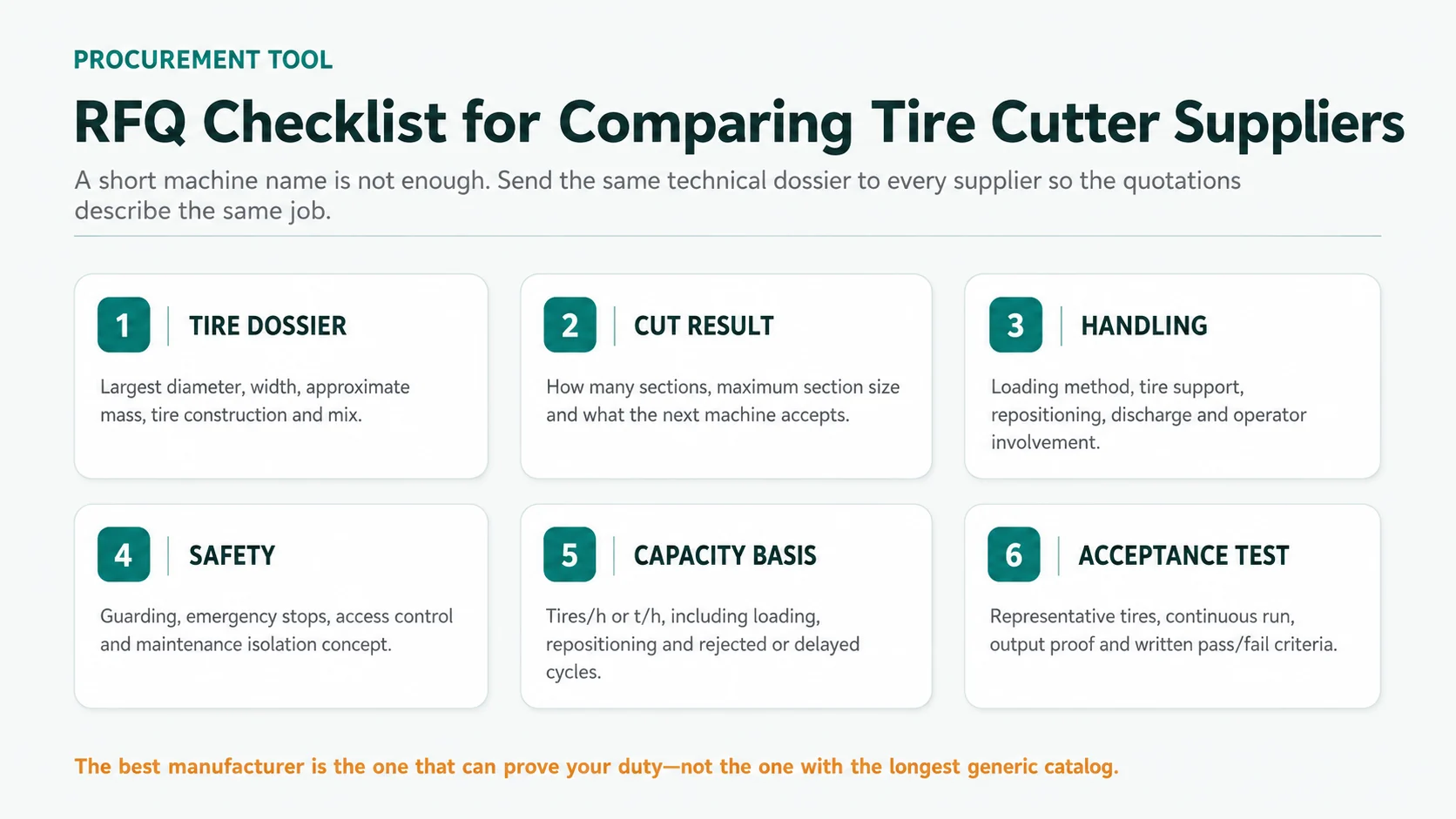
Send the same dossier to every manufacturer. Otherwise the lowest quote may simply describe an easier duty.
A useful RFQ begins with tires, not with motor power. Send photos of the largest representative tire next to a tape measure or known reference. Provide outside diameter, width, approximate mass and tire type. If the input includes mixed tires, describe the percentage of passenger, truck, agricultural and OTR material rather than quoting only the largest example.
Next, define the cut result. “Cut into pieces” is not precise enough. State the maximum section size the downstream shredder can accept, how many cuts are expected per tire, and whether sidewalls or bead areas need to be separated. If the tire will be loaded by forklift, crane or telehandler, say so; handling time often limits real throughput more than the cutting stroke.
Finally, ask for an acceptance test. The test should use representative tires, not a clean demonstration tire that is easier than your feed. Agree on pass/fail criteria for complete cycle time, output section size, blade condition, hydraulic temperature, operator intervention and any jam or repositioning events. For a large OTR project, a short test can reveal more than pages of catalog specifications.
FAQ
Is a tire cutting machine the same as a tire shredder?
No. A hydraulic tire cutter or shear makes a limited number of large sections. A tire shredder uses rotating shafts and knives to produce repeated smaller pieces in a continuous process. Some projects need both; many passenger-tire projects need only the shredder.
What should I send to a manufacturer before asking for a quote?
Send photos of representative tires, maximum outside diameter, width, approximate weight, tire construction, required cut result, target throughput, loading method, downstream equipment and available plant space. For OTR tires, include the largest tire rather than only an average size.
How should I compare tire cutter capacity?
Compare the complete operating cycle under the same tire mix: loading, clamping, cutting, repositioning, unloading and routine interruptions. A short hydraulic stroke time is not the same as a verified tires-per-hour production rate.
Need a Tire Cutter for Truck, Agricultural or OTR Tires?
Send your tire photos, maximum dimensions, approximate weight, target throughput and downstream process. YUXI can review whether your project needs direct shredding, sidewall or bead treatment, hydraulic pre-cutting, or a combined front end.
Marie has 8+ years of experience in tire shredding and recycling equipment,with a focus on tire shredders,rubber recycling machines,TDF production,rubber crumb processing,and complete tire recycling systems.