Crumb Rubber vs Rubber Powder: Size, Process & Uses
Crumb rubber and rubber powder come from the same waste tire, but they are not the same production target. In most equipment quotations, crumb rubber means a screened granule measured in millimeters or relatively coarse mesh sizes, while rubber powder means a finer product produced after an additional grinding stage. That distinction sounds simple. In practice, it is where many project specifications become vague.
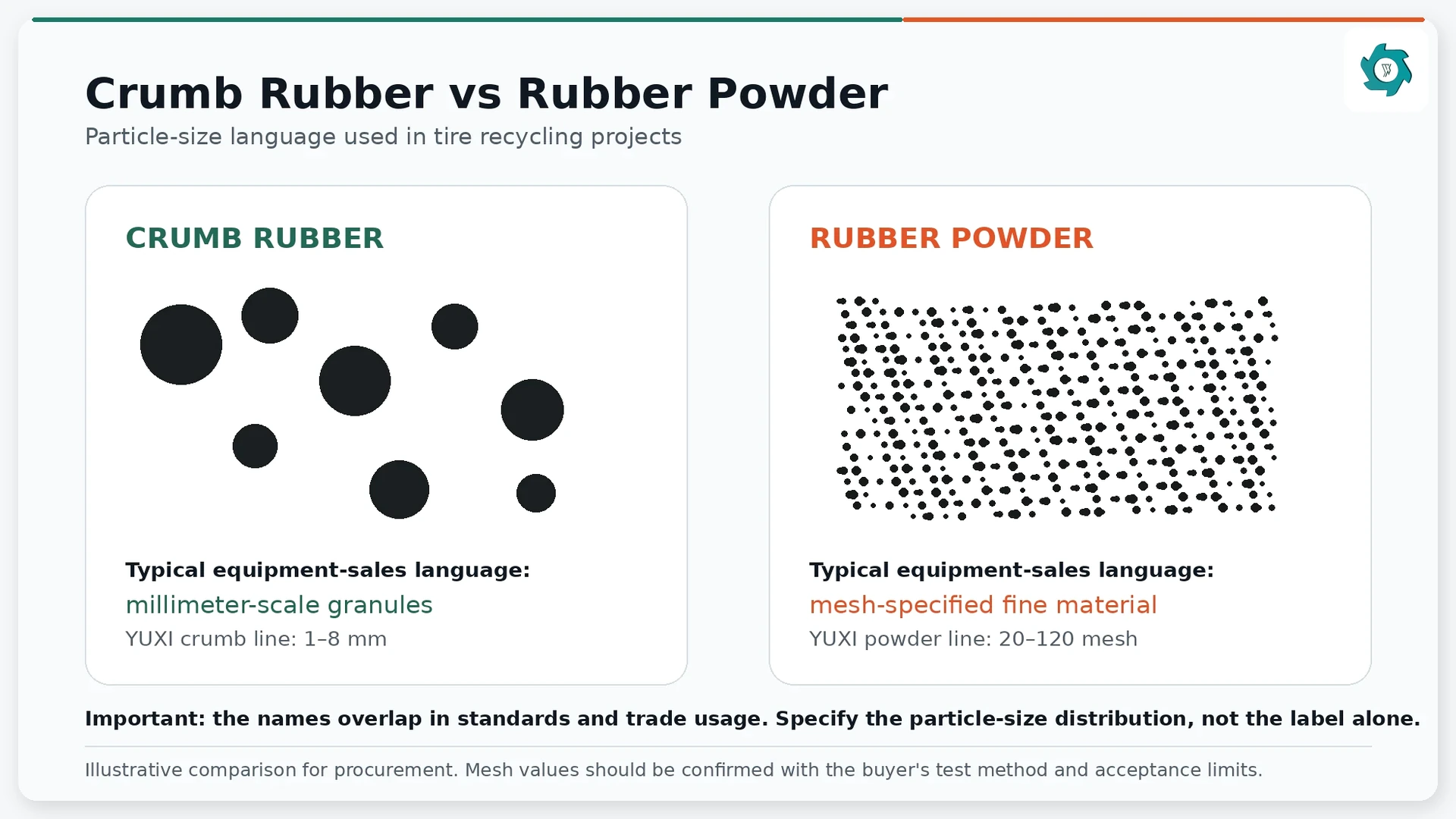
Crumb rubber is usually discussed as millimeter-scale granules, while fine rubber powder is commonly specified by mesh. The exact commercial boundary can overlap.
Crumb Rubber vs Rubber Powder at a Glance
Point
Crumb Rubber
Rubber Powder
Typical project language
Granules or crumb, often described in mm or coarser mesh ranges
Fine recycled rubber, usually sold with a mesh designation
YUXI line reference
1–8 mm granulator output
20–120 mesh finished powder
Main final size-reduction machine
Rubber granulator
Rubber grinder / fine mill after granulation
Separation status
Steel and textile should already be substantially removed
Requires clean, well-graded crumb before fine grinding
Capacity behavior
Usually higher finished throughput at a coarser target
Finer mesh normally adds grinding duty and can reduce finished throughput
Common end-use direction
Surfaces, mats, molded goods, asphalt and intermediate feedstock
Compounding, fine molded products, fillers, boards, adhesives and other fine-material applications
The Size Difference: Millimeters, Mesh and the Gray Area Between Them
For a tire recycler, particle size is the first obvious difference. A rubber crumb production line can stop after granulation, fiber separation and grading when the required saleable product is a controlled granule. On the current YUXI process page, the granulator output is stated as 1–8 mm, while the primary finished crumb target is highlighted as 0–5 mm after grading. The rubber powder plant continues beyond that point and uses a grinding system to produce 20–120 mesh material.
Mesh numbers run in the opposite direction from particle size: a higher mesh number means a smaller sieve opening. ASTM D5644, for example, references 20 mesh around 850 μm, 100 mesh around 150 μm and 120 mesh around 125 μm in its product-designation framework.[1] That is why a request for “80 mesh powder” is much more useful than a request for “very fine rubber.”
Procurement note: never convert a buyer’s mesh requirement from a casual online chart and treat it as an acceptance specification. Confirm the test sieve series, allowed oversize, allowed fines and sampling method. The same nominal mesh label can hide a different particle-size distribution.
The Process Difference: Powder Adds Another Finishing Stage
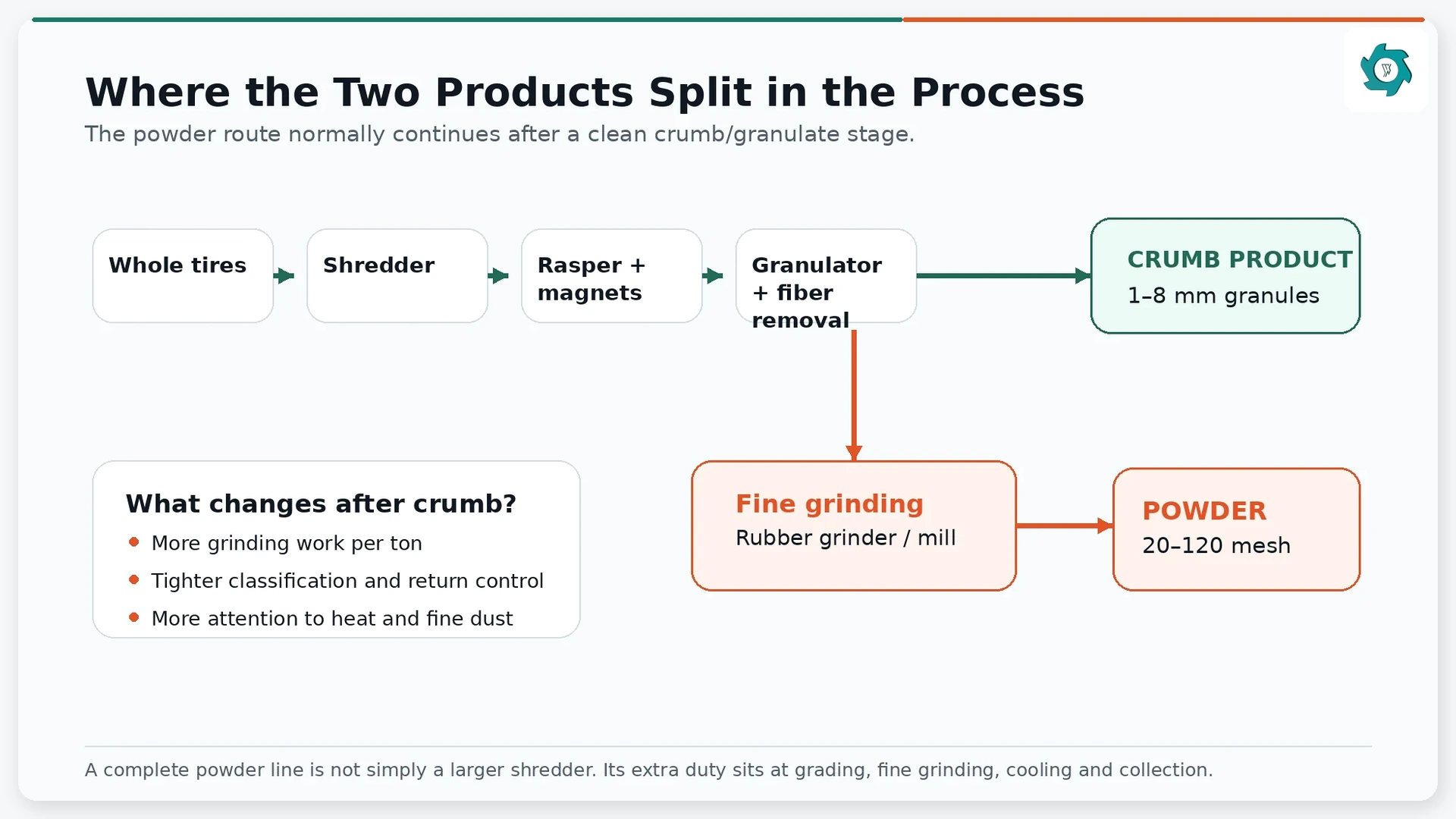
Upstream, the two routes look very similar. Whole tires still need to be prepared, shredded, opened so steel can be liberated, passed under magnetic separation, granulated and cleaned of textile. The process only becomes distinctly different after a clean granulate has been produced.
The rubber powder route normally starts with the same clean granulate that could already be sold as crumb, then adds fine grinding, cooling, classification and powder collection.
At the crumb stage, the granulator and screen are doing most of the final sizing work. Oversize returns to the reduction circuit; accepted material goes to collection. EPA describes the same basic control logic: screens classify the crumb, magnets remove wire and air separation removes fabric.[2]
For powder, the accepted crumb becomes feedstock rather than the final saleable product. It enters a rubber grinder or fine mill, where more surface area is created and more heat is generated. The plant now has to control several things that were less demanding one stage earlier: mill loading, cooling, fine-particle classification, dust capture and the recirculating load created by material that does not yet meet the chosen mesh.
This is why a powder project should not be quoted by simply attaching a grinder to a crumb line on paper. The feed into that grinder has to be clean and reasonably uniform. Residual steel is hard on wear parts. Excess textile makes separation and collection unstable. A broad feed-size distribution can also push more material into the return loop. The detailed waste-tire-to-rubber-powder process is therefore best treated as a connected material-flow problem, not eight independent machines.
Equipment: What a Powder Line Adds to a Crumb Line
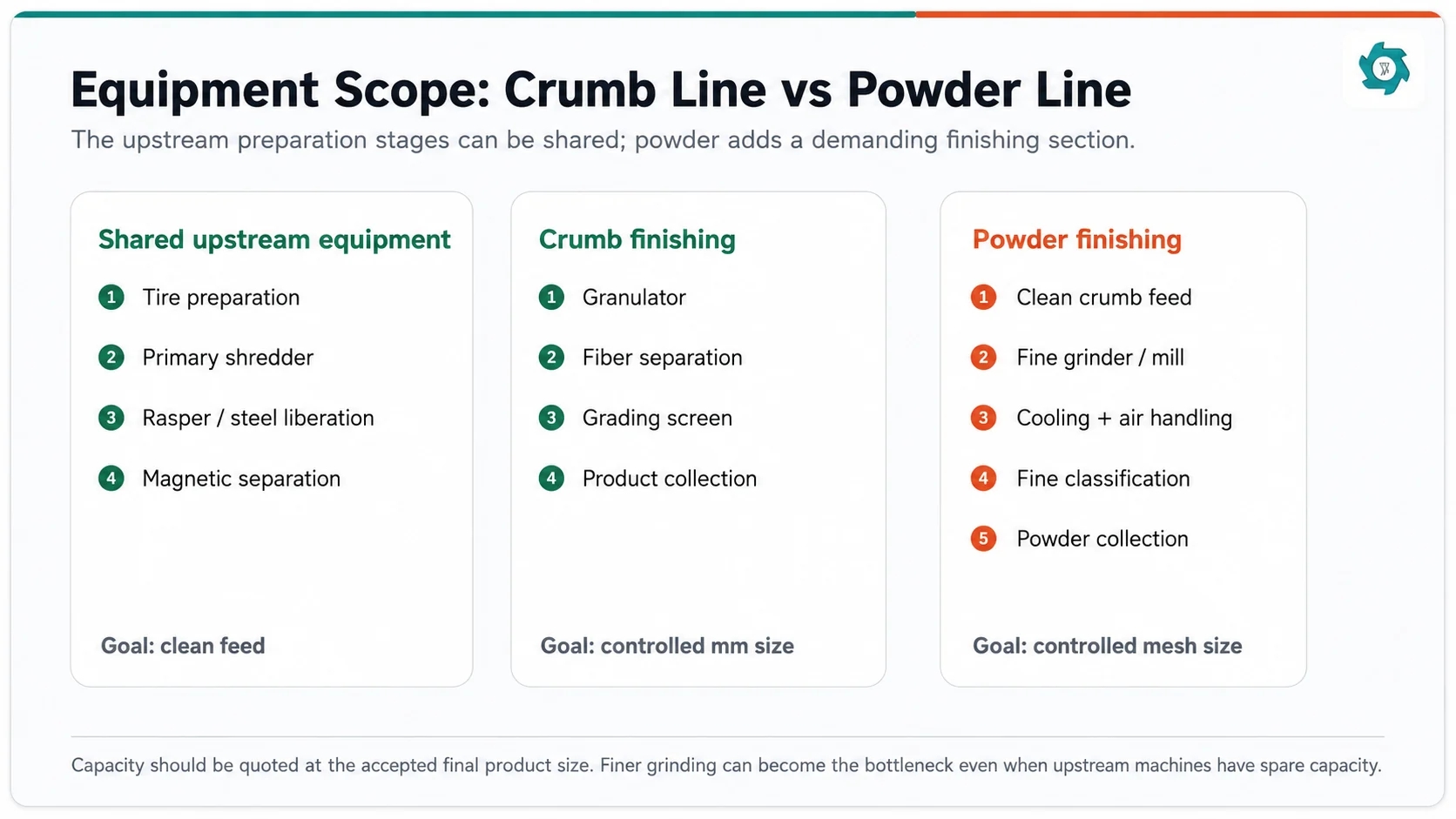
The easiest way to compare equipment is to separate the plant into three blocks: shared upstream preparation, crumb finishing and powder finishing.
Both routes share the heavy tire-preparation stages. Powder production adds a finer and more sensitive finishing section after clean crumb is available.
Shared upstream equipment
A whole-tire project may include bead removal or tire cutting before the primary shredder, depending on tire type and line design. The shredder creates manageable pieces. A rasper or comparable secondary reduction stage opens the rubber around embedded steel, after which magnetic separation removes liberated wire.
That upstream work is not optional just because the final product is fine. In fact, the finer the final product, the more important feed cleanliness becomes. Steel that slips through early stages does not disappear; it reaches more sensitive downstream cutters and screens.
Crumb finishing equipment
A granulator reduces cleaned tire chips into the target granule range. Textile is loosened and removed by air separation, while screens divide accepted material from oversize. For many crumb markets, that is enough. The plant can package different screened fractions if there are buyers for more than one grade.
Powder finishing equipment
Powder production adds the fine-grinding system and the controls around it. Depending on the line, that can include a grinding mill, cooling circuit, air handling, fine screening or classification, return conveyors and dust collection. A buyer comparing quotations should check whether these auxiliary items are actually included. “Rubber grinder” as one line item does not describe the whole finishing section.
Capacity: Why the Same Plant Cannot Promise the Same Tons per Hour at Every Size
Coarse material takes less size-reduction work than fine material. Once a project moves from millimeter granules into finer mesh ranges, the grinding stage often becomes the constraint. A recent review of ground tire rubber recycling also notes that processing cost becomes a bigger challenge as tire rubber is ground to fine sizes.[3]
Suppose the upstream shredder and granulator can comfortably feed several tons per hour. That does not mean the same number should be printed as the guaranteed output for 80- or 120-mesh powder. Finished capacity should be stated at the required accepted size, after return material has been accounted for. Otherwise, two suppliers may appear to quote the same capacity while actually describing two different points in the line.
Product Quality: Cleanliness Matters Before Fineness
A finer product is not automatically a better product. A 60-mesh powder with visible textile or residual wire may be less useful to a compounder than a coarser material with stable gradation and low contamination. Before discussing the last 20 mesh of size reduction, lock down the basic quality controls.
Steel: confirm the allowable residual metal and how it will be checked.
Fiber: define whether the buyer is limiting visible fiber, mass percentage or another test result.
Particle-size distribution: specify more than a single nominal mesh if the application is sensitive.
Moisture and cleanliness: agree on storage and packaging conditions so a good product does not become a handling problem.
Sampling: decide where and how samples are taken during acceptance testing.
ASTM D5603 and D5644 are useful because they push the discussion toward classification and testable particle-size distribution rather than vague naming.[4][1] For a buyer who already knows the powder grade, the rubber powder mesh size guide is the more relevant next step than choosing a machine by motor power alone.
Uses: Where Crumb Rubber and Rubber Powder Usually Go
ASTM D5603 lists recycled vulcanizate particulate rubber across uses that include synthetic turf infill, asphalt-rubber, molded rubber products, devulcanization and other tire and non-tire applications.[4] What changes is the grade each downstream process can accept.
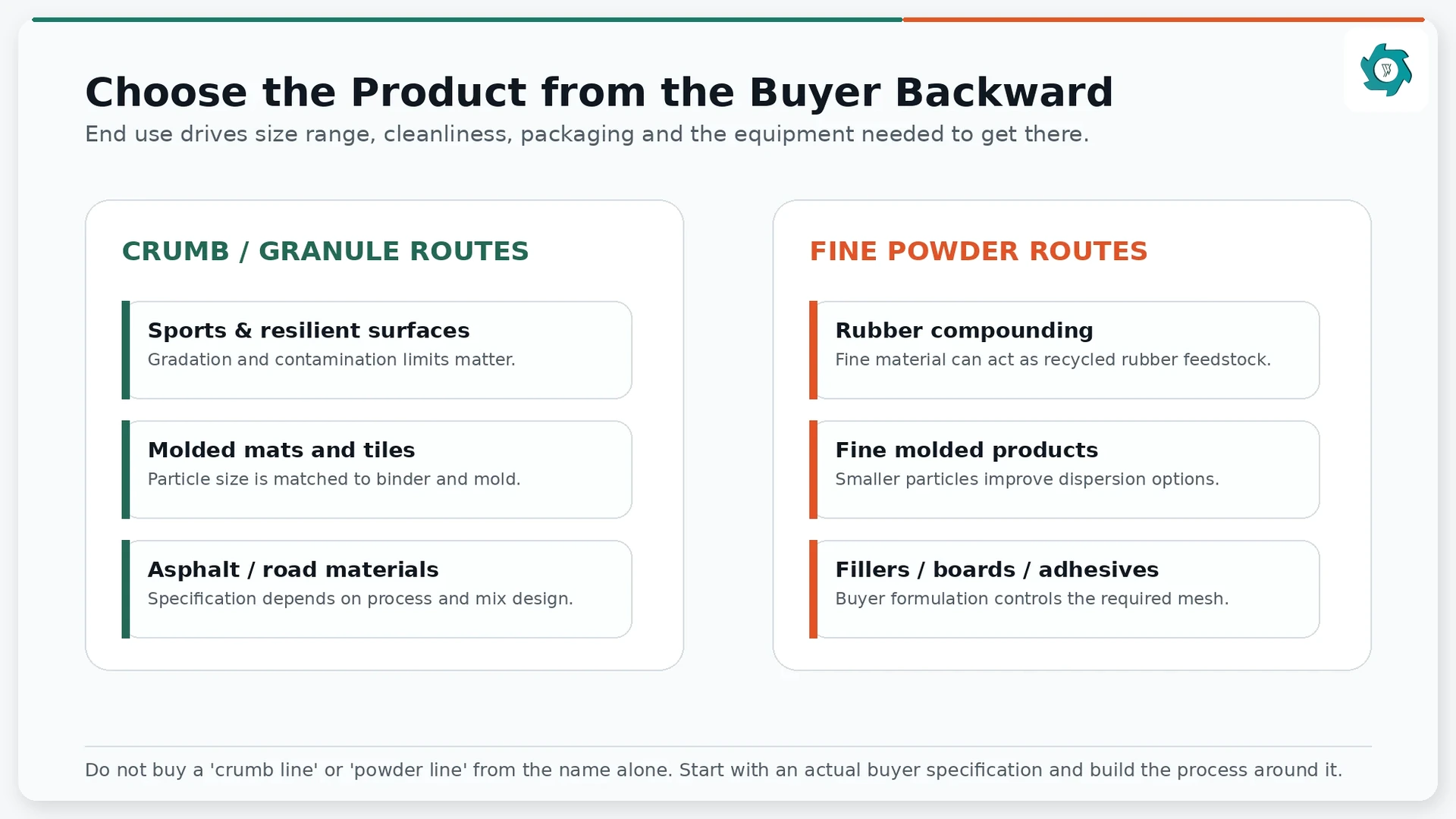
Choose the plant from the receiving specification backward. The same end-use category may purchase different gradations from different suppliers.
Crumb rubber applications
Crumb and granulated rubber are widely associated with resilient surfaces, molded mats and tiles, selected asphalt applications and other products where a controlled but visibly granular feed is acceptable. EPA’s tire-crumb work also reflects the use of screened recycled tire crumb in synthetic turf systems.[2]
However, “sports surface” is not a particle-size specification. A running track layer, playground system and turf infill can call for different gradations and quality limits. The recycler still needs the receiving specification.
Rubber powder applications
Fine powder is attractive where the rubber needs to disperse more evenly through a compound, binder or molded matrix. Typical commercial directions include rubber compounding, finer molded products, recycled boards, selected adhesives and filler applications. ASTM also recognizes recycled particulate rubber as a compounding material that can be added back into suitable rubber formulations.[4]
Finer is not always more profitable. A market that willingly buys 1–3 mm granules can be a better business than making 100-mesh powder with no contracted customer. The grinder adds energy use, wear, air handling and another potential bottleneck. The selling price has to justify that extra processing.
Which Product Should a New Tire Recycling Project Target?
Start with the buyer. If local customers already consume screened crumb, stopping after granulation may reduce project complexity and leave more throughput available. If a compounder, molded-product factory or road-material customer requires a fine mesh, then the powder route can make sense—but only after the required grade and monthly demand are confirmed.
Choose crumb first when…
Your confirmed buyers accept millimeter-scale granules.
You want a simpler finishing section and higher finished throughput.
You plan to sell multiple screened granule fractions.
You may add fine grinding later after the market is proven.
Choose powder when…
A real buyer has already specified a mesh range.
The required sales price supports extra grinding cost.
You can manage fine dust, cooling and return material.
Acceptance will be based on the finished powder, not upstream feed rate.
For budget comparison, also separate the standalone grinding-machine price from the installed cost of the complete finishing section. The rubber powder machine price guide explains why capacity, mesh target, separation scope, conveyors, dust control and installation boundary can change the quotation.
Five Questions to Put in the RFQ
What exact finished size must be accepted? Give the mm range or mesh designation and the test method.
What contamination limits apply? State steel, textile and other visible contamination requirements.
Where is capacity measured? Require tons per hour of accepted finished product, not the feed rate into the shredder.
What material is allowed to recirculate? Ask how oversize is returned and whether return load is included in the capacity calculation.
What utilities and auxiliaries are included? Cooling, dust collection, air separation, screens, conveyors and packaging should not be left as assumptions.
The Practical Difference in One Sentence
Crumb rubber is usually the clean, screened granulate produced after tire shredding, steel liberation and granulation; rubber powder is the finer product made by taking that clean granulate through an additional controlled grinding and classification stage.
Need to Choose Between Crumb and Powder Production?
Send your tire mix, target particle size or mesh, required finished capacity, buyer quality limits, voltage and workshop dimensions. YUXI can configure the line around the product you actually plan to sell.
FAQ
What size is crumb rubber?
There is no single universal crumb-rubber size. Different markets buy different gradations. On YUXI’s crumb production route, the granulator stage is designed around 1–8 mm output, but a buyer should specify the exact accepted fraction needed for the end use.
What mesh is considered rubber powder?
The commercial boundary varies. YUXI’s rubber powder plant is designed for a stated 20–120 mesh range. ASTM classifications use particle-size distribution and mesh designations for recycled vulcanizate particulate rubber rather than relying only on the word “powder.”
Can a crumb rubber plant make rubber powder?
Only if it includes the additional fine-grinding and classification section. A normal crumb line can produce clean granules that serve as feedstock for a powder grinder, but the grinder, cooling, fine screening, air handling and collection system must be sized for the required mesh.
Why does finer rubber powder usually reduce capacity?
Finer material needs more size-reduction work. The grinding mill may become the bottleneck, and more material can circulate through the classification return loop before it reaches the accepted mesh. Capacity should therefore be quoted at the finished product size.
Which is the better one, crumb rubber or rubber powder?
Neither is automatically always better. Powder may sell into higher-value applications, while it also adds grinding energy, wear, cooling and dust-control cost. A project is stronger when the chosen product already has a confirmed buyer and realistic local demand.
Marie has 8+ years of experience in tire shredding and recycling equipment,with a focus on tire shredders,rubber recycling machines,TDF production,rubber crumb processing,and complete tire recycling systems.