Which Tire Mulch Machine Manufacturers Belong on a 2026 Shortlist?
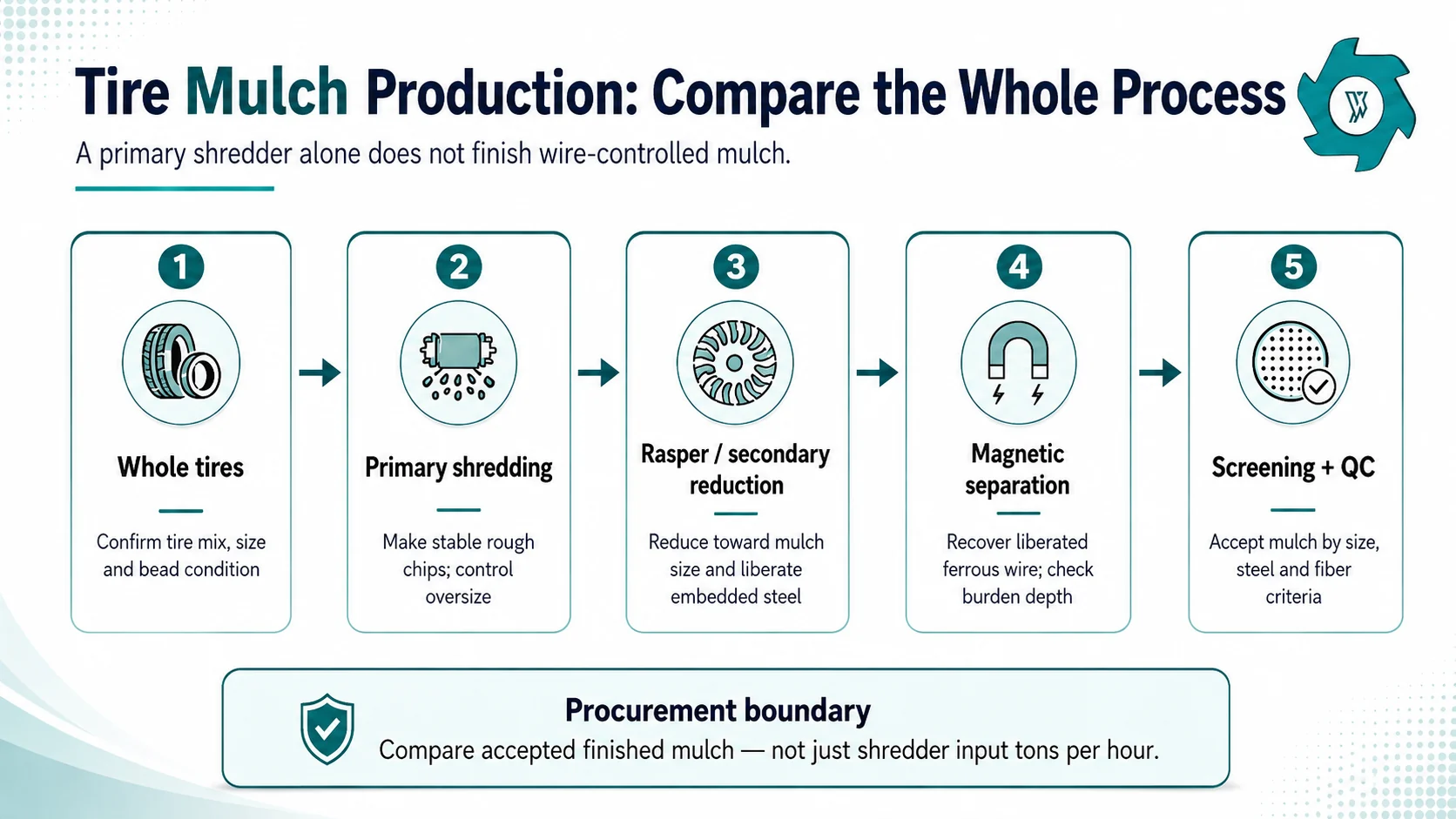
A tire mulch line looks simple on a flow chart. Whole tires go in, rubber chips come out. The purchasing work starts when you ask what happens between those two points. A primary shredder may make rough chips quickly, yet those chips can still carry embedded steel, mixed sizes and enough return load to slow the next machine. A supplier that is excellent at primary shredding is not automatically the best supplier for finished mulch.
For this comparison, a “tire mulch machine manufacturer” means a company with public evidence that its equipment can participate directly in producing coarse recycled-rubber chips or wire-controlled mulch, not merely destroy whole tires. We looked at published tire-specific shredding, secondary reduction, steel liberation or separation, screening, plant integration and service scope.
Compare the full material path. Finished mulch quality is created by several stages, not by the primary shredder alone.
How We Compared Tire Mulch Machine Manufacturers
The first filter was direct relevance. A general industrial shredder company can process rubber, but that does not tell a tire recycler how embedded belt wire will be liberated, how oversize will return to the cutting stage, or how the finished fraction will be sampled. We gave more weight to suppliers that publish tire-specific routes for wire-free chips, mulch, coarse rubber or downstream granulation.
The second filter was process coverage. For most whole-tire projects, the useful boundary begins at feeding and primary size reduction and continues through secondary cutting, magnetic recovery and screening. If your feed is already prepared chips, a smaller mulch module may be enough. YUXI’s own rubber mulch machine cost guide makes the same distinction: a downstream module and a complete whole-tire line should not be compared as though they contain the same equipment.
Third, we looked for evidence that the supplier explains output rather than hiding behind motor power. Published chip ranges, specific wire-free or mulch systems, screen recirculation, steel-separation stages and documented plant cases all make a quotation easier to audit. Capacity claims were treated cautiously because one company may quote fresh feed while another quotes accepted final product.
Finally, we considered application fit. Passenger tires, truck tires and OTR tires can reach a similar downstream product but do not create the same cutting and handling duty. The practical differences are covered in more detail in this passenger, truck and OTR tire mulch guide.
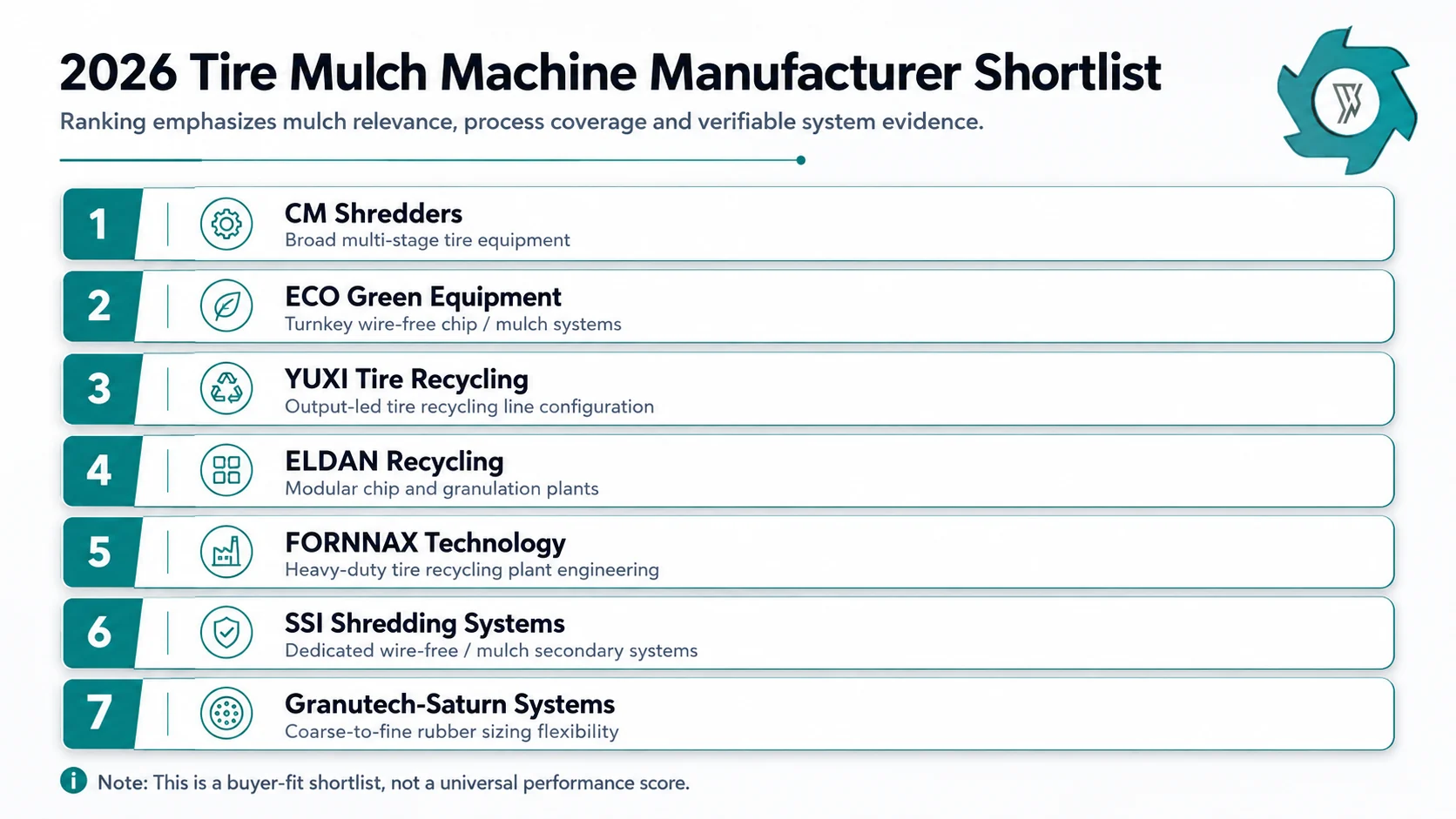
Top 7 Tire Mulch Machine Manufacturers: Side-by-Side
Rank
Manufacturer
Published tire-mulch relevance
Best fit
Important buying note
1
CM Shredders
Primary shredders, chipping, Liberator, steel reclamation, granulation and finishing
Established multi-stage tire recycling projects
Normalize the exact line boundary; CM covers several product depths
2
ECO Green Equipment
Turnkey systems for TDS, wire-free chips, rubber mulch, crumb and powder
Buyers wanting one supplier across several tire outputs
Ask which stations are included for your mulch specification
3
YUXI Tire Recycling
Primary shredding plus dedicated wire-free mulch and downstream rubber routes
Output-led projects that may expand from mulch to crumb rubber
Write accepted mulch capacity and steel/fiber criteria into the test
4
ELDAN Recycling
Tyre chip plants and complete granulation/separation plants
Modular plants with strong separation emphasis
Clarify whether your target is chip/mulch or finer granulate
5
FORNNAX Technology
Heavy-duty tyre recycling plants with steel-free chip / rubber mulch output
High-duty projects and plant-scale engineering
Confirm real feed mix and accepted-output test conditions
6
SSI Shredding Systems
Published wire-free and mulch systems using secondary single-rotor reduction
Projects stopping at coarse wire-controlled material
SSI explicitly separates mulch capability from crumb-rubber production
7
Granutech-Saturn Systems
Complete tire systems with coarse rubber for playgrounds through finer crumb/powder
Buyers needing broad particle-size flexibility
Define the exact coarse product before comparing with dedicated mulch lines
The ranking favors direct tire-mulch relevance and verifiable process coverage.
1. CM Shredders
Its tire portfolio includes primary shredders, chipping shredders, Liberator systems, granulators, steel reclamation and final milling, screening and cleaning systems. CM specifically states that its Liberator and wire-reclaim arrangement is used in rubber mulch and crumb-rubber production.1
That breadth matters when a plant owner wants one engineering conversation from whole-tire intake to a cleaned rubber fraction. It also reduces a common integration problem: buying a primary shredder from one company, a secondary grinder from another and then discovering that the discharge size, burden depth or return load is poorly matched.
Why it stands out: Deep tire-specific product range, published steel-liberation equipment, and a clear route from primary shredding to downstream rubber processing.
What to verify: Do not assume every CM tire line is a mulch line. Request the exact equipment list, finished fraction, capacity basis, screens, magnets and recycle path for your product.
2. ECO Green Equipment
ECO Green is one of the clearest companies to research because it organizes its tire recycling offer around saleable outputs. Its site describes turnkey systems for tire-derived shreds, wire-free chips, rubber mulch, crumb rubber and fine rubber powder, along with shredding, grinding, conveying, screening, magnets and controls.2
For a buyer who expects the plant to evolve, that output-based structure is useful. A business might start with wire-free chip or mulch, then add finer granulation once local markets are proven. The engineering question is not whether ECO Green can show more equipment; it is how much of that equipment belongs in the first purchase.
Why it stands out: Turnkey tire focus and a published product path that explicitly includes wire-free chips and rubber mulch.
What to verify: Ask for the guaranteed product boundary: chip size distribution, residual steel criterion, fiber condition, accepted tons per hour and what happens to oversize.
3. YUXI Tire Recycling
The current tire shredder machine page presents primary size reduction with screening and automatic return of oversized pieces. Downstream, the mulch route adds the work that a primary shredder cannot finish: further reduction, steel liberation, magnetic recovery and product-size control.
This distinction is important for buyers who ask for “10–20 mm from whole tires” and receive a quotation that only shows a twin-shaft shredder. YUXI’s tire rasper guide places the rasper between rough shredding and fine granulation, where it cuts pre-shredded chips and opens the rubber around embedded wire before magnetic separation. That makes the line easier to audit stage by stage.
YUXI is also a reasonable fit when the initial business is mulch but the long-term plan includes smaller crumb. The company’s published product structure separates mulch from crumb-rubber processing instead of pretending that one screen change converts a mulch line into a fine granulation plant. The rasper-versus-granulator comparison is useful here: the two machines sit in different parts of the process and solve different problems.
Why it stands out: Clear stage separation, a practical screen-return concept at primary shredding, a natural upgrade path from coarse chips to wire-free mulch and finer rubber, plus published CE documentation for shredder and tyre-recycling-line equipment.
What to verify: Do not accept a nominal “wire-free” percentage without a sampling rule. Put target size, visible or residual steel, fiber requirement, accepted output and FAT procedure into the quotation.
4. ELDAN Recycling
ELDAN has a long-standing, modular approach to tire recycling. Its published tyre-recycling program separates primary shred production from chip production and granulation. The company describes a chip plant that can take shreds, pre-cut tires or whole passenger-car tires and make adjustable 10–50 mm chips that are approximately 98% free of steel wire; it also offers complete granulation and separation plants for finer rubber.3
That makes ELDAN especially interesting for buyers who want a defined stopping point. A plant can be organized around saleable chips, or the process can continue into granulate. The advantage is modularity. The risk is purchasing more downstream refinement than the mulch market actually pays for.
Why it stands out: Strong separation engineering, modular plant architecture and clearly published chip versus granulate process stages.
What to verify: Match the selected ELDAN plant to your commercial product. “Almost steel-free chip,” direct-use mulch and fine ASTM-oriented granulate are not the same acceptance specification.
5. FORNNAX Technology
FORNNAX is a serious candidate for plant-scale tire recycling, particularly where heavy-duty shredding and system engineering matter. Its current tire-recycling materials describe plants that convert waste tires into higher-value rubber fractions, and its input/output information identifies steel-free chips or rubber mulch at roughly 12–30 mm as one of the plant outputs.4
For a high-duty project, the appeal is less about a single compact machine and more about the ability to engineer the line around tires that place real load on the front end. Buyers dealing with truck, industrial or prepared OTR material should still insist on a feed envelope. “Tire” is too broad a material description for an acceptance test.
Why it stands out: Heavy-duty tire recycling focus and plant engineering that reaches a steel-free chip / mulch stage.
What to verify: Ask FORNNAX to state which feed mix supports the quoted output, how oversize circulates, and whether capacity refers to fresh feed or accepted finished mulch.
6. SSI Shredding Systems
SSI deserves a place on a mulch shortlist because it publishes a dedicated “wire free” and “mulch” system rather than only a generic tire application. Its SR900 Uni-Shear tire package is described as processing pre-shredded tires into roughly 12–25 mm chips while stripping steel from the rubber so downstream magnetic systems can recover it. SSI also publishes a clear boundary: it supplies primary and secondary tire systems but does not position itself as a crumb-rubber production-system supplier.5
That boundary can actually be useful. If the project stops at coarse wire-controlled chips, there is little value in paying for a supplier’s finer granulation capability unless expansion is already funded. SSI is therefore a strong comparison point for processors who know that mulch, wire-free chip or TDF is the commercial endpoint.
Why it stands out: Explicit mulch-system documentation, robust primary/secondary shredding heritage and a clear statement about where its tire-processing scope stops.
What to verify: SSI’s published high-capacity figures depend on horsepower, screen and application. Require a test based on your feed and accepted product, not the upper end of a brochure range.
7. Granutech-Saturn Systems
The company describes complete tire granulation systems using shredders, granulators and refiner equipment, and explicitly notes that its systems can make coarse rubber for playground applications as well as finer crumb for turf.6
It is slightly lower in this mulch-specific ranking because much of Granutech’s published positioning extends beyond mulch into crumb and powder. That is not a weakness in engineering terms; it simply means a buyer should define whether the project really needs broad downstream flexibility or only a robust coarse-rubber line.
Why it stands out: Long-established tire recycling equipment, broad sizing flexibility and complete-system capability from shredding through finer processing.
What to verify: Translate “coarse rubber for playgrounds” into your exact particle-size distribution, metal criterion, fiber requirement and packaging or coloring handoff.
How to Compare Tire Mulch Machine Quotations Without Getting Misled
The easiest quotation to misunderstand is the one with a large tons-per-hour number and no product definition. A primary shredder can accept material much faster than a downstream screen can release an accepted mulch fraction. The return loop is doing real work, so capacity must be measured after the agreed size and quality checks.
Start with feed. State the passenger/truck/OTR mix by weight if possible, not by an occasional photo. If large tires need preprocessing, say so before pricing. YUXI’s rubber mulch process guide explains why problems often appear at the handoff between primary shredding, rasping, magnetic separation and screening rather than inside one isolated machine.
Then define the product. “20 mm mulch” is incomplete. A screen opening is a machine setting; it is not a finished-product specification. Write the accepted size distribution, oversize and fines tolerances, whether exposed wire is allowed, how residual metal will be checked, and how much textile fiber the buyer accepts. For playground surfacing, the metal issue is not cosmetic: the U.S. Consumer Product Safety Commission advises that recycled tire rubber mulch should be inspected before installation to ensure metal has been removed.7
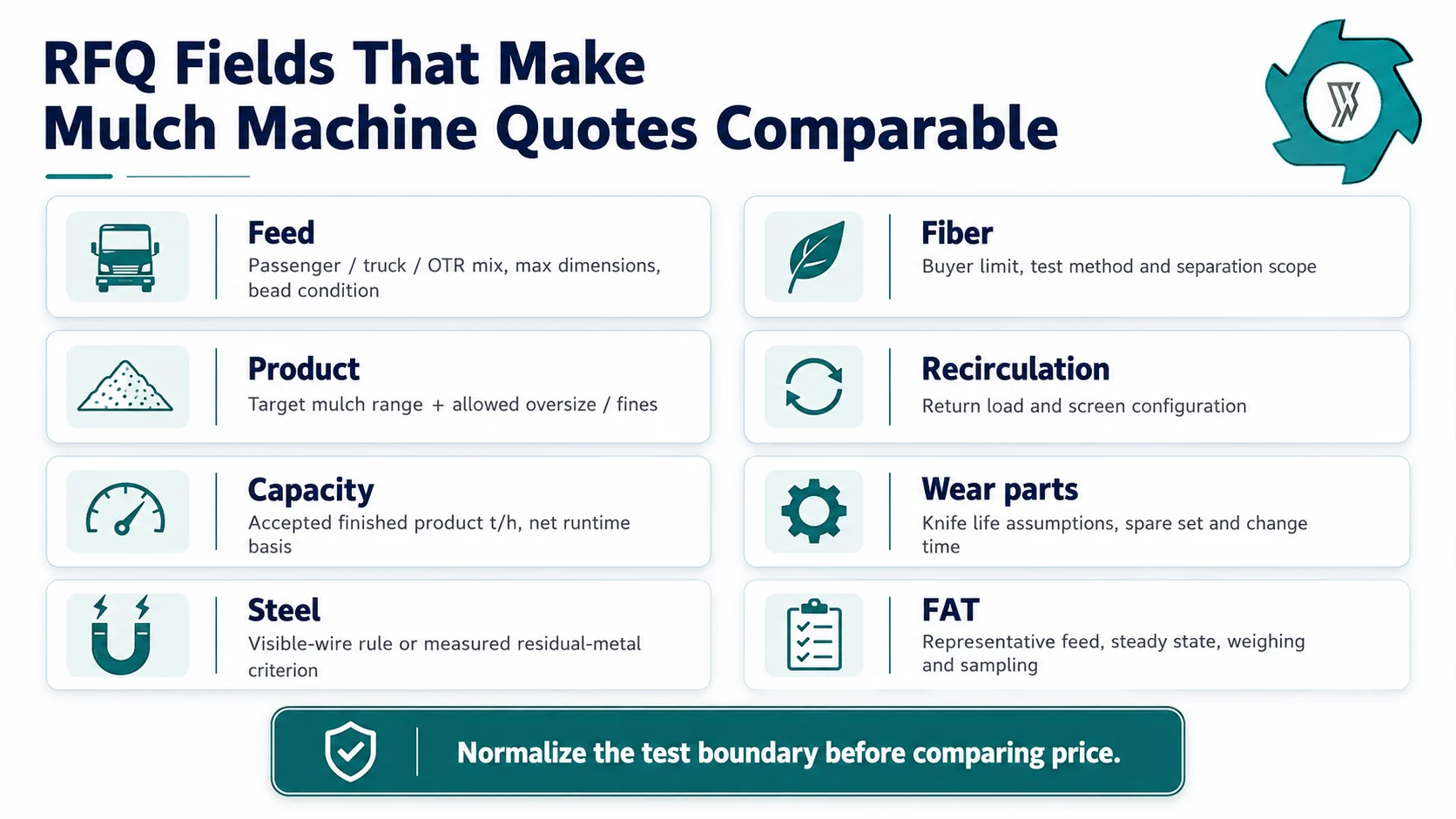
A comparable quotation needs the same feed, product, capacity and test boundary across every supplier.
Ask every supplier for the same eight items
Feed envelope: tire categories, maximum dimensions, bead condition and contamination.
Target product: particle-size distribution, oversize and fines allowance.
Accepted capacity: finished mulch t/h over a stated net runtime.
Steel criterion: visible-wire rule, residual-metal test or both.
Fiber criterion: buyer requirement and test method.
Recirculation: screen arrangement, return path and expected recycle load.
Wear plan: knife or cutter life assumptions, spare quantities and replacement access.
FAT method: representative feed, run duration, weighing, sampling and recorded settings.
Also separate capital cost from project cost. Conveyors, dust collection, electrical cabinets, platforms, magnets, spare cutters, freight, foundation work and commissioning may sit outside the base-machine price. If price is the main issue, use a normalized equipment list before deciding that one supplier is cheaper.
The Factory Acceptance Test Matters More Than the Ranking
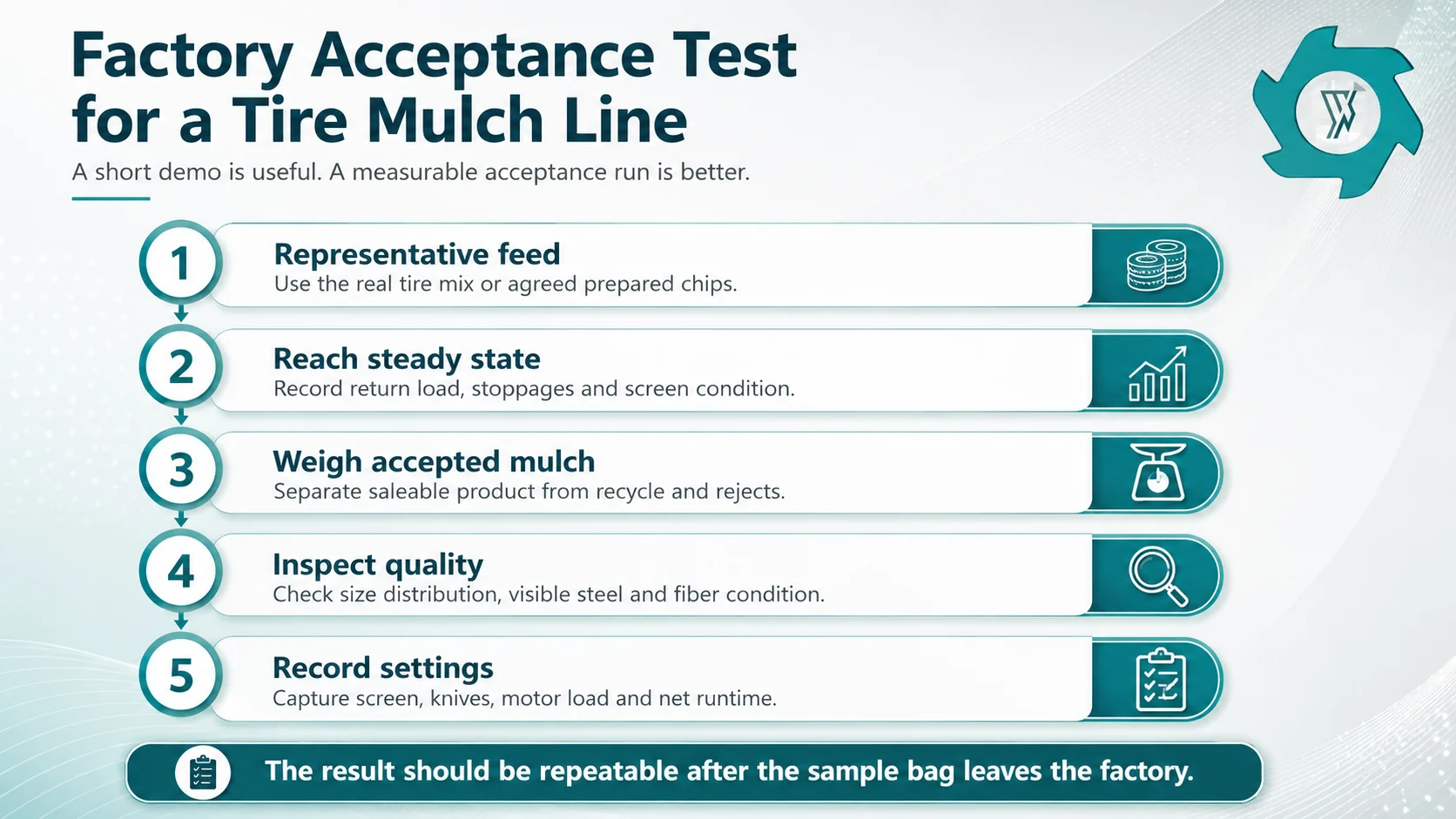
A shortlist gets you to the factory gate. It does not prove the line. A useful FAT starts with material that resembles your real feed and continues long enough for screens, return conveyors and the secondary cutting chamber to reach a normal circulating load. Fresh knives and a five-minute demonstration can make almost any line look comfortable.
During the test, weigh accepted mulch separately from returned oversize and rejects. Record net runtime, stoppages and the setting that produced the sample. If the product will be sold directly into playground or landscaping channels, inspect more than appearance. Size, wire and fiber should be checked by an agreed method. The same logic applies when reading a tire shredder output-size guide: the machine stage and the finished product stage are different measurement points.
Write the FAT method before the machine is loaded. The goal is a repeatable production result, not a good-looking sample bag.
Practical rule: If two suppliers will not quote capacity at the same accepted-product boundary, do not compare their t/h numbers in the same column.
Tire Mulch Machine Manufacturer FAQ
What is a tire mulch machine?
It is usually not one machine. A complete route can include primary shredding, secondary reduction or rasping, magnetic steel recovery, screening, recirculation and, when the buyer requires it, additional fiber control. Some suppliers sell the full line while others specialize in only one or two stages.
Which manufacturer is best for a complete rubber mulch line?
There is no universal winner. CM Shredders and ECO Green publish broad tire-recycling equipment portfolios, while YUXI, ELDAN, FORNNAX and other suppliers organize systems around different output stages. The better choice is the supplier that can prove your required tire mix, finished mulch specification and accepted output rate under a defined test.
Can a tire shredder make finished rubber mulch by itself?
Usually not. A primary tire shredder is mainly a front-end size-reduction machine. Finished mulch generally needs further reduction and steel liberation, magnetic separation and size control. The exact line depends on the incoming tire condition and the final product specification.
What output size should I specify for rubber mulch?
Specify a target particle-size distribution rather than only a screen opening. Many commercial mulch routes work in a coarse chip range, but the correct target depends on landscaping, playground, equestrian or downstream-processing requirements. Include oversize and fines tolerances in the RFQ.
How should I compare capacity between manufacturers?
Ask for accepted finished mulch tons per hour over a stated net runtime. Also record fresh feed, recycle load, rejects, downtime, tire mix, screen configuration and product-quality limits. Input throughput and accepted-product throughput are not interchangeable.
What should be checked during a factory acceptance test?
Use representative feed, run long enough to reach steady state, weigh accepted product separately, inspect size distribution and residual steel or visible wire, record fiber condition, and document machine settings, recirculation and downtime. The test method should be written before the test starts.
Compare a Tire Mulch Line Around Your Real Product
Send your tire mix, maximum feed dimensions, target mulch range, accepted finished capacity, steel and fiber criteria, power supply and workshop limits. The quotation can then separate the primary shredder, secondary reduction, magnetic recovery, screening, recirculation and optional downstream stages on one measurable boundary.
Sources and Engineering References
CM Shredders — Tire Equipment. Primary shredders, chipping, Liberator, steel reclamation, granulation and finishing systems; rubber mulch use is stated for the steel liberation/reclamation stage.
ELDAN Recycling — Tyre Recycling Solutions. Published chip and granulation plant stages, including adjustable 10–50 mm chip production and steel separation information.
SSI Shredding Systems — Tires. Published wire-free and mulch production system using the SR900; also states that SSI does not offer crumb-rubber production systems.
Marie has 8+ years of experience in tire shredding and recycling equipment,with a focus on tire shredders,rubber recycling machines,TDF production,rubber crumb processing,and complete tire recycling systems.