




A practical buyer’s guide to the tire granulator stage: what should enter the machine, how knives and screens control cutting, why output is a distribution rather than one number, and how to compare machines without confusing chamber throughput with saleable crumb rubber.
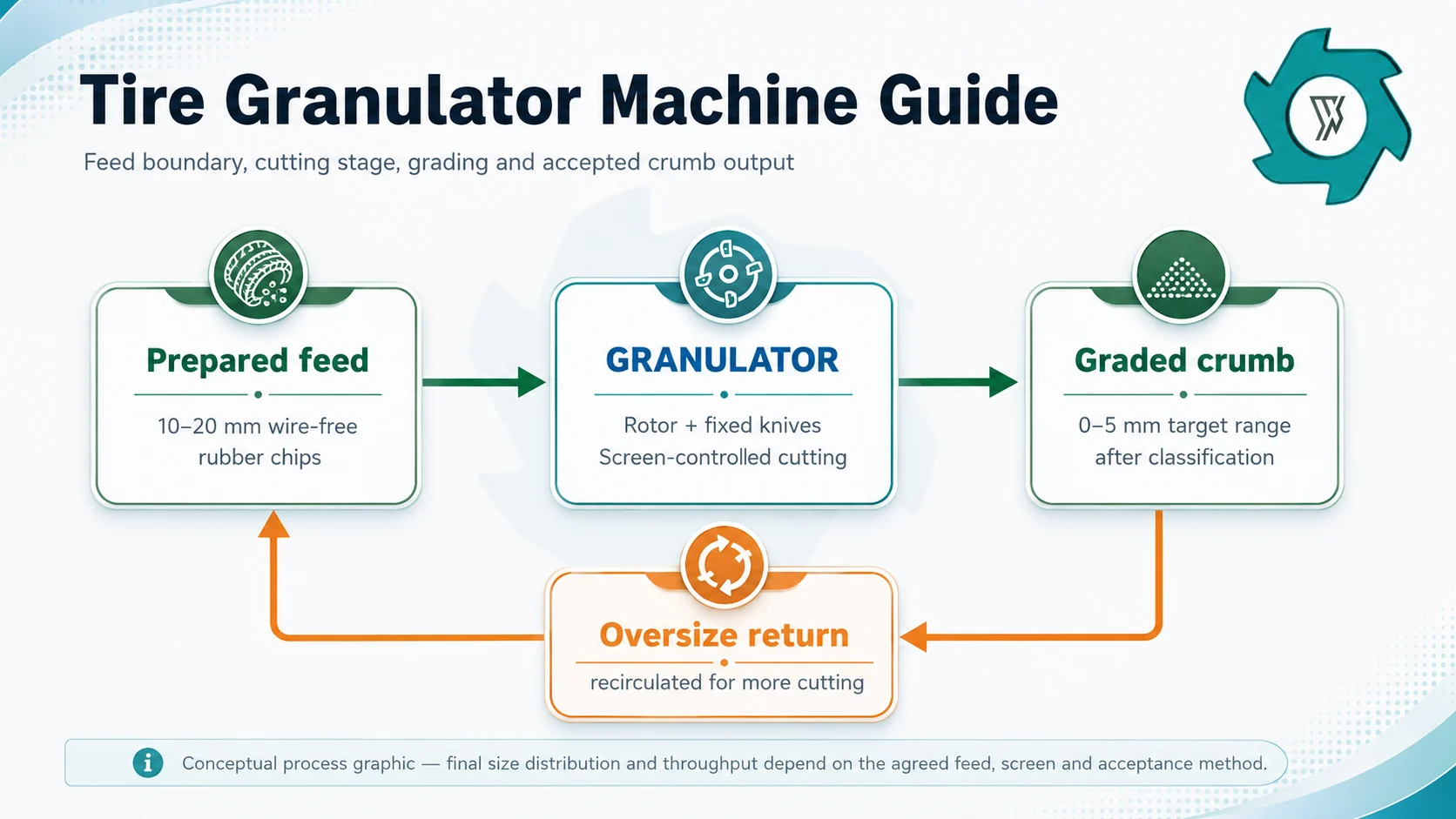
Two granulator quotations can both say “1–6 mm output” and still describe very different production duties. One supplier may be talking about material leaving the cutting chamber. Another may be quoting product collected after screening, oversize return, secondary magnetic recovery and fiber separation. The number looks the same. The plant balance is not.
That distinction matters in tire recycling because fine size reduction is where an upstream problem becomes expensive. Oversize chips increase repeated cutting. Residual steel reaches the most sensitive wear parts. Dull knives push more material around the chamber instead of cutting it cleanly. A smaller screen may improve the upper size limit while increasing return load and reducing accepted finished tonnes per hour. A tire granulator machine should therefore be selected as part of a defined feed-and-product system, not from motor power or a brochure capacity alone.
What a Tire Granulator Actually Does
A tire granulator receives prepared rubber chips and repeatedly shears them between rotating and stationary cutting edges until particles are small enough to leave through the configured screen and downstream grading system. In YUXI’s current crumb-rubber process, the downstream granulation module starts from approximately 10–20 mm wire-free chips. The process section lists granulator output around 1–6 mm, while the machine details also show 1–8 mm depending on configuration. The plant’s primary finished-product direction is 0–5 mm after grading and oversize return.
The practical output depends on more than a screen hole. Feed-size distribution, residual metal, knife sharpness, knife clearance, screen open area, feed rate, internal retention and external oversize recirculation all affect how quickly saleable material is produced. A buyer should therefore specify the accepted particle-size distribution and finished-product rate, then ask the supplier to prove both at the same time.
Where the Granulator Sits in a Tire Recycling Line
A granulator should not be expected to solve every problem that arrives from upstream. In a normal whole-tire route, primary shredding first opens the tire into rough chips. A rasper then reduces those chips again and liberates much of the embedded steel. Magnetic separation removes the released ferrous fraction before the cleaner rubber reaches fine granulation. The existing tire rasper vs rubber granulator comparison explains that sequence in detail.
For an expansion project, however, the granulator may be the first new machine purchased. That can work when the site already produces or buys prepared rubber chips that meet the supplier’s written feed limits. the YUXI Tire Rubber Crumb Plant uses approximately 10–20 mm wire-free chips as the downstream module feed and asks the buyer to confirm residual steel and fiber before machine selection.
Feed size
Do not specify only an average. Record the normal distribution, maximum piece dimension, long strips and the percentage of oversize material.
Residual steel
“Wire-free” needs an acceptance rule. A visually clean pile can still contain short or embedded steel that changes wear risk inside fine cutting equipment.
Fiber and contamination
Loose textile, dirt, stones and tramp metal should be treated as separate feed conditions. Each affects cutting, screening or downstream separation differently.
If the upstream stage is still uncertain, use the tire rasper machine guide to define the steel-liberation handoff before requesting a granulator. The granulator is much easier to size when the incoming material is already a controlled product rather than a vague “tire shred.”
Tire Granulator Working Principle: Five Things Happen at Once
At first glance, a granulator looks simple: a rotor turns inside a chamber and rubber becomes smaller. The useful engineering picture is more specific. Cutting, retention, discharge and recirculation happen together, and a change in one part shifts the load elsewhere.
1. Prepared chips are metered into the cutting chamber
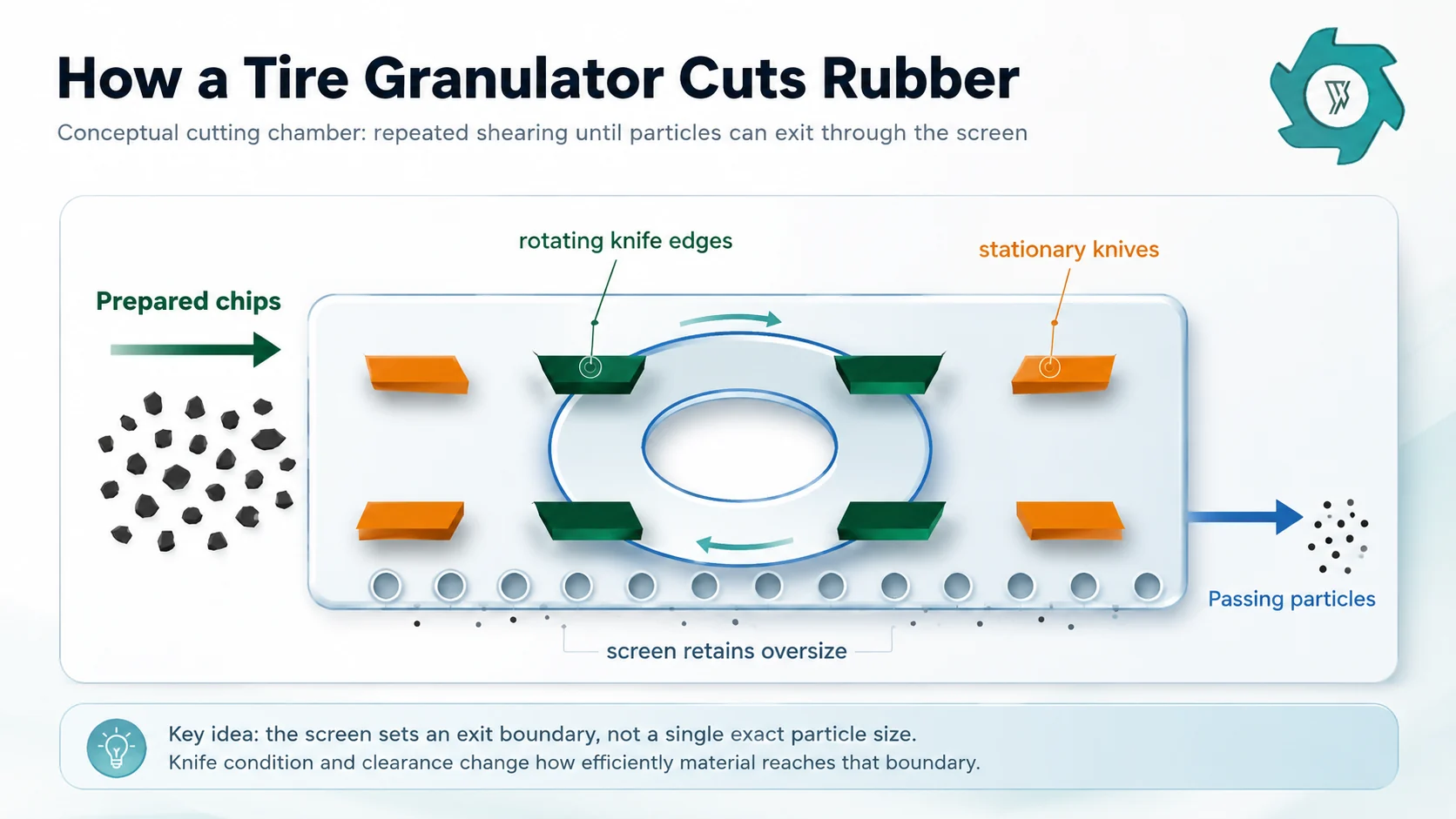
Steady feeding matters more than a dramatic full-hopper test. A surge of rubber can increase chamber load, fill the screen area and change the amount of material recirculating inside the machine. A controlled feed conveyor or dosing arrangement gives the cutting system a more repeatable load.
2. Rotor knives pass stationary knives
The moving cutting edges repeatedly pass fixed edges and shear the rubber. The exact rotor layout varies by manufacturer, but the principle is common to industrial knife granulators. CM, for example, describes its own tire granulators as knife-based machines that reduce rubber chips into crumb and offers different screens and resharpenable knives.1
3. Larger pieces remain in the chamber
Material that cannot pass the installed screen stays in the cutting zone for another pass. This is why the screen is part of the load equation. A smaller opening can keep a piece in the chamber longer, increasing the number of cutting events needed before it leaves.
4. Passing material leaves the granulator
Once particles pass the machine’s discharge boundary, they continue to whatever finishing system the project uses. That may include an external grading screen, another magnet, aspiration or a fiber separator. The exact arrangement should be shown on the process flow diagram rather than inferred from the machine name.
5. External oversize may return for another pass
The U.S. EPA describes tire crumb production as staged size reduction in which sifting screens classify the product and return oversize material to the reduction process; magnets remove wire and air separators remove fabric.2 That distinction is important. Internal screen retention and an external grading-screen return loop are related, but they are not the same stream. A quotation should show both if both are used.
Main Components Buyers Should Understand Before Comparing Models
A datasheet often leads with installed power and chamber dimensions. Those fields matter, but they do not tell you how the machine will behave with your rubber. For a granulator purchase, the cutting and discharge system deserves at least the same attention.
| Component / interface | What it does | What to ask in the quotation |
|---|---|---|
| Rotor and rotor knives | Carry the moving cutting edges through the rubber bed. | Rotor configuration, knife quantity and geometry, approved operating direction, replacement method and balancing/service requirements where applicable. |
| Stationary / bed knives | Provide the fixed cutting edge against which rotor knives shear material. | Number and position, adjustment method, regrinding allowance and minimum service dimension. |
| Knife-setting system | Maintains the designed relationship between moving and stationary edges. | Machine-specific clearance procedure, gauges or fixtures supplied, fastener procedure and post-service verification. |
| Screen | Retains material until it can pass the configured opening. | Aperture, thickness, open area, panel layout, change method, wear limit and spare-screen scope. |
| Chamber liners / wear surfaces | Protect structural parts exposed to repeated rubber and contaminant contact. | Replaceable wear areas, inspection access and spare-part identification. |
| Drive and load control | Provides cutting energy and responds to overload conditions. | Installed drive data, starting method, load monitoring, protection logic and how the feeder responds when granulator load rises. |
| Discharge / aspiration interface | Moves passing material to grading and fiber-control stages. | Discharge height, conveyor or pneumatic interface, extraction connection and the downstream equipment included in supplier scope. |
Granulator Blades: Material Grade Is Only One Part of the Wear Question
Blade material attracts attention because it is easy to put in a comparison table. It is also easy to misuse. A supplier may name a tool-steel grade or hardness while leaving out heat treatment, knife geometry, edge preparation, allowable regrind, clearance and the actual feed condition used to estimate service life. Those missing details can matter as much as the alloy name.
Sharpness changes the way the chamber uses energy
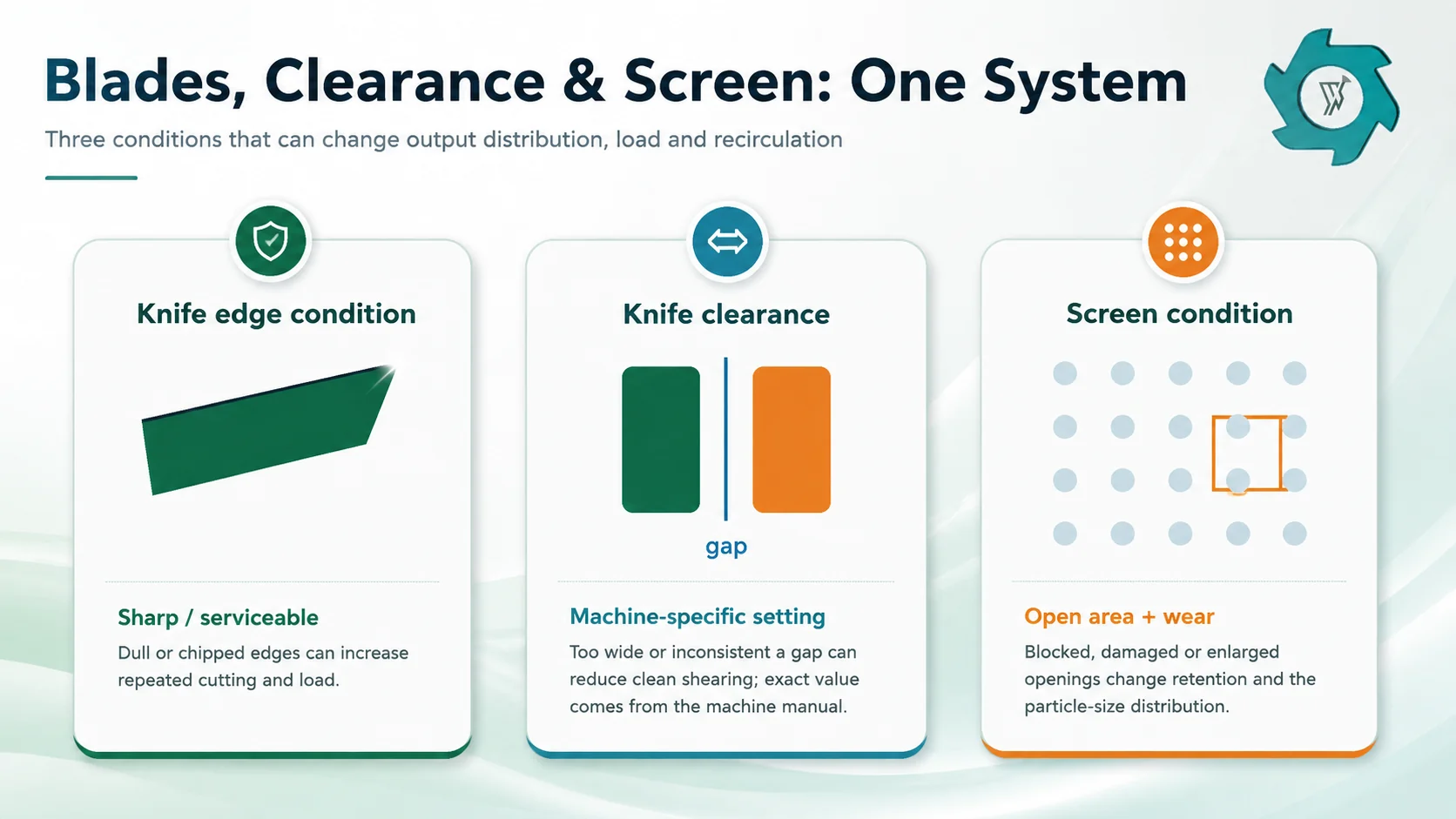
As edges round over, rubber can deform or move before it is cut. Operators may first notice a lower stable feed rate, a heavier circulating load, more heat at the cutting stage or a change in the particle distribution. Those symptoms are not proof of one failure by themselves, but they are reasons to inspect the knives rather than immediately increasing feed or changing a screen.
Knife clearance is a machine setting, not an internet number
There is no responsible universal clearance value for every tire granulator. Rotor diameter, knife geometry, mounting method, thermal behavior and supplier design all matter. The purchase package should include the approved setting procedure and the service tools needed to reproduce it. After knives are sharpened or replaced, the clearance should be reset according to that machine’s manual before production resumes.
Residual steel shortens the distance between normal wear and damage
Prepared tire rubber is not the same duty as clean plastic regrind. Even when the main steel-recovery stage is upstream, the buyer should define how remaining metal is checked. The existing wire-free rubber guide is useful here because it separates embedded, exposed and loose steel instead of hiding everything inside one purity number.
Ask about regrinding before asking for a blade-life promise
A fixed “hours per blade” figure is weak unless the tire mix, feed preparation, target screen, throughput, contamination and sharpening limit are also fixed. A better spare-parts discussion covers whether the knives are resharpenable, how many regrinds are permitted before minimum dimensions are reached, how adjustment compensates for material removal, and how many complete spare sets the plant should hold.
Useful RFQ wording: “Please state the quoted rotor and stationary knife arrangement, knife material and heat-treatment specification, approved clearance-setting method, regrinding allowance, minimum service dimension, expected spare set and the feed/test conditions used for any wear-life estimate.”
Screen Size Does Not Equal Finished Particle Size
A screen aperture is an equipment setting. Finished crumb is a particle-size distribution. Confusing the two is one of the easiest ways to create a dispute during commissioning.
Irregular rubber pieces can orient differently as they move across or through an opening. Some particles pass quickly; others remain for several cutting cycles. Downstream grading may then split that discharge into accepted product, fines, another saleable fraction and oversize return. The result is a distribution, not a pile of identical particles matching the nominal aperture.
ASTM D5644 provides a method for determining the particle-size distribution of recycled vulcanizate particulate rubber.3 For a commercial acceptance test, the buyer still needs to state the required sieve stack, percentage passing or retained, sampling procedure and pass/fail rule. “Make 5 mm crumb” is not enough.
Smaller or tighter target
Usually means more cutting and/or classification work. More material can remain in the chamber or return from external grading before it becomes accepted product.
Wider target
May permit more of the granulator discharge to become saleable product on the first pass, but only if the downstream buyer accepts that distribution.
Worn or damaged screen
Can change the effective opening and allow a different fraction to pass. Wear limits should be physical inspection criteria, not only calendar intervals.
Blinded or overloaded screen
Reduces effective open area. Material stays in the cutting zone longer and the apparent “screen size” no longer predicts practical output.
The process decision also depends on what the customer actually sells. The rubber mulch vs crumb rubber guide separates the coarse-product stopping point from the additional granulation needed for smaller crumb. Upstream, the published 10–20 mm rubber mulch size-control guide explains how screen geometry and recirculation shape the prepared feed before it reaches fine granulation. Once the market requires a narrower crumb fraction, classification and recycle capacity become part of the granulator selection rather than optional accessories.
What Determines Tire Granulator Output and Real Capacity?
“How many tons per hour?” is the right commercial question, but it needs a measurement boundary. YUXI’s pillar publishes a configurable complete-line feed range; that should not be copied into this page as a universal single-granulator capacity. The granulator must be selected against the actual prepared feed and finished product.
Sustained accepted crumb t/h = mass of product that passes the agreed checks ÷ total measured test time
This definition keeps the commercial capacity boundary clear. It does not count the same oversize twice because it traveled through the machine twice, and it does not count steel or fiber side streams as rubber product. Stops, cleaning and manual interventions remain part of the measured test period. If machine running rate is also reported, it should be shown separately from sustained accepted output.
| Variable | Why it changes practical output | What to record during a test |
|---|---|---|
| Incoming chip size and shape | Larger, thicker or irregular pieces require more cutting before they can pass. | Representative feed sample, distribution and maximum-piece rule. |
| Residual metal / contamination | Can interrupt cutting, damage edges or force more conservative operation. | Feed inspection and rejected contaminant record. |
| Knife condition and clearance | Changes cutting efficiency and the number of passes needed. | Starting condition, service history and setting confirmation. |
| Installed screen | Controls retention boundary and effective open area. | Aperture, panel configuration and screen condition. |
| External grading target | A tighter accepted fraction can increase return material even if chamber discharge is unchanged. | Accepted fraction, oversize return and fines separately. |
| Feed rate stability | Surges can overload the chamber or downstream screen and fiber system. | Fresh-feed mass over time and load trend. |
| Fiber-removal duty | Loose textile and fine rubber must be separated without excessive product loss. | Accepted crumb and fiber side stream; note visible rubber carryover. |
| Planned / unplanned stops | Knife checks, screen cleaning, blockages and interventions reduce sustained finished output over the measured production period. | Total elapsed time, actual running time and reason for each stop. |
The most useful supplier test therefore has at least three rate numbers: fresh prepared feed into the granulation section, gross internal/return circulation where it can be measured, and accepted finished crumb leaving the final product boundary. A short video of a full discharge conveyor is not a substitute for those numbers.
How to Select a Tire Granulator Machine
Selection becomes easier when the project is worked backward from the product rather than forward from a machine model. Start with what the customer must receive, then define the feed the granulator will actually see.
1. Freeze the feed boundary
State whether the granulator receives 10–20 mm prepared chips, another controlled fraction or purchased rubber feedstock. Include representative photos and a physical sample if possible. If the feed contains material from different tire categories, state the mix rather than sending only the cleanest sample.
2. Write the output as an acceptance specification
Define the target particle-size distribution, maximum oversize, permitted fines, separate steel and textile limits, moisture condition if relevant and the sampling/test method. Do this before comparing screens.
3. Define capacity at the finished-product boundary
Ask for accepted finished tonnes per hour at that exact product specification. If a supplier also gives nominal chamber or feed capacity, keep it in a separate column.
4. Compare the cutting system as a serviceable assembly
Request rotor and stationary knife details, adjustment method, regrind limits, access arrangement, screen-change procedure, wear liners and the normal spare-parts package. ELDAN’s current product catalog, for example, separates heavy granulators, fine granulators and several material-separation machines into distinct equipment families.4 The useful lesson is not to copy another supplier’s model; it is to confirm which duty and auxiliary equipment your own quotation actually includes.
5. Check the return and separation interfaces
The granulator can be correctly sized and still sit in a poorly balanced line. Verify the grading-screen capacity, oversize-return conveyor, magnetic stage, fiber separator, dust-extraction connection and product bins at the same target rate.
6. Ask what happens when load rises
The quotation should explain the control relationship between feed conveyor and granulator load, overload protection, restart sequence and any interlocks with downstream equipment. Exact control logic is supplier- and project-specific, but it should be visible before commissioning rather than discovered during the first blockage.
7. Leave room for maintenance
Knife and screen service is routine work, not an unusual breakdown. Layout drawings should reserve safe access for opening the chamber, removing screens, handling knives, cleaning around the machine and moving replacement parts. Site-specific guarding, lockout/tagout, dust and fire requirements must be reviewed against local rules and the final installed system.
Factory Acceptance Test: Prove Output and Wear Conditions Together
A granulator FAT should answer a simple question: can the quoted configuration process the representative prepared feed into the agreed finished product at the agreed sustained rate without temporary shortcuts?
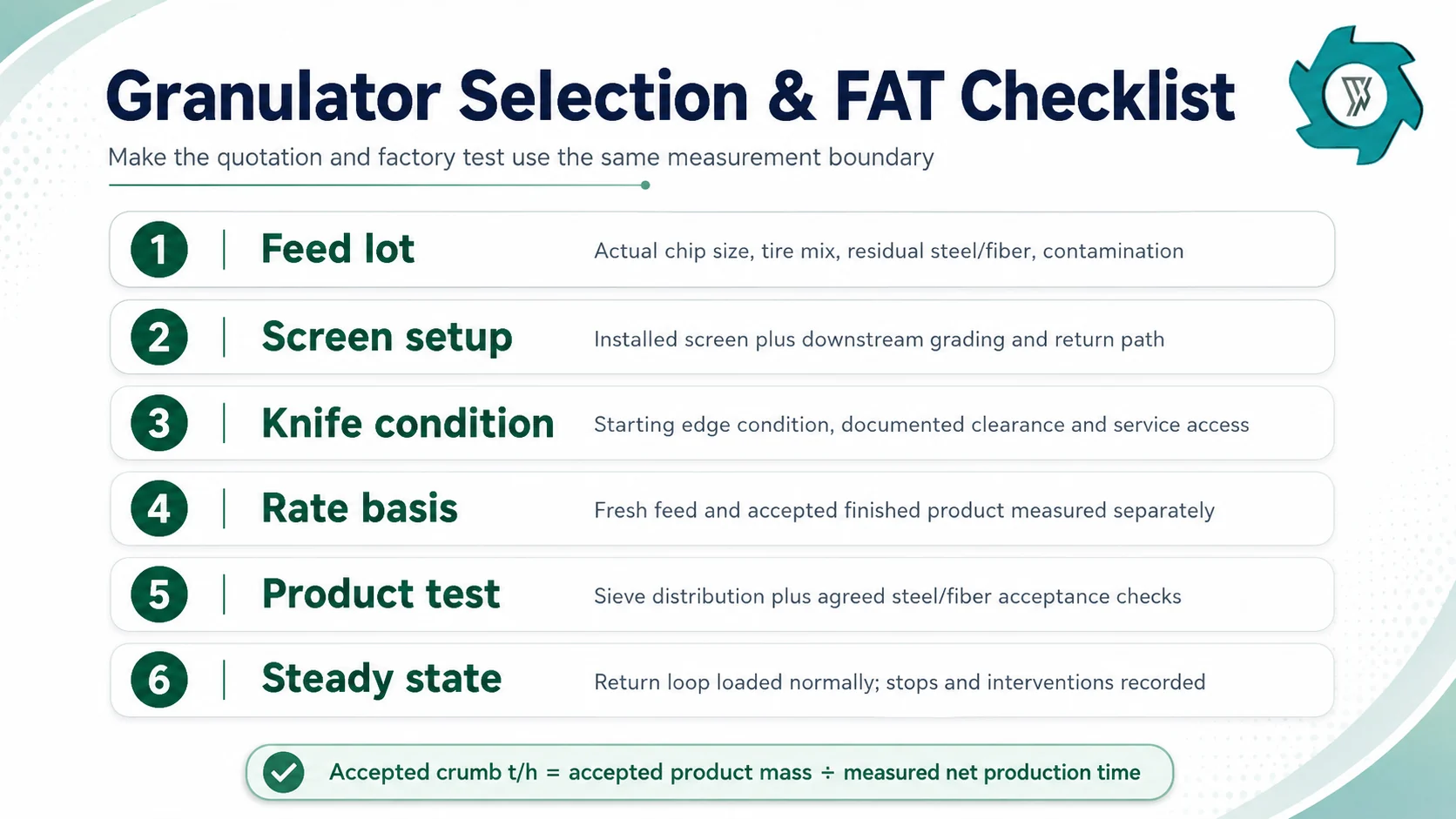
- Approve the feed lot. Record chip-size distribution, maximum pieces, tire-material source, residual steel/fiber condition, contamination and total test quantity.
- Document the machine configuration. Record installed screen, cutting-system condition, knife setting status and the included downstream grading/separation equipment.
- Reach steady state. Allow the chamber and external return loop to reach normal loading before the official measurement interval.
- Measure fresh feed. Weigh the material entering the granulation section during the measured period.
- Measure accepted product. Weigh only crumb that passes the agreed size and cleanliness checks.
- Record side streams and return. Keep oversize recycle, steel, fiber, fines and rejects visible rather than burying them in one “loss” number.
- Record total elapsed time and actual running time separately. Keep the full test clock running through screen cleaning, manual intervention, adjustments and other stops, then record actual machine running time as a separate operating metric.
- Sample over time. Build a representative composite sample instead of choosing one attractive handful from the finished bin.
- Run the agreed sieve test. Report percentage retained or passing at the control sieves, not just the largest particle seen.
- Inspect the machine after the run. Check knives, screen and chamber for abnormal damage, trapped metal or another condition that would make the test unsustainable in normal production.
Do not accept a “capacity demonstration” that removes the production screen, bypasses fiber separation, uses unusually clean hand-selected feed or stops the clock during repeated interventions. The test should represent the configuration the buyer will operate.
Common Tire Granulator Buying Mistakes
Buying by motor power
More installed power does not define feed condition, cutting geometry, screen duty, finished size or accepted throughput.
Using screen hole as the product spec
The screen is one control. The customer buys a particle distribution with limits for oversize and fines.
Ignoring residual steel
A granulator quote based on clean rubber cannot be applied automatically to steel-rich chips from an unstable upstream process.
Comparing feed t/h with finished t/h
One number may include material that will return to the machine; the other should represent accepted saleable product.
Asking only for “best blade material”
Heat treatment, geometry, clearance, regrind allowance and actual contamination control are part of the same wear system.
Forgetting service access
A screen or knife that is easy to list in a spare-parts sheet can still be difficult to replace if the layout leaves no handling space.
Testing with one easy feed lot
A passenger-tire-dominated or hand-cleaned batch may not represent a mixed commercial feed with truck-tire rubber and variable textile.
Adding fine powder later without planning
Crumb granulation and fine powder grinding are different duties. Future powder expansion needs space, utilities, dust control and a separate process review.
Information to Send Before YUXI Selects a Granulator Configuration
A useful inquiry is more specific than “send price for a 2 t/h tire granulator.” Even when two projects want the same nominal tonnes per hour, their cutting duty can be different.
- Starting material and process point: purchased chips, existing mulch-line output or another prepared feed.
- Normal chip-size distribution, maximum dimension and photos of oversize pieces.
- Tire-source mix where known: passenger, truck or other categories and approximate proportions.
- Residual steel condition and the method used to call the feed “wire-free.”
- Loose textile/fiber condition, dirt, stones, water and other contamination.
- Required finished particle-size distribution, not only a nominal mm or mesh label.
- Maximum oversize, fines and separate metal/fiber limits.
- Target accepted finished tonnes per hour and daily/annual operating plan.
- Whether one fraction or multiple graded products will be collected.
- Existing conveyors, magnets, screens, fiber separator and dust system to be reused.
- Voltage, frequency, available electrical capacity and local component/documentation requirements.
- Workshop dimensions, feed/discharge elevations and maintenance-clearance constraints.
- Required spare knives, spare screens and preferred spare-parts holding period.
- Future plan for narrower grading or fine rubber powder.
Need a Granulator Configuration for Your Tire Crumb Line?
Send the prepared chip size, residual steel/fiber condition, required crumb distribution, accepted finished capacity, voltage and available layout. YUXI can then review the granulator together with the screen, return loop and separation interfaces instead of quoting the cutting chamber in isolation.
Frequently Asked Questions
What is a tire granulator machine?
A tire granulator is a fine size-reduction machine used after the main shredding and steel-liberation stages. It repeatedly cuts prepared rubber chips with rotating and stationary knives, retaining larger pieces until they can pass the configured screen and continue to grading and separation.
Can a tire granulator process whole tires directly?
It should not be assumed. YUXI’s current downstream crumb module is based on prepared, approximately 10–20 mm wire-free rubber chips. Whole tires normally require upstream preparation, shredding, rasping and magnetic steel recovery before fine granulation.
Is granulator screen size the same as crumb rubber size?
No. The screen controls which particles can leave the cutting chamber, but the discharge is still a distribution of shapes and sizes. Finished product should be defined by an agreed sieve test, oversize/fines limits and sampling rule.
What blade material is best for a tire granulator?
There is no responsible universal grade without the machine design and duty. Ask the supplier for the actual knife material, heat treatment, hardness where specified, geometry, clearance method, regrind allowance and the feed conditions behind any wear-life estimate.
Why does granulator capacity fall with a finer product target?
A finer or tighter target usually requires more cutting and classification. Material may remain in the chamber longer or return from downstream grading, so accepted finished output can fall even when the motor and basic machine are unchanged.
How should tire granulator capacity be tested?
Use representative prepared feed, the production screen and normal downstream separation. Reach steady state, measure fresh feed and accepted product separately, record recirculation and stops, and test the finished crumb against the agreed particle-size and cleanliness specification.
External References
- CM Shredders. CM Granulators. Official manufacturer page used only as an industry example of a knife granulator with configurable screens; its specifications are not transferred to YUXI.
- U.S. Environmental Protection Agency. Tire Crumb Questions and Answers. EPA describes staged size reduction, screening/oversize return, magnetic metal removal and air separation of fabric.
- ASTM International. ASTM D5644-23 — Determination of Particle Size Distribution of Recycled Vulcanizate Particulate Rubber.
- ELDAN Recycling. Product Sheets. Official catalog showing separate heavy/fine granulator and material-separation equipment families; cited for equipment-category context only.