




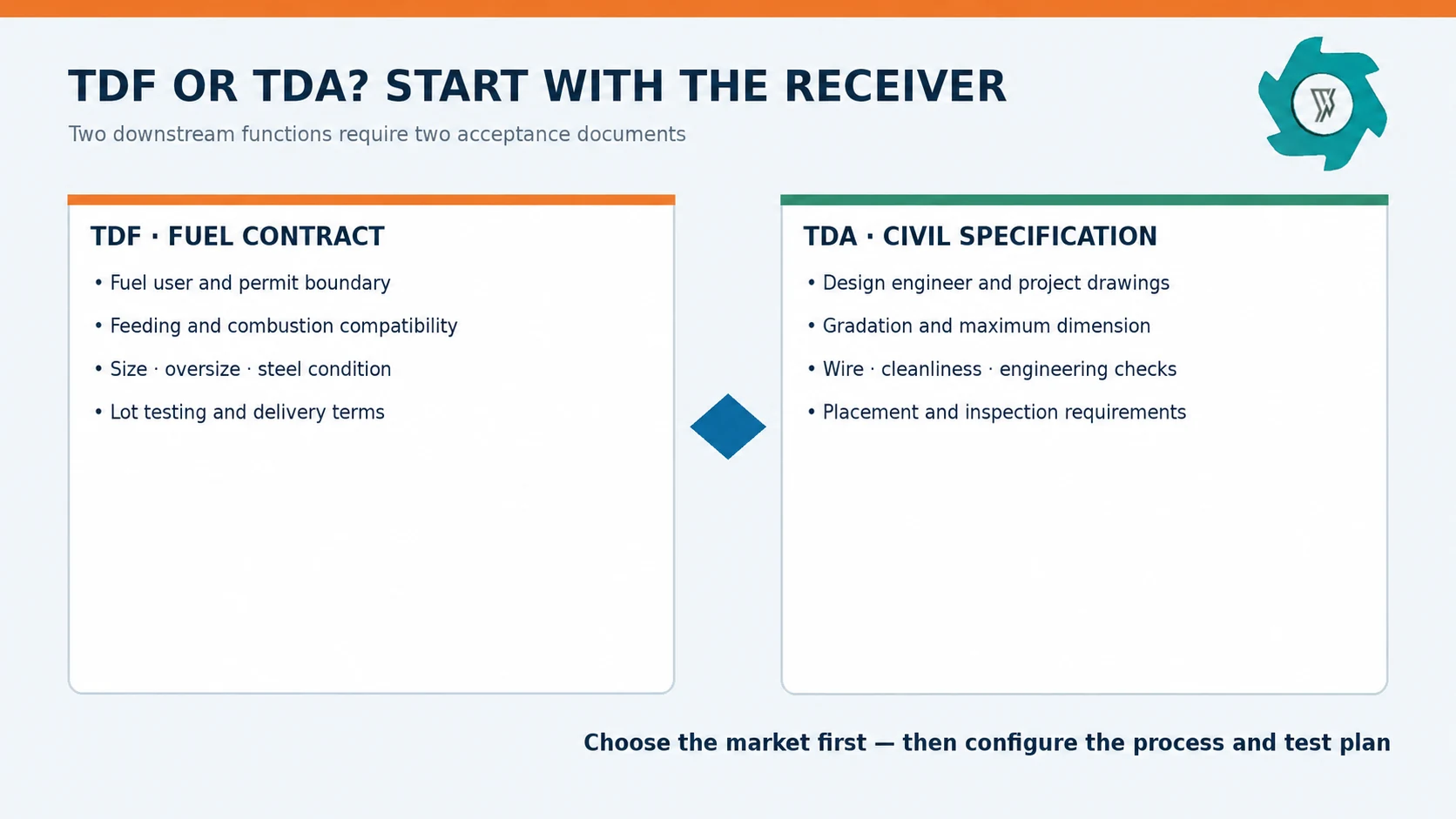
TDF and TDA can start with the same discarded tire and even leave the same primary shredder. They are not interchangeable products. Tire-derived fuel is bought for controlled combustion; tire-derived aggregate is accepted as an engineered material for civil works.
The decisive difference is the function after the tire plant
TDF is sold for energy recovery in facilities such as cement kilns, pulp and paper mills and suitable industrial boilers. Its useful properties are fuel value and, depending on the user, the mineral contribution from tire steel. TDA replaces or supplements conventional civil materials where low unit weight, drainage, compressibility, thermal insulation or vibration behavior is valuable. CalRecycle lists lightweight fill, road and embankment repair, drainage and vibration mitigation among established applications.1
A fuel user is concerned with stable feeding and combustion. A civil engineer is concerned with the installed layer and its interaction with soil, water, loads and construction equipment. Calling all rough tire chips “TDF” or “TDA” hides the most important commercial fact: the same lot may be acceptable to one receiver and rejected by the other.
| Decision point | TDF | TDA |
|---|---|---|
| Product function | Supplemental fuel used under the receiving facility’s operating, permit and emissions controls | Engineered fill, drainage, insulation, vibration or related civil material |
| Specification owner | Fuel user, permit conditions and purchasing contract | Design engineer, project drawings, agency specification and contract |
| Typical acceptance focus | Size distribution, oversize, steel condition, moisture/contamination, chemistry where required, feeding behavior | Gradation, maximum dimension, protruding wire, cleanliness, unit weight, placement and project-specific engineering properties |
| Destination constraint | Fuel receiving, storage, metering, combustion and emissions compliance | Hauling, placement, lift thickness, compaction, cover and environmental/design requirements |
| Capacity basis | Accepted fuel delivered per running hour and per elapsed hour | Accepted TDA mass or placed volume, tied to the specified gradation and density basis |
Size labels are useful only inside a named specification
The YUXI Tire TDF Plant describes a standard 50–80 mm setting and an adjustable range up to roughly 150 mm. Those figures explain one equipment configuration. A cement kiln that accepts larger chips and a boiler with a smaller feed opening may write different limits.
TDA terminology spans a wider coarse range. ASTM D7760-18 covers hydraulic-conductivity testing for tire chips, tire shreds and TDA with particle sizes of approximately 12–305 mm.2 CalRecycle illustrates Type A at about 2–3 inches and Type B at approximately 8–12 inches.1
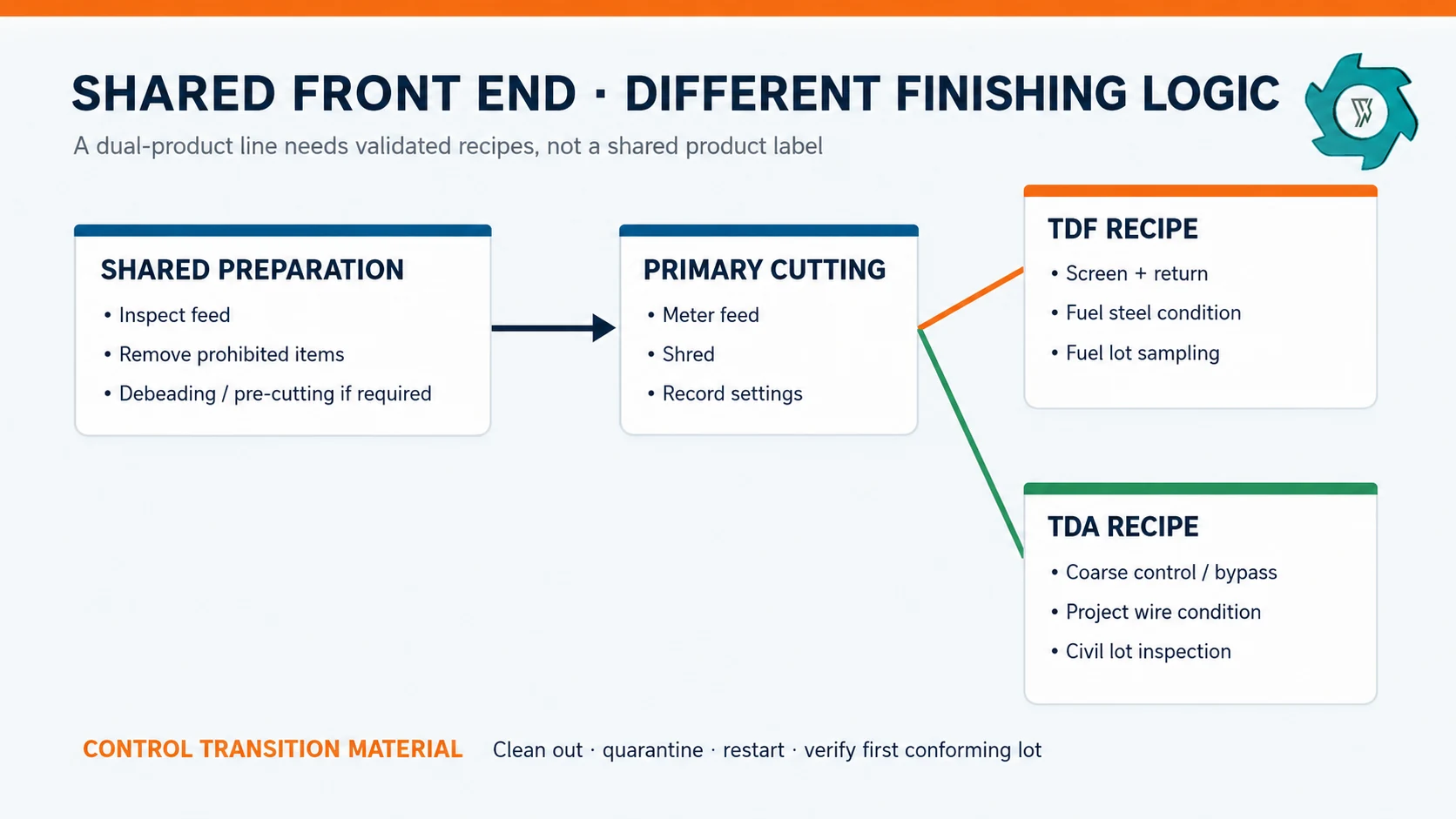
Both products normally begin with tire inspection, removal of prohibited items, metered feeding and size reduction. Large truck or OTR tires may need bead-wire removal or pre-cutting to fit the selected shredder and reduce shock loading. From there, the routes diverge.
TDF route
A typical route uses shredding, screening and an oversize-return loop. Finer settings increase recirculating load: material that does not pass the screen returns to cutting, so headline shredder throughput is not finished-product capacity. Fuel buyers may accept steel-bearing TDF, request bead removal, or impose tighter limits. The practical rule in the TDF quality specification guide still applies here.
TDA route
TDA can use a coarser screen, a different cutter arrangement or a controlled bypass, but coarse does not mean uncontrolled. Long strips, partially cut sidewalls and hazardous protruding wire can create placement and safety problems even when the average piece looks large enough. The project may also restrict soil, glass, free liquid and other contaminants. If a plant is quoting a dual-product line, it should show how the discharge route prevents a previous fuel recipe from contaminating a civil-material lot.
Steel is not a simple “remove or keep” decision
Steel condition is one of the easiest places to write a misleading comparison. For TDF, some cement users value part of the steel as process input, while other fuel-handling systems restrict loose or exposed wire. For TDA, the design specification may permit steel-bearing pieces but limit protrusions that could injure workers, damage geosynthetics or complicate placement. Complete liberation and magnetic recovery, by contrast, move the output toward wire-free mulch rather than coarse TDA.
Record bead treatment separately from belt-wire condition, then define maximum exposed length, loose-wire policy and inspection or sampling method. Buyers comparing a coarse route with a wire-free mulch plant should also recognize that the latter adds secondary reduction and steel liberation to make a different 10–20 mm product.
Applications and the proof each market expects
TDF market proof
- Compatible feed envelope and reliable metering
- Lot size distribution and oversize result
- Steel, fiber, moisture and contamination condition
- Fuel analysis when required by the user
- Traceable shipment and retained sample
TDA project proof
- Project gradation and maximum dimension
- Protruding-wire and cleanliness inspection
- Source and lot identification
- Density or volume basis used for ordering
- Placement, lift, cover and inspection records
ASTM D6270-25 is the current listed practice for scrap tires in civil engineering applications.3 Its scope makes the design engineer responsible for deciding whether the material is appropriate and which tests and specifications facilitate construction and environmental protection. A 2022 Vermont Agency of Transportation report, for example, evaluates TDA specifically for underdrain applications rather than treating every coarse tire shred as a generic aggregate.4 That is a different governance model from a fuel acceptance agreement.
For TDF, the receiving facility must remain within applicable operating and emissions requirements. EPA’s archived technical FAQ notes that combustion performance depends on properly designed equipment, good combustion control, particulate controls and compliance testing.5 The industrial boiler guide explains why feed system limits and permit conditions should be confirmed before a chip size is promised.
Can one plant switch between TDF and TDA?
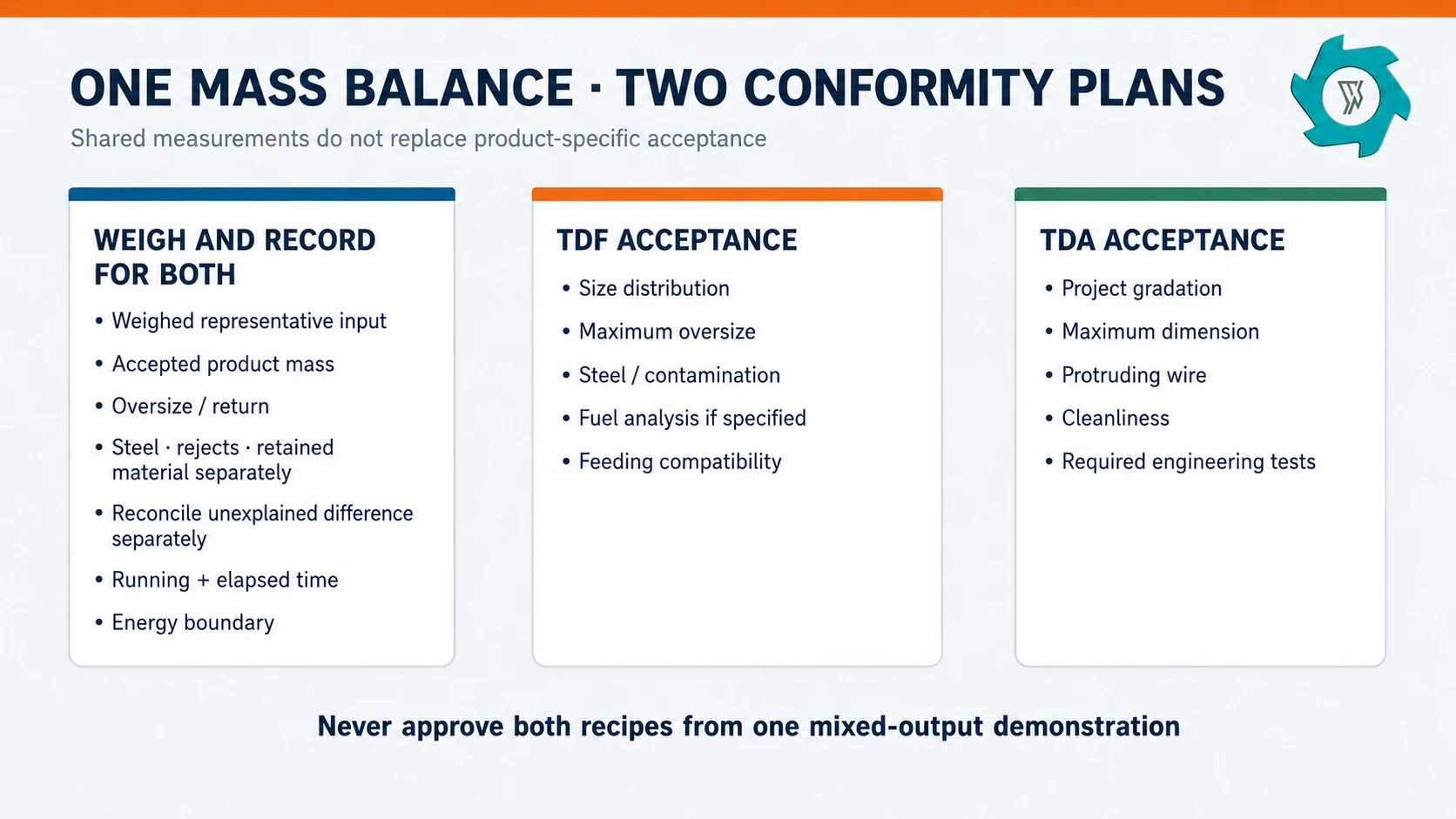
Yes, when the equipment and operating documents are designed around two validated recipes. The business case should not assume instant changeover. A larger TDA opening can reduce return load, but a screen change, bypass setting, conveyor cleanout and separate stockpile may consume production time. Switching back to a tighter TDF recipe can temporarily increase oversize until the circuit stabilizes.
A credible dual-product quotation identifies:
- the exact feed envelope used for each capacity claim;
- the installed screen, alternate screen or bypass arrangement;
- bead removal and loose-wire handling for each recipe;
- how mixed transition material is quarantined;
- weighing and sampling points for accepted product, return, steel and rejects;
- changeover labor, lifting equipment and expected downtime;
- separate guarantees for TDF and TDA rather than one “maximum throughput.”
A supplier can use the format in the TDF plant RFQ guide, but the TDA appendix should be signed off by the project engineer. A fuel user’s specification cannot stand in for civil design.
Do not release TDA until the civil project passes four gates
TDF normally has a repeat receiver that can test incoming fuel. TDA often moves against a specific construction package, so the processor needs a project-release gate before manufacturing inventory. EPA describes civil-engineering tire material as a substitute for materials such as lightweight fill, drainage aggregate or soil—not as a generic disposal route.6
| Release gate | Evidence required before production | Stop condition |
|---|---|---|
| 1. Authorized use | Applicable approval, beneficial-use determination, permit position or agency acceptance for the destination | The buyer only says that shredded tires are “generally allowed” |
| 2. Design | Issued project drawings/specification naming the application, material class, layer geometry and interfaces | No design engineer has accepted responsibility for material selection |
| 3. Product | Testable gradation, maximum piece, wire, cleanliness, sampling and rejection clauses | Order contains only a trade label such as “Type A” without its governing document |
| 4. Construction | Delivery sequence, placement method, lift/cover requirements, inspection point and responsibility for nonconforming loads | Processor is expected to infer site practice from a tonnage forecast |
ASTM D6270-25 includes design and construction guidance intended to minimize internal heating and limits the practice’s application to TDA fills below the thickness boundary addressed by its guidance.7 A processor should never turn that into a universal fill-thickness recommendation: the current standard, project design and local approval must govern the actual installation.
Give every lot a product passport
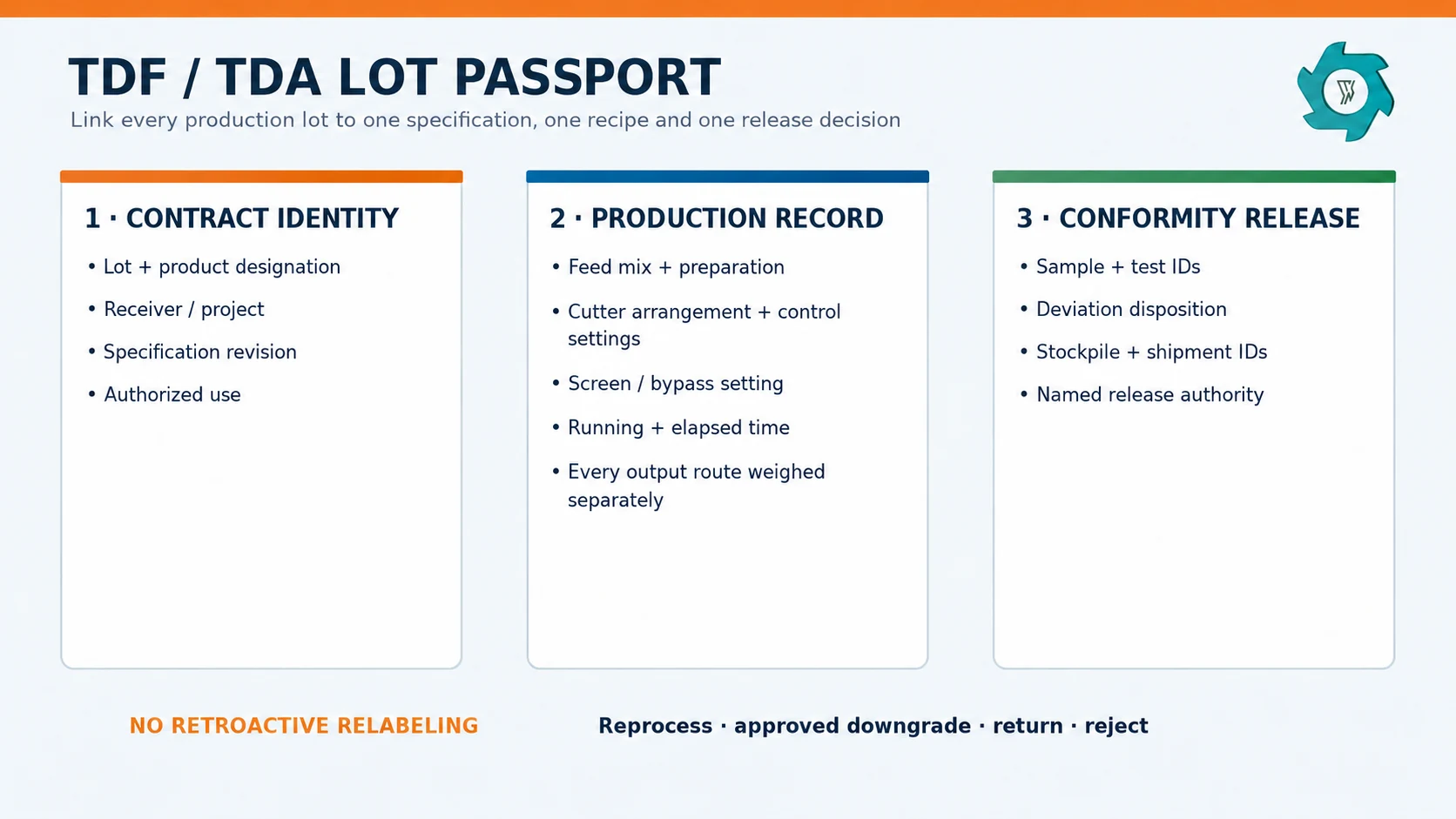
Each production lot should carry a compact record that links the receiving contract to what happened on the line. This prevents coarse transition material from being relabeled after production merely because another buyer appears.
Identity and production
- Unique lot and recipe ID
- Product designation: TDF or named TDA class
- Feed source, tire mix and excluded material
- Start/end time and scale tickets
- Screen/bypass, cutter and preparation settings
Conformity and release
- Contract/specification revision
- Sampling locations and sample IDs
- Results, deviations and disposition
- Stockpile bay and shipment IDs
- Named person authorized to release the lot
Write the disposition options before a failure occurs: reprocess, downgrade to another already-approved specification, return, or reject. Any downgrade must preserve traceability and satisfy the second receiver’s written requirements.
Compare economics at the delivered, accepted product boundary
Coarser TDA may require less cutting energy and fewer recirculation passes than smaller TDF. TDA can be project-based, ordered by volume, and sensitive to the construction schedule. Its low bulk density can use trailer volume before legal payload is reached. TDF may be denser or smaller, but it still carries storage, fire-control and fuel-user delivery constraints.
Use a scenario model rather than a generic cost-per-ton promise:
| Cost or revenue variable | Why it differs | Evidence to collect |
|---|---|---|
| Saleable yield | Transition material, oversize and rejects differ by recipe | Mass balance from representative trials |
| Processing cost | Screen opening, return load, wear and changeover vary | Power boundary, blade records and labor time |
| Freight | Payload may be limited by mass or trailer volume | Measured loose bulk density and route quote |
| Inventory | Fuel delivery may be regular; TDA demand may follow projects | Offtake schedule, stockpile limits and working capital |
| Acceptance risk | Rejected fuel and rejected construction material have different remedies | Written sampling, inspection and dispute procedure |
The useful equation is contribution per accepted delivered unit, not price minus shredder electricity. Include feed acquisition, preparation, processing, changeover, sampling, storage, loadout, freight, rejection allowance and any recovered-steel credit. When TDA is sold by volume, show the assumed loose or compacted density; otherwise a per-cubic-yard margin cannot be compared with a per-ton TDF margin.
Normalize mass-based TDF and volume-based TDA before choosing a route
A spreadsheet should preserve both mass and volume instead of forcing one estimate into the other’s unit.
Loose shipment volume = accepted product mass ÷ measured loose bulk density
Loaded freight cost per accepted mass = trip cost ÷ accepted mass actually carried
Contribution per feed mass = (product revenue + by-product credit − all variable processing, testing, handling, rejection and delivery costs) ÷ weighed feed mass
Measure loose bulk density from representative product. For placed TDA, keep loose delivery volume separate from compacted in-place volume. Settlement and compaction belong to the civil design and construction records. For TDF, keep received mass separate from any moisture or contamination adjustment in the buyer’s settlement formula.
Run at least three commercial cases: contracted base load, delayed TDA project, and temporary loss of the fuel receiver. This exposes whether the plant has genuine outlet flexibility or simply two product names competing for one stockpile area.
Contract fields that make a dual-product guarantee enforceable
| Contract field | TDF schedule | TDA schedule |
|---|---|---|
| Governing document | Fuel purchase specification and revision | Project specification/drawing and revision |
| Product unit | Accepted mass at stated settlement basis | Accepted mass and/or stated loose or placed volume basis |
| Size proof | Sieve/sample method, distribution and maximum oversize | Named gradation, maximum dimension and elongated-piece rule |
| Steel proof | Bead treatment, exposed/loose steel limit and test method | Protrusion/loose-wire rule and inspection method |
| Other quality | Moisture, ash, chemistry, textile and prohibited material where specified | Cleanliness plus specified physical/environmental tests |
| Capacity guarantee | Accepted output per running and elapsed hour at frozen recipe | Accepted output per running and elapsed hour at frozen recipe |
| Changeover | Screen/bypass work, cleanout, transition-lot disposition, labor, time and first-lot verification | |
| Remedy | Retest rule, reprocessing responsibility, rejection boundary and documented dispute sample | |
Factory acceptance test for a dual-product claim
Run the TDF and TDA recipes as separate stable tests using representative feed. The same weighing discipline applies to both, but each product needs its own conformity check.
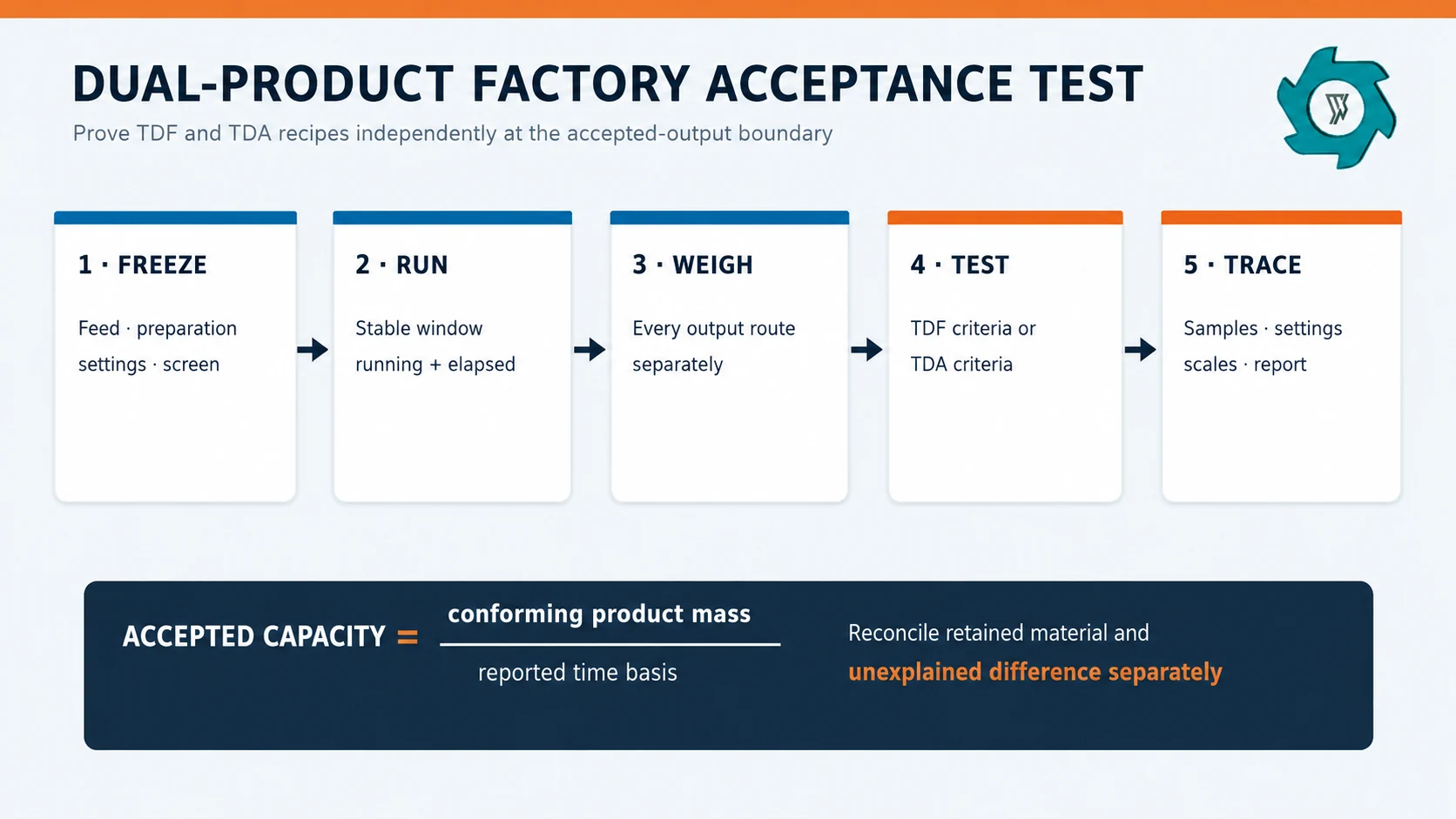
- Freeze feed and settings. Record tire categories, preparation, cutter arrangement, screen or bypass and control settings.
- Use a stable observation window. Report machine running time and elapsed test time; list stops, reversals and interventions.
- Weigh routes separately. Input, accepted product, oversize/return, recovered steel, other rejects and retained material should not be merged.
- Reconcile the balance. Report unexplained difference separately instead of hiding it inside “losses.”
- Test the named product. TDF: size, oversize, steel/contamination and contract analyses. TDA: project gradation, maximum piece, protruding wire, cleanliness and required engineering tests.
- Keep traceability. Seal retained samples, photos, scale records, settings and the test report to the lot and recipe.
The same discipline is expanded in the TDF plant factory acceptance test. For a dual-purpose line, add a witnessed changeover and verify the first conforming lot after the switch.
A practical selection sequence
- Secure at least one realistic offtake route for each proposed product.
- Obtain the full receiver or project specification, not a verbal size request.
- Map every requirement to feed preparation, cutting, screening, separation, handling and test equipment.
- Trial the worst credible tire mix rather than clean passenger tires only.
- Calculate accepted delivered economics under low, expected and high demand.
- Buy dual-product flexibility only when the changeover method and both guarantees are written into the contract.
This sequence prevents a common capital mistake: purchasing a coarse tire shredder first and searching for a legal, specification-compliant market afterward. TDF and TDA are both established outlets, but neither is simply “shredded tires.”
Frequently Asked Questions
Is TDA the same material as TDF?
TDF is prepared and accepted as a fuel, while TDA is specified as an engineered civil-construction material. Similar-looking tire pieces can still fail the receiving specification because their size distribution, exposed steel, cleanliness and verification requirements differ.
Can one tire shredder make both TDF and TDA?
Sometimes, but not by changing the product name alone. The shredder, screen, return loop, feed preparation, discharge handling and sampling plan must cover both contracts. A coarser TDA product may need a different screen or bypass, while a fuel buyer may require tighter sizing or a different steel condition.
Does TDA always require complete steel removal?
No universal rule applies to every TDA project. The project specification controls allowable protruding wire, particle geometry and handling safety. Some applications accept steel-bearing tire pieces; others impose stricter limits. The producer should obtain the written specification before selecting separation equipment.
Which product is cheaper to manufacture?
The cheaper product is the one the plant can make and deliver within a real contract. Coarser TDA can reduce cutting and recirculation, but project-specific grading, wire, cleanliness, testing, placement schedules and freight can dominate. TDF may require more size control, yet a nearby continuous fuel user can provide steadier offtake.
What should be tested before buying a dual-product line?
Run a separate witnessed trial for each product recipe. Record representative feed, machine settings, running and elapsed time, every weighed output route, size distribution, oversize or return, steel condition, contamination, energy boundary and interventions. Acceptance should be based on saleable output, not shredder inlet rate.
Turn the receiver’s specification into a plant scope
Send the tire mix, TDF acceptance sheet, TDA project specification, required capacity, site power and delivery plan. YUXI can map the process boundary, screen options, separation steps and test points before equipment is quoted.
Engineering References
- CalRecycle, TDA guide. Applications and examples.
- ASTM International, D7760 standard. Hydraulic-conductivity testing.
- ASTM International, waste standards. Scrap-tire civil-use context.
- VTrans, underdrain report. TDA field context.
- U.S. EPA, TDF FAQ. Fuel-use questions.
- U.S. EPA, civil applications. Processed scrap-tire uses.
- ASTM International, D6270 standard. Civil engineering applications.