Ambient vs Cryogenic Grinding for Tire Rubber Powder
Ambient and cryogenic grinding can both turn prepared tire rubber into powder, but they do not create the same particle surface or the same plant economics.Firstly,the cryogenic systems chill the rubber until it become brittle,and then break it.The single change of material state will affect the mill,the morphology of particle,cooling requirement,and the operating cost.In some other applications,it can also affect the behaves in the next process.[1][2]
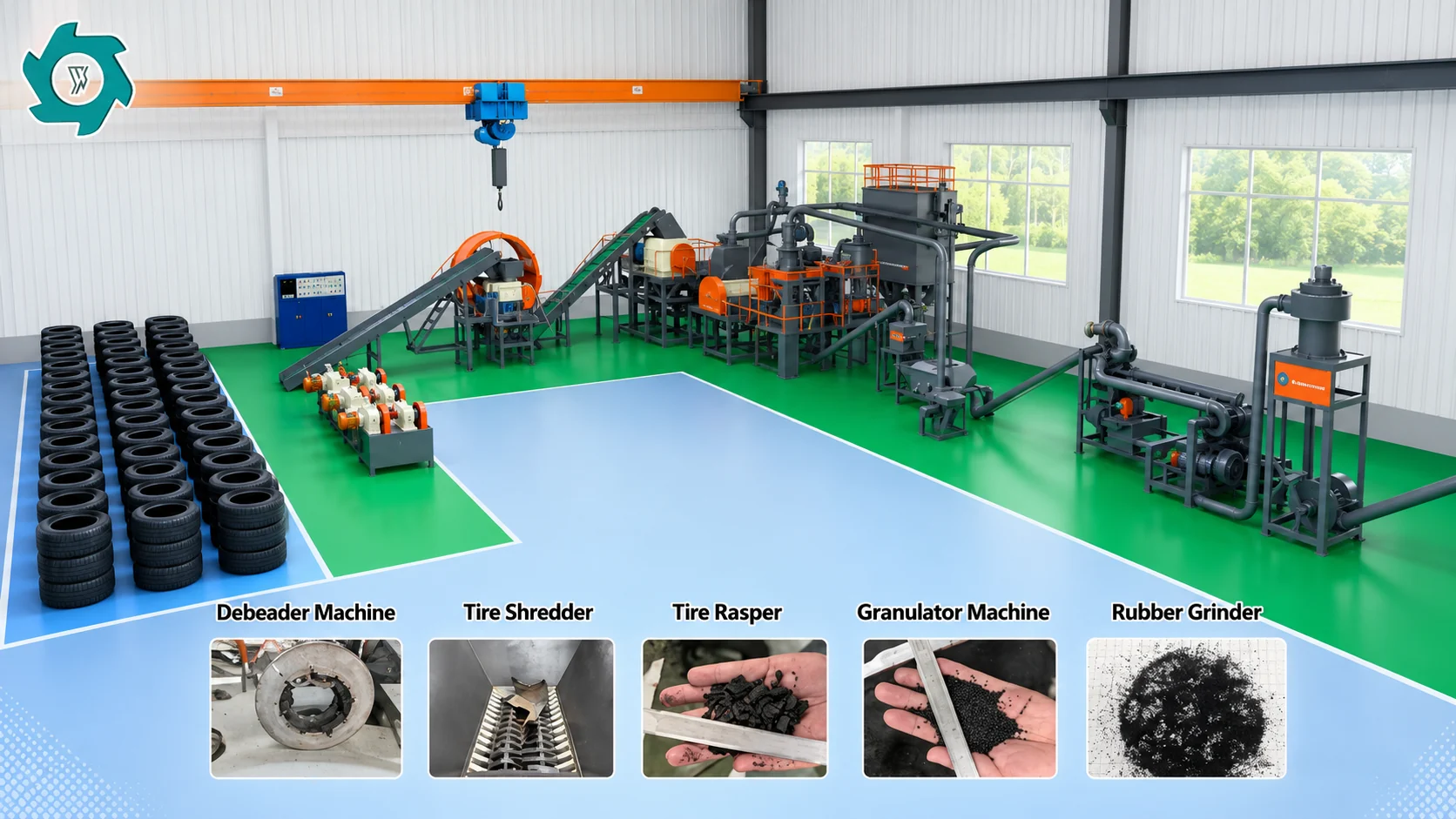
YUXI’s tire rubber powder plant is based on ambient mechanical processing: steel and textile are removed upstream, clean 1–8 mm rubber granulate is graded, and the final grinding section produces powder in the stated 20–120 mesh range. That is a different equipment boundary from a cryogenic line with liquid-nitrogen storage and low-temperature conditioning.
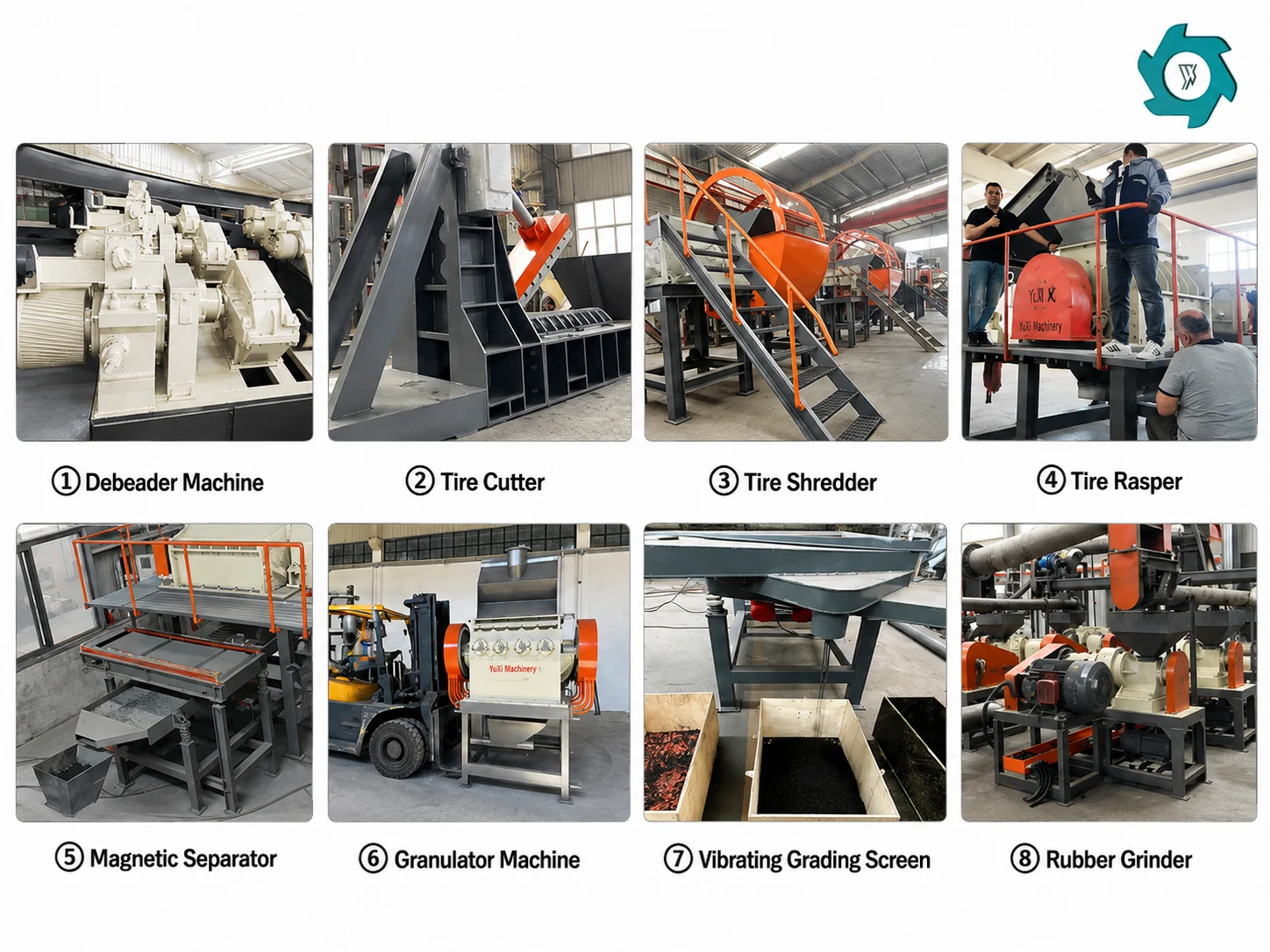
Ambient tire-to-powder processing is a chain of preparation, shredding, steel liberation, granulation, grading, fiber removal and fine grinding—not a single mill.
Ambient vs Cryogenic Grinding at a Glance
Decision point
Ambient mechanical grinding
Cryogenic grinding
Rubber condition during size reduction
Elastic; reduced mainly by cutting, shearing and repeated mechanical work
Cooled below the brittle-transition region, then fractured by impact
Typical particle surface
Irregular, torn and relatively rough
Smoother, cleaner-edged and generally less developed
Fine-grinding heat
Heat must be controlled with airflow, water cooling, feed control or other cooling measures
Low temperature is created intentionally before/during fracture
Main consumables / cost pressure
Electricity, wear parts, screens, cooling, recirculation and dust handling
Liquid nitrogen plus electricity, storage, insulated handling and controls
Plant complexity
Conventional mechanical line; easier to integrate where cooling water and ventilation are available
Adds cryogenic storage, dosing, temperature control and low-temperature equipment
Where it is often attractive
General crumb/powder production, rubberized materials and applications that benefit from a rougher particle surface
Fine, clean and tightly controlled powders where the downstream buyer pays for the specification
Key mistake to avoid
Quoting capacity at coarse feed instead of accepted fine powder
Comparing mill energy without including nitrogen and cryogenic infrastructure
How Ambient Tire Rubber Grinding Works
In an ambient system, the rubber is not intentionally frozen. It remains resilient while knives, rollers, discs or other grinding elements work against it. The machine therefore has to overcome elasticity as well as reduce size. A particle may deform, recover, turn and pass through the cutting zone several times before it reaches the accepted size.
A fine mill should not be treated as a machine that can accept whatever leaves a tire shredder. Whole tires first need controlled size reduction and separation. In the YUXI route, a rasper opens the rubber around the embedded steel, magnets recover liberated wire, a granulator reduces the cleaned material, and airflow removes textile fiber before fine grinding. The waste-tire-to-rubber-powder process guide covers those upstream handoffs in more detail.
A controlled ambient line prepares the rubber before fine grinding. Residual steel and fiber become much harder to manage once the product reaches powder size.
Why heat becomes a bottleneck
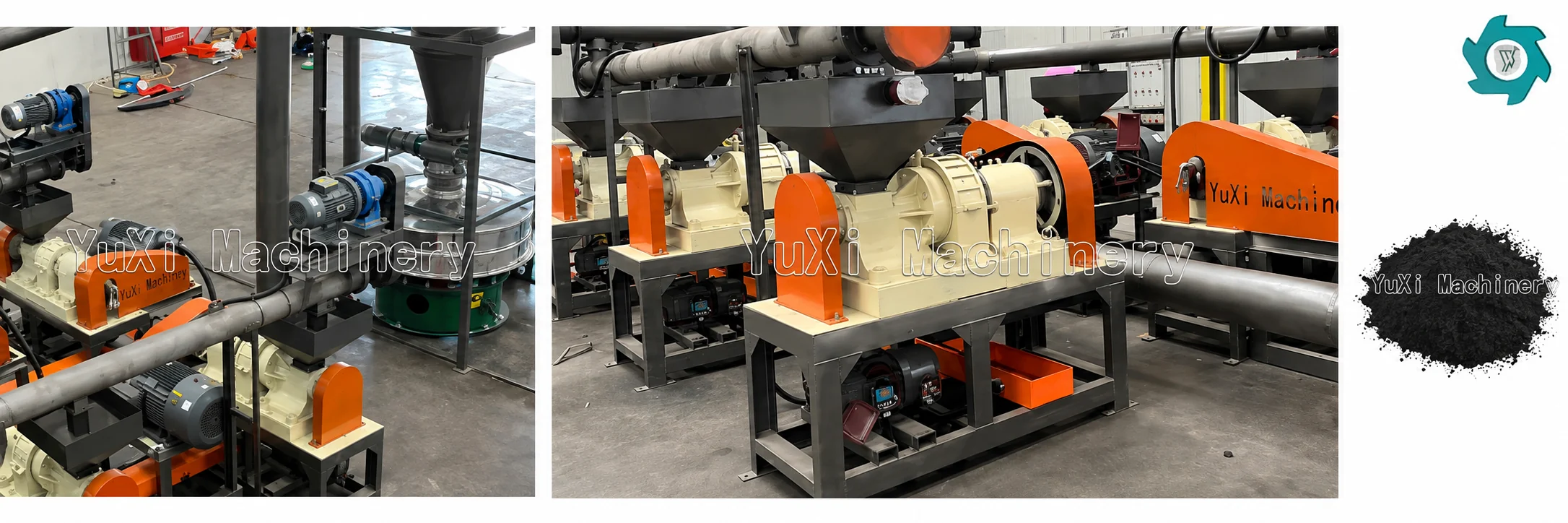
Rubber absorbs mechanical work and does not fracture as cleanly as a brittle mineral. Fine grinding therefore generates heat. If feed is forced through a mill faster than the grinding and cooling system can handle it, the temperature will rise and the output can become unstable, and the material may smear or agglomerate instead of classifying cleanly. Water cooling and airflow are common ways to control this duty; the YUXI pillar uses wind and water cooling in its final grinder section.
That does not mean an ambient mill has one fixed capacity. More material stays in the grinding/classification loop, while the smallest accepted fraction leaves the system. This is why our normal selection sequence starts with the saleable powder specification and works backward to the mill duty.
How Cryogenic Tire Rubber Grinding Works
Cryogenic grinding changes the problem before the mill sees it. Rubber is cooled below its glass-transition region, commonly using liquid nitrogen. In that state, the material becomes brittle because it loses much of its elasticity. Federal Highway Administration guidance describes cryogenic tire rubber grinding as low-temperature conditioning followed by impact milling, while EPA background material similarly notes the use of liquid nitrogen and hammer milling.[2][3]
A practical cryogenic line therefore needs more than a hammer mill. It requires a way to store and supply the cryogen, meter it to the process, cool the rubber uniformly, control temperature, transfer brittle material without excessive warming, and collect the ground product. Those items change both capital cost and operating responsibility. The local supply chain for liquid nitrogen matters as much as the nameplate power on the mill.
Why cryogenic fracture looks different
When elastic rubber is torn and cut at ambient temperature, the fracture path is irregular. When frozen rubber shatters, the particle surface is usually smoother and less porous. Peer-reviewed reviews and RSC literature consistently describe ambient particles as rougher or more developed, and cryogenic particles as smoother with lower surface area.[4][5]
That difference can matter downstream. A rough particle can provide more mechanical interlocking in some polymer or binder systems. A smoother particle may flow differently and may be preferred where a fine, clean and more regular powder is the priority. Neither morphology is automatically superior. A compounder may care more about dispersion, viscosity, surface treatment or final physical properties than about whether the grinder was ambient or cryogenic.
Particle Size Is Only One Part of the Powder Specification
It is tempting to make the comparison entirely about mesh. That is incomplete. ASTM treats recycled vulcanizate particulate rubber as a material defined by particle-size distribution, and ASTM D5644 provides methods for measuring that distribution.[6] A commercial powder specification should also control residual steel, loose textile fiber, moisture or conditioning basis, oversize, fines and the sampling method.
The distinction matters because two powders can both be sold as “80 mesh” yet contain different distributions around that label. One can carry more fines; another can have a wider tail of coarse particles. For this reason, the RFQ should state the sieve stack and the percentage passing or retained at each control sieve. The same rule applies whether the powder is ambient-ground or cryogenically ground.
Surface Morphology: Rough Ambient Powder vs Smoother Cryogenic Powder
Surface morphology is one of the clearest technical differences between the two routes. Ambient grinding tends to tear the rubber and expose a rough, irregular surface. Cryogenic fracture generally creates smoother particles. Research comparing ground tire rubber produced by different methods has linked these surfaces to differences in specific surface development and interaction with new polymer matrices.[1][4]
That is why “finer is better” can be the wrong conclusion. An ultra-clean, smooth cryogenic particle does not automatically create stronger bonding. Conversely, an ambient particle with a rough surface does not automatically satisfy a high-value compounder’s tolerance for contamination or particle-size spread.
We normally recommend sending representative powder samples to the downstream processor before freezing the plant design. A short production trial can settle questions that the chart can not deal with: how the powder disperses, whether the surface needs treatment, whether it changes compound viscosity,and how much off-spec fine material the buyer can tolerate.
Energy Use: Separate Mill Power from Total Process Cost
Cryogenic grinding is sometimes described as energy-saving because brittle rubber needs less mechanical work to fracture.Liquid nitrogen has to be produced, delivered, stored and consumed, and the cryogenic section needs insulated equipment and controls. Reviews of tire-rubber grinding make the same distinction: cryogenic grinding can increase production rate and reduce milling energy, yet nitrogen consumption remains a major cost driver.[1][4]
Ambient grinding has a different cost profile. It uses more direct mechanical work as the product becomes finer. Wear, screen condition, recirculation, water/air cooling and dust extraction become important. There is no nitrogen bill, but the accepted-tonne energy cost can climb when the target moves deeper into fine powder.
Cost item
Ambient route
Cryogenic route
Grinding electricity
Can rise strongly with finer targets and higher return load
Fracture can require less mill work once rubber is brittle
Cooling
Air, water and heat-management equipment
Liquid nitrogen is a core process consumable
Wear parts
Knives, plates, screens and grinder wear components
Impact mill wear plus cryogenic handling equipment
Electrical supply plus cryogen storage, delivery and low-temperature controls
Economic sensitivity
Electricity price, wear life, mesh, recirculation and capacity utilization
Local nitrogen price/availability, consumption rate, mesh and product premium
The correct comparison is cost per accepted tonne of powder at the same specification. A quotation that compares only motor kW is incomplete. So is a cryogenic estimate that treats nitrogen as a minor accessory. If project economics are the main concern, the rubber powder machine price and line cost guide explains how feed boundary, mesh and accepted output change the equipment scope.
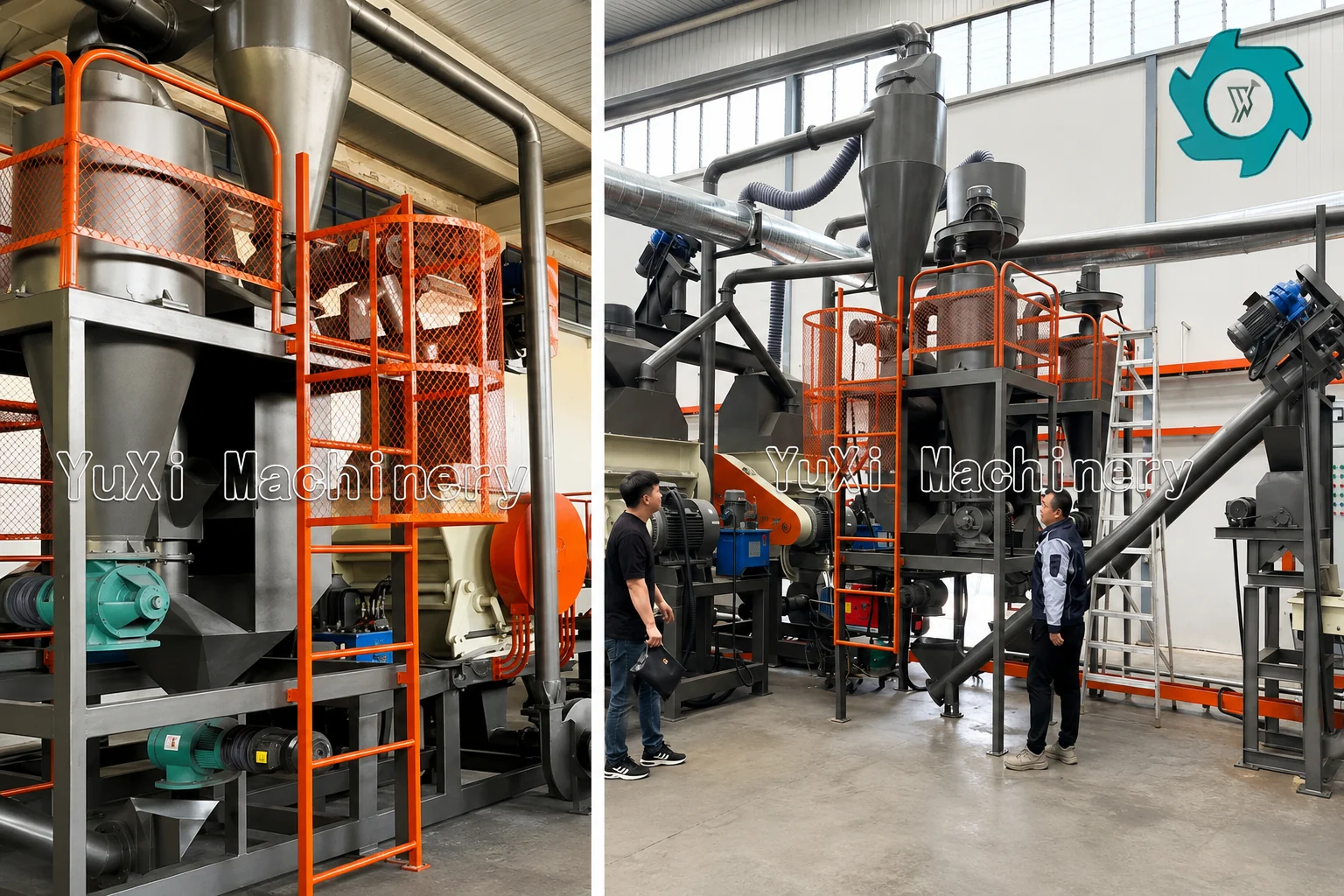
In an ambient line, the fine grinder is only the last reduction stage. Feed cleanliness, stable metering, cooling and classification determine how much powder is actually saleable.
Purity Depends on Separation Before the Grinder
Cryogenic processing is sometimes marketed as the path to “purer” powder. The grinding temperature alone cannot guarantee that. A tire contains bead steel, belt wire and textile reinforcement. Those contaminants have to be removed through preparation and separation, regardless of how the final size reduction is performed. EPA describes tire crumb production as a sequence that uses screens, magnets and air separation to remove oversize material, steel and fabric.[3]
For an ambient plant, that means the rasper and magnets must liberate and recover steel before the granulator and fine mill. Textile should be aspirated from a controlled granulate stream rather than allowed into the powder stage. The crumb rubber quality specification guide gives a useful contract framework for particle distribution, steel, fiber, moisture and sampling. The same logic should be carried into a fine-powder purchase specification.
Fine grinding should begin with controlled, clean granulate. Steel and textile removal are upstream quality-control jobs, not problems to leave for the final powder mill.
Which Route Is Better for 20–120 Mesh Tire Rubber Powder?
For many conventional tire-recycling projects, ambient grinding is the more straightforward starting point. The equipment integrates naturally with mechanical shredding, rasping, granulation, magnetic separation and fiber removal. There is no cryogen supply chain to manage, and the rougher particle surface can be useful in applications where interfacial contact matters.
Cryogenic grinding becomes more interesting when the product specification is difficult to achieve economically with repeated ambient passes, or when a downstream user is willing to pay for a fine, clean and tightly controlled powder. It is especially worth evaluating where liquid nitrogen is reliably available at an industrial price and the plant can keep the cryogenic section highly utilized. Low utilization is hard on cryogenic economics because the infrastructure remains while the value-producing tonnage disappears.
When ambient grinding is usually the easier fit
The feed is already part of a conventional whole-tire recycling line.
The target is within a practical 20–120 mesh range and the required finished rate can be met with controlled cooling and classification.
Local nitrogen cost or supply reliability is unattractive.
The downstream application accepts or prefers a rough, irregular particle surface.
The operator wants a mechanical process that can share maintenance and utility practices with the rest of the plant.
When cryogenic grinding deserves a serious study
Mechanical grinding becomes a severe capacity or heat bottleneck at the required size.
A smoother, more regular particle is preferred by the downstream process.
Liquid nitrogen is available consistently and its delivered cost has been included in the business model.
A pilot trial shows enough yield, throughput or product-value advantage to cover the added cryogenic system.
What to Put in an RFQ for Ambient or Cryogenic Grinding
Feed: tire type or prepared rubber feed, nominal size, maximum size, residual steel/fiber condition and moisture condition.
Product: sieve/mesh distribution, oversize and fines limits, residual steel, free textile fiber and any buyer-specific contamination limit.
Capacity: accepted finished powder tonnes per hour at the stated specification.
Grinding route: ambient or cryogenic, including all cooling or cryogen equipment inside the supplier battery limit.
Utilities: installed power, normal operating power, cooling-water requirement, compressed air if applicable, and—for cryogenic systems—nitrogen consumption and storage/delivery assumptions.
Quality verification: sampling point, sieve test, contamination test, test duration and retained samples.
What is the main difference between ambient and cryogenic tire rubber grinding?
Ambient grinding reduces rubber mechanically while it remains elastic, using cutting, shearing and controlled cooling. Cryogenic grinding cools rubber below its glass-transition region, commonly with liquid nitrogen, so it becomes brittle and can be fractured by impact.
Which process makes rougher rubber powder particles?
Ambient mechanical grinding usually creates more irregular particles with a rougher, more developed surface. Cryogenic fracture usually creates cleaner-edged, smoother particles with lower surface roughness.
Is cryogenic grinding always cheaper for fine rubber powder?
No. Cryogenic grinding can reduce the mechanical work required for brittle fracture, but the operating and infrastructure cost of liquid-nitrogen supply, storage, insulated handling and process controls will increase. The economic result depends on local nitrogen cost, throughput, the particle-size target, and product value.
Can an ambient rubber powder plant produce 80 or 120 mesh powder?
Yes, an ambient fine-grinding system can be configured for fine powder ranges, but accepted output normally falls as the target becomes finer and the grinding, cooling, classification and recirculation duties increase. The required mesh and finished throughput should be guaranteed together.
Does cryogenic grinding automatically produce purer rubber powder?
Not automatically. Cryogenic processing can support clean fracture and efficient liberation, but finished purity still depends heavily on upstream bead removal, steel liberation, magnetic separation, fiber separation, screening and clean material handling.
Which grinding route should a tire recycler choose?
Choose from the buyer specification backward. Ambient grinding is often practical for conventional rubber powder markets where operating simplicity and rough particle surface are useful. Cryogenic grinding deserves evaluation when very fine, clean or tightly controlled powder can command enough value to justify nitrogen and cryogenic-system costs.
Compare the Grinding Route Around Your Powder Specification
Send your starting material, target mesh distribution, accepted output, steel and fiber limits, operating hours, voltage and downstream application. YUXI can size the ambient tire rubber powder line around the real product requirement and identify where grinding, cooling, separation or classification will control capacity.
Marie has 8+ years of experience in tire shredding and recycling equipment,with a focus on tire shredders,rubber recycling machines,TDF production,rubber crumb processing,and complete tire recycling systems.