




“40 mesh, 99.7% purity” sounds precise, but it is not yet a purchase specification. We still need to know the particle-size distribution, how residual steel and textile fiber are measured, the moisture basis, the sampling plan, and whether the required production rate is measured before or after oversize is returned.
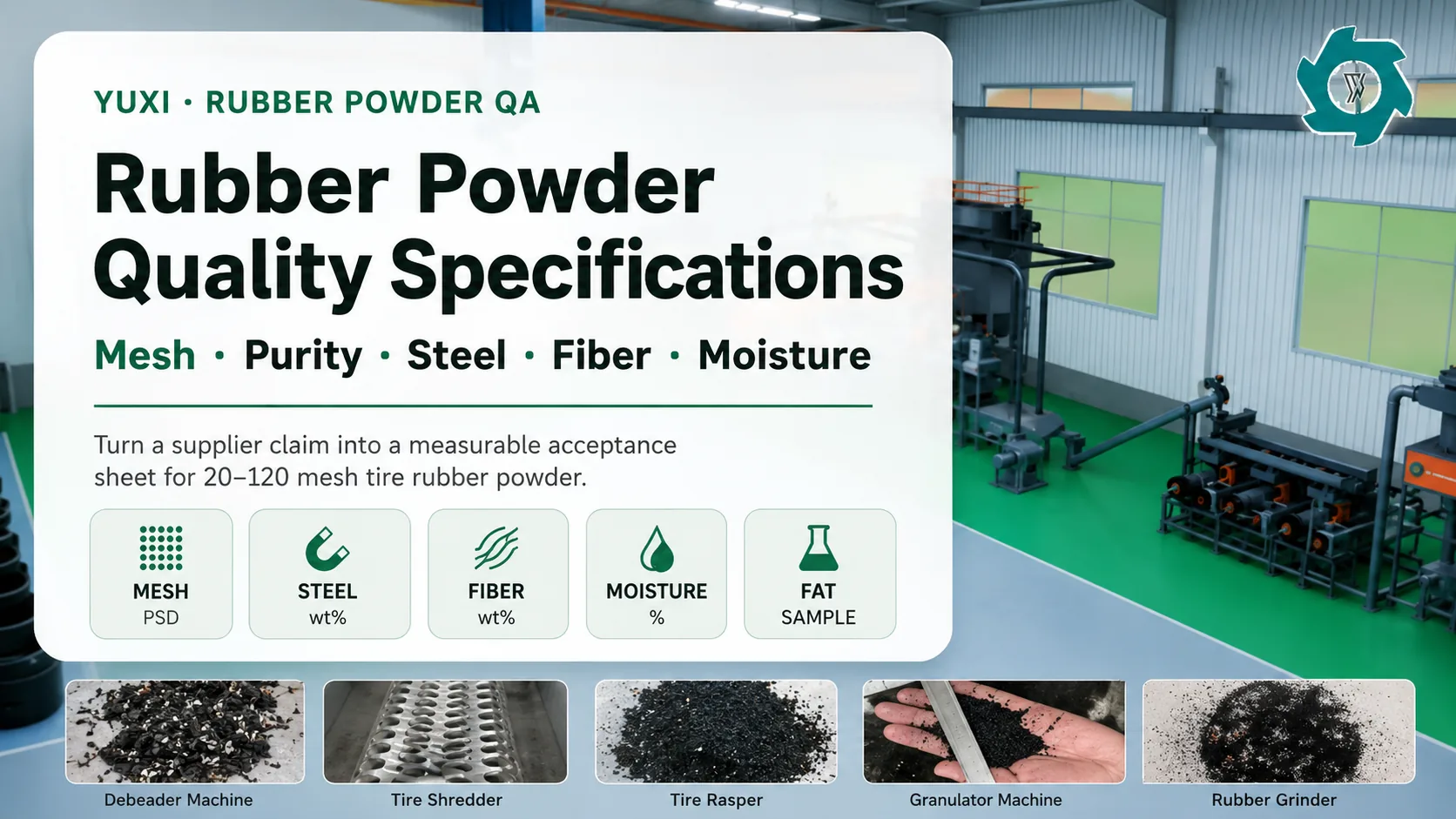
Write Five Separate Acceptance Lines Instead of One “Purity” Number
A practical rubber powder specification separates properties that are controlled by different parts of the production line. Particle size comes mainly from grinding, classification and return. Steel depends on liberation and magnetic recovery. Textile fiber needs its own separation step. Moisture is strongly affected by feed condition, storage and packing. Combining all of them into a single purity percentage makes troubleshooting difficult and supplier comparisons unreliable.
| Quality item | What the purchase specification should state | Why it matters to the plant |
|---|---|---|
| Particle-size distribution | Sieve series, target grade, % retained or passing on each controlling sieve, oversize allowance, test method. | Defines grinding duty, classifier loading, return rate and accepted output. |
| Residual steel / magnetic metal | Maximum mass percentage, sample mass, magnet/test method and whether visible wire is separately prohibited. | Checks steel liberation plus first and second magnetic recovery stages. |
| Free textile fiber | Maximum mass percentage, collection method and dry/as-received basis. | Checks fiber separator setting, airflow, feed stability and classification. |
| Moisture | Maximum percentage, drying/test method, basis and sampling condition. | Moist powder can agglomerate, bias sieving and complicate dosing or storage. |
| Lot, packing and sampling | Lot size, bag type, sample location, number of increments, sample reduction, sealing and retained sample. | Makes the result representative instead of depending on one convenient scoop. |
“80 Mesh” Does Not Mean Every Particle Is 180 μm
Common U.S. openings are about 850 μm for No. 20, 425 μm for No. 40, 180 μm for No. 80 and 125 μm for No. 120. Ground tire rubber is irregular, so a commercial grade contains a distribution rather than one exact diameter.
ASTM D5644-23 is especially useful for this discussion because it assigns mesh designations from a measured particle-size distribution.[1] Its current mechanical sieve-shaker scope covers recycled vulcanizate rubber at 90 μm (170 mesh) and larger. The standard also allows a controlled upper-retained fraction that varies with the nominal mesh range.
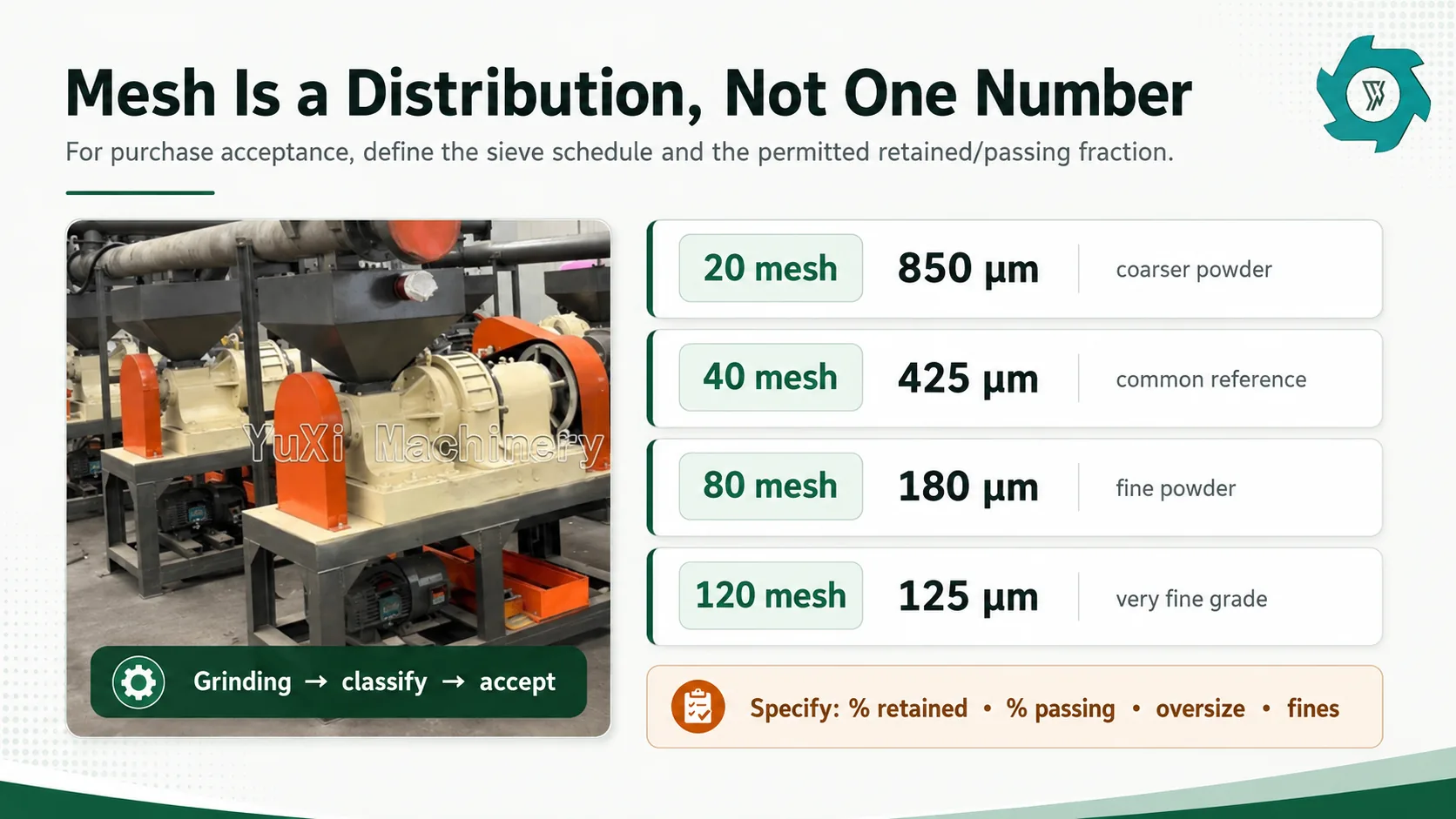
| Nominal reference | Approx. opening | What to put in the RFQ or contract |
|---|---|---|
| 20 mesh | 850 μm | Controlling sieve and permitted oversize; clarify whether this is coarse powder or fine crumb in the buyer’s terminology. |
| 40 mesh | 425 μm | Passing/retained percentages plus contamination limits and accepted finished t/h. |
| 60 mesh | 250 μm | PSD, recirculation basis and sampling location. |
| 80 mesh | 180 μm | Fine-grade PSD, temperature/handling conditions and output after classification. |
| 100 mesh | 150 μm | Buyer test method, fines/oversize boundary and packaging requirement. |
| 120 mesh | 125 μm | Fine-grade yield and stable-run acceptance; do not use grinder feed rate as finished capacity. |
For a deeper application-by-application discussion, see the rubber powder mesh size and applications guide.
Residual Steel and Free Fiber Need Different Separation and Different Tests
Steel: liberation comes before magnetic recovery
A magnet cannot pull out steel that is still strongly encapsulated inside a large rubber piece. In a tire-to-powder line, the rasper first opens the rubber around embedded cord. Magnetic recovery then removes liberated steel, and a second magnetic pass can capture finer steel released after additional size reduction.
For acceptance, distinguish at least two ideas: visible dangerous wire and magnetic metal by mass. A sample can look clean while still carrying fine metallic fragments. Conversely, one isolated visible strand may fail a customer’s handling rule even when the total metal percentage is low.
Fiber: non-magnetic contamination needs airflow and classification
Textile fiber is light, irregular and non-magnetic. It can travel with rubber fines, bridge in transfers or appear as fuzz in a bag. Fiber removal therefore relies on liberation, particle grading, controlled airflow and stable loading rather than magnets.
Excessive airflow is not automatically better. It can entrain saleable rubber fines, so the plant must balance fiber removal against rubber loss. The final specification should say whether the limit covers free visible textile, a weighed dry textile fraction, or another agreed method.
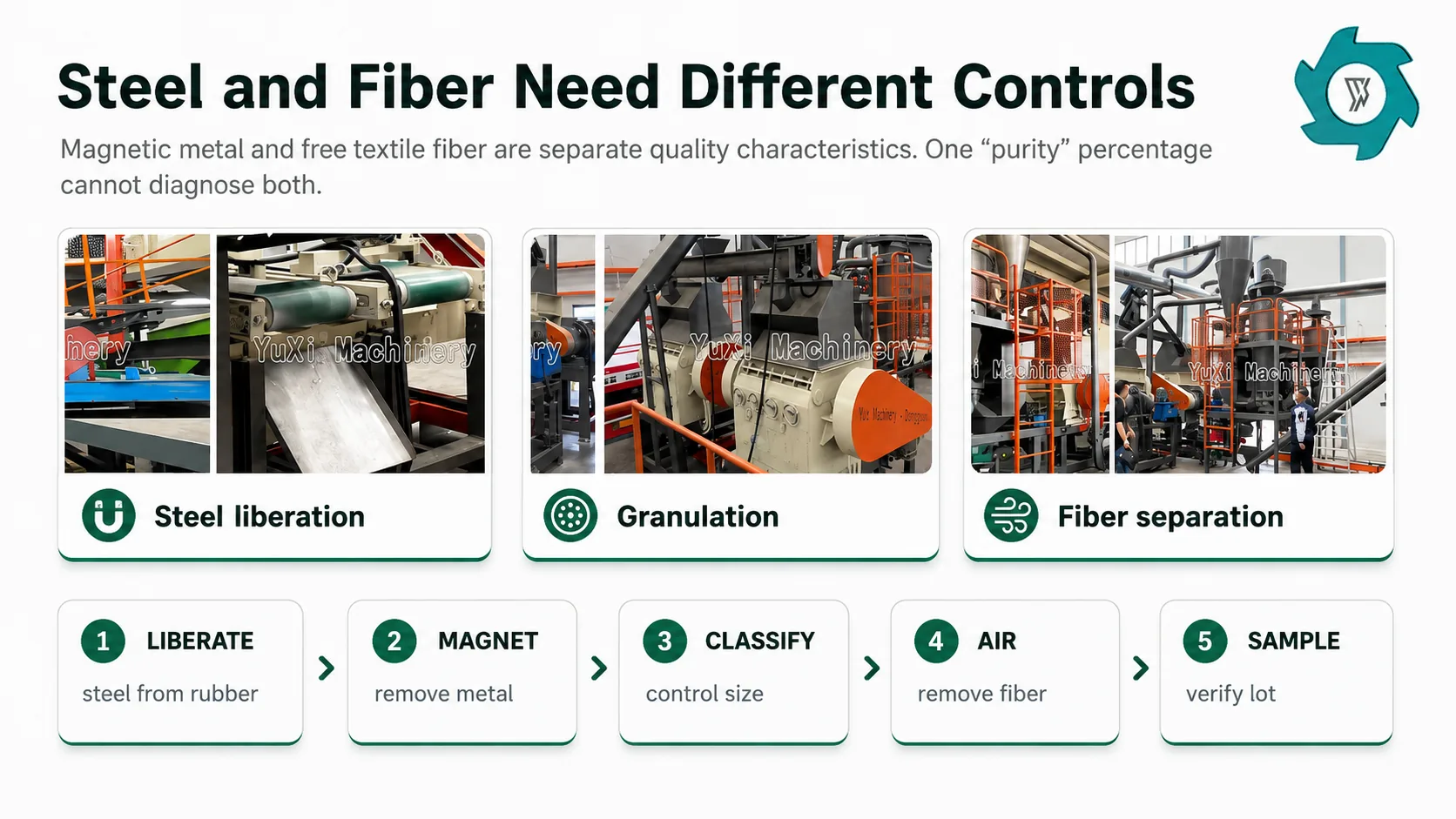
The complete high-purity tire rubber powder plant places steel liberation, magnetic recovery, granulation, grading and fiber separation before final fine grinding. That process order matters because the grinder should receive already-clean rubber granulate rather than be asked to correct upstream contamination.
Measure Moisture on a Defined Basis and Protect the Lot After Testing
Moisture is easy to overlook because ambient tire grinding does not intentionally add water to the rubber as a product ingredient. The finished powder can still pick up moisture from wet feed, humid air, wash-related upstream processes, open storage or damaged bags.
For fine powder, moisture matters in three practical ways. First, damp particles can form soft agglomerates and change the sieve result. Second, they can affect dosing and blending at the customer’s plant. Third, a lot that passes a factory test can arrive in a different condition if packaging is not sealed or storage is poorly controlled.
- State whether moisture is reported on an as-received or dry basis.
- Name the drying method, temperature/time approach or referenced standard.
- Take the sample from the same product condition that the buyer will receive.
- Define the bag, liner, seal, lot identification and storage expectations.
California Test 385 provides a useful example of why the method belongs in the specification: its asphalt-rubber CRM procedure records original and oven-dried sample masses before sieve analysis.[2] That is an application-specific test example, not a universal moisture limit for every tire rubber powder market.
Ash Can Be Useful, but It Does Not Mean the Same Thing as Dirt
A tire already contains mineral fillers and inorganic ingredients as part of its original formulation. An ash result therefore does not automatically equal “foreign dirt.” Road grit, stones or mineral contamination can raise the result, but so can legitimate tire-compound ingredients. If ash is used as an acceptance criterion, the contract should name the test method, the expected feedstock family and the reason the downstream process needs the limit.
ASTM D8268-19(2023) is useful here because it treats composition evaluation as part of quality control and classification for recycled vulcanizate particulate rubber and points users toward standard composition test methods.[3] For an equipment supplier, the practical lesson is simple: do not invent one universal ash specification from the machine alone. The value must come from the buyer’s material requirement and an agreed laboratory method.
Process contamination
Free steel, textile, stones, wood, soil and other unintended material should be controlled by feed inspection and separation. These are process-quality issues.
Material composition
Ash, polymer content and other composition data describe the rubber material itself. They may vary with passenger, truck and mixed-tire feed even when the line is operating correctly.
Separate a Brochure Claim, a Project Guarantee and a Routine COA
Quality numbers become more reliable as the evidence becomes closer to the actual project. A website or catalog can describe the normal machine range. A quotation can define the proposed test basis. A FAT can demonstrate the line with representative feed. Routine production records or certificates of analysis (COAs) then show whether later lots continue to meet the agreed specification.
| Evidence | What it is good for | What it should not be used for |
|---|---|---|
| Website / catalog figure | Initial screening of machine range and process concept. | A substitute for a buyer-specific material acceptance standard. |
| Quotation specification | Defines feed assumptions, target mesh, test methods, limits and acceptance basis before ordering. | A claim that the same result applies to every tire mix or operating condition. |
| FAT report | Demonstrates the agreed product with representative feed during a witnessed stable run. | Proof of full-year consistency without operating and QC records. |
| Routine COA / lot record | Shows PSD, contamination and moisture for defined production lots after commissioning. | A meaningful document if the sampling plan, method or lot identity is missing. |
A Good Lab Test Is Worth Little if the Sample Is Not Representative
Rubber powder can segregate during conveying and packing. Finer material may concentrate differently from coarser particles, while light fiber can move with air. A sample taken from the cleanest point or one convenient bag can therefore give a better result than the actual production lot.
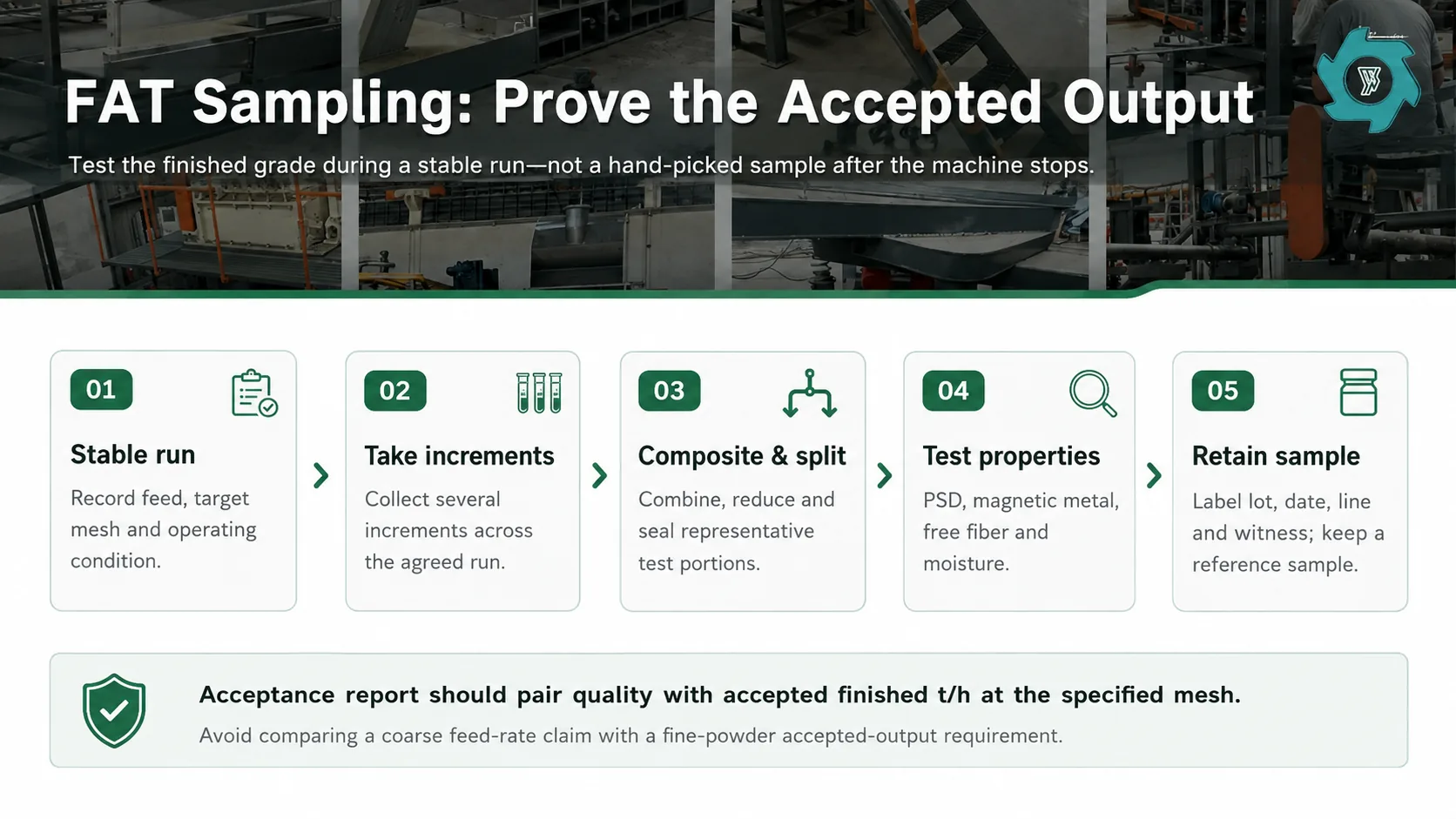
Before a factory acceptance test (FAT), agree on where samples are taken, how many increments are collected and how they are reduced. For bagged material, a multi-location plan is much stronger than an open-top scoop. Caltrans CT 385, for example, samples bulk bags from multiple positions and levels before compositing.[2] The exact plan for a rubber powder project may differ, but the principle is useful: sample across the lot, then reduce the composite without hand-picking.
Production record
Record feed tire mix, upstream granule condition, target mesh, start/stop time and material routed back for regrinding.
Sample record
Identify sample point, time, increment count, composite mass, split method, test portion and retained reference sample.
Test record
List sieve result, magnetic metal, free fiber, moisture, test method, equipment ID and who witnessed the test.
Capacity record
Measure accepted finished powder at the required specification. Report internal return separately from saleable output.
Pair Product Quality with Accepted Finished Tons per Hour
| FAT item | What to agree before the test | What to record |
|---|---|---|
| Feed condition | Tire type or clean granule feed, size range, contamination and moisture condition. | Actual feed lot and representative photos/sample. |
| Target powder | Mesh / PSD schedule and oversize/fines limits. | Full sieve result for each required test portion. |
| Cleanliness | Steel, fiber and optional foreign-matter limits plus methods. | Measured result and recovered contaminant mass. |
| Moisture | Limit and test basis. | As-received and/or dry mass as the method requires. |
| Run duration | Warm-up exclusion, stable-run period and sampling intervals. | Start/stop time, interruptions and reason for any pause. |
| Accepted capacity | Finished t/h at the required grade. | Accepted product mass; oversize return and reject kept separate. |
| Retained sample | Quantity, sealing, labels and custody. | Duplicate sample IDs signed by both parties where appropriate. |
If you are still deciding the grinding and classification equipment before writing the FAT, the rubber powder machine buyer guide explains how feed size, target mesh, cooling, screening and return load change the machine selection.
When a Lot Fails, the Failed Property Should Point to a Process Check
| Off-spec result | Likely process areas to review | Do not assume |
|---|---|---|
| Too much oversize | Grinder loading, screen condition, classifier capacity, return path, feed-size stability. | That more motor power alone will correct the PSD. |
| Steel above limit | Rasper liberation, material layer on magnet, magnet position/belt condition, second magnetic pass. | That “wire-free granules” automatically mean zero fine metal. |
| Fiber above limit | Granulation, grading, fiber-separator airflow, feed surges, rubber fines loss. | That increasing air volume always improves the net result. |
| Moisture above limit | Feed storage, exposure after grinding, bag liner/seal, sampling condition. | That a dry-looking surface represents the whole bag. |
| Lot-to-lot variation | Feed tire mix, recirculation, screen wear, bin segregation, sampling discipline. | That one good laboratory sample proves continuous production. |
Rubber Powder Quality Specification Questions
Is a high purity percentage enough to specify tire rubber powder?
No. A purity figure should be backed by separate measurable limits for particle-size distribution, steel, textile fiber, moisture and any other contaminant important to the buyer. The method and sampling plan also need to be agreed.
What is the difference between nominal mesh and particle-size distribution?
Nominal mesh is a short grade label. Particle-size distribution shows how much material is retained on or passes each controlling sieve. PSD is the better acceptance basis because real ground rubber contains particles of different sizes.
Should steel and fiber be included in one contamination percentage?
Usually not. Steel is magnetic and is controlled by liberation plus magnetic separation, while textile fiber is non-magnetic and is controlled by granulation, grading and airflow. Separate limits make both acceptance and troubleshooting clearer.
Why does moisture matter for fine rubber powder?
Moisture can contribute to agglomeration, change sieve behavior, affect storage and dosing, and make a factory sample differ from the material received after transport. The limit should therefore include a test basis and packaging condition.
How should rubber powder be sampled during a FAT?
Take representative increments during an agreed stable run, combine them into a composite, reduce the sample by an agreed method, test the required properties and keep a sealed retained sample. Avoid selecting one convenient or unusually clean scoop.
What capacity should be guaranteed for 80 or 120 mesh powder?
Use accepted finished tons per hour at the required PSD and cleanliness limits. Do not substitute whole-tire input, grinder feed or internal circulating load for saleable finished output.
Define the Output Acceptance Specification Before Final Machine Selection
Send your tire or granule feed, target mesh, PSD requirement, steel limit, fiber limit, moisture requirement, packaging and required accepted t/h. The grinding, classification and separation scope can then be matched to a testable finished product.
References
- ASTM D5644-23 – particle-size distribution and mesh designation.
- California Test 385 – sampling, gradation and moisture example.
- ASTM D8268-19(2023) – composition evaluation and quality control.