




Tire Bead Cutter RFQ Checklist: Make Every Supplier Quote the Same Job
A tire bead cutter request for quotation should do more than ask for a model, motor power and price. Its real job is to make competing suppliers respond to the same tire duty, the same accepted cut result and the same commercial boundary. Without that common basis, a purchasing team can receive three attractive prices that represent three different machines, different guarding, different test assumptions and different amounts of work left for the buyer.
A waste tire bead cutting machine cuts through the steel-reinforced bead/sidewall area and separates a bead-rich section from the main tire body before further processing. The RFQ should convert that general function into a project-specific procurement package.
Before issuing the RFQ, the purchasing team should separate three decisions: defining the machine requirement, qualifying the supplier, and fixing the commercial offer. The specification checklist supports the first task, while manufacturer evaluation addresses the second. The RFQ should then lock the price, supply boundary, evidence and contractual deliverables against those agreed requirements.
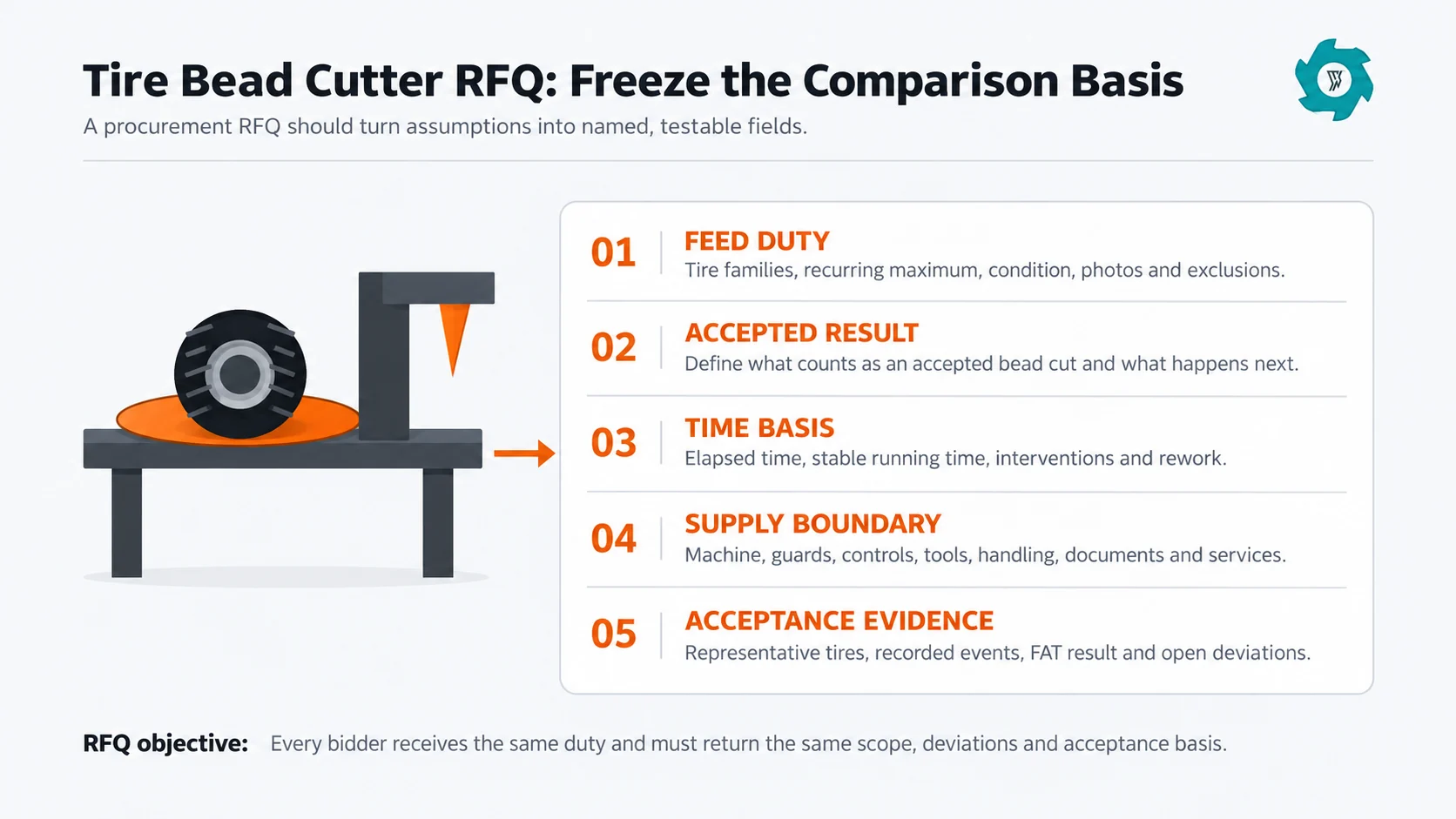
1. Start With an RFQ Cover Sheet That Controls the Revision
Put one project identifier, RFQ revision and response deadline on the cover sheet. State the buyer company, project location, requested quotation currency, required quotation validity, contact person and the exact document set that forms the inquiry. This sounds administrative, but revision control prevents a common failure: the mechanical team sends a new tire range while purchasing still compares a price based on the old one.
List every attachment by name and revision. Typical attachments are the tire duty sheet, site utility sheet, layout sketch, technical requirement, commercial requirement, FAT draft and supplier deviation schedule. Tell suppliers that their quotation must reference the RFQ revision. If they use their own proposal number, require both identifiers on the front page.
For every requirement that a supplier cannot meet exactly, the supplier should enter a deviation, proposed alternative and commercial effect.
2. Give Every Bidder the Same Feed Passport
The RFQ must give enough information to stop suppliers from choosing their own easy test material. Identify the regular tire families, approximate share of passenger versus light-truck or truck tires, the largest recurring tire, unusual construction that matters commercially, incoming condition and representative photographs. If special tires are excluded, say so.
A useful feed passport distinguishes routine, occasional and excluded material. The largest tire ever seen in the yard is not automatically a design case, and an average diameter is not enough when the difficult recurring tire drives cutter load and handling. Tell the supplier which cases must be processed in normal production and which cases may be diverted to another route.
For mixed tire streams, add a short operating statement. Are tires pre-sorted by size? Can water, dirt or rims be present? Is loading manual, assisted or forklift-supported? Does the operator change the setup between families? These facts affect the complete cycle even when the cutting mechanism is unchanged.
3. Define the Accepted Cut Result Before You Ask for Capacity
The RFQ should state what the operator must be able to release after one normal cycle. For example, the requirement may be a main tire body that can proceed to the next machine plus a separately handled bead-rich sidewall or ring section. The steel can still be embedded in rubber unless the project has explicitly purchased a separate recovery step.
Write down the permitted rework. If a normal cycle may include cutting both sides, say whether that is one completed tire or two machine cycles. If a second pass is allowed, define when it counts as normal and when it counts as rework. If exposed wire, incomplete separation or manual finishing makes the output unacceptable for the next machine, include that condition too.
This definition should match the process route. A standalone preparation station has a different interface from a fully integrated line. Buyers deciding where the responsibility stops can use the standalone bead cutter versus complete recycling line comparison before issuing the RFQ.
4. Put Capacity on a Declared Time and Quality Basis
The RFQ should state the representative tire mix, the accepted cut condition and the time basis. At minimum, request both complete elapsed time and stable running time during the FAT. Elapsed time includes loading, positioning, normal adjustment, cutting, discharge and ordinary handling. Stable running time is useful for diagnosing the active machine period, but it should not replace the full operating burden.
Require the test record to show input count, accepted count, rework count, second passes, stops and operator interventions. A supplier may still quote a nominal tires-per-hour value for commercial comparison, but the FAT result should reveal how that figure was achieved. This prevents a fast cutting stroke from being presented as full-cycle plant output.
Do not force one universal guaranteed number across passenger and truck tires unless the feed mix is defined. A better guarantee is tied to the agreed representative set. If different tire families have materially different cycle times, request a table.
5. Freeze the Supply Boundary Item by Item
The biggest price differences often come from scope, not steel weight or motor size. Make the supplier complete an inclusion table. Name the core machine, worktable and positioning system, cutter assembly, guards, emergency-stop devices, local control panel, isolator, cables within the machine boundary, lubrication accessories, special tools, first-fill consumables if applicable, spare cutters, labels, manuals, drawings, packing and factory testing.
Then define the interfaces around the machine. Who provides the loading aid? Who provides the discharge bin for bead sections? Does the supplier include an infeed or outfeed conveyor? Where does the electrical supply terminate? Who installs cable from the plant distribution board? Who provides anchors, grout, foundation work and lifting equipment? Who disposes of test tires after FAT? None of these interfaces is difficult to define before quotation, but each can create cost or delay when left unresolved.
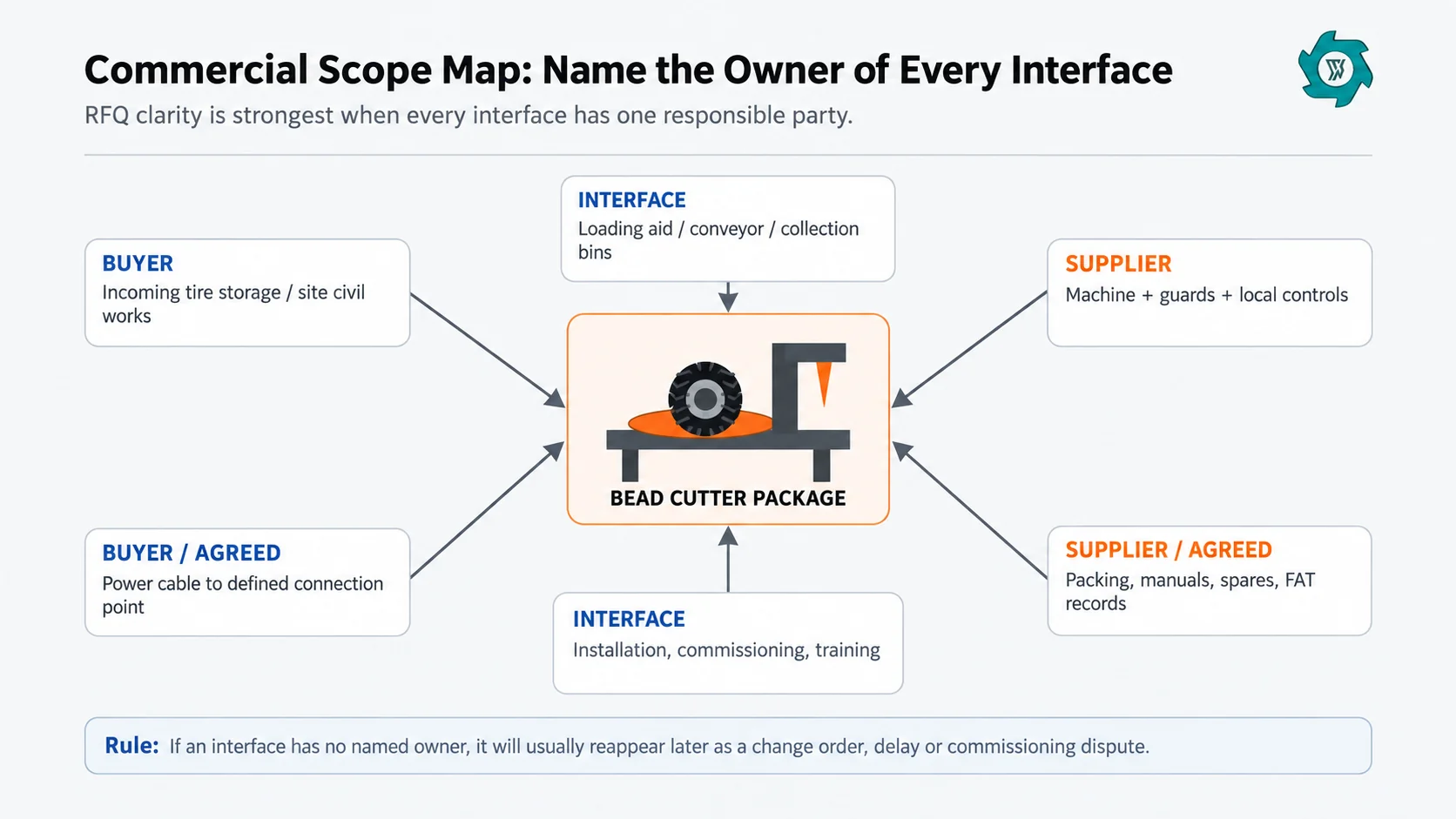
For each interface, use one of four statuses: supplier included, buyer supplied, optional price or excluded. Avoid “by others” unless the responsible party is identified. If an item is optional, ask for a separate price and lead-time effect so it can be normalized later.
6. Specify the Safety and Electrical Deliverables, Not Just “CE” or “Safe Design”
The RFQ should ask what safeguards and technical documents are supplied with the actual machine configuration. ISO 12100 provides a general methodology for machinery risk assessment and risk reduction.[1] In the United States, OSHA 29 CFR 1910.212 addresses machine guarding for hazards including points of operation, rotating parts and other machine hazards.[2] OSHA 29 CFR 1910.147 separately addresses hazardous-energy control during servicing and maintenance where unexpected energization, startup or release of stored energy could cause injury.[3]
Do not turn the RFQ into a generic safety standard. Ask for concrete project deliverables: guard arrangement, access points, emergency-stop locations, energy-isolation points, safety labels, operating and maintenance instructions, electrical schematic, component list where agreed, and the machine-specific steps required for cutter change and fault recovery. The buyer’s own competent safety and electrical personnel should review the delivered package against local requirements.
For the machine electrical equipment, IEC 60204-1 covers general requirements for electrical, electronic and programmable electronic equipment of machines from the point of connection of the supply to the machine electrical equipment.[4] State the site voltage, frequency, earthing arrangement if relevant to the supplier, control voltage expectations and any project-specific component preferences.
The detailed work-cell questions belong in the tire bead cutting machine safety guide; the RFQ’s job is to ensure the chosen protective measures and documentation are actually inside the quoted scope.
7. Write the FAT Requirement Before the Purchase Order
A factory acceptance test is far more useful when the protocol is attached to the RFQ. Agree the test tire families, how they will be identified, the machine configuration, test duration or batch logic, operator responsibilities, data fields, acceptance criteria and what happens when the result is conditional. Do this before a supplier has an incentive to define the test around whatever is easiest to demonstrate.
Require the supplier to return a proposed FAT procedure with the quotation rather than leaving the test method until manufacturing is complete. The RFQ should identify who supplies the representative tires, who pays for their preparation and disposal, whether the buyer will witness the FAT in person or remotely, and what evidence must be returned after the test. Once the procedure is agreed, give it a controlled revision so neither party can quietly change the acceptance basis before FAT.
Define the consequence of a conditional or failed result before award. A conditional pass should create a numbered punch list with an owner, due date and required closure evidence. If a corrective change affects the cutter configuration, guarding, controls or accepted output, state whether the affected test must be repeated. The RFQ should also identify who carries the cost of a retest and whether shipment can proceed while any punch-list items remain open.
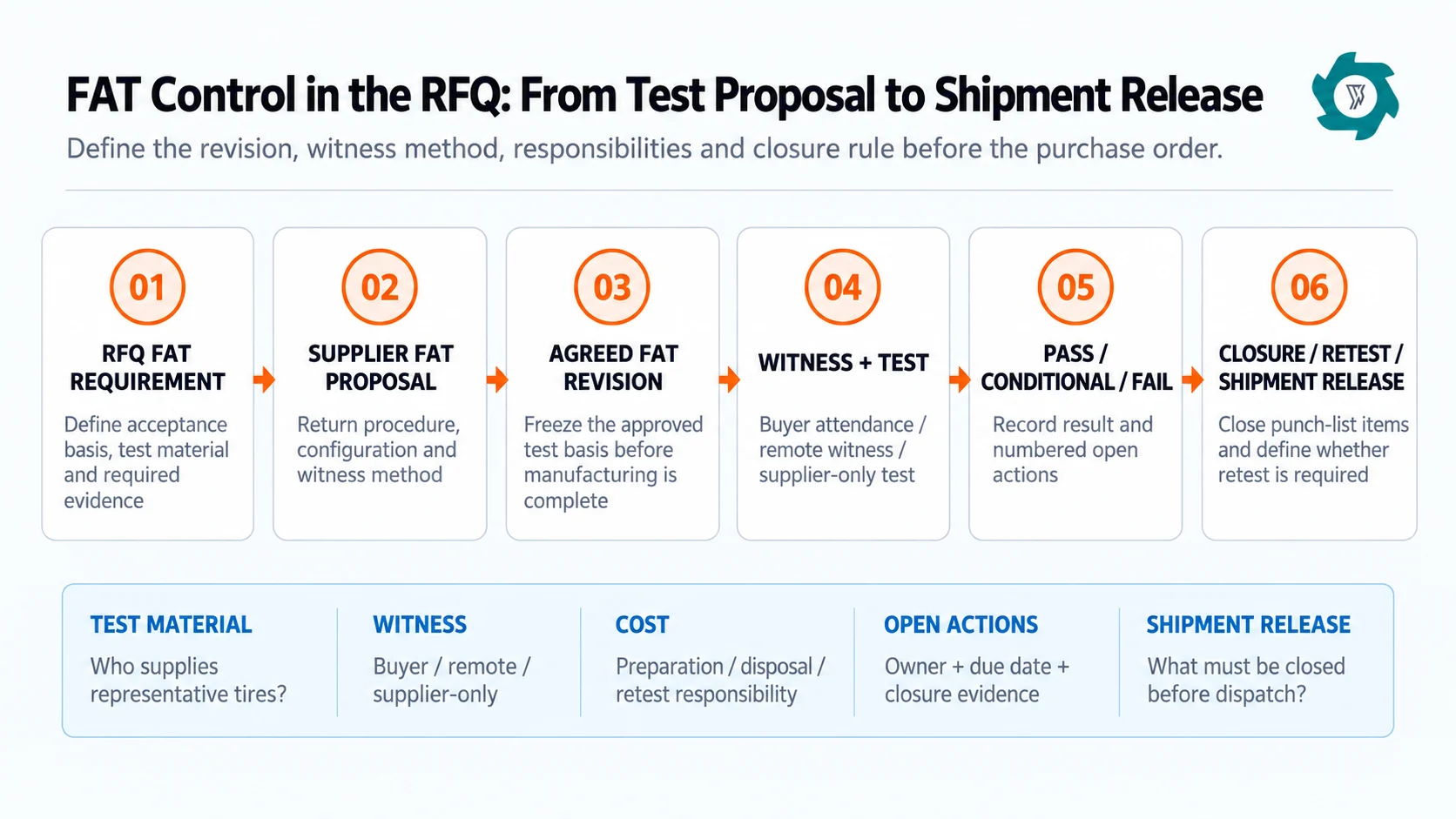
Finish each test with a disposition: pass, conditional pass with named open actions, or fail against a stated requirement. Open points need an owner and due date. When a change is made after FAT, state whether evidence must be repeated before shipment or verified at commissioning.
A short FAT can show that the agreed machine cuts representative tires under the test conditions. It cannot automatically prove long-term cutter life, local labor productivity, annual availability or site electrical quality. Those claims require separate evidence. If lifetime operating economics matter, use the tire bead cutter operating cost model to define which data should be collected after commissioning.
8. Ask for a Deviation Schedule That Purchasing Can Actually Use
Make the deviation schedule a mandatory return document. A practical table has six columns: RFQ clause, supplier response, deviation or exception, proposed alternative, price effect and schedule effect. Add a seventh column for buyer disposition during clarification. This creates a single place where unresolved differences remain visible.
Ask the supplier to identify any conflicting standard term specifically. The goal is to stop contradictions from hiding across brochures, emails and quotation footnotes.
When the preferred supplier is selected, freeze the accepted deviation schedule into the order package. A final technical and commercial clarification sheet is often shorter than the original RFQ, but it should point back to the controlling documents and revisions.
9. Normalize the Bids Before You Rank Them
Build one spreadsheet or table with the RFQ fields down the left side and bidders across the top. Mark included, excluded, optional, buyer-supplied and not stated. Where an excluded item is still required for the project, add a budget allowance or obtain a firm price. Where a technical deviation changes production or acceptance risk, do not convert it automatically into money; flag it for engineering review.
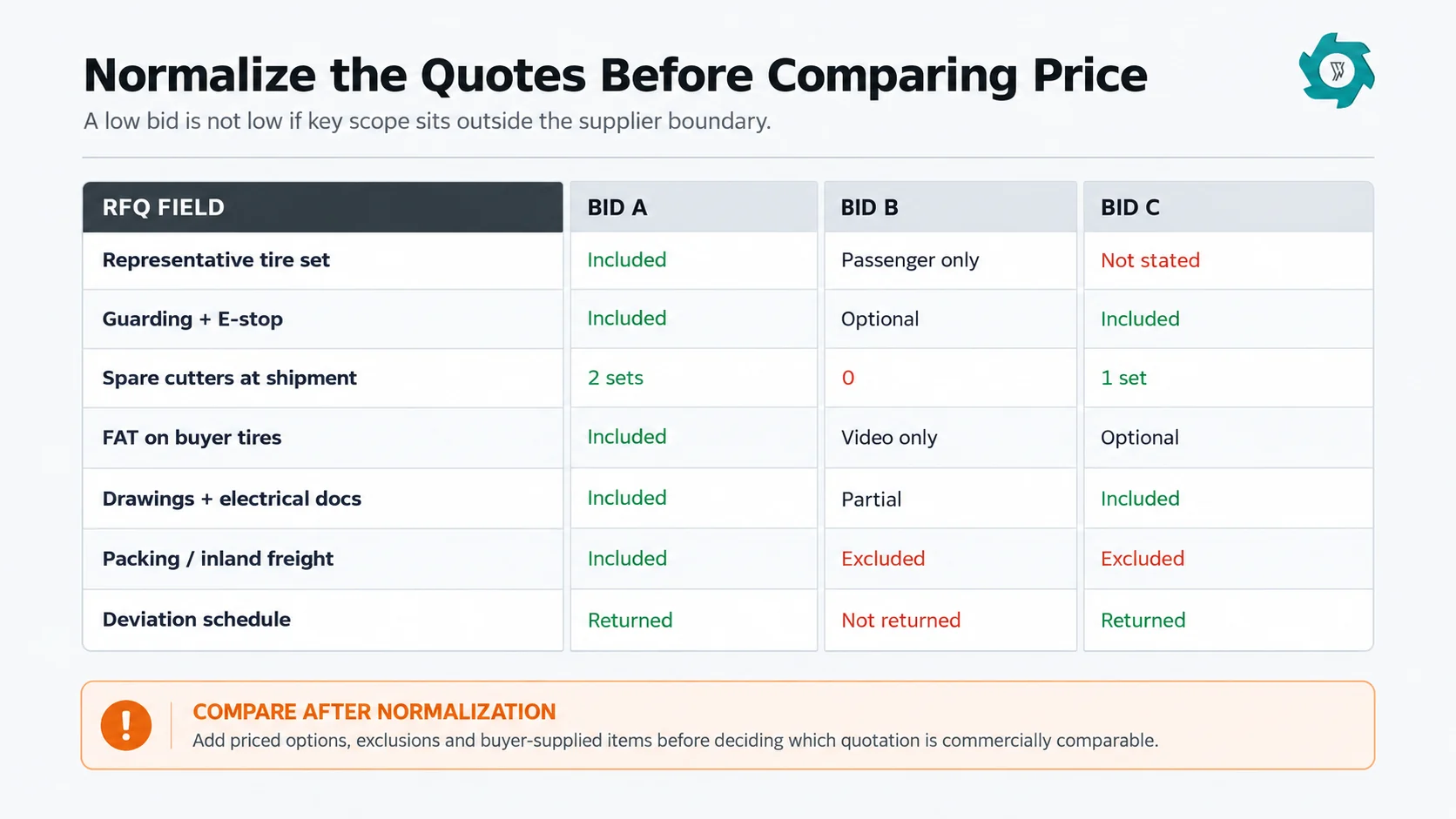
A useful comparison separates three totals. First is the supplier’s quoted equipment price. Second is the normalized procurement price after adding required options and excluded supply. Third is the project exposure: unresolved technical or commercial items that could still become cost or delay. Keeping these numbers separate avoids false precision.
10. Include Spares, Wear Parts and First-Year Support in the RFQ
The cutter is a wear item, so ask for the recommended shipment quantity and the basis for that recommendation. Request part numbers, unit prices, lead times and any special tool required for replacement. If the supplier cannot responsibly guarantee cutter life because tire construction varies, that is acceptable; ask instead for representative experience, inspection criteria and the recommended stock policy for your operating schedule.
Separate commissioning spares from operating spares. Commissioning spares cover items that might be needed during setup or early adjustment. Operating spares cover expected wear or service needs. Ask whether common electrical components are locally replaceable or tied to proprietary programming. For remote support, make clear how help will be provided, which language will be used, what response hours apply, and whether the control system needs internet access from the buyer’s site.
Training should be matched to the people who will use it, whether that means operator instruction, maintenance training, a basic electrical troubleshooting overview, or a combination of these.
11. Fix Packing, Delivery and Trade Terms With a Named Place
International machinery quotations should identify the delivery rule and the named place precisely. Incoterms 2020 mainly deals with delivery—who arranges what, who pays which transport costs, and when risk passes from seller to buyer.[5] Technical scope, payment, warranty, and acceptance still need to be written separately into the contract.
The RFQ needs to show exactly how the equipment will be shipped and where responsibility changes hands. Include the agreed Incoterms 2020 term, delivery location, packing approach, estimated shipping size and weight, and any container or inland transport needs. If timber packaging is involved, check early whether the destination requires treatment certificates or other documents. If the buyer needs the machine to fit a particular container strategy, ask the supplier to identify any disassembly and the reassembly work expected at site.
12. Use Milestones That Match Evidence, Not Calendar Dates Alone
A practical order can tie milestone payments or approvals to defined evidence: approved drawings, completion of manufacturing, successful FAT, shipment documents and site commissioning where included. The payment structure may vary by company and supplier, but each milestone should still be tied to clear evidence.
Payment stages may differ from one project to another, but each one should have a clear document, result, or approval behind it. Set an expected buyer review period so the supplier cannot attribute an open design issue to indefinite approval delay. Likewise, state whether approval releases manufacturing responsibility or merely confirms interface information. In most projects, the supplier remains responsible for the machine meeting the agreed requirements even after drawing review.
13. One-Page Tire Bead Cutter RFQ Checklist
| RFQ block | Minimum buyer input | Required supplier response |
|---|---|---|
| Project control | Project ID, RFQ revision, response date, currency, quotation validity | Quote number linked to RFQ revision; valid-until date |
| Feed duty | Tire families, recurring maximum, photos, condition, exclusions | Confirmed range plus deviations or special setup |
| Accepted result | Definition of completed cut, permitted rework, next process | Confirmed output condition and cycle interpretation |
| Capacity basis | Representative mix, shift pattern, time basis | Nominal rate plus FAT method and assumptions |
| Machine scope | Required guards, controls, tools, handling interfaces | Included / optional / excluded schedule |
| Utilities | Voltage, frequency, connection boundary, other utilities | Connected load, interface data and deviations |
| Documents | Manuals, drawings, schematics, parts list, safety information | Document register and delivery stage |
| FAT | Representative tires, records, acceptance criteria | Test plan, evidence package and deviation closure |
| Spares | Operating schedule and stock expectation | Recommended list, price, lead time, part numbers |
| Commercial | Incoterm, named place, packing, payment and schedule requirements | Price breakdown, packed data, lead time, commercial deviations |
| Support | Installation/commissioning/training requirement | Scope, duration, travel assumptions and remote-support terms |
| Deviations | Mandatory deviation template | Completed clause-by-clause deviation schedule |
Send this checklist with the same attachments to every shortlisted supplier. Do not personalize the technical duty for each bidder during the first round. Clarifications can differ later, but the starting comparison should remain common.
14. RFQ Red Flags That Usually Create Cost Later
- Capacity with no tire set: the number may describe the easiest tire.
- “Standard guarding” with no arrangement: the delivered work cell may not match the buyer’s access and operating method.
- No list of exclusions: missing scope is discovered only after the preferred bidder is chosen.
- FAT “available on request”: the evidence boundary has not been priced or planned.
- Spare cutter price omitted: a wear item becomes an urgent post-order purchase.
- Delivery term without a named place: freight, risk and handling responsibilities can be interpreted differently.
- Supplier quotation says “as per catalog”: project-specific tire limits and interfaces are not controlled.
- No deviations returned: this is not proof of full compliance unless the supplier explicitly accepts the RFQ requirements.
The RFQ makes weaknesses, assumptions and missing scope visible early enough to act on them. That is the information gain procurement needs: not more specifications, but a traceable chain from tire duty to price, evidence and responsibility.
Frequently Asked Questions
What should be included in a tire bead cutter RFQ?
Include the tire duty, accepted cut result, operating schedule, site utilities, required safeguards, supply boundary, documentation, spare parts, FAT method, delivery term and a deviation schedule. The purpose is to make each supplier quote the same job rather than return a different interpretation of the project.
How is an RFQ different from a bead cutter specification sheet?
A specification sheet describes technical requirements. An RFQ uses those requirements inside a procurement package that also defines price scope, interfaces, documents, testing, commercial terms, exclusions and the format suppliers must use when they respond.
Should capacity be guaranteed in tires per hour?
Capacity can be stated in tires per hour, but the RFQ should also define the representative tire mix, accepted cut condition and time basis. Record elapsed time, rework and interventions so a short cutting stroke is not confused with complete productive output.
What should a bead cutter FAT prove?
A useful FAT proves the agreed configuration on representative tires and records complete cycles, accepted output, interventions, rework and open deviations. It does not automatically prove lifetime wear, local labor cost or final site performance unless those items are separately defined and tested.
How should buyers compare quotations with different exclusions?
Normalize them. Put the same RFQ fields into one comparison sheet, add the cost or responsibility for excluded items, mark technical deviations, and compare only after the supply boundary is aligned. Keep unresolved assumptions visible rather than assigning them a zero cost.
Which Incoterm should be used for a tire bead cutter purchase?
The Incoterms 2020 term should match how the buyer and seller have agreed to divide shipping and delivery responsibilities. The RFQ should name the chosen rule and the precise named place or port. Buyers should confirm the commercial and customs implications with their logistics and legal teams rather than treating an Incoterm as a complete sales contract.
Turn Your Tire Data Into a Comparable RFQ
Send representative tire photos, the recurring maximum size, target operating schedule, downstream process, local power supply and required project boundary. YUXI can respond against a defined RFQ instead of a generic machine request.
References
- Risk assessment. Machine risk-reduction guidance.
- Machine guarding. Guarding requirements.
- Energy control. Hazardous-energy control.
- Electrical safety. Machine electrical equipment.
- Incoterms. Delivery responsibility rules.