




Buying a tire bead cutter as a standalone machine and buying it as part of a complete tire recycling line are not two sizes of the same purchase. They create different project boundaries. A standalone station asks one machine to produce a defined prepared tire body and a separately handled bead-rich section. A complete line asks every upstream and downstream machine, transfer, buffer, control and safety interface to work as one production system.
That difference is easy to underestimate. The waste tire bead cutting machine is a front-end preparation unit: it cuts through the steel-reinforced bead/sidewall area and separates that section from the main tire body before further size reduction. The machine can work by itself, but the buying decision should be based on what happens immediately before and after it—not on whether a larger quotation simply includes more equipment.
Buy the Boundary You Can Actually Operate
A standalone bead cutter can be a better fit if suitable downstream equipment is already available. It also works well for batch operation, provided the two output streams can be stored safely and the bead-cutting station can be run and maintained on its own schedule.
A complete line is often a better fit for a new project where material needs to move through several connected stages. It is also worth considering when downstream equipment has to be sized around the bead cutter, several conveyors or separators are involved, or a single control system would make the line easier to balance and operate.
Do not decide from machine count. Define the approved tire mix, accepted cut result, downstream product, practical rate, buffer requirement, labor boundary, control philosophy and factory acceptance test. The better option is the one that closes those interfaces with the least unresolved work.
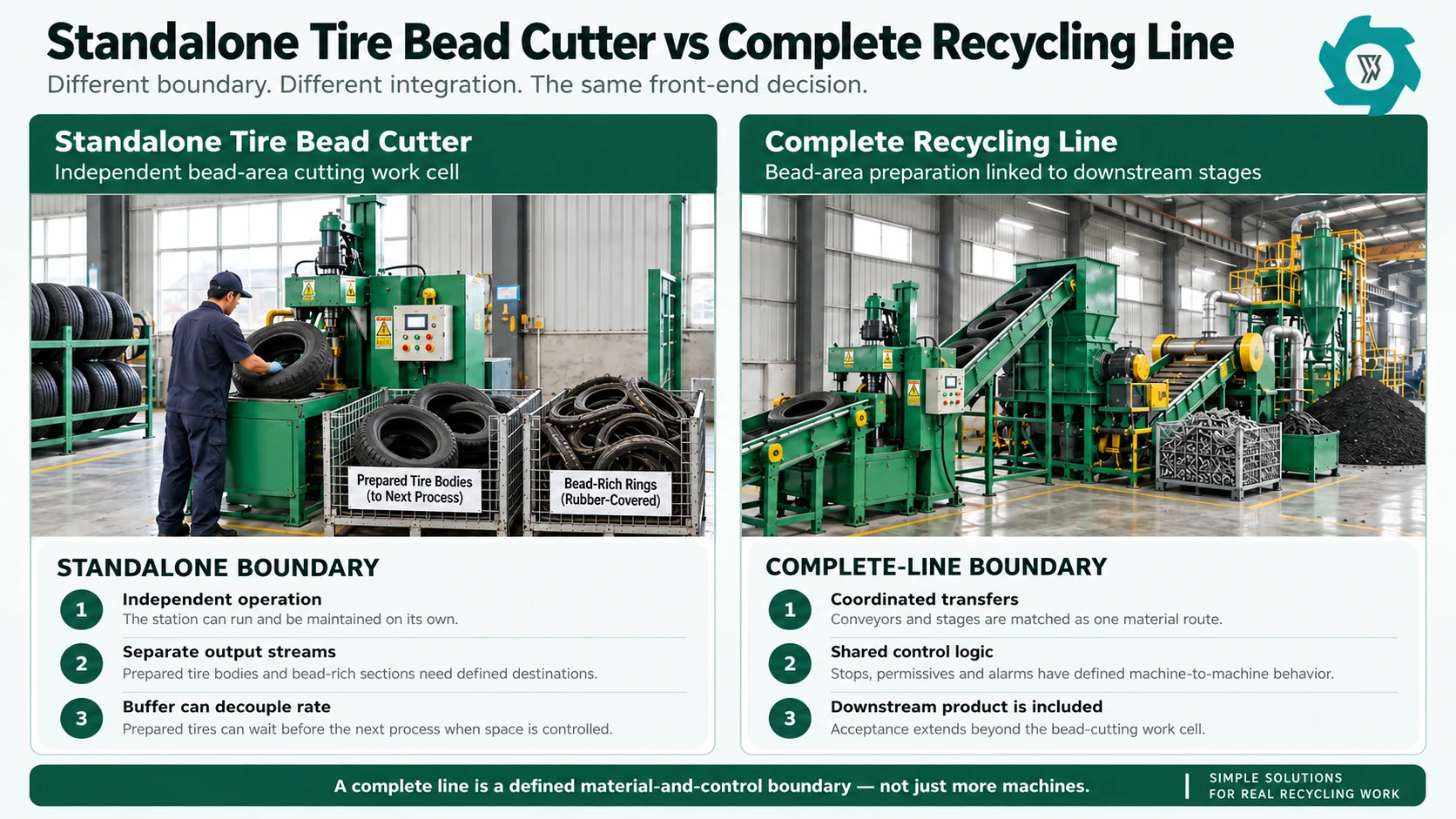
The Real Choice Is Project Boundary, Not Machine Count
A bead cutter performs one specific transformation: a whole or approved waste tire enters the work cell; a prepared tire body and a bead-rich sidewall or ring leave it. The prepared body still needs a destination. The bead-rich fraction still needs a collection route. Tires still have to reach the station, and the outputs have to leave it without creating an unsafe or expensive handling problem.
A complete recycling plant moves the boundary outward. Instead of asking only whether the cutter completes a clean cycle, the project asks whether feeding, bead-area preparation, size reduction, screening, steel recovery, fiber removal and product collection can meet the final product requirement. EPA’s description of tire-crumb production is a useful reminder of that system view: scrap tires are reduced through multiple stages, steel and fabric are removed, screens classify the material, and oversize is returned for further reduction.1 A front-end machine can be correct while the overall route is still poorly matched.
This is why “standalone versus complete line” should not be treated as “cheap versus expensive” or “small versus large.” A high-throughput plant may still use an independently controlled bead station with a buffer. For a small greenfield project, an integrated package may be easier to manage when there is no existing conveyor, shredder, magnet, platform, or control system to build around. The main issue is whether each part of the process already has a clear owner or still needs to be supplied and coordinated.
What a Standalone Bead Cutter Must Include in Practice
A serious single-machine package still needs a defined input method, operating zone, output collection arrangement, utilities, guarding, service access and test boundary.
The machine also needs a written output definition. Tire beads are built from steel-wire hoops embedded into the sidewall structure, not from loose wire sitting inside the tire.2 After cutting, the removed section can therefore still contain rubber around the bead steel. A buyer who expects clean ferrous wire from the cutter alone has defined the wrong acceptance result. The standalone station should be approved against what it is designed to produce: a prepared tire body and a separate bead-rich section.
For an existing recycling plant, this independent boundary can be useful. The bead cutter can be installed near raw-tire storage, operated only for tire families that benefit from bead-area preparation, and stopped for inspection without automatically shutting every downstream machine. A buffer of prepared tire bodies can decouple the station from the next process. That flexibility is often more valuable than forcing every front-end machine into one continuous interlocked sequence.
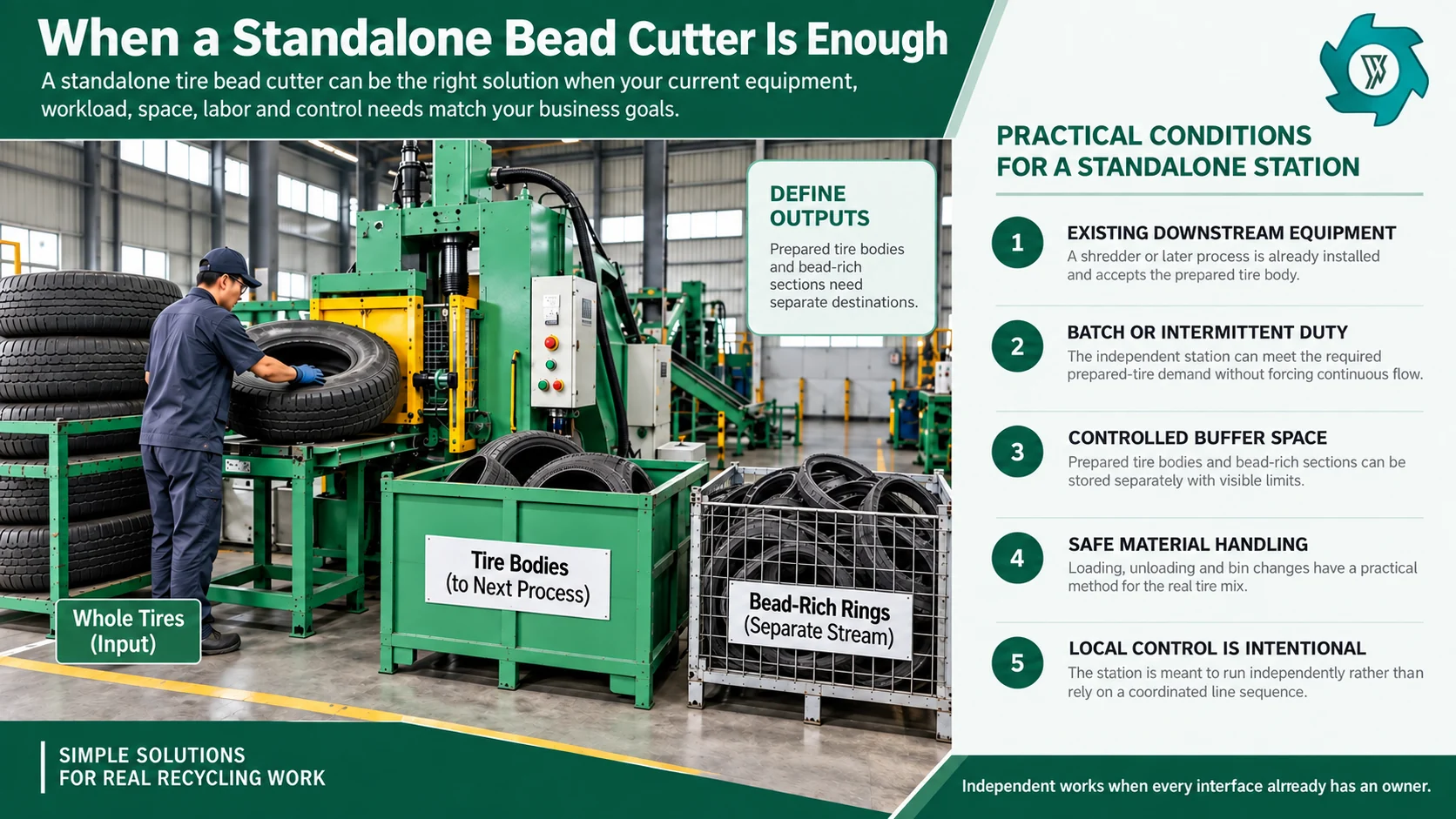
When the Standalone Option Usually Makes More Sense
1. You are upgrading an existing plant
If the plant already has a suitable tire shredder, conveyors and steel-separation stages, replacing the whole route to add bead cutting is rarely the first engineering move. The narrower question is whether early bead-area preparation removes a real constraint: unstable tire presentation, concentrated bead loading, repeated manual preparation or excessive work at the shredder feed. A standalone station can address that boundary.
2. Tire preparation is intermittent
Some yards do not process one uniform tire stream all day. Passenger tires may run directly while truck or heavier tires are routed through additional preparation. An independent bead cutter can support that split. Operators can build an inventory of prepared tires during one part of the shift and run the downstream process later, provided the storage method and work-in-process limit are controlled.
3. The prepared tire leaves your site or goes to another department
A company may prepare tires for another recycling facility, another production area or a third-party processor. In that case, bead cutting can be the finished service performed at this site. The commercial boundary ends at an accepted prepared tire body plus the separately handled bead-rich material.
4. You need operational independence
An independent station can have its own schedule, operator, maintenance window and local production record. That is useful when a plant wants to trial a new tire family, validate a preprocessing method, or add capacity gradually. The trade-off is that the buyer must actively manage every interface that an integrated line would otherwise coordinate.
What “Complete Recycling Line” Should Mean
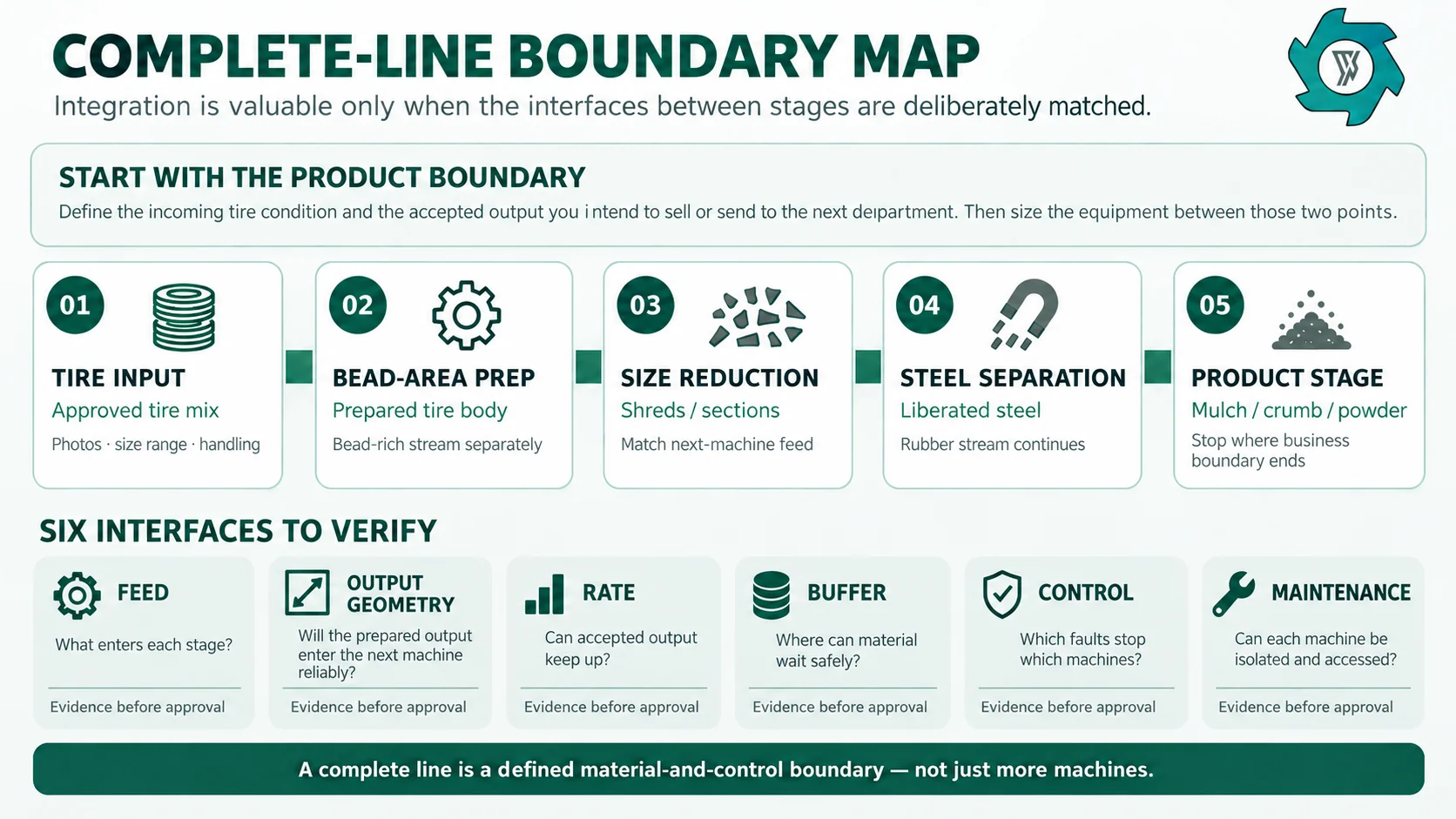
A complete line is not simply a bead cutter sold beside several other machines. It should connect the material route from the defined incoming tire condition to a defined downstream product. YUXI’s broader tire recycling equipment and plant range separates this by output: rough chips, wire-free mulch, crumb and powder require different processing depth. That distinction matters because the front end should be designed backward from the product.
For example, a project producing granulation feed needs more than a cut tire. The prepared tire has to enter primary size reduction, steel must be liberated and recovered, the rubber fraction must reach the next size-reduction stage, and the accepted product must satisfy the next machine’s input condition. A powder route adds even more downstream work. The bead cutter is one decision inside that chain.
The complete-line advantage appears when the supplier and buyer define those transitions together: conveyor height, discharge direction, maximum tire or section envelope, buffer position, accepted output rate, return loops, magnet location, control handshakes, maintenance access and product collection. The line should reduce unresolved interfaces.
Six Interfaces That Decide Whether Integration Adds Value
Most bad line decisions can be traced to an interface that nobody defined. Before choosing standalone or integrated equipment, write down the following six boundaries.
| Interface | Standalone question | Complete-line question | Evidence to request |
|---|---|---|---|
| Feed | How are approved tires staged and loaded? | How does the feeding system meter the tire mix into the first machine? | Tire dossier, loading method, maximum dimensions and representative test batch. |
| Output geometry | What exactly counts as an accepted prepared tire body? | Will that body or section reliably enter the next machine? | Photos, dimensions, cut acceptance definition and downstream opening. |
| Rate | Can the station meet required prepared-tire demand? | Can every connected stage sustain the same accepted production rate? | Elapsed-time test, accepted units, intervention log and downstream queue behavior. |
| Buffer | Where are tire bodies and bead-rich sections stored? | Where can material accumulate when one stage slows or stops? | Buffer locations, maximum work-in-process, bin capacity and removal frequency. |
| Control | What local start/stop and alarm logic is needed? | Which machines must exchange permissives, stop signals and fault states? | Control philosophy, cause-and-effect list and emergency-stop boundary. |
| Maintenance | Can the cutter be isolated and serviced without blocking other work? | Can one machine be isolated while adjacent sections remain in a safe state? | Isolation plan, access clearances, lifting points and maintenance route. |
Do Not Match the Line by Nameplate Rate
Capacity matching is not “bead cutter rate equals shredder rate.” A bead cutter may be discussed in tires per hour; a shredder may be quoted by mass throughput; a granulator may be limited by the size and cleanliness of incoming rubber. Those values cannot be compared until the tire mix, accepted result and elapsed-time boundary are aligned.
Use the same representative batch to estimate how many accepted prepared tires leave the cutter, how much material reaches the next machine, and how long the full route takes including ordinary loading, discharge and routine interventions. If the cutter can prepare material faster than the shredder consumes it, a planned buffer may be enough. If the shredder can consume material faster than the cutter supplies it, the front-end station may become the constraint.
Do not eliminate all buffer in pursuit of “continuous flow.” A small, visible buffer can protect the line from normal cycle variation and short maintenance events. The design problem is uncontrolled accumulation. A queue that blocks an aisle, mixes bead-rich material with prepared tire bodies, or requires repeated forklift reshuffling is not a buffer strategy.
Material Handling Is Often the Hidden Deciding Factor
A standalone machine creates two physical streams at one station. Someone or something must move both. For light, regular tires, a well-designed manual or assisted work cell may be practical. For larger or mixed commercial tires, handling can dominate the cycle. The correct comparison therefore includes operator travel, lifting aids, bin changes, forklift interference and the distance to the next process.
A complete line can reduce transfers by placing conveyors and receiving machines in the correct sequence, but automation does not automatically remove handling. Large tires may still need controlled loading. Bead-rich sections still need their own collection path. Maintenance still needs lifting and access. If a line drawing shows machines touching one another with no clearance for people, bins or service tools, it is not integrated.
Where large tires need additional sectioning before shredding, the tire cutting machine should be treated as another interface. The project should define which tire families need sectioning, what section condition the shredder accepts, and how the material moves between the bead-cutting and tire-cutting steps.
Local Control vs Coordinated Line Control
A standalone bead cutter usually benefits from simple local control because the operator owns the immediate work cell. That can make troubleshooting clearer: the station starts, completes its cycle, stops and is maintained independently. When it feeds a buffer rather than a live downstream machine, there may be no reason to give the bead cutter permission logic from the shredder.
A stopped conveyor should not continue receiving material until it overfills. A downstream fault may need to inhibit upstream feeding. Emergency stops and access gates need a defined boundary rather than a collection of unrelated buttons. OSHA’s machine-guarding rule requires guarding where machine operation exposes employees to hazards such as points of operation, nip points and rotating parts.3 For servicing, OSHA’s hazardous-energy standard addresses control of unexpected energization, start-up and stored energy.4
The practical buying point is to require the supplier’s control philosophy, list the machines included in each stop or permissive, and make sure the plant’s own safety and electrical teams can integrate the equipment under applicable requirements.
Compare the Installed Boundary, Not Sticker Price
A standalone bead cutter normally has a narrower equipment package, but “lower machine price” is not the same as “lower project cost.” The buyer may still need foundation work, electrical distribution, local extraction or housekeeping measures, barriers, tire handling, output bins, lifting equipment, freight, installation, commissioning and spares. Existing plants may already have many of those items, which is exactly why the standalone route can be economical there.
A complete line has a larger initial equipment package but may reduce duplicated engineering, field wiring, transfer design and repeated installation work. Whether that produces a lower unit cost cannot be assumed from the equipment list. It depends on utilization, labor, maintenance, product yield, energy use, downtime and the revenue or internal value of the accepted outputs. The right commercial comparison puts every excluded responsibility into one of three columns: supplier, buyer or not required.
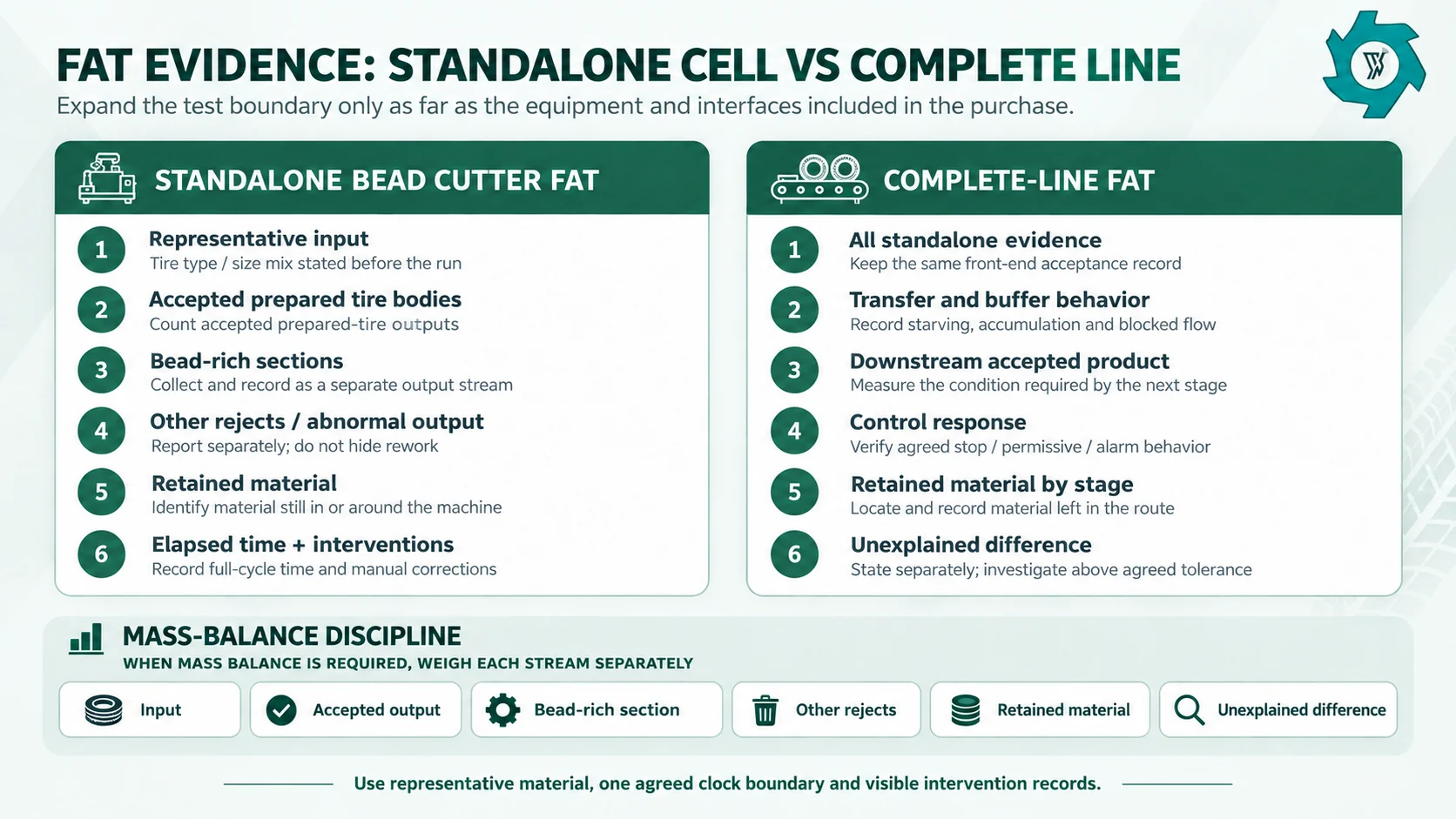
Factory Acceptance Testing Should Match the Purchase Boundary
A standalone machine FAT should prove the machine duty. A complete-line FAT should prove the route. Mixing those two creates weak acceptance records.
For a standalone bead cutter, use a representative tire batch and define the expected cut result before the test. Record the number of tires processed, accepted prepared tire bodies, bead-rich sections, second passes, manual corrections, elapsed time and operator interventions. If the FAT includes a mass balance, weigh the input and each material stream separately, including prepared tire bodies, bead-rich sections, other rejects and retained material. State any unexplained difference separately rather than combining it with rejects or losses.
For a complete line, keep that front-end record but extend the boundary to the downstream accepted product. Record where material accumulates, whether conveyors starve or overload, how faults propagate, whether the downstream machine accepts the prepared tire condition, and whether the final separation or sizing target is met under the agreed test conditions. Any unexplained difference in a mass balance should be stated separately.
A Practical Decision Matrix
| Project condition | Standalone bead cutter tends to fit | Complete line tends to fit |
|---|---|---|
| Existing downstream machines are already suitable | Strong fit; add only the missing preparation duty. | Usually unnecessary unless major downstream replacement is already planned. |
| New greenfield plant with no handling or controls | Possible for a deliberately narrow first phase. | Stronger fit when the business requires several connected processing stages from day one. |
| Intermittent or mixed tire preparation | Strong fit when routing and buffers are controlled. | Useful only if the rest of the process also benefits from coordinated flow. |
| Continuous multi-stage production | Can work with a deliberate buffer and clear local controls. | Often easier to engineer when several machines must remain rate-balanced. |
| Prepared tires are sold or transferred elsewhere | Often the correct commercial boundary. | Additional stages may have no business value at this site. |
| Buyer wants one party to own multiple interfaces | Requires very clear responsibility splits. | Can reduce interface gaps if the quotation explicitly includes them. |
| Future expansion is likely but timing is uncertain | Good phased-investment option if utilities and layout leave room. | Good when future product route is already funded and technically defined. |
RFQ Checklist: Information That Changes the Recommendation
- Tire mix: passenger, SUV, light truck, truck, bus or other approved tire families, plus representative photos and markings.
- Maximum geometry: outside diameter, width and approximate weight of the largest recurring tire.
- Current condition: whole tire, sidewall already cut, bead wire already drawn, damaged tire or mixed preparation states.
- Required bead-cut result: one side or both sides as applicable, acceptable remaining attachment, and how the bead-rich section will be handled.
- Project output: prepared tires, rough shreds, TDF, wire-free rubber, crumb, powder or another defined intermediate product.
- Demand: target accepted output per hour or shift, operating hours and expected tire mix during that period.
- Existing assets: conveyors, shredder, screen, magnet, granulator, dust collection, bins, forklifts, platforms and controls that will remain in service.
- Layout: available floor space, clear height, doors, vehicle routes, raw-tire storage and product-storage areas.
- Utilities: voltage, frequency, available electrical capacity and other site services required by the proposed equipment.
- Control preference: independent station, coordinated sequence, remote status, interlocks and intended emergency-stop boundary.
- Acceptance criteria: representative test batch, elapsed time, accepted output definition, intervention log and product-quality checks.
- Expansion plan: next product stage that may be added later and the approximate location reserved for it.
Final Selection Rule
A standalone bead cutter works best when the bead-preparation step is already clearly defined and the downstream process is either in place or handled separately. The site also needs enough room and handling capacity for both output streams, without creating a new bottleneck elsewhere in the line.
A complete recycling line makes more sense when several machines must work together to produce the required final product. In that case, feed transfer, controls, line balance, and testing between stages can have a direct effect on capacity and product quality, so handling them as one integrated system usually reduces coordination problems later.
If the answer is still unclear, do not add assumptions. Draw the material boundary from incoming tire to the product you intend to sell, mark every transfer, buffer, control and maintenance handoff, and assign an owner to each one. The correct purchasing boundary becomes much easier to see once no interface is left blank.
FAQ
Can a tire bead cutter be used as a standalone machine?
Yes. It can operate as an independent preprocessing station when tire loading, output collection, buffer space, utilities, guarding, maintenance access and the downstream destination are already defined.
When should I buy a complete tire recycling line instead?
Consider a complete line when a new project needs several connected stages, the final product requires shredding and separation after bead cutting, and material transfers, controls and capacity matching should be engineered together.
Does a standalone bead cutter produce clean steel wire?
Not normally. A bead cutter separates the bead-rich sidewall or ring from the main tire body. Rubber can remain around the bead steel, so a separate recovery step may be required if clean ferrous material is the target.
Is a complete line always more efficient than standalone equipment?
No. Integration can reduce handling and interface gaps, but only when the connected stages are well matched and sufficiently utilized. An existing plant may be better served by one independent machine that solves a specific constraint.
How should capacity be compared between the two options?
Use a representative tire batch and compare accepted output over elapsed time. Include normal loading, discharge, interventions, queues and the downstream acceptance condition instead of comparing catalog rates with different counting units.
What should a factory acceptance test prove?
A standalone FAT should prove the bead-cutting work cell and its accepted outputs. A complete-line FAT should also prove material transfer, buffer behavior, coordinated controls, downstream acceptance and the final agreed product condition.
Define the Project Boundary Before Requesting the Quote
Prepare tire photos and markings, size range, expected shift volume, existing equipment, required final product, workshop layout, utilities and the acceptance result you want tested. Those details make it possible to decide whether the project needs one independent bead-cutting station or a broader recycling-line configuration.
Engineering References
- EPA crumb. Tire-crumb production context.
- USTMA tire. Tire bead construction.
- OSHA guarding. Machine guarding.
- OSHA LOTO. Hazardous-energy control.