




A tire bead cutting machine is simple to describe and easy to buy badly. Two suppliers can show machines that look similar in a short video, yet one may understand the buyer’s tire mix, document the build, test the difficult tires and support the machine after shipment while the other is selling a catalog configuration with unanswered limits.
The evaluation should therefore start with evidence. The commercial product boundary is clear: a waste tire bead cutting machine cuts through the steel-reinforced bead/sidewall area and separates a bead-rich section from the main tire body before further processing. The manufacturer still has to prove that its proposed machine can do that job on the buyer’s real tires, under the buyer’s expected operating conditions, with documents and support that survive beyond the sales conversation.
Evaluate the Evidence Chain, Not the Sales Claim
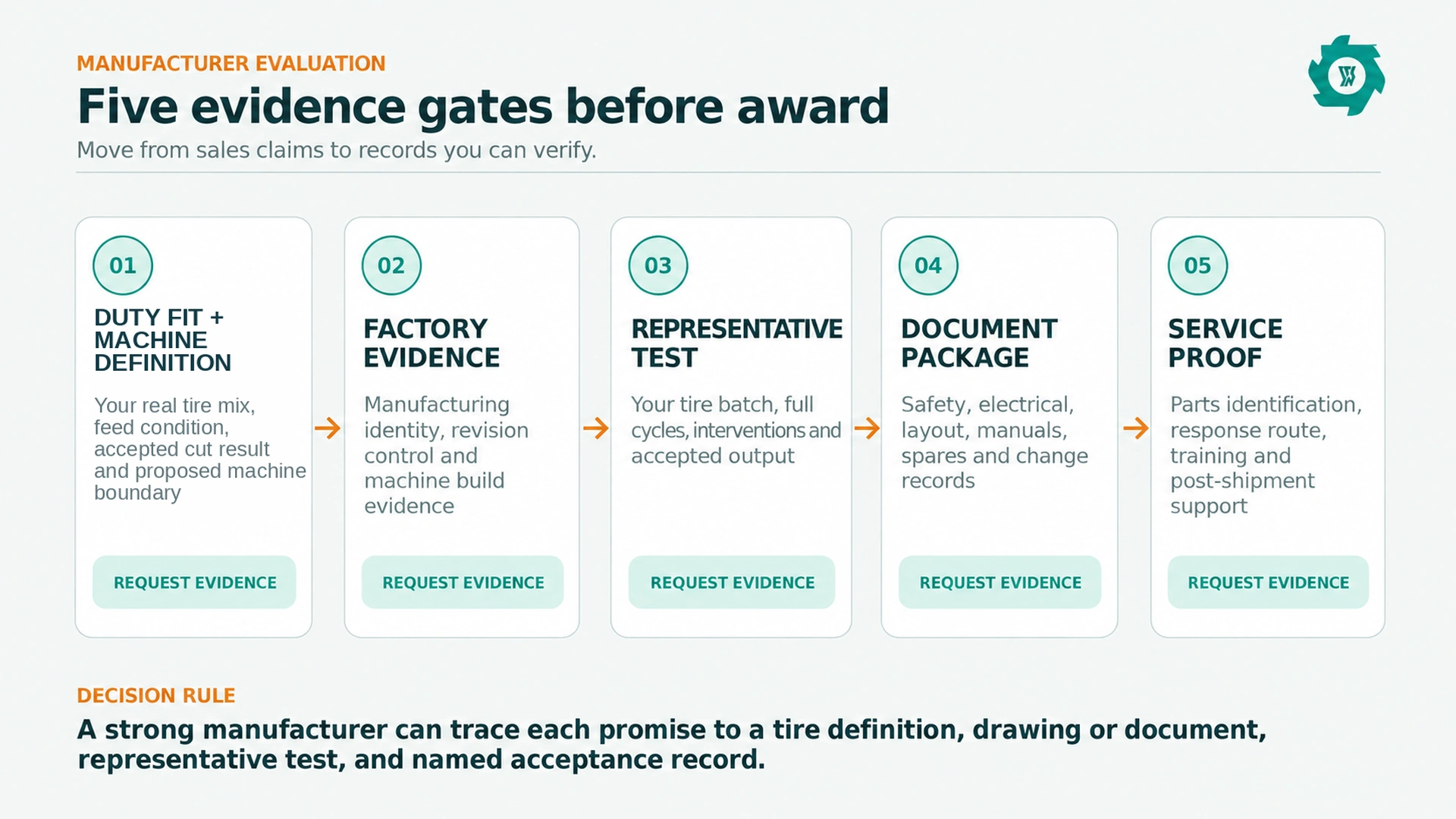
A strong manufacturer can connect five things without gaps: your tire duty and proposed machine → the way it is built → a representative test → the document package → service proof. If one link is missing, the purchase carries an unresolved assumption.
Start by freezing the tire range and accepted cut result. Then ask the supplier to show project-specific drawings, explain its manufacturing and change-control process, run representative tires, record full-cycle results, and state what is included in the quotation. Finally, verify the safety/electrical documentation, wear-part identification, training method and post-shipment support route.
Do not award points simply because a supplier has a large workshop, a certificate logo, a fast cutting clip or a low machine price. Those items can be useful evidence, but only when they answer a requirement that matters to your project.
1. Freeze the Tire Duty Before You Compare Factories
The first test of a manufacturer happens before the factory audit. Send the same tire dossier to every shortlisted supplier and see whether each one asks useful follow-up questions. At minimum, the dossier should describe the tire families processed routinely, the largest recurring tire, representative photos and markings, approximate dimensions, the incoming condition, the required cut result, expected working pattern, local power supply and what happens to the prepared tire body afterward.
This prevents an easy procurement mistake: comparing quotations for different duties. A supplier quoting a light passenger-tire station is not necessarily cheaper than a supplier quoting for heavier truck tires; the two proposals may simply be solving different problems. The same applies to capacity. If one quotation assumes pre-sorted tires and another assumes a mixed stream with frequent adjustments, their production figures cannot be compared until the assumptions are normalized.
Use the tire bead cutting machine specification checklist to define the machine-side questions, but keep the manufacturer review one level higher: did the supplier translate the tire data into a traceable proposal, or did it immediately send a standard model and price?
2. Confirm That the Supplier Is Quoting the Right Machine Function
Search results use “bead cutter,” “sidewall cutter,” “ring cutter,” “debeader” and even “tire cutter” loosely. Before evaluating manufacturing quality, make sure each supplier is quoting the same functional result.
For this article, the accepted result is a prepared tire body plus a separately handled bead-rich sidewall or ring section. The steel bead can still be embedded in rubber. A machine that pulls bead wire from a prepared ring performs a different duty, and a heavy tire section cutter solves another problem again.
Request a short process sketch from each supplier. It does not need to be artistic. It should show the incoming tire condition, operator loading position, cutting action, the two output streams and the next destination. If the supplier cannot draw that boundary clearly, more detailed discussions about motor size or cutter material are premature.
3. Audit Manufacturing Evidence Without Turning the Visit Into a Factory Tour
A useful factory visit or remote audit should follow the proposed bead cutter from drawing to finished assembly. Ask to see a machine of the same family under construction if one is available, then trace how the supplier controls drawings, fabricated parts, purchased components, assembly checks and final machine identification.
You do not need to prescribe the manufacturer’s internal quality system. You do need enough evidence to know that the machine shown during the sales call is connected to the machine that will be shipped. Good questions include: Which drawing revision controls this order? How is the cutter support or fixture checked during assembly? How are purchased electrical components identified? Where is the machine serial or project identity recorded? How are approved design changes communicated to the buyer?
a quality-management standard is a recognized quality-management standard and certification can be relevant evidence of a supplier’s management system.[1] It should not be treated as a product-performance certificate. A quality-management badge does not prove that a particular bead cutter fits your largest tire, reaches an agreed production result or includes the guarding you requested.
4. Review the Design Package Before Production Gets Too Far
Manufacturer capability becomes easier to judge when documents are exchanged early. Before the machine is finished, request the project documents that affect your site: overall dimensions, operating position, service access, machine mass if needed for handling, electrical supply data, relevant guarding arrangement, emergency-stop concept, isolation points, and the interface to any downstream equipment.
For safety evidence, ask for a project-specific risk assessment, guarding logic, hazardous-energy control method and electrical design basis. These should be documented engineering controls, not brochure language.[2][3][4][5]
For electrical equipment, machine electrical-equipment requirements-1 covers general requirements for electrical, electronic and programmable electronic equipment of machines from the point where the electrical supply connects to the machine.[5] The buyer should therefore ask which electrical standard or local requirements the manufacturer is designing around and have its own qualified electrical/safety team review the final package.
Do not accept “standard design” as a reason to skip drawings. Standard machines still need the correct voltage/frequency, operating orientation, access clearances and project options. If a dimension or component changes after approval, require the revision to be identified.
5. Demand Representative-Tire Evidence, Not a Highlight Reel
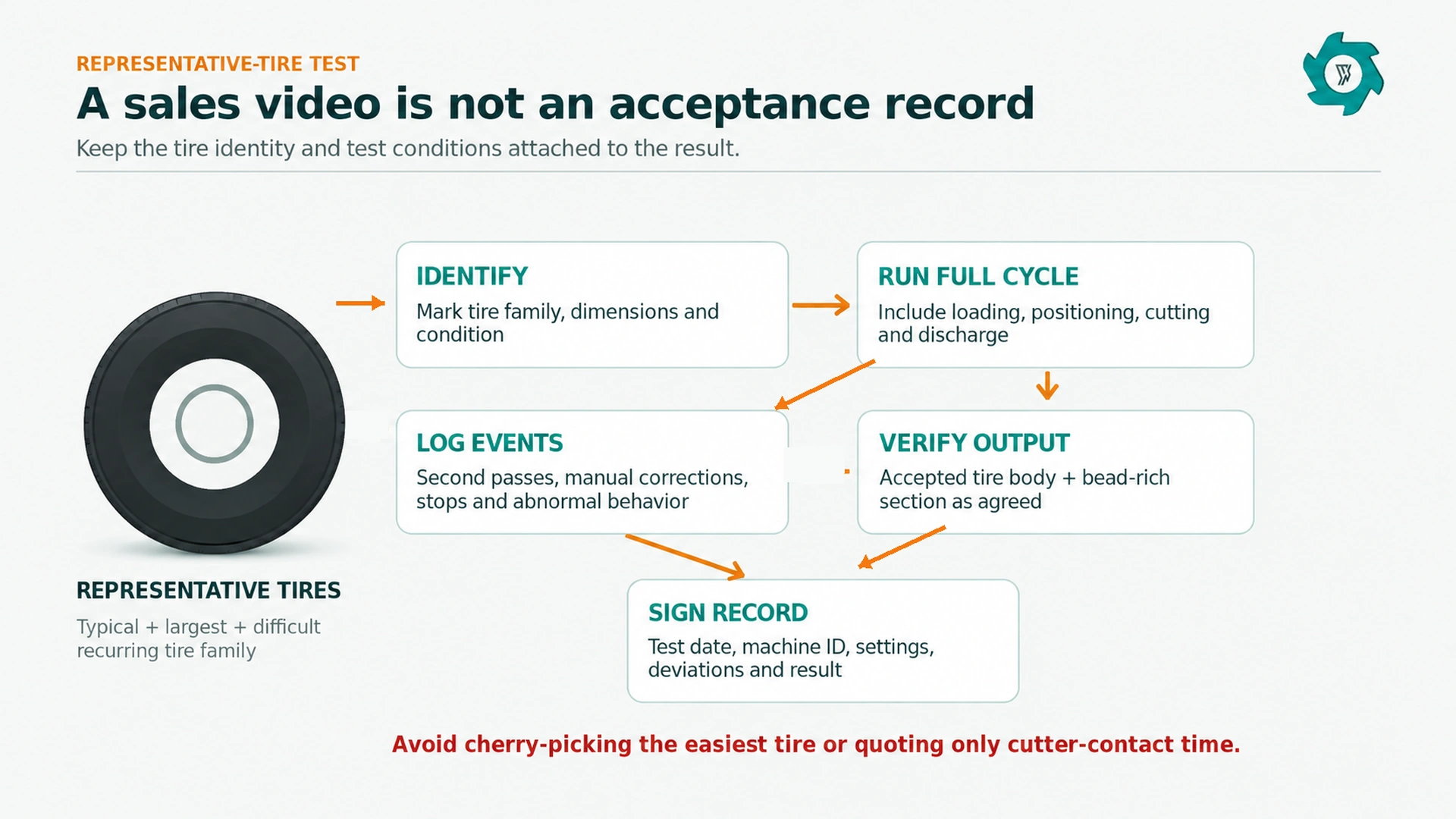
Freeze the test before it happens. Identify the representative tire families, include the largest or difficult recurring tire that matters commercially, and define the accepted cut result. Agree what will be recorded: complete cycles, elapsed time, second passes, manual repositioning, abnormal stops, cutter adjustments, rejected output and any deviations from the test plan. If capacity is an acceptance issue, state the time basis in advance.
Do not force a universal batch size. Use enough representative tires to expose normal variability and the difficult recurring cases you expect to run.
The test should preserve identity. Photograph or label the tires before processing, keep the machine/project identifier visible, and save the final record with the date and agreed configuration. This is especially important when a buyer is qualifying several suppliers remotely. Otherwise, the sales team can unintentionally mix evidence from different machines or earlier projects.
6. Separate Demonstration, Verification and Acceptance
A demonstration shows how the machine works. Verification checks a particular requirement, such as whether the approved tire can be positioned and cut as intended. Acceptance is a contractual decision against agreed criteria.
The distinction matters because a supplier can run an excellent demonstration without satisfying the purchase conditions. Conversely, a machine may pass the agreed acceptance criteria even if the demonstration is not visually dramatic. Procurement should care about the second case.
Build the pre-shipment test around measurable questions. Can the approved tires be loaded and positioned by the agreed method? Does the cut produce the defined prepared tire body and bead-rich section? Are ordinary operator corrections within the agreed boundary? Are alarms and stop functions demonstrated according to the test plan? Are required project documents available at the test revision? If a deviation occurs, is it recorded with an owner and disposition?
If your project is deciding between one independent machine and several connected stages, use the standalone bead cutter versus complete recycling line guide to define how far the acceptance boundary should extend downstream.
7. Check Whether Safety Is Engineered or Added as a Sales Answer
Safety is one of the quickest ways to distinguish a mature supplier conversation from a superficial one. Ask the manufacturer to walk through the operating sequence: loading, positioning, cutting, discharge, clearing an abnormal condition, cutter replacement and maintenance. Then ask where the operator is expected to stand and how access to hazardous motion is controlled.
For U.S. projects, machine-safety rules’s machine-guarding requirements make point-of-operation exposure a real design issue, while servicing activities can bring hazardous-energy control into the operating plan.[3][4] The supplier should be able to provide useful machine information, but the employer remains responsible for its workplace program, training and site-specific compliance.
The tire bead cutting machine safety guide covers guarding and isolation in more detail. During manufacturer evaluation, the main question is whether the supplier’s answers are specific to the proposed machine or copied from a general safety paragraph.
For EU-bound machinery, also pay attention to timing. machinery compliance rules on machinery applies from 20 January 2027 under the current consolidated text.[6] A project scheduled to be placed on the EU market around that transition should confirm the applicable conformity route and documentation with competent specialists.
8. Evaluate Maintainability Before the First Cutter Wears
A manufacturer is easier to live with when wear parts are identifiable before failure. Ask for the recommended spare list, part-identification method, replacement procedure, service clearances and any tools or lifting provisions needed for routine work.
Pay particular attention to the cutting tool and its mounting. Do not accept a promised replacement interval unless the supplier can relate it to the tire duty and operating history. Tire construction, bead strength, setup, alignment and operating practice can all affect wear. A better supplier explains what condition signals should trigger inspection and how the correct replacement is identified.
Installation information matters here too. The installation and commissioning guide addresses foundation, access, utilities and startup planning. Manufacturer evaluation should check whether those details are available early enough for the buyer to prepare the site.
9. Test the After-Sales Process Before You Need It
“Lifetime support” and “24/7 service” are easy phrases to print. The better question is how a real service case moves. Ask who receives a technical problem, what information the supplier needs, how a part is identified, whether remote diagnosis is available, and what happens when the issue needs escalation from sales to engineering.
You can test this before award. Send one realistic scenario: for example, a recurring incomplete cut on a tire family that previously ran well. Ask what photos, measurements or operating observations the support team would request.
10. Normalize Quotations Before Comparing Price
Put each quotation into the same comparison sheet. Separate the base machine from guarding and controls, electrical configuration, wear and spare parts, crating, freight basis, installation or commissioning, training, documentation, pre-shipment testing and any excluded site work.
Require three commercial answers for every line: included, excluded or deviation. If one supplier includes a project-specific test and spare cutter while another leaves both out, the lower headline price is not yet the lower comparable price.
Freeze the approved technical revision before the purchase order. Later changes to the worktable, controls or cutter arrangement should be identified and approved so the delivered machine still matches the layout and spare-parts records.
11. Use a Weighted Scorecard So Evidence Can Beat Presentation
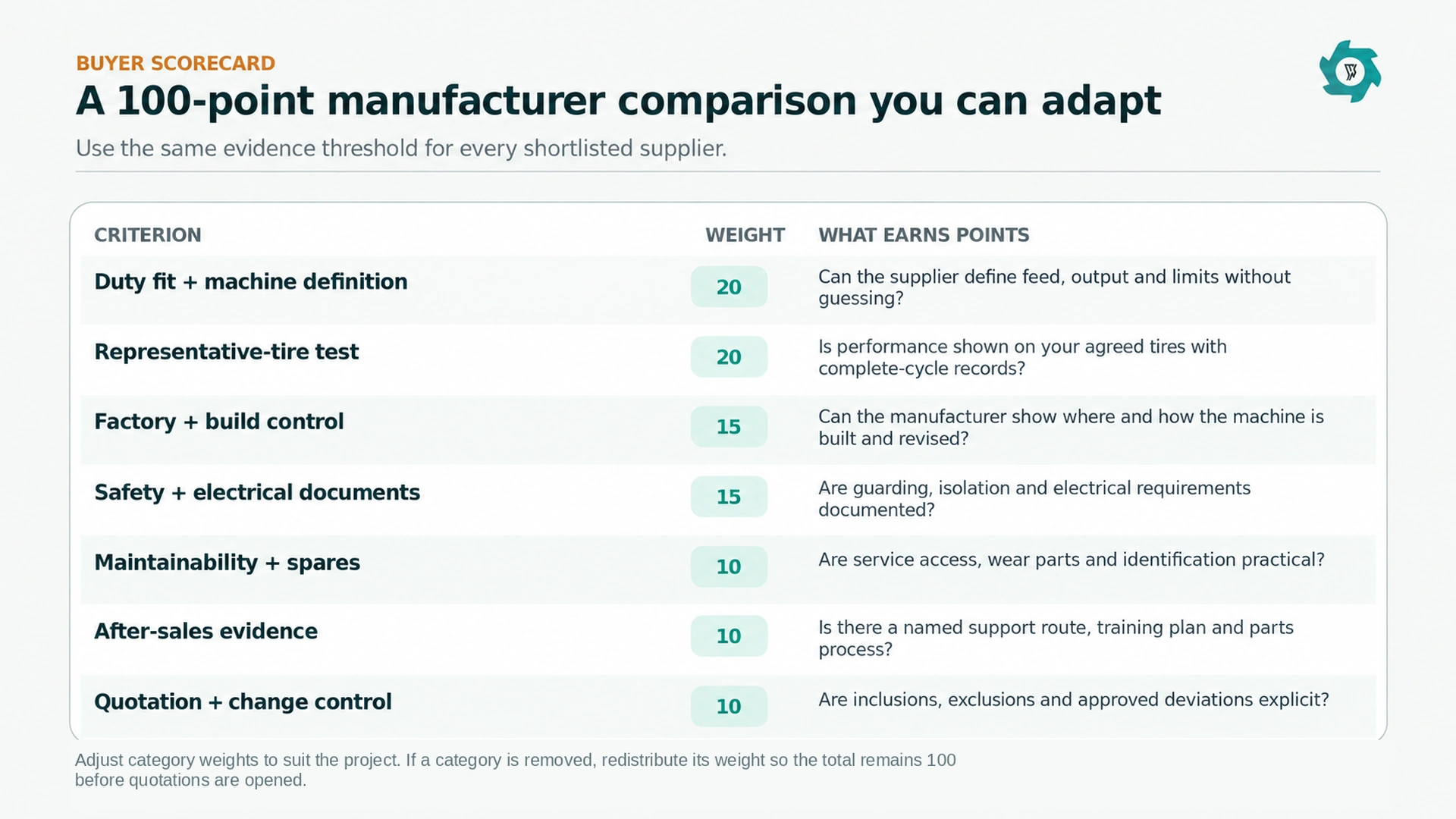
The example below uses 100 points, but the weights are editorial rather than universal. Adjust them before quotations are opened and then apply the same scoring rule to every shortlisted manufacturer.
| Criterion | Suggested weight | High-score evidence |
|---|---|---|
| Duty fit and machine definition | 20 | Approved tire range, clear input/output definition, limits and project-specific machine description. |
| Representative-tire test | 20 | Agreed batch, complete-cycle record, difficult recurring tires, interventions and accepted result. |
| Factory and build control | 15 | Traceable machine identity, drawing revision, assembly evidence and controlled changes. |
| Safety and electrical documents | 15 | Project-specific guarding, isolation and electrical information suitable for buyer review. |
| Maintainability and spares | 10 | Service access, wear-part identification, spare list and replacement information. |
| After-sales process | 10 | Named support route, diagnostic information requirements, training and escalation method. |
| Quotation and change control | 10 | Clear inclusions/exclusions, deviation list, commercial boundary and approved revisions. |
The score should reward evidence quality. A published claim is weaker than a project-specific written confirmation; a written confirmation is weaker than a representative test record; a test record is weaker if the machine or tire identity cannot be traced. This is how a smaller supplier with disciplined engineering can fairly outperform a larger supplier with impressive marketing but weak project control.
12. Red Flags That Deserve a Pause Before Award
| Red flag | Why it matters | Buyer response |
|---|---|---|
| “All tire types are fine” without a defined range | The supplier has not established the real operating boundary. | Require a written tire dossier and exclusions. |
| Capacity is shown only as a short cutting action | Loading, positioning, discharge and corrections may dominate the real cycle. | Request full-cycle accepted output on the agreed tire mix. |
| Only generic machine photos are available | The quoted configuration may not be traceable to a current build. | Ask for machine-family assembly evidence and project drawings. |
| Safety answer is “CE/ISO” with no machine detail | Management-system or conformity language does not replace machine-specific design evidence. | Request guarding, isolation and electrical information for the proposed machine. |
| Drawings change but revision numbers do not | Site preparation and spare-parts records can become inconsistent. | Freeze approved documents and require controlled revisions. |
| Spare parts are described only as “available” | The plant may not be able to identify or order a wear part quickly. | Request part identification and a recommended spare list before shipment. |
| Quotation exclusions are left blank | Unpriced buyer responsibilities appear later as project surprises. | Force each line into included, excluded or deviation. |
13. A Practical Pre-Award Checklist
- The same tire dossier has been sent to every shortlisted manufacturer.
- The proposed machine function and accepted output are written, not assumed from the product name.
- The largest and difficult recurring tires are identified for representative testing.
- The supplier has provided a project drawing and the document carries a revision or other traceable identity.
- The buyer has reviewed operating position, access, utilities, guarding concept and energy-isolation information with qualified site personnel.
- The test plan defines the tire batch, complete-cycle timing basis, accepted output, interventions and deviation handling.
- Wear parts can be identified and ordered from a spare-parts list or equivalent record.
- Training, commissioning assistance and technical support have a defined delivery method.
- The quotation states what is included, excluded and different from the request.
- The final technical and commercial revision is frozen before order.
FAQ
What is the most important thing to verify before choosing a tire bead cutter manufacturer?
Verify that the manufacturer can define the machine around your actual tire range and accepted cut result, then prove that duty on a representative test batch. Factory size, certificates and a polished video are supporting evidence, not substitutes for a project-specific test.
How should I compare two tire bead cutter suppliers with different capacity claims?
Normalize the tire mix and time boundary first. Compare accepted output over the same elapsed-time basis, including loading, positioning, discharge, second passes and ordinary operator interventions. Do not compare a short cutting stroke or best-case cycle with a full production cycle.
Should I require a factory acceptance test before shipment?
For an industrial purchase, a pre-shipment acceptance test is useful when the feed tires, accepted output, test duration, recorded events and pass criteria are agreed before the test. A casual video made after the machine is complete is weaker evidence because the conditions were not frozen in advance.
What is a warning sign when evaluating a bead cutter supplier?
A common warning sign is a quotation that gives confident performance claims but cannot tie them to a defined tire range, accepted cut result or representative test. Other concerns include changing drawings without revision control, unclear exclusions, generic safety answers, and spare parts that cannot be identified before shipment.
Turn the Manufacturer Review Into a Testable RFQ
Send the tire dossier, required output condition, expected operating pattern, site utilities and downstream destination first. Then ask the shortlisted supplier to return the machine definition, drawing, test plan, document list, spare-parts proposal and clear quotation boundary against the same information.
Engineering References
- Quality system. Quality-management evidence.
- Risk assessment. Machinery risk-reduction guidance.
- Machine guarding. Guarding requirements.
- Energy control. Hazardous-energy control.
- Electrical safety. Machine electrical equipment.
- Machinery rule. Machinery compliance context.