




Wondering how a 1 ton/hour tire recycling production line can turn waste tires into valuable resources? This guide will walk you through its production process, equipment selection, and implementation tips to help you quickly enter the resource recycling industry.
I. Why is 1 Ton/Hour the “Golden Capacity” for Small and Medium-Sized Recycling Projects?
For enterprises new to tire recycling, “1 ton/hour” is the optimal choice that balances cost and practicality:
- Friendly Investment: Compared with large-scale production lines, the initial investment for 1-ton equipment is reduced by more than 40%, requiring no millions of funds and being more suitable for startups or regional small-scale projects.
- Flexible Site Requirements: The entire production line only needs 2150-3230 sq ft of workshop space, no large-scale land acquisition or renovation is required, and it can be quickly set up and put into operation.
- Market Matching: A capacity of 1 ton/hour just covers the tire recycling demand in a region. It avoids inventory backlogs due to overcapacity or missing local recycling resources due to insufficient capacity, and can flexibly adjust production direction according to market demand for different recycled materials.
II. Complete Production Process of a 1 Ton/Hour Tire Recycling Production Line
A standard 1 ton/hour tire recycling production line goes through 7 interlocking processes, each determining the quality of the final recycled materials:
- Preprocessing: Disassembly and Sorting
Before entering the crushing process, waste tires need to be preliminarily processed—use a tire disassembler to separate the steel wire in the bead (accounting for about 10-15% of the tire weight), and manually sort out impurities such as metal and fabric mixed in the tires to ensure the efficiency and product purity of the subsequent crushing process. - Rough Crushing: Shredding Tires into Small Pieces
The preprocessed tires are fed into a double-shaft shredder. After being sheared and extruded by the cutters, they become 2-4 inches “tire chunks”. In this process, rubber, steel wire and fiber are initially separated to lay the foundation for subsequent fine processing. The shredder of the 1 ton/hour production line is generally equipped with a 75-100 HP motor, and the cutters are made of AISI 4140 material, with a service life of 800-1000 hours. - Medium Crushing: Refining Rubber Particles
The roughly crushed tire chunks enter a rubber crusher (or hammer mill) and are further crushed into 0.4-0.8 inches rubber particles. At the same time, residual steel wire is separated by magnetic separation equipment. To avoid rubber dust pollution, a dust removal system must be equipped in this link to meet environmental protection requirements. - Fine Grinding: Obtaining Rubber Powder of Different Mesh Sizes
According to customer needs, the medium-crushed particles are fed into a fine grinder and ground into rubber powder of 20-80 mesh—20-40 mesh rubber powder can be used for asphalt modification, while 60-80 mesh fine rubber powder can be directly used in the production of high-end rubber products, and its price is more than 30% higher than that of ordinary particles. - Steel Wire Separation and Purification
After treatment by magnetic separators and eddy current separators, the steel wire in the tires is completely separated and purified, and finally steel wire with a purity of more than 99% is obtained, which can be directly sent to the steel mill for recycling. Based on per ton of waste tires, 265-330 lbs of steel wire can be recovered, and the revenue from this part alone can cover 15-20% of the production line’s operating costs. - Fiber Separation: Recycling Polyester/Nylon Fiber
Through air separators and vibrating screens, polyester or nylon fibers in tires are separated. These fibers can be used in the production of non-woven fabrics, enhance the crack resistance of concrete, or be used as an additive in building materials, further improving the resource utilization rate of waste tires. - Finished Product Storage and Packaging
Finally, rubber powder, steel wire and fiber are stored in silos respectively, and packaged according to customer needs—such as 55 lbs/bag of rubber powder or ton bags of steel wire, which are convenient for subsequent transportation and sales.
III. Key Equipment Selection Points for 1 Ton/Hour Production Lines
For 1-ton production lines, equipment selection directly affects the project’s profitability. Here are the key points for selecting several core equipment:
- Double-Shaft Shredder
Pay attention to cutter material, motor power and actual output—recommend equipment equipped with a 75 HP motor and AISI 4140 cutters, which can ensure a stable output of 1-1.2 tons/hour. At the same time, regularly check the wear of the cutters and replace them in time to avoid affecting production efficiency. - Rubber Crusher
Focus on hammer material and screen aperture—choose AISI 1045 hammers and 0.4 inches screens to ensure the uniformity of particles. At the same time, avoid hard impurities from entering the equipment to prevent hammer damage. - Fine Grinder
Pay attention to roller material and mesh adjustment range—recommend tungsten steel rollers and equipment with an adjustable range of 20-100 mesh. Ensure the particles are dry before grinding to avoid caking. - Magnetic Separator
Focus on magnetic field strength and separation efficiency—choose equipment with a magnetic field strength ≥ 12,000 gauss and separation efficiency ≥ 98%. Regularly clean impurities on the magnetic roller to ensure separation effect. - Dust Removal System
Pay attention to air volume and filtration accuracy—choose equipment with an air volume ≥ 177,000 CFM and filtration accuracy ≤ 10μm, and connect it to all crushing and grinding links to avoid dust leakage.
IV. Implementation Preparation Tips for 1 Ton/Hour Tire Recycling Production Lines
To quickly put a 1 ton/hour production line into operation and make profits, these implementation details cannot be ignored:
- Site Planning: Prioritize workshops close to waste tire recycling points to reduce transportation costs; reserve equipment operation space and finished product storage areas in the workshop, and arrange water, electricity and dust removal pipelines properly.
- Qualification Handling: Handle relevant qualifications such as environmental protection approval and renewable resource recycling filing in advance to avoid compliance issues after production.
- Raw Material Channels: Establish long-term cooperation with local auto repair shops and scrap yards to ensure stable supply of waste tires. At the same time, attract individual car owners to provide tires through the “exchange old for money” method.
- Sales Channels: Connect with downstream customers such as rubber product factories, asphalt modification enterprises and steel mills in advance to understand their specific needs for recycled materials, such as the mesh size of rubber powder and the purity of steel wire, and adjust production accordingly.
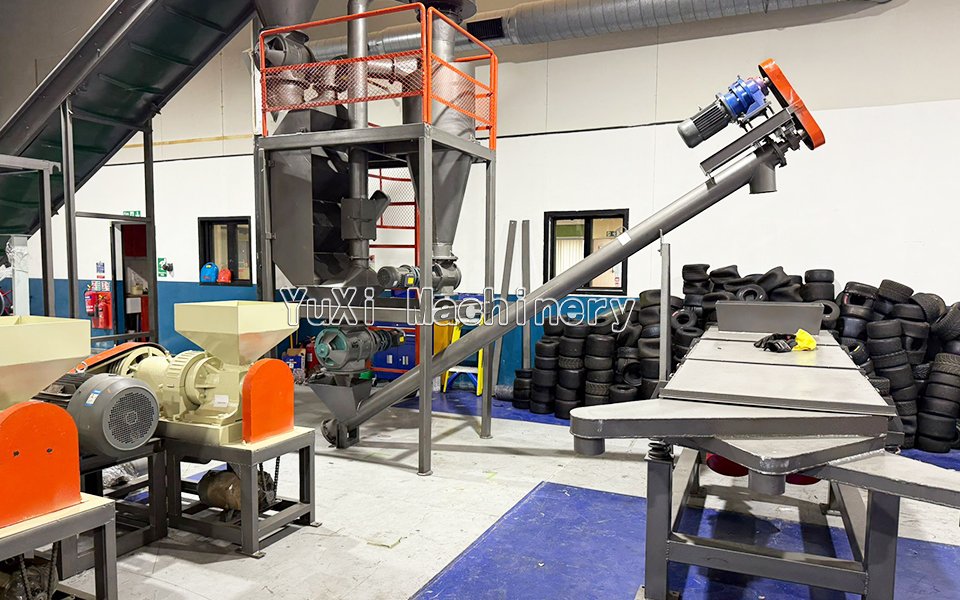
V. Investment and Revenue Analysis of 1 Ton/Hour Tire Recycling Production Lines
For enterprises wanting to enter the industry, investment and revenue are the core considerations. We take a standard 1 ton/hour production line as an example for a clear calculation:
Initial Investment
- Equipment Purchase: Approximately 48,000-62,000 USD, including core equipment such as shredders, crushers, grinders, sorting equipment and dust removal systems.
- Workshop and Infrastructure: Approximately 21,000-27,000 USD, including rental or renovation of 2150-3230 sq ft workshops and laying of water and electricity facilities.
- Other Expenses: Approximately 7,000-14,000 USD, including equipment transportation, installation and commissioning.
- Total Investment: Approximately 76,000-103,000 USD.
Operating Costs (Based on 8 hours per day and 25 days per month)
- Waste Tire Purchase: Approximately 1,100-1,400 USD/ton, the specific price varies by region and tire type.
- Electricity Fee: Approximately 160-200 USD/ton, the total power of the equipment is about 200 HP, calculated at an electricity price of 0.12 USD/kWh.
- Labor Cost: Approximately 70-110 USD/ton, generally 2-3 workers are needed to operate the equipment and sort materials.
- Other Costs (Consumables, Maintenance, etc.): Approximately 40-70 USD/ton.
- Average Operating Cost per Ton: Approximately 1,370-1,780 USD.
Revenue Calculation
- Rubber Powder: Calculated at a market price of 2,000-2,700 USD/ton, about 700-800kg of rubber powder can be produced per ton of waste tires.
- Steel Wire: Calculated at a market price of 2,700-3,400 USD/ton, about 120-150kg of steel wire can be produced per ton of waste tires.
- Fiber: Calculated at a market price of 1,100-1,400 USD/ton, about 50-80kg of fiber can be produced per ton of waste tires.
- Average Revenue per Ton: Approximately 2,200-3,000 USD.
- Average Profit per Ton: Approximately 550-1,250 USD. Based on a monthly output of 200 tons, the monthly profit is about 110,000-250,000 USD, and the payback period is about 6-10 months.
A 1 ton/hour tire recycling production line is not a compromise for “small capacity”, but a “lightweight key” for small and medium-sized enterprises to enter the resource recycling field—with controllable investment and flexible site requirements, it turns waste tires from “environmental burdens” into recycled resources that can create stable revenue. From the refined processing of the production process, to the targeted matching of equipment selection, and then to the detailed control of the implementation link, this production line not only solves the environmental problem of tire recycling, but also provides entrepreneurs with a low-threshold and high-return green track.