




If you’re looking for answers to questions like “How to choose a 1-ton-per-hour tire recycling production line” or “How much money can I make from recycling 1 ton of tires”, this article will explain the equipment principles, parameters, profitability, and maintenance in full detail—so you can determine if this production line is right for you after reading.
I. First, Understand: What Exactly Is a 1-ton-per-hour Tire Recycling Production Line?
Many people think “tire recycling is just cutting tires into pieces”, but a 1-ton-per-hour production line is a closed-loop processing system: from the input of waste tires (both car and truck tires can be processed) to the output of recycled materials such as rubber powder, steel wire, and fiber within 1 hour, the entire process is automated and does not require a large number of workers.
Core Parameters (2025 Latest Data)
- Processing Capacity: 1 ton per hour (20-22 tons per day for 24-hour continuous operation)
- Total Power: 230kw (frequency conversion control, 30% more energy-efficient than traditional equipment)
- Installation Area: 200-250㎡ (including raw material warehouse, equipment area, and finished product warehouse)
- Raw Material Compatibility: Car tires, truck tires, engineering tires (all with a diameter ≤ 1.2 meters)
- Finished Product Specification: 10-30mesh (1-3mm rubber powder, 5mm particle size can be customized)
- Lead Time: 45 working days (including installation and commissioning guidance)
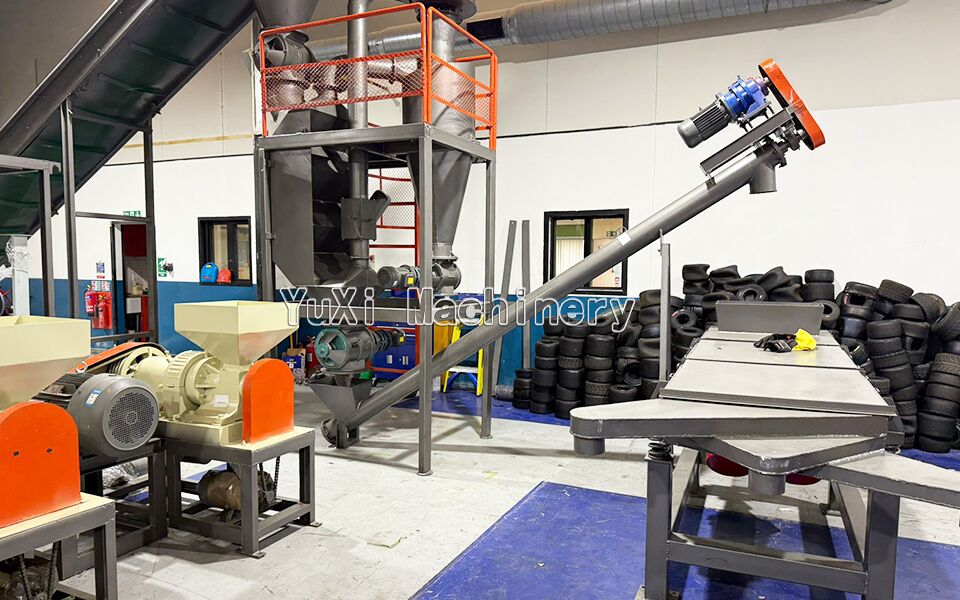
II. The “4-Step Transformation Process” of a 1-ton-per-hour Tire Recycling Production Line
This production line is not a “black-box device”; you can see the “transformation” of tires at every step:
- Step 1: Feeding + Rough Shredding—Cutting 1-meter Tires into “Small Cubes”
First, waste tires are fed into the double-shaft shredder via a belt conveyor. The cutters are made of “Cr12MoV alloy steel”, which can cut the steel wire and cord fabric in the tires, turning the tires into 5-10cm “tire blocks”—this step has a processing speed of 1.2 tons per hour, ensuring no “material shortage” in subsequent links. - Step 2: Fine Shredding + Separation—Separating Rubber, Steel Wire, and Fiber
The roughly shredded tire blocks enter the rubber fine shredder and are turned into 1-3cm rubber granules through “hammering + grinding”; then they enter the magnetic separator (magnetic field strength ≥ 12000 gauss), which can adsorb 100% of the steel wire. Next, the airflow separator (wind speed adjustable to 18-22m/s) blows away the light fiber, leaving rubber granules with a purity of ≥ 98%. - Step 3: Screening + Dust Removal—Making Finished Products “Clean and Uniform”
The rubber granules enter the vibrating screen (3-layer screen, aperture 1mm/3mm/5mm) and are classified by particle size; at the same time, the baghouse dust collector (filter area ≥ 150㎡) captures the rubber dust generated during the shredding process, with a filtration efficiency of ≥ 99.5%, keeping the workshop dust concentration ≤ 10mg/m³ and complying with the Atmospheric Pollutant Emission Standard. - Step 4: Finished Product Packaging—Direct Connection to Downstream Customers
The screened rubber powder is packaged by an automatic packaging machine (25kg/50kg per bag optional), the steel wire is pressed into “steel wire cakes” (50kg per piece) by a baler, and the fiber can be compressed into “fiber bales”—these finished products can be directly sold to asphalt plants, plastic runway factories, and steel mills without secondary processing.
III. The “3 Core Advantages” of a 1-ton-per-hour Tire Recycling Production Line
Advantage 1: Processing 1 Ton per Hour, Capacity Perfectly Matches Small and Medium-sized Recycling Plants
- The tire recycling volume in many regions is “10-20 tons per day”, and a 1-ton-per-hour production line (20 tons per 24 hours) can just “fully utilize” the raw materials, avoiding “overcapacity” or “raw material accumulation”;
- Compared with a “2-ton-per-hour production line”, its investment cost is 40% lower and its floor area is 30% smaller, making it more suitable for entrepreneurs new to the recycling industry.
Advantage 2: Only 80-100 kWh of Electricity per Ton of Tires, Lower Operating Costs Than Peers
- The production line adopts “frequency conversion motor + waste heat recovery” technology: the motor can automatically adjust the speed according to tire hardness, and the heat generated by shredding is recycled to heat the separation airflow. Only 80-100 kWh of electricity is needed per ton of tires, 50% less than traditional small workshops (150 kWh per ton);
- The service life of the cutters is ≥ 500 tons of tires, and the cutter cost per ton of tires processed is only 4 yuan, far lower than the industry average of 10 yuan per ton.
Advantage 3: 100% Resource Utilization of Finished Products, Earning 300-500 Yuan per Ton
- Calculated based on 2025 market prices:
◦ Purchase price of 1 ton of waste tires: 800-1000 yuan;
◦ Output of 0.7 tons of rubber powder (selling price 1500-1800 yuan/ton): revenue 1050-1260 yuan;
◦ Output of 0.15 tons of steel wire (selling price 2000-2200 yuan/ton): revenue 300-330 yuan;
◦ Output of 0.1 tons of fiber (selling price 200-300 yuan/ton): revenue 20-30 yuan;
- After deducting electricity (80 yuan), labor (50 yuan), and maintenance (20 yuan), the net profit per ton is 300-500 yuan. Calculated based on 300 days a year, the net profit can reach 90,000-150,000 yuan.
IV. “Usage & Maintenance Guide” for 1-ton-per-hour Tire Recycling Production Line
Daily Operation Precautions
- Before feeding, stones and nails on the tires must be cleaned (to avoid damaging the cutters), and the inner tube must be removed from tires with inner tubes;
- Check the wear of the shredder cutters before starting the machine every day (the cutter edge needs to be ground when the wear is ≥ 2mm);
- Add grease (Lithium Grease No. 3) to the bearings of the fine shredder once every 100 tons of tires processed.
Environmental Protection Maintenance Points
- Clean the filter bags of the baghouse dust collector once every 3 months (blow back with compressed air, do not wash with water);
- Replace the sound-absorbing cotton of the muffler once a year (to ensure the noise is ≤ 80 decibels);
- Test the workshop dust concentration once a month to ensure it is ≤ 10mg/m³.
Profit Expansion Tips
- Sign a “long-term recycling agreement” with local tire shops to keep the purchase price below 800 yuan/ton;
- Provide “modified rubber powder” (adding 2% modifier) to asphalt plants, which can sell for an extra 150 yuan per ton;
- Collect the carbon black generated by the production line (extracted through pyrolysis) and sell it to ink factories for more than 2000 yuan per ton.
V. Frequently Asked Questions (FAQ)
Q1: How much does a 1-ton-per-hour tire recycling production line cost?
A: The 2025 market price is 280,000-350,000 yuan (including equipment, installation, and commissioning), 40% cheaper than a 2-ton-per-hour production line.
Q2: How many people are needed to operate the production line?
A: Only 1-2 people: 1 person is responsible for feeding and monitoring the equipment, and 1 person is responsible for packaging the finished products. The automation level is very high.
Q3: Can the production line pass environmental assessment?
A: Yes. This production line is equipped with a baghouse dust collector and muffler, and the dust and noise meet national standards. As long as you submit the environmental assessment materials as required, you can pass.
Q4: Is it easy to find downstream customers for rubber powder?
A: Yes. Asphalt plants, plastic runway factories, and waterproof coiled material factories all need rubber powder, and many manufacturers will take the initiative to purchase.
VI. Conclusion: Who Is the 1-ton-per-hour Tire Recycling Production Line Suitable For?
If you are:
- An entrepreneur who wants to enter the circular economy field;
- A waste station owner with stable tire recycling channels;
- A small or medium-sized recycling plant that wants to expand its business;
This 1-ton-per-hour tire recycling production line is a “cost-effective choice”—it has low investment, low operating costs, and stable profitability, helping you turn “black pollution” into “green wealth”.