




Wondering how a 3 ton/hour tire recycling production line balances environmental responsibility and commercial benefits? This article combines on-site cases from Germany, the United States, and Japan to break down equipment selection, cost estimation, and compliance key points, helping you quickly determine if this “golden-scale” solution is suitable for you.
I. Why is 3 Ton/Hour the “Golden Scale” for Tire Recycling?
80% of small and medium-sized recycling enterprises prioritize 3 ton/hour production lines — a daily processing capacity of 72 tons perfectly matches:
- A raw material collection radius of 100-200 kilometers
- Annual regional waste tire generation (20,000-30,000 tons)
- Local digestion demand for recycled products (asphalt plants, rubber product factories, etc.)
Core advantage: The modular design can adapt to passenger car/mining tires, with a unit processing energy consumption 12% lower than that of 10 ton/hour large-scale lines, and the initial investment is only 1/3 of the latter.
II. Foreign Cases: On-Site Details of 3 Ton/Hour Production Lines
Case 1: Community Recycling Hub in Essen, Germany (Solving the “Not In My Backyard” Effect)
- Equipment Configuration: Bruks Siwertell dual-shaft shearer (120-ton shearing force) + CM Shredders 40-mesh grinding system
- Environmental Design: Low-noise enclosure + dust collection system (emission <4mg/m³), integrated into the community recycling center
- Benefits: Rubber powder supplied to asphalt plants (for quiet pavements), with a processing profit of 85 euros per ton, and steel wire directly sold to steel mills
Case 2: Oilfield Tire Processing Line in Houston, USA (Adapting to Engineering Tires)
- Custom Modifications: Pre-cutting workstation to split 1.8-meter engineering tires, high-pressure roller mill to process into 10mm rubber blocks
- Energy Recycling: 150HP biomass boiler generating electricity using pyrolysis gas, meeting 80% of power demand
- Compliance: Wastewater reused after membrane filtration, achieving “zero discharge” operation
Case 3: Closed-Loop Recycling Line in Kobe, Japan (From Tire to Tire)
- Core Technology: -196℃ liquid nitrogen cryogenic grinding, producing 200-mesh ultra-fine rubber powder (directly used in new tire tread production)
- Data: Each ton of waste tires processed reduces CO₂ emissions by 3.2 tons, recycled rubber powder replaces 30% of virgin rubber, reducing new tire costs by 12%
- Policy: Annual cost savings of 12 million yen
III. 7 Key Selection Details for 3 Ton/Hour Production Lines
Preprocessing: Prioritize Dual-Shaft Shearers
- Blade material: AISI D2 tool steel, service life of 8,000 tons
- Hydraulic push feeding is 3 times more efficient than manual feeding
Sorting: Ensuring Full Component Value
- Magnetic separator magnetic field ≥12,000 gauss, steel wire separation rate ≥99.8%
- Air classifier wind speed 1.2-1.5m/s for separating polyester fibers
Post-Processing: Matching Product Requirements
- 40-mesh rubber powder → asphalt modification, 80-mesh → rubber products, 200-mesh → high-end tire recycling
- Pyrolysis system temperature 400-450℃, yielding 40% pyrolysis oil + 30% carbon black
IV. Frequently Asked Questions (FAQ)
What is the initial investment?
Complete equipment (including preprocessing + sorting + grinding): 800,000-1,200,000 euros, additional 150,000-200,000 euros for environmental protection facilities.
How many operators are needed?
PLC automatic control requires only 3-4 operators (1 for feeding, 1 for central control, 2 for packaging), enabling 24-hour continuous operation.
What is the market demand for recycled products?
- Europe: Annual demand for rubber powder reaches 1.2 million tons (for asphalt modification)
- United States: TDF accounts for 3% of industrial boiler fuel
- Japan: The proportion of ultra-fine rubber powder reused in tires is increasing year by year
- What environmental protection indicators need to be met?
- Emission <4mg/m³
- Wastewater reuse rate 100%
- Noise ≤75dB(A)
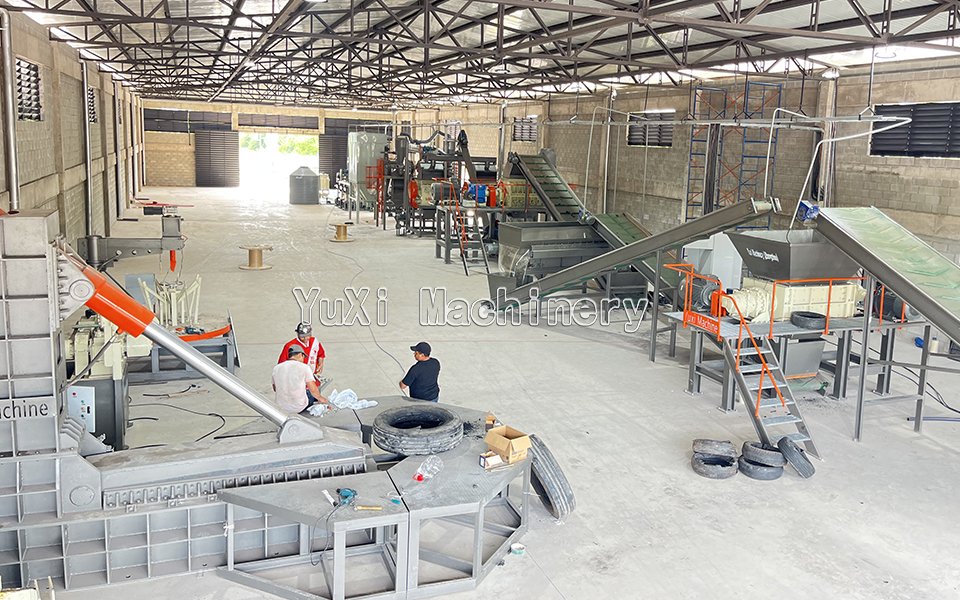
The 3 ton/hour tire recycling production line is the optimal “small but refined” solution — avoiding the low efficiency and high energy consumption of small equipment, and eliminating the high investment and long cycle of large-scale lines. From the community hub in Germany to the closed-loop recycling line in Japan, cases prove that it can achieve a win-win situation of “environmental protection + economy”.