




Ever wondered how small and medium-sized enterprises (SMEs) can efficiently recycle waste tires without massive investment? This article delves into the core configuration, optimized workflow, EU compliance, profit model, and practical value of 1 ton/hour tire recycling production lines, revealing why it’s the go-to choice for small-scale tire recycling projects.
I. What is a 1 Ton/Hour Tire Recycling Production Line? Grasp Its Core Positioning in 3 Minutes
A 1 Ton/Hour Tire Recycling Production Line is a compact, cost-effective integrated system designed to process 1 ton of waste tires per hour (equivalent to 6,000-8,000 tons annually, based on 2,000 working hours) into recycled rubber products such as rubber granules, rubber powder, or TDF (Tire Derived Fuel). Unlike large-scale lines (3-10 tons/hour) that require huge upfront investment and extensive site space, this small-scale line focuses on “flexibility, energy-saving, and low threshold,” perfectly matching the needs of SMEs, local recycling stations, and regional waste management projects.
According to data from the European Small and Medium-Sized Enterprises Association (SMEunited), over 60% of tire recycling enterprises in the EU are SMEs, and 75% of them choose 0.5-2 tons/hour production lines. A 1 ton/hour line balances efficiency and cost: its investment is only 1/3-1/5 of a large-scale line, while the recycling efficiency can meet the local waste tire disposal demand (usually 5,000-10,000 tons per year in a county or small city).
II. Core Configuration of 1 Ton/Hour Tire Recycling Production Line: 5 Compact and Efficient Modules
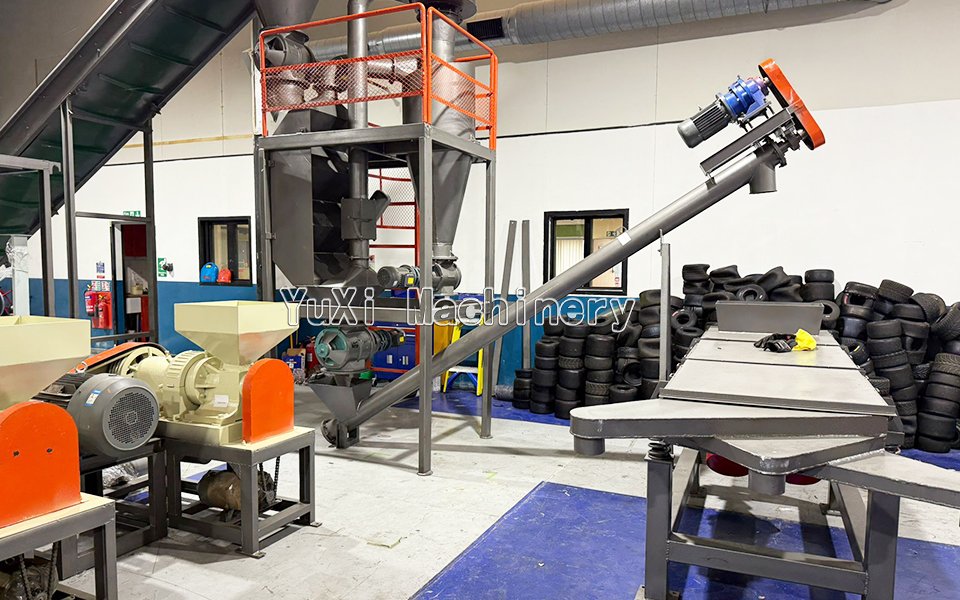
The line adopts a modular, space-saving design, with a total occupied area of only 300-500 square meters. Its core configuration focuses on “high integration and low energy consumption,” including 5 key modules:
- Integrated Feeding & Pretreatment Module
This module combines a small conveyor belt (width 600mm, speed 0.8m/s) and a manual auxiliary feeding platform, with a feeding capacity of 1-1.2 tons/hour. It is equipped with a simple debeading device (manual + semi-automatic combined) to remove metal bead rings from waste tires, avoiding damage to subsequent equipment. The module also includes a preliminary sorting table to manually remove large foreign objects (stones, metal blocks) mixed in waste tires. - Compact Primary Shredder
The core equipment is a single-shaft shear shredder with a motor power of 45-55kW (complying with EU IE3 energy efficiency standards). It adopts a high-strength alloy steel blade (hardness HRC60-65) and a compact structure (length × width × height: 2.5m × 1.8m × 2.2m), which can cut whole waste tires into 30-50mm rubber blocks at a speed of 15-20 rpm. The shredder is equipped with an overload protection system and an automatic reversing function to prevent jamming and blade damage. - Secondary Crushing & Grading Module
The module integrates a small hammer crusher (motor power 30-40kW) and a double-layer vibrating screen (screen mesh 2mm and 4mm). The 30-50mm rubber blocks are crushed into 1-4mm rubber granules (the most versatile specification) or 5-10mm TDF by the crusher, and then classified by the vibrating screen. Unqualified coarse particles (>4mm or >10mm) are returned to the crusher for reprocessing, ensuring the qualification rate of finished products is over 98%. - Precision Impurity Removal Module
A small magnetic separator (magnetic field strength 12,000Gs) and an eddy current separator (power 5.5kW) are integrated to remove ferrous and non-ferrous metals. The magnetic separator has a separation efficiency of over 99.5% for steel wires, and the eddy current separator can separate copper, aluminum, and other non-ferrous metals, ensuring the metal content in the finished product is less than 0.3% (meeting EU EN 15353 standards for small-scale production). - Environmental Protection Control Module
Tailored to small-scale production, the module includes a mini bag-type dust collector (air volume 5,000m³/h, dust emission concentration ≤5mg/m³) and a sound insulation cover (noise ≤75dB(A) at the factory boundary), fully complying with EU EN 13284-1 and EN ISO 11200 standards. The dust collector is equipped with an automatic ash cleaning function, and the sound insulation cover is detachable for easy equipment maintenance.
III. Optimized Workflow of 1 Ton/Hour Tire Recycling Production Line: 6 Streamlined Steps
The workflow is designed to be simple and easy to operate, requiring only 2-3 operators to complete the entire process. The streamlined steps are as follows:
- Manual Sorting & Debeading
Waste tires are first transported to the sorting table, where operators remove foreign objects and severely damaged tires. Then, the semi-automatic debeading device removes the metal bead rings (recycled separately, with a recovery rate of over 99%). This step takes about 5-8 minutes per tire, ensuring the feeding quality. - Integrated Feeding
Sorted and debeaded tires are manually placed on the conveyor belt, which transports them to the primary shredder at a stable speed. The feeding process is controlled by a foot switch, allowing operators to adjust the feeding speed according to the shredder’s operating status, avoiding overload. - Primary Shredding
The single-shaft shear shredder cuts the tires into 30-50mm rubber blocks. The shredder’s blade gap is adjustable (5-10mm), and the cutting temperature is controlled below 60°C by a built-in cooling fan, preventing rubber aging. - Secondary Crushing
Rubber blocks are conveyed to the small hammer crusher, which crushes them into fine particles. The crusher’s hammerhead is made of wear-resistant alloy steel, with a service life of 3-6 months (depending on the processing volume). The crushing speed is adjusted according to the desired particle size (1-4mm for rubber granules, 5-10mm for TDF). - Impurity Removal & Grading
Crushed particles pass through the magnetic separator to remove ferrous metals, then through the eddy current separator to remove non-ferrous metals. The double-layer vibrating screen classifies the particles: 1-4mm rubber granules are sent to the storage bin, 5-10mm TDF is collected separately, and unqualified particles are recycled for reprocessing. - Packaging & Storage
Qualified rubber granules or TDF are conveyed to a small automatic packaging machine (packaging weight 25kg/bag), which can complete packaging, sealing, and labeling. The finished products are stored in a dry, ventilated warehouse to avoid moisture absorption and mildew.
IV. Application Scenarios of 1 Ton/Hour Tire Recycling Production Line: 3 Targeted Fields
Due to its small scale and flexible output, the production line is mainly used in 3 targeted fields, perfectly matching the needs of small-scale operations:
- Local Waste Tire Disposal
For counties, small cities, or regional waste management centers, the line can process 6,000-8,000 tons of waste tires annually, solving the local “black pollution” problem. For example, a small city in southern France with a population of 50,000 generates about 7,000 tons of waste tires per year. A 1 ton/hour production line can fully meet the disposal demand, with low investment and quick results. - SME Rubber Product Processing
SMEs engaged in the production of rubber floor mats, sports equipment, or waterproof materials can use the line to produce self-used rubber granules, reducing raw material procurement costs by 30-40%. A small rubber mat factory in Germany uses a 1 ton/hour line to recycle waste tires, producing 1-4mm rubber granules for its own production, saving 150,000-200,000 euros in raw material costs annually. - TDF Supply for Small-Scale Industrial Users
The line can produce TDF (5-10mm) to supply small-scale industrial users such as local brick kilns, small cement plants, or heating boilers. TDF has a high calorific value (38-42MJ/kg) and can replace 20-30% of coal, helping small industrial users reduce energy costs and meet environmental standards. A small brick kiln in Poland uses TDF produced by a 1 ton/hour line, reducing coal consumption by 25% and carbon dioxide emissions by 20%.
V. EU Compliance & Advantage Analysis of 1 Ton/Hour Tire Recycling Production Line
Strict Compliance with EU Standards
Formal 1 ton/hour production lines fully meet EU regulations for small-scale tire recycling, including:
- Product quality: Rubber granules meet EU EN 14034 standards (metal content ≤0.3%, moisture content ≤3%, tensile strength ≥3MPa); TDF meets EU EN 15353 standards (calorific value ≥38MJ/kg, sulfur content ≤0.8%);
- Environmental emissions: Dust emission ≤5mg/m³, noise ≤75dB(A), complying with EU industrial environmental limits;
- Energy efficiency: The total power of the line is 80-100kW, with a unit energy consumption of 80-100kWh/ton of waste tires, meeting EU IE3 energy efficiency standards.
Core Advantages for Small-Scale Operations
- Low investment threshold: The total investment of the line is 300,000-500,000 euros, which is much lower than the 1-3 million euros of medium-scale lines. SMEs can easily afford it with loans or government subsidies;
- Small site requirement: Occupying only 300-500 square meters, it can be installed in existing workshops without additional land acquisition, saving costs;
- Simple operation and maintenance: The workflow is streamlined, requiring only 2-3 trained operators. The maintenance cost is 30,000-50,000 euros per year, accounting for only 10-15% of the annual profit;
- Flexible product output: It can switch between producing rubber granules and TDF according to market demand, avoiding inventory backlogs.
VI. Profit Model & Investment Return of 1 Ton/Hour Tire Recycling Production Line
Profit Composition
The profit of the line mainly comes from 3 parts:
- Sales of finished products: 1 ton of waste tires can produce 0.7-0.8 tons of rubber granules (market price 250-350 euros/ton) or 0.8-0.9 tons of TDF (market price 200-300 euros/ton);
- Metal recycling: 1 ton of waste tires can recover 5-8kg of metal (steel, copper, aluminum), with a recycling income of 10-15 euros/ton;
- Government subsidies: Many EU countries provide subsidies for small-scale tire recycling, usually 50-100 euros/ton of waste tires processed.
Investment Return Calculation
Taking a 1 ton/hour line with an annual processing capacity of 7,000 tons as an example:
- Total investment: 400,000 euros (equipment + installation + initial raw materials);
- Annual cost: Raw materials (waste tires 80-120 euros/ton) + labor (2 operators × 30,000 euros/year) + energy (80kWh/ton × 0.2 euros/kWh × 7,000 tons) + maintenance = about 1.2 million euros;
- Annual revenue: Finished product sales (7,000 tons × 0.75 tons × 300 euros/ton) + metal recycling (7,000 tons × 12 euros/ton) + subsidies (7,000 tons × 80 euros/ton) = about 2.1 million euros;
- Annual profit: About 900,000 euros, with a payback period of 4-5 months (far shorter than the 1-2 years of medium-scale lines).
VII. Industry Challenges & Solution Tips for 1 Ton/Hour Tire Recycling Production Line
Common Challenges
- Unstable supply of waste tires: Small-scale operations may face insufficient supply of waste tires, affecting production capacity;
- Limited product sales channels: SMEs have weak market expansion capabilities, making it difficult to sell large quantities of finished products;
- High blade wear: The blade of the single-shaft shredder wears quickly, increasing maintenance costs.
Practical Solutions
- Establish a stable recycling network: Cooperate with local auto repair shops, tire dealers, and waste management centers to sign long-term recycling contracts, ensuring a daily supply of 3-5 tons of waste tires;
- Develop localized sales channels: Supply to local small rubber product factories, construction companies, or industrial users, reducing transportation costs and improving sales stability;
- Choose wear-resistant blades: Use imported alloy steel blades (service life 3-6 months) instead of ordinary blades, and negotiate with suppliers for bulk purchase discounts to reduce maintenance costs.
VIII. Common Questions About 1 Ton/Hour Tire Recycling Production Line: 5 Practical Answers
- What is the minimum site requirement for the production line?
The minimum site area is 300 square meters, including 200 square meters for the production workshop (height ≥5 meters) and 100 square meters for the warehouse. The site should be close to the road for convenient transportation of waste tires and finished products. - How many operators are needed to run the line?
Only 2-3 operators are needed: 1 person is responsible for feeding and sorting, 1 person for equipment operation and monitoring, and 1 person for packaging and storage (can be part-time). The operators only need 1-2 weeks of training to master the operation skills. - Can the line produce both rubber granules and TDF?
Yes. By adjusting the screen gap of the secondary crusher and the vibrating screen, the line can switch between producing 1-4mm rubber granules and 5-10mm TDF. The switching process takes about 1-2 hours, which is very flexible. - Is the line eligible for EU government subsidies?
Yes. As long as the line meets EU environmental and energy efficiency standards, it can apply for subsidies from the EU or local governments. The subsidy amount is usually 50-100 euros/ton of waste tires processed, and the application process takes 1-3 months. - What is the service life of the core equipment?
The service life of the primary shredder and secondary crusher is 8-10 years, the blade needs to be replaced every 3-6 months, and the conveyor belt, dust collector, and other auxiliary equipment need to be replaced every 5-7 years. The manufacturer usually provides a 1-year warranty and lifelong maintenance services.