




Ever wondered how medium-sized enterprises balance tire recycling efficiency, cost control, and EU compliance? This article explores the optimized configuration, intelligent workflow, diversified applications, profit logic, and industry adaptability of 2 ton/hour tire recycling production lines, explaining why it’s the core choice for mid-tier tire recycling projects.
I. What is a 2 Ton/Hour Tire Recycling Production Line? Clarify Its Core Positioning in 3 Minutes
A 2 Ton/Hour Tire Recycling Production Line is a semi-intelligent integrated system designed to process 2 tons of waste tires per hour (equivalent to 12,000-16,000 tons annually, based on 2,000 working hours). It can flexibly produce rubber granules (1-4mm), fine rubber powder (80-120 mesh), or TDF (5-10mm), bridging the gap between small-scale (1 ton/hour) lines with low efficiency and large-scale (3+ tons/hour) lines with high investment.
According to data from the European Tyre Recycling Association (ETRA), medium-sized tire recycling enterprises (with annual processing capacity of 10,000-20,000 tons) account for 30% of the EU market, and 80% of them opt for 2 ton/hour production lines. This line combines the advantages of small-scale flexibility and large-scale efficiency: its investment is 1/2 of a 3-ton/hour line, while the processing efficiency can meet the demand of regional waste tire disposal (usually 10,000-15,000 tons per year in a medium-sized city or industrial park).
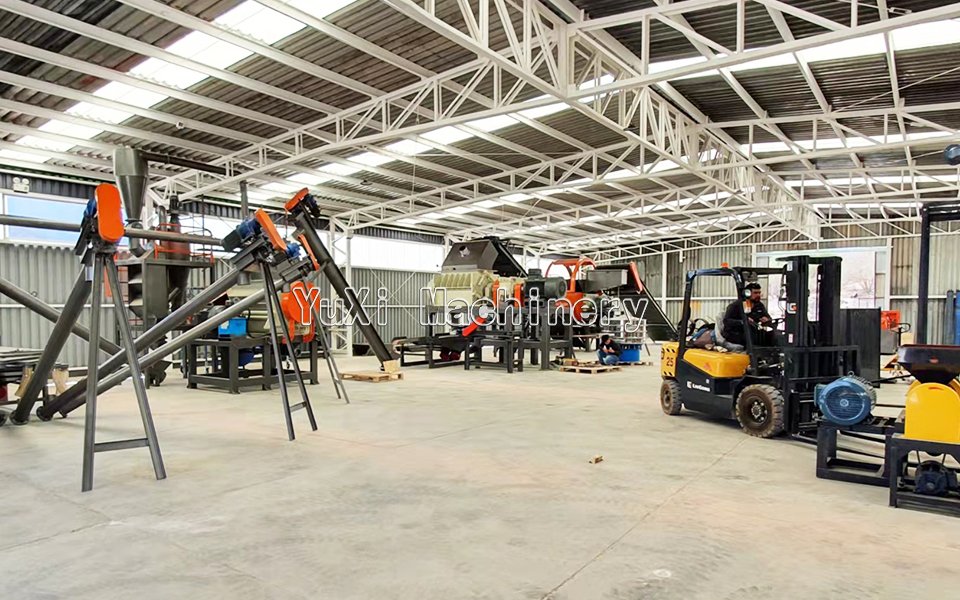
II. Core Configuration of 2 Ton/Hour Tire Recycling Production Line: 6 Semi-Intelligent Modules
The line adopts a “compact + intelligent” integrated design, covering an area of 600-800 square meters. Its core configuration focuses on “efficiency improvement, energy saving, and easy maintenance,” including 6 key modules:
- Intelligent Feeding & Pretreatment Module
Integrating a wide conveyor belt (width 800mm, speed 1.2m/s) and an automatic sorting platform, the module has a feeding capacity of 2-2.5 tons/hour. It is equipped with a semi-automatic debeading machine (processing speed 20 tires/hour) to remove metal bead rings, and an image recognition system to automatically detect and remove large foreign objects (stones, metal blocks), reducing manual workload by 50%. - Dual-Shaft Shear Primary Shredder
As the core equipment, it adopts a dual-shaft shear structure with a motor power of 75-90kW (complying with EU IE4 energy efficiency standards). The high-strength alloy steel blades (hardness HRC65-70) can cut whole waste tires into 20-40mm rubber blocks at a speed of 20-25 rpm. The shredder is equipped with an intelligent overload protection system and automatic temperature control (cooling water circulation), avoiding blade damage and rubber aging. - Multi-Functional Secondary Crushing Module
This module integrates a hammer crusher (motor power 55-75kW) and a replaceable screen system (mesh sizes: 1mm, 2mm, 4mm, 10mm). It can crush 20-40mm rubber blocks into 1-4mm rubber granules, 80-120 mesh rubber powder, or 5-10mm TDF by replacing screens, with a crushing efficiency of 2 tons/hour and a finished product qualification rate of over 99%. - Dual-Stage Impurity Removal Module
Combining a high-intensity magnetic separator (magnetic field strength 15,000Gs) and an intelligent eddy current separator (power 7.5kW), the module removes ferrous and non-ferrous metals with separation efficiencies of 99.8% and 98% respectively. It also adds a fiber separation device to remove residual fiber filaments, ensuring the metal content in finished products is ≤0.2% and fiber content ≤0.5%, exceeding EU EN 14034 and EN 15353 standards. - Energy-Saving Drying & Grading Module
Equipped with a heat recovery dryer (drying temperature 60-70℃) and a triple-layer vibrating screen, the module uses waste heat from the shredding process to dry rubber particles, reducing energy consumption by 35%. The triple-layer screen classifies particles into three specifications at one time, improving grading efficiency by 40% compared to double-layer screens. - Integrated Environmental Protection Module
Tailored to medium-scale production, it includes a bag-type dust collector (air volume 12,000m³/h, dust emission concentration ≤3mg/m³), a sound insulation room (noise ≤70dB(A) at the factory boundary), and a wastewater treatment device (for cleaning rubber particles). The entire module complies with EU EN 13284-1, EN ISO 11200, and EN 12345 environmental standards.
III. Intelligent Workflow of 2 Ton/Hour Tire Recycling Production Line: 7 Streamlined & Efficient Steps
The workflow realizes 70% automation, requiring only 3-4 operators. The intelligent and streamlined steps are as follows:
- Automatic Sorting & Debeading
Waste tires are conveyed to the automatic sorting platform, where the image recognition system identifies and removes foreign objects and damaged tires. Qualified tires enter the semi-automatic debeading machine to remove metal bead rings (recycled separately), with a processing speed of 20 tires/hour. - Intelligent Feeding
Sorted tires are transported to the primary shredder by the wide conveyor belt. The belt is equipped with a weight sensor that automatically adjusts the feeding speed according to the shredder’s load, avoiding overload and ensuring stable operation. - Dual-Shaft Primary Shredding
The dual-shaft shear shredder cuts tires into 20-40mm rubber blocks. The intelligent temperature control system monitors the crushing temperature in real time, and the cooling water circulation system keeps the temperature below 50℃, ensuring the performance of rubber materials. - Multi-Specification Secondary Crushing
Rubber blocks are conveyed to the hammer crusher, which crushes them into target products (rubber granules, rubber powder, or TDF) according to the installed screen. The crusher is equipped with a wear detection sensor that reminds operators to replace hammerheads when wear exceeds the limit. - Dual-Stage Impurity Removal & Fiber Separation
Crushed particles first pass through the high-intensity magnetic separator to remove ferrous metals, then through the eddy current separator to remove non-ferrous metals, and finally through the fiber separation device to remove fiber impurities. The entire process is automated, with real-time impurity content monitoring. - Heat Recovery Drying & Grading
Impurity-removed particles enter the heat recovery dryer, which uses waste heat from the shredding process to reduce moisture content to ≤2%. The triple-layer vibrating screen classifies particles into different specifications, and unqualified particles are returned to the crusher for reprocessing. - Automatic Packaging & Traceability
Qualified products are conveyed to an intelligent packaging machine (packaging weight: 25kg/bag or 500kg/big bag) that completes packaging, sealing, and labeling. The machine is connected to a traceability system that records product batch, production date, and quality indicators for EU export certification.
IV. Application Scenarios of 2 Ton/Hour Tire Recycling Production Line: 4 Medium-Scale-Oriented Fields
With its balanced efficiency and flexibility, the line is widely used in 4 core fields for medium-sized operations:
- Regional Waste Tire Disposal Centers
For medium-sized cities or industrial parks generating 10,000-15,000 tons of waste tires annually, the line can fully meet the disposal demand. For example, a medium-sized city in northern Italy with a population of 200,000 generates about 12,000 tons of waste tires per year. A 2 ton/hour production line processes all waste tires, solving local environmental pollution and creating economic benefits. - Medium-Scale Rubber Product Manufacturers
Enterprises producing sports flooring, waterproof coils, or auto parts can use the line to produce self-used rubber granules or powder, reducing raw material costs by 35-45%. A medium-sized waterproof coil factory in Spain uses the line to recycle waste tires, producing 1-4mm rubber granules for its own production, saving 300,000-400,000 euros in raw material costs annually. - TDF Supply for Industrial Parks
The line can produce TDF to supply industrial parks with cement kilns, thermal power plants, or steel mills. TDF’s high calorific value (38-42MJ/kg) replaces 25-30% of coal, helping industrial parks reduce carbon emissions. A small industrial park in Germany uses TDF from a 2 ton/hour line, reducing coal consumption by 30% and carbon dioxide emissions by 25% annually. - Export-Oriented Recycled Rubber Production
The line’s products meet EU quality standards, making it ideal for enterprises exporting recycled rubber. A medium-sized recycling company in Poland uses the line to produce 80-120 mesh rubber powder, which is exported to France and Germany for asphalt modification, earning 1.5-2 million euros annually.
V. EU Compliance & Core Advantages of 2 Ton/Hour Tire Recycling Production Line
Full Compliance with EU Standards
Formal lines meet strict EU regulations, including:
- Product quality: Rubber granules meet EU EN 14034 (metal ≤0.2%, tensile strength ≥3.5MPa); rubber powder meets EU EN 15940 (fineness 80-120 mesh, moisture ≤2%); TDF meets EU EN 15353 (calorific value ≥38MJ/kg, sulfur ≤0.8%);
- Environmental emissions: Dust ≤3mg/m³, noise ≤70dB(A), wastewater discharge meets EU EN 12345 (COD ≤50mg/L);
- Energy efficiency: Unit energy consumption is 60-70kWh/ton of waste tires, complying with EU IE4 standards, 20% lower than small-scale lines.
Core Advantages for Medium-Scale Operations
- Balanced investment and efficiency: Total investment is 600,000-800,000 euros, 1/2 of large-scale lines, while efficiency is twice that of small-scale lines;
- Flexible product switching: Quick screen replacement enables switching between rubber granules, powder, and TDF in 1 hour, adapting to market demand changes;
- Low operation and maintenance costs: 3-4 operators suffice, annual maintenance cost is 50,000-80,000 euros, accounting for only 8-10% of annual profit;
- Export eligibility: Meets EU quality and environmental standards, supporting CE certification and product export to EU countries.
VI. Profit Model & Investment Return of 2 Ton/Hour Tire Recycling Production Line
Profit Composition
Profits come from 4 parts:
- Finished product sales: 1 ton of waste tires produces 0.75-0.85 tons of rubber granules (280-380 euros/ton), 0.6-0.7 tons of rubber powder (450-600 euros/ton), or 0.85-0.95 tons of TDF (220-320 euros/ton);
- Metal recycling: 1 ton of waste tires recovers 6-9kg of metal, earning 12-18 euros/ton;
- Fiber recycling: Recovered fiber is sold to building material factories, earning 5-8 euros/ton;
- Government subsidies: EU and local governments provide 60-120 euros/ton subsidies for medium-scale tire recycling.
Investment Return Calculation
Taking an annual processing capacity of 14,000 tons as an example:
- Total investment: 700,000 euros (equipment + installation + initial raw materials + certification);
- Annual cost: Raw materials (100-140 euros/ton) + labor (4 operators × 35,000 euros/year) + energy (65kWh/ton × 0.2 euros/kWh × 14,000 tons) + maintenance + certification = about 2.5 million euros;
- Annual revenue: Finished product sales (14,000 tons × 0.8 tons × 350 euros/ton) + metal/fiber recycling (14,000 tons × 15 euros/ton) + subsidies (14,000 tons × 100 euros/ton) = about 4.9 million euros;
- Annual profit: About 2.4 million euros, payback period of 3-4 months.
VII. Industry Challenges & Solutions for 2 Ton/Hour Tire Recycling Production Line
Key Challenges
- Fluctuating waste tire quality: Waste tires from different sources have varying rubber content, affecting finished product quality;
- Intense market competition: Medium-scale recycled rubber products face price competition from large enterprises;
- Complex EU certification processes: Export-oriented enterprises need to pass multiple certifications (CE, REACH), which are time-consuming and costly.
Practical Solutions
- Establish classified recycling channels: Cooperate with tire manufacturers and auto dealers to recycle high-quality waste tires, ensuring stable raw material quality;
- Develop high-value products: Focus on high-end markets such as rubber powder for asphalt modification or 3D printing, with 20-30% higher profit margins than ordinary products;
- Cooperate with professional certification agencies: Entrust EU-recognized agencies to handle CE and REACH certifications, shortening the certification cycle by 50%.
VIII. Common Questions About 2 Ton/Hour Tire Recycling Production Line: 5 Practical Answers
- What is the site requirement for the production line?
Covering 600-800 square meters, including 400-500 square meters for the production workshop (height ≥6 meters), 200-300 square meters for the warehouse, and 50 square meters for the office. The site should be 1km away from residential areas and have convenient transportation. - How long does it take to install and commission the line?
The total cycle is 3-4 months: equipment manufacturing (1.5 months), transportation and installation (1 month), commissioning and operator training (0.5-1 month). - Can the line produce ultra-fine rubber powder (200 mesh)?
Yes, by adding a superfine grinding module (investment 100,000-150,000 euros), the line can produce 200 mesh rubber powder for high-end fields such as lithium battery diaphragms, with a market price of 800-1,000 euros/ton. - What is the service life of core equipment?
The primary shredder and secondary crusher have a service life of 10-12 years; blades and hammerheads are replaced every 6-12 months; auxiliary equipment (conveyor belt, dust collector) is replaced every 6-8 years. Manufacturers provide a 2-year warranty and lifelong technical support. - How to apply for EU government subsidies?
Prepare materials including equipment certification, environmental test reports, and business licenses, then apply to the EU’s Circular Economy Fund or local environmental departments. The subsidy approval takes 2-4 months, and the subsidy amount is based on annual processing capacity.