




When a mining site or scrap yard emails us asking which machine can process OTR tires, they usually want one heavy shredder that takes a 2.5-meter tire whole. We have to talk them out of that setup almost every time.
Most primary dual-shaft tire shredders are built around 1,000 mm to 1,200 mm highway truck tires. Drop an uncut 23.5R25 loader tire or a 27.00R49 haul-truck tire into that hopper and the rubber bridges across the top of the rotors. Even if the teeth catch a corner, the thick bead cable bundle stalls the shaft or chips the alloy edge within days.
In real recycling yards, OTR tires go through heavy hydraulic cutting first. Once the tire is down to 300 to 500 mm chunks, a primary shredder or a pyrolysis reactor can take it safely.
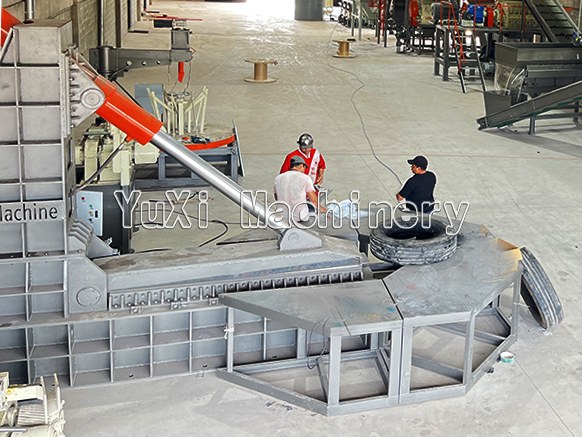
Match the Front-End Machine to Your Tire Diameter
People call both a 1.4-meter tractor tire and a 3.6-meter dump-truck tire “OTR.” On the workshop floor they require completely different hydraulic tonnage and frame openings. Measure the biggest outer diameter sitting in your yard before comparing quotes.
| Tire Size Range | Common Examples | Front-End Equipment | Downstream Path |
|---|---|---|---|
| 1.2 m – 1.6 m | Agricultural, forklift, skid-steer | Bead/sidewall cutter and hydraulic tire cutter | Primary shredder into 50–100 mm TDF or rubber mulch |
| 1.6 m – 2.5 m | 18.00R25, 23.5R25 quarry loaders | Heavy-frame hydraulic OTR tire cutting machine (sidewall + block shear) | Heavy dual-shaft shredder, then crumb rubber or fine powder |
| 2.5 m – 4.0 m | 27.00R49, 40.00R57 mining haul trucks | OTR sidewall cutter + high-pressure hydraulic block cutter (with crane/loader assist) | 300–500 mm blocks for pyrolysis or dedicated heavy shredder |
How an OTR Line Actually Runs Day to Day
Bead and Sidewall Removal
With standard 12.00R20 truck tires, a hydraulic tire wire drawing machine pulls the bead ring straight out in one stroke. Heavy OTR tires have much thicker steel bundles buried deep in the rim seat, so a hook puller alone often bends or slips. Cutting the two sidewalls off first with a heavy bead/sidewall cutter isolates the bead ring and flattens the crown for the next cut.
Hydraulic Block Cutting
Next comes the hydraulic OTR tire cutting machine. It shears the crown strips and sidewalls down into 300 to 500 mm chunks that fit smoothly into a primary shredder hopper. If you are unsure whether a standard cutter can handle your tires, check the cylinder pressure and throat differences in our standard tire cutter vs. OTR tire cutter breakdown.
Budget time and space for material handling around this station. A 2-meter mining tire weighs over half a ton, so operators cannot roll it around by hand. Yards that run smoothly keep a small wheel loader or a jib crane right beside the cutter table.
Primary Shredding and Fine Grinding
Once cut into blocks, OTR rubber runs reliably through a low-speed, high-torque dual-shaft tire shredder equipped with a disc screen return. From 50–100 mm chips, you can sell straight to cement kilns via a TDF line, or keep processing through rasping, magnetic steel separation, granulation, and milling into 1–5 mm rubber granules and 30–120 mesh powder.
OTR tread rubber carries a higher natural rubber ratio than passenger car tires. Molded tile factories and reclaimed rubber plants usually pay a better rate for clean OTR-based crumb and powder, which helps offset the slower front-end cutting speed.
Notes From Our 3 T/H Mixed-Tire Project in Paraguay
We ran into this exact mixed-feed problem on a 3 T/H tire recycling line in Paraguay. The customer took in passenger tires, highway truck tires, and mining truck tires up to 2.5 meters on the same site. Their buyers needed 2 mm and 4 mm granules alongside 30-mesh and 50-mesh rubber powder for floor tiles, shoe soles, and road asphalt.
Sizing the entire main shredder around the occasional 2.5-meter tire would have inflated both machine cost and hourly kW draw. We placed heavy OTR pre-cutting ahead of a standard 3 T/H shredding and grinding line. Regular shifts run at steady power on car and truck tires, while mining tires get sectioned in the cutting bay and blended into the feed conveyor.
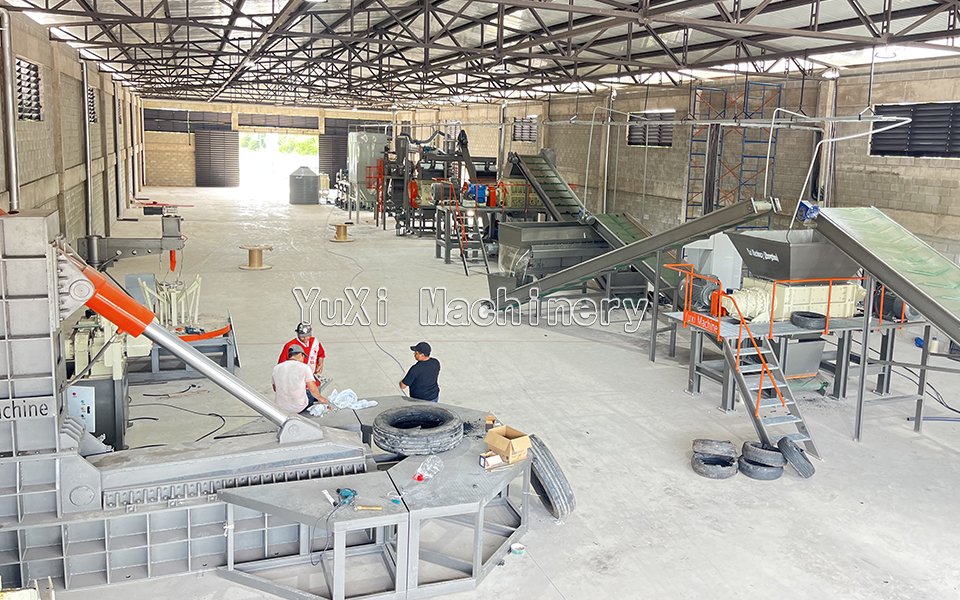
Questions Customers Ask Before Buying OTR Machines
Can we stop at block cutting if our buyer runs a pyrolysis plant?
Yes. Many pyrolysis yards only install an OTR sidewall cutter and a hydraulic block cutter to get rubber down to 300 to 400 mm pieces. You save the cost and power of a primary shredder unless your continuous pyrolysis feeder strictly calls for 50 to 80 mm chips.
What happens if we feed 1.6-meter loader tires into a regular truck tire shredder?
The first batch might go through if the hopper is wide enough, then the heavy bead wire and deep tread lugs start chipping the blade tips. Pre-cutting those tires into four pieces takes around two minutes and keeps your rotor knives running much longer between hardfacing cycles.
What specs do you need to quote an OTR cutting or recycling setup?
Send us three facts through our contact form: your biggest tire code (like 23.5R25 or 27.00R49), roughly how many tons per shift you want to process, and the end product you plan to sell (blocks, 50 mm TDF, 1–5 mm crumb, or 30–80 mesh powder). With those numbers we can size the hydraulic cutter, shredder power, and floor space accurately.