


Summary
Recovered tire steel wire can look ready for sale while still carrying rubber, textile, fines and other material that a steel buyer does not want. The practical question is not simply whether a magnet recovered the wire. It is whether the chopped steel stream meets an agreed grade, can be sampled consistently, and can be delivered in a form the receiver can handle. ReMA’s online specifications now list a nine-grade processed tire-wire system effective April 13, 2026, based on the percentage of rubber and fiber. Those grade descriptions are a useful starting point, but a buyer’s own limits, sampling method and delivery conditions still govern the transaction [1].
This guide looks at the steel-rich stream leaving mechanical tire recycling equipment. It explains why residual rubber remains, how to read the 2026 grades, where an extra cleaning step makes sense, and how to write a purchase specification that two companies can actually test. It does not claim that any specific YUXI machine achieves a stated steel purity. If a quote includes a cleanliness target, that target must be tied to a representative input, agreed test boundary and written acceptance method.
Not all recovered tire steel is the same product
A buyer may ask for “tire wire,” but the seller may have two physically different materials in mind. One is bead wire pulled or cut from the tire’s bead area. The other is a tangled or chopped steel fraction collected after tire shredding, rasping, granulation and magnetic separation. Each carries different preparation work, rubber attachment and handling problems. Their grade descriptions should not be mixed.
For this article, processed tire wire means the chopped ferrous material recovered as a side stream from tire size reduction and separation. Pulled bead wire is not the subject. YUXI already covers its pretreatment route in a separate guide to tire bead wire after cutting. Someone buying a downstream wire-cleaning module needs the actual chopped-wire feed, not a photograph of bead rings.
The distinction matters as soon as a plant quotes quality. If a customer asks for “less than 3% rubber,” does that refer to rubber and fiber combined? Is it measured on a dry mass basis? Does it include free crumb lodged in the wire bundle? Has the wire already been chopped to an agreed size? A favorable sample cannot answer these questions unless it represents the delivered lot.
The YUXI Tire Wire Free Mulch Plant is relevant because the rasper and subsequent separation stages create separate rubber and steel streams. The product page describes a configurable process route; it is not, by itself, an independently verified guarantee about the commercial grade of every steel lot.
Why a magnetic steel fraction still contains rubber
A magnet attracts ferrous material. It does not break the bond between rubber and wire. In a shredded tire, strands can remain partly embedded in rubber chips, folded into bundles or entangled with loose crumb. A strong magnet can recover those pieces along with the exposed metal. That is useful for protecting the rubber product, yet it can make the steel side stream heavy with rubber.
Three mechanisms are easy to confuse. First, attached rubber is still mechanically bonded to wire. Second, entrained rubber is loose but trapped between many wire strands. Third, rubber carried over with the magnet’s burden may never have been connected to the steel at all. The remedies are not identical. More magnetic force may collect more wire without improving its cleanliness. Further cutting can liberate attached rubber; controlled screening and material agitation can separate free material. A second magnetic pass may recover steel that escapes with the rubber, but it does not automatically solve rubber carried into the steel outlet.
Bunting’s technical description of tire-recycling magnetic separation makes this two-sided problem explicit: recover metal while minimizing loss of good rubber into the metal fraction [2]. Its account describes a first magnetic lift of liberated wire followed, when required, by processing the collected metal fraction to release rubber before another separation step. This is the right way to frame the system—not as a competition for the strongest magnet in isolation.
The degree of liberation depends on feed preparation and the material received by the rasper. A large rubber-coated lump may need more reduction before cleaning; loose crumb can sometimes be removed without another intensive cut. Steel loading, moisture, fines, screen condition and the way material lands on a conveyor can also change separation behavior. Those are investigation points, not proof of a particular failure in a YUXI installation.
What changed in the 2026 processed tire-wire grading system?
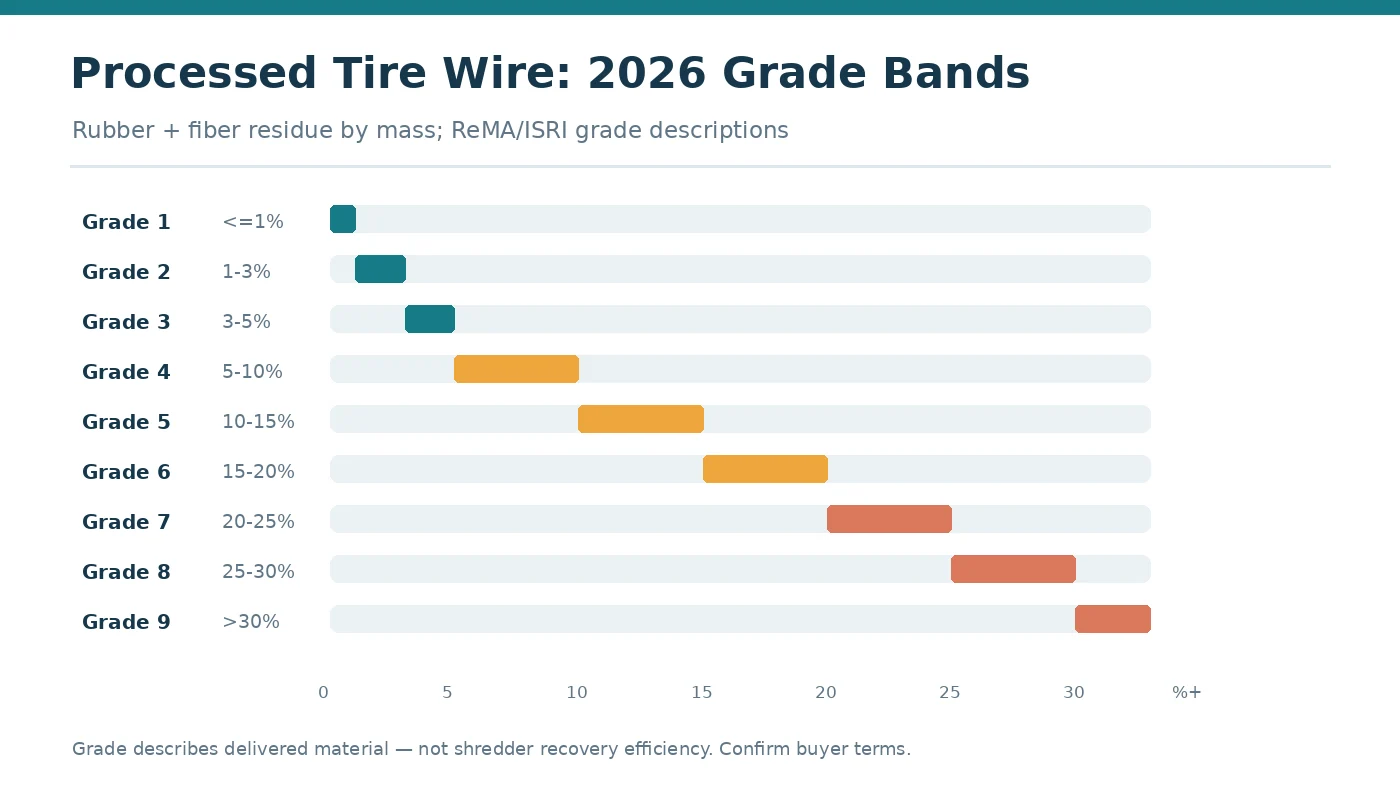
ReMA’s official live specifications list processed tire wire as chopped ferrous scrap and give nine grades effective April 13, 2026 [1]. The grades describe rubber and fiber residue, not a measured yield from a shredder and not a machine warranty. At the commercial boundary, the parties still need to agree what will be delivered and how the residue is determined.
| 2026 grade | Rubber/fiber description | What the buyer should confirm |
|---|---|---|
| Grade 1 | 1% or less | How the low residue is demonstrated |
| Grade 2 | 1–3% | Sampling and treatment of material at a boundary |
| Grade 3 | 3–5% | Whether the receiver accepts this band |
| Grade 4 | 5–10% | Whether additional processing is required |
| Grade 5 | 10–15% | Price adjustment and downstream disposal of residue |
| Grade 6 | 15–20% | Whether the lot is still commercially attractive |
| Grade 7 | 20–25% | Receiver limitations and alternate outlets |
| Grade 8 | 25–30% | Recleaning economics before shipping |
| Grade 9 | More than 30% | Whether the shipment has a viable buyer at all |
The online ReMA grade pages supply the official wording. Percentages at adjacent endpoints are printed as bands; a purchase order should make the boundary and rounding rules unambiguous rather than assume a software label will resolve them. Grade alone does not specify wire length, delivered bulk density, chemical composition, unwanted nonferrous metal, bale integrity, shipping moisture or sampling frequency.
There is also a version trap. The January 2026 PDF circular used an earlier set of processed-wire grade descriptions, while ReMA’s online pages show the revised April 2026 system [1, 3]. When discussing an offer, write down the revision or effective date. A January PDF and a later online grade should not be treated as the same document. This is a small paperwork detail that can become a large rejection dispute.
A buyer’s specification may be tighter—or simply different
ReMA categories help buyers and sellers speak the same language. They are not a substitute for a receiving steelworks’ own acceptance sheet. Gerdau’s publicly available Wilton scrap specification, revised in 2023, describes chopped processed tire wire and specifies a maximum 10% rubber/fiber content together with a minimum bulk density of 20 lb/ft³ [4]. A separate Gerdau tire-wire specification published for other listed receiving locations mentions less than 2% rubber/fiber [5]. These are documents with different scopes and revisions, not a single company-wide guarantee of what every mill will accept today.
That contrast explains why an equipment seller should not offer “ReMA Grade 4 steel” and stop there. A receiving mill might want a certain residue range, minimum density, prohibited-contaminant list, maximum bundle dimension or delivery format. It may reject an otherwise grade-compliant lot because the wire cannot be charged efficiently, the inspection method is disputed, or the load contains contaminants outside the rubber/fiber grade.
A steel processor can also change its intake rules. Ask for the current purchase specification directly from the receiving facility before signing an equipment performance guarantee. Treat a public historical specification as evidence of the type of commercial terms used, not as a currently binding purchase agreement.
Define the product boundary before quoting purity
The steel fraction leaving a magnet is not necessarily the same as the fraction after a cleaning module or the material loaded into a truck. A quotation should say which outlet is measured. If the steel-rich stream passes through a screen, secondary rasper, magnetic drum and compactor, name the final discharge and where any off-spec return goes.
In an integrated recycling line, this also affects the rubber product. Rubber carried into the steel bin is lost from that rubber stream unless it is recovered for reprocessing. The related steel and fiber separation guide covers the line-level separation side. Here, the focus remains the market value and testability of the steel outlet.
How to test residual rubber and fiber without making up a purity number
The simplest truthful starting point is a defined, representative sample and a written separation procedure agreed by buyer and seller. There is no defensible universal “shake for five minutes, then weigh” recipe in the sources used here. If a buyer has a qualified test protocol, follow it. Otherwise, build a trial procedure and validate that the two parties obtain comparable results before applying a rejection threshold to commercial loads.
Choose the lot and sampling points
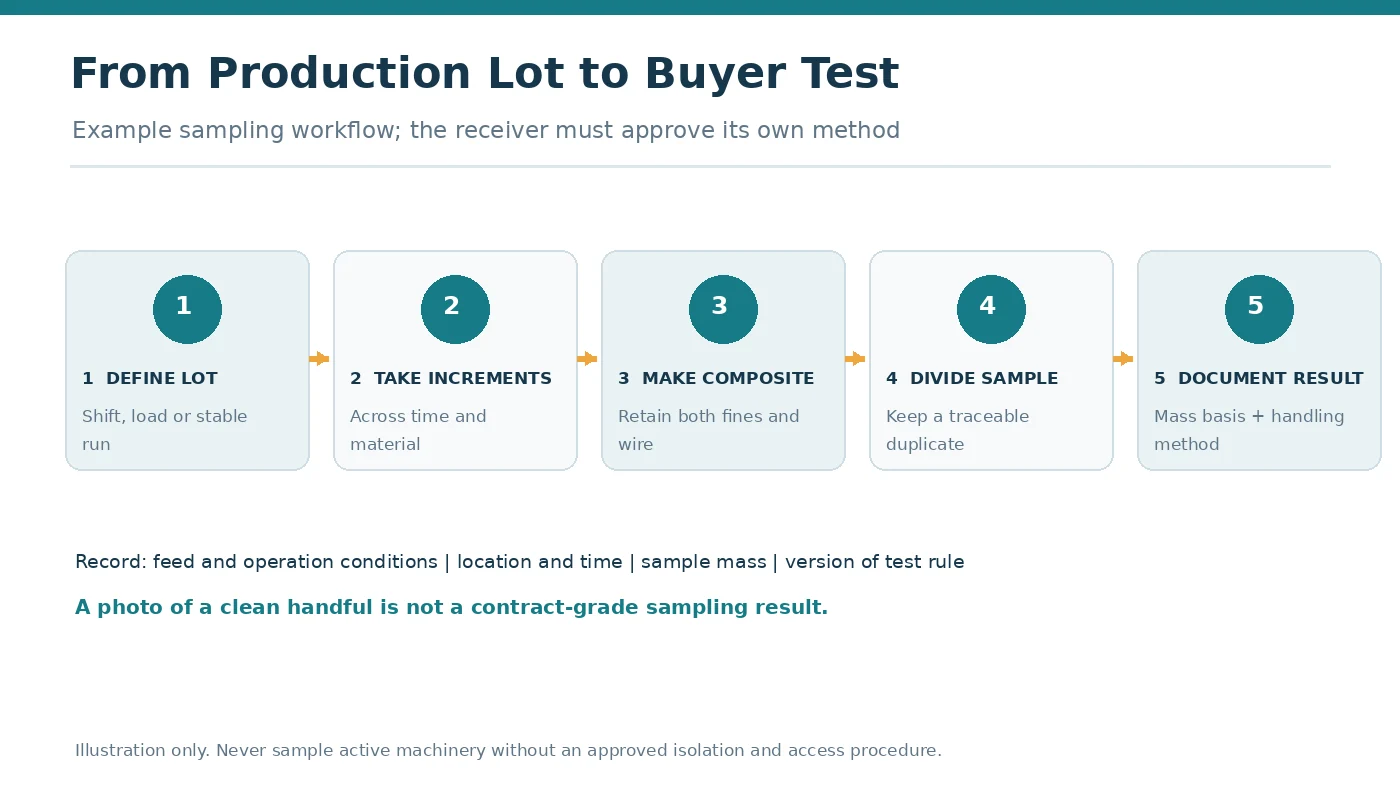
Define a lot by shipment, production shift or stable run. Do not combine material from a clean morning run with a visibly contaminated restart without recording the change. Collect increments across time and, where safe and practical, across the stream or the shipment. A convenient handful from the top of a bale tends to favor what is easy to reach, not necessarily what is present in the load.
For loose chopped wire, sample at a controlled discharge point using an approved safe procedure. For compressed bales, sampling method and access must be agreed before baling: the outer strands may be much cleaner than the inside. Never ask an operator to reach into running magnetic equipment or manually pull wire from an active conveyor. Use a safe isolation and sampling arrangement designed for the installed plant.
Record each increment’s approximate time or location, sample mass, material form, source lot and any process changes. Combine and reduce the sample using a documented method that avoids selectively losing fines or loose rubber. Photographs help identify problems but cannot replace a mass result when a purchase specification requires one.
Separate material categories before weighing
At minimum, identify (a) ferrous wire, (b) rubber attached to wire, (c) loose rubber and (d) textile or other nonmetallic contaminants. Some testing procedures may require a different classification; use the buyer’s agreed scheme as the governing one. The point is to avoid counting loose rubber in one test but excluding it in another.
If additional mechanical separation is required to release attached material, state how that preparation affects the result. A cleaner-looking specimen after aggressive lab treatment may not represent the material delivered to a steelworks. Likewise, an operator manually picking off a few heavy chunks can bias the sample. Document what was removed, how, and whether mass was lost during preparation.
For a hypothetical calculation only, suppose a 20 kg representative sample yields 18.8 kg classified ferrous wire and 1.2 kg combined rubber/fiber according to the agreed procedure. That would be 6% combined nonmetallic residue by sample mass. The arithmetic is simple; the hard part is agreeing on a reproducible classification and ensuring the sample actually represents the lot. This example is not YUXI test data, a standardized analytical procedure or a claimed commercial grade.
Do not confuse three percentages
Steel recovery efficiency asks how much recoverable steel from the input ended up in the collected steel stream. Steel fraction purity asks what share of the collected material is steel under the specified measurement basis. Rubber loss to the steel stream asks how much valuable rubber was diverted from its intended outlet. These numbers have different denominators; one cannot stand in for the others.
The buyer needs the delivered steel quality. The recycling-plant operator also needs to know what happened to rubber diverted with the magnetic product. Two plants can ship wire with comparable residue percentages while sending very different amounts of rubber into the side stream because their total steel recovery rates, feed mixes and cleaning stages differ.
When is a second steel-cleaning step worth adding?
A steel-cleaning module is not automatically useful just because the first magnetic product looks dark. The decision is commercial and depends on the lot’s current contamination, the buyer’s required grade, recovered rubber value and the installed processing cost.
ELDAN’s published Steel Wire Quality Upgrading System brochure is a helpful example of two layouts, not a benchmark for YUXI. It describes an in-line scheme that screens the steel product and returns oversize to recover embedded wire, and a stand-alone layout that uses a rasper before screening [6]. Its published output purity and capacity values are manufacturer statements tied to its listed configurations; they should not be borrowed as general industry results or promised for another machine.
A 2023 study in RSC Sustainability investigated a chemical approach to remove vulcanized rubber from recovered tire steel [7]. It shows that rubber-contaminated tire steel is also a research problem beyond conventional magnetic separation. It does not establish an economical mechanical cleaning yield, a production-scale YUXI process or a standard scrap acceptance test.
The first question is therefore: which material is actually causing rejection? Large rubber-coated wire bundles may justify further liberation. Mostly free crumb trapped in wire may suggest screening and controlled material presentation. Excess loose textile may require a different separation strategy. A new magnetic conveyor alone cannot solve every type of contamination.
A simple cleaning decision worksheet
| Question | Evidence to collect | Why it changes the decision |
|---|---|---|
| What arrives at the cleaner? | Wire length, attached rubber, loose crumb, textile and moisture | Determines whether cutting, screening or another step is appropriate |
| What grade is needed? | Written buyer acceptance rule and test procedure | Prevents over-cleaning to an unspecified ideal |
| Where does released rubber go? | Separate measured return or saleable-rubber route | Avoids treating recovered rubber as waste |
| What is the true operating cost? | Energy, wear parts, labor, maintenance, handling and stops | A cleaner stream is not automatically more profitable |
| What happens to off-spec output? | Rework, alternate buyer, storage and rejection plan | Makes the risk of failing a grade visible |
| Is the plant actually capacity-limited? | Accepted kilograms per hour after cleaning | A small cleaner can become a full-line bottleneck |
Work the economics per accepted tonne, not per inlet tonne
Consider two hypothetical offers. One has a low investment cost but regularly produces wire requiring manual rework. Another has a more complete cleaning route but consumes additional power and wear parts. Comparing the machinery price alone conceals the saleable yield.
For both alternatives, record net accepted steel mass in the same time window, the commercial price actually offered for that grade, the cost of reprocessing rejected lots, disposal or storage of nonmarketable residues, and the additional rubber recovered. Do not assume that reducing rubber/fiber from one band to another always earns the same premium. Pricing can depend on the local steelworks and the current contract.
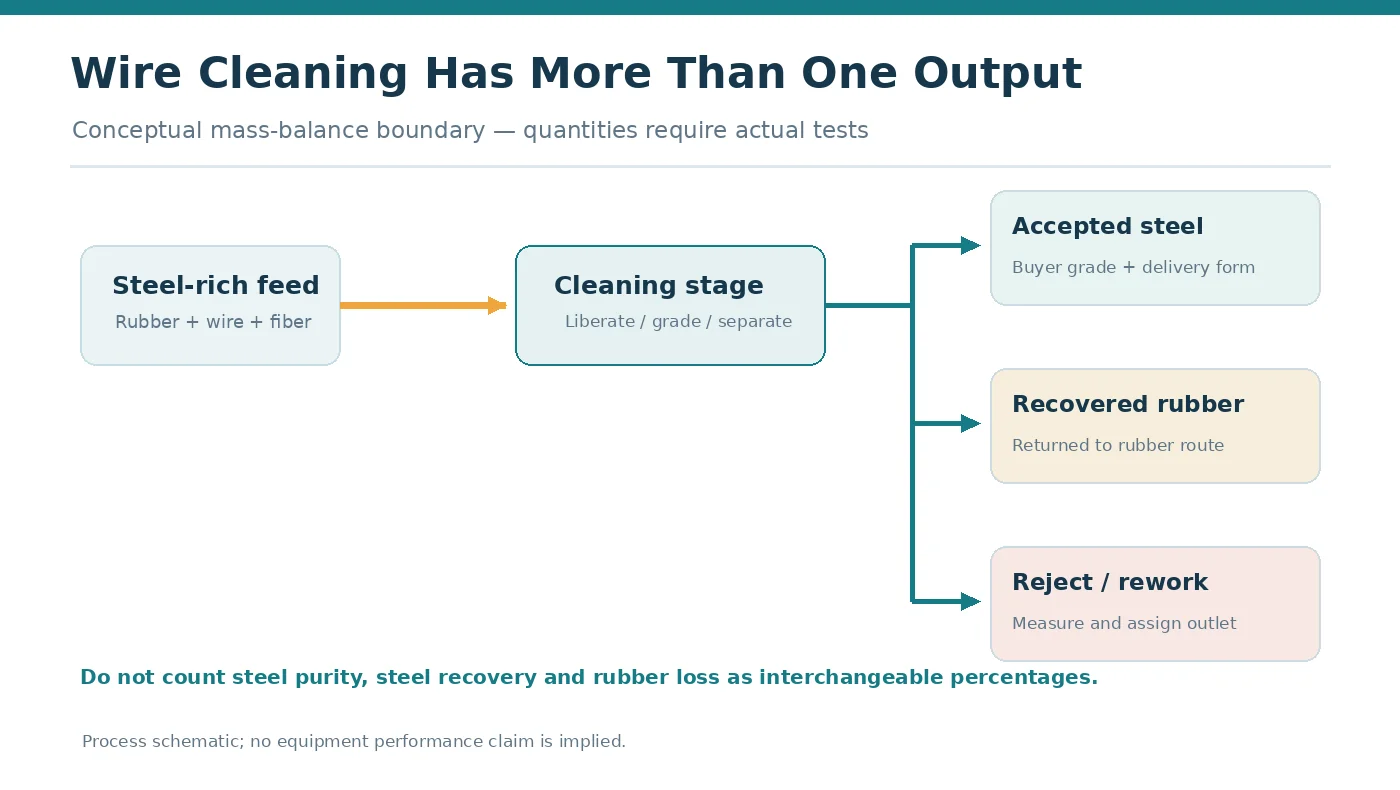
The related tire rasper machine guide explains the liberation stage upstream. Here, a buyer should ask a different question: after liberation, how much acceptable ferrous product and usable returned rubber does the proposed cleaning configuration actually produce under the declared test conditions?
What a useful plant trial should show
An isolated clean sample is not a plant trial. A wire buyer may receive several truckloads over time; quality needs to remain repeatable through normal feed variation. For a recycling equipment quotation, choose representative tire categories and define any pretreatment before the test. A clean batch of passenger tires tells little about a future mixed passenger/truck feed if the process depends on different reinforcement and bead content.
Set the sampling boundary at the intended commercial steel outlet. Record normal running conditions, the amount of steel-rich material entering any cleaner, cleaned wire leaving it, returned rubber, oversize recirculation and nonmarketable rejects. Where possible, compare an accepted-stable period rather than a brief burst that has no downstream balance. If the steel product is compacted for delivery, include the handling and discharge operations in the trial protocol.
Ask for a sequence of samples, not one preferred specimen. Label the early, middle and late sample from the stable test window. Note changes in incoming tire type, wire loading, cleaning screen condition and maintenance events. A process that passes only after an operator hand-selects a perfect sample should not be treated as proven for normal unattended production.
A well-designed trial report also admits what it did not test. It may verify rubber/fiber content under the agreed method while leaving chemical composition or scrap-mill furnace suitability to the buyer’s own tests. It may show output density but not transportation cost in the destination country. Stating limitations protects both sides from turning one successful trial into a blanket performance promise.
How to write the buyer’s acceptance sheet
A purchasing manager often receives a machine quote long before the wire outlet has an identified customer. That sequence makes acceptance difficult. The recommended order is to contact a prospective metal recycler, obtain its real scrap specification, and then ask the tire-equipment supplier which parts of the line can be configured and tested against those requirements.
Start with these fields. They do not replace a signed buyer specification; they provide a practical structure for obtaining one.
| Contract field | What to write down |
|---|---|
| Product name | Chopped processed tire wire, not pulled bead wire |
| Grade and revision | ReMA/ISRI designation and effective date, or receiver’s own grade |
| Rubber/fiber content | Contract maximum, measurement basis and boundary rule |
| Other contaminants | Prohibited nonferrous, dirt, oils, mixed scrap and other restrictions |
| Piece form | Chopped length or allowable range, as specified by receiver |
| Packing and density | Loose, bale or briquette; minimum density where applicable |
| Sampling | Lot definition, collection method, number of increments and retained sample |
| Test and dispute rule | Classification method, repeat test, tolerance, independent lab if agreed |
| Delivery | Weighing, labeling, storage conditions, documentation and rejection route |
Three items are often omitted. First is change control: a new feed mix or cleaner configuration can invalidate an earlier quality demonstration. Second is where the test is performed: at the recycling plant, after baling, or at receipt. Third is who pays for rework if the material falls outside specification. These do not sound like recycling technology, but they decide whether good material becomes a commercial dispute.
A realistic purchase scenario
A recycler tells its equipment supplier that it wants “premium steel.” The supplier shows a picture of bright wire and quotes a magnetic system. Months later, the chosen steel buyer asks for chopped wire with an agreed rubber/fiber ceiling and a particular delivery density. The seller has no sampling method and no trial result at the compacted discharge. Neither party can prove that the photographed sample represented the shipped lot.
The mistake was not necessarily selecting the wrong magnet. It was postponing the commercial specification until after choosing the process. A better RFQ starts with the desired buyer outcome and asks for a testable boundary at the wire discharge. If no steel buyer is yet identified, the quote should say the wire grade remains to be confirmed, rather than imply an automatic premium market.
How should YUXI equipment be discussed in this decision?
YUXI publicly describes tire recycling lines that use shredding, rasping and magnetic separation. Those pages can help a project buyer understand available equipment stages and discuss what should be included in a quotation. They do not provide independently verified tests of every possible final wire grade. This guide therefore makes no claim that YUXI equipment meets ReMA Grade 1, Grade 2, a Gerdau intake limit or any steel mill’s contract requirement without a project-specific test.
A buyer interested in deeper downstream material upgrading can compare the steel side stream of a wire-free mulch route with the additional equipment described in the Tire Rubber Crumb Plant. More process stages do not guarantee saleable wire. What matters is the actual liberation and separation duty, the returned rubber, and the output test agreed with the intended receiver.
For a practical quotation, send YUXI the tire mix, pretreatment status, desired accepted rubber product, estimated steel-rich side stream, and any available steel buyer specification. If no buyer specification exists, say so. A useful proposal should identify which material-quality outcomes are assumptions, which are configuration choices, and which require confirmation during a trial.
Buyer mistakes worth avoiding
Mistake 1: calling magnetic recovery “steel purity.” A magnet can collect ferrous pieces wrapped in rubber. Recovery and cleanliness are not the same measurement.
Mistake 2: using a grade without naming its revision. ReMA’s published grading changed in 2026. Old quotations and new online grade pages may describe different bands [1, 3].
Mistake 3: treating a steel mill’s PDF as a universal rule. A particular Gerdau facility document is evidence of that facility’s stated conditions at its revision date. It is not a promise that another receiving site or a future shipment will be accepted [4, 5].
Mistake 4: paying for maximum cleaning without a sale outlet. A low-residue wire stream can be expensive to produce. If the receiving market pays little extra, an elaborate cleaner may have a poor return.
Mistake 5: measuring only the steel outlet. A magnetic fraction may hide valuable crumb rubber. Recovering more marketable rubber can change the overall economics even if the steel sale price barely moves.
Mistake 6: comparing a laboratory-cleaned specimen with the delivered bale. Aggressive manual preparation changes what is being measured. The contract needs a realistic, reproducible method.
FAQ
What is processed tire wire in recycling?
It is the chopped ferrous wire fraction recovered during mechanical processing of scrap tires. It differs from pulled bead wire, which remains in loop form after bead removal. The product’s rubber/fiber residue, size and delivery condition determine whether a buyer will accept it.
Does ReMA Grade 1 mean a tire recycling machine has 99% steel recovery?
No. Grade 1 describes rubber/fiber content in the processed wire product under a grade definition. Steel recovery is a separate measure with a different denominator. Do not substitute a product grade for a machinery recovery guarantee.
How much rubber can recovered tire wire contain?
It varies with tire type, liberation and separation, and the condition of the delivered lot. ReMA lists grade bands from 1% or less to more than 30% rubber/fiber, but a receiving buyer may set narrower acceptance rules. No single percentage applies to all wire leaving tire recycling plants.
Can a stronger magnet remove the rubber attached to steel wire?
Not by magnetic attraction alone. Rubber bonded to wire needs liberation or a cleaning process. Additional magnetic stages can help separate material after liberation, but they cannot replace the mechanical work needed to release embedded wire.
Can the wire from a tire shredder be sold directly to a steel mill?
Sometimes, if the final wire meets a receiver’s actual requirements. Another lot may need recleaning, grading, compacting or a different buyer. Confirm residue, prohibited material, density and accepted form with the intended receiving facility before building revenue assumptions into a project.
What should a supplier prove in a tire-wire cleaning trial?
Ask for a representative feed, stable test window, final wire sample at the commercial outlet, an agreed residue-testing procedure, measured accepted steel output, any rejected material, returned rubber, and the handling conditions used for delivery. Where a particular mill’s acceptance is required, the mill or its authorized representative should confirm the specification.
References and technical sources
- ReMA/ISRI Specifications, Ferrous – Special (Tire Wire), online processed tire-wire grades, effective April 13, 2026. Official Grade 2 page; ReMA April 2026 update.
- Bunting, Metal Removal in Rubber Tire Recycling – Magnetic Separation. Technical article.
- ReMA, January 2026 ISRI Specifications Circular, earlier processed tire-wire grade descriptions. Archived circular PDF.
- Gerdau, Wilton Scrap Specifications, tire-wire section, dated January 1, 2023. Published buyer specification PDF.
- Gerdau, Iron & Steel Scrap Specifications: Tire Wire, published location-specific sheet. Buyer specification PDF.
- ELDAN Recycling, Steel Wire Quality Upgrading System, manufacturer technical brochure. Original brochure PDF.
- Royal Society of Chemistry, Cleaning steel by devulcanizing rubber from used automotive tires, RSC Sustainability (2023), DOI 10.1039/d3su00218g. Peer-reviewed study. A research-stage chemical route, not a claim about YUXI mechanical cleaning or its commercial performance.