




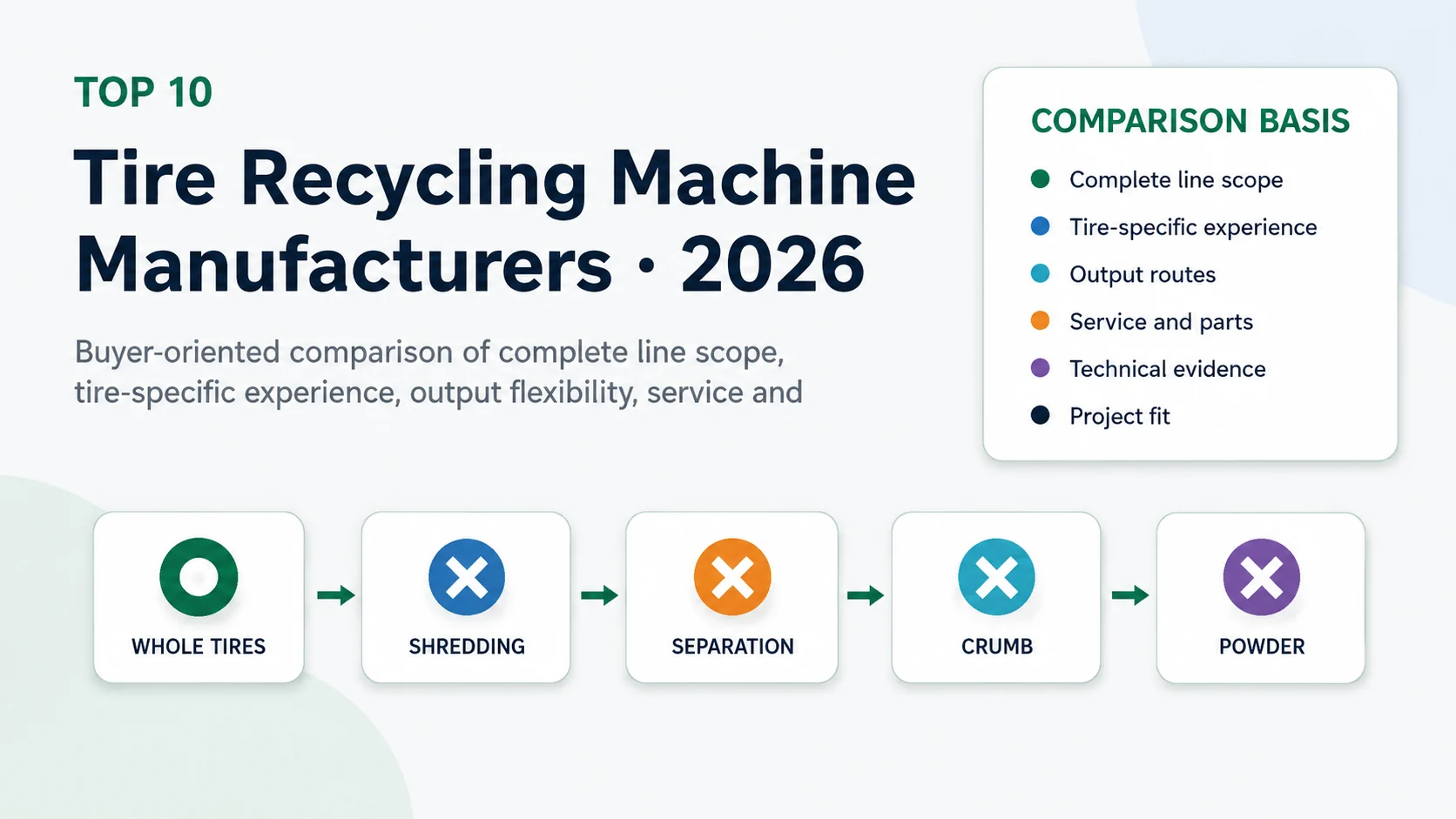
A “tire recycling machine manufacturer” can mean three very different suppliers: a specialist that builds one excellent shredder, an integrator that combines machines from several vendors, or a manufacturer able to engineer the route from whole tires to TDF chips, wire-free mulch, crumb rubber or fine powder. Treating those companies as interchangeable is where many procurement comparisons go wrong.
Which Manufacturers Lead the 2026 Shortlist-
| Rank | Manufacturer | Headquarters | Best-fit strength |
|---|---|---|---|
| 1 | ELDAN Recycling | Denmark | Documented modular plants from chips to granulate and powder |
| 2 | CM Shredders | United States | Tire-dedicated turnkey systems and steel-liberation depth |
| 3 | Granutech-Saturn Systems | United States | Expandable 2-, 3- and 4-stage tire recycling systems |
| 4 | ECO Green Equipment | United States | Modular, commercial-scale turnkey tire product line |
| 5 | YUXI Machinery | China | Configurable TDF, mulch, crumb and powder production routes |
| 6 | MTB Recycling | France | Integrated European lines, compact systems and material recovery |
| 7 | FORNNAX Technology | India | Heavy-duty primary, secondary and granulation modules |
| 8 | Genox Recycling Technology | China | Integrated rasping, granulation, dust and automation systems |
| 9 | SSI Shredding Systems | United States | Custom high-duty shredding and integrated size reduction |
| 10 | UNTHA Shredding Technology | Austria | Energy-efficient TDF and tire pre-shredding |
How the Manufacturer List Was Organized
We compared the public evidence that matters when a buyer is deciding whether a supplier can deliver one machine, several connected modules or a complete tire recycling line. A manufacturer moved higher when it showed deeper tire-specific process coverage, clearer project evidence and a more complete path to a saleable final product.
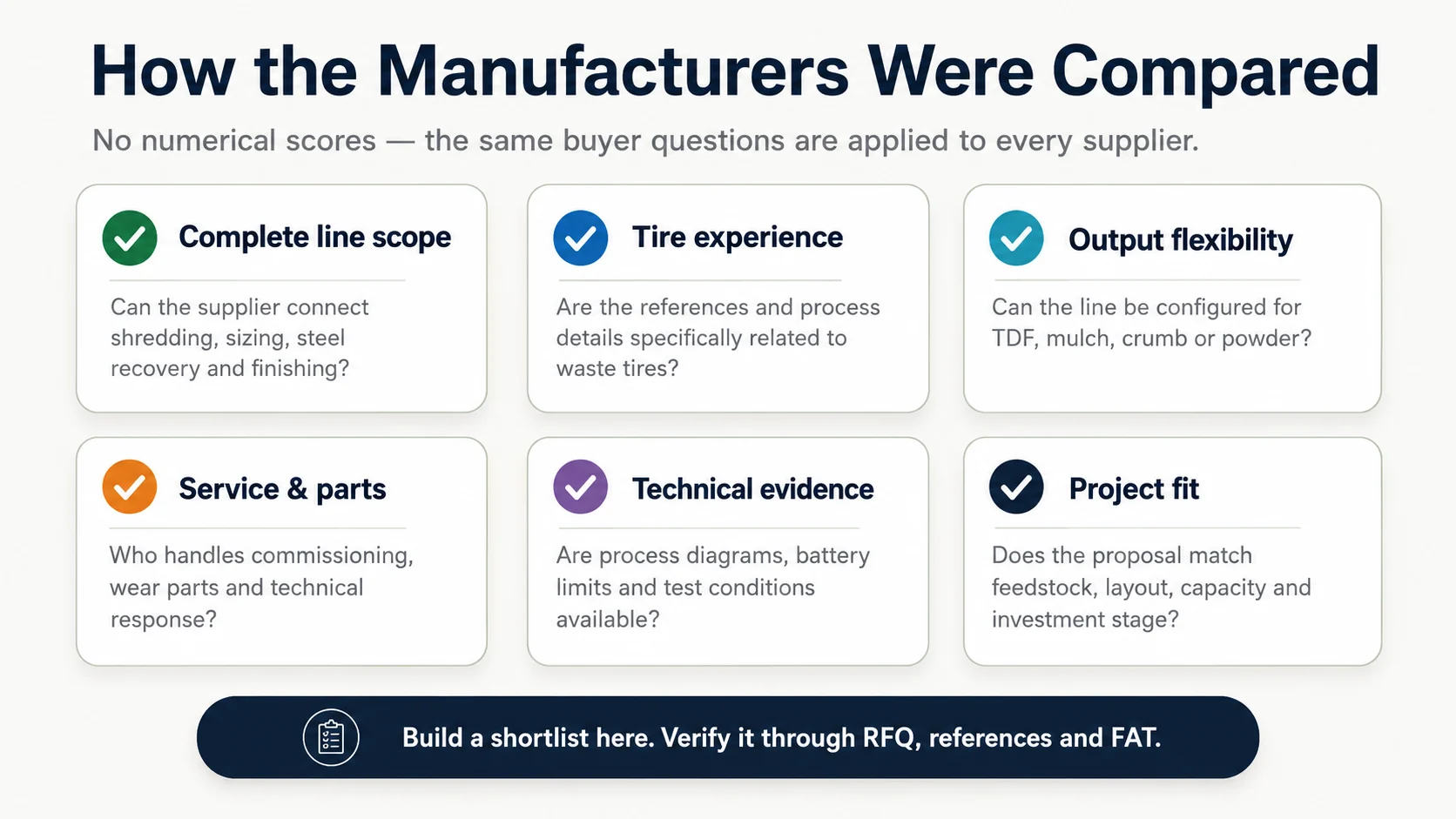
| Comparison factor | What buyers should look for | Common warning sign |
|---|---|---|
| End-to-end tire process coverage | Primary shredding, controlled sizing, steel liberation, granulation, fiber control, milling and plant integration. | A generic industrial shredder presented as a complete tire plant. |
| Tire-specific operating experience | Documented tire applications, named plants, comparable references or clearly described customer cases. | Copied claims or broad “global leader” language without tire-project detail. |
| Output flexibility | Routes for TDF, mulch, crumb, powder, steel recovery and later expansion. | One nominal screen size without a downstream separation plan. |
| Service and spare-parts support | Commissioning, training, remote support, wear parts and regional response arrangements. | A sales contact without a defined technical response channel. |
| Technical transparency | Process diagrams, battery limits, test facilities, cases and measurable output definitions. | Capacity claims without feedstock, finished product or test conditions. |
| Project fit | Ability to match capacity, budget, layout, voltage, labor and staged investment. | Selecting a supplier only because it has the largest machine or lowest headline price. |
Why price does not determine the order: a low quote may stop at the shredder discharge, while another proposal includes screening, oversize return, steel and fiber separation, controls, dust collection, commissioning and spares. The tire shredder machine price guide explains why the equipment boundary must be normalized before comparing numbers.
What Counts as a Tire Recycling Machine Manufacturer-
A manufacturer needed to show more than a single small cutter, a general-purpose twin-shaft shredder or an online catalogue of unrelated machines. The company had to publish a credible tire-processing route or an integrated system that moves material through at least two major stages.
Machine specialist
Builds a strong primary or secondary machine. It may be the correct choice for a retrofit, but the buyer must integrate conveyors, screening and separation.
System manufacturer
Designs several connected tire-specific machines and controls the process interfaces, recirculation and accepted output.
Turnkey integrator
Takes responsibility for line design, supplied modules, controls, installation support and a defined performance test—even when some components are sourced.
A company does not automatically appear higher merely because it supplies every machine. A focused shredder specialist can be the better partner for a TDF plant or an existing recycler replacing its front end. However, the keyword tire recycling machine manufacturers normally signals broader commercial investigation: the buyer is trying to identify who can convert the incoming tire stream into a saleable output, not just who can cut rubber.
The YUXI tire recycling plant hub illustrates this output-first distinction by separating TDF chips, wire-free mulch, crumb rubber and powder into different process depths. That is also the boundary used throughout this comparison.
Top 10 Tire Recycling Machine Manufacturers
1 ELDAN Recycling
Why it leads the list: ELDAN combines a long tire-recycling history with unusually broad public documentation of complete plants, upgrade modules and operating references. Its published tire portfolio covers chips, granulate, fine powder, material separation and steel cleaning. The company also describes modular combinations that can process whole passenger tires and pre-cut mining tires while producing multiple fractions in one plant.1
Best fit: established recyclers and well-financed greenfield projects that need a documented process from primary reduction through high-quality separated products. ELDAN is particularly strong when flexibility matters—such as producing chips during one market cycle and more deeply processed granulate during another.
2 CM Shredders
Why it stands out: CM’s public company history says tire recycling has been a core focus since 1980, with hundreds of installations across five continents and more than 28 countries. Its line extends from primary and chipping shredders through Liberators, granulators, fiber removal, milling, screening and fully integrated plants.2
Best fit: buyers who want a tire-dedicated North American supplier with strong steel-liberation and downstream recovery experience. CM is a particularly credible shortlist candidate for TDF, clean steel recovery, mulch, granulate and crumb projects where knife geometry, screening and product consistency are central.
3 Granutech-Saturn Systems
Why it stands out: Granutech-Saturn publishes a clear 2-, 3- and 4-stage tire-system architecture. Its equipment family includes shredders, grinders, granulators, powderizers and refiner mills, with modular expansion from steel-free mulch or low-steel fuel through granulate and sub-millimeter products. The company traces its corporate history to 1968 and reports in-house engineering, manufacturing and testing space in Texas.3
Best fit: North American projects, high-duty applications, OTR or mixed-tire systems and buyers who expect to expand processing depth over time. The staged architecture is useful when the first phase sells TDF or mulch and later phases add crumb or powder.
4 ECO Green Equipment
Why it stands out: ECO Green publicly positions itself as a turnkey tire-recycling supplier and presents a modular equipment family spanning shredding, grinding and finished-product systems. Its catalogue is easy for commercial buyers to navigate by application, and the company has built a recognizable global tire-specific brand rather than treating tires as one incidental waste stream.4
Best fit: entrepreneurs and established recyclers who want a packaged, modular route with a clear progression from tire downsizing to higher-value rubber products. The company is often relevant to projects where layout compactness, phased expansion and commercial support matter alongside machine design.
5 YUXI Machinery
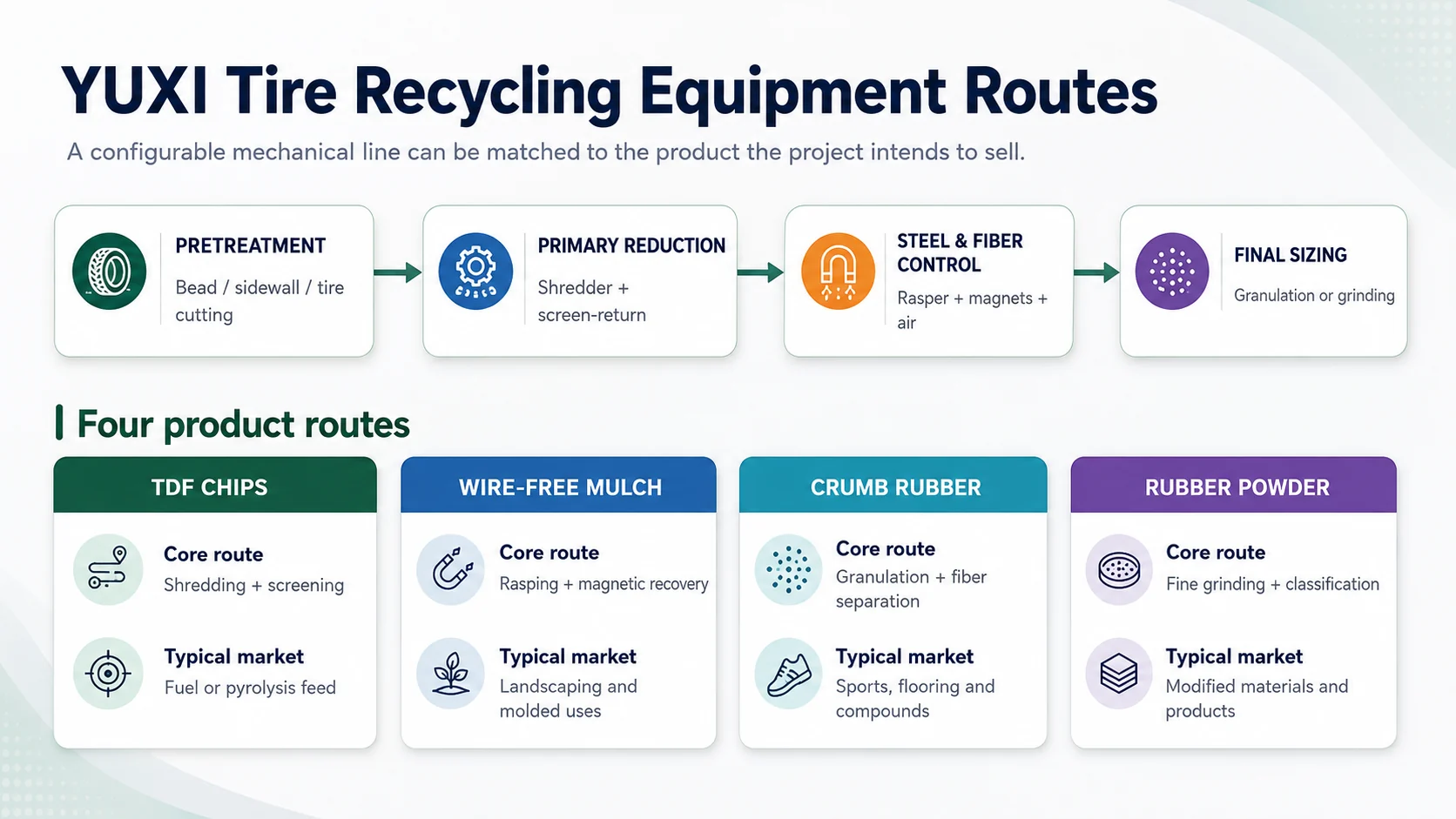
YUXI publishes an integrated mechanical tire-recycling platform rather than one isolated machine. Its product structure covers tire pretreatment, primary shredding, screening and return, rasper processing, magnetic steel recovery, granulation, fiber separation and powder grinding. The routes are organized around four commercially distinct outputs: TDF chips, wire-free rubber mulch, crumb rubber and rubber powder.5
Best fit: small and mid-sized international projects that need a line configured around local feedstock, available space, voltage, labor and investment stage. YUXI publishes a configurable 0.5–20 t/h processing range and custom layouts matched to tires, space and the target market. This makes the company especially relevant when a buyer wants to begin with TDF or mulch while preserving a practical path toward crumb or powder.
Where YUXI compares well: YUXI differentiates itself through a broad equipment range, four defined finished-product routes and one project scope covering pretreatment, shredding and downstream recovery. Using one supplier for several connected stages may reduce interface coordination, provided that battery limits, acceptance criteria and performance responsibility are clearly written into the contract.
6 MTB Recycling
Why it stands out: MTB combines equipment manufacturing with its own recycling and test activity. Its official tire page describes complete lines for passenger, heavy, civil-engineering and mining tires, with shredding, granulation, sorting, steel recovery and compact containerized concepts. MTB publicly states target granulate and steel-purity figures, which provides a useful starting point for an acceptance discussion.6
Best fit: European projects, compact plants and buyers that value a manufacturer with practical recycling-site experience. MTB is especially interesting where clean material recovery and containerized or space-conscious engineering are more important than simply maximizing first-pass shredder throughput.
7 FORNNAX Technology
Why it stands out: FORNNAX offers primary shredders, secondary shredders, granulators and separation systems, and publishes a dedicated tyre-recycling plant route. It also describes a global sales-partner network and after-sales support. That combination gives it more complete-line credibility than a supplier focused only on one large shredder.7
Best fit: high-throughput, heavy-duty projects, particularly where robust primary and secondary size reduction is the main engineering challenge. It is also a logical shortlist candidate for buyers in India, the Middle East and other regions served by its partner network.
8 Genox Recycling Technology
Why it stands out: Genox’s published tire system includes pre-shredding, two-stage rasping for steel liberation, fine granulation, textile and dust extraction, optional milling, linked automation, sound attenuation and temperature-control measures. That is a credible integrated process rather than a generic shredder listing.8
Best fit: buyers who value automation, dust-control integration and a Chinese manufacturing base with a broader recycling-system portfolio. Genox may be especially suitable where the tire line must share engineering standards or controls philosophy with other material-recycling systems.
9 SSI Shredding Systems
Why it stands out: SSI publishes tire-processing systems for passenger, truck, aircraft, agricultural, OTR and mining tires, with primary and secondary configurations for TDF, wire-free chips and mulch. Its official tire application page also states an important boundary: SSI does not supply crumb-rubber production systems.9
Best fit: custom primary and secondary reduction, difficult tires, high-duty retrofit projects and buyers that already have downstream granulation or powder partners. SSI is strongest when the project requires engineered tire shredding rather than a complete crumb-rubber plant from one supplier.
10 UNTHA Shredding Technology
Why it stands out: UNTHA publishes a strong tire and rubber application for its energy-efficient XR and related shredders, including one-step TDF sizing, mobile or stationary configurations and case evidence for alternative-fuel production. Its technology can be a compelling answer when the project problem is controlled single-stage shredding.10
Best fit: TDF, pyrolysis feed preparation, mobile operations and facilities that prioritize energy-efficient pre-shredding rather than a complete ambient crumb or powder line from one supplier.
Side-by-Side Manufacturer Comparison
| Manufacturer | Published tire line depth | Strongest public advantage | Likely project profile | Question to resolve first |
|---|---|---|---|---|
| ELDAN | Chips to granulate, powder and separation upgrades | Long history, complete systems and named cases | Large or quality-focused integrated plants | Which acceptance values apply to your feed- |
| CM | Whole tire to TDF, steel liberation, crumb and milling | Tire-dedicated history and installation base | Tire-focused North American or global projects | What regional service and parts response is contracted- |
| Granutech-Saturn | Expandable 2-, 3- and 4-stage systems | Long corporate history and staged system architecture | High-duty, phased and OTR-capable projects | What product leaves each project phase- |
| ECO Green | Modular turnkey tire equipment family | Commercially organized tire-specific portfolio | Packaged or phased commercial plants | Where exactly does the quoted battery limit end- |
| YUXI | TDF, mulch, crumb and powder routes | Broad equipment range and configurable project scope | Configurable international projects across multiple output routes | Which comparable line and FAT basis will be used- |
| MTB | Shredding, granulation, sorting and compact systems | Manufacturing plus recycler/test-site experience | European and compact material-recovery plants | How are purity figures sampled and guaranteed- |
| FORNNAX | Primary, secondary, granulation and separation | Heavy-duty product range and partner network | High-throughput regional projects | Which downstream cleaning modules are included- |
| Genox | Rasping, granulation, milling, dust and automation | Detailed integrated-system features | Automated lines and multi-material groups | Who provides tire-specific commissioning locally- |
| SSI | Custom shredders and integrated size-reduction systems | Large global installation base and testing | Difficult-feed front ends and retrofits | Who owns downstream product-quality performance- |
| UNTHA | Single-stage and staged tire shredding for TDF | Application cases and energy-focused shredders | TDF, pyrolysis feed and mobile processing | Which partner supplies crumb or powder stages- |
Choose the Manufacturer by the Product You Will Sell
Manufacturer reputation is secondary to process fit. We have seen buyers ask for a “five-ton tire line” before confirming whether five tons referred to incoming whole tires, accepted TDF chips or clean crumb. Those are different plants. Start with the saleable product, then compare suppliers that publish the necessary process depth.
TDF or pyrolysis feed
Prioritize feed envelope, low-speed torque, chip distribution, screening return, exposed-wire requirement and accepted output. Strong shredder specialists such as SSI or UNTHA may compete effectively with full-line suppliers when deep steel and fiber separation are unnecessary. Review the tire shredder for TDF production guide before issuing the RFQ.
Wire-free mulch
The decisive stage is often not the primary shredder but the rasper, magnetic recovery and controlled recirculation. Shortlist companies that can prove steel liberation and accepted 10–20 mm production under representative feed.
Crumb rubber
Look beyond nominal millimeters. The line must manage steel, textile, dust, heat, fines and particle distribution. ELDAN, CM and Granutech-Saturn are strong established candidates; YUXI is also relevant when the buyer needs a configurable crumb route at a smaller or staged project scale.
Fine rubber powder
Powder production adds energy, heat and wear. Confirm whether the manufacturer supplies the actual mill, cooling or temperature strategy, classification, dust collection and product test—or simply connects a third-party machine. YUXI’s published route includes powder grinding as part of a deeper mechanical line, but the final mesh distribution and accepted output still belong in the contract.
OTR and mining tires need a separate feed review. “Processes OTR tires” can mean whole-tire loading, pre-cut sections or only mining-tire fragments. Send the maximum tire diameter, width, approximate mass, construction and proposed pretreatment route. Do not accept a passenger-tire demonstration as evidence for mining tires.
What Evidence Should Every Shortlisted Supplier Provide-
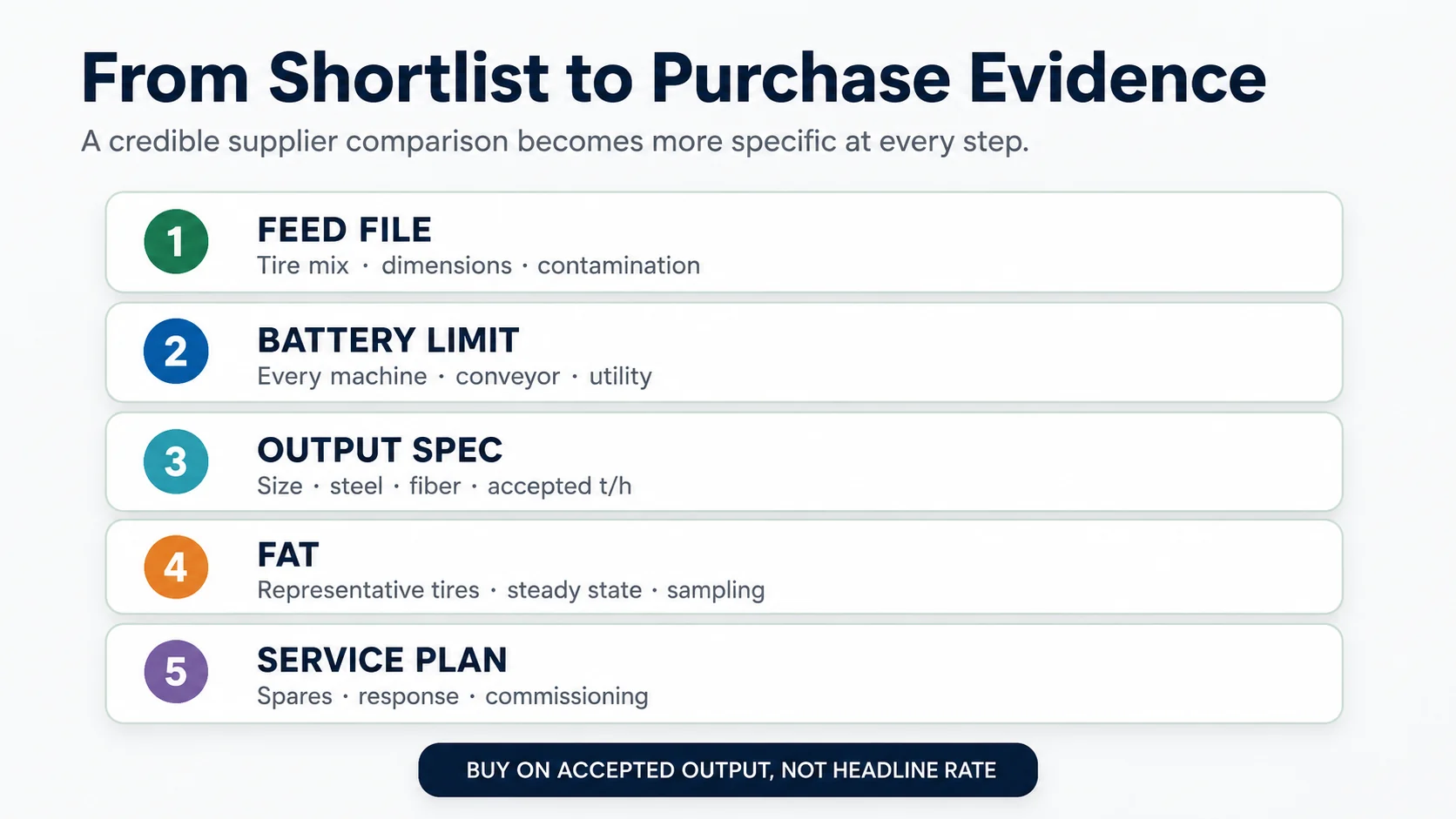
A top-ten list is useful for building the first shortlist. It cannot choose the machine for you. The next step is to force every supplier onto the same technical and commercial basis. The tire shredder selection guide provides more detail for the front end; the checklist below applies to the complete line.
- Feed definition: tire categories, dimensional range, truck/OTR share, rims removed, bead condition, contamination and moisture.
- Product definition: target size distribution, maximum piece, oversize allowance, exposed-wire limit, residual steel, textile and fines.
- Capacity basis: incoming tons per hour and accepted finished tons per hour, both measured after the line reaches steady state.
- Battery limits: every conveyor, screen, magnet, return loop, air system, dust collector, steel discharge and product bin included or excluded.
- Utilities: connected and typical load, voltage, compressed air, cooling, ventilation, fire protection interface and dust-control requirements.
- Wear package: blades, screens, hooks, liners, bearings, belts and filters expected for the first operating period.
- Controls: interlocks, load control, reverse logic, alarms, remote support, language, data logging and cybersecurity boundary.
- Factory test: representative tires, test duration, material balance, downtime classification, sampling and acceptance criteria.
- Site services: layout, foundations, erection supervision, commissioning, operator training and production ramp-up.
- References: at least two comparable plants processing a similar tire mix into the same finished product.
- Commercial basis: Incoterm, freight scope, taxes, warranty, payment milestones, quote validity and exclusions.
- After-sales plan: named response channel, remote diagnosis, critical parts stock, lead times and regional technician availability.
Compare cost per accepted saleable ton—not purchase price per installed motor kilowatt.
One practical method is to issue a compliance table with three answer columns: included, excluded and deviation. Do not allow blank cells. That simple discipline exposes whether a cheap quotation omits the screen-return loop, dust control or commissioning that another supplier has included.
Why YUXI Is a Strong Tire Recycling Equipment Option
YUXI’s most useful competitive advantage is not a claim that it is the oldest or largest company in the list. It is the ability to discuss the full mechanical route with one manufacturer. The published portfolio includes bead and sidewall pretreatment, primary shredding, screening and oversize return, rasper processing, magnetic steel recovery, granulation, fiber removal and powder grinding.
Four finished-product routes
YUXI organizes its equipment around TDF chips, wire-free mulch, crumb rubber and fine rubber powder. This output-first structure helps buyers compare the required process depth instead of purchasing an undefined “complete plant.”
Staged investment
A project can be planned around the required first-stage product while reserving interfaces for later rasping, granulation or powder grinding. The expansion path should be confirmed in the initial layout, power plan and controls scope.
Custom project configuration
YUXI publishes a configurable 0.5–20 t/h processing range and custom layouts matched to tire type, available space and the intended market. Its About Us page also states more than 30 years of industry experience and market coverage across more than 80 countries and regions.
One equipment conversation
Using one supplier for several connected stages may reduce interface disputes between the shredder, conveyors, screen, magnetic separators and downstream machines. That benefit depends on a written battery limit, acceptance test and clear performance responsibility.
The first four manufacturers remain ahead because their public tire-specific histories, reference libraries or regional service structures are more mature. That does not make them automatically better for every project. Buyers prioritizing configurable process depth, phased investment, direct factory communication and a clearly defined 0.5–20 t/h project range may find YUXI the stronger practical fit, provided that the quotation is verified through comparable references and a representative factory acceptance test.
Compare a YUXI Tire Recycling Line with Other Shortlisted Suppliers
Send representative tire photos or video, tire categories and maximum dimensions, target product and size, accepted hourly output, steel and fiber limits, local power, workshop dimensions and destination country. YUXI can prepare a process route and battery-limit list so you can compare its equipment scope, expansion path and service package on the same basis as other manufacturers.
Frequently Asked Questions
Who is the best tire recycling machine manufacturer?
There is no universal best supplier. ELDAN leads this editorial list because of complete-line breadth, long tire-specific experience and documented references. The right choice still depends on tire mix, finished product, capacity, service location, expansion plan and project budget. YUXI may be a stronger practical fit for buyers prioritizing configurable line scope, phased investment and direct factory coordination rather than the longest public reference history.
Is a tire shredder manufacturer the same as a tire recycling plant manufacturer?
Not always. A shredder manufacturer may supply only the primary size-reduction stage. A complete plant manufacturer or integrator must also manage sizing, recirculation, steel recovery, fiber separation, dust, product collection, controls and the performance boundary required by the final product.
Should I buy a complete line from one manufacturer?
One accountable supplier can reduce interface risk, but it is not automatically superior. An experienced integrator may combine best-in-class machines effectively. The contract should identify who owns controls integration, line throughput, finished-product quality, commissioning and warranty responsibility across every interface.
How should tire recycling machine capacity be compared?
Use the same representative tire mix, feed preparation, target product, size distribution, steel and fiber limits, screen-return arrangement, blade condition and test duration. Record both incoming throughput and accepted saleable output after the complete line reaches steady state.
What information should I send manufacturers before requesting a quote?
Send tire categories, minimum and maximum dimensions, representative photos or video, bead and contamination condition, annual supply, desired product and size, accepted capacity, local voltage, workshop dimensions, labor assumptions, destination country and the services to be included.
Official Manufacturer Sources Reviewed
- ELDAN Recycling. Tyre Recycling Solutions. Complete plant configurations, product routes and customer case information. Accessed August 6, 2026.
- CM Shredders. Company and History. Tire-specific history, installation footprint, equipment scope and service statements. Accessed August 6, 2026.
- Granutech-Saturn Systems. Industrial Turnkey Tire Recycling Systems. 2-, 3- and 4-stage system descriptions and modular expansion. Accessed August 6, 2026.
- ECO Green Equipment. Tire Recycling Equipment. Tire-specific equipment and turnkey system portfolio. Accessed August 6, 2026.
- YUXI Machinery. Tire Recycling Plants and Company Information. Public product hub and About Us materials reviewed for the 0.5-20 t/h configurable range, four output routes, custom-layout language, stated industry experience and market coverage. Reviewed August 6, 2026.
- MTB Recycling. Tires and Rubber Recycling. Complete lines, processed tire categories, compact systems and output claims. Accessed August 6, 2026.
- FORNNAX Technology. Tyre Recycling Plant. Three-stage primary shredding, secondary processing, granulation and 0.8–4 mm crumb-rubber output scope. Accessed August 6, 2026.
- Genox Recycling Technology. Tire Recycling System. Rasping, granulation, milling, automation, dust and temperature-control features. Accessed August 6, 2026.
- SSI Shredding Systems. Tire Recycling Shredders. Primary and secondary tire systems, TDF and wire-free applications, OTR processing, and the stated exclusion of crumb-rubber production systems. Accessed August 6, 2026.
- UNTHA Shredding Technology. Tires and Rubber Shredding. TDF sizing, mobile and stationary configurations, and tire application data. Accessed August 6, 2026.