




China has no shortage of companies willing to quote a “complete” tire recycling line. The hard part is discovering what complete means. A TDF line, a wire-free mulch plant and a 40-mesh powder system can all begin with a tire shredder, yet their downstream equipment, wear pattern, energy demand and acceptance tests are very different.1
A China-Specific Guide, Not Another Global Brand List
Our existing global manufacturer guide compares international suppliers across broad tire-processing routes. Separate articles already cover shredder makers, TDF equipment, tire cutting, crumb rubber and rubber powder. This article instead examines a narrower purchasing problem: how overseas buyers should compare Chinese suppliers whose quotations may use the same line name while drawing the equipment boundary in different places.
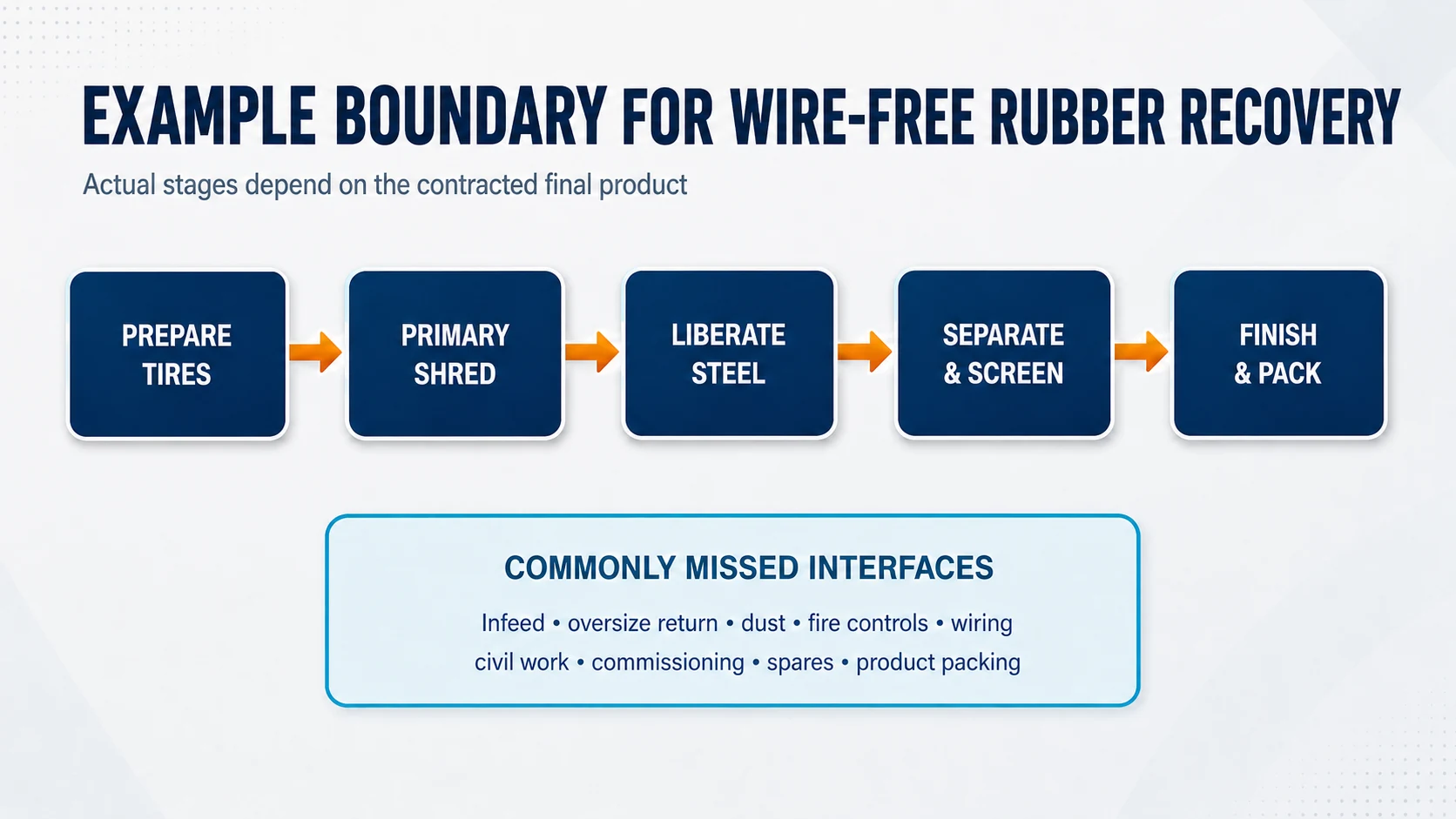
Start by separating the project into preprocessing, primary size reduction and downstream recovery, then compare each supplier against the same process boundary. A front-end package can be technically sound without being a complete crumb-rubber plant; a complete mechanical line can still exclude packing, fire protection, compressed air or site wiring.
How the Manufacturers Were Compared
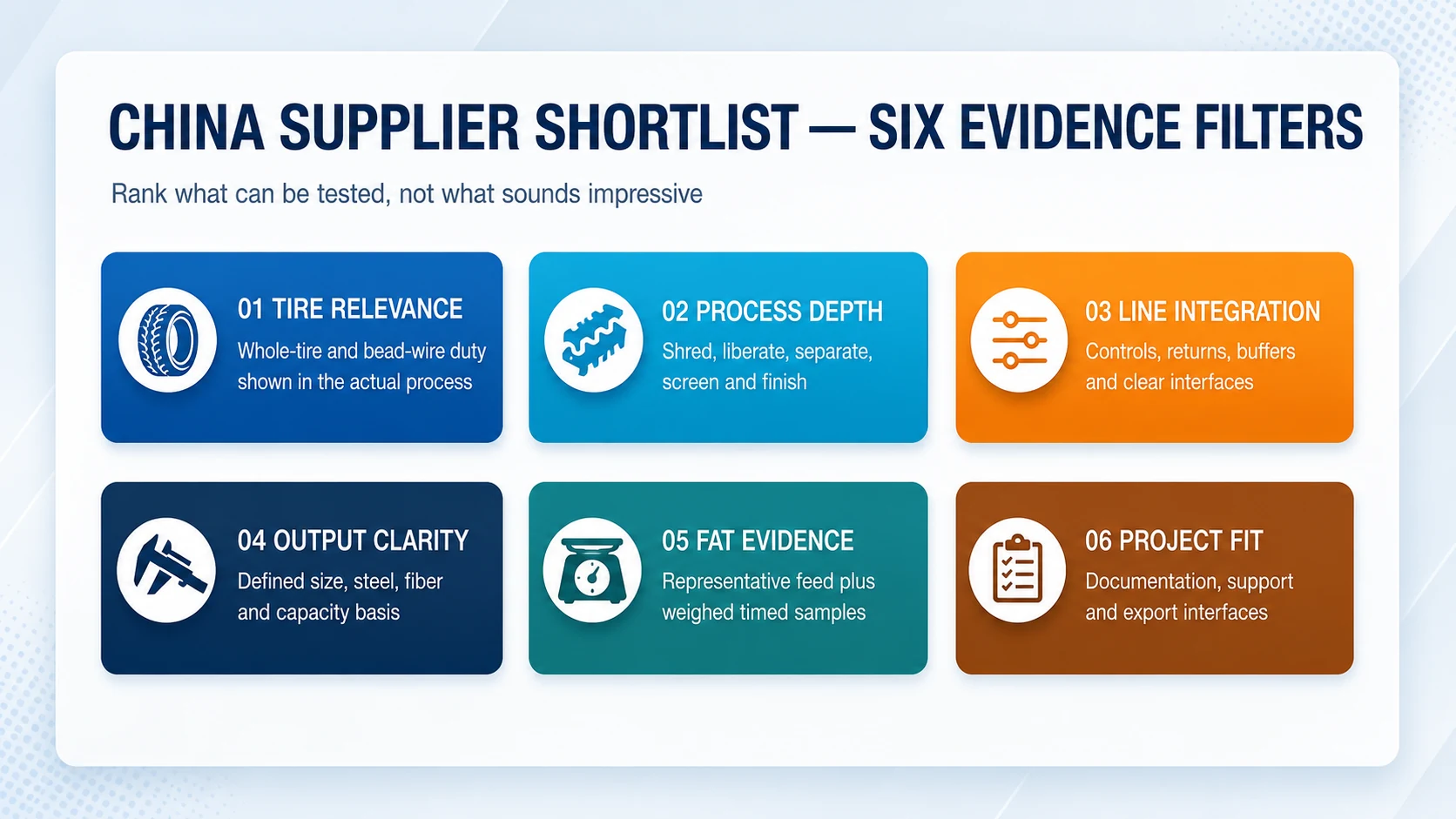
The ranking uses six purchasing filters: direct tire-recycling relevance; published process depth; ability to connect multiple stages; clarity about feed and output; evidence a buyer can request at FAT; and fit for export projects.
Top 10 Tire Recycling Machine Manufacturers in China
| Rank | Manufacturer | Relevant equipment focus | Best-fit buying situation | Key point to verify |
|---|---|---|---|---|
| 1 | YUXI Machinery | Preprocessing, tire shredding and configurable TDF, mulch, crumb and powder routes | Buyers who want to define a line from final product backward | Freeze the exact feed mix, accepted output and included auxiliaries in the FAT schedule |
| 2 | Genox Recycling Technology | Pre-shredding, rasping, steel liberation, granulation and milling systems | Integrated mechanical recovery with several downstream product depths | Confirm which sound, cooling, fire and separation options are in the quoted boundary |
| 3 | 3E Machinery | Shredders, raspers, granulators, separators and rubber-powder lines | Projects comparing a wide feed envelope and modular line capacities | Test the actual tire mix; a broad published range is not a single guaranteed operating point |
| 4 | Shredwell Recycling | Primary shredders, tire chips and staged rubber recycling plants | Buyers prioritizing heavy front-end size reduction and staged expansion | Separate primary-shred throughput from saleable downstream output |
| 5 | GEP ECOTECH | Industrial shredding, screening, conveying and system integration | TDF, preprocessing and projects sharing equipment logic with other solid wastes | Ask for tire-specific wear, recirculation and wire-handling evidence |
| 6 | ENERPAT | Shredders and recycling equipment for tire and mixed industrial applications | Buyers comparing standardized machines within a wider recycling portfolio | Define the downstream line owner and interfaces beyond the shredder |
| 7 | Gomine Recycling Machinery | Tire cutting, crushing, steel/fiber separation and rubber-powder equipment | Small and mid-scale projects seeking a conventional mechanical route | Verify guarding, dust extraction, automation depth and maintainable throughput |
| 8 | SUNY Group | Granule and powder production lines with preprocessing and separation | Buyers looking at compact output-focused systems | Reconcile claimed purity and capacity through weighed timed samples |
| 9 | WANROOETECH | Shredding, granulation and rubber recycling machinery | Projects comparing individual machines or assembled multi-stage lines | Clarify controls integration, interlocks and responsibility for commissioning |
| 10 | Beston Group | Waste-tire pyrolysis systems and associated material preparation | Projects where recovered oil, gas and carbonaceous solid are the intended route | Do not compare a thermal plant directly with a mechanical crumb-rubber line; permits and emissions differ fundamentally |
1. YUXI Machinery
YUXI takes first place in this China-specific edition because its tire portfolio is organized around different finished products rather than a single shredder. Buyers can map preprocessing and primary shredding into TDF, wire-free mulch, crumb rubber or powder.
For a procurement team, the strongest use of that breadth is configuration. A tire shredder machine can sit at the front of several routes, but screen aperture, oversize return, steel liberation and downstream cleaning determine the accepted product. Buyers should still require a revision-controlled equipment list and test plan.
2. Genox Recycling Technology
Genox shows a deep mechanical path: pre-shredding, staged rasping, steel separation, granulation and optional milling. That makes it relevant when the target goes beyond rough chips. Its published system approach also highlights issues buyers sometimes discover late, including sound attenuation, temperature management and fire protection. The commercial comparison must mark each of those as included, optional or by others.
3. 3E Machinery
3E publishes tire-line configurations across passenger, truck and OTR duties and across several output sizes. The useful signal is process range. The risk is treating a catalog envelope as one guaranteed line.
4. Shredwell Recycling
Shredwell is a credible candidate for primary tire shredding and staged tire systems. It is especially relevant when a project may begin with chips and add downstream recovery. Buyers should distinguish gross feed rate from accepted product rate. Oversize recirculation, stopped time and rejected material can make those numbers diverge even when the shredder itself is busy.
5. GEP ECOTECH
GEP ECOTECH brings broad shredding and system-integration experience. It may fit TDF or front-end preparation projects, particularly when screening and conveying are important. Because the company works across waste streams, request tire-specific references and evidence for bead wire, wrapping, rotor access and cutter life.
6. ENERPAT
ENERPAT offers shredders and a wider recycling-machinery portfolio. That can simplify sourcing when the buyer needs standardized size-reduction equipment. It also makes boundary control important. If downstream steel liberation or granulation is supplied by another party, the contract must define feed size, surge capacity, controls signals and responsibility at every interface.
7. Gomine Recycling Machinery
Gomine is relevant to conventional tire cutting, crushing, separation and powder routes. It may suit buyers seeking a more compact or cost-conscious line. The review should concentrate on guarding, dust capture, bearing and blade access, temperature control and real staffing. These practical items often determine whether nominal output survives routine operation.
8. SUNY Group
SUNY markets lines for rubber granules and powder with steel and fiber separation. The correct test is not whether a clean sample can be produced. It is whether timed composite samples from a stable run meet the written size and contamination limits while all rejects, steel, fiber and fines are weighed.
9. WANROOETECH
WANROOETECH supplies shredding and granulation machinery across polymers and rubber. Buyers considering an assembled line should map the controls as carefully as the machines: start sequence, blocked-chute detection, overload reversal, emergency stops and downstream permissives.
10. Beston Group
Beston belongs on the shortlist only for buyers intentionally evaluating pyrolysis. Thermal conversion produces a different product slate and requires a different environmental, safety and permitting review from mechanical recycling. Its inclusion makes a useful procurement point: select the recovery route before comparing suppliers. Do not place oil yield beside crumb-rubber purity in one scoring column.
Normalize the Process Boundary Before Comparing Price
One supplier may include infeed, recirculation, magnets, fiber separation, dust collection and packing; another may quote only the core machines. Put every proposal into the same block flow diagram and label each interface “supplier,” “buyer” or “third party.”
| Target product | Process depth that normally needs verification | Acceptance evidence |
|---|---|---|
| TDF chips | Preparation, primary/secondary cutting, sizing screen, oversize return | Size distribution, oversize, steel condition, accepted tons per running hour |
| Wire-free mulch | Repeated size reduction, steel liberation, magnetic separation, screening | Residual steel method, size band, oversize and recovered steel mass |
| Crumb rubber | Granulation, repeated steel/fiber separation, classification | Particle distribution, steel, fiber, fines, moisture and yield |
| Rubber powder | Fine grinding, thermal control, classification and dust collection | Mesh method, temperature, contaminants, accepted yield and energy |
| Pyrolysis feed | Size preparation and removal of prohibited contamination; thermal plant separately reviewed | Feed envelope plus project-specific permit, emission and product tests |
The simplest TDF plant should not be scored against a fine-powder system. Likewise, a wire-free mulch plant needs enough liberation before magnetic separation; adding a larger magnet cannot capture steel that remains locked inside rubber.
Turn the RFQ Into a Mass-Balance Test
Start with a representative batch. Record passenger, truck, OTR and solid tires separately; include bead condition, dirt, water and prohibited items. Then require each supplier to state whether capacity means as-received feed, dry feed, machine input or accepted output.
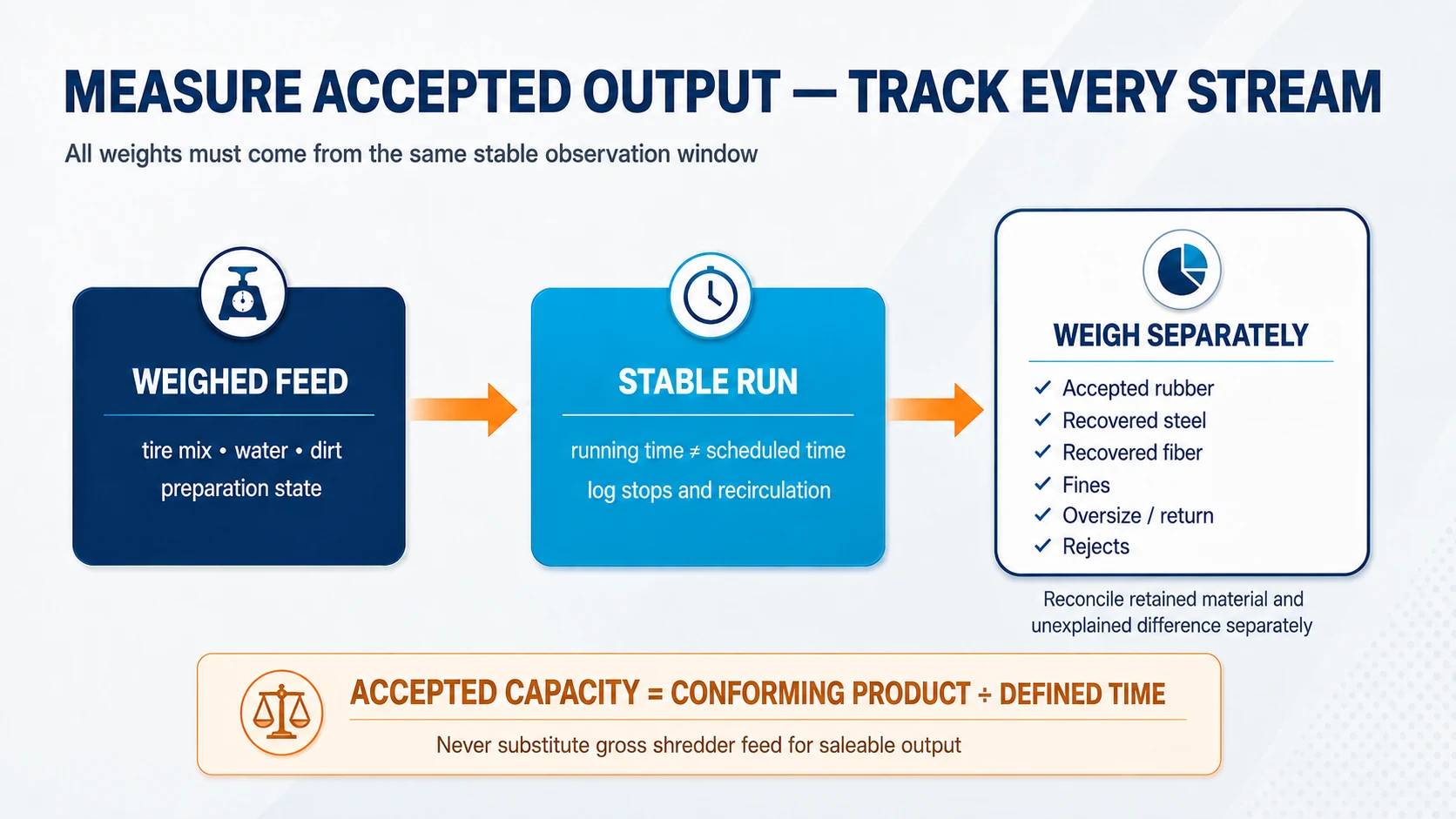
For the test window, weigh input, accepted rubber, steel, fiber, fines, oversize and rejects. Record running time separately from scheduled time. The reconciliation does not need to close perfectly—scale resolution, retained material and dust create differences—but an unexplained gap is a reason to investigate.
Eight FAT Checks That Belong in the Contract
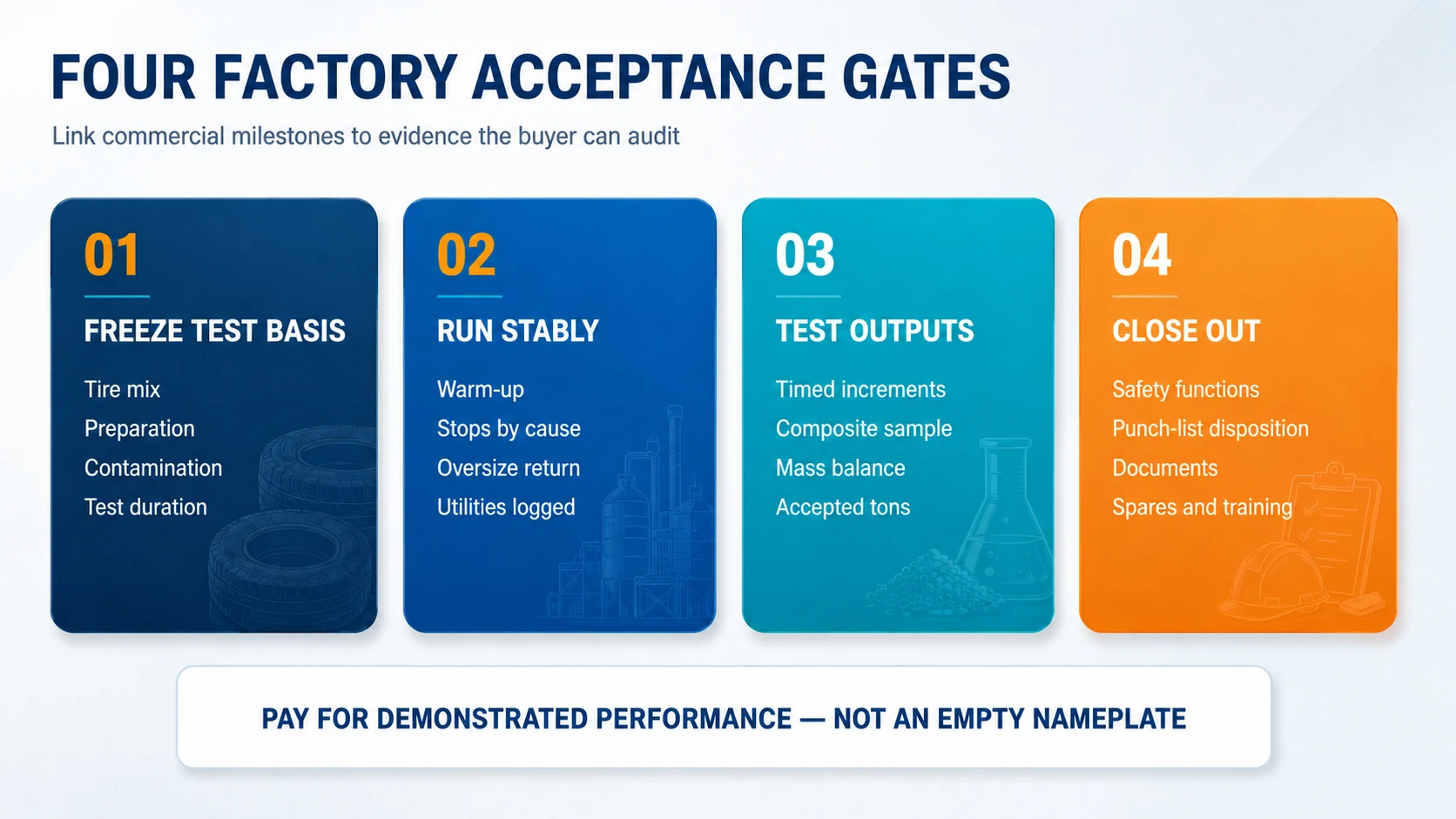
- Representative feed: define tire types, size range, bead state, contamination and preparation.
- Stable run: agree warm-up, observation duration, allowable interruptions and restart treatment.
- Accepted capacity: calculate conforming product per running hour and per scheduled hour.
- Product sampling: take timed increments, form a composite and split it for agreed laboratory methods.
- Mass balance: weigh every output stream, return and reject over the same period.
- Utilities: log electricity and any compressed air or water against accepted tons.
- Safety functions: demonstrate guards, interlocks, emergency stops, isolation points, overload response and alarms.
- Maintainability: inspect blade access, screen changes, magnet cleaning, bearing points, wear liners and listed spares.
OSHA’s machinery and hazardous-energy guidance makes clear why moving parts and unexpected energization must be addressed in the operating concept.2, 3 Tire cutting, granulation and transfer can also create combustible dust; hazard controls should follow a site-specific assessment rather than a generic dust-collector promise.4
Commercial rule: compare landed, commissioned cost per accepted ton at the required specification. Include freight, duty, civil work, wiring, extraction, fire controls, start-up spares, installation and the production lost during maintenance.
Questions to Send Every Chinese Supplier
- Which tire types are included, and which require debeading or cutting first?
- What exactly enters and leaves your guaranteed process boundary?
- Is throughput based on feed or accepted product, and over what observation time?
- Which test method defines size, residual steel, fiber, moisture and contamination?
- Where does oversize go, and is return capacity included in the motor and conveyor sizing?
- Which parts are locally sourced, which are branded components, and what substitutions are permitted?
- What drawings, PLC backup, manuals, spare-parts list and remote support are delivered?
- Can the FAT use our representative tires and independent sampling?
If the final product is fine material, examine the full rubber powder plant, not only the mill. Steel and fiber that were not adequately removed upstream will reappear as quality, wear and dust problems downstream.
Use a Weighted Scorecard—With Pass/Fail Gates First
A weighted score can make a purchasing decision look objective while hiding a fatal mismatch. A supplier might score well on price, delivery and presentation even though its line has never processed the buyer’s truck-tire percentage. Prevent that by separating eligibility gates from scored criteria. A failed gate removes the proposal from commercial ranking.
| Pass/fail gate | Evidence to request | Reason it cannot be averaged away |
|---|---|---|
| Feed envelope | Maximum tire dimensions, OTR/solid-tire exclusions, bead preparation and contamination limits | An unsuitable tire can stop feeding, overload cutters or invalidate output guarantees |
| Required product | Signed specification covering size distribution, steel, fiber, moisture and sampling method | A line that makes the wrong grade has no commercial value at its nominal throughput |
| Legal and safety basis | Applicable conformity documents, risk assessment scope, guarding and electrical standard5 | Local acceptance or safe operation cannot be traded for a lower price |
| Demonstrable capacity | Comparable reference or representative-material FAT with a defined time basis | Nameplate motor power and empty-machine video do not prove accepted production |
| Serviceable locally | Wear drawings, recommended spares, remote access plan and response commitments | An unavailable proprietary part can turn a minor failure into weeks of lost production |
Once every candidate passes the gates, score what remains. The starting allocation is 25% process and output fit, 20% FAT evidence, 15% maintainability, 15% total installed cost, 10% controls and safety, 10% documentation/support, and 5% delivery. Adjust the weights before opening final prices.
Scoring discipline: require a note beside every score. “4/5—drawing D-104 shows a powered oversize return” is auditable. “4/5—good design” is not. Score unavailable evidence as unknown, not automatically zero; then set a deadline for the supplier to close the evidence gap.
Normalize Capacity With One Worked Example
Suppose Supplier A quotes 3.0 t/h at the shredder inlet. During a one-hour observed run, the line receives 3.0 tonnes, returns 0.45 tonnes of oversize through the cutting loop, produces 2.22 tonnes of conforming rubber, recovers 0.39 tonnes of steel and fiber, rejects 0.08 tonnes and retains or cannot reconcile 0.31 tonnes. The commercial capacity is not automatically 3.0 t/h. For the specified rubber product, the demonstrated accepted rate is 2.22 t/h during that observation.
| Reported number | Value in example | Correct use |
|---|---|---|
| Gross feed rate | 3.00 t/h | Useful for infeed and upstream logistics |
| Internal oversize circulation | 0.45 t during test | Used to check return-conveyor and cutting reserve; do not count it as fresh feed |
| Accepted rubber rate | 2.22 t/h | Basis for saleable-product capacity if the sample passes specification |
| Rubber yield on feed | 74% | 2.22 ÷ 3.00; interpret with recovered steel, fiber, rejects and unexplained mass |
| Scheduled-hour rate | Depends on stops | Accepted tonnes divided by the full agreed window, including chargeable interruptions |
Convert Purchase Price Into Five-Year Cost per Accepted Ton
Two lines with similar prices can have very different economics once wear, staffing and product yield are included. Build a scenario model rather than pretending to know one exact lifetime cost. Use low, expected and high cases for cutter life, electricity, scheduled hours and accepted yield.
Five-year cost per accepted ton = (landed equipment + installation + commissioning + five-year energy + labor + wear parts + planned maintenance + expected unplanned-maintenance cost − residual value) ÷ accepted tonnes produced.
| Cost input | Common quoting trap | Normalization rule |
|---|---|---|
| Electrical demand | Installed motor total presented as energy use | Request logged kWh during a stable test and divide by accepted tonnes |
| Labor | Operators listed but loader, sorting, packing or cleaning omitted | Count every staffed function across the full shift |
| Wear parts | Blade set price without service interval or usable edges | Model cost per accepted ton between documented service events |
| Yield | Throughput used as saleable output | Apply the agreed product test and subtract off-spec material |
| Downtime | A single uptime promise with no exclusions | Model scheduled maintenance and failures separately; do not double count lost production |
| Freight and site work | FOB equipment compared with a commissioned local offer | Bring every proposal to the same installed and ready-to-run boundary |
Audit the Spare-Parts Chain Before the Machine Ships
Ask the supplier to classify each critical item as standard local purchase, branded international component, supplier-machined wear part or proprietary control item. For every proprietary part, record drawing availability, normal manufacturing lead time, emergency lead time and whether an equivalent can be fitted without software changes.
| Part group | Evidence before shipment | Practical stock decision |
|---|---|---|
| Cutters, knives and screens | Material specification, dimensions, usable edges, rebuild limit and change procedure | Stock enough for the first planned service plus damage contingency |
| Bearings, seals and belts | Manufacturer codes and approved equivalents | Source locally where possible; keep long-lead sizes on site |
| Motors, gearboxes and couplings | Nameplates, service factors, mounting drawings and lubricant schedule | Identify repair capability and the longest-lead assembly |
| Sensors and PLC hardware | Bill of materials, program backup, passwords and network architecture | Hold critical sensors and one agreed controls recovery route |
| Magnets, air systems and dust equipment | Cleaning access, filters, valves, wear points and performance basis | Stock consumables according to measured loading, not calendar guesswork |
A “two-year spare-parts package” is not meaningful until quantities are tied to operating hours, tire mix and maintenance strategy. Separate consumables, insurance spares and commissioning spares. They protect against different risks.
Write Contract Hold Points Around Evidence
Use hold points where a mistake becomes expensive to reverse. Suggested gates are: process design approval before fabrication; general-arrangement and load approval before civil work; controls and safety review before energization; dry commissioning before material testing; FAT before final shipment payment; and site acceptance after installation. Each gate needs named documents, approval time and a rule for unresolved comments.
Also define what happens after a failed FAT. The contract should state whether the supplier may adjust the line, how many retests are included, who pays for additional feed and travel, which changes require new documentation, and when the buyer may reject the equipment. A test with no consequence is a demonstration, not an acceptance test.
FAQ: China Tire Recycling Machine Manufacturers
What should a complete tire recycling quotation include?
It should define the accepted tire mix, hourly basis, finished-product specification, every included machine, conveyors and returns, separation stages, dust and fire controls, utilities, civil interfaces, commissioning, spares and a measurable FAT protocol.
How should buyers verify a tire recycling machine manufacturer?
Use one RFQ sheet for every candidate, inspect a comparable running line or factory, test representative tires, reconcile the mass balance and utilities, examine wear access, and tie payment milestones to documented FAT and site acceptance criteria.
Is the cheapest tire recycling line usually the best value?
No. A lower quotation may omit recirculation, separation, dust collection, controls, installation or output verification. Compare the cost of producing one accepted ton at the required quality, not only the equipment price.
Compare a Line Around Your Real Output
Send YUXI your tire mix, target product, capacity basis, contaminant limits, site utilities and available layout. We can return a process boundary and equipment configuration that your team can place beside competing quotations.
Engineering References
- US EPA, scrap tires. End-use and management context.
- OSHA, machine guarding. Moving-part protection guidance.
- OSHA, lockout/tagout. Hazardous-energy control guidance.
- OSHA, combustible dust. Dust hazard resources.
- European Union, machinery regulation. EU machinery legal text.