




A pulp or paper mill does not buy “shredded tires” in the abstract. It buys a supplemental fuel that must pass through a real receiving hopper, conveyor, metering device and boiler feed point without wire hang-ups, uncontrolled oversize or a disputed ash outcome. For that reason, the mill’s written acceptance sheet should come before the shredder configuration.
Why Paper-Mill TDF Is Not the Same Product as Kiln TDF
Cement kilns may be able to tolerate or use some tire steel in the process. Pulp and paper mills commonly face a different constraint: steel wire can catch or accumulate in the fuel-handling system. The US EPA also notes that some mills need iron-free ash for its intended outlet, making de-wiring commercially important even when the boiler could physically burn the rubber.1
That distinction changes the process route. “Steel-in,” “steel-reduced” and “wire-free” are not interchangeable purchasing terms. A mill should say what it will inspect and measure. Otherwise, a processor can remove bead bundles, pass the product under a magnet and still deliver chips that contain exposed or embedded belt wire beyond the receiver’s practical tolerance.
Translate the Mill’s Fuel Route into an Acceptance Sheet
ASTM D6700 treats TDF use as a combination of combustion, handling, environmental and residue considerations—not a heating-value decision alone.2 For a paper mill, the following fields should be written before an equipment supplier promises output.
| Acceptance field | What the mill should define | Why it changes the line |
|---|---|---|
| Nominal chip window | Length/width basis, target range and measurement method | Sets screen opening and recirculating load |
| Hard oversize | Maximum dimension, allowed count or mass fraction, and lot disposition | Protects chutes, screws and metering openings |
| Exposed wire | Permitted projection, how it is measured and sample size | Controls snagging risk; may require more liberation |
| Loose ferrous metal | Mass limit and collection/test method | Defines magnet duty and cleanout expectations |
| Embedded steel | Whether included in total-steel testing and the analytical method | Separates visual acceptance from true total metal content |
| Moisture | As-received limit, method, sealed sample handling and timing | Affects delivered energy, storage and contract settlement |
| Foreign material | Rims, rocks, dirt, oils, non-tire rubber and prohibited items | Protects equipment and the mill’s permit/ash boundary |
| Lot and sampling | Lot size, increment points, composite method and retained sample | Makes acceptance repeatable instead of subjective |
Use Four Gates Instead of One Pass/Fail Label
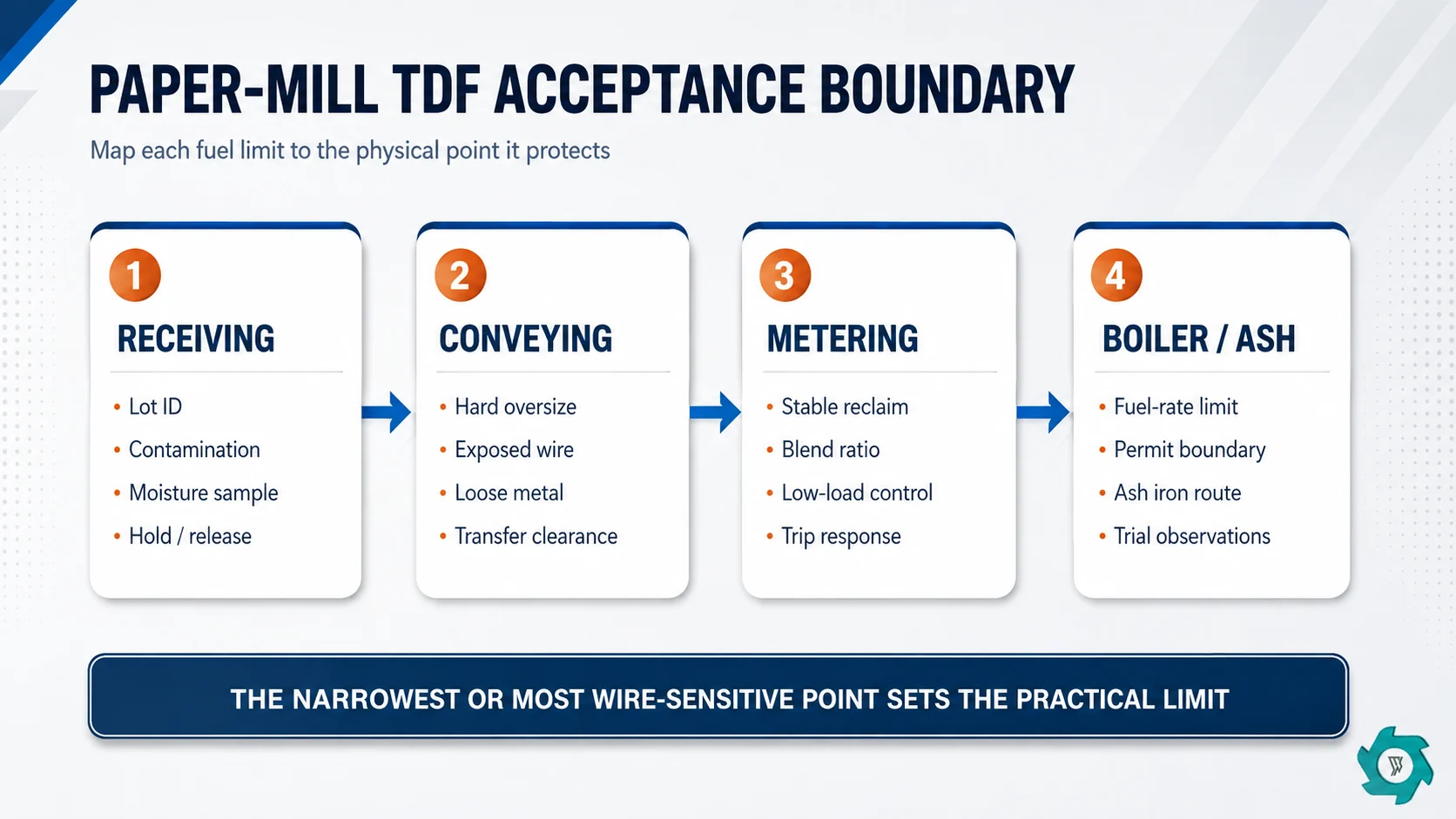
A single “wire-free TDF” result hides where a load can fail. A more useful mill acceptance plan releases material through four consecutive gates. The processor then knows whether to re-screen, run the material under the magnet again, reprocess it for better steel liberation or investigate contamination.
| Gate | Question answered | Typical evidence | Disposition if it fails |
|---|---|---|---|
| 1. Identity | Is this the declared tire-derived lot? | Supplier, origin, tire mix, production window and seal/lot ID | Quarantine until traceability is restored |
| 2. Handling | Will it pass the receiving and feed route? | Chip distribution, hard oversize, exposed wire, bulk-flow observation | Re-screen or reprocess; do not blend |
| 3. Metal | Does it meet the mill’s separate loose- and residual-steel rules? | Collected loose metal, visual wire count and contracted total-steel test | Re-magnetize or improve liberation |
| 4. Fuel / compliance | Does it meet the purchased energy and site boundary? | Moisture, energy basis, prohibited material and any required chemistry | Hold for agreed retest or reject |
Once an unreleased load is blended with bark, correcting a TDF-only failure may no longer be possible. The receiver should therefore define the last point at which a truck or lot can still be isolated.
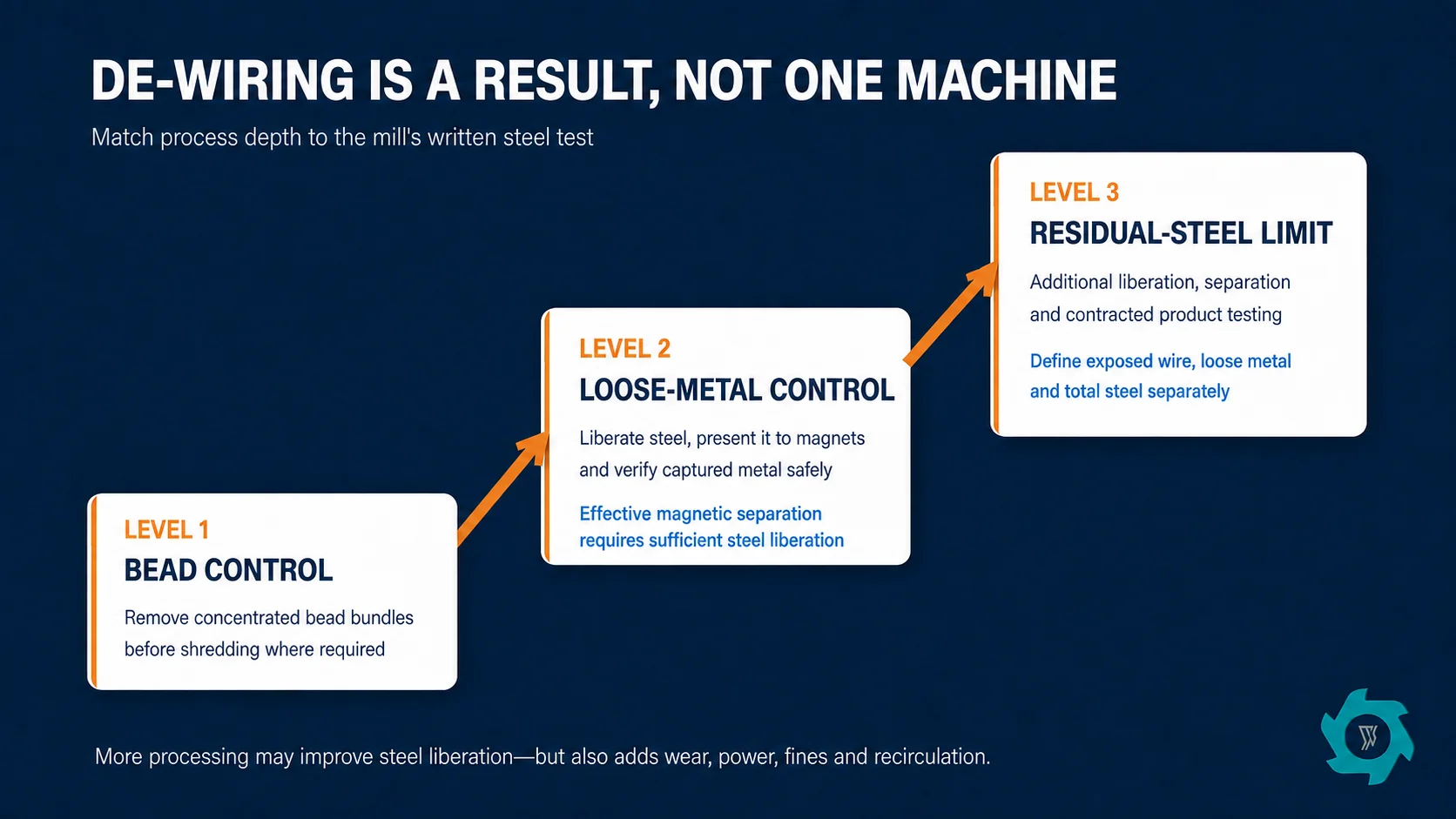
De-Wiring: Specify the Result, Not Just the Machine
A debeader removes concentrated bead bundles before shredding. It can reduce shock loading and downstream steel burden, particularly with truck and larger tires, but it does not remove all belt steel. A magnet captures only ferrous material that has been sufficiently liberated and presented within its effective field. Additional size reduction improves liberation, yet also adds power, wear, fines and recirculation.
The right route therefore depends on the mill’s test:
- Bead control: remove bead wire where feedstock construction, blade loading or the contract requires it.
- Controlled shredding: create a chip small enough for the receiver while avoiding unnecessary reprocessing.
- Screen and return: send oversize back to cutting; do not treat the return stream as finished product.
- Metal liberation: add further reduction only when the required steel result cannot be reached at the initial chip size.
- Magnetic separation: remove liberated ferrous metal with documented belt loading, presentation depth and cleanout access.
- Finished-product verification: test exposed wire, loose metal and, when contracted, total residual steel as separate fields.
The YUXI Tire TDF Plant uses preparation, shredding, screening and oversize return as its published core route. A tighter steel requirement may need a deeper liberation and separation route than ordinary fuel chips.
Close the Steel Mass Balance During a Production Test
A magnet belt covered with recovered wire looks convincing, but it does not prove the residual steel in the released fuel. For a witnessed test, record steel at the boundaries that can actually be weighed: bead steel removed, loose steel captured after shredding, ferrous rejects, and residual steel measured in the finished sample. Keep process spill and retained material visible so the arithmetic is not presented as a precise recovery percentage when part of the steel inventory is unmeasured.
Observed steel balance = bead steel + magnet steel + ferrous rejects + estimated residual steel in released TDF
Compare that observed total with the steel entering in the representative tire mix only as a reasonableness check. Tire construction varies, and a short test may not provide a reliable input-steel value. The most defensible commercial guarantee remains the receiver’s measured residual product limit—not a theoretical steel-recovery claim.
| Record separately | Do not assume | Useful diagnostic signal |
|---|---|---|
| Bead steel removed before shredding | That bead removal equals full de-wiring | Sudden change may indicate tire-mix or debeader performance change |
| Loose steel collected by each magnet | That all belt wire is magnetically available | Low capture plus high residual steel points to poor liberation or presentation |
| Residual steel in accepted TDF | That a visual check measures embedded steel | Directly tests the purchased product where a method is agreed |
| Long exposed wires by count/length rule | That total-steel percentage predicts snagging | Directly relates product shape to feed-system risk |
Fit the Chip to the Feed System, Not a Market Label
EPA’s historic assessment describes TDF as a supplemental fuel in waste-wood or hog-fuel boilers and notes that variable wood size, moisture and heating value are part of the operating context.3 The useful project question is not whether a nominal chip is called “two-inch TDF.” It is whether the actual distribution can move through the mill’s route.
Record the hopper throat, grizzly spacing, transfer-point clearances, belt transitions, screw or rotary-valve geometry, metering opening and final injection point. Then identify which dimension controls each one. Long, flexible chips and wire projections can bridge or snag even when their apparent plan-view size passes a simple screen check.
For this reason, the acceptance sheet should distinguish:
- the target chip window used for normal process control;
- the permitted oversize tail;
- a receiver-defined hard maximum that triggers hold or rejection;
- long protruding wire, which is not solved by reporting rubber-chip size alone;
- fines, when they affect dust, housekeeping or fuel distribution.
When screen behavior or recirculation becomes unstable, diagnose the process with the TDF plant troubleshooting guide rather than opening the screen until throughput looks better. Accepted output—not gross discharge—is the capacity that matters.
Receiving, Storage and Metering Requirements
Keep the TDF lot identifiable through unloading and release. If it is premixed into a bark pile before checks are complete, isolation becomes difficult and any nonconformance contaminates a much larger fuel inventory. A separate bay, controlled reclaim method and defined blending point usually give the operator better control of fuel ratio and traceability.
| Mill-side point | Commissioning check | Evidence to record |
|---|---|---|
| Truck receiving | Safe tipping, visual contamination check, lot isolation | Load ID, supplier, mass, photographs and hold/release status |
| Storage | Drainage, pile limits, fire plan and incompatible-material exclusion | Bay assignment, residence time and inspection log |
| Reclaim | Bridging and segregation under low and full inventory | Stable reclaim rate and intervention frequency |
| Metal control | Magnet performance and safe captured-metal removal | Collected metal per accepted tonne and abnormal pieces |
| Metering/blending | Low-load turndown, ratio control and trip response | TDF rate, companion-fuel rate and time-aligned boiler data |
| Feed chute | Representative chip flow, wire hang-up inspection | Blockage events, cause and cleared material |
Storage, moisture and fire controls require site-specific design. The separate TDF storage and handling guide covers pile management, conveying and commissioning checks in more depth.
Work Backward from the Ash Destination
Bottom ash, fly ash and captured metal may follow different routes, and the intended sale, reuse or disposal route can be more restrictive than combustion itself. Before setting a steel limit, the mill should document where each residue stream goes, who accepts it, which iron or metal condition matters, and whether a change in supplemental fuel requires new testing or approval. EPA’s paper-industry summary specifically identifies ash iron as one reason some mills purchase de-wired TDF.1
Do not convert an ash buyer’s requirement directly into a guessed TDF steel percentage. Boiler partitioning, grate removal, ash collection and existing fuel contaminants affect the relationship. A better commissioning method is to establish baseline ash, introduce a characterized TDF lot under an approved trial, keep the residue streams separate where practicable, and measure the actual response before finalizing the fuel contract.
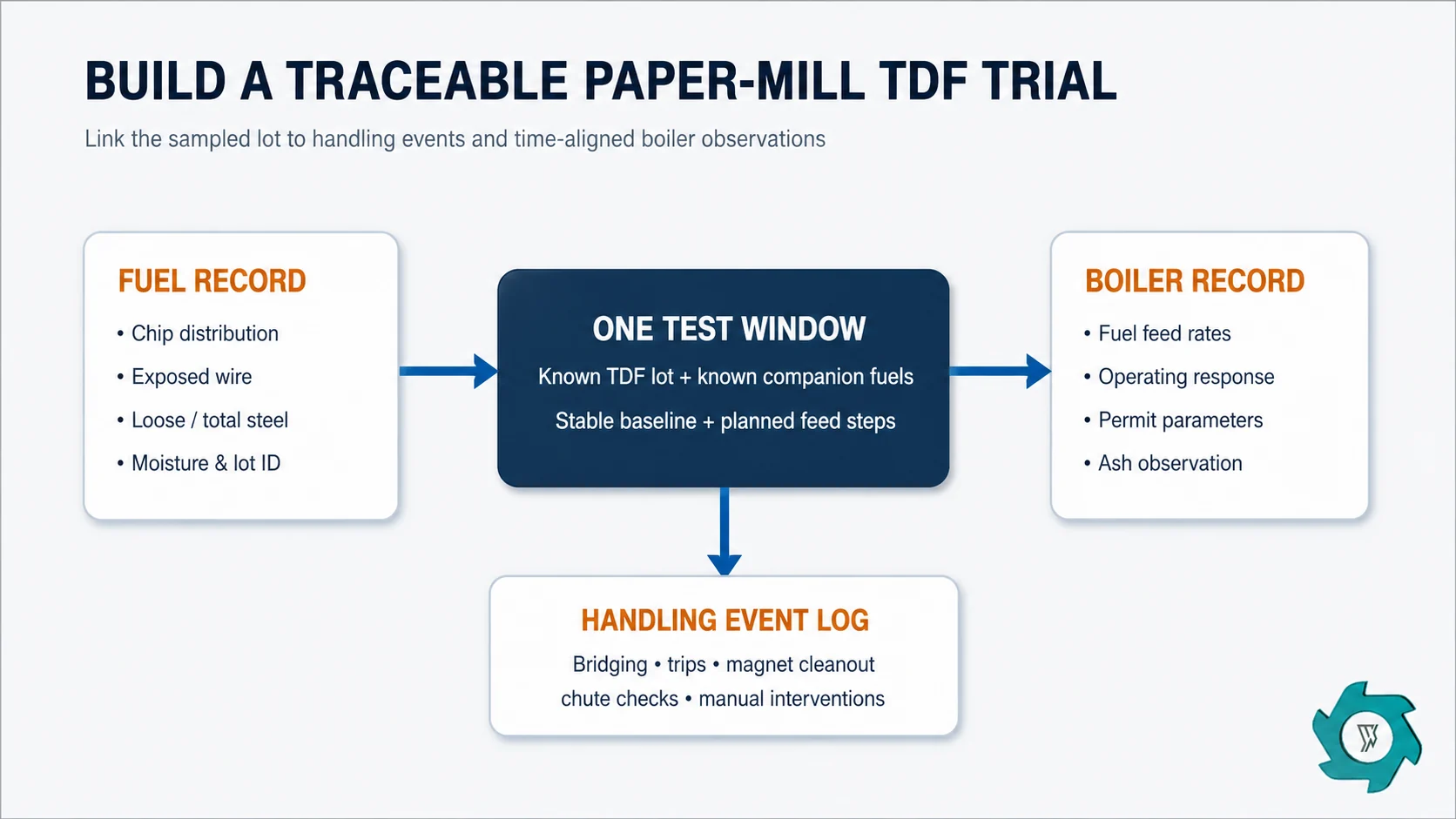
Run a Trial That Can Separate Fuel Quality from Feed Problems
Plan the trial so the mill can distinguish a poor fuel lot from a receiving or metering fault. Use a representative TDF lot, document the companion fuels, stabilize the baseline and then introduce TDF in planned steps within the facility’s permit and operating procedures.
- Define the baseline: record bark/wood condition, steam load, grate or bed condition, excess oxygen, relevant temperatures, emissions-control operation and ash route.
- Release the lot: sample the finished TDF against the agreed size, wire, loose-metal, moisture and contamination fields before blending.
- Trace the material: retain lot identity from delivery through the test window.
- Log handling events: note bridging, magnet cleanout, chute inspection, trips and manual interventions with timestamps.
- Align operating data: compare fuel feed rates and boiler observations using the correct residence-time lag; do not attribute an instantaneous change to fuel that has not reached combustion.
- Inspect ash and equipment: record iron accumulation, disposal or beneficial-use constraints, and any wire recovered downstream.
- Set the decision: accept, conditionally accept, rework or reject the lot using pre-agreed rules.
Separate Three Trial Decisions
| Decision | Pass basis | If it does not pass |
|---|---|---|
| Fuel-product acceptance | The sampled lot meets the written chip, wire, metal, moisture and contamination rules | Processor corrects the production or release method |
| Mechanical feed compatibility | The approved lot is unloaded, reclaimed, metered and fed without unacceptable intervention | Mill and supplier isolate the limiting interface; do not automatically blame chip size |
| Boiler / site approval | Operation, controls, permit conditions and residue route remain within the mill’s approved test plan | Mill determines operating, blending, control or authorization changes |
For each decision, define a hard stop, an observation that triggers investigation, and a normal operating range. For example, one isolated chute check is not automatically equivalent to a feed-system failure, while repeated manual clearing at the same transfer point should not be hidden inside an average feed rate.
Historical EPA reports describe successful use in properly designed and controlled systems, but they do not create a universal substitution rate for a new mill.4 Boiler design, permit terms, companion fuels, ash management and feed-system capacity remain site-specific.
Capacity Should Be Quoted as Accepted Paper-Mill Fuel
A line can process many raw tonnes and still produce fewer accepted tonnes when tight sizing or steel removal drives recirculation and rejects. Quote both the input basis and the finished release basis.
Accepted TDF output = released lot mass ÷ stable production time
State the tire mix, screen configuration, steel-control route, oversize return, sample method, interruptions included or excluded and the mill specification used for release. The tire shredder for TDF production guide shows why size, steel handling and screen return must be attached to any capacity statement.
RFQ Data Sheet for a Pulp or Paper Mill Project
- mill and boiler type, existing primary and supplemental fuels;
- permit boundary and planned TDF heat-input or mass-rate range;
- receiving, storage, reclaim, conveying, metering and final feed interfaces;
- written chip-size, hard-oversize, exposed-wire, loose-metal and total-steel definitions;
- moisture, contamination, chemistry or calorific-value requirements and methods;
- ash collection, sale, reuse or disposal route and its iron restriction;
- representative passenger/truck/OTR tire mix and prohibited inputs;
- lot size, sampling point, composite procedure, retained sample and dispute process;
- accepted finished tonnes per hour and required operating schedule;
- FAT material quantity, stable test duration, witnessing and acceptance criteria;
- delivery format, truck unloading rate and buffer-storage requirement;
- local power, guarding, dust, fire, noise and documentation requirements.
For the underlying size-control choices, see the TDF chip size guide. It explains why chip dimensions and steel exposure must remain separate acceptance fields.
Minimum Shipment Certificate
At minimum, include the lot and truck IDs, net mass, production dates, declared tire mix, applicable specification revision, sampling point and time, chip/oversize result, exposed-wire result, loose-metal result, moisture result, exceptions or rework, release authorization and retained-sample ID. Do not copy test values from a previous batch into a certificate for a new load.
Configure the Line Around the Mill’s Acceptance Sheet
Send YUXI the representative tire mix, paper-mill feed interface, chip and steel limits, accepted-output target and test basis. The equipment discussion can then distinguish essential de-wiring and size-control stages from processing that adds cost without improving mill acceptance.
FAQ: TDF for Pulp and Paper Mills
Do pulp and paper mills require wire-free TDF?
Many mills require de-wired or tightly steel-controlled TDF because wire can obstruct fuel handling and iron may affect the planned use of ash. The receiving mill must define measurable limits for exposed wire and loose metal.
What TDF chip size should a paper mill specify?
There is no universal size. The maximum chip dimensions and oversize allowance should be based on the narrowest chute, metering device and boiler feed opening, then verified with an agreed sampling and measurement method.
Can a magnet alone produce wire-free TDF?
Magnets remove liberated ferrous metal, but steel still embedded in rubber may require additional size reduction and liberation. The required process depends on how the receiver defines and tests steel.
Should TDF be blended with bark before storage?
Only if the mill’s engineered handling plan calls for it. Separate receiving and metering usually make inventory, sampling and blend-rate control easier, while premixing can make a rejected TDF lot harder to isolate.
How should TDF line capacity be stated?
State accepted finished tonnes per hour for the representative tire mix, target chip and steel limits, screen-return arrangement and continuous test period. Raw input rate is not the same as released fuel output.
What should a mill provide before equipment is selected?
Provide the fuel acceptance sheet, boiler and feed-system constraints, steel and oversize limits, delivery and storage route, sampling plan, ash destination, permit boundary and required accepted-output rate.
Engineering References
- US EPA, TDF guidance. Paper-mill handling, de-wiring and ash context.
- ASTM International, D6700 standard. Guide for scrap tires used as TDF.
- US EPA, air implications. Pulp and paper boiler context.
- US EPA, scrap tire handbook. Industrial-boiler and paper-mill cases.