




A tire debeader looks like a simple front-end machine until two quotations are put side by side. One supplier may be quoting a whole-tire, twin-hook machine for truck tires. Another may expect the sidewall or bead ring to be prepared first. A third may use the term OTR for equipment intended for a very different tire size range. This 2026 shortlist separates those duties before ranking the manufacturers.
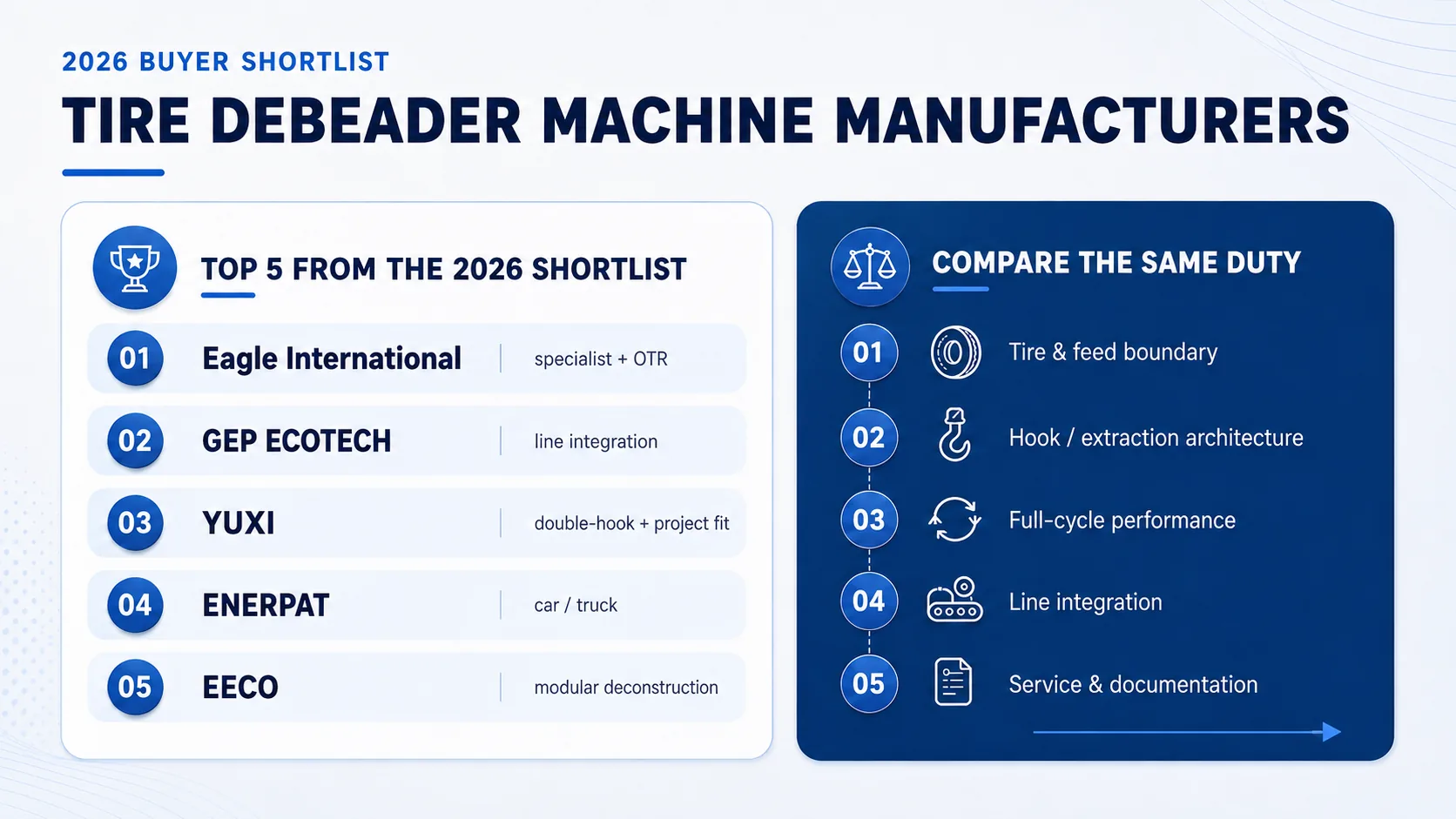
| Rank | Manufacturer | Public debeader evidence | Best-fit direction | Buyer verification point |
|---|---|---|---|---|
| 1 | Eagle International | Dedicated car/truck debeader plus separate OTR debeader | Specialist tire preprocessing, including true heavy OTR projects | Choose the correct platform; standard truck and OTR duties are not the same. |
| 2 | GEP ECOTECH | Dedicated hydraulic and bidirectional tire debeader content with project integration | Truck-tire pretreatment and integrated tire recycling systems | Confirm the tire range and capacity under representative FAT conditions. |
| 3 | YUXI | Current double-hook hydraulic tire wire drawing machine pillar | Car, bus and truck tire projects connected to cutting, shredding or rubber processing | Confirm prepared feed, tire diameter and whether an OTR-specific configuration is required. |
| 4 | ENERPAT | Dedicated tire debeader page with car/truck and portable/stationary options | Car and truck tires up to super-single class | Normalize optional lift, power source and site handling scope. |
| 5 | Engineering & Equipment Co. (EECO) | Bead wire remover and carcass bead remover inside a staged deconstruction system | Modular tire dismantling rather than a conventional whole-tire twin-hook workflow | Do not compare cycle rate directly with whole-tire debeaders without matching feed state. |
| 6 | SUMAC | Single-hook and double-hook models with published technical sheets | Truck-tire line projects needing a conventional bead-pulling stage | Actual capacity depends on the tire type, bead structure, and machine configuration. |
| 7 | Shuliy Machinery | Single- and double-hook hydraulic configurations with public parameter tables | Medium/heavy tire pretreatment with clear basic machine options | Verify actual tire dimensions, full-cycle rate and after-sales scope against representative feed. |
| 8 | HANLV Machinery | Multiple debeader variants including automatic car, single-hook and double-hook models | Projects that want several architecture choices from one catalogue | Confirm the exact model with drawings, operating videos and agreed FAT conditions. |
| 9 | Dongguan Yuntong | Dedicated twin-hook tire debeader products within a tire recycling equipment range | Integrated tire shredding / crushing projects | Confirm the quoted configuration with model drawings, representative feed and agreed test conditions. |
| 10 | Shredwell Recycling | Debeader listed within a broad tire recycling machine and plant architecture | Projects looking for a complete tire recycling line from a single supplier. | Final machine selection should be based on the tire size range, bead structure, and overall line configuration. |
How This Manufacturer Ranking Was Built
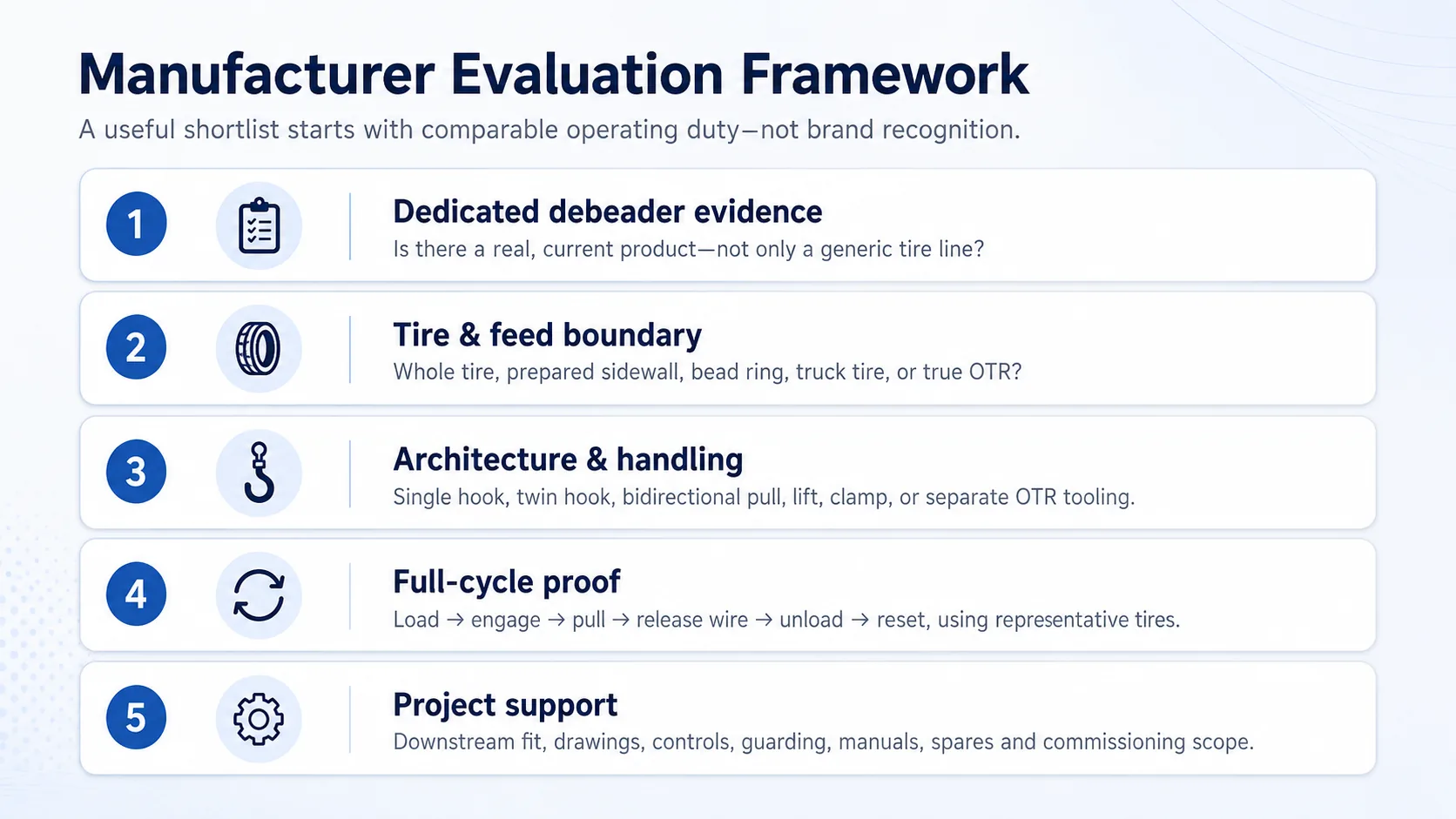
The first filter was simple: can we verify from a current manufacturer-controlled source that the company actually offers equipment for tire bead-wire removal or a clearly related staged bead-removal process? Candidates that only sell generic shredders were not enough.
The second filter was comparability. A tire debeader can mean different things. Some machines pull both bead bundles from a whole passenger or truck tire. Some work one side at a time. Some expect a sidewall or prepared bead ring. EECO uses a staged deconstruction approach. Eagle publishes a completely different OTR platform for mining tires.
The final order considers five practical signals: dedicated product evidence, a clearly stated tire/feed boundary, machine architecture and handling detail, evidence that can support a complete-cycle test, and the supplier’s ability to connect the machine to a real tire recycling process.
First Define What “Tire Debeader” Means in Your Project
The most common procurement mistake is asking ten suppliers for “a 1,000 tires per shift debeader” without saying what arrives at the machine. Handling can take longer than the pulling stroke. A machine that looks fast in a close-up video can become slow when an operator has to rotate, re-hook or drag heavy wire away after every cycle.
YUXI’s current tire wire drawing machine page provides a useful example of a defined boundary: the machine uses a hydraulic pulling system and high-strength hooks, is positioned for car, bus and truck tire work, and notes that prepared bead rings are common feed. It also says exact model, motor power and capacity should be confirmed from tire diameter, bead structure and project layout. For large OTR tires, a customized extractor or cutting route may be required.
An OTR tire can be a very different handling and force problem from a truck tire. If a supplier uses one broad “truck/OTR” label, ask for the exact tire markings shown in its test videos and references. Do not use a brochure category as proof that the quoted machine handles your largest tire.
Top 10 Tire Debeader Machine Manufacturers to Compare in 2026
1. Eagle International — Strongest Dedicated Tire and OTR Evidence
Eagle International earns the first position because it treats tire preprocessing as a product category in its own right. Its standard debeader is documented for car and truck tires and is designed to pull both beads in the same operating cycle. The company also publishes portable and stationary configurations, handling assistance and multiple power options. That level of disclosure makes it easier to define what is being quoted.
The larger distinction is OTR. Eagle does not simply add “OTR” to the standard debeader description. It publishes a separate OTR Debeader with adjustable die plates, handling hardware, hydraulic shear features and a tire-size boundary extending into large radial mining tires.
Best fit: recyclers that want a tire-preprocessing specialist, especially where true OTR capability must be demonstrated.
Verify before order: whether the standard or OTR platform is required, the actual tire mix, material-handling method, site mobility need, and the full operating cycle rather than the published pull time alone.
2. GEP ECOTECH — Strong Front-End Integration for Tire Recycling Plants
GEP ECOTECH has a dedicated tire debeader product and a broader tire-recycling equipment architecture that includes shredding, rasping, grinding and complete units. Its public materials describe hydraulic bead extraction and distinguish uni-directional and bidirectional configurations. The bidirectional design is positioned for pulling both sides in one cycle, which is relevant when a plant needs to reduce repeated positioning.
The company publishes the debeader as part of TBR and rubber-granule processing routes rather than as an isolated machine. That makes it easier to discuss what happens after the wire is removed and how the front-end capacity should match the downstream line.
Best fit: truck-tire or integrated tire-recycling projects that want one supplier to coordinate several process stages.
Verify before order: Confirm the applicable tire diameter range, expected throughput and complete-cycle performance with representative tires under agreed FAT conditions.
3. YUXI — Strong Project Fit for Car, Bus and Truck Tire Lines
YUXI’s standard offer is a hydraulic double-hook tire wire drawing machine used before tire cutting, shredding, rubber powder production or other downstream processing. The operating sequence covers loading, clamping, hook positioning, hydraulic pulling and bead-wire collection, allowing the machine to be integrated with a broader tire recycling system.
Machine configuration is selected according to tire diameter, bead structure, labor arrangement and project layout rather than one universal specification. Standard applications cover car, bus and truck tires, while large OTR projects may require a customized extraction or cutting route.
Best fit: projects where the debeader has to be matched with a tire cutter, shredder or rubber-processing line rather than purchased as a disconnected machine.
Verify before order: send real tire photos and markings, the prepared feed condition, maximum tire dimensions, shift volume, local power and the downstream machine. Then request a test on comparable tires.
4. ENERPAT — Clear Car and Truck Debeader Scope
ENERPAT publishes a dedicated tire debeader that pulls both beads from car and truck tires and states a maximum tire class up to super-single truck tires. The company also describes stationary and portable choices and electric or diesel power options.
ENERPAT is especially relevant where the debeader is being added to a shredding operation. The public page also connects bead removal with reduced downstream shredder wear and recovery of a separate steel stream.
Best fit: car/truck tire preprocessing with site-specific mobility or power-source needs.
Verify before order: exact tire geometry, optional car-tire die plates, lifting/handling scope, guarding, controls and how the machine will be fed and discharged in the buyer’s layout.
5. Engineering & Equipment Co. (EECO) — Best Alternative for Modular Tire Deconstruction
EECO should not be treated as a direct copy of the common double-hook whole-tire debeader. Its product architecture is staged. The company publishes machines for removing sidewalls, carcass beads and bead wire, then further processing tread and sidewall material.
EECO’s public catalogue separates a bead wire remover from a carcass bead remover and describes a staged system for turning tire sections into saleable components. This can make sense for smaller or phased operations that want to add individual machines over time.
Best fit: modular dismantling and staged material recovery, especially when a buyer wants discrete machines rather than a complete shredding line.
Verify before order: compare like with like. A bead-wire remover receiving a prepared sidewall cannot be judged against a whole-tire double-hook debeader on raw tires by “tires per hour” alone.
6. SUMAC — Broad Single- and Double-Hook Offering
SUMAC publishes both hydraulic single-hook and double-hook tire debeader models and supplies them inside tire-recycling line documentation. It describes the feed boundary, machine components and separate model architectures instead of using one generic image for every configuration.
For projects handling mixed truck tires, actual output can vary with tire size, bead construction and the selected machine configuration. Capacity should therefore be confirmed against the intended feed mix and operating conditions.
Best fit: conventional truck-tire pretreatment where the buyer wants a choice between single- and double-hook approaches.
Verify before order: exact model revision, drive type, tire limit, lifting method, safety frame and the guaranteed complete-cycle basis.
7. Shuliy Machinery — Clear Basic Configuration Tables
Shuliy’s tire machinery site documents hydraulic single-hook and double-hook debeaders and publishes a straightforward table covering machine power, size, weight, nominal tire diameter range and pieces per hour.
Best fit: buyers that want clearly separated single- and double-hook options for medium/heavy tire work.
Verify before order: representative tire size, actual feed preparation, sustained shift rate, wire-release handling and spare-hook/support terms.
8. HANLV Machinery — Wide Debeader Catalogue
HANLV publishes one of the broader debeader catalogues in this group. Its current category page lists an automatic car-tire debeader, a hydraulic single-hook machine, a double-hook machine and an automatic double-hook design.
HANLV’s range gives buyers several machine architectures to compare for different tire types and operating requirements. The final choice should be matched to the actual feed condition, tire dimensions, handling method and required production rate.
Best fit: projects comparing several debeader formats from one manufacturer.
Verify before order: the exact model code, feed condition, car vs truck applicability, control sequence, guarding and stable-run capacity on the actual tire mix.
9. Dongguan Yuntong — Direct Twin-Hook Products Inside a Tire Equipment Range
Dongguan Yuntong presents itself as a tire recycling equipment manufacturer and lists dedicated tire debeader products alongside tire shredders, cutters, rubber crushers and pulverizers. Its public product summaries describe double-bead wire pulling and twin-hook features, which is enough to make the company a credible candidate for a deeper RFQ.
Best fit: buyers considering a single supplier for several tire size-reduction stages.
Verify before order: model drawing, hydraulic/drive architecture, tire-size envelope, operator handling, safety system, parts list and a representative material test.
10. Shredwell Recycling — Complete-Line Context, but Debeader Evidence Needs More Depth
Shredwell has strong public coverage of tire shredders, raspers, granulators, pulverizers and complete tire recycling plants. Its current tire machine architecture also lists a debeader.
For complete-line projects, the debeader should be matched to the tire size range, feed preparation, material-handling method and downstream shredding capacity.
Best fit: complete-line buyers willing to perform a detailed technical clarification.
Verify before order: confirm the tire-size range, machine configuration, handling arrangement, model drawings and FAT conditions for the quoted system.
Which Manufacturer Fits Which Tire Debeading Project?
| Project condition | Manufacturers worth starting with | Why |
|---|---|---|
| Passenger and truck tires; conventional whole-tire bead pulling | Eagle, GEP, YUXI, ENERPAT | Direct debeader evidence and clearly described front-end tire duty. |
| High-output truck tire line with interest in twin/bidirectional pulling | GEP, YUXI, SUMAC, Shuliy | Public double-hook or bidirectional architecture; still normalize handling and FAT. |
| Large mining / true OTR tires | Eagle first; then custom-engineered alternatives after proof | Eagle publishes a separate OTR platform and tire envelope rather than extending a truck model by marketing language. |
| Modular tire dismantling and staged bead recovery | EECO | Different workflow built around sidewall, bead and tread deconstruction. |
| One supplier for broader tire recycling equipment | GEP, YUXI, ENERPAT, Yuntong, Shredwell | Debeading can be reviewed together with cutting, shredding or downstream rubber processing. |
| Need several catalogue options before technical narrowing | HANLV, SUMAC, Shuliy | Multiple configurations are visible publicly, but model-by-model verification is necessary. |
Compare Full-Cycle Output, Not the Best Pulling Stroke
A tire debeader’s hydraulic cylinder may complete the pulling movement quickly, but a plant does not get paid for cylinder strokes. It gets useful output after a tire is loaded, positioned, engaged, pulled, released and removed. The bead wire also has to be taken away safely. If the tire slips or the bead tears, the operator may need a second pull. That time belongs in the production number.
Supplier test starts with representative tires and a written feed condition. Run enough cycles to move past the demonstration effect of one easy tire. Count incomplete pulls, hook resets, jams, wire-release delays and any time the operator waits for material handling. Then calculate a sustainable complete-cycle rate. This is the number that should be compared with the upstream tire preparation and the downstream cutter or shredder.
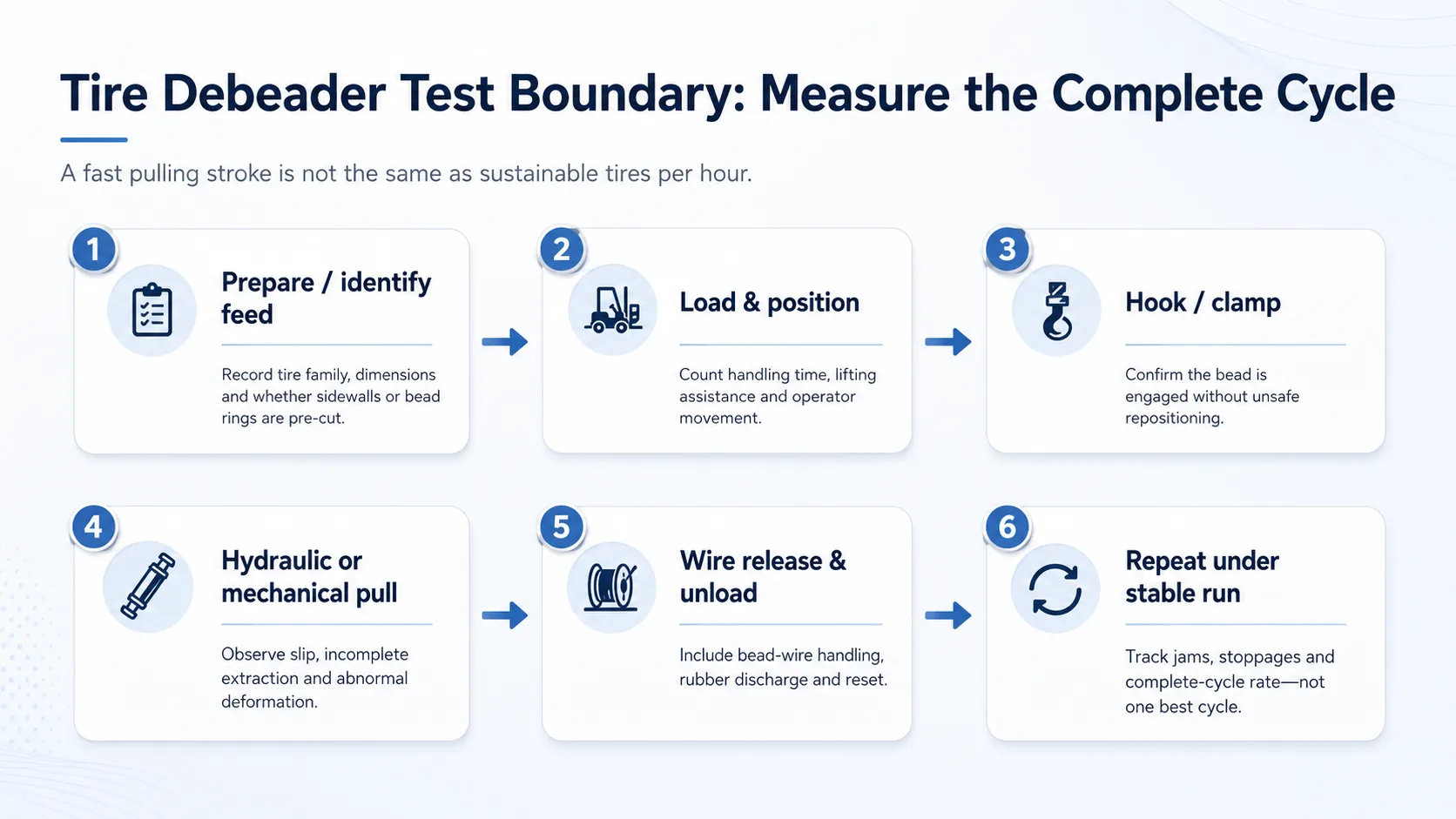
The same logic is used in the more detailed tire debeader selection guide. For a manufacturer ranking, it is enough to remember one rule: do not compare a supplier’s fastest hydraulic pull with another supplier’s full load-to-reset cycle.
Use One RFQ Data Sheet for Every Tire Debeader Manufacturer
Price quotations become misleading when the technical boundary is different. One quote may include a lifting device, safety guarding and electrical cabinet. Another may be a bare hydraulic machine that expects manual tire handling. A third may include integration with a shredder. Before price comparison, force the scope into the same columns.
Send representative tire photos and markings, the percentage mix by tire family, maximum diameter and width, and the feed state at the debeader. State whether the machine receives whole tires, sidewalls or prepared bead rings. Add the required tires per shift, downstream equipment, local voltage and frequency, available floor space, indoor/outdoor conditions and the material-handling method.
Then define what you expect from the supplier: machine, lift or feed assist, hydraulic station, controls, guards, discharge handling, foundation/interface drawing, spare hooks and wear parts, manuals, commissioning, training and FAT. If these items are not aligned, the cheapest quote can easily become the most expensive installed option.
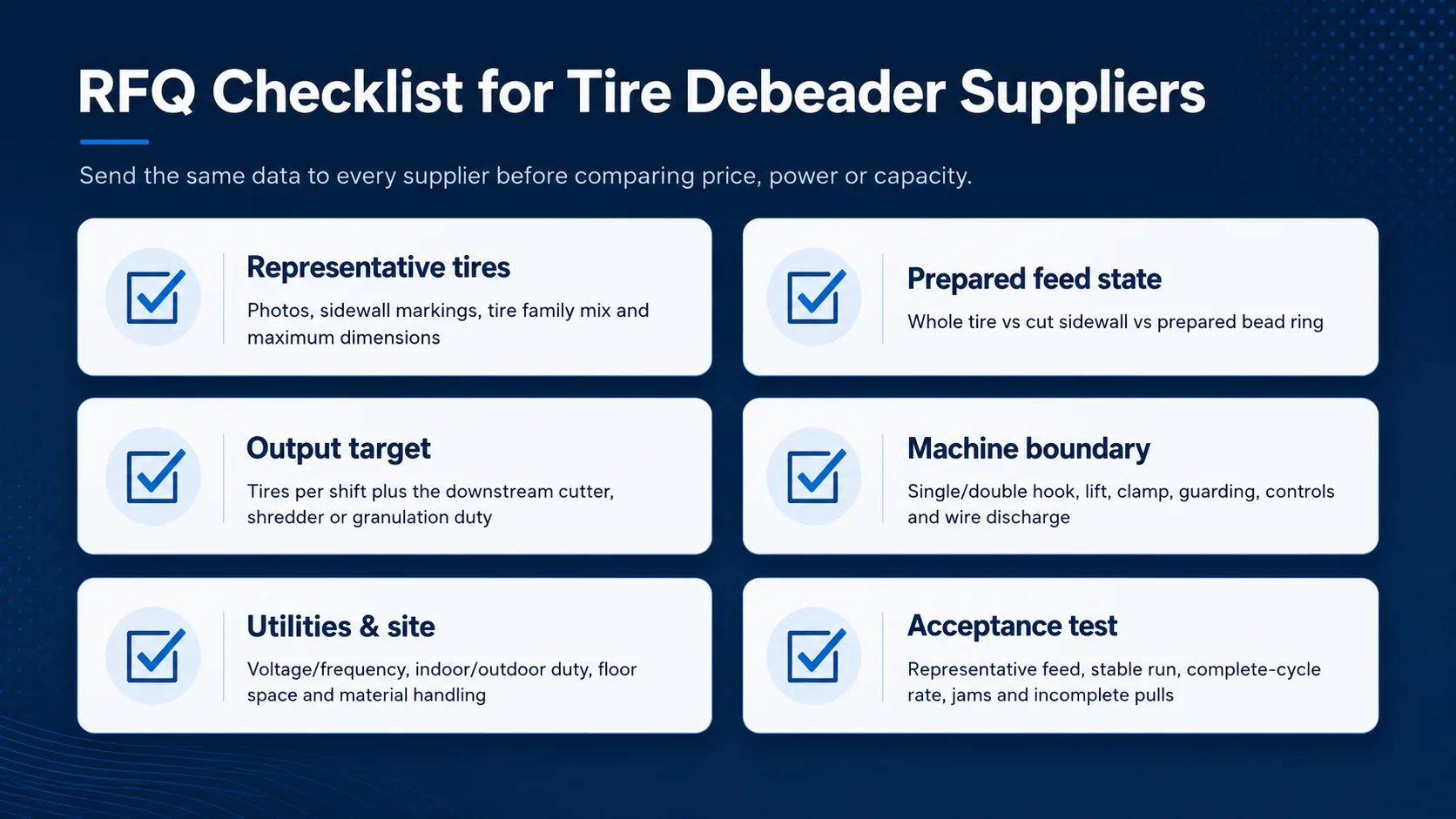
For the commercial side, the existing tire debeader machine price and RFQ guide goes deeper into quote normalization. The key point here is that manufacturer rank does not replace a normalized project quotation.
Five Mistakes That Distort a Tire Debeader Manufacturer Comparison
1. Treating every “OTR” claim as the same equipment class
Ask for exact tire markings. A heavy truck tire and a large mining tire may both appear under an “OTR/heavy tire” category in marketing material, but the handling, bead structure and machine frame requirements can be completely different.
2. Comparing whole-tire machines with prepared-sidewall machines
Feed preparation transfers labor and equipment to another station. If one supplier starts from a prepared bead ring, include the sidewall-cutting step when you compare total labor and output.
3. Choosing by motor power or pulling force alone
Those values do not describe hook geometry, stroke, tire support, handling, cycle logic, guard access, steel-wire discharge or reliability. They are specifications, not a complete performance model.
4. Accepting “pieces per hour” without a tire definition
A mixed pile may include passenger tires, light truck tires and heavy radial truck tires. The rate from one selected tire size is not automatically the rate of the plant’s real feed mix.
5. Ranking a complete-line supplier higher just because it sells more machines
A broader equipment catalogue does not automatically mean a better fit for the debeading stage. Compare the actual machine, tire range and project requirements instead.
FAQ: Tire Debeader Machine Manufacturers
Who are the leading tire debeader machine manufacturers?
For an evidence-based 2026 shortlist, manufacturers worth comparing include Eagle International, GEP ECOTECH, YUXI, ENERPAT, Engineering & Equipment Co. (EECO), SUMAC, Shuliy, HANLV, Dongguan Yuntong and Shredwell. The right supplier still depends on tire type, feed preparation, machine architecture and downstream duty.
Which tire debeader manufacturer is strongest for OTR tires?
Eagle International stands out because it publishes a separate OTR Debeader for radial mining tires rather than presenting a standard truck-tire debeader as an OTR solution.
Is a double-hook tire debeader always better than a single-hook model?
No. A double-hook or bidirectional machine can reduce repeated handling when both beads can be extracted in one working cycle, but the better choice depends on tire preparation, loading method, required shift output, available space, utilities, maintenance access and the downstream process. Compare complete-cycle performance rather than hook count alone.
How many tire debeader suppliers should I shortlist for an RFQ?
Three to five qualified suppliers is usually enough for a serious RFQ. More quotations can add noise if the suppliers are not quoting the same feed condition, tire range, machine boundary and acceptance test. Normalize those items first, then compare commercial terms.
What should I ask a tire debeader manufacturer to prove before purchase?
Ask for a representative-tire test that shows loading, positioning, hook engagement, wire extraction, wire release, unloading and reset. Record incomplete pulls, slips, jams, operator interventions and the sustained complete-cycle rate. Also confirm guarding, controls, spare parts, drawings, manuals and downstream integration.
Compare a Tire Debeader Against Your Actual Tire Mix
Send tire photos and sidewall markings, prepared feed condition, maximum tire dimensions, expected shift volume, downstream process, local power and workshop layout. YUXI can define the correct debeading boundary and prepare a configuration for comparison on the same project basis.